
Life, 1897-04-01 · page 4 of 20
Life — April 1, 1897 — page 4: what you’re looking at
What you’re looking at
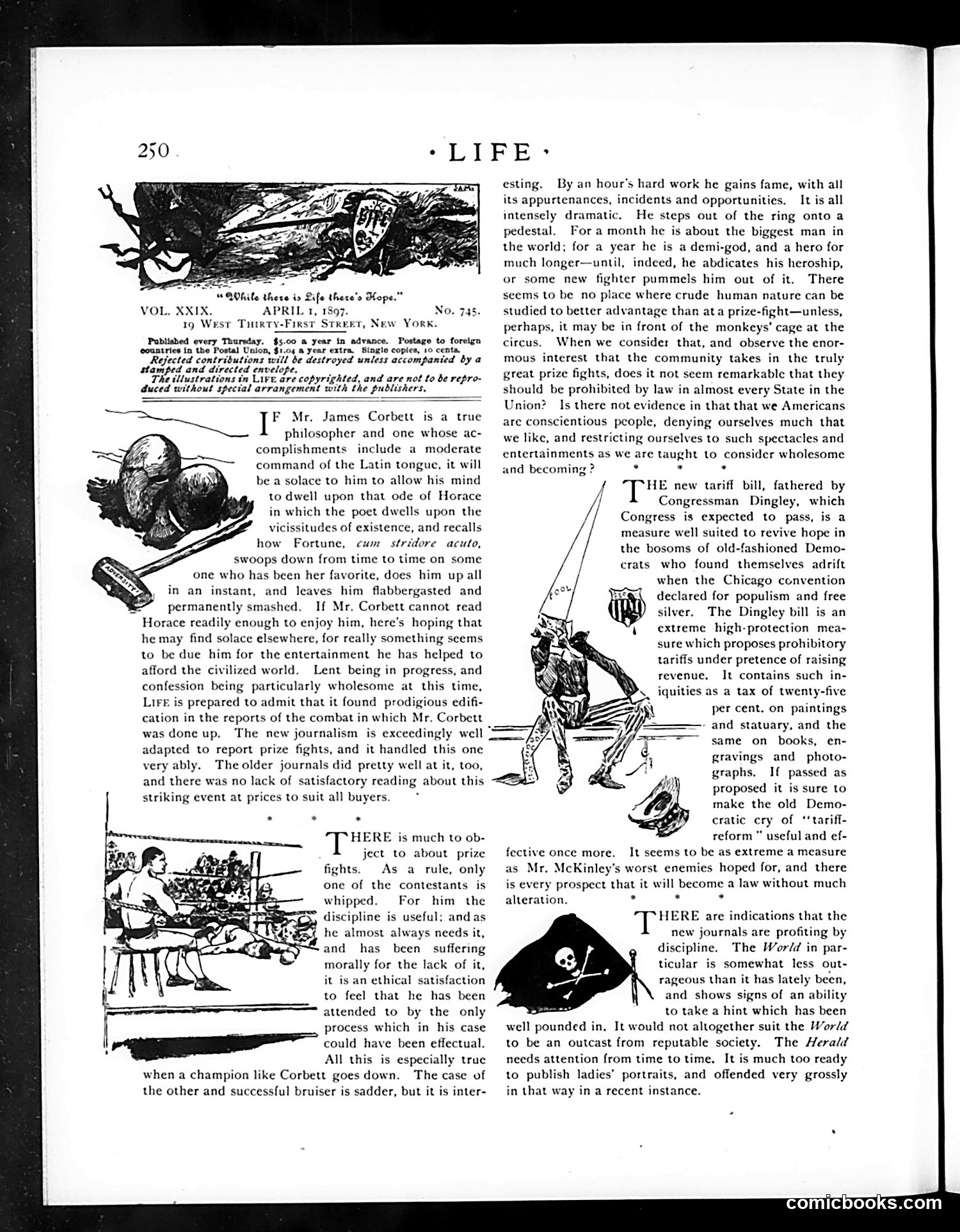
The page features two cartoons commenting on contemporary issues: **Top cartoon** ("While there is Life there's Hope"): Depicts a skeletal figure—likely representing Death or Misfortune—looming over a prone man. This appears to relate to the article's discussion of James Corbett, the boxer, suggesting the precariousness of fame and fortune in prize-fighting. **Bottom cartoon**: Shows a figure at what appears to be a printing press or writing desk, illustrating the article's critique of sensationalist journalism. The text discusses how new journals are using "discipline" (boxing coverage) to boost circulation, sometimes unethically—including publishing unflattering ladies' portraits. Both cartoons satirize the exploitative nature of late-19th-century media and prize-fighting entertainment culture.
📄 Transcribed text from this page (OCR, searchable)
Machine-transcribed from the original scan — historical spelling and the odd misread are preserved.
* LIFE: “QWhile there is Life there's Hope.” VOL. XXIX APRIL 1, 1897. No. 745. 19 West Tiixty-First Street, New York. Published every Thursday. $5.00 a year in advance. Postage to foreign countries in the Postal Union, $1.04 @ year extra. Single copies, 10 centa, Rejected contributions will be destroyed unless accompanied by a stamped and directed envelope, . The illustrations in Live are copyrighted, and are not to be repro- duced without special arrangement with the publishers. F Mr. James Corbett is a true philosopher and one whose ac- complishments include a moderate command of the Latin tongue, it will be a solace to him to allow his mind to dwell upon that ode of Horace in which the poet dwells upon the vicissitudes of existence, and recalls how Fortune, cum stridore acuto, swoops down from time to time on some one who has been her favorite, does him up all in an instant, and leaves him flabbergasted and permanently smashed. If Mr, Corbett cannot read Horace readily enough to enjoy him, here’s hoping that he may find solace elsewhere, for really something seems to be due him for the entertainment he has helped to afford the civilized world. Lent being in progress, and confession being particularly wholesome at this time, Lire is prepared to admit that it found prodigious edifi- cation in the reports of the combat in which Mr. Corbett was done up. adapted to report prize fights, and it handled this one very ably. The older journals did pretty well at it, too, and there was no lack of satisfactory reading about this striking event at prices to suit all buyers. HERE is much to ob- ject to about prize fights. As a rule, only one of the contestants is whipped. For him the discipline is useful; and as he almost always needs it, and has been suffering morally for the lack of it, it is an ethical satisfaction to feel that he has been attended to by the only process which in his case could have been effectual. All this is especially true when a champion like Corbett goes down. The case of the other and successful bruiser is sadder, but it is inter- The new journalism is exceedingly well 7 esting. By an hour's hard work he gains fame, with all its appurtenances, incidents and opportunities. It is all intensely dramatic. He steps out of the ring onto a pedestal. Fora month he is about the biggest man in the world; for a year he is a demi-god, and a hero for much longer—until, indeed, he abdicates his heroship, or some new fighter pummels him out of it. There seems to be no place where crude human nature can be studied to better advantage than ata prize-fight—unless, perhaps, it may be in front of the monkeys’ cage at the circus. When we consider that, and observe the enor- mous interest that the community takes in the truly great prize fights, does it not seem remarkable that they should be prohibited by law in almost every State in the Union? Is there not evidence in that that we Americans are conscientious people, denying ourselves much that we like, and restricting ourselves to such spectacles and entertainments as we are taught to consider wholesome and becoming ? . , . HE new tariff bill, fathered by Congressman Dingley, which Congress is expected to pass, is a measure well suited to revive hope in the bosoms of old-fashioned Demo- crats who found themselves adrift when the Chicago convention declared for populism and free silver. The Dingley bill is an extreme high-protection mea- sure which proposes prohibitory tariffs under pretence of raising revenue, It contains such in- iquities as a tax of twenty-five per cent. on paintings - and statuary, and the same on books, en- gravings and photo- graphs. If passed as proposed it is sure to make the old Demo- cratic cry of ‘tariff- reform " useful and ef- fective once more. It seems to be as extreme a measure as Mr. McKinley's worst enemies hoped for, and there is every prospect that it will become a law without much alteration. . . . HERE are indications that the new journals are profiting by discipline. The World in par- ticular is somewhat less out- rageous than it has lately been, and shows signs of an ability to take a hint which has been well pounded in, It would not altogether suit the World to be an outcast from reputable society. The Herald needs attention from time to time, It is much too ready to publish ladies’ portraits, and offended very grossly in that way in a recent instance. comicbooks.com