
Life, 1897-04-01 · page 12 of 20
Life — April 1, 1897 — page 12: what you’re looking at
What you’re looking at
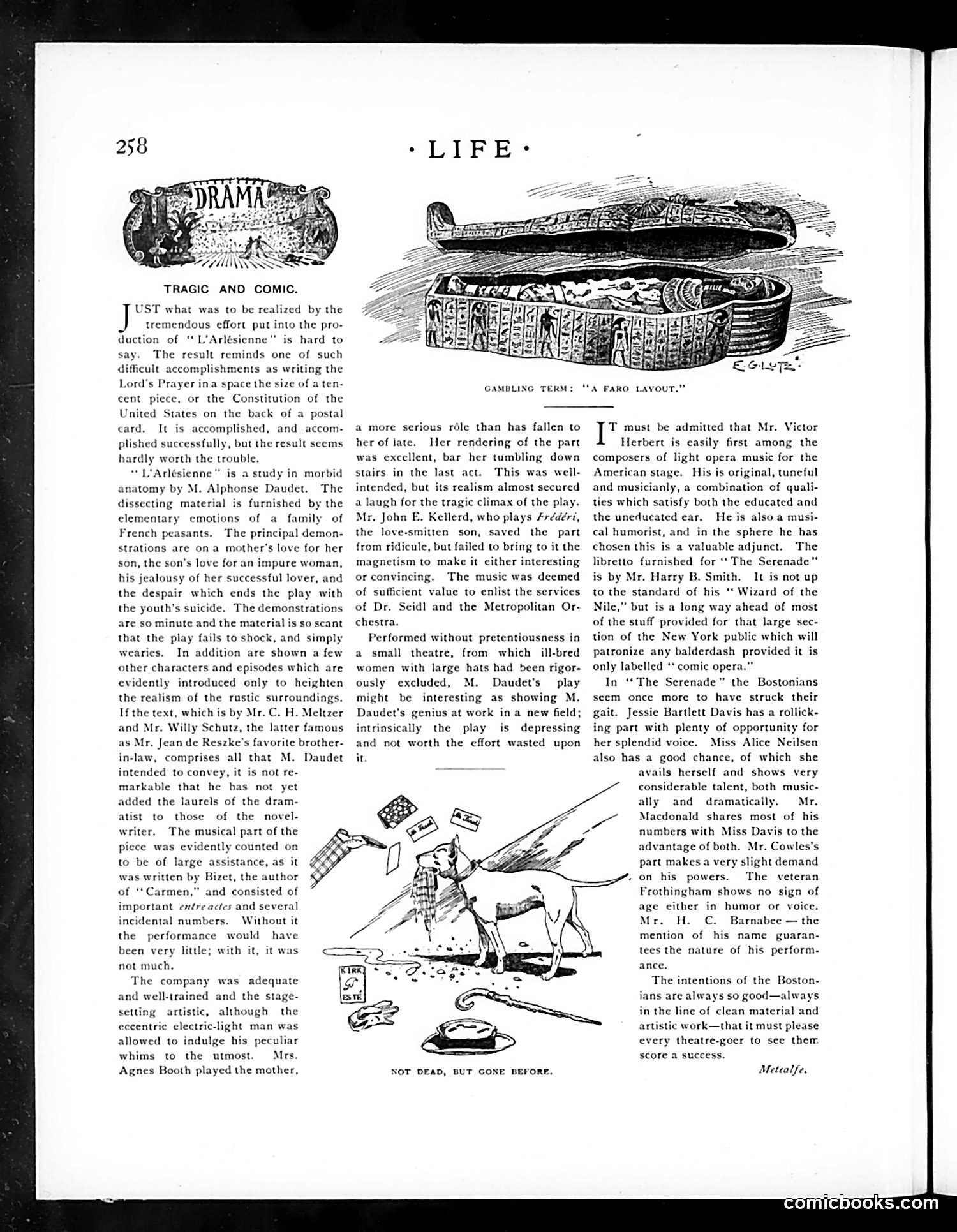
This page contains two sections: a theater review titled "Tragic and Comic" discussing the production of "L'Arlésienne," and a separate cartoon labeled "Not Dead, But Gone Before." The main cartoon depicts a dog sniffing at scattered gambling items (dice, cards, money) on the ground. The caption suggests this is satirizing gambling culture—the "dead" subject appears to be gambling itself or a gambler's fortunes, portrayed humorously through the dog's investigation of the remnants. The theater section reviews various Boston productions, critiquing their artistic merit and performances. The text discusses composers and light opera, suggesting this is cultural criticism from early 20th-century American society. The page reflects Life magazine's dual focus on theatrical satire and visual humor targeting contemporary social behaviors like gambling.
📄 Transcribed text from this page (OCR, searchable)
Machine-transcribed from the original scan — historical spelling and the odd misread are preserved.
TRAGIC AND COMIC. UST what was to be realized by the J tremendous effort put into the pro- duction of is hard to The result reminds one of such ult accomplishments as writing the Lord's Prayer ina space the size cent piece, or the Constitution of the United States on the back of a postal card. plished successfully, but the result seems hardly worth the trouble. “ L'Arlésienne ” anatomy by M. Alphonse Daudet. dissecting material is furnished b; clementa: of a French pea “L'Arlésienne” faten- It is accomplished, and accom- is a study in morbid The the of emotions fami nts. The principal demon- strations are ona mother's love for her son, the son's love for an impure woman, his jealousy of her successful lover, and the despair which ends the play with the youth’s suicide. The demonstrations are so minute and the material is so scant that the play fails to shock, and simply wearics. In addition are shown a few other characters and episodes which are evidently introduced only to heighten the realism of the rustic surroundings. If the text, which is by Mr. C. H. Meltzer and Mr, Willy Schutz, the latter famous as Mr, Jean de Reszke’s favorite brother- in-law, comprises all that M. Daudet intended to convey, it is not re- markable that he has not yet added the laurels of the dram- atist to those of the writer. The musical part of the piece was evidently counted on to be of large assistance, as it was written by Bizet, the author of ‘*Carmen,” and consisted of important entre actes and several Without it performance would novel- incidental numbers. the been very little; with it, it was not much. The company was adequate and well-trained and the stage- the eccentric electric-light man was allowed to indulge his peculiar whims to the utmost. Mrs. Agnes Booth played the mother, have setting artistic, although GAMBLING TERM: a more serious réle than has fallen to her of late. Her rendering of the part was excellent, bar her tumbling down stairs in the last act. This was well- intended, but its realism almost secured a laugh for the tragic climax of the play. Mr. John E. Kellerd, who plays Frédéri, the love-smitten son, saved the part from ridicule, but failed to bring to it the magnetism to make it either interesting orconvincing. The music was deemed of sufficient value to enlist the services of Dr. Seidl and the Metropolitan Or- chestra. Performed without pretentiousness in a small theatre, from which ill-bred women with large hats had been rigor- ously excluded, M. Daudet’s play might be interesting as showing M. Daudet's genius at work ina new field; intrinsically the play is depressing and not worth the effort wasted upon it. NOT DEAD, BUT GONE BEFORE. “A FARO Layour.” T must be admitted that Mr. Victor Herbert is easily first among the composers of light opera music for the American stage. His is original, tuneful and musicianly, a combination of quali- ties which satisfy both the educated and the uneducated car. cal humorist, and in the sphere he has chosen this is a valuable adjunct. The libretto furnished for ‘*The Serenade” is by Mr. Harry B. Smith. It is not up to the standard of his ‘* Wizard of the Nile,” but is a long way ahead of most of the stuff provided for that large sec- tion of the New York public which will patronize any balderdash provided it is only labelled ** comic opera.” In ‘*The Serenade” the Bostonians seem once more to have struck their gait. Jessie Bartlett Davis has a rollick- ing part with plenty of opportunity for her splendid voice. Miss Alice Neilsen also has a good chance, of which she avails herself and shows very considerable talent, both music- ally and dramaticaily Mr. Macdonald shares most of his numbers with Miss Davis to the advantage of both. Mr. Cowles’s part makes a very slight demand on his The veteran Frothingham shows no sign of He is also a musi- powers. age either in humor or voice. Mr. H. C. Barnabee — the mention of his name guaran- tees the nature of his perform. ance. The intentions of the Boston- ians are always so good—always in the line of clean material and artistic work—that it must please every theatre-goer to sce them score a success. Metcalfe. Ccomicbooks.com