
Life, 1897-04-01 · page 6 of 20
Life — April 1, 1897 — page 6: what you’re looking at
What you’re looking at
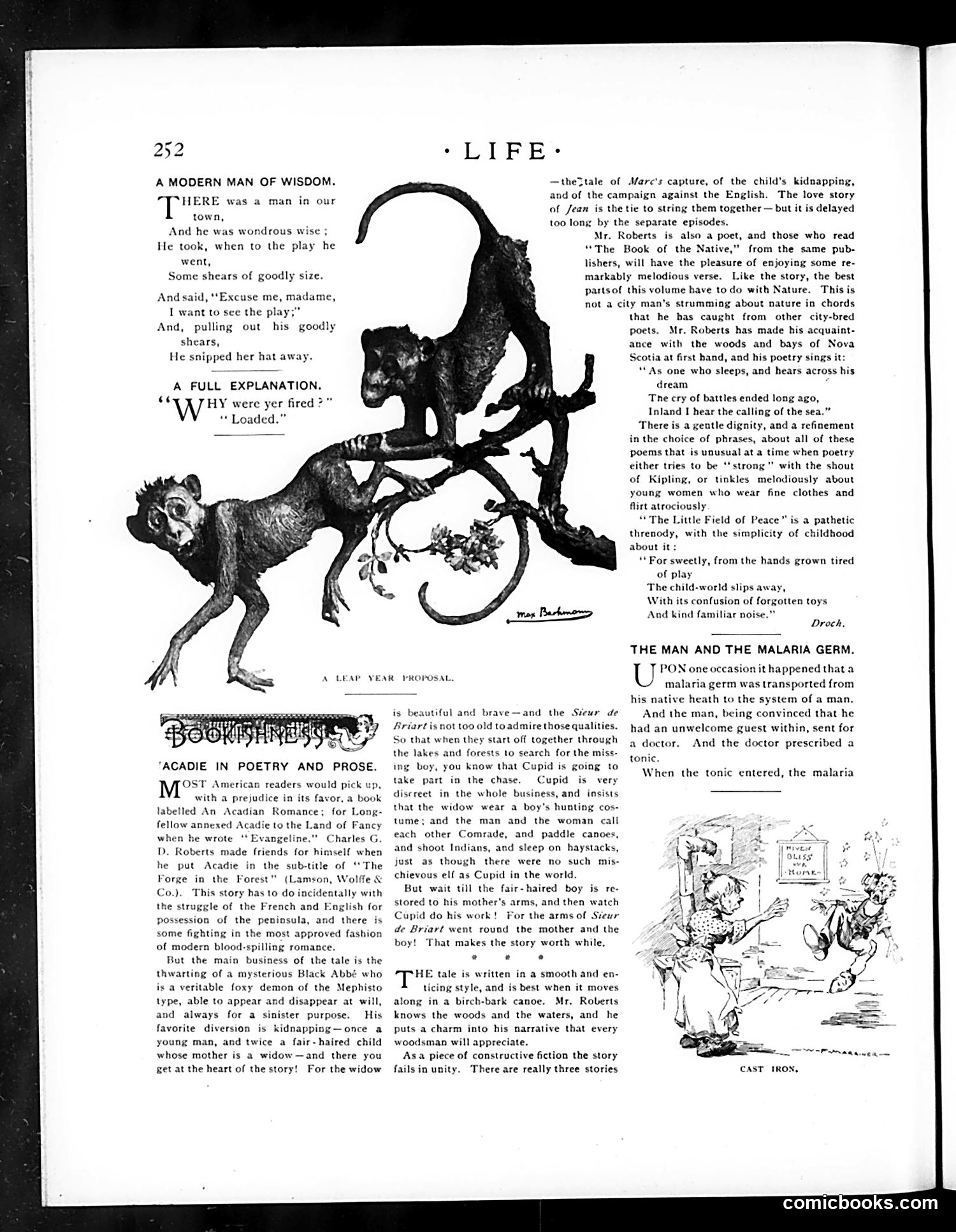
**"A Modern Man of Wisdom"** (top left): This brief poem mocks an overly cautious gentleman who attends theater but nervously requests to leave before the play begins—satirizing excessive caution or anxiety about public outings. **"A Full Explanation"** (middle): A simple joke where someone asks why a gun was fired, answered simply: "Loaded." The humor lies in the obvious, unstated answer. **"A Leap Year Proposal"** (center illustration): Features a woman (with exaggerated features typical of the era) pursuing a man who appears to be fleeing or falling backward. This references the tradition where women propose to men during leap years—satirizing role reversals and the apparent chaos this causes. The page demonstrates Life's approach: brief humorous commentary on social conventions and gender relations through simple jokes and illustration.
📄 Transcribed text from this page (OCR, searchable)
Machine-transcribed from the original scan — historical spelling and the odd misread are preserved.
252 A MODERN MAN OF WISDOM. HERE was a town, And he was wondrous wise ; He took, when to the play he went, Some shears of goodly size. man in our Andsaid, “Excuse me, madame, I want to sce the play;" And, pulling out his goodly shears, He snipped her hat av A FULL EXPLANATION. HY were yer fired ?” ‘* Loaded.” “cc LEAP YEAR "ACADIE IN POETRY AND PROSE. OST American readers would pick uy with a prejudice in its favor, a book labelled An Acadian Romance; for Long- fellow annexed Acadie to the Land of Fancy when he wrote “Evangeline.” Charles G. D. Roberts made friends for himself when put Acadie in the sub-title of “The Forge in the Forest (Lamson, Wolffe & Co.). This story has to do incidentally with the struggle of the French and English for possession of the peninsula, and there is some fighting in the most approved fashion of modern blood-spilling romance. Rut the main business of the tale is the thwarting of a mysterious Black Abbé who is a veritable foxy demon of the Mephisto type, able to appear and disappear at will, and always for a sinister purpose. His favorite diversion is kidnapping—once a young man, and twice a fair-haired child whose mother is a widow —and there you get at the heart of the story! For the widow he > LIFE: —theltale of Marc's capture, of the child's kidnapping, and of the campaign against the English. The love story of Jean is the tie to string them together — but it is delayed too long by the separate episodes. Mr. Roberts is also a poet, and those who read “‘The Book of the Native,” from the same pub- lishers, will have the pleasure of enjoying some re- markably melodious verse. partsof this volume have to do with Nature. Like the story, the best This is not a city man’s strumming about nature in chords PROPOSAL. is beautiful and brave—and the Sieur de Briart is not too old to admire those qualities. So that when they start off together through the lakes and forests to search for the miss- ing boy, you know that Cupid is going to take part in the chase. Cupid i discreet in the whole business, and insists that the widow wear a boy's hunting cos- tume; and the man and the woman call each other Comrade, and paddle canoes, and shoot Indians, and sleep on haystacks, just as though no such mis- chievous elf as Cupid in the world. But wait till the fair-haired boy is re- stored to his mother's arms, and then watch Cupid do his work! For the arms of Sieur de Briart went round the mother and the boy! That makes the story worth while. e 8 @ in very there were HE tale is written in a smooth and en- ticing style, and is best when it moves along in a birch-bark canoe. Mr. Roberts knows the woods and the waters, and he puts a charm into his narrative that every woodsman will appreciate. Asa piece of constructive fiction the story failsin unity. There are really three stories that he bas caught from other city-bred poets. Mr. Roberts has made his acquaint- ance with the woods and bays of Nova Scotia at first hand, and his poetry sin, As one who sleeps, and hears across his dream : The cry of battles ended long ago, Inland I hear the calling of the sea.” ‘There is a gentle dignity, and a refinement in the choice of phrases, about all of these poems that is unusual at a time when poetry either tries to be “strong” with the shout of Kipling, or tinkles melodiously about young women who wear fine clothes and flirt atrociously “The Little Field of Peace” is a pathetic threnody, with the simplicity of childhood about it: “For sweetly, from the hands grown tired of play The child-world slips aw With its confusion of forgotten toys And kind familiar noise.” Droch, THE MAN AND THE MALARIA GERM. U malaria germ was transported from his native heath to the system of a man, And the man, being convinced that he had an unwelcome guest within, sent for And the doctor prescribed a PON one occasion it happened that a a doctor. tonic. When the tonic entered, the malaria eenadeue Te CAST IRON, comicbooks.com