
A complete issue · 20 pages · 1896
Life — December 17, 1896
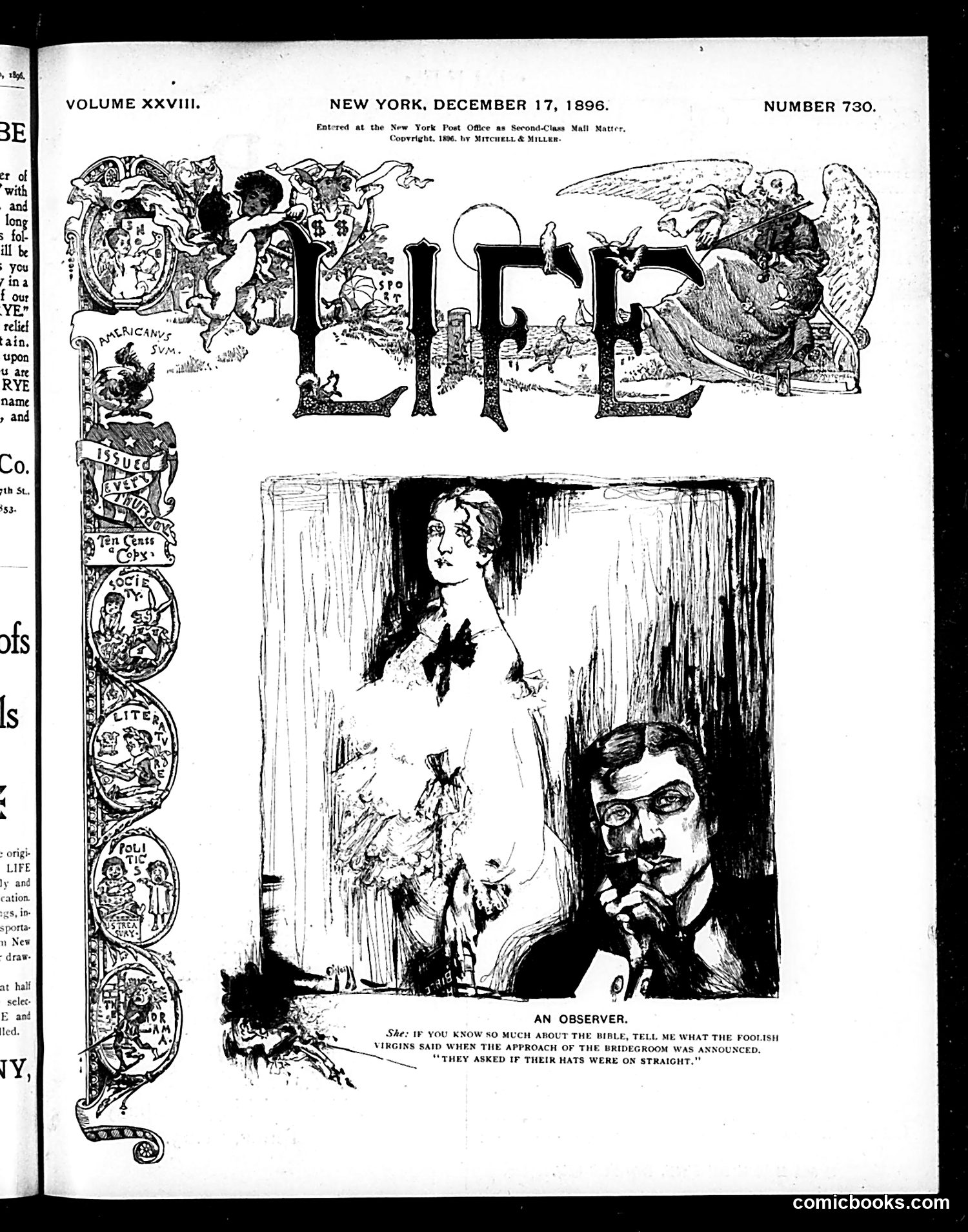
The page features a cartoon titled "An Observer" depicting two figures examining a woman's portrait. The caption references a foolish virgin's remark about the bridegroom's approach, with virgins asking "if their hats were on straight." The satire appears to critique social vanity and superficial concerns—specifically women's preoccupation with appearance (hat alignment) during serious moments. The "observer" figure (likely a male critic or social commentator) watches this scene with apparent disapproval or amusement. The elaborate decorative border on the left suggests this is Life's cover or feature page. Without additional context about the specific social event or public figures referenced, the precise targets remain unclear, though it broadly mocks Victorian-era feminine vanity and misplaced priorities.
This page consists almost entirely of **period advertisements** from circa 1910s-era Life magazine. There are no political cartoons or satirical content to analyze. The ads promote: - **Stern Bros**: lace goods and holiday gift items - **The Wallace Company**: silversmith goods - **Arnold Constable & Co**: women's undergarments and infant wear - **Sunset Limited**: a luxury train service - **Life Publishing Company**: framed proofs of original drawings and a book called "Fables for the Times" by H.W. Phillips The only illustration is a sketch accompanying the framed proofs offer—showing two figures in period dress, likely meant to advertise Life's artistic content rather than convey satirical commentary. This is a straightforward commercial page with no discernible political or social satire.
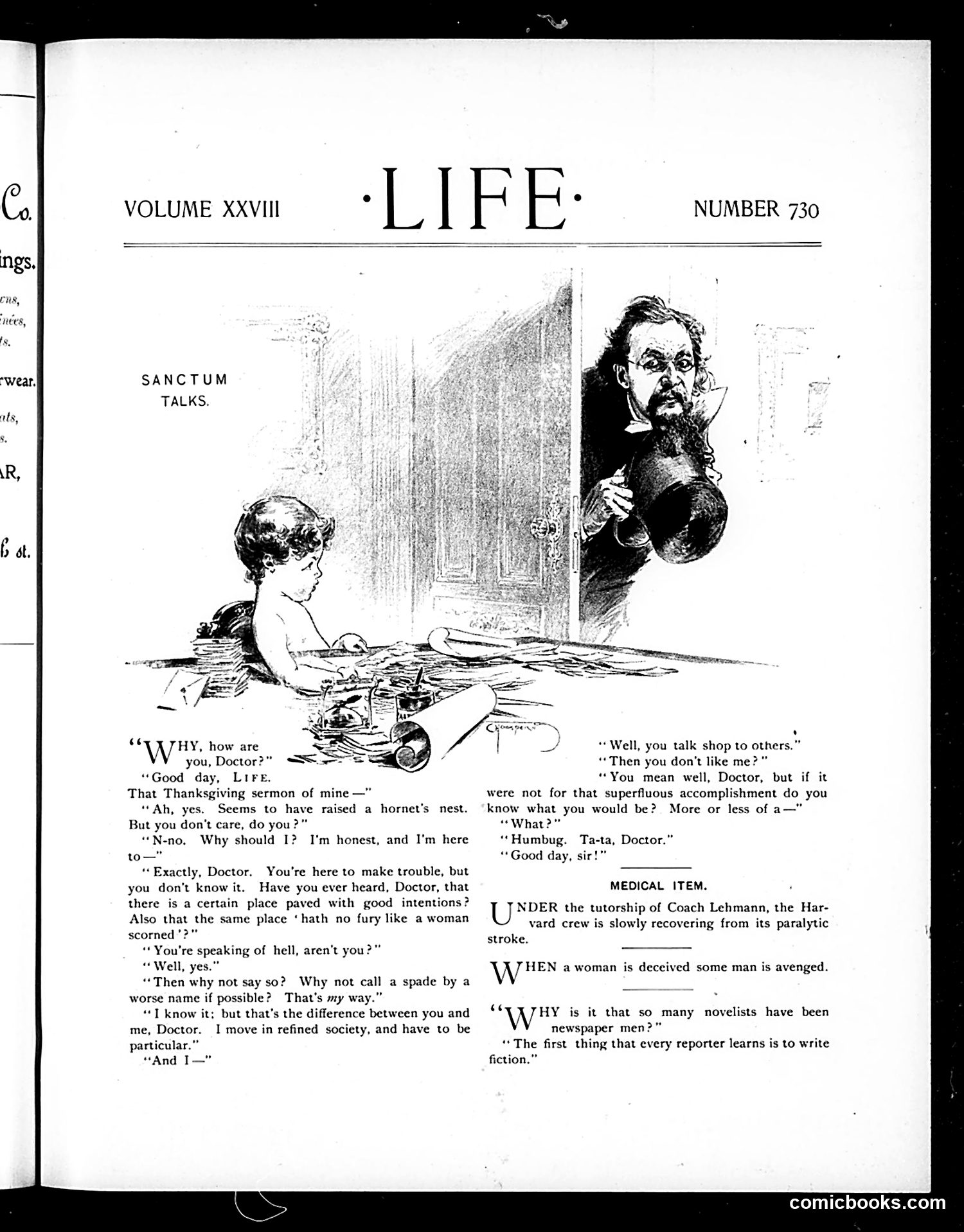
This page from *Life* magazine (Volume XXVIII, #730) features a satirical dialogue between a woman visitor and a bearded male doctor in his office. The cartoon mocks the doctor's hypocrisy: he preaches moral virtue in Thanksgiving sermons yet lives differently personally. The woman challenges his self-righteousness, suggesting his refined social pretenses mask questionable behavior. The satire critiques how respectable professionals—particularly clergymen or doctors—publicly advocate morality while privately engaging in conduct they publicly condemn. The "sanctum" (inner office/sacred space) becomes ironic, revealing the gap between public persona and private practice. This reflects broader Progressive-era skepticism toward institutional authority and sanctimoniousness among the elite.
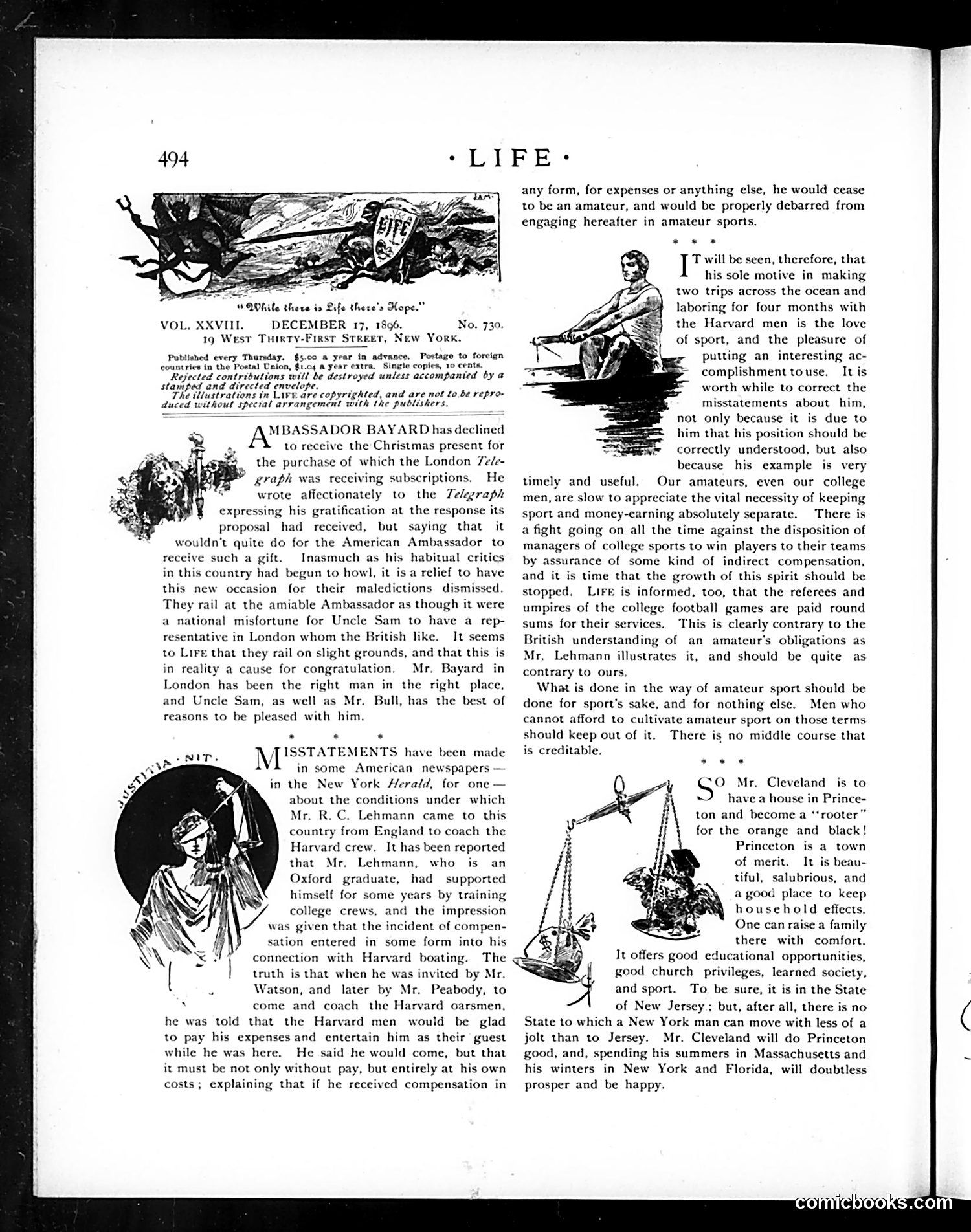
The page contains satirical commentary on amateur athletics and amateurism rules. The main cartoon depicts what appears to be a classical allegorical female figure labeled "While there is Life there's Hope," likely referencing debates about athletic compensation. The text discusses R.C. Lehmann, an Oxford graduate invited to coach Harvard's rowing crew. The satire criticizes American newspapers (particularly the *Herald*) for falsely claiming Lehmann received compensation for coaching—which would violate amateurism rules and disqualify him. The piece argues that amateur sport should remain unpaid "for sport's sake" and attacks the growing practice of indirectly compensating amateur athletes. It concludes with commentary on Mr. Cleveland's move to Princeton, treating it as a lighthearted society matter. The satire targets both sensationalist journalism and the erosion of amateur athletic principles.
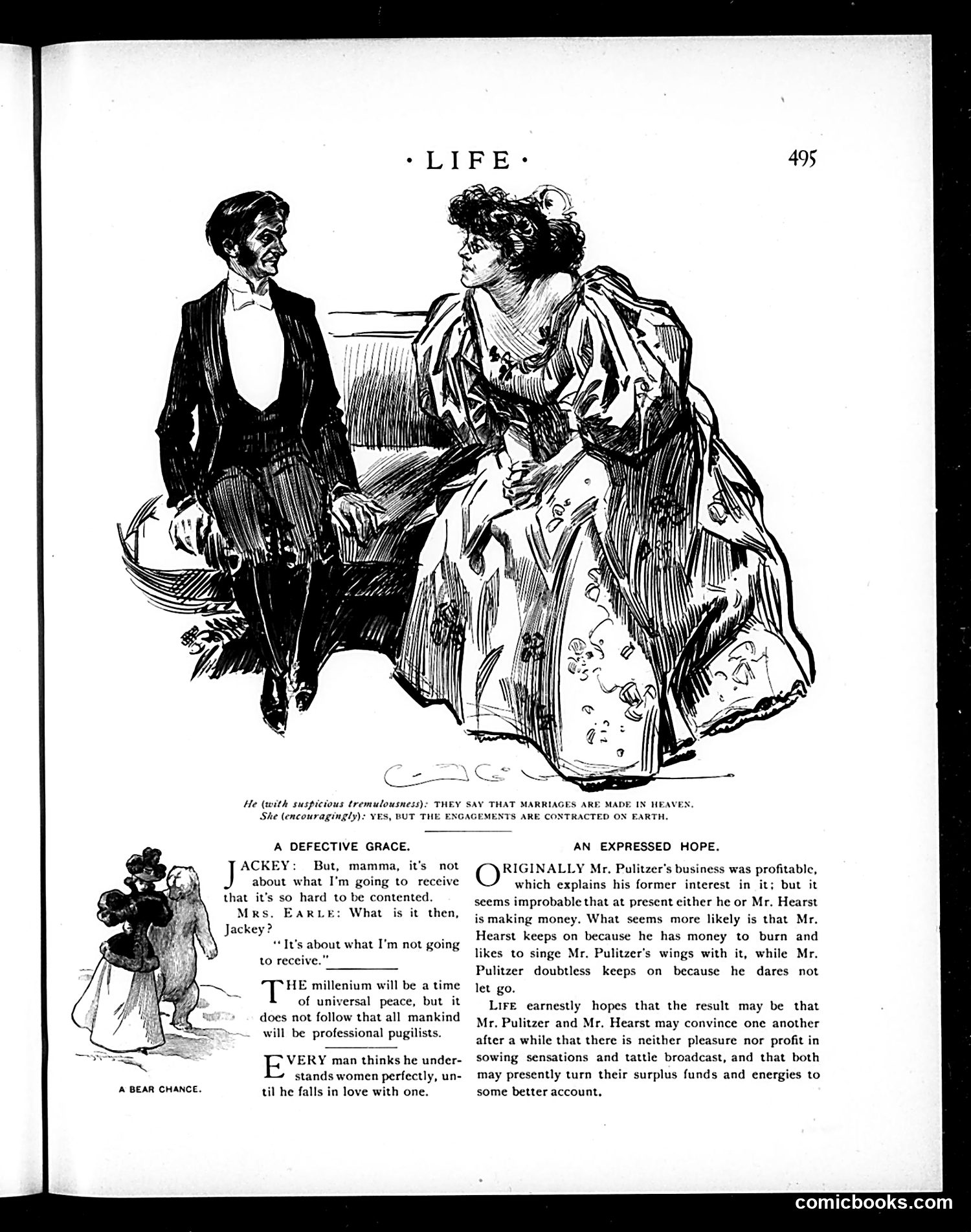
This page contains social satire about marriage and gender dynamics from the early 20th century. The top illustration depicts a couple discussing marriage, with the caption presenting competing views: the man says marriages are "made in heavens," while the woman retorts that "engagements are contracted on earth"—suggesting cynicism about romantic ideals versus practical reality. Below, two separate pieces mock contemporary attitudes. "A Defective Grace" features a character named Jackey complaining about his expectations versus what he'll actually receive in marriage. "A Bear Chance" and "An Expressed Hope" contain commentary on love and marriage prospects, with satirical observations about how men view women and romantic commitment. The overall tone critiques both genders' contradictory expectations about matrimony.
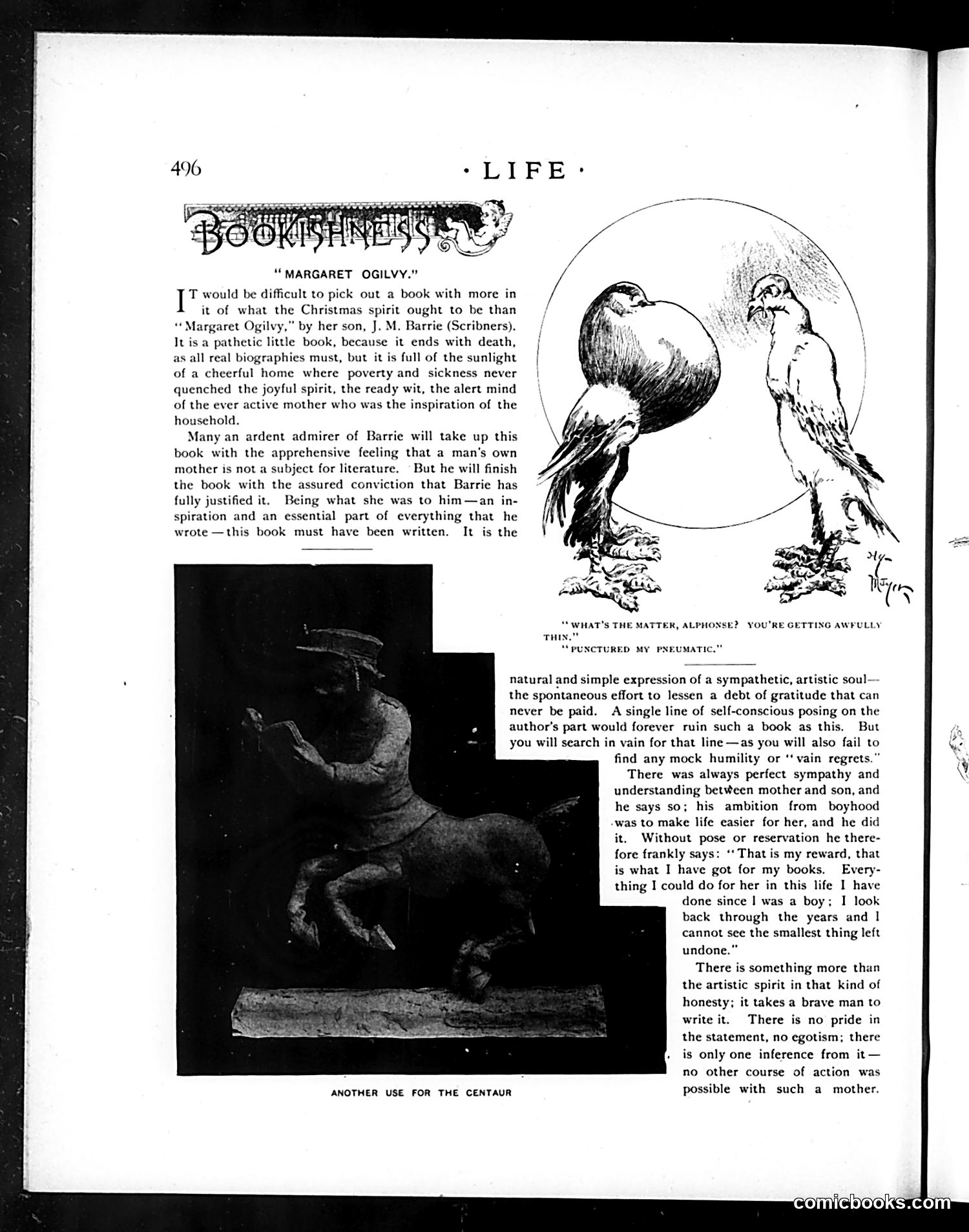
This page reviews J.M. Barrie's novel "Margaret Ogilvy," a biographical work about the author's mother. The text praises the book's depiction of a poor but spiritually rich Scottish household, emphasizing Barrie's genuine gratitude toward his mother rather than literary pretension. The two illustrations support this theme: the bird cartoon (captioned about a "punctured pneumatic") appears to be a lighthearted visual joke, while the photograph labeled "Another Use for the Centaur" shows a classical sculpture, likely satirizing Victorian attitudes toward art and domesticity. This is literary criticism/book review rather than political satire—it celebrates Barrie's emotional honesty and maternal devotion as the book's genuine merit.
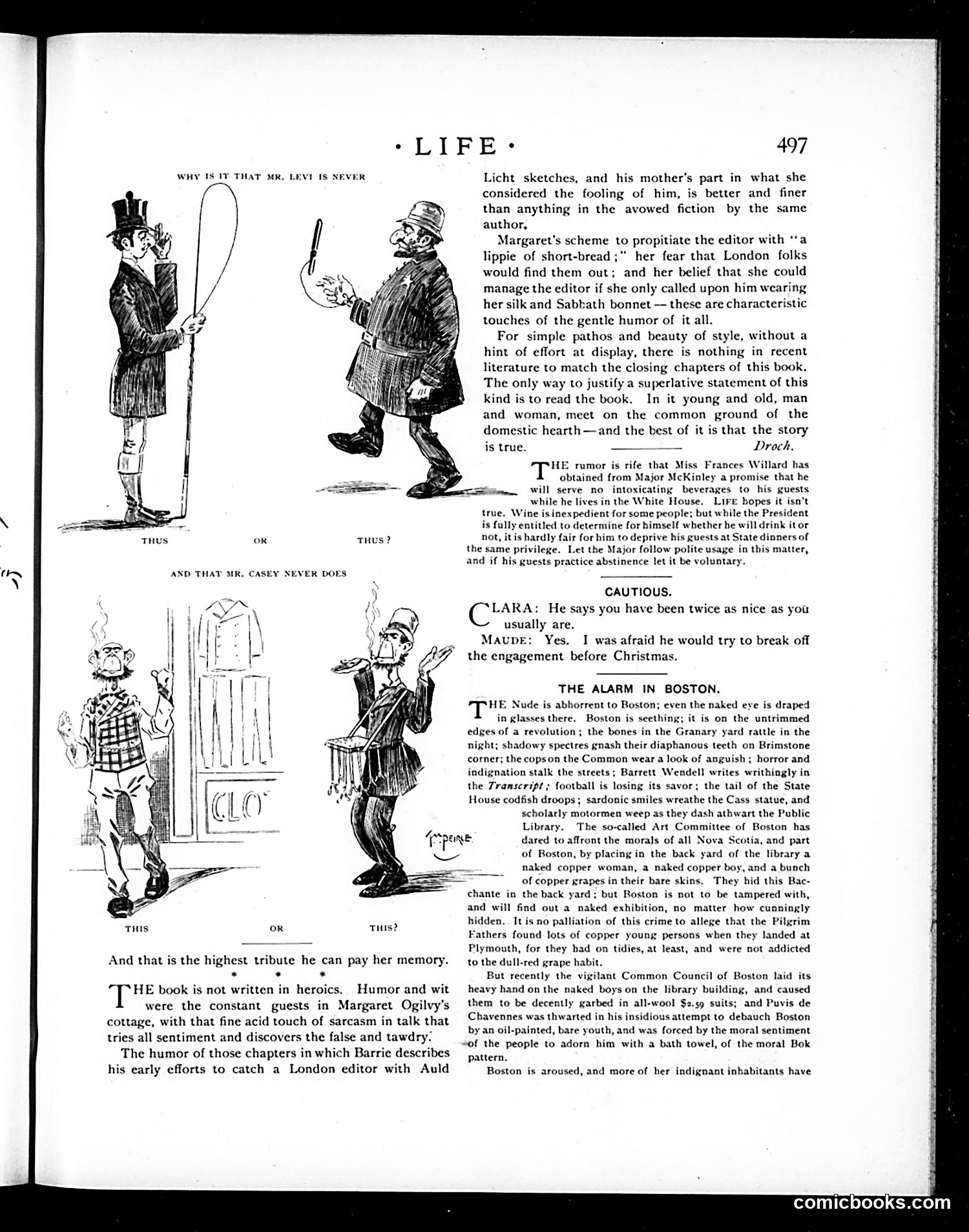
This page contains satirical cartoons and commentary about social etiquette and Boston morality controversies. The top cartoons humorously illustrate contrasting behaviors—labeled "Why is it that Mr. Levi is never thus or or thus?" and "And that Mr. Casey never does this or or this?"—depicting exaggerated postures and gestures to mock social hypocrisy regarding propriety. The text discusses Frances Willard's temperance pledge and an "Alarm in Boston" regarding nude art displays and moral outrage. It satirizes Boston's prudish reaction to artistic nudity at public institutions, noting the city's inhabitants became "indignant" over copper sculptures of nude figures. The overall tone mocks class-based inconsistencies in moral standards and Boston's particular sensitivity to artistic representation of the nude form during what appears to be an early-20th-century cultural debate.
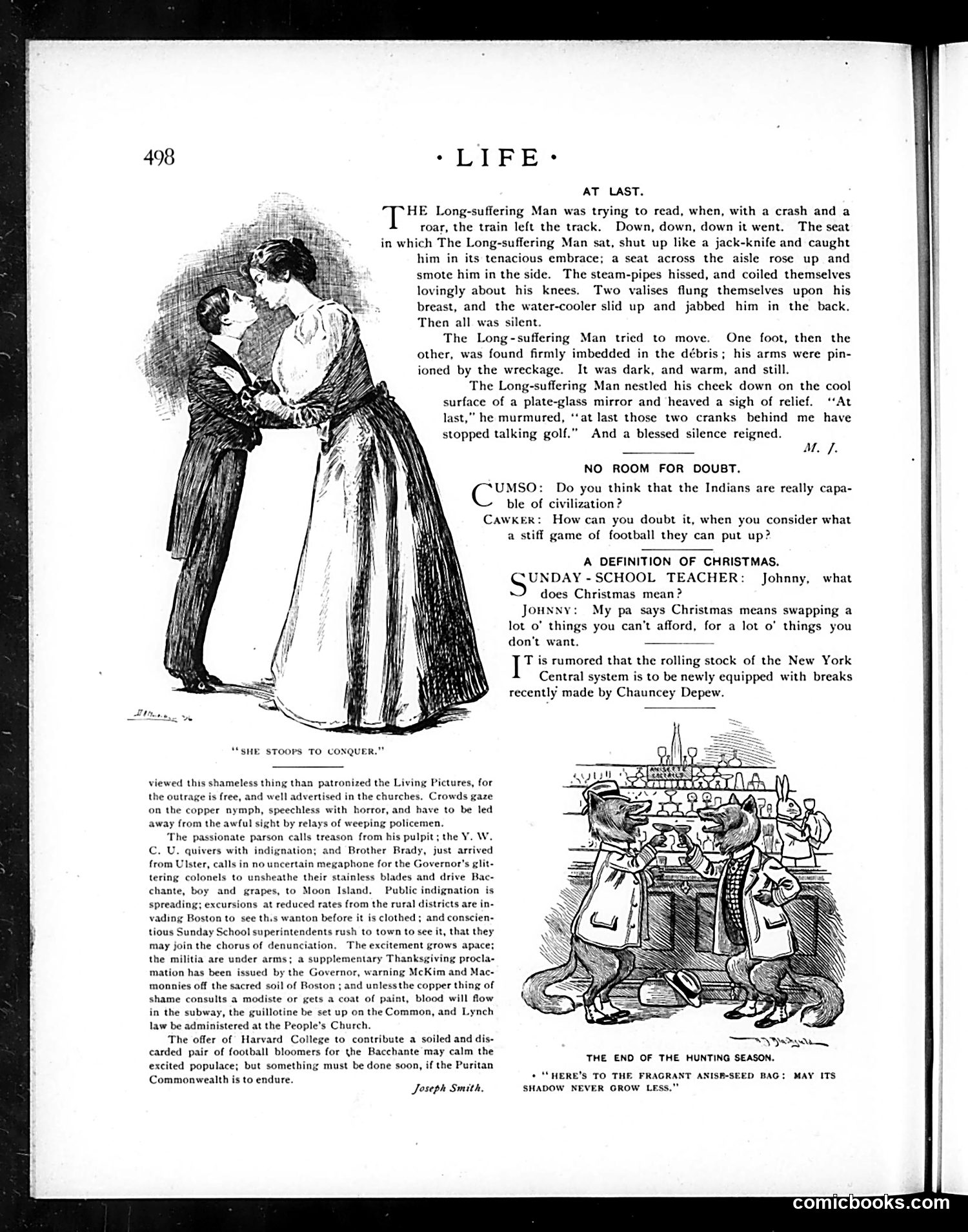
**Main Illustration**: "She Stoops to Conquer" depicts a man and woman in an intimate embrace after a train wreck. The caption references Oliver Goldsmith's 1773 comedy, suggesting the woman is "conquering" through romance or social maneuvering. **"No Room for Doubt"**: A brief humorous exchange where Cumso questions whether Indians are capable of civilization. Cawker's response—that they can play competitive football—is satirical commentary on American priorities, suggesting that athletic prowess, not intellectual achievement, defines "civilization" in American society. **"A Definition of Christmas"**: A Sunday School teacher asks what Christmas means. Johnny's answer—exchanging things you can't afford for things you don't want—is satirical social critique of commercialism and consumer culture during the holiday season.
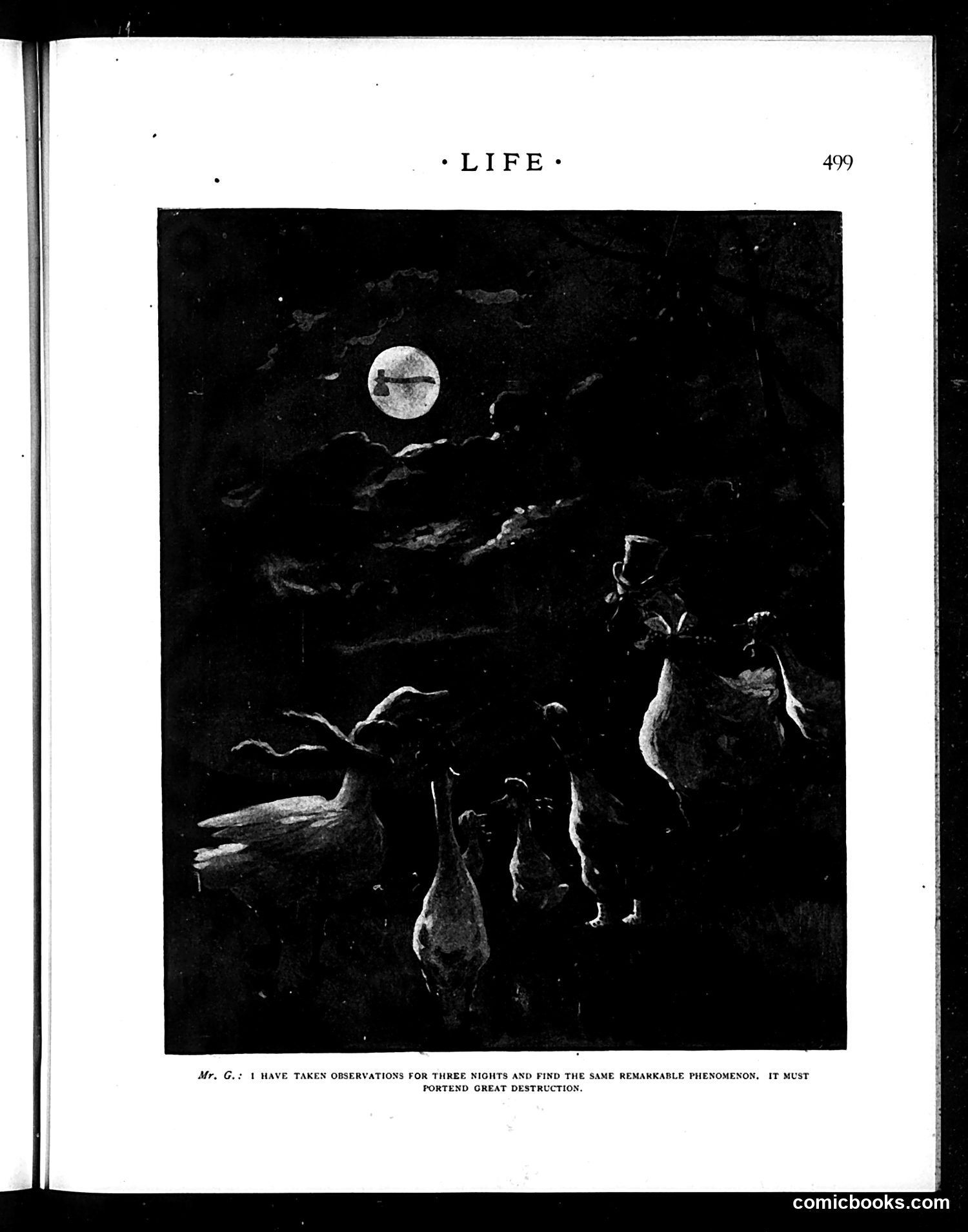
This is a dramatic nighttime illustration showing several animals (appearing to be dogs or wolves) gathered beneath a full moon, with one figure pointing upward. The caption attributes the scene to "Mr. G.," who claims to have observed "the same remarkable phenomenon" over three nights, concluding it "must portend great destruction." The image appears to be satirizing superstitious beliefs—specifically how people (represented by the animals) interpret natural phenomena like the moon through the lens of fear and omens. The pointing figure suggests someone promoting apocalyptic interpretations of ordinary celestial events. This likely mocks either contemporary fortune-telling, astrology, or panic-mongering about supposed cosmic signs. The satire targets gullible audiences prone to believing catastrophic predictions based on misread natural occurrences.
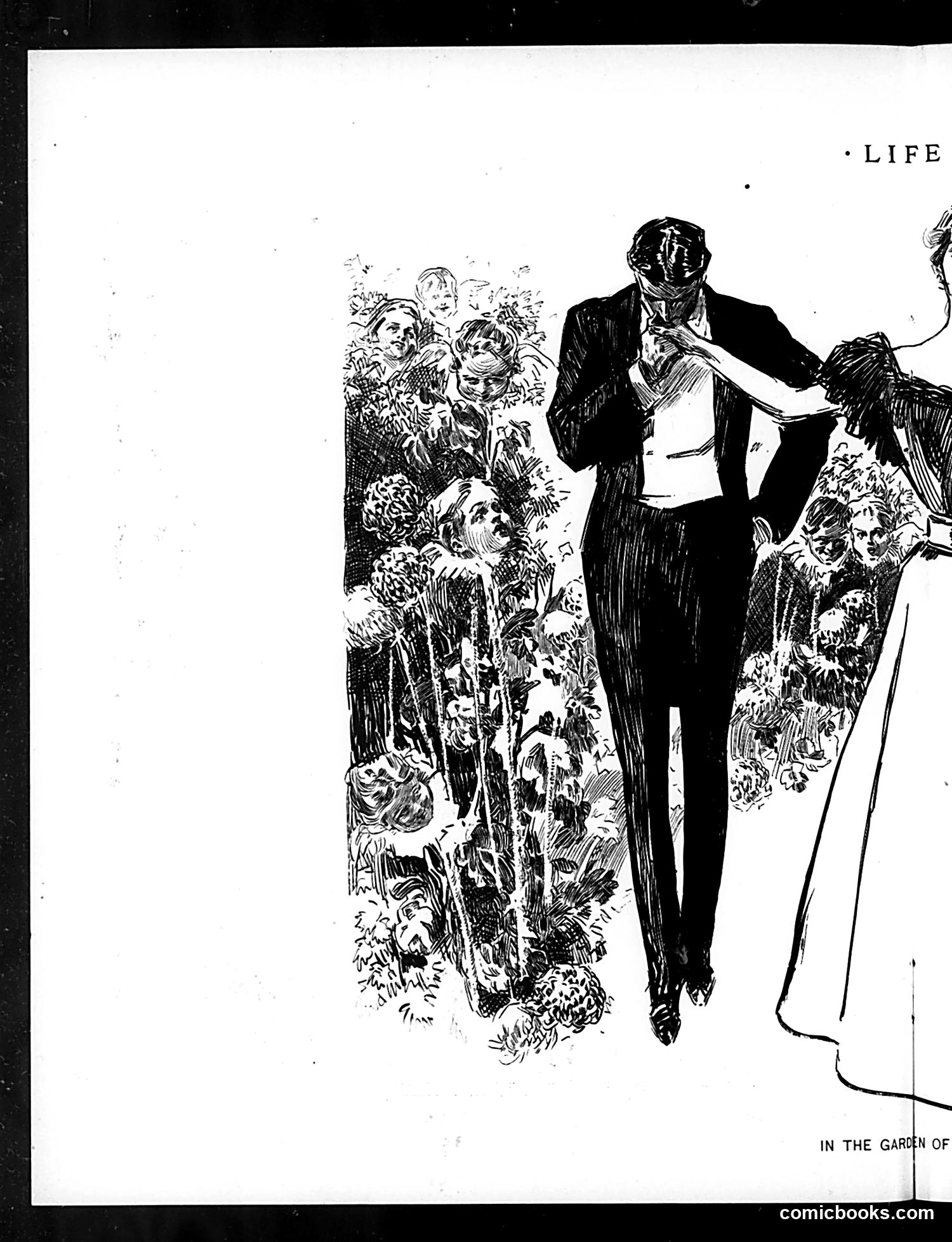
This appears to be a satirical illustration from *Life* magazine showing a well-dressed man in formal attire presenting or displaying a group of figures emerging from or surrounded by foliage and flowers. The caption reads "IN THE GARDEN OF" (text cut off). The illustration likely satirizes someone presenting or promoting a curated group—possibly political candidates, social figures, or artistic subjects—as if arranging them like decorative plants in a garden. The formal presentation and the somewhat artificial arrangement suggests mockery of careful image-curation or selective presentation. Without the complete caption, I cannot definitively identify the specific figures or political context, though the style suggests early-to-mid 20th century satire. The central figure's prominent positioning and the others' arrangement implies hierarchical commentary on power, influence, or manufactured appeal.
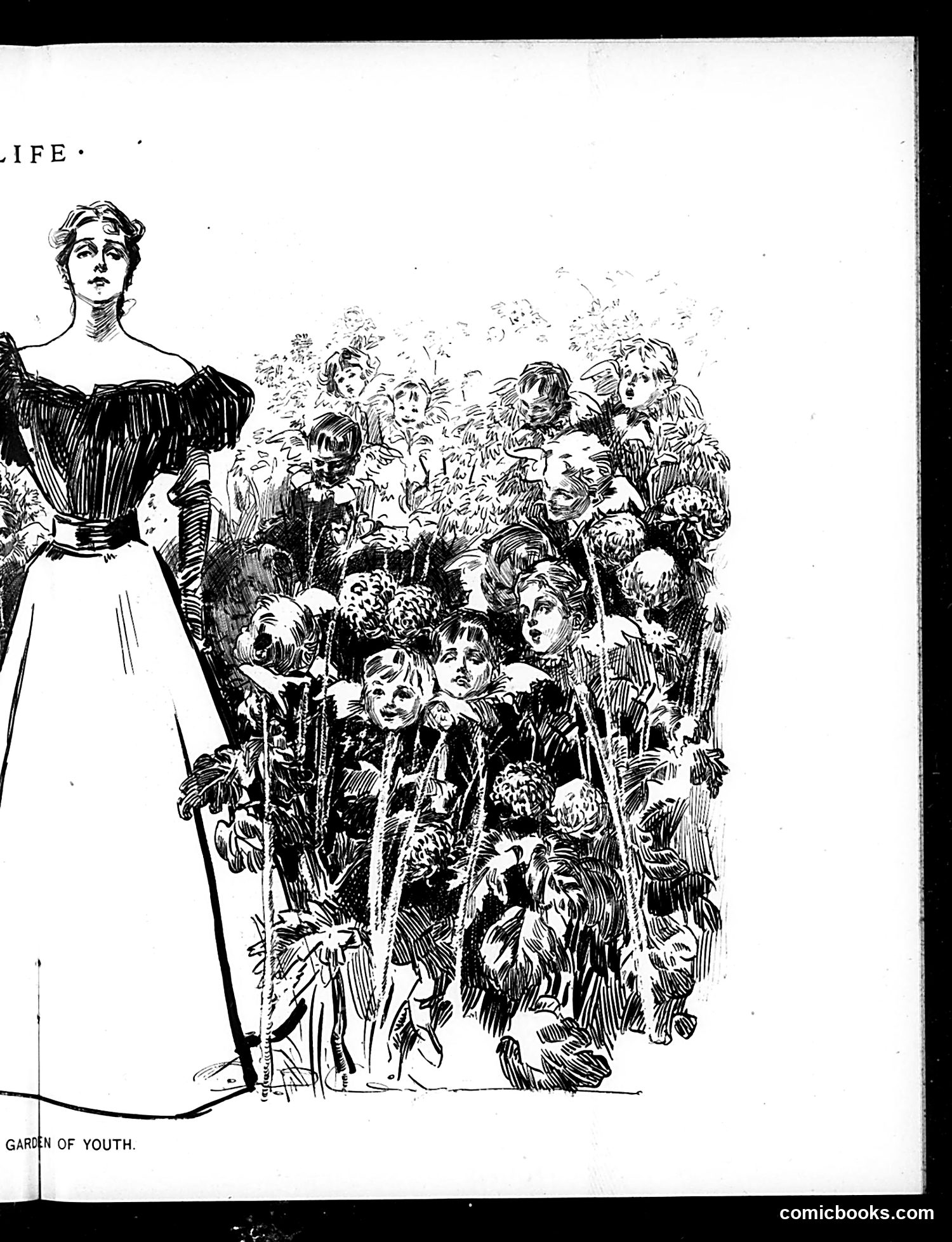
This appears to be a satirical illustration titled "Garden of Youth" depicting a tall, elegant woman in classical dress standing among a crowded group of cherubic children and younger figures. The composition suggests commentary on beauty, fertility, or perhaps the commercialization of youth and motherhood in early 20th-century America. The "garden" metaphor—with the woman as a cultivated, refined specimen surrounded by proliferating offspring—likely critiques either idealized notions of motherhood or contemporary anxieties about population, class, and reproduction. The stark contrast between the composed adult figure and the teeming multitude of children creates satirical tension about social expectations or demographic concerns of the era. Without additional context from the magazine issue, the specific political or social target remains unclear.
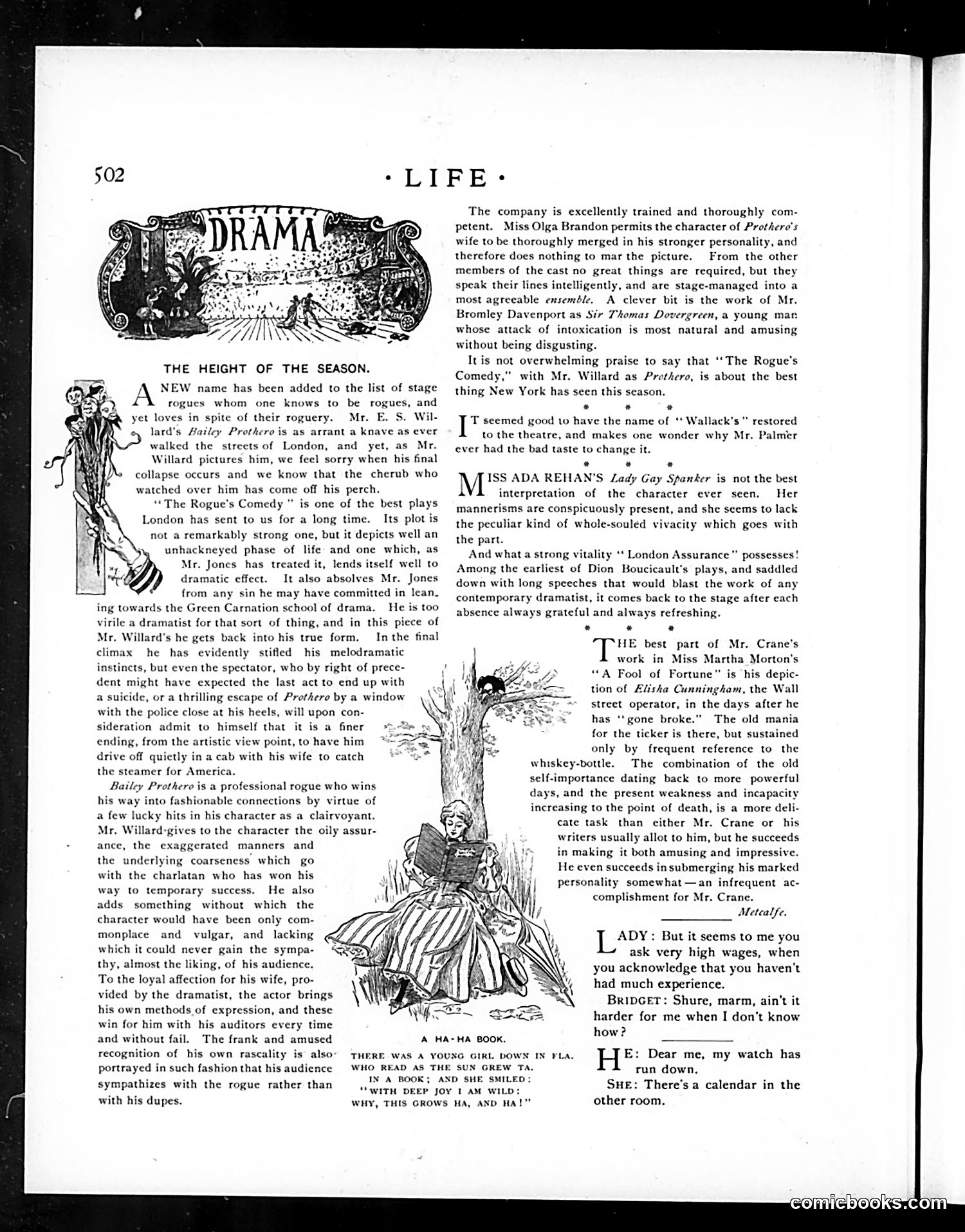
This page reviews contemporary London stage productions for American readers. The main critique covers **"The Rogue's Comedy,"** starring actor **Mr. Willard** as Bailey Prothero, a charming con artist/clairvoyant who infiltrates high society. The reviewer praises Willard's nuanced portrayal—he depicts the rogue with genuine affection for his wife and self-aware charm that makes audiences sympathize with him despite his crimes. The reviewer also commends the realistic (non-melodramatic) ending where Prothero escapes by cab rather than through theatrical window-chase. Secondary reviews critique **Miss Ada Rehan's** performance in "London Assurance" as lacking vitality, and praise **Mr. Crane's** work in "A Fool of Fortune." A brief note celebrates restoring the **Wallack's Theatre** name. The decorative illustrations show period-appropriate theatrical figures typical of Life's satirical style. This is straightforward arts criticism rather than political satire.
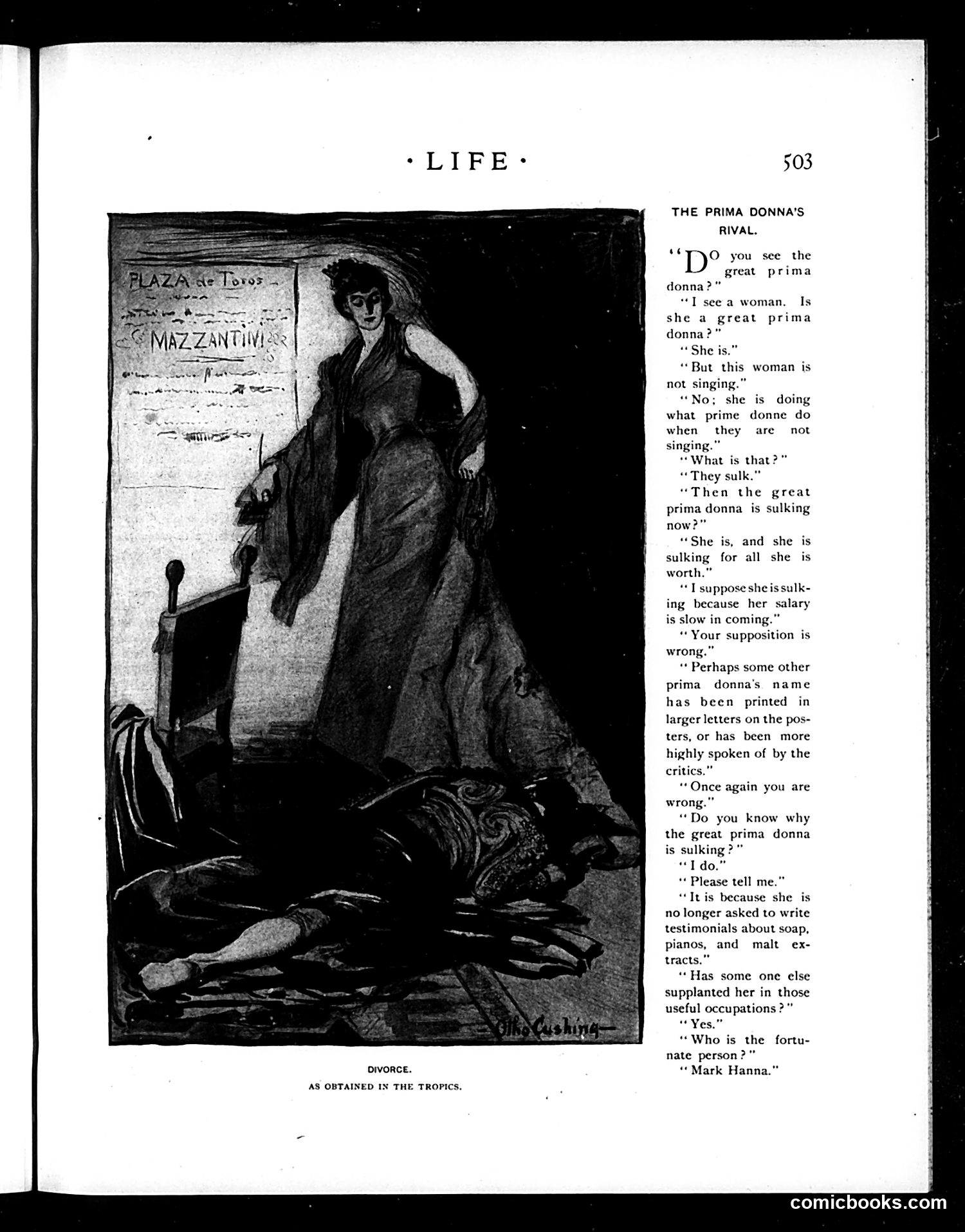
This satirical cartoon mocks a famous opera singer ("prima donna") sulking in her dressing room. The joke centers on a contemporary scandal: the prima donna has lost lucrative endorsement deals for commercial products (soap, pianos, malt extracts)—the real money-maker for celebrities of the era. The punchline reveals her rival is **Mark Hanna**, a prominent Republican politician and wealthy industrialist of the Gilded Age, known for his financial influence. The satire suggests that even a powerful political figure has displaced the opera singer from the endorsement market, implying either that Hanna's celebrity or resources have surpassed hers, or that commercial interests favor him. The subtitle "As Obtained in the Tropics" is unclear—possibly referencing exotic divorce laws or a satirical fiction premise. The satire targets both celebrity vanity and the commercialization of fame in early 20th-century America.
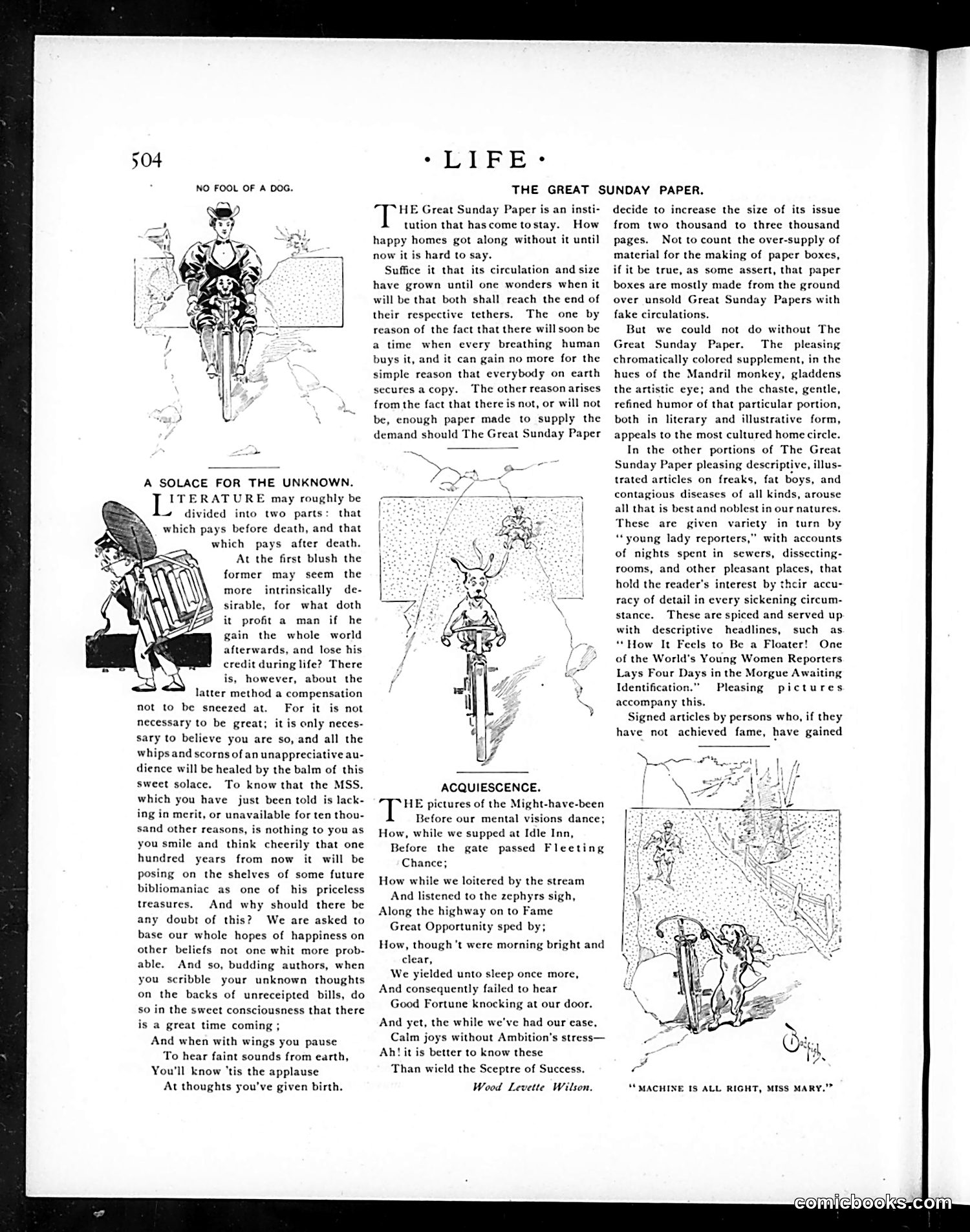
This page contains three satirical pieces mocking literary and journalistic pretensions of the era: **"A Solace for the Unknown"** (left column with illustration of a struggling writer) ridicules unpublished authors who console themselves that their rejected work will achieve posthumous fame. The satire suggests this is delusional comfort—no more rational than other unfounded hopes—yet advises aspiring writers to embrace this delusion since they'll never know otherwise. **"The Great Sunday Paper"** (right column) satirizes the explosive growth and absurd claims of Sunday newspapers. It mocks their inflated circulation numbers, suggesting they're padded with fake readers and that unsold papers are recycled into cardboard boxes. The piece sardonically praises the sensationalist content—freaks, fat boys, diseases—and young female reporters investigating lurid stories in sewers and morgues, claiming this appeals to readers' "noblest" instincts. **"Acquiescence"** (poem at bottom) philosophically muses on missed opportunities and fortune, concluding that calm contentment beats ambitious striving. All three pieces target the gap between reality and self-deception in publishing.
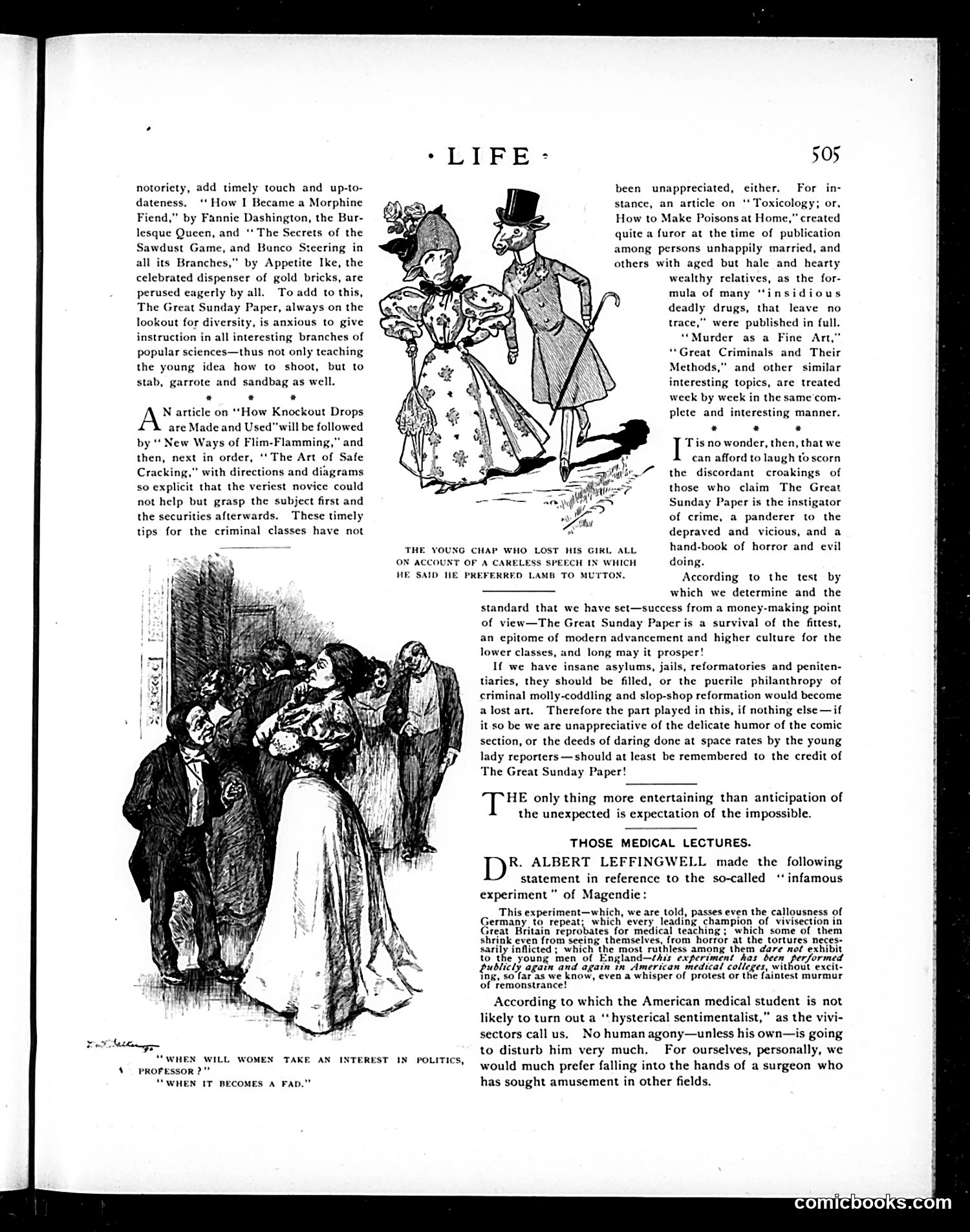
This page satirizes sensationalist Sunday newspapers through mock praise. The unnamed "Great Sunday Paper" publishes scandalous instructional content—articles on making knockout drops, poisoning, safe-cracking, and murder techniques—ostensibly to teach "popular sciences" to the lower classes. The satire's point: these papers claim educational merit while actually providing criminal instruction and exploiting readers' morbid interests. The top cartoon depicts a well-dressed man and woman; the caption references a young man losing his girlfriend due to "careless speech" about preferring "lamb to mutton"—a crude sexual innuendo that was socially ruinous for women's reputations. The bottom section critiques vivivisection (animal experimentation) in American medical colleges, contrasting their callousness with European medical ethics. Dr. Albert Leffingwell argues American medical students perform brutal experiments without protest, producing morally numb practitioners rather than "hysterical sentimentalists." Both sections attack institutional hypocrisy and moral corruption.
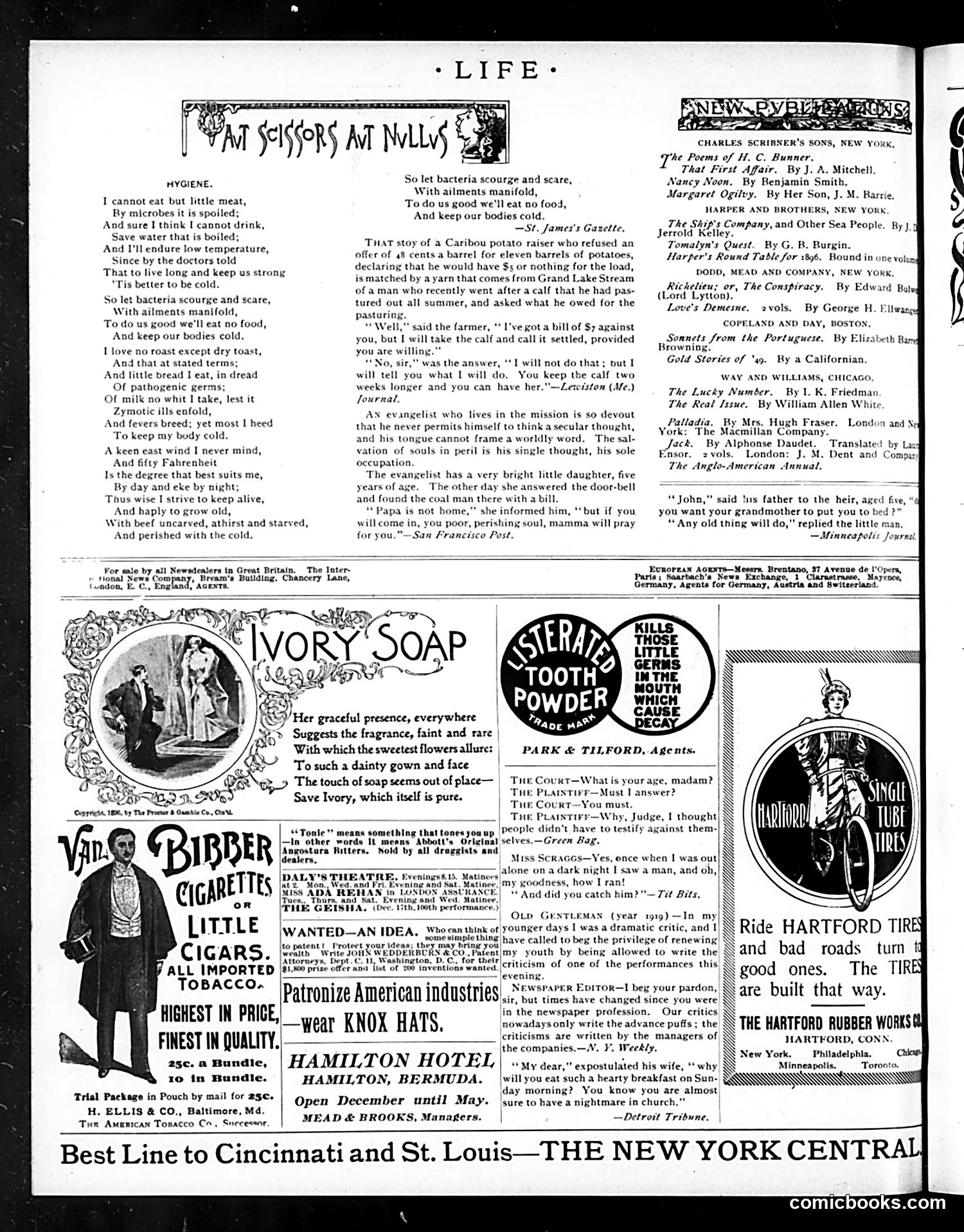
## "HYGIENE" Poem This satirical poem mocks the late-Victorian/early-Edwardian obsession with **germ theory and medical extremism**. Following discoveries about bacteria and disease transmission, some people adopted absurdly restrictive health practices—eating almost nothing, drinking only boiled water, enduring cold temperatures constantly. The satire's point: taken to logical extremes, health-consciousness becomes self-defeating and life-denying. The speaker starves himself, avoids all nourishment from fear of "pathogenic germs," and suffers perpetually in the cold—ultimately defeating health's actual purpose (living well). ## Supporting Anecdotes The brief stories about the Caribou potato farmer and the calf owner reinforce a theme: **stubborn unreasonableness about money and exchange** (possibly contemporary economic tensions). The evangelist's daughter joke plays on religious excess: her parroting of her father's pious language to a "poor, perishing" coal man illustrates how rigid ideology produces absurd social consequences. **Overall:** The page satirizes both medical obsessiveness and dogmatism across contexts.
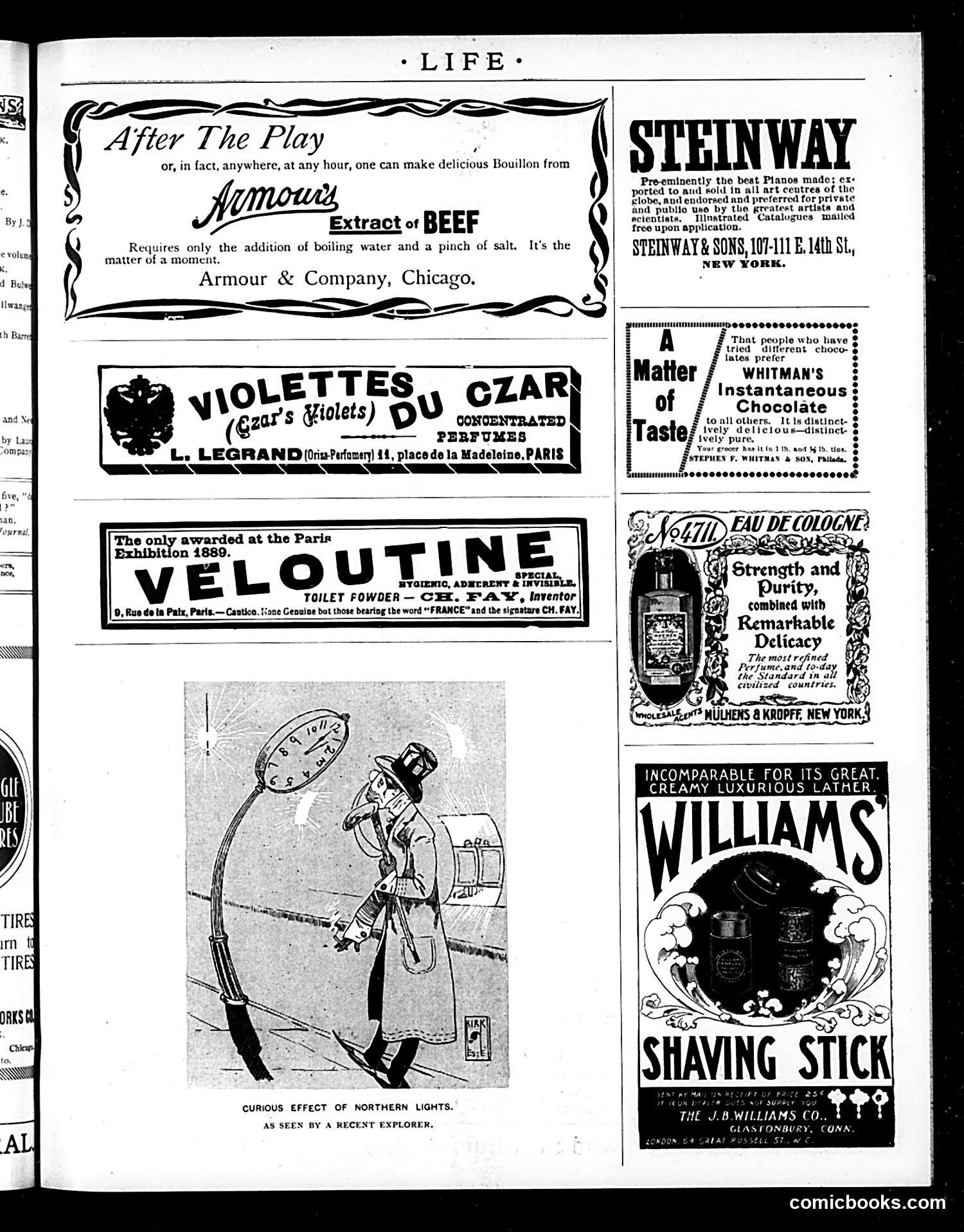
This page is primarily **advertisements** with one satirical cartoon. The main illustration, captioned "Curious Effect of Northern Lights as Seen by a Recent Explorer," depicts a figure holding a large net beneath an aurora borealis, appearing to attempt capturing the northern lights themselves. The joke is **absurdist satire**: an explorer treating a natural phenomenon (the aurora) as if it were a catchable creature. This likely mocks either credulous Victorian-era reports from Arctic explorers or the public's fascination with exotic polar exploration narratives—people believed almost anything about distant lands. The surrounding ads (Armour beef extract, Steinway pianos, Whitman's chocolate, shaving products) are typical period marketing, offering no satirical content. The page demonstrates how Life magazine mixed humor with advertising revenue in the early 20th century.
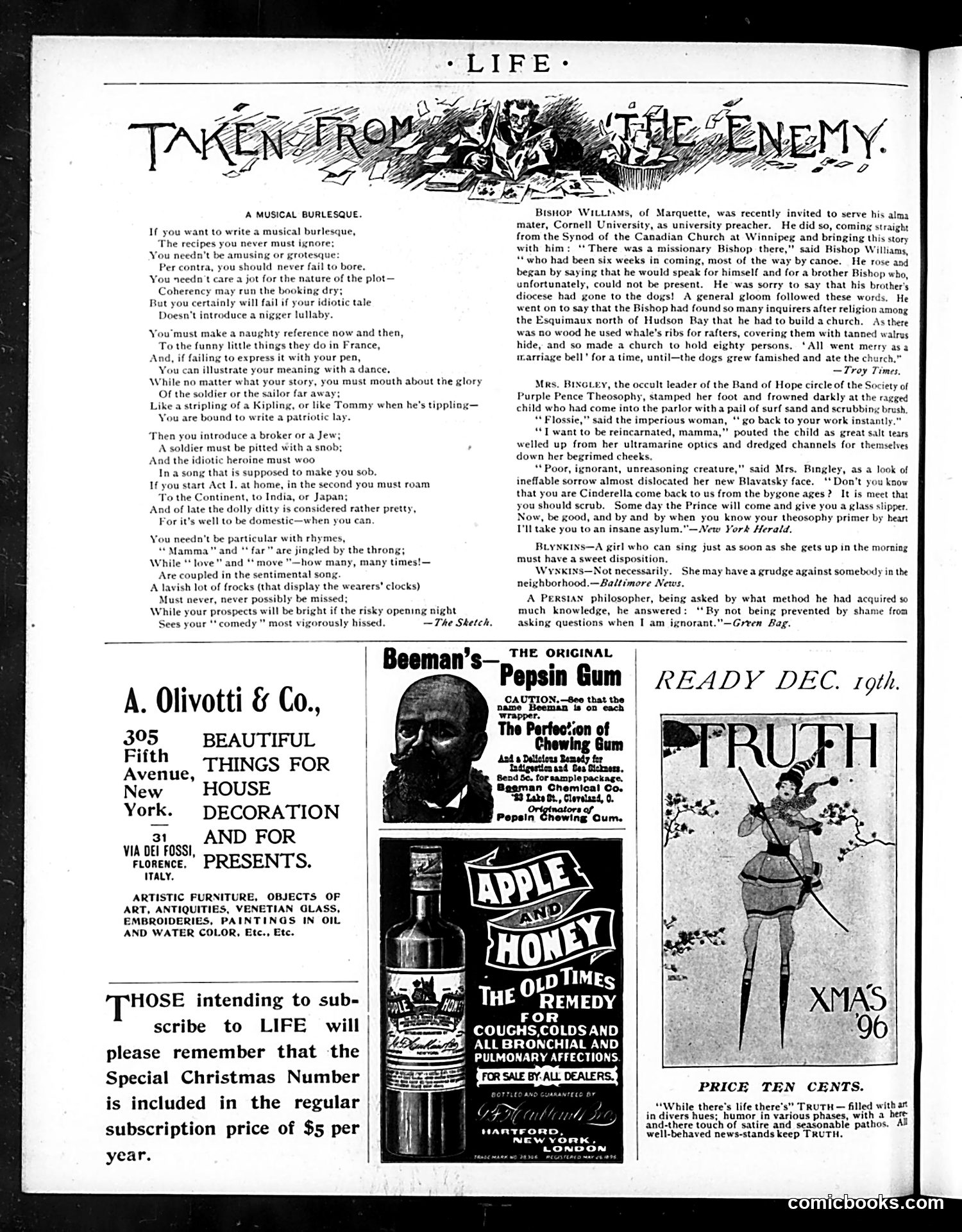
This page contains satirical commentary typical of early 20th-century Life magazine: **"A Musical Burlesque"** is a scathing critique of formulaic musical theater. The poem mocks how producers create successful shows by ignoring coherence and instead relying on clichés: "nigger lullabies," patriotic soldier songs, French innuendo, exotic locations, sentimental heroines, and predictable love songs. It suggests audiences will reward mediocre entertainment that employs these tired tropes, even when opening nights are "vigorously hissed." **The remaining anecdotes** satirize contemporary fads and pretension—particularly spiritualism and theosophy (represented by "Mrs. Bingley" of the "Purple Pence Theosophy"), which are mocked through absurd scenarios about reincarnation and mystical nonsense. The page is primarily **satirical humor** aimed at popular entertainment conventions and pseudointellectual movements of the era, not overtly political commentary.
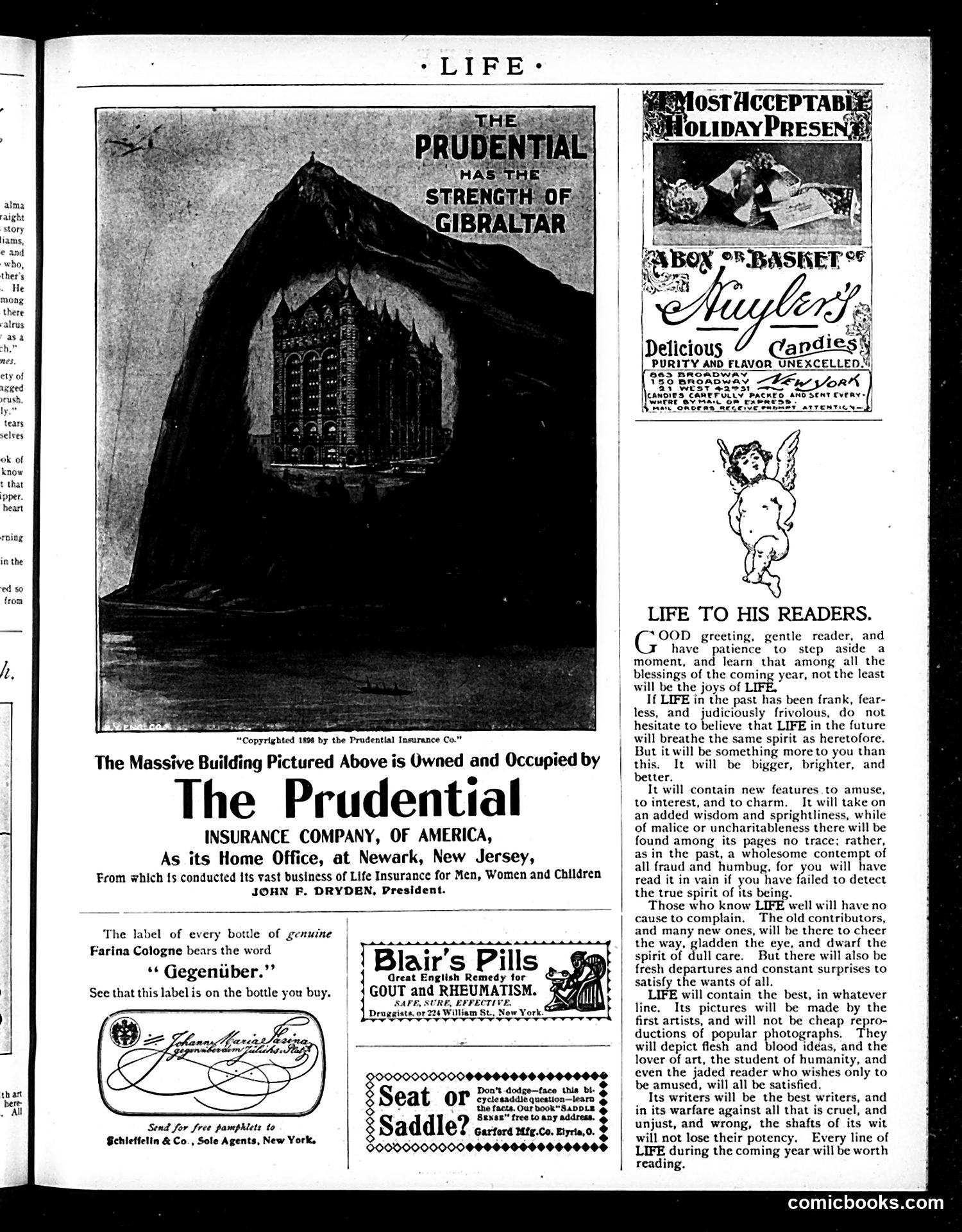
This page is primarily **advertising masquerading as editorial content**. The dominant image shows the Prudential Insurance Company's Newark office building framed within an arch, with accompanying text promoting the company and its president, John F. Dryden. The caption compares the building's strength to the Rock of Gibraltar—a common advertising metaphor for corporate stability and trustworthiness. The page also contains advertisements for patent medicines (Blair's Pills for gout/rheumatism), cologne, and saddles, interspersed with an editorial message from Life's editors promising the magazine will remain "frank, fearless, and judiciously frivolous" while maintaining "wholesome contempt of all fraud and humbug." **The irony**: Life positions itself as a critic of fraudulent schemes, yet this very page is filled with dubious patent medicine ads—precisely the kind of medical quackery satire magazines typically mocked. This suggests either the magazine's economic dependence on such advertising, or the era's general acceptance of these products.
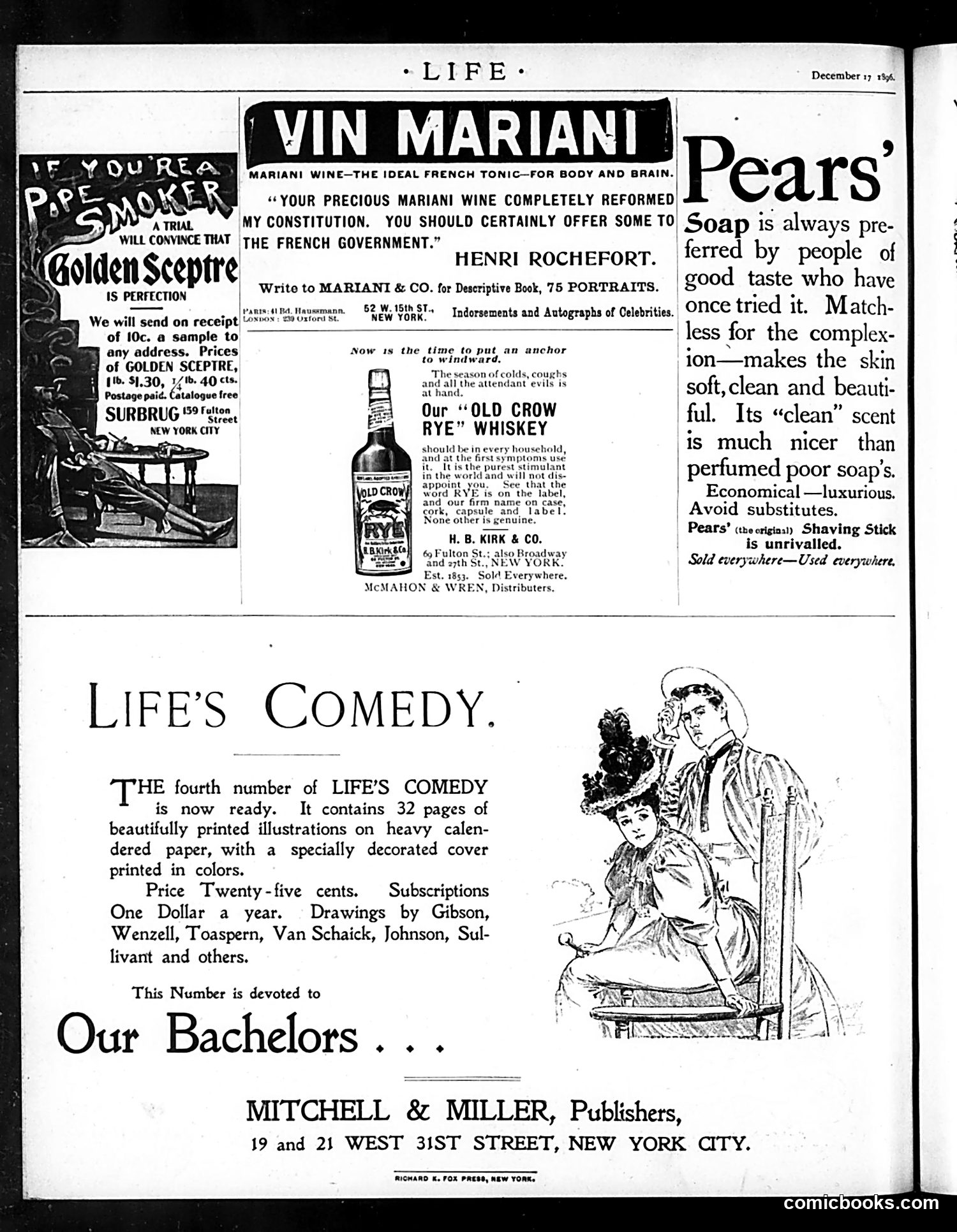
This is primarily an **advertising page** with no political cartoons or satire. It features four product endorsements typical of the era: **Vin Mariani**: A French tonic wine marketed as a health reformer. The quote from Henri Rochefort (a French politician/writer) claims it "completely reformed" his constitution—a common exaggerated testimonial style for patent medicines of this period. **Golden Sceptre Smoking Tobacco**: Advertised as "perfection." **Old Crow Rye Whiskey**: Marketed as a "pure stimulant" for household use, reflecting the era before alcohol prohibition and stricter drug regulations. **Pears' Soap**: Positioned as a luxury product for people of "good taste," emphasizing its pleasant scent versus inferior competitors. The page also announces **Life's Comedy** (an illustrated humor publication), featuring drawings by Gibson and other cartoonists. The advertisements reflect pre-FDA standards when unregulated health claims and patent medicines were openly marketed without scientific evidence.