
Life, 1896-12-17 · page 4 of 20
Life — December 17, 1896 — page 4: what you’re looking at
What you’re looking at
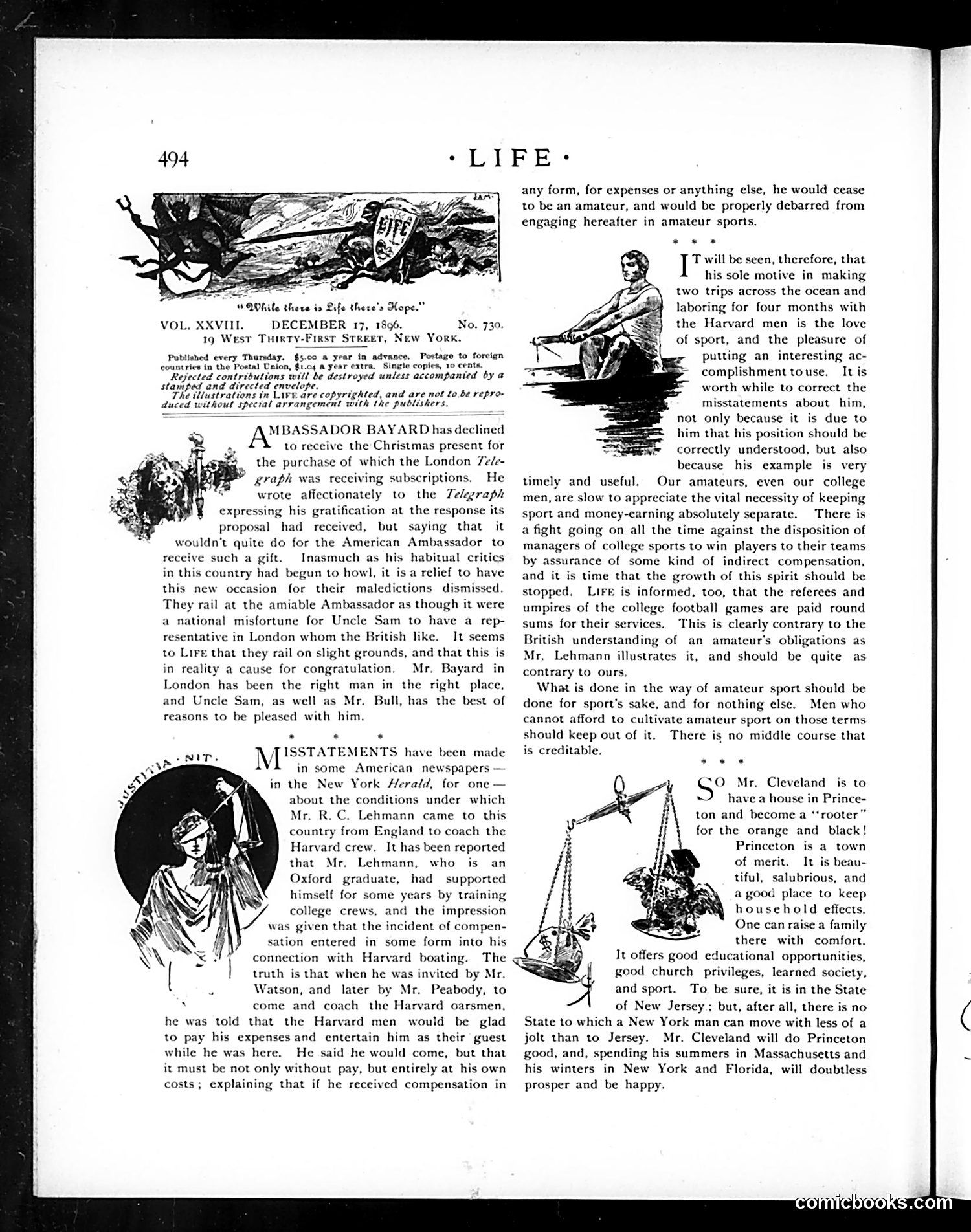
The page contains satirical commentary on amateur athletics and amateurism rules. The main cartoon depicts what appears to be a classical allegorical female figure labeled "While there is Life there's Hope," likely referencing debates about athletic compensation. The text discusses R.C. Lehmann, an Oxford graduate invited to coach Harvard's rowing crew. The satire criticizes American newspapers (particularly the *Herald*) for falsely claiming Lehmann received compensation for coaching—which would violate amateurism rules and disqualify him. The piece argues that amateur sport should remain unpaid "for sport's sake" and attacks the growing practice of indirectly compensating amateur athletes. It concludes with commentary on Mr. Cleveland's move to Princeton, treating it as a lighthearted society matter. The satire targets both sensationalist journalism and the erosion of amateur athletic principles.
📄 Transcribed text from this page (OCR, searchable)
Machine-transcribed from the original scan — historical spelling and the odd misread are preserved.
* LIFE: “OQMNile there is Life there's Hope.” VOL. XXVIII. DECEMBER 17, 1896. No. 730. 19 West Tuirty-First STREET, New York. Published every Thursday. $5.00 a year in advance. Postage to foreign countries in the Postal Union, $1.04 @ year extra, Single copies, 10 cents. Rejected contributions will be destroyed untess accompanied by @ stamped and directed envelope. The illustrations in LAFe. are copyrighted, and are not to.be repro- duced without special arrangement with the publishers, MBASSADOR BAYARD has declined to receive the Christmas present for the purchase of which the London 7e/e- graph was receiving subscriptions. He wrote affectionately to the Telegraph ing his gratification at the response its proposal had received, but saying that it wouldn't quite do for the American Ambassador to receive such a gift. Inasmuch as his habitual crit in this country had begun to howl, it is a relief to have this new occasion for their maledictions dismissed. They rail at the amiable Ambassador as though it were a natio misfortune for Uncle Sam to have a rep- resentative in London whom the British like. It seems to Lire that they rail on slight grounds, and that this is in reality a cause for congratulation. Mr. Bayard in London has been the right man in the right place, and Uncle Sam, as well as Mr. Bull, has the best of reasons to be pleased with him. expres ISSTATEME in some S have been made newspapers — in the New York Herald, for one — about the conditions under which Mr. R. C, Lehmann came to this country from England to coach the Harvard crew. It has been reported that Mr. Lehmann, who is an Oxford graduate, had supported himself for some years by training American sation entered in some form into his connection with Harvard boating. The truth is that when he was invited by Mr. Watson, and later by Mr, Peabody, to come and coach the Harvard oarsmen, he was told that the Harvard men would be glad to pay his expenses and entertain him as their guest while he wv aid he would come, but that it must be not only without pay, but entirely at his own costs; explaining that if he received compensation in any form, for expenses or anything else, he would cease to be an amateur, and would be properly debarred from engaging hereafter in amateur sports. T will be seen, therefore, that his sole motive in making two trips across the ocean and laboring for four months with the Harvard men is the love of sport, and the pleasure of putting an interesting ac- complishment touse. It is worth while to correct the misstatements about him, not only because it is due to him that his position should be correctly understood, but also because his example is very timely and useful. Our amateurs, even our college men, are slow to appreciate the vital necessity of keeping sport and money-earning absolutely separate. There is a fight going on all the time against the disposition of managers of college sports to win players to their teams by assurance of some kind of indirect compensation, and it is time that the growth of this spirit should be stopped. Lire is informed, too, that the referees and umpires of the college football games are paid round sums for their services. This is clearly contrary to the British understanding of an amateur’s obligations as Mr. Lehmann illustrates it, and should be quite as contrary to ours. What is done in the way of amateur sport should be done for sport's sake, and for nothing else. Men who fford to cultivate amateur sport on those terms should keep out of it. There is no middle course that is creditable. 7 ee ~O Mr. Cleveland is to ~ havea house in Prine ton and become a ‘‘rooter”™ for the orange and black! Princeton is a town of merit. It is beau- tiful, salubrious, and a good place to keep household effects. One can raise a family there with comfort. It offers good educational opportunities, good church privileges, learned society, and sport. To be sure, it is in the State of New Jersey; but, after all, there is no State to which a New York man can move with less of a jolt than to Jersey. Mr. Cleveland will do Princeton good, and, spending his summers in Massachusetts and his winters in New York and Florida, will doubtless prosper and be happy.