
Life, 1896-12-17 · page 12 of 20
Life — December 17, 1896 — page 12: what you’re looking at
What you’re looking at
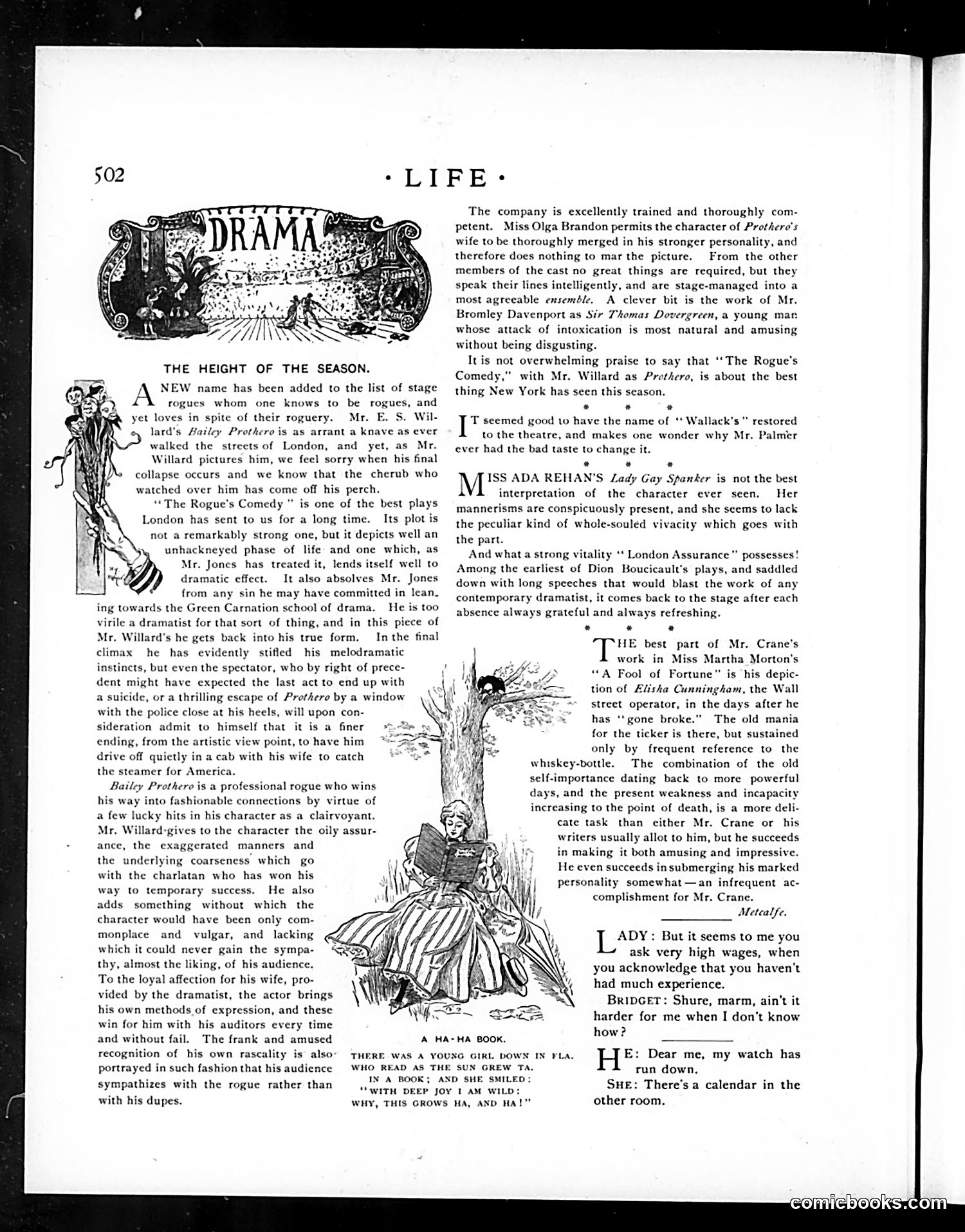
This page reviews contemporary London stage productions for American readers. The main critique covers **"The Rogue's Comedy,"** starring actor **Mr. Willard** as Bailey Prothero, a charming con artist/clairvoyant who infiltrates high society. The reviewer praises Willard's nuanced portrayal—he depicts the rogue with genuine affection for his wife and self-aware charm that makes audiences sympathize with him despite his crimes. The reviewer also commends the realistic (non-melodramatic) ending where Prothero escapes by cab rather than through theatrical window-chase. Secondary reviews critique **Miss Ada Rehan's** performance in "London Assurance" as lacking vitality, and praise **Mr. Crane's** work in "A Fool of Fortune." A brief note celebrates restoring the **Wallack's Theatre** name. The decorative illustrations show period-appropriate theatrical figures typical of Life's satirical style. This is straightforward arts criticism rather than political satire.
📄 Transcribed text from this page (OCR, searchable)
Machine-transcribed from the original scan — historical spelling and the odd misread are preserved.
*LIFE: THE HEIGHT OF THE SEASON. A. NEW name has been added to the list of stage rogues whom one knows to be rogue yet loves in spite of their roguery. Mr. lard's Bailey Prothero is as arrant a knave as ever walked the streets of London, and yet, as Mr. Willard pictures him, we feel sorry when his final collapse occurs and we know that the cherub who watched over him has come off his perch. “The Rogue's Comedy " is one of the best plays London has sent to us for a long time. Its plot is not a remarkably strong one, but it depicts well an unhackneyed phase of life and one which, as Mr. Jones has treated it, lends itself well to dramatic effect. It also absolves Mr. Jones from any sin he may have committed in lean. ing towards the Green Carnation school of drama. He is too virile a dramatist for that sort of thing, and in this piece of Mr. Willard’s he gets back into his true form. In the final climax he has evidently stifled his melodramatic instincts, but even the spectator, who by right of prece- dent might have expected the last act to end up with ora thrilling escape of Prothero by a window with the police close at his heels, will upon con- sideration admit to himself that it is a finer ending, from the artistic view point, to have him drive off quietly in a cab with his wife to catch the steamer for America. Bailey Prothero is a professional rogue who wins his way into fashionable connections by virtue of a few lucky hits in his character as a clairvoyant. Mr. Willard-gives to the character the oily assur- ance, the exaggerated manners and ying coarseness which go with the charlatan who has won his way to temporary success. He also adds something without which the character would have been only com- monplace and vulgar, and lacking which it could never gain the sympa- thy, almost the liking, of his audience, To the loyal affection for his wife, pro- vided by the dramatist, the actor brings his own methods.of expression, and these win for him with his auditors every time and without fail. The frank and amused recognition of his own rascality is also portrayed in such fashion that his audience sympathizes with the rogue rather than with his dupes. the under! A HA- THERE WAS A YOUN WHO READ AS THE IN A BOOK “WITH DEEP Joy AND SHE SMILED: WHY, THIS GROWS HA, AND HA!” The company is excellently trained and thoroughly com- petent. Miss Olga Brandon permits the character of Prothero's wife to be thoroughly merged in his stronger personality, and therefore does nothing to mar the picture. From the other members of the cast no great things are required, but they speak their lines intelligently, and are stage-managed into a most agreeable ensemble, A clever bit is the work of Mr. Bromley Davenport as Sir Thomas Dovergreen, a young mar whose attack of intoxication is most natural and amusing without being disgusting. It is not overwhelming praise to say that ‘The Rogue's Comedy,” with Mr. Willard as Prethero, is about the best thing New York has seen this season, . * * T seemed good to have the name of ‘* Wallack’s"” restored to the theatre, and makes one wonder why Mr. Palmer ever had the bad taste to change it. * * ISS ADA REHAN’S Lady Gay Spanker is not the best interpretation of the character ever seen. Her mannerisms are conspicuously present, and she seems to lack the peculiar kind of whole-souled vivacity which goes with the part. And what a strong vitality ‘* London Assurance” possesses! Among the earliest of Dion Boucicault’s plays, and saddled down with long speeches that would blast the work of any contemporary dramatist, it comes back to the stage after each absence always grateful and always refreshing. . ° * HE best part of Mr. Crane's work in Miss Martha Morton's A Fool of Fortune” is his depic- tion of Elisha Cunningham, the Wall street operator, in the days after he has ‘gone broke.” The old mania for the ticker is there, but sustained only by frequent reference to the whiskey-bottle. The combination of the old self-importance dating back to more powerful days, and the present weakness and incapacity increasing to the point of death, is a more deli- cate task than cither Mr. Crane or his writers usually allot to him, but he succeeds in making it both amusing and impressive. He even succeeds in submerging his marked personality somewhat —an infrequent ac- complishment for Mr. Crane. Metcalfe. ADY: But it seems to me you ask very high wages, when you acknowledge that you haven't had much experience. BrivGer: Shure, marm, ain't it harder for me when I don’t know how? HA BOOK. GIRL Dow: SUN GREW Ta. E: Dear me, my watch has run down. Sue: There's a calendar in the other room. TAM WILD