
Life, 1896-12-17 · page 7 of 20
Life — December 17, 1896 — page 7: what you’re looking at
What you’re looking at
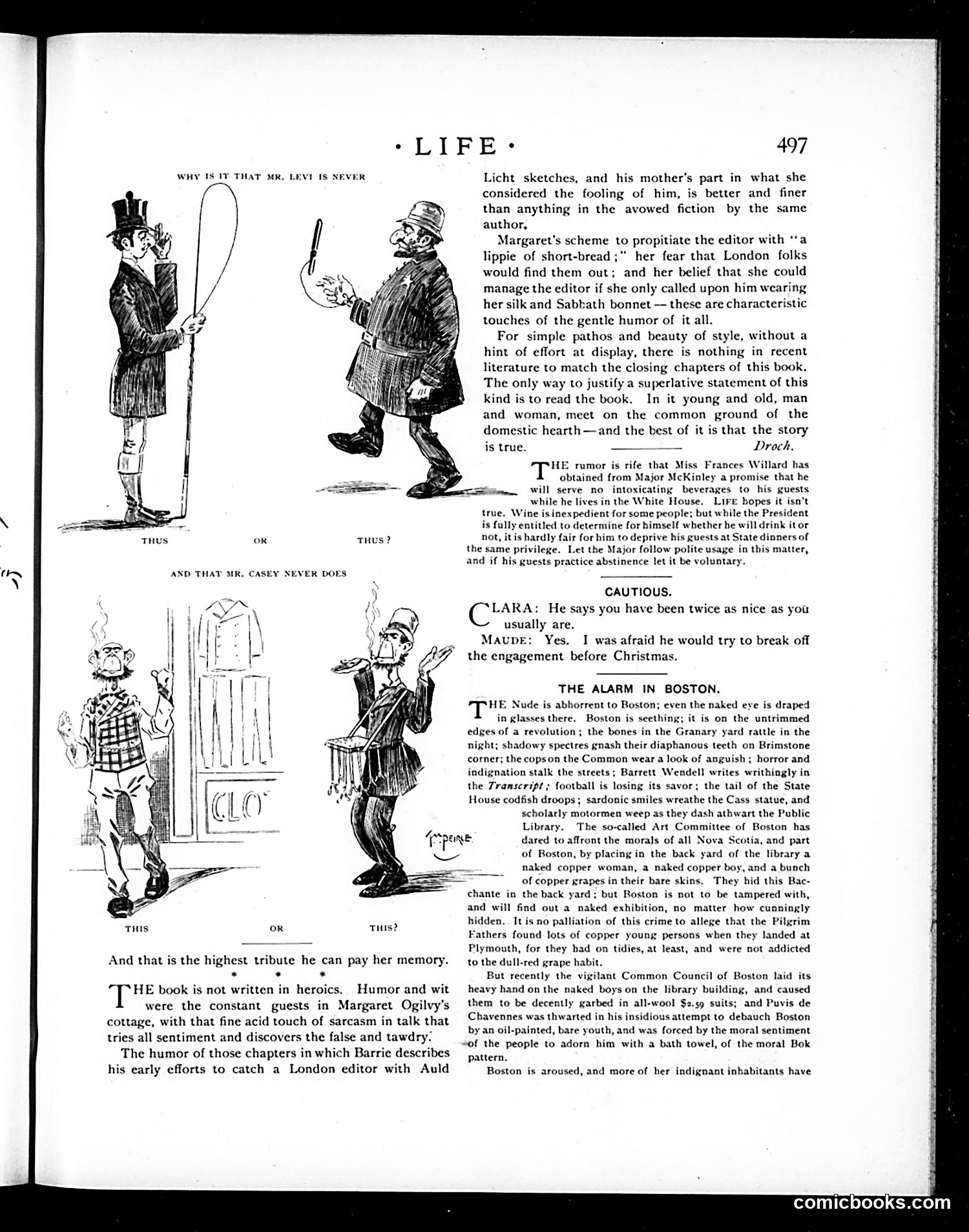
This page contains satirical cartoons and commentary about social etiquette and Boston morality controversies. The top cartoons humorously illustrate contrasting behaviors—labeled "Why is it that Mr. Levi is never thus or or thus?" and "And that Mr. Casey never does this or or this?"—depicting exaggerated postures and gestures to mock social hypocrisy regarding propriety. The text discusses Frances Willard's temperance pledge and an "Alarm in Boston" regarding nude art displays and moral outrage. It satirizes Boston's prudish reaction to artistic nudity at public institutions, noting the city's inhabitants became "indignant" over copper sculptures of nude figures. The overall tone mocks class-based inconsistencies in moral standards and Boston's particular sensitivity to artistic representation of the nude form during what appears to be an early-20th-century cultural debate.
📄 Transcribed text from this page (OCR, searchable)
Machine-transcribed from the original scan — historical spelling and the odd misread are preserved.
WHY IS IT THAT MR, LEVI IS NEVER THUS? AND THAT MR, CASEY NEVER DOES “pene Set oR THIS? And that is the highest tribute he can pay her memory. * . . HE book is not written in heroics. Humor and wit were the constant guests in Margaret Ogilvy’s cottage, with that fine acid touch of sarcasm in talk that tries all sentiment and discovers the false and tawdry. The humor of those chapters in which Barrie describes his early efforts to catch a London editor with Auld 497 s, and his mother’s part in what she considered the fooling of him, better and finer than anything in the avowed fiction by the same author, Margaret's scheme to propitiate the editor with ‘‘a lippie of short-bread ;" her fear that London folks would find them out; and her belief that she could manage the editor if she only called upon him wearing her silk and Sabbath bonnet — these are characteristic touches of the gentle humor of it all. For simple pathos and beauty of style, without a hint of effort at display, there is nothing in recent literature to match the closing chapters of this book, The only way to justify a superlative statement of this kind is to read the book. In it young and old, man and woman, meet on the common ground of the domestic hearth—and the best of it is that the story is true. Droch. HE rumor is rife that Miss Frances Willard has obtained from Major McKinley a promise that be Il serve no intoxicating beverages to his guests while he lives in the White House. Lire hopes it isn’t true. Wine is inexpedient for some people; but while the Pr is fully entitled to determine for himself whether he will drin| not, it is hardly fair for him to deprive his guests at State dinners of the same privilege. Let the Major follow polite usage in this matter, and if his guests practice abstinence let it be voluntary. a CAUTIOUS. LARA: He says you have been twice as nice as you usually are. Mauve: Yes. I was afraid he would try to break off THE ALARM IN BOSTON. HE Nude is abhorrent to Boston; even the naked eye is draped in glasses there. Boston is seething; it is on the untrimmed edges of a revolution; the bones in the Granary yard rattle in the night; shadowy spectres gnash their diaphanous teeth on Brimstone corner; the copson the Common wear a look of anguish ; horror and indignation stalk the streets; Barrett Wendell writes writhingly in the Transcript ; football is losing its savor; the tail of the State House codfish droops ; sardonic smiles wreathe the Cass statue, and scholarly motormen weep as they dash athwart the Public Library. The so-called Art Committee of Boston has dared to affront the morals of all Nova Scotia, and part of Boston, by placing in the back yard of the library a naked copper woman, a naked copper boy, and a bunch of copper grapes in their bare skins. They hid this Bac- chante in the back yard but Boston is not to be tampered with, and will find out a naked exhibition, no matter how cunningly hidden. It is no palliation of this crime to allege that the Pilgrim Fathers found lots of copper young persons when they landed at Plymouth, for they had on tidies, at least, and were not addicted to the dull-red grape habit, But recently the vigilant Common Council of Boston laid its heavy hand on the naked boys on the library building, and caused them to be decently garbed in all-wool $2.59 suits; and Puvis de Chavennes was thwarted in his insidious attempt to debauch Boston by an oil-painted, bare youth, and was forced by the moral sentiment ‘of the people to adorn him with a bath towel, of the moral Bok pattern. Boston is aroused, and more of her indignant inhabitants have comicbooks.com