
Life, 1896-12-17 · page 6 of 20
Life — December 17, 1896 — page 6: what you’re looking at
What you’re looking at
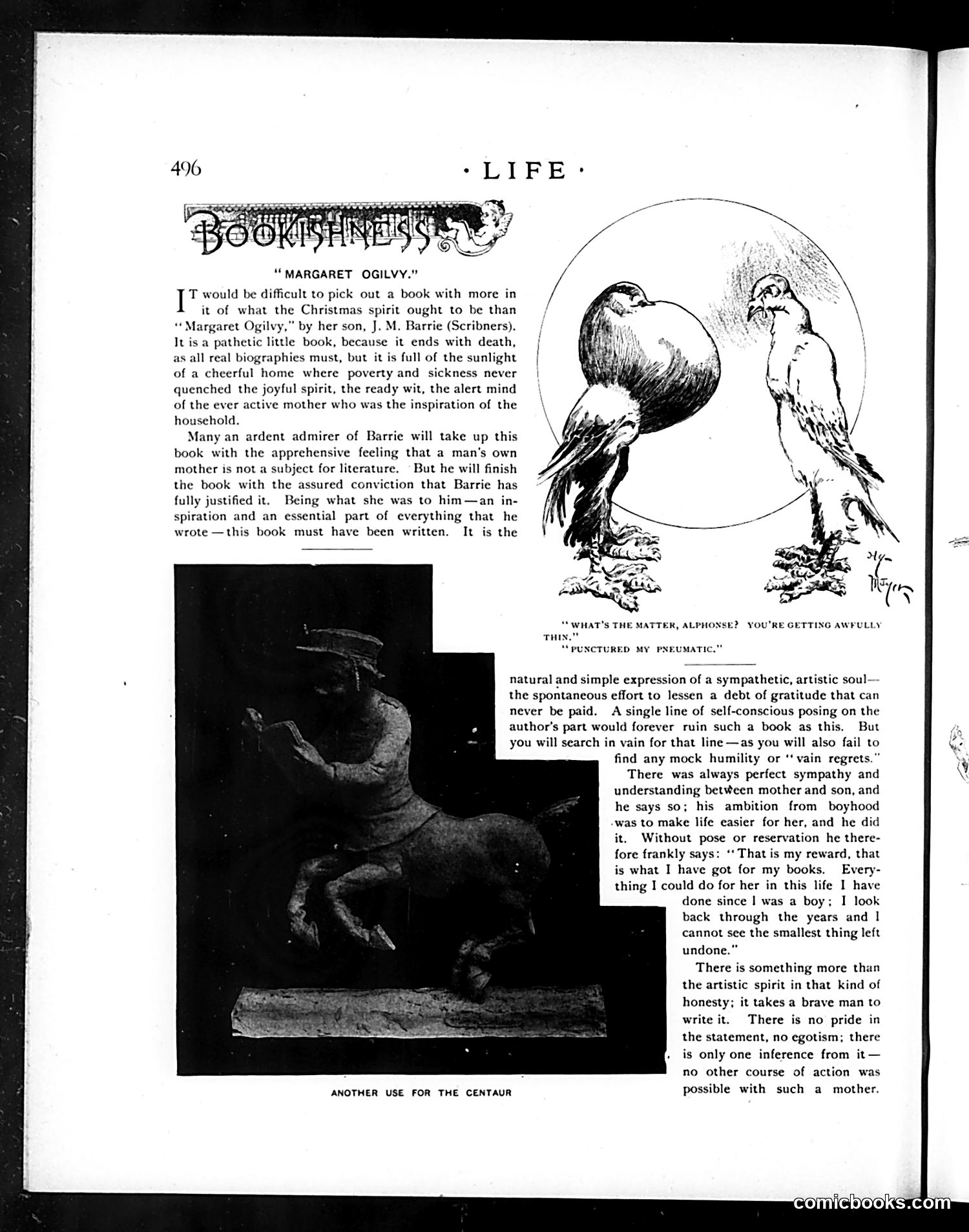
This page reviews J.M. Barrie's novel "Margaret Ogilvy," a biographical work about the author's mother. The text praises the book's depiction of a poor but spiritually rich Scottish household, emphasizing Barrie's genuine gratitude toward his mother rather than literary pretension. The two illustrations support this theme: the bird cartoon (captioned about a "punctured pneumatic") appears to be a lighthearted visual joke, while the photograph labeled "Another Use for the Centaur" shows a classical sculpture, likely satirizing Victorian attitudes toward art and domesticity. This is literary criticism/book review rather than political satire—it celebrates Barrie's emotional honesty and maternal devotion as the book's genuine merit.
📄 Transcribed text from this page (OCR, searchable)
Machine-transcribed from the original scan — historical spelling and the odd misread are preserved.
“MARGARET OGILVY.” T would be difficult to pick out a book with more in it of what the Christmas spirit ought to be than argaret Ogilvy,” by her son, J. M. Barrie (Scribners). It is a pathetic little book, because it ends with death, as all real biographies must, but it is full of the sunlight of a cheerful home where poverty and sickness never quenched the joyful spirit, the ready wit, the alert mind of the ever active mother who was the inspiration of the household, Many an ardent admirer of Barrie will take up this book with the apprehensive feeling that a man's own mother is not a subject for literature. But he will finish the book with the assured conviction that Barrie has fully justified it. Being what she was to him—an in- spiration and an essential part of everything that he wrote —this book must have been written. It is the yn “WHAT'S THE MATTER, ALPHONSE? YOU'RE GETTING AWFULLY natural and simple expression of a sympathetic, artistic soul- the spontancous effort to lessen a debt of gratitude that can never be paid. A single line of self-conscious posing on the author's part would forever ruin such a book as this. But you will search in vain for that line —as you will also fail to find any mock humility or ‘vain regrets.” There was always perfect sympathy and understanding between mother and son, and he says so; his ambition from boyhood was to make life easier for her, and he did it. Without pose or reservation he there- fore frankly says: ‘‘ That is my reward, that is what I have got for my books. Every- thing I could do for her in this life I have done since | was a boy; I look back through the years and | cannot see the smallest thing left undone.” There is something more than the artistic spirit in that kind of honesty; it takes a brave man to write it. There is no pride in the statement, no egotism; there is only one inference from it — no other course of action was ANOTHER USE FOR THE CENTAUR possible with such a mother.