
A complete issue · 18 pages · 1896
Life — October 15, 1896
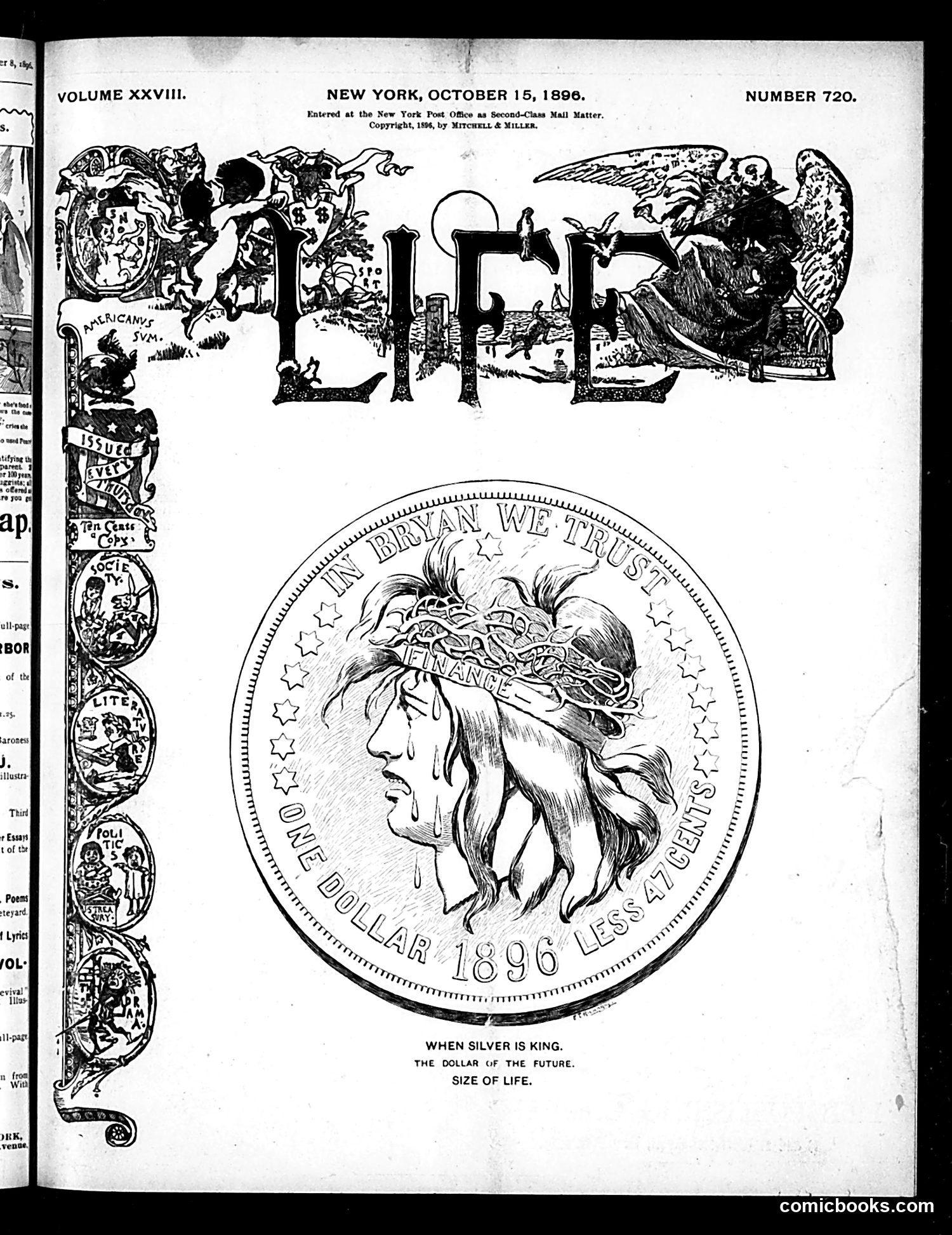
This page features a large coin design titled "When Silver is King: The Dollar of the Future" — a satirical commentary on the 1896 presidential election's monetary debate. The image depicts Lady Liberty wearing a crown of wheat sheaves, with text reading "In Bryan We Trust" and dated "1896." This mocks William Jennings Bryan's Free Silver campaign, which advocated unlimited silver coinage to help farmers and debtors. The satire suggests that if Bryan won and "silver became king," the dollar would be devalued and unstable. Life's conservative Republican editors opposed free silver, viewing it as economically reckless. The coin's design parodies official currency while criticizing Bryan's populist monetary policy as dangerous fantasy rather than sound financial practice.
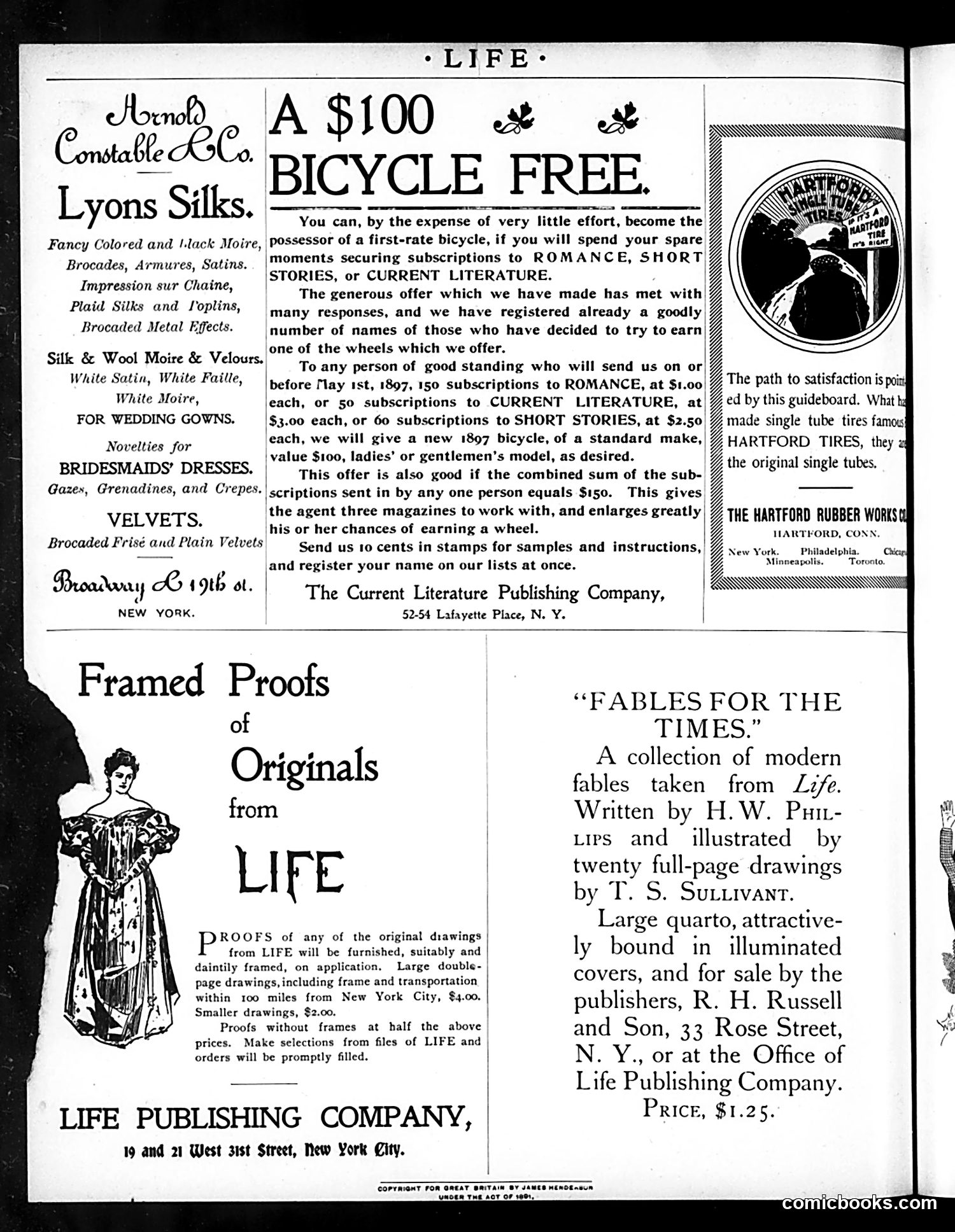
This page is primarily **advertising, not political cartoon content**. The visible advertisements include: - Arnold Constable & Co. promoting Lyons Silks for clothing - The Current Literature Publishing Company offering a **$100 bicycle as a promotional incentive** for magazine subscriptions - Hartford Rubber Works advertising tires - Life Publishing Company promoting "Framed Proofs of Originals from LIFE" - A book advertisement for "Fables for the Times" by H.W. Phillips, illustrated by T.S. Sullivan There is **no political satire or cartoon visible** on this page. The illustrated figure in the "Framed Proofs" section appears to be a decorative fashion illustration rather than a caricature. This is a commercial page focused on selling subscriptions, products, and publishing services to Life magazine's readers.
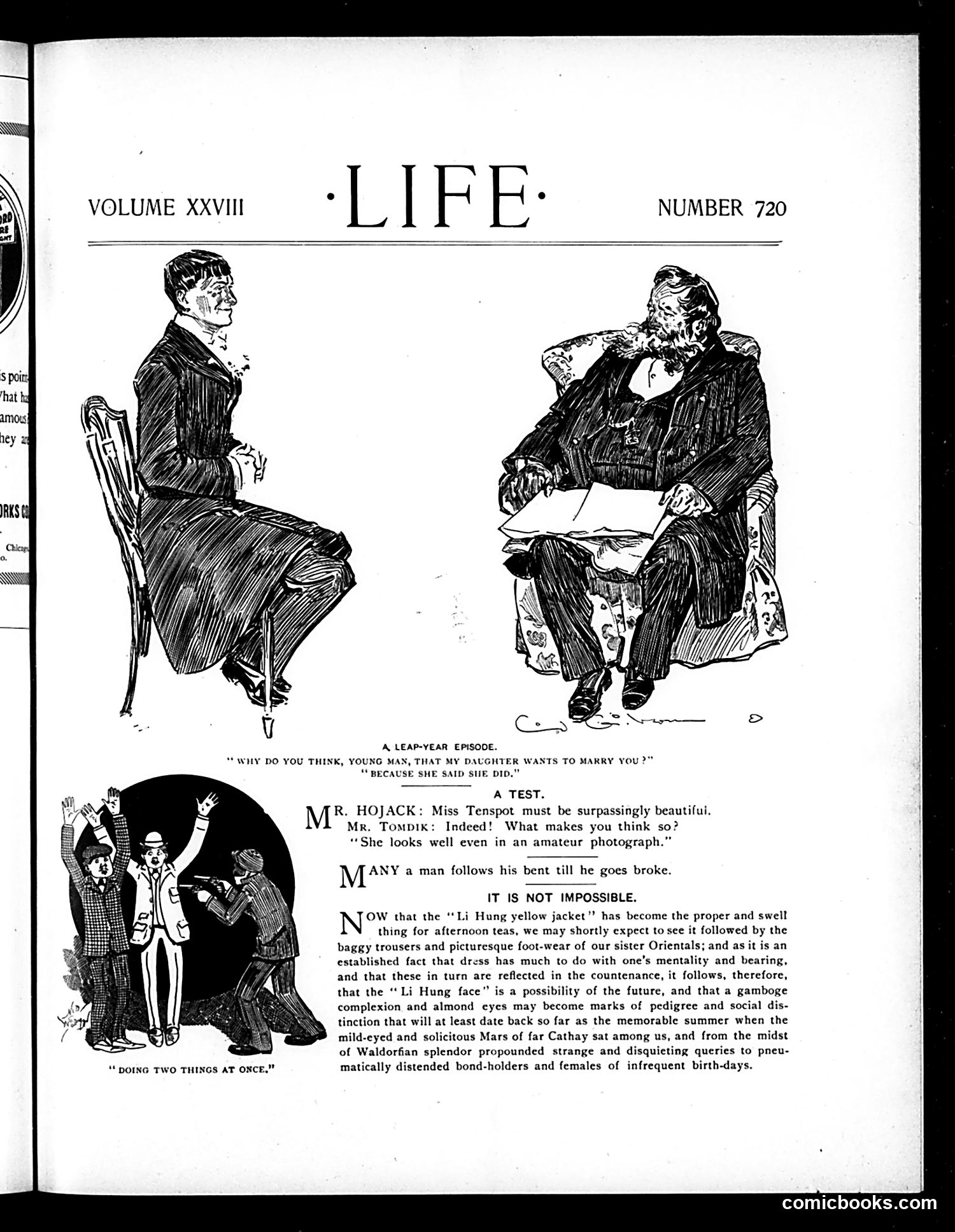
This page contains satirical humor about early 20th-century social conventions: **Top cartoon** ("A Leap-Year Episode"): References leap-year tradition where women could propose to men. The dialogue jokes that a father consents to his daughter's marriage proposal simply because "she said she did." **Middle section** ("A Test"): Two gentlemen discuss a woman's beauty, with one noting she looks good even in amateur photographs—backhanded compliment humor about photography's limitations. **Bottom cartoon** ("Doing Two Things at Once"): The text discusses the "Li Hung yellow jacket" becoming fashionable for afternoon teas, satirizing how exotic fashion trends (here, Chinese-inspired clothing) influence social status and class distinctions among the wealthy. The humor relies on period-specific social anxieties about gender roles, photography, and fashion snobbery.
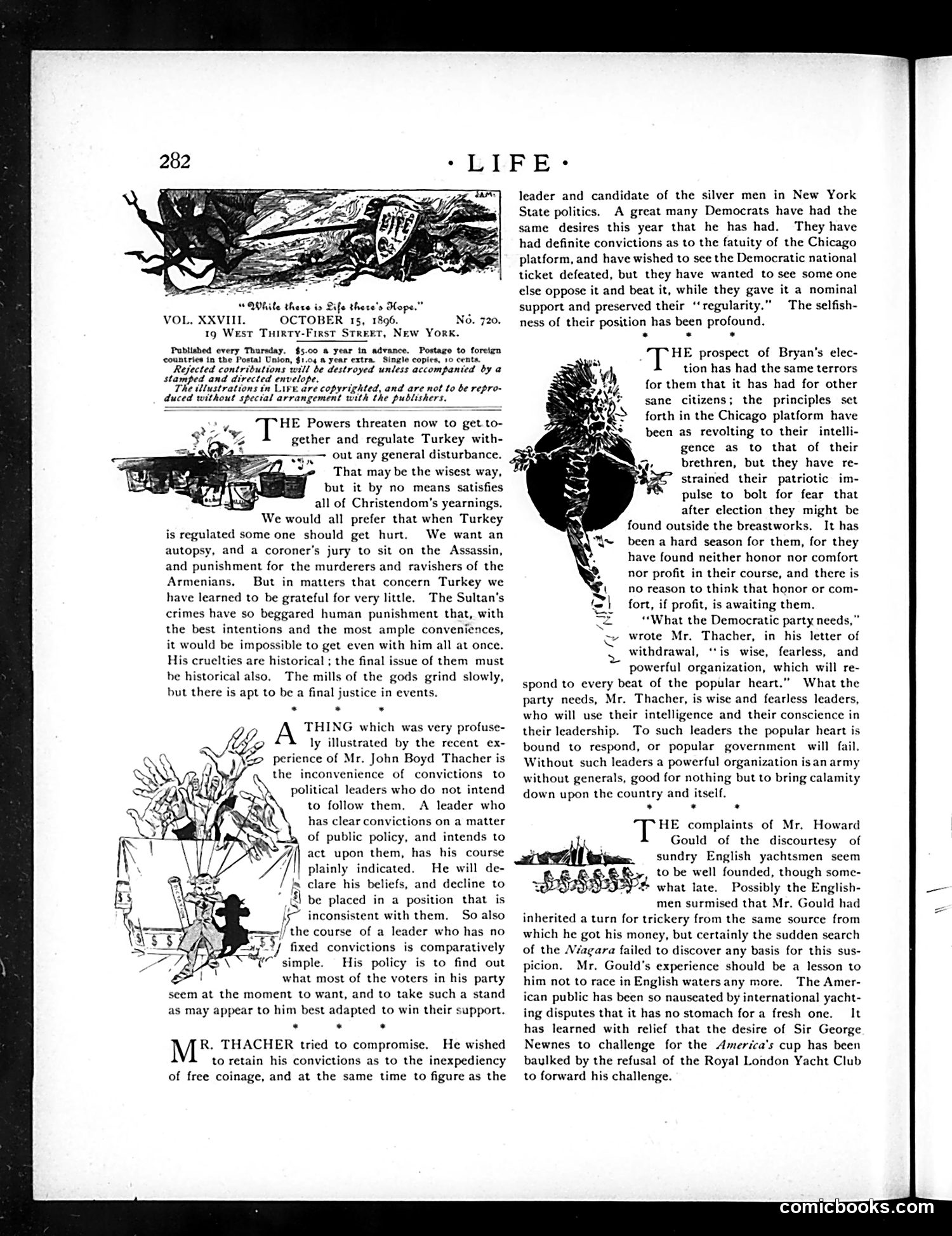
This page contains political commentary on the 1896 U.S. presidential election, specifically criticizing William Jennings Bryan's "free silver" campaign. The text discusses Bryan's threat to Democratic party unity and argues that the party needs "wise, fearless" leaders rather than Bryan's leadership. The cartoons illustrate the chaos Bryan's candidacy allegedly caused: one depicts tangled chaos (labeled "Where there is Life there's Hope"), and another shows a figure amid financial turmoil with dollar signs, suggesting economic anxiety about Bryan's monetary policies. The page also discusses the Armenian crisis and mentions a yachting dispute involving Mr. Howard Gould and English yachtsmen over the America's Cup challenge. The overall tone is satirical criticism of Bryan's radical platform from a more conservative perspective.
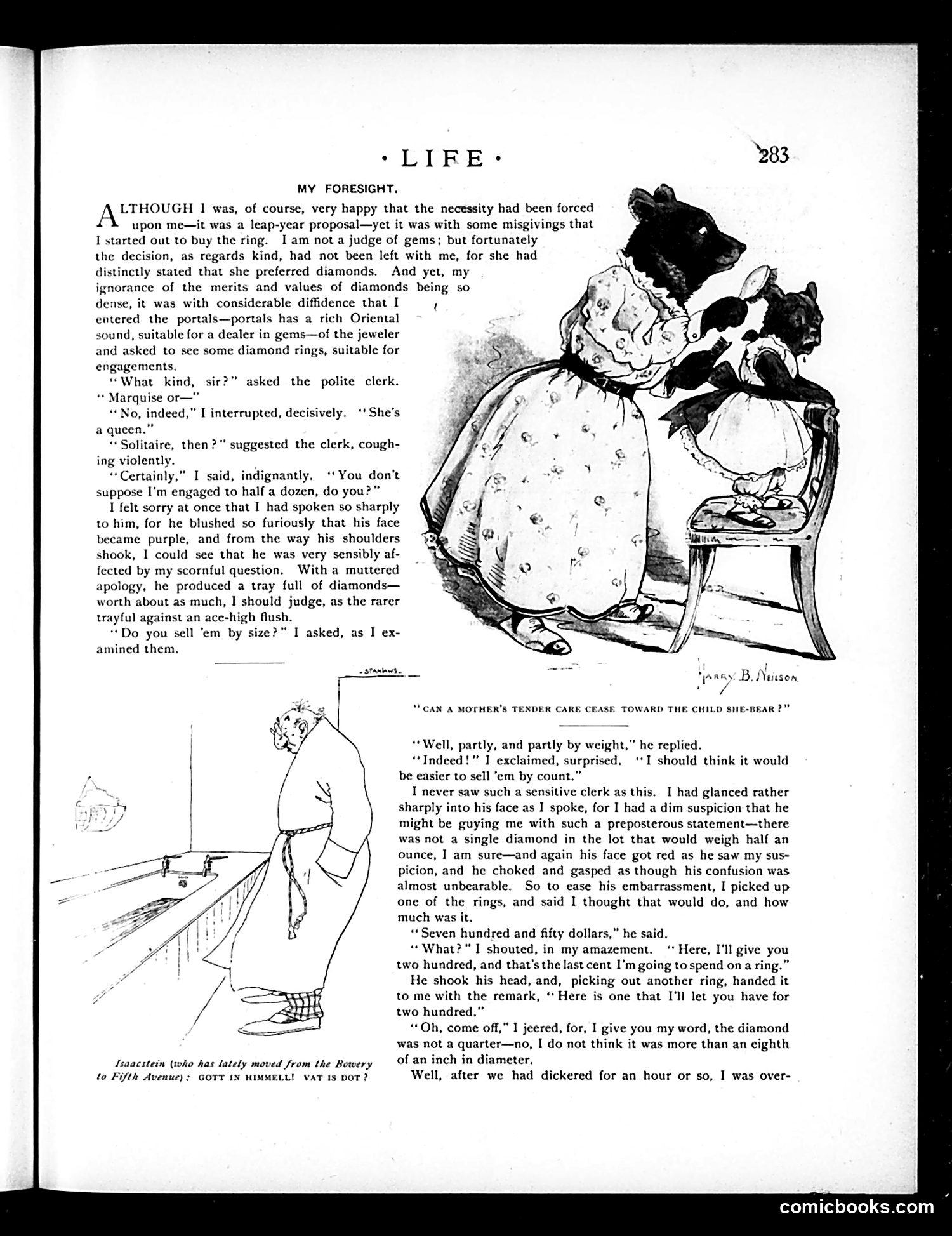
This page contains a humorous narrative essay titled "My Foresight" about purchasing an engagement ring. The accompanying illustrations satirize the social awkwardness of diamond shopping and masculine discomfort with jewelry transactions. The main illustration shows a woman with two small dogs, likely representing the narrator's fiancée. A secondary sketch depicts a jeweler at his counter—a common target of satire for perceived dishonesty and inflated pricing. The joke centers on the narrator's naïveté: he believes the clerk's claims about diamond weight and value, only to realize he's been overcharged. The satire targets both masculine ignorance about gems and jewelers' reputation for deceptive sales practices—a social anxiety that remains recognizable today. The quip "Can a mother's tender care cease toward the child she-bear?" appears to be unrelated wordplay.
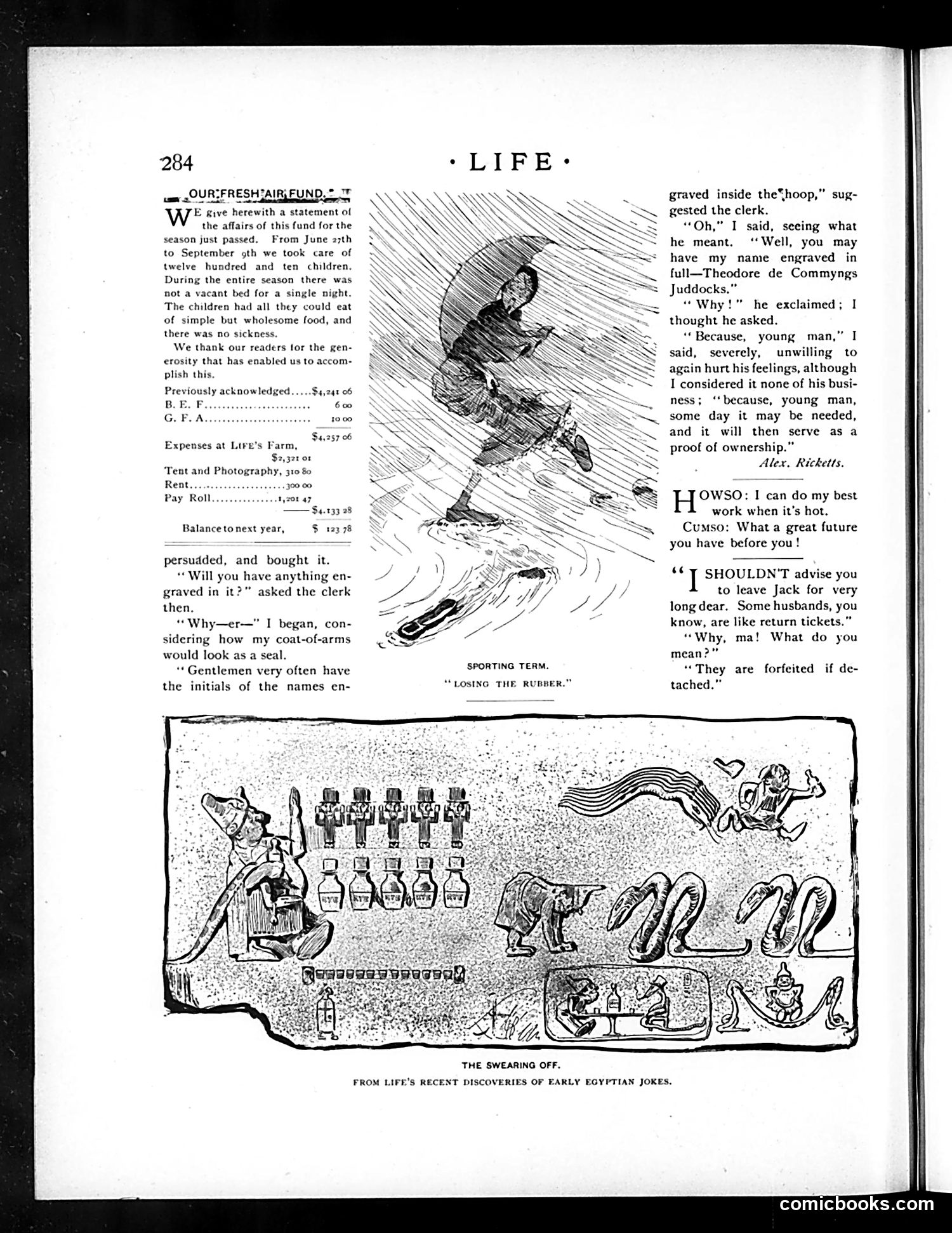
**Upper Section:** A narrative dialogue about engraving a name on a coat-of-arms. A clerk suggests engraving "Theodore de Commynes Juddocks" on the coat, but the patron refuses, explaining that such engravings serve as "proof of ownership" — a jab at social pretension and the ridiculous naming conventions of those seeking to appear aristocratic. **Lower Section:** An advertisement titled "The Swearing Off" presents what appears to be an Egyptian papyrus-style cartoon, labeled "from Life's recent discoveries of early Egyptian jokes." This is likely satirizing both the contemporary fascination with Egyptology and the notion that even ancient civilizations made jokes about excessive drinking — suggesting this is a timeless human folly rather than modern excess. Both items mock social pretension and self-deception.
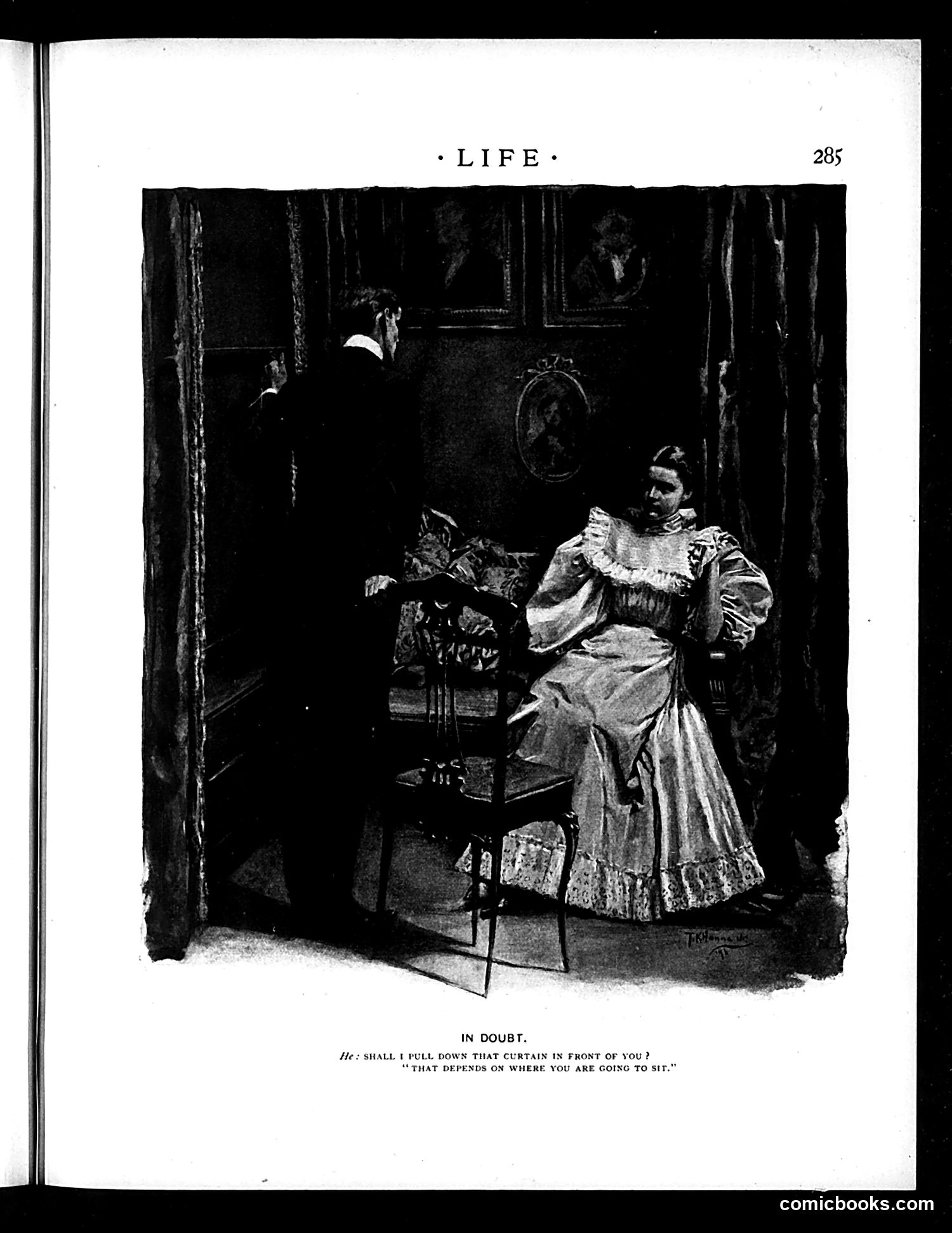
This single-panel cartoon depicts a domestic scene titled "In Doubt." A woman in an elaborate Edwardian dress sits while a man in formal attire stands nearby. The caption reads: "He: 'Shall I pull down that curtain in front of you?' / 'That depends on where you are going to sit.'" The joke plays on social etiquette and gender dynamics of the early 1900s. The woman's response implies she wants the curtain positioned based on the man's seating choice—a witty, flirtatious comment suggesting her comfort or modesty depends on his proximity. It satirizes the formality and careful choreography of Victorian/Edwardian courtship, where physical positioning and propriety were heavily codified social rituals.
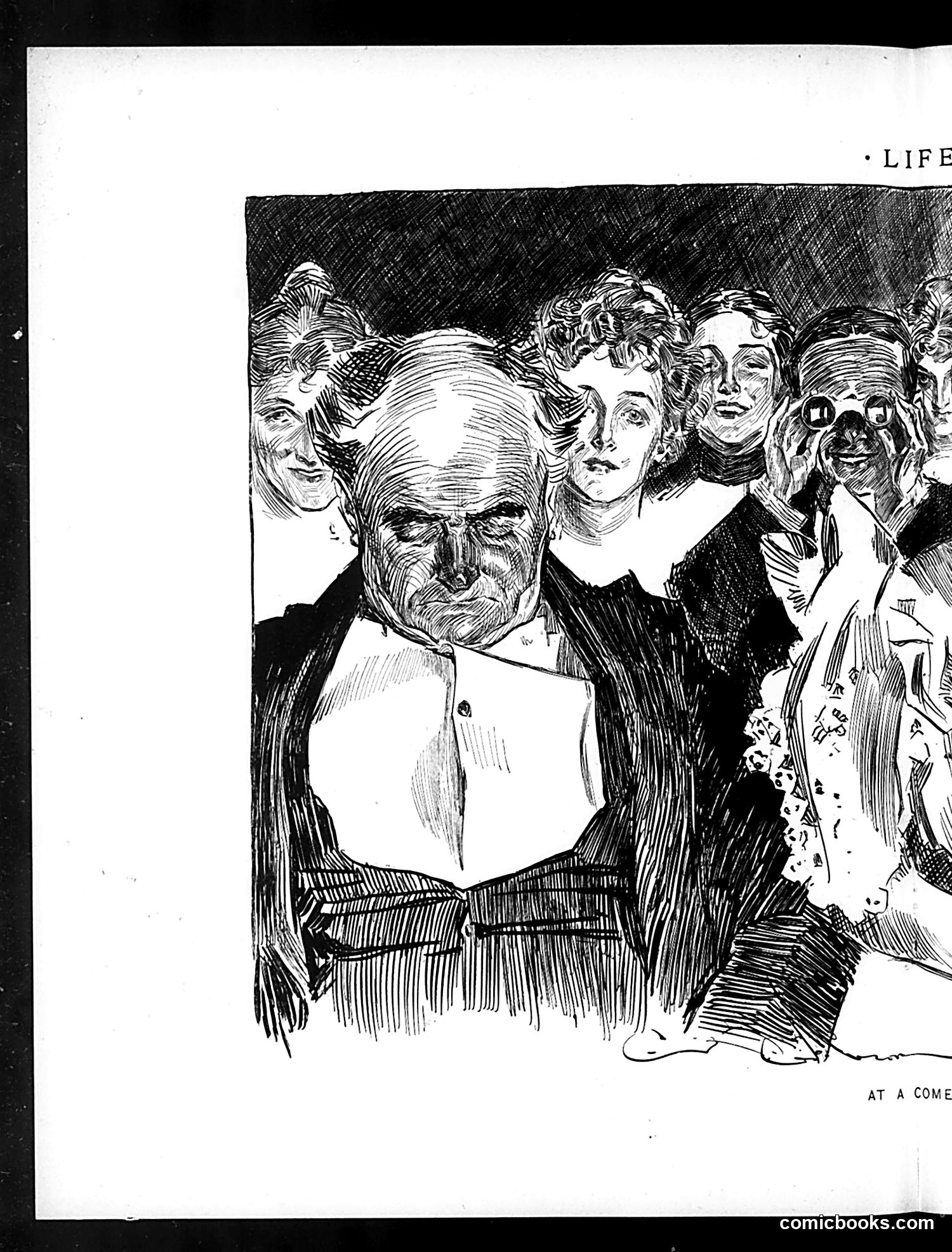
This appears to be a satirical illustration from *Life* magazine showing a formal social gathering. The central figure is a bald man in white-tie evening dress, surrounded by several other well-dressed individuals at what the partial caption indicates is "AT A COME[DY]" (likely a comedy or social event). The style and composition suggest social satire targeting upper-class society figures, a common *Life* magazine subject. The exaggerated facial features and caricatured drawing style are typical of the magazine's satirical approach to mocking pretension and social hierarchies among the wealthy and influential. However, without the complete caption or additional context, I cannot definitively identify the specific individuals depicted or the precise social commentary intended.
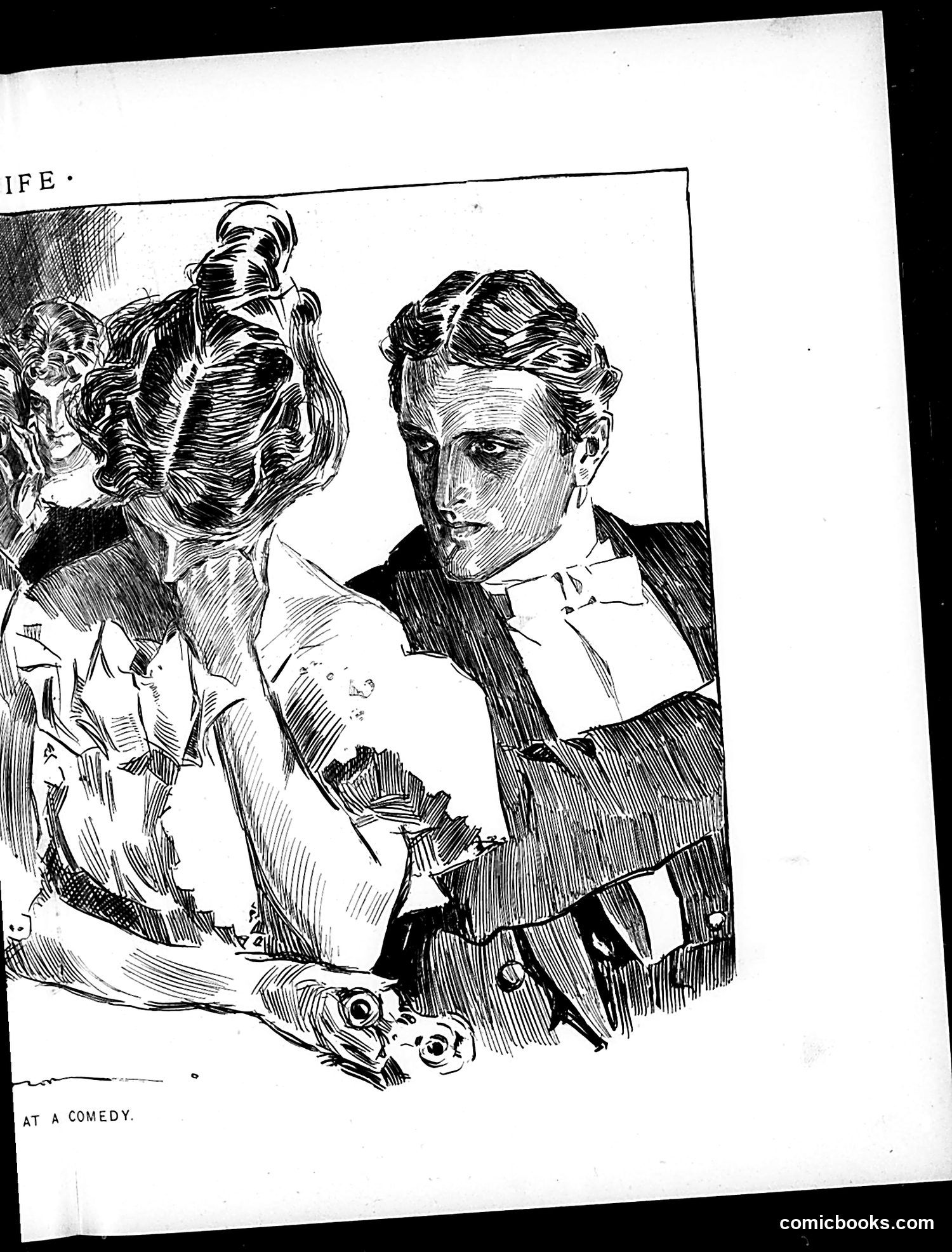
This sketch depicts a well-dressed man in formal evening wear (tuxedo and bow tie) attending a theatrical comedy, sitting beside a woman in an elegant white gown. The man's expression appears somewhat detached or unimpressed despite the entertainment, while the woman's animated face and gestures suggest she is thoroughly enjoying herself. The satire likely comments on gender differences in social behavior or entertainment preferences during the early 20th century—specifically, the contrast between a man's affected sophistication or aloofness at public events versus a woman's genuine emotional engagement. The title emphasizes the irony of being "at a comedy" while displaying an unamused demeanor, mocking the masculine pretense of refined indifference to entertainment meant to provoke laughter.
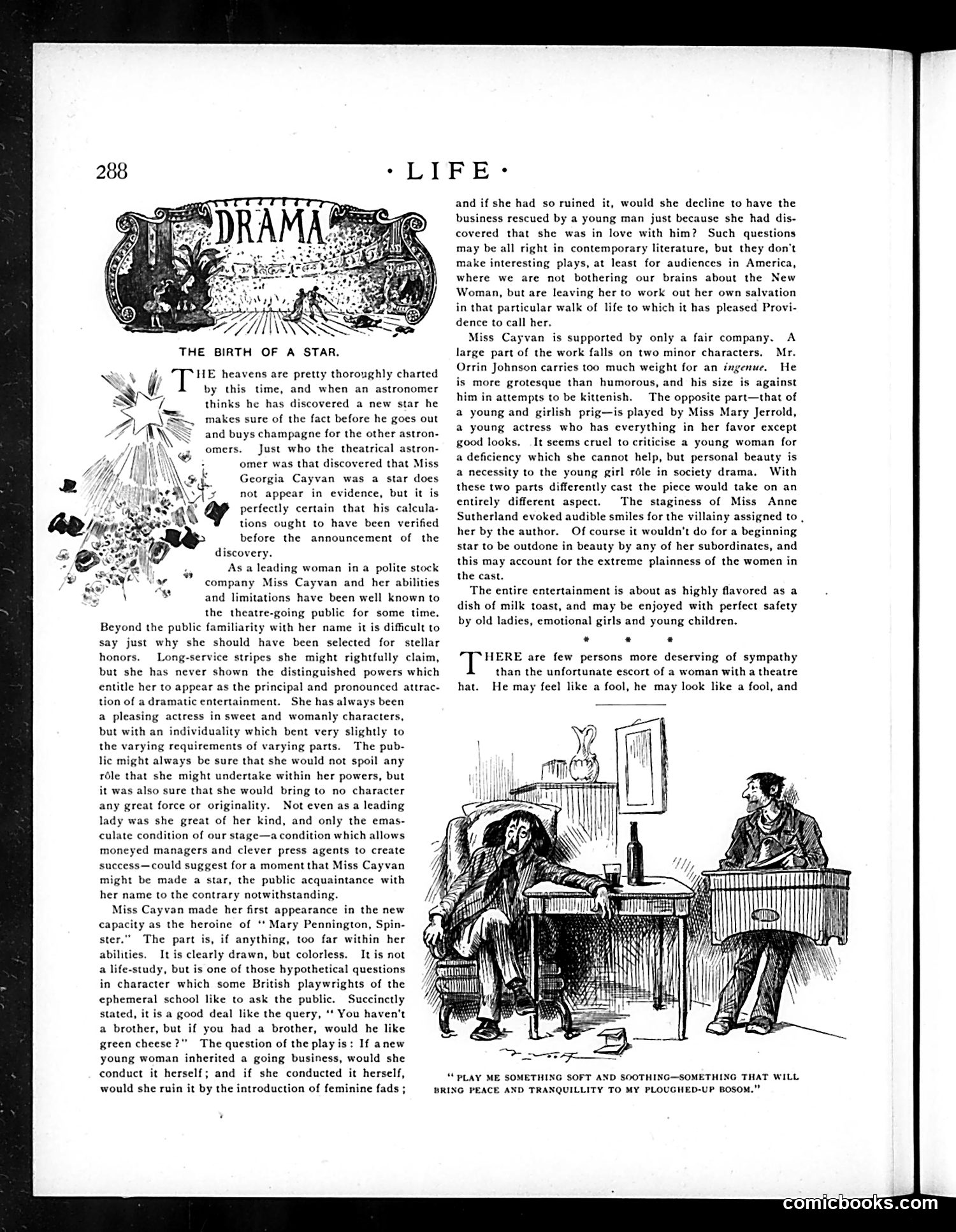
This page reviews a theatrical production starring Georgia Cayvan. The main cartoon depicts a scene from the play "Mary Pennington, Spinster," showing a woman in a theatre hat confronting a man at his desk—likely illustrating a plot point where she seeks his assistance. The text critiques the production harshly. It argues the play itself is thin entertainment ("milk toast"), suitable mainly for "old ladies, emotional girls and young children." The review suggests Cayvan succeeds despite weak material, though her co-star Orrin Johnson is criticized as "grotesque" and overweight for his romantic role. The caption's complaint about needing "soothing" entertainment reflects period attitudes toward drama's purpose for female audiences.
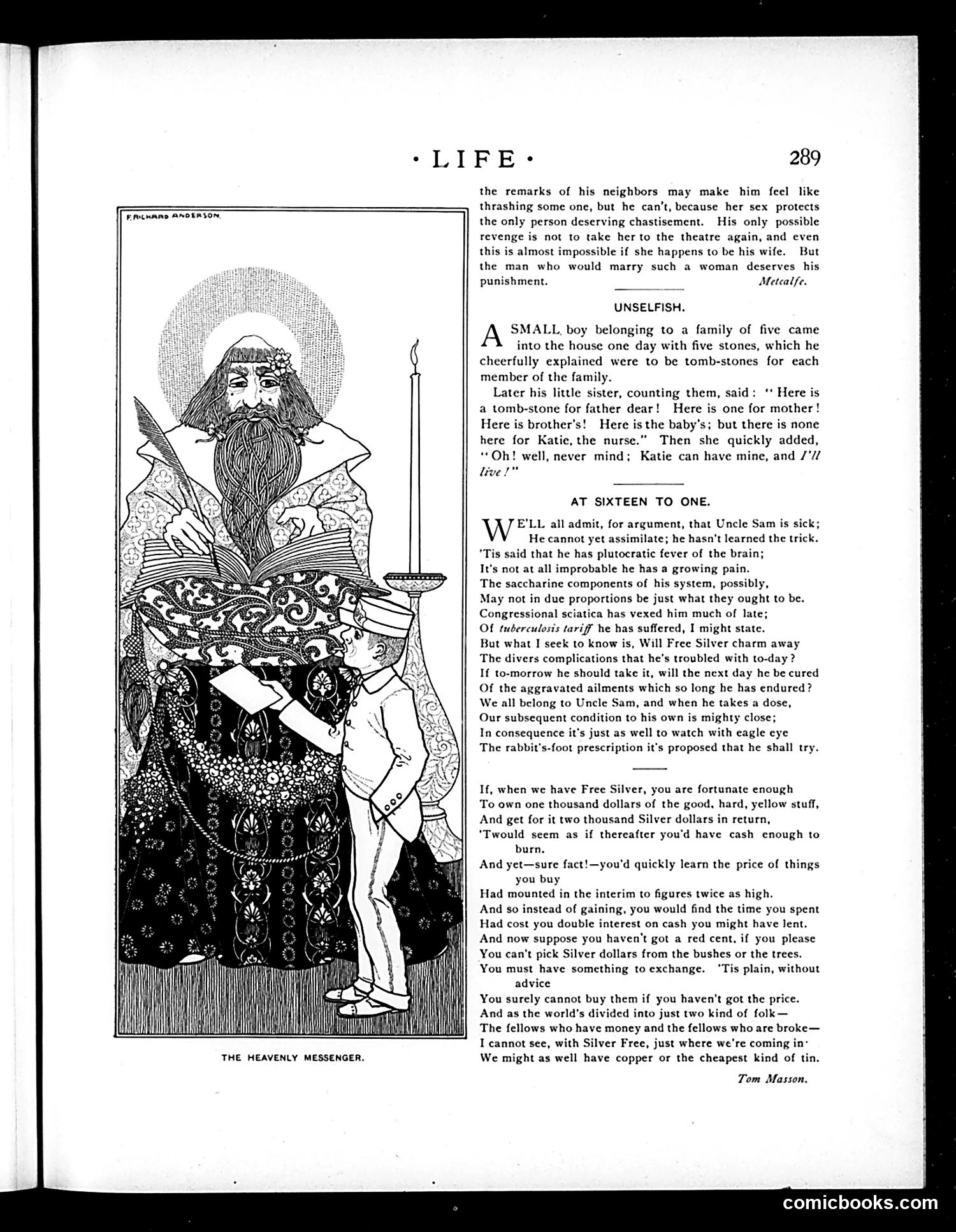
The illustration depicts a bearded, saint-like figure with a halo, labeled "The Heavenly Messenger." Based on the adjacent text column titled "AT SIXTEEN TO ONE," this appears to be political satire about monetary policy during America's free silver debate (late 1890s). The figure likely represents either Free Silver advocates or a specific political leader promoting the 16-to-1 silver-to-gold ratio. The "heavenly messenger" framing is ironic—suggesting supporters viewed this as salvation, while the satirist mocks it as false religious promise. The accompanying poem by Tom Mason criticizes Free Silver economics, arguing it would cause inflation and financial chaos. The satire conflates monetary policy with religious fanaticism, suggesting Free Silver believers had unrealistic, almost cultish faith in the policy's benefits.
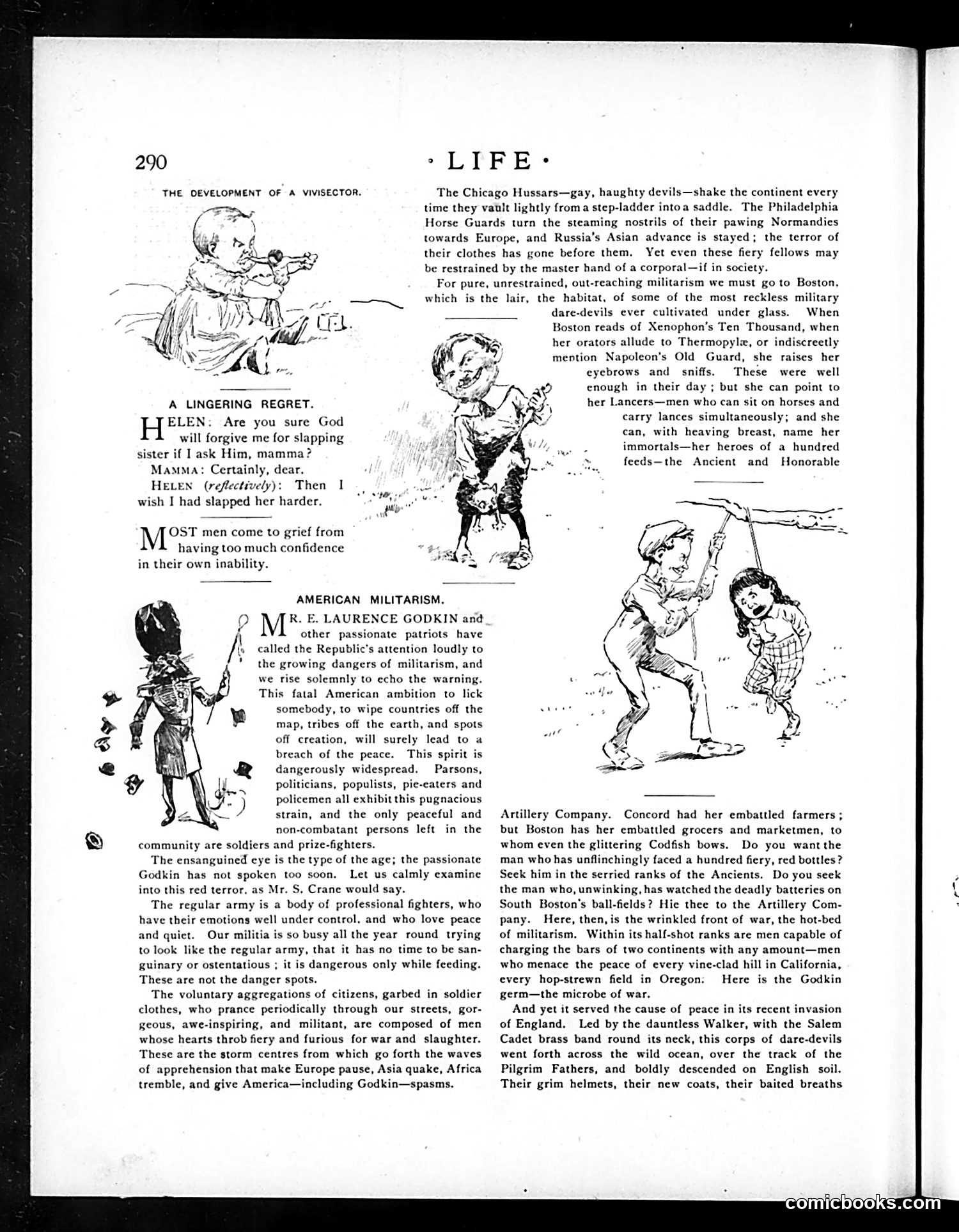
This page satirizes American militarism, specifically targeting Boston's volunteer militia organizations like the Ancient and Honorable Artillery Company. The main essay mocks E. R. Laurence Godkin's warnings about militarism as overwrought, arguing that the real danger lies not in professional soldiers or regular militia, but in civilian volunteer military groups who parade through streets in uniform. The satire's central irony: these Boston volunteers—described as grocers and marketmen—are presented as the continent's most dangerous warmongers, despite their mundane civilian occupations. References to Xenophon, Thermopylae, and Napoleon elevate their pretensions absurdly. The cartoons above show childhood development into a militaristic adult ("vivisector"), and a domestic scene of sibling violence, illustrating broader themes of aggression and lack of restraint in American society. The piece uses exaggerated praise of Boston's militia as deadpan satire, suggesting that American martial enthusiasm is both widespread and dangerously irrational.
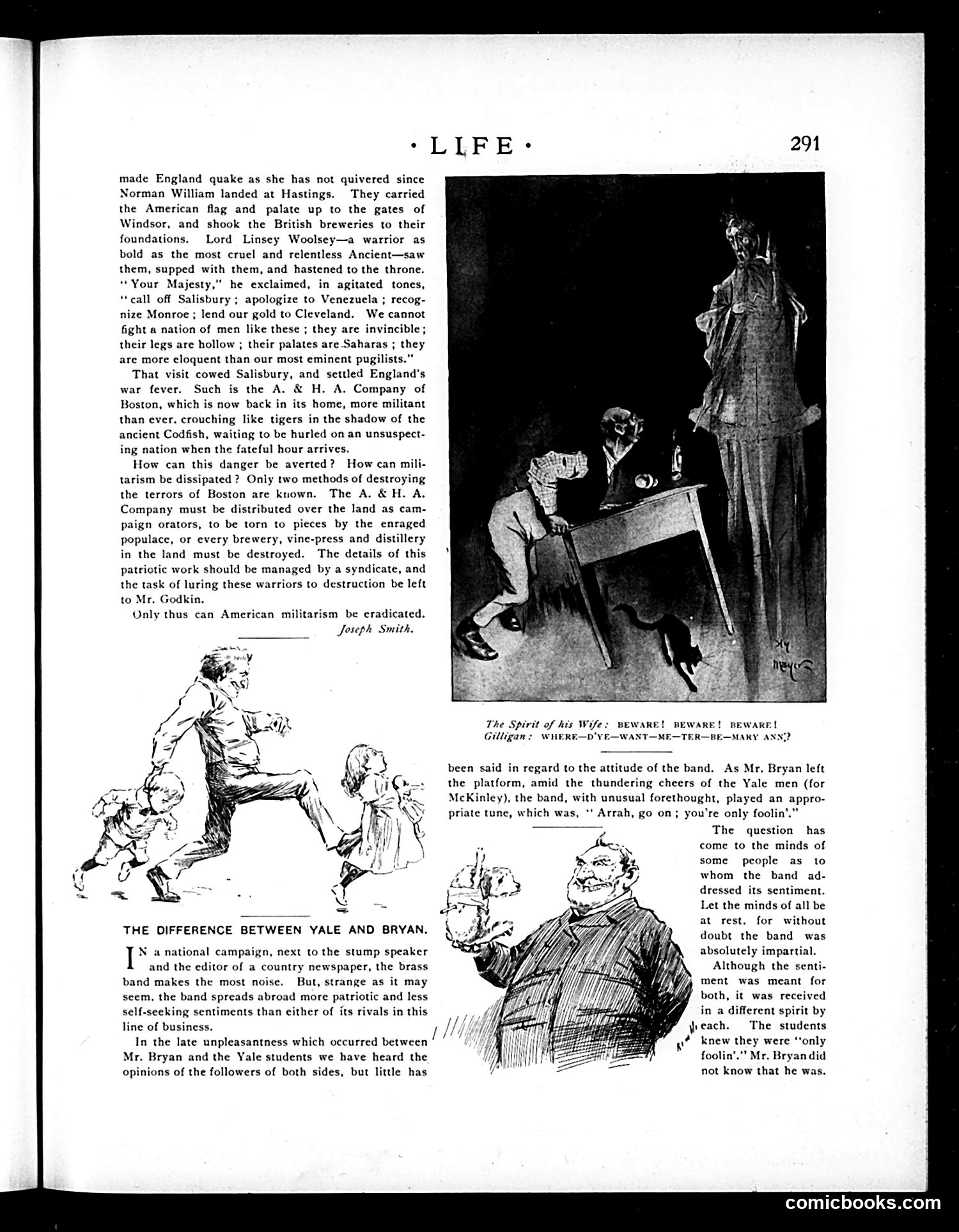
This page satirizes American militarism and the 1896 presidential campaign. The main text mocks the A. & H. A. Company (a Boston brass band), describing their visit to England in hyperbolic terms—claiming they so intimidated British leadership that Lord Salisbury abandoned war threats. The author (Joseph Smith) ironically proposes destroying militarism by either scattering the band as campaign speakers or demolishing all breweries and distilleries. The lower section contrasts Yale students' reception of William Jennings Bryan (the Democratic candidate) with their brass band's commentary. When Bryan spoke to a McKinley-supporting Yale audience, the band played "Arrah, go on; you're only foolin'"—a tune meant to mock both sides. The satire suggests the students understood the joke at Bryan's expense, while Bryan himself did not recognize he was being ridiculed. The cartoons visually support these themes of public spectacle and political theater.
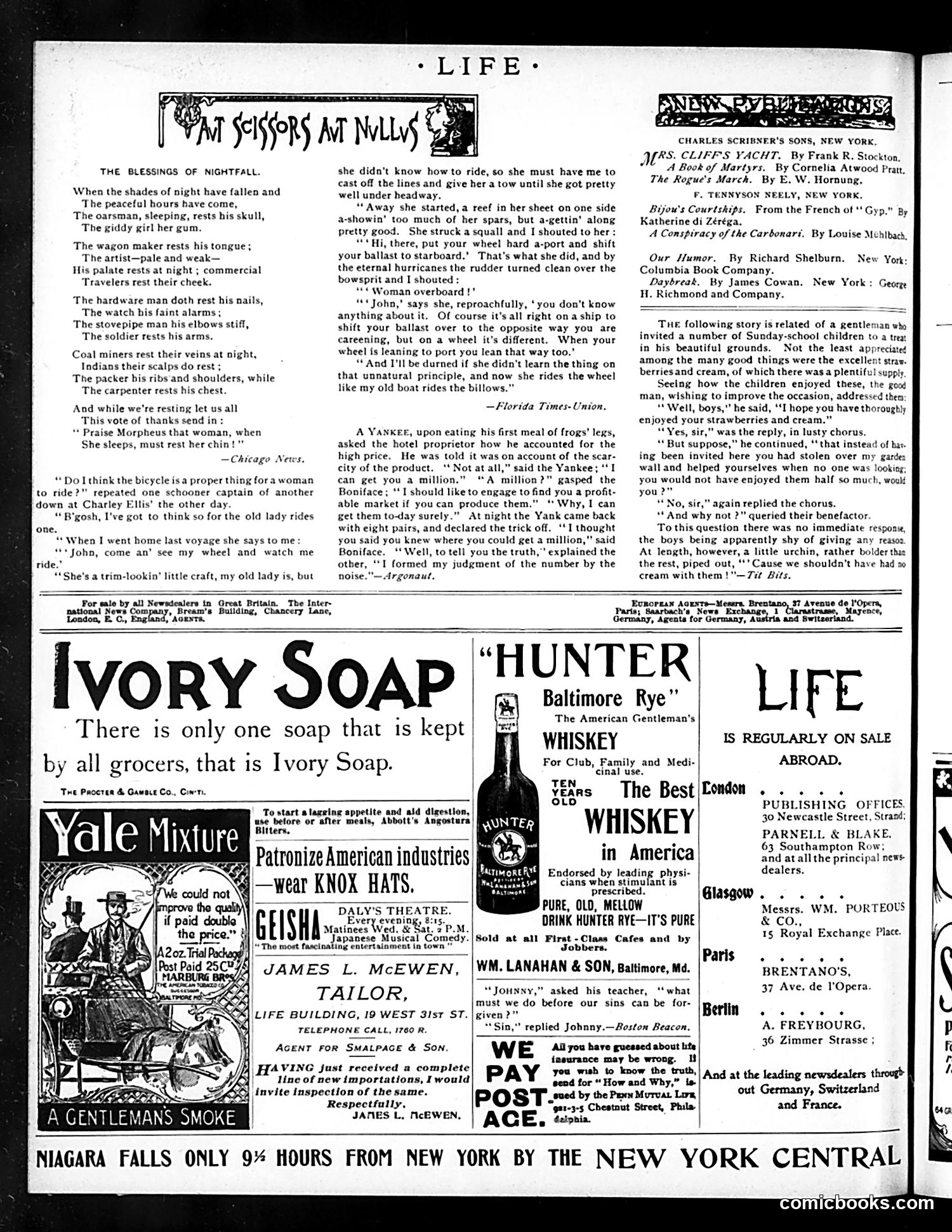
This page is primarily **advertising and light humor** rather than political satire. The main content includes: 1. **"The Blessings of Nightfall"** — A humorous poem listing various workers who rest at night (coal miners, soldiers, carpenters, etc.), ending with a joke about women resting their chins while sleeping. 2. **Three anecdotes about miscommunication**: A ship captain's wife learning to "ride a wheel" using nautical principles; a Yankee estimating frog legs availability by noise rather than actual supply; and a schoolmaster's moral lesson to children about strawberries. The satire is gentle and domestic—poking fun at gender differences, regional American types (the Yankee), and self-important moralizing. There's no identifiable political reference or caricature of specific figures. The page is dominated by **period advertisements** (Ivory Soap, Yale Mixture tobacco, Hunter Whiskey, Knox Hats) typical of early 1900s magazines, positioned around the editorial content.
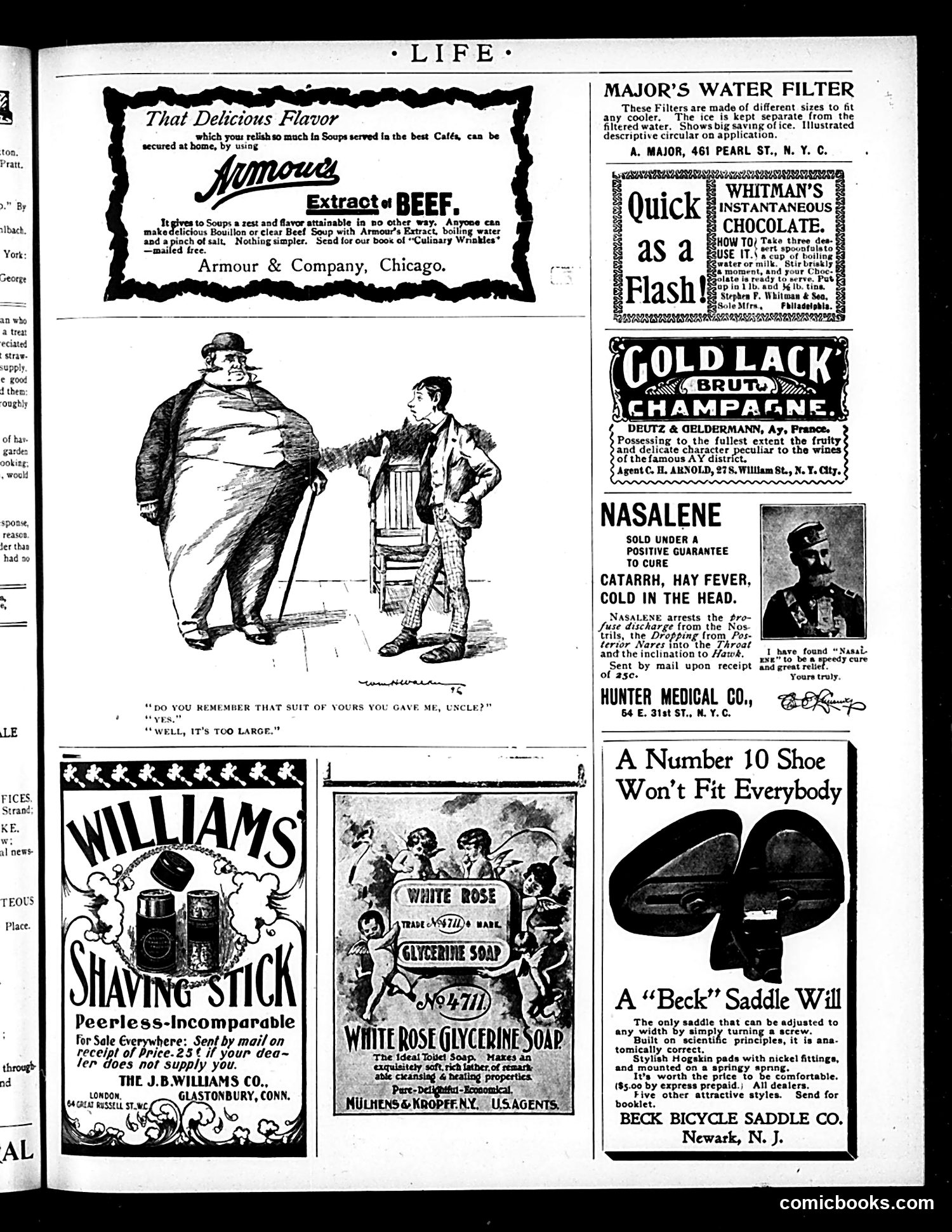
This page is primarily **advertising**, not political satire. It showcases consumer products from the early 1900s with one small cartoon. The sole cartoon depicts two men—a large, heavyset figure and a smaller one—with the caption "Do you remember that suit of yours you gave me, uncle?" / "Well, it's too large." This appears to be a **class-based humor** joke about hand-me-downs: the implication is that a cast-off suit from a wealthy uncle has become too large for the poor recipient, suggesting either he's gained weight from improved circumstances, or he's deliberately overstated the suit's fit to seem more prosperous. The surrounding ads reflect period concerns: water filters (sanitation), hay fever cures (Nasalene), beef extract (nutrition), and soap. These products address genuine health anxieties of the era before modern medicine and sanitation became standard. **The cartoon's humor trades on class differences and the dignity issues surrounding charity clothing**—a recognizable social dynamic of the time.
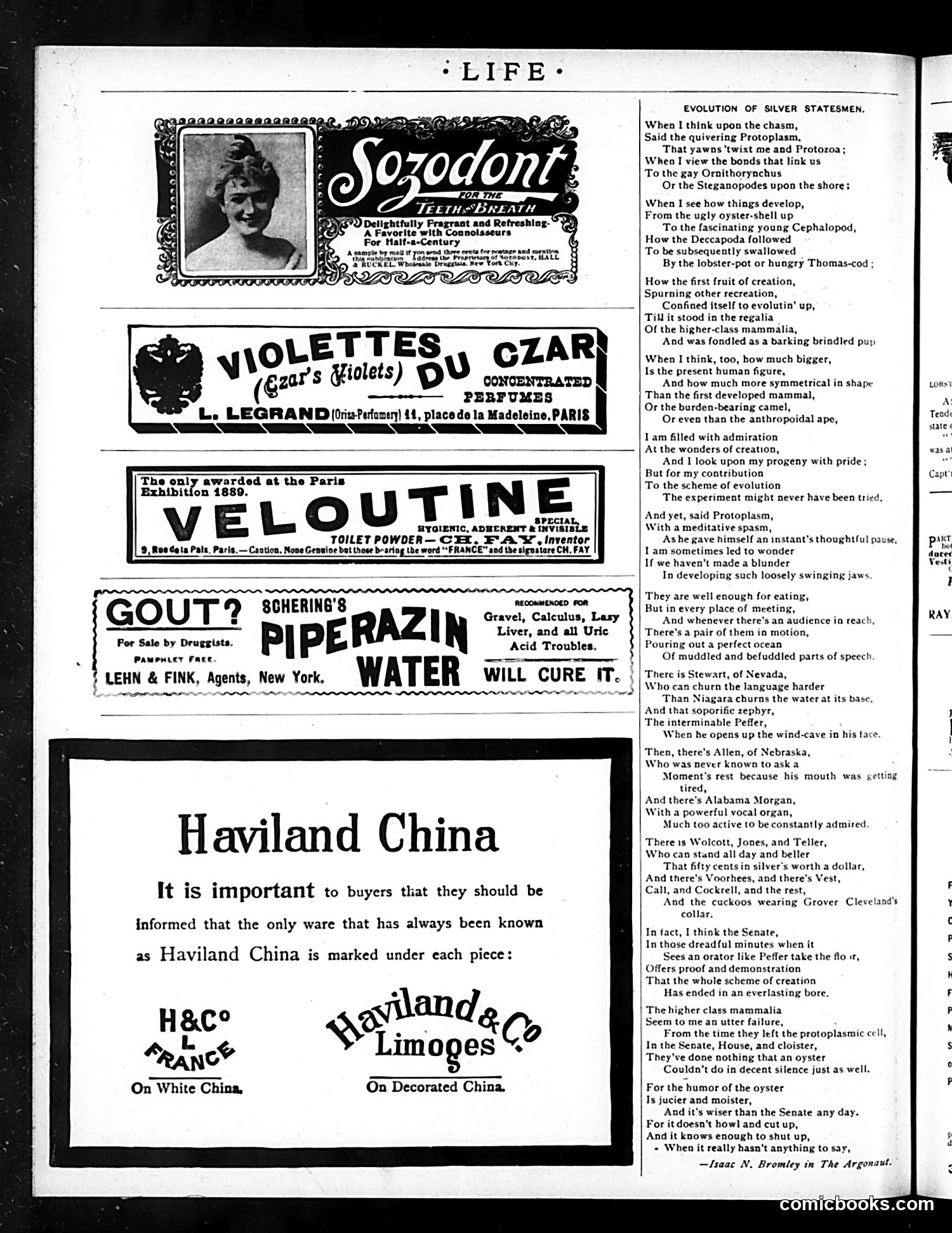
This page is primarily a satirical poem mocking U.S. senators of the era (appears to be 1890s based on references). The poem uses Darwin's theory of evolution as a framework to argue that politicians represent a *devolution* rather than progress. The satire targets specific senators by name—Stewart of Nevada, Peffer (likely Kansas), Allen of Nebraska, Morgan of Alabama, Wolcott, Jones, Teller, Voorhees, and others—characterizing them as gabbling, incompetent speakers obsessed with the "free silver" debate (silver currency advocates are mocked for claiming "fifty cents in silver's worth a dollar"). The poem's central joke: evolution has produced humans with "loosely swinging jaws" that won't stop talking, whereas oysters—primitive creatures—wisely remain silent. The senators are thus positioned as evolutionary failures, their constant speechifying proof that higher development hasn't improved humanity. The surrounding advertisements (for Sozodont toothpaste, perfumes, and patent medicines) are incidental commercial content typical of the era.
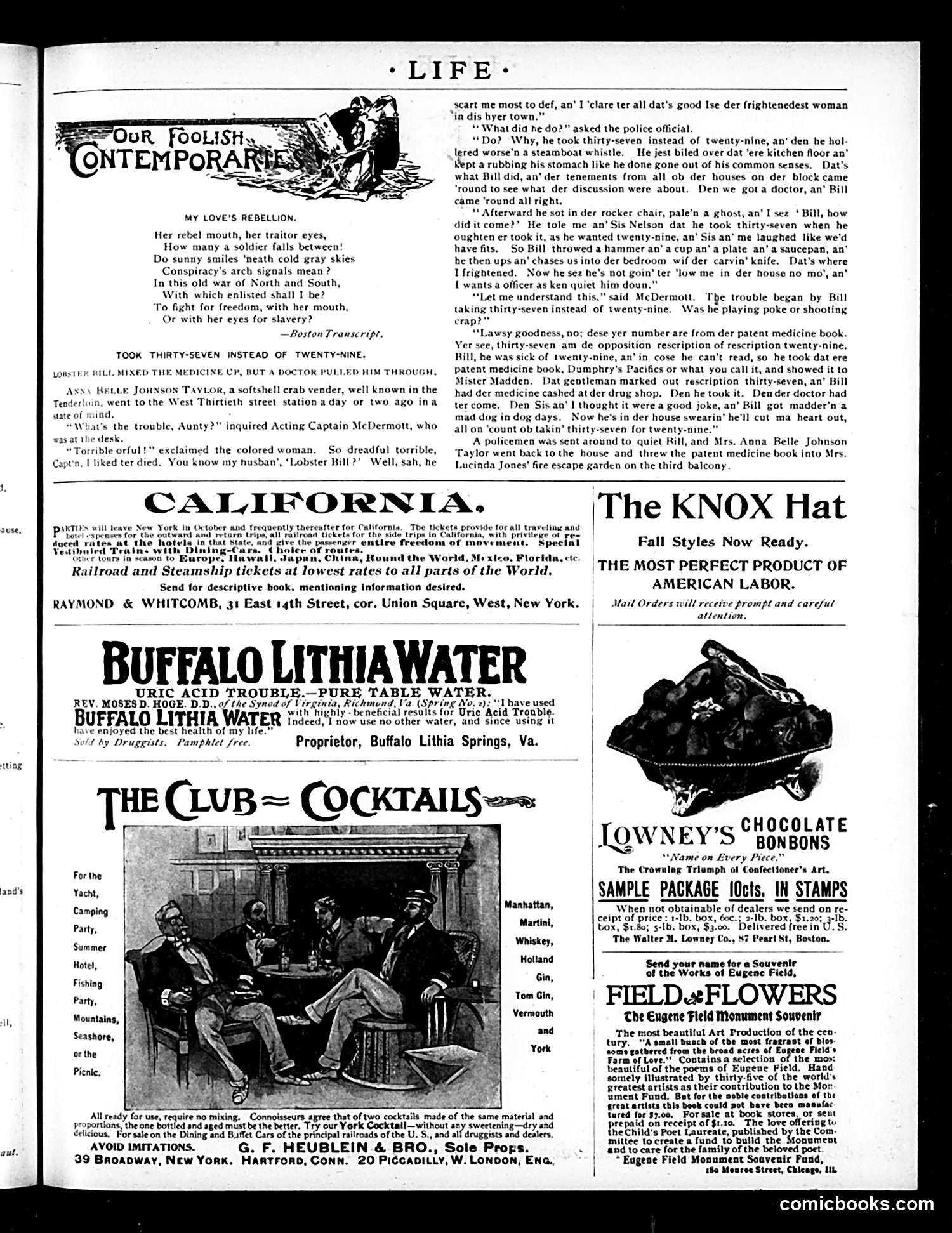
This page contains a humorous story-cartoon rather than a visual political cartoon. The piece satirizes patent medicine culture and poor literacy in early 20th-century America. **The Setup:** "Lobster Bill," a man of limited reading ability, confuses patent medicine dosages. Seeking remedy #29, he accidentally takes dose #37 from a patent medicine book (likely "Dumphry's Pacifics"), causing violent illness and subsequent rage. **The Satire:** The story mocks: 1. **Patent medicine fraud** — the proliferation of dubious remedies with numbered prescriptions 2. **Illiteracy** — Bill cannot read labels independently, relying on others to identify medications 3. **Class/race stereotypes** — the dialect-heavy dialogue of working-class African American characters was standard period humor **The Point:** The exaggerated consequences (Bill attacking his wife with a knife over medicine confusion) highlight how dangerous unregulated patent medicines were when combined with poor consumer literacy—a genuine public health concern of the era, presented as comedy.
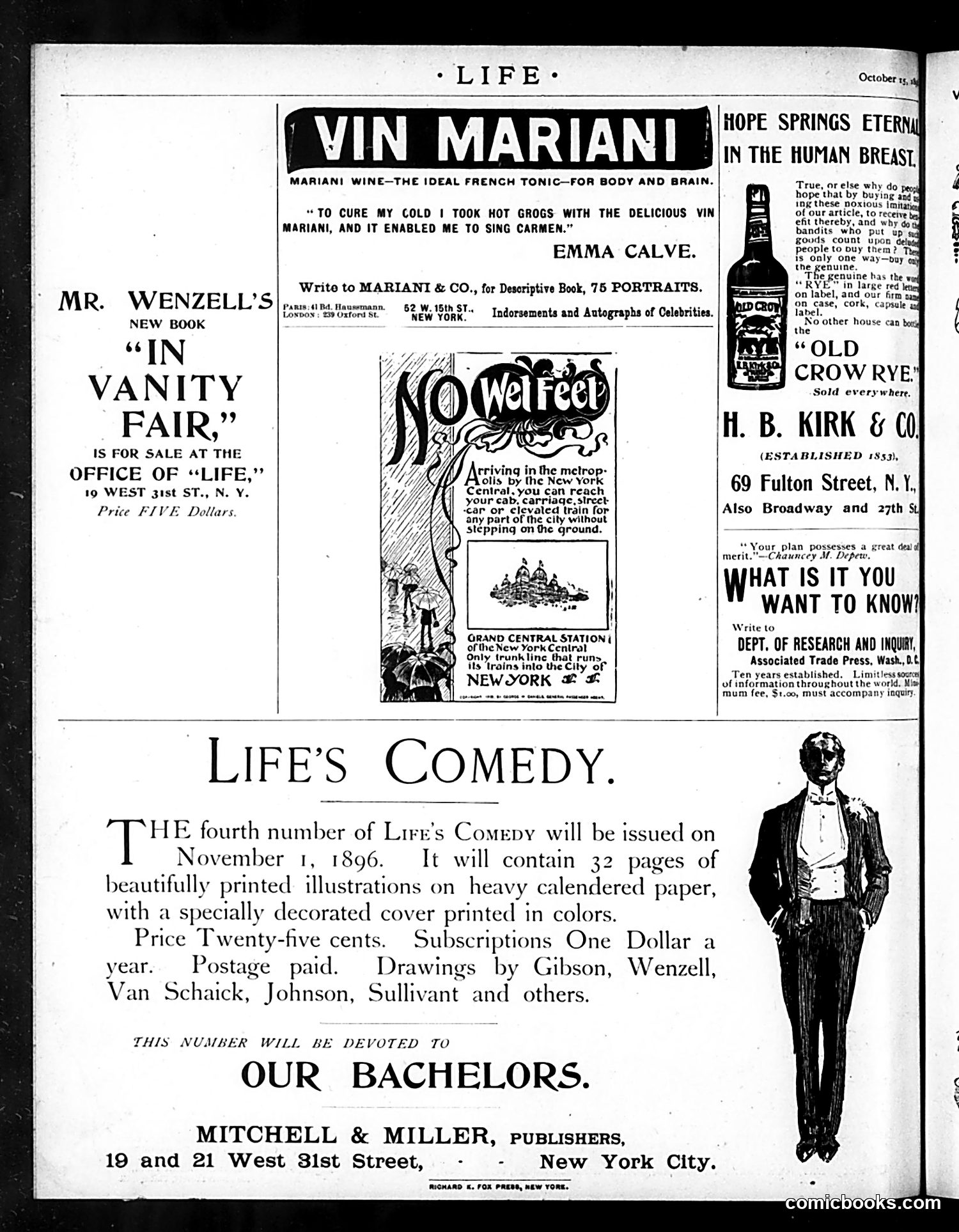
This is primarily an **advertising and announcement page** rather than satirical content. The page promotes: 1. **Vin Mariani wine** — a French "tonic" claiming medicinal benefits. The quote from opera singer Emma Calvé endorsing it for colds is a celebrity testimonial, a common advertising tactic of the era. 2. **Mr. Wenzell's book "In Vanity Fair"** — selling for five dollars through Life's office. 3. **No Wet Feet shoe advertisement** — promoting a New York Central railroad connection allowing travel without stepping on ground. 4. **Life's Comedy #4** — announcing the November 1, 1896 issue devoted to "Our Bachelors," illustrated by Gibson and others, priced at 25 cents. 5. **Various service advertisements** — including H.B. Kirk & Co. whiskey and a research inquiry department. The page reflects late-Victorian consumer culture: patent medicines marketed with dubious health claims, illustrated humor magazines as entertainment, and emerging transportation innovations.