
Life, 1896-10-15 · page 4 of 18
Life — October 15, 1896 — page 4: what you’re looking at
What you’re looking at
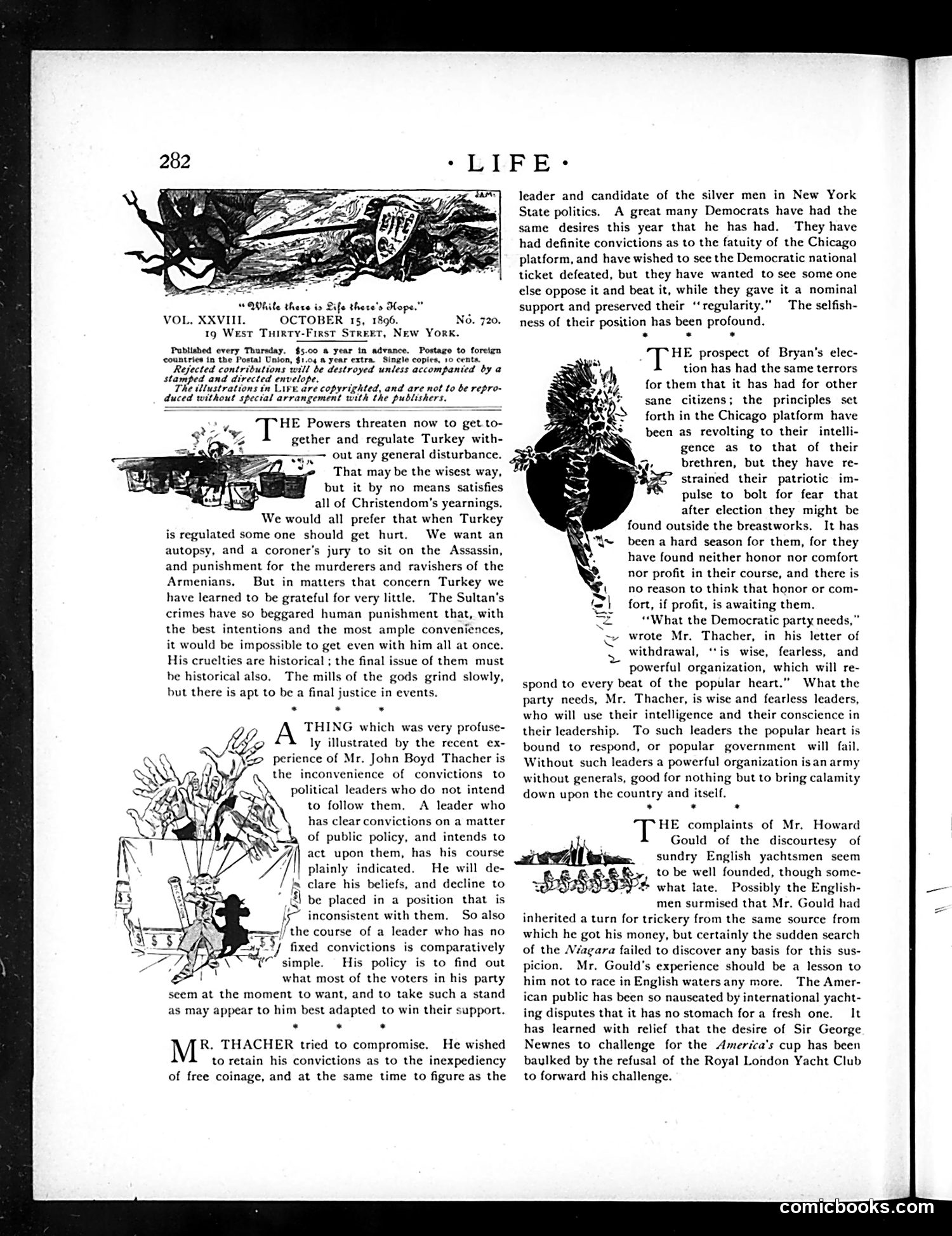
This page contains political commentary on the 1896 U.S. presidential election, specifically criticizing William Jennings Bryan's "free silver" campaign. The text discusses Bryan's threat to Democratic party unity and argues that the party needs "wise, fearless" leaders rather than Bryan's leadership. The cartoons illustrate the chaos Bryan's candidacy allegedly caused: one depicts tangled chaos (labeled "Where there is Life there's Hope"), and another shows a figure amid financial turmoil with dollar signs, suggesting economic anxiety about Bryan's monetary policies. The page also discusses the Armenian crisis and mentions a yachting dispute involving Mr. Howard Gould and English yachtsmen over the America's Cup challenge. The overall tone is satirical criticism of Bryan's radical platform from a more conservative perspective.
📄 Transcribed text from this page (OCR, searchable)
Machine-transcribed from the original scan — historical spelling and the odd misread are preserved.
> LI “White there is Life there's Hope.” VOL. XXVIII. OCTOBER 15, 1896. No. 720. 19 West THirty-First STREET, New York. Published every Thursday. $5.00 @ year in advance, Postage to foreign countries in the Postal Union, $1.04 a year extra. Single copies, 10 cents. Rejected contributions will be destroyed unless accompanied by a stamped and directed envelope. The illustrations in Live are copyrighted, and are not to be repro- duced without special arrangement with the publishers, HE Powers threaten now to get to- gether and regulate Turkey with- — out any general disturbance. That may be the wisest way, but it by no means satisfies all of Christendom’s yearnings. We would all prefer that when Turkey is regulated some one should get hurt. We want an autopsy, and a coroner's jury to sit on the Assassin, and punishment for the murderers and ravishers of the Armenians, But in matters t concern Turkey we have learned to be grateful for very little. The Sultan's crimes have so beggared human punishment that, with the best intentions and the most ample conveniences, it would be impossible to get even with him all at once. His cruelties are historical ; the final issue of them must he historical also, The mills of the gods grind slowly, but there is apt to be a final justice in events. Ni Wee gs THING which was very profuse- ly illustrated by the recent ex- perience of Mr. John Boyd Thacher is the incon nce of convictions to political leaders who do not intend to follow them. A leader who has clear convictions on a matter of public policy, and intends to act upon them, has his course plainly indicated. He will de- clare his beliefs, and decline to ‘! be placed in a position that is inconsistent with them. So also —==-|/ the course of a leader who has no g®3/ fixed convictions is comparatively ~ simple. His policy is to find out what most of the voters in his party seem at the moment to want, and to take sucha stand as may appear to him best adapted to win their support. * . . R. THACHER tried to compromise. He wished to retain his convictions as to the inexpediency of free coinage, and at the same time to figure as the FE: leader and candidate of the silver men in New York State politics. A great many Democrats have had the same desires this year that he has had. They have had definite convictions as to the fatuity of the Chicago platform, and have wished to sce the Democratic national ticket defeated, but they have wanted to see some one else oppose it and beat it, while they gave it a nominal support and preserved their “regularity.” The selfish- ness of their position has been profound. . . . HE prospect of Bryan's elec- tion has had the same terrors for them that it has had for other sane citizens; the principles sect forth in the Chicago platform have as revolting to their intelli- gence as to that of their brethren, but they have re- strained their patriotic im- pulse to bolt for fear that after election they might be found outside the breastworks, It has been a hard season for them, for they have found neither honor nor comfort nor profit in their course, and there is no reason to think that honor or com- fort, if profit, is awaiting them. “What the Democratic party needs,” wrote Mr. Thacher, in his letter of withdrawal, ‘‘is wise, fearless, and powerful organization, which will re- spond to every beat of the popular heart.” What the party needs, Mr. Thacher, is wise and fearless leaders, who will use their intelligence and their conscience in their leadership. To such leaders the popular heart is bound to respond, or popular government will fail. Without such leaders a powerful organization isan army without generals, good for nothing but to bring calamity down upon the country and itself. . HE complaints of Mr. Howard Gould of the discourtesy of sundry English yachtsmen seem to be well founded, though some- : ‘ Ec SSSR what late. Possibly the English- men surmised that Mr. Gould had inherited a turn for trickery from the same source from which he got his money, but certainly the sudden search of the Véagara failed to discover any basis for this sus- picion. Mr. Gould’s experience should be a lesson to him not to race in English waters any more. The Amer- ican public has been so nauseated by international yacht- ing disputes that it has no stomach fora fresh one. It has learned with relief that the desire of Sir George Newnes to challenge for the America’s cup has been baulked by the refusal of the Royal London Yacht Club to forward his challenge. comicbooks.com