
Life, 1896-10-15 · page 12 of 18
Life — October 15, 1896 — page 12: what you’re looking at
What you’re looking at
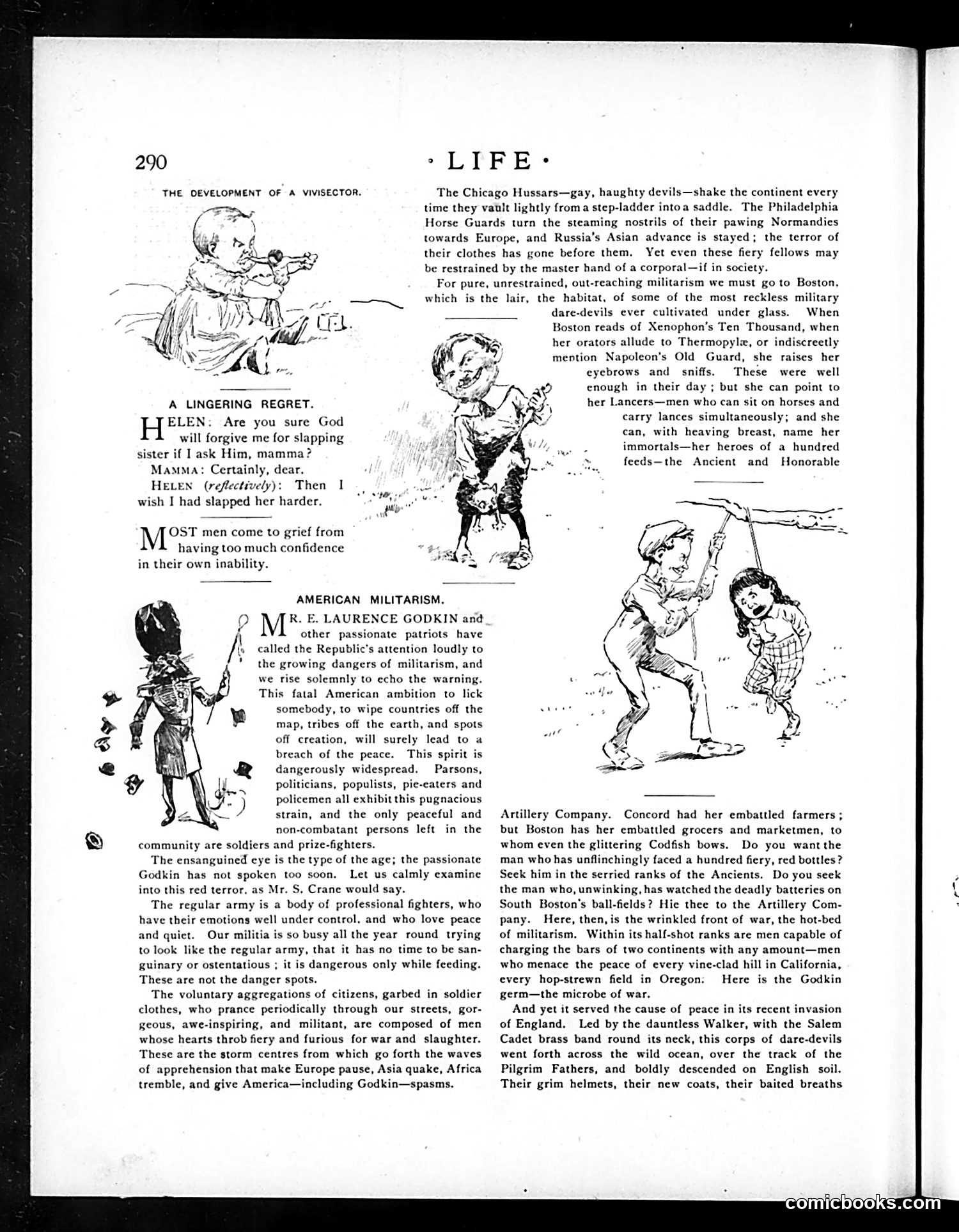
This page satirizes American militarism, specifically targeting Boston's volunteer militia organizations like the Ancient and Honorable Artillery Company. The main essay mocks E. R. Laurence Godkin's warnings about militarism as overwrought, arguing that the real danger lies not in professional soldiers or regular militia, but in civilian volunteer military groups who parade through streets in uniform. The satire's central irony: these Boston volunteers—described as grocers and marketmen—are presented as the continent's most dangerous warmongers, despite their mundane civilian occupations. References to Xenophon, Thermopylae, and Napoleon elevate their pretensions absurdly. The cartoons above show childhood development into a militaristic adult ("vivisector"), and a domestic scene of sibling violence, illustrating broader themes of aggression and lack of restraint in American society. The piece uses exaggerated praise of Boston's militia as deadpan satire, suggesting that American martial enthusiasm is both widespread and dangerously irrational.
📄 Transcribed text from this page (OCR, searchable)
Machine-transcribed from the original scan — historical spelling and the odd misread are preserved.
290 THE DEVELOPMENT OF A VIVISECTOR. > LIFE: The Chicago Hussars—gay, haughty devils—shake the continent every time they vault lightly froma step-ladder intoa saddle. The Philadelphia Horse Guards turn the steaming nostrils of their pawing Normandies towards Europe, and Russia's Asian advance is stayed; the terror of their clothes has gone before them. Yet even these fiery fellows may be restrained by the master hand of a corporal—if in society. For pure, unrestrained, out-reaching militarism we must go to Boston, which is the lair, the habitat, of some of the most reckless military A LINGERING REGRET. ELEN: Are you sure God will forgive me for slapping sister if l ask Him, mamma? Mamma: Certainly, dear. HELEN (reflectively): Then 1 wish I had slapped her harder. OST men come to grief from having too much confidence in their own inability. AMERICAN MILITARISM. R. E, LAURENCE GODKIN and other passionate patriots have called the Republic's attention loudly to the growing dangers of militarism, and we rise solemnly to echo the warning. This fatal American ambition to lick somebody, to wipe countries off the map, tribes off the earth, and spots off creation, will surely lead to a breach of the peace. This spirit is dangerously widespread. Parsons, politicians, populists, pie-eaters and policemen all exhibit this pugnacious strain, and the only peaceful and non-combatant persons left in the community are soldiers and prize-fighters. The ensanguined eye is the type of the age; the passionate Godkin has not spoken too soon, Let us calmly examine into this red terror, as Mr. S, Crane would say. The regular army is a body of professional fighters, who have their emotions well under control, and who love peace and quiet. Our militia is so busy all the year round trying to look like the regular army, that it has no time to be san- guinary or ostentatious ; it is dangerous only while feeding. These are not the danger spots. The voluntary aggregations of citizens, garbed in soldier clothes, who prance periodically through our streets, gor- geous, awe-inspiring, and militant, are composed of men whose hearts throb fiery and furious for war and slaughter. These are the storm centres from which go forth the waves of apprehension that make Europe pause, Asia quake, Africa tremble, and give America—including Godkin—spasms. dare-devils ever cultivated under glass. When Boston reads of Xenophon’s Ten Thousand, when her orators allude to Thermopyle, or indiscreetly meption Napoleon's Old Guard, she raises her eyebrows and sniffs. These were well enough in their day ; but she can point to her Lancers—men who can sit on horses and carry lances simultaneously; and she can, with heaving breast, name her immortals—her heroes of a hundred feeds—the Ancient and Honorable Artillery Company. Concord had her embattled farmers ; but Boston has her embattled grocers and marketmen, to whom even the glittering Codfish bows. Do you want the man who has unflinchingly faced a hundred fiery, red bottles? Seek him in the serried ranks of the Ancients. Do you seek the man who, unwinking, has watched the deadly batteries on South Boston's ball-fields? Hie thee to the Artillery Com- pany. Here, then, is the wrinkled front of war, the hot-bed of militarism. Within its half-shot ranks are men capable of charging the bars of two continents with any amount—men who menace the peace of every vine-clad hill in California, every hop-strewn field in Oregon. Here is the Godkin germ—the microbe of war. And yet it served the cause of peace in its recent invasion of England. Led by the dauntless Walker, with the Salem Cadet brass band round its neck, this corps of dare-devils went forth across the wild ocean, over the track of the Pilgrim Fathers, and boldly descended on English soil. Their grim helmets, their new coats, their baited breaths