
Life, 1896-10-15 · page 10 of 18
Life — October 15, 1896 — page 10: what you’re looking at
What you’re looking at
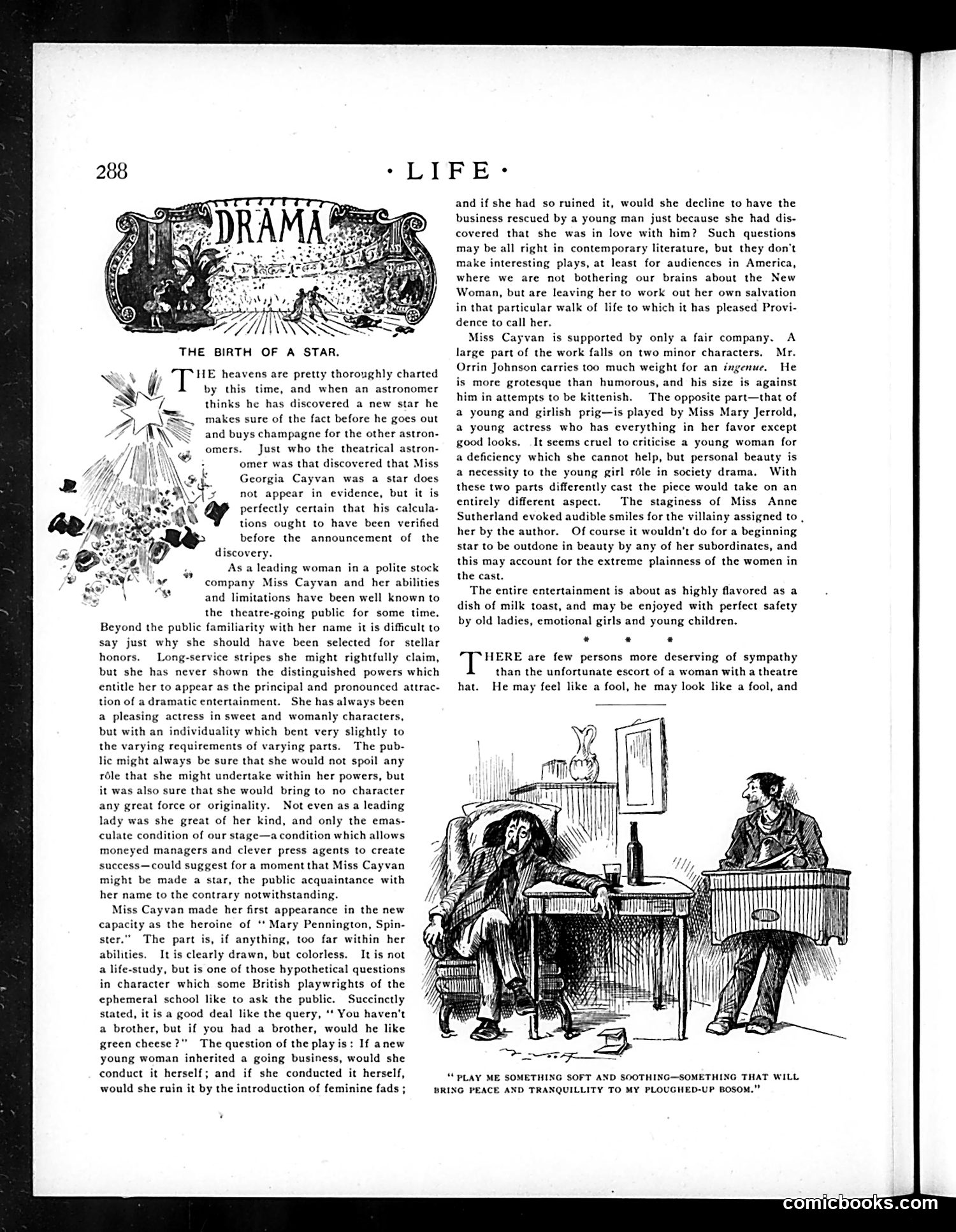
This page reviews a theatrical production starring Georgia Cayvan. The main cartoon depicts a scene from the play "Mary Pennington, Spinster," showing a woman in a theatre hat confronting a man at his desk—likely illustrating a plot point where she seeks his assistance. The text critiques the production harshly. It argues the play itself is thin entertainment ("milk toast"), suitable mainly for "old ladies, emotional girls and young children." The review suggests Cayvan succeeds despite weak material, though her co-star Orrin Johnson is criticized as "grotesque" and overweight for his romantic role. The caption's complaint about needing "soothing" entertainment reflects period attitudes toward drama's purpose for female audiences.
📄 Transcribed text from this page (OCR, searchable)
Machine-transcribed from the original scan — historical spelling and the odd misread are preserved.
> LI THE BIRTH OF A STAR. HE heavens are pretty thoroughly charted by this time, and when an astronomer thinks he has discovered a new star he makes sure of the fact before he goes out and buys champagne for the other astron- omers. Just who the theatrical astron- omer was that discovered that Miss Georgia Cayvan was a star does not appear in evidence, but it is perfectly certain that his calcula- tions ought to have been verified before the announcement of the Jing woman ina polite stock company Miss Cayvan and her abilities and limitations have been well known to the theatre-going public for some time. Beyond the public familiarity with her name it is difficult to say just why she should have been selected for stellar honors. Long-service stripes she might rightfully claim, but she has never shown the distinguished powers which entitle her to appear as the principal and pronounced attrac- tion of a dramatic entertainment. She has always been a pleasing actress in sweet and womanly characters, but with an individuality which bent very slightly to the varying requirements of varying parts. The pub- lic might always be sure that she would not spoil any role that she might undertake within her powers, but it was also sure that she would bring to no character any great force or originality. Not even as a leading lady was she great of her kind, and only the emas- culate condition of our stage—a condition which allows moneyed managers and clever press agents to create success—could suggest fora moment that Miss Cayvan might be made a star, the public acquaintance with her name to the contrary notwithstanding. Miss Cayvan made her first appearance in the new capacity as the heroine of ‘ Mary Pennington, Spin- ster.” The part is, if anything, too far within her abilities. It is clearly drawn, but colorless. It is not a life-study, but is one of those hypothetical questions in character which some British playwrights of the ephemeral school like to ask the public. Succinctly stated, it is a good deal like the query, ‘* You haven't a brother, but if you had a brother, would he like green cheese?” The question of the play is: If anew young woman inherited a going business, would she conduct it herself; and if she conducted it herself, would she ruin it by the introduction of feminine fads ; BRING PEACE AND TRANQUILLITY TO MY PLOUGHED: FE: and if she had so ruined it, would she decline to have the business rescued by a young man just because she had dis- covered that she was in love with him? Such questions may be all right in contemporary literature, but they don't make interesting plays, at least for audiences in America, where we are not bothering our brains about the New Woman, but are leaving her to work out her own salvation in that particular walk of life to which it has pleased Provi- dence to call her. Miss Cayvan is supported by only a fair company. A large part of the work falls on two minor characters. Mr. Orrin Johnson carries too much weight for an ingenue. He is more grotesque than humorous, and his size is against him in attempts to be kittenish. The opposite part—that of a young and girlish prig—is played by Miss Mary Jerrold, a young actress who has everything in her favor except good looks, It seems cruel to criticise a young woman for a deficiency which she cannot help, but personal beauty is a necessity to the young girl réle in society drama. With these two parts differently cast the piece would take on an entirely different aspect. The staginess of Miss Anne Sutherland evoked audible smiles for the villainy assigned to , her by the author. Of course it wouldn't do for a beginning star to be outdone in beauty by any of her subordinates, and this may account for the extreme plainness of the women in the cast. The entire entertainment is about as highly flavored as a dish of milk toast, and may be enjoyed with perfect safety by old ladies, emotional girls and young children. * * . HERE are few persons more deserving of sympathy than the unfortunate escort of a woman with a theatre hat. He may feel like a fool, he may look like a fool, and “ PLAY ME SOMETHING SOFT AND SOOTHING—SOMETHING THAT WILL UP BOSOM." comicbooks.com