
A complete issue · 18 pages · 1896
Life — October 8, 1896
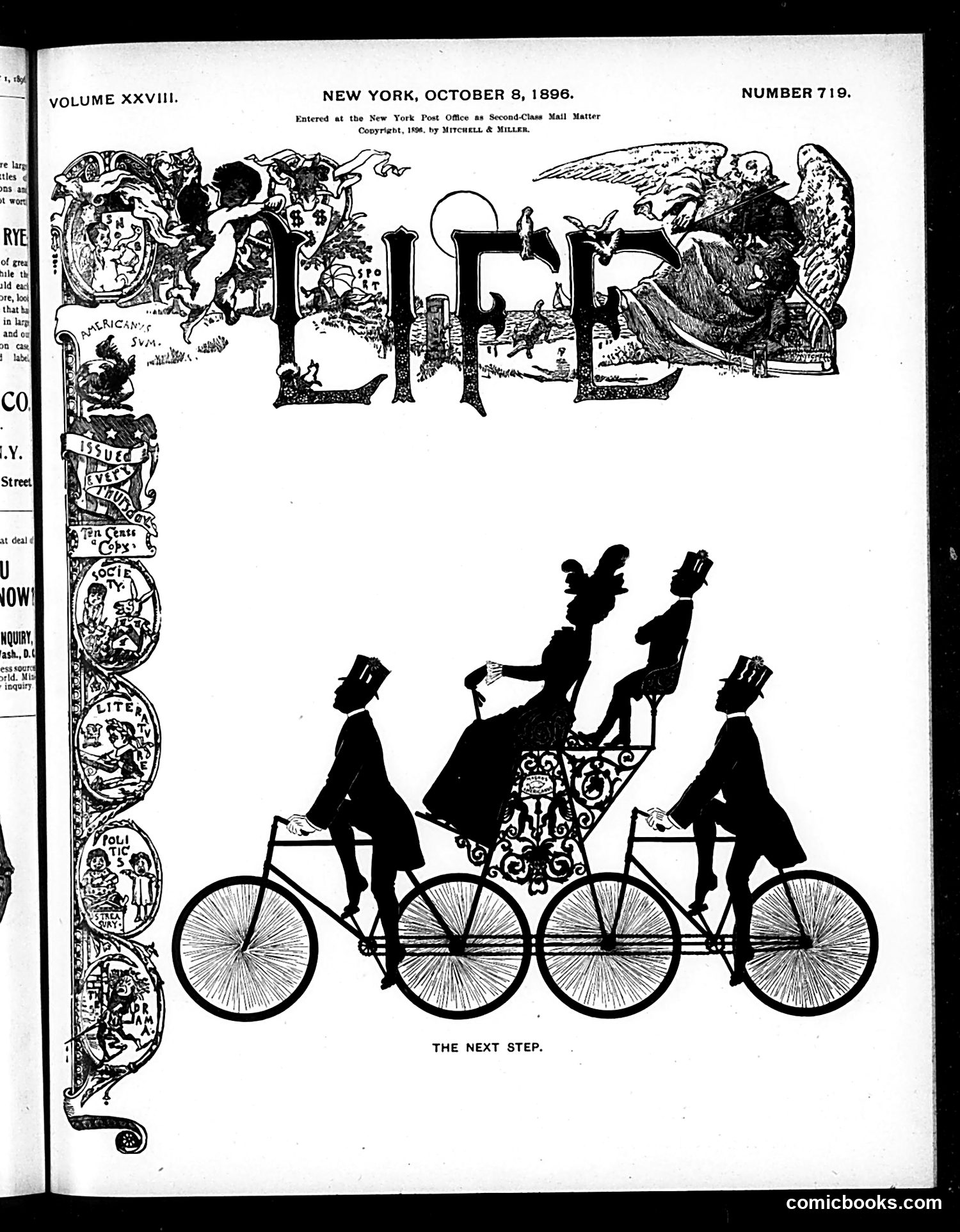
The cartoon titled "The Next Step" satirizes women's increasing social mobility and independence. It depicts three gentlemen in top hats riding bicycles while two women sit elevated on an ornate platform between them—suggesting women are being transported or elevated by male-powered machinery. The satire likely critiques anxieties about the "New Woman" of the 1890s. The bicycle was revolutionary technology that granted women unprecedented freedom and mobility. The caption "The Next Step" appears to mock predictions that women's liberation through bicycles would lead to further social upheaval or role reversals—here imagining women becoming passengers literally carried by men's efforts rather than achieving true independence. The elaborate decorative mastheads on the left are typical of Life's ornate design aesthetic.
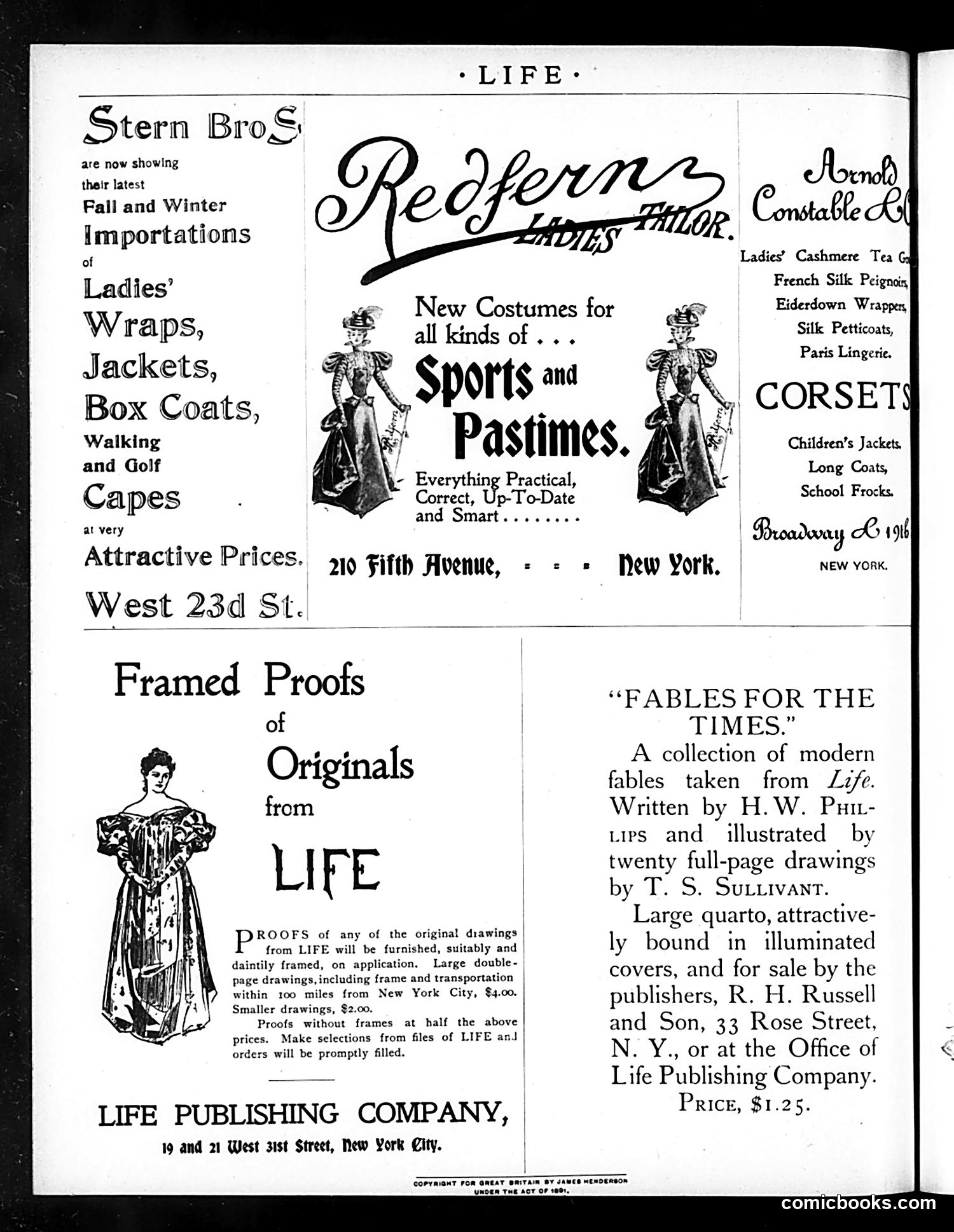
This page is primarily **advertising rather than editorial content**. It contains four separate ads: 1. **Stern Bros.** (West 23d St.) advertises fall/winter women's clothing imports 2. **Redfern, Ladies' Tailor** (Fifth Avenue) promotes "Sports and Pastimes" costumes 3. **Arnold Constable & Co.** lists corsets and children's clothing 4. **Life Publishing Company** advertises framed proofs of original drawings and promotes a book called "Fables for the Times" by H.W. Phillips, illustrated by T.S. Sullivant There are no political cartoons visible on this page—only decorative fashion illustrations typical of early 1900s magazine advertising. The "Fables" book promotion suggests Life also published satirical illustrated literature, but this particular page shows primarily commercial content rather than satire.
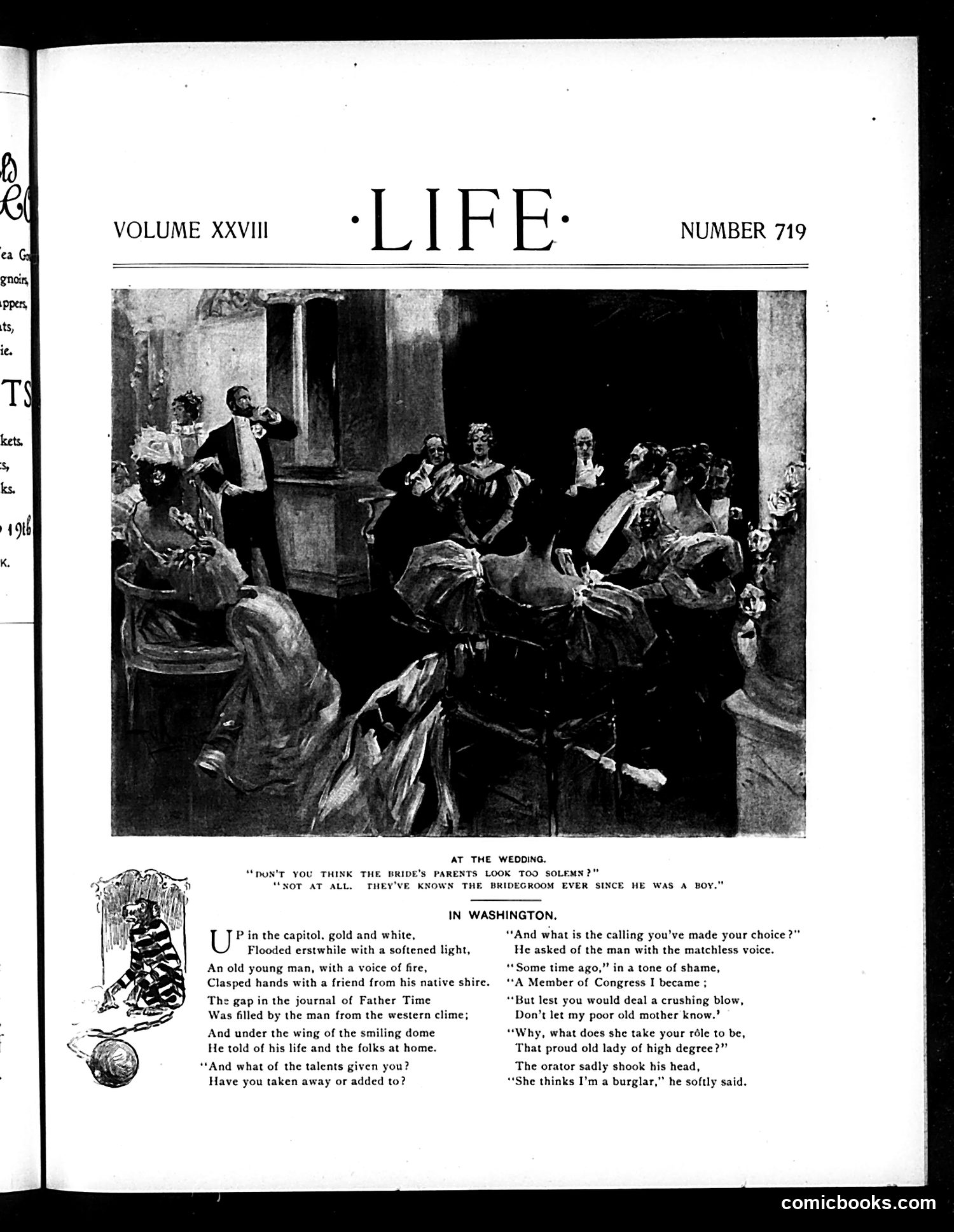
This page contains a satirical poem titled "In Washington" accompanied by an illustration labeled "At the Wedding." The cartoon depicts a formal wedding scene where guests appear concerned about the bride's parents looking "too solemn." The poem satirizes a congressman who became "a Member of Congress" and now faces his mother's disapproval of his career choice, with her calling him a "burglar." This appears to be social satire about political corruption—suggesting congressmen "burglarize" public funds or betray their constituents' trust through dishonest dealings. The humor relies on the disconnect between respectable appearances (weddings, congressional office) and the implied moral failings of politicians. It's early 20th-century commentary on governmental ethics and public distrust of elected officials.
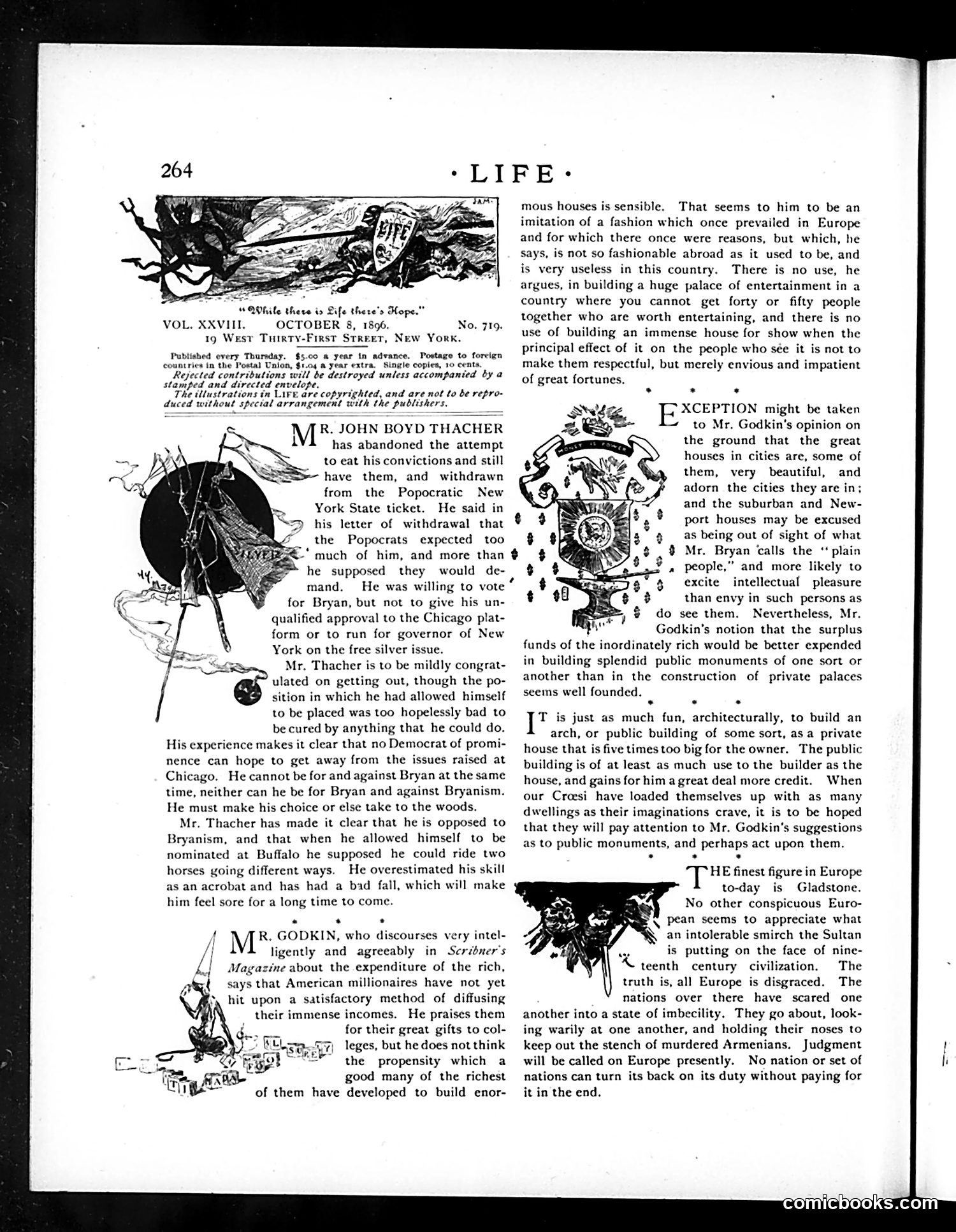
This page contains commentary on wealthy Americans' spending habits, specifically critiquing John Boyd Thacher's withdrawal from New York Democratic politics and discussing Mr. Godkin's views on how the rich display their wealth. The text satirizes American millionaires' tendency to build enormous private mansions rather than fund public monuments. Godkin argues that while Europeans appreciate grand public architecture, wealthy Americans waste resources constructing ostentatious private palaces that generate envy rather than respect. The final section references European political turmoil—specifically "the Sultan...putting on the face of nineteenth century civilization," appearing to critique Ottoman Empire policies (likely Armenian massacres of 1894-96). The passage suggests Europe itself is morally compromised and cannot judge others. The page uses text-based satire rather than prominent political cartoons to deliver its social criticism.
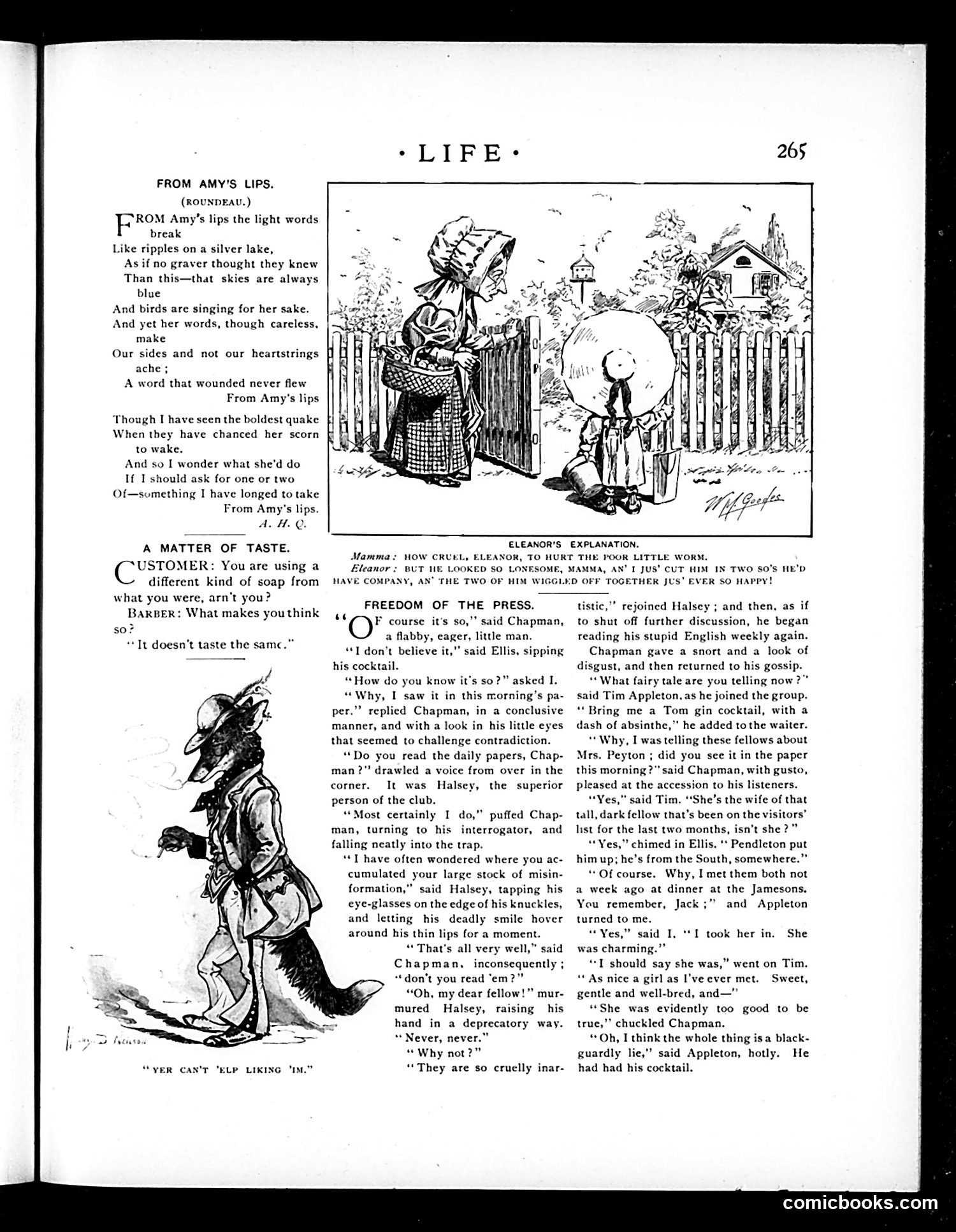
This page contains three distinct pieces of humor: 1. **"From Amy's Lips" (Roundeau)**: A sentimental poem about a child's innocent wisdom, paired with an illustration of a woman and child at a fence. The satire appears gentle—mocking the era's obsession with saccharine children's quotes in literature. 2. **"A Matter of Taste"**: A brief comic dialogue between a barber and customer about soap quality. The accompanying illustration shows a disheveled man. The humor is straightforward wordplay about taste preferences. 3. **"Freedom of the Press"**: A longer satirical piece featuring characters named Chapmal, Ellis, Halsey, and Appleton discussing whether a woman they know is "charming." The satire mocks casual gossip disguised as sophisticated club conversation and the unreliability of rumor-based opinions. All reflect early 20th-century upper-class social satire.
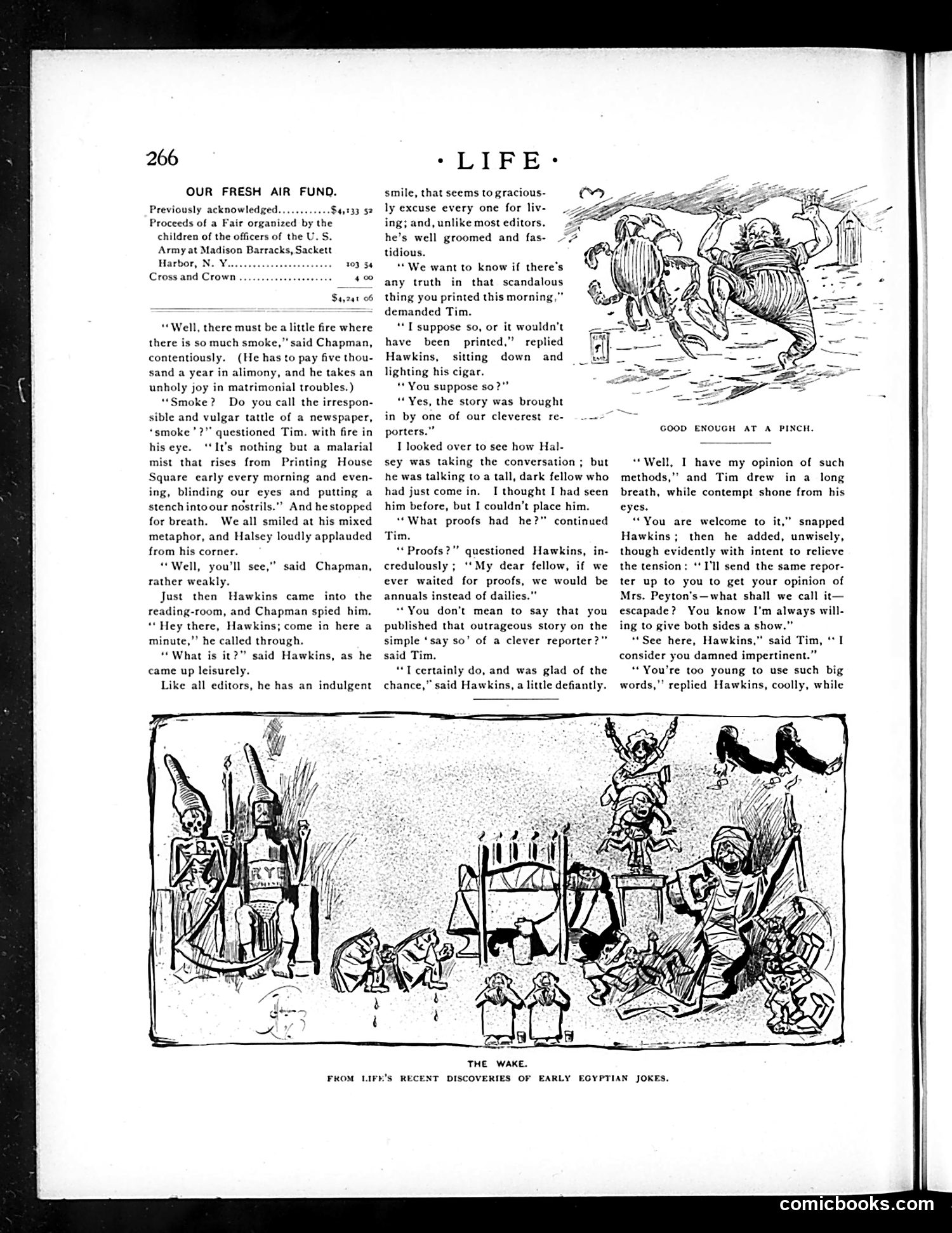
This page contains two distinct elements: **Upper section:** A conversational piece about newspaper journalism. Chapman and Hawkins debate whether newspapers print scandalous stories responsibly. Hawkins defends publishing an "outrageous story" as the work of "a clever reporter," while Chapman argues editors should exercise restraint. The dialogue satirizes tension between sensationalism and journalistic ethics—a perennial concern. **Lower cartoon:** Titled "The Wake: From Life's Recent Discoveries of Early Egyptian Jokes," this depicts an ancient Egyptian funeral scene with hieroglyphic-style figures. The caption's humor relies on the anachronistic suggestion that Egyptians told jokes about their own funeral practices, mocking both pseudo-scholarly antiquarianism and the magazine's own comedic pretensions. Both pieces critique media and intellectual practices of the era.
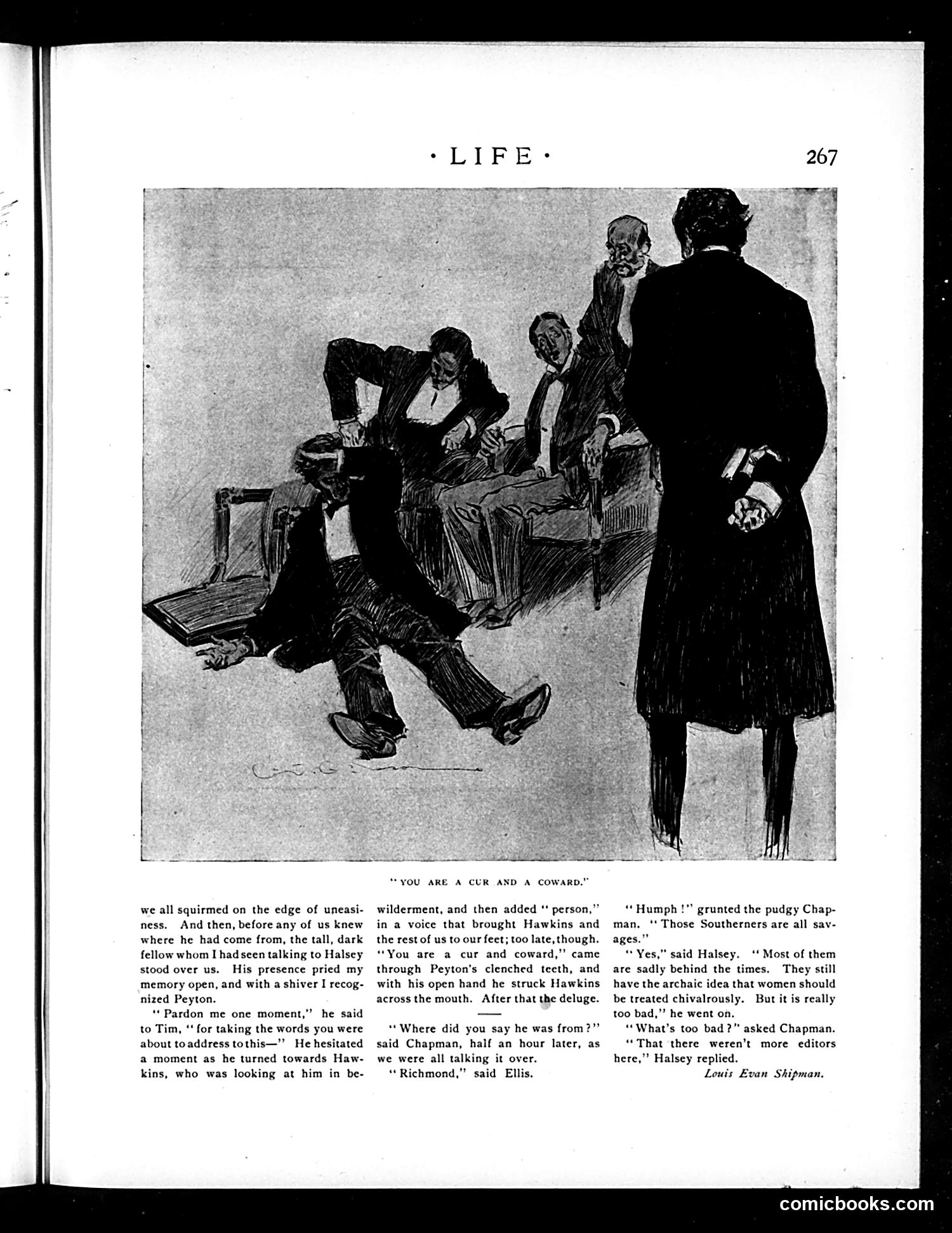
This page from *Life* magazine features a sketch titled "You Are a Cur and a Coward," depicting what appears to be a confrontation in an office or formal setting. A man on the floor has been knocked down, while several other men in suits stand around him—some appearing shocked or concerned. The accompanying text references a dispute between named characters (Peyton, Hawkins, Chapman, Halsey, Ellis, and Tim), with dialogue suggesting conflict over offensive remarks. One character struck another "across the mouth," and the text discusses whether the aggressor should apologize or face consequences. The cartoon appears to satirize masculine honor codes and violence in professional or editorial settings, likely commenting on the heated disputes common in journalism or publishing of that era. The specific historical context and identities of the figures remain unclear without additional documentation.
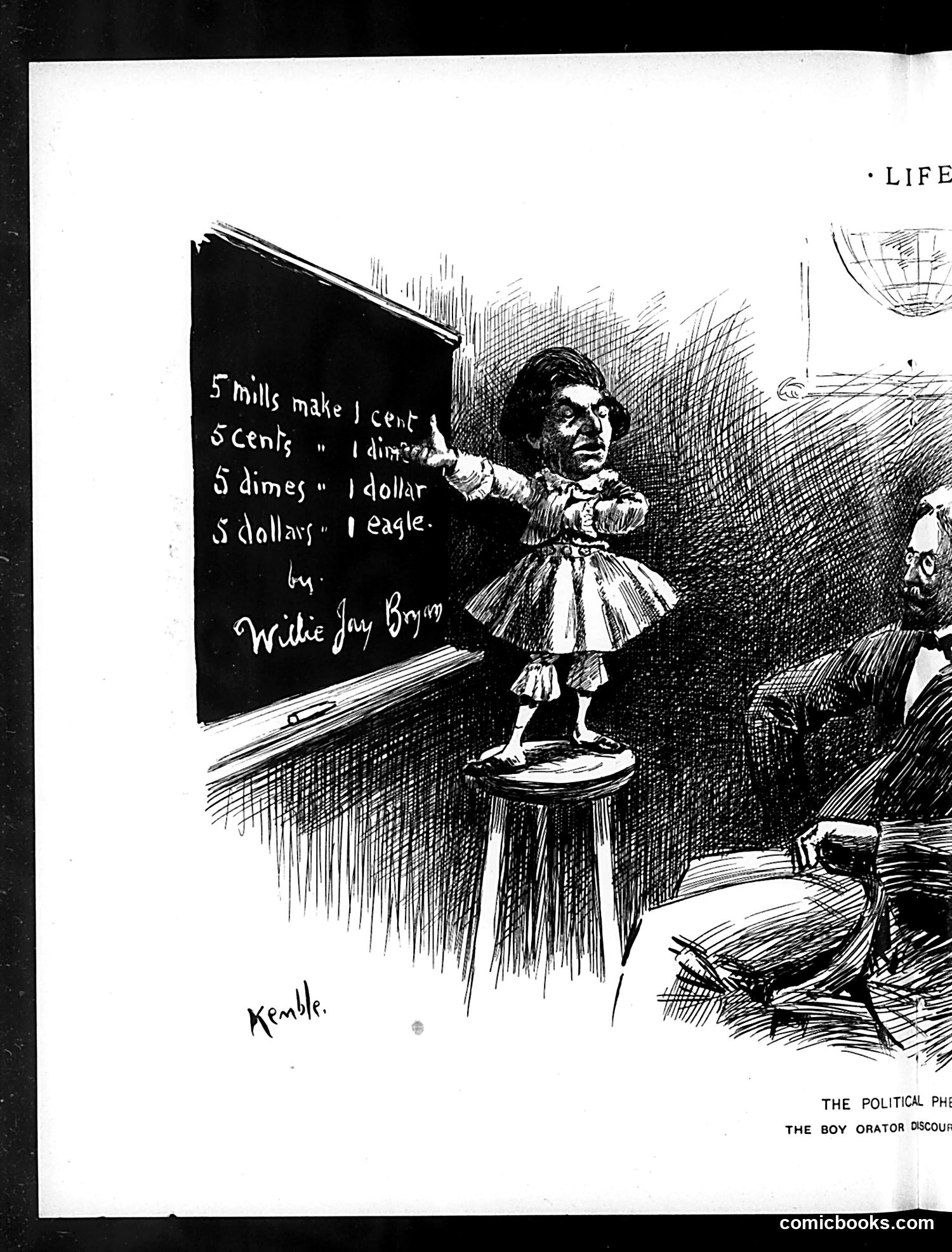
This cartoon by Kemble satirizes a child performing as a public speaker or "boy orator." The child stands on a stool pointing to a blackboard listing currency conversions—"5 mills make 1 cent / 5 cents 1 dime / 5 dimes 1 dollar / 5 dollars 1 eagle"—attributed to "Willie Jay Bryan." This appears to reference William Jennings Bryan, the populist politician famous for his 1896 presidential campaign centered on monetary policy, particularly the debate over silver versus gold currency standards. The joke mocks Bryan's monetary arguments by reducing them to a child reciting basic arithmetic about coins—suggesting his economic theories were simplistic or that his passionate oratory obscured rather than clarified complex financial issues.
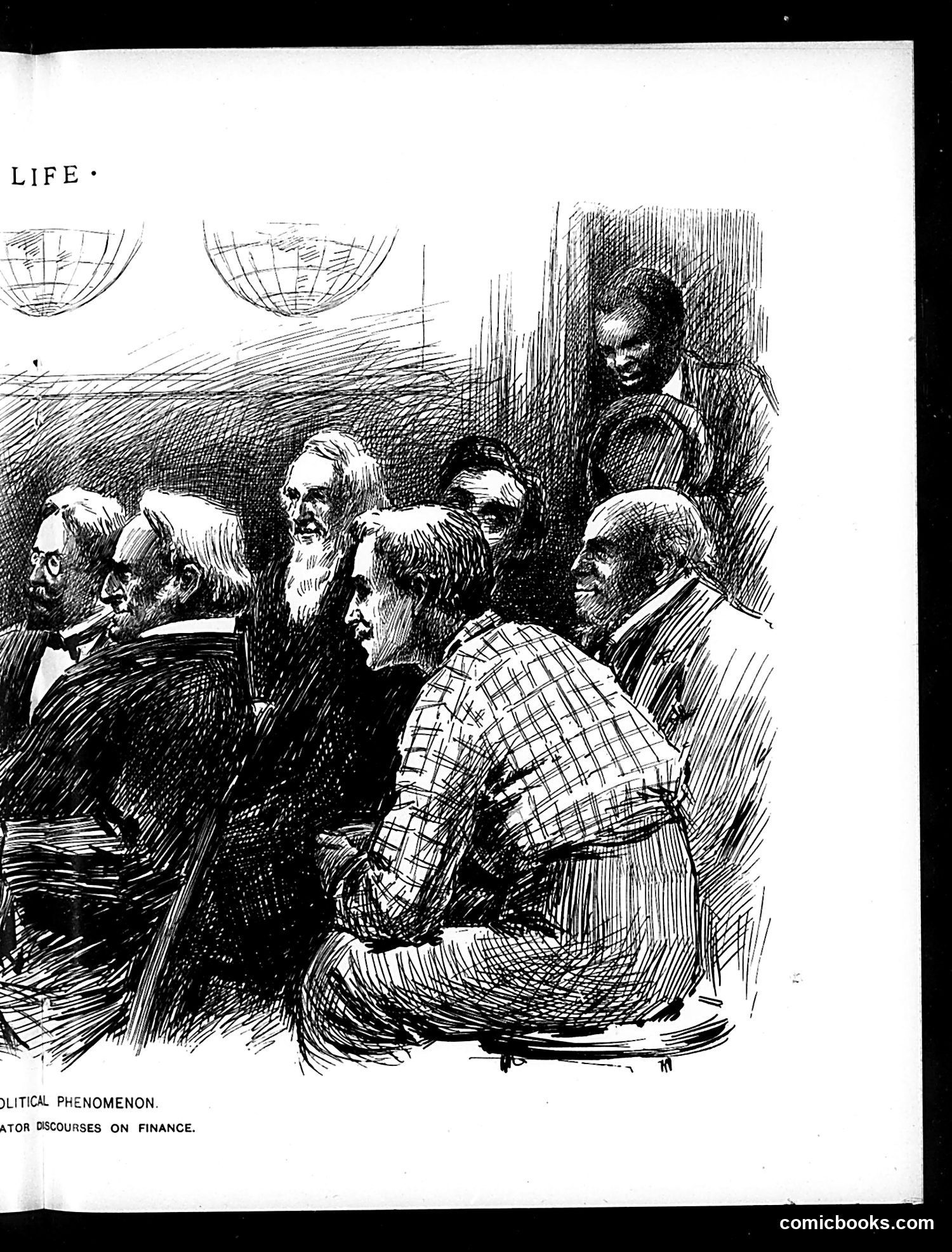
This Life magazine cartoon depicts what the caption identifies as "A Political Phenomenon: A Senator Discourses on Finance." The sketch shows a group of men gathered indoors, with several bearded gentlemen in 19th-century attire listening intently to a central figure speaking about financial matters. The satire appears to target the incongruity of a U.S. Senator—a politician—attempting to discuss complex economic policy, suggesting either that senators lacked financial expertise or that their public pronouncements on such technical matters were absurdly out of place. The crowded, attentive gathering suggests an ironic tone: the "phenomenon" being satirized is presumably the novelty or absurdity of a senator presuming to authoritatively address finance before an audience. This reflects period skepticism about politicians' competence in economic matters.
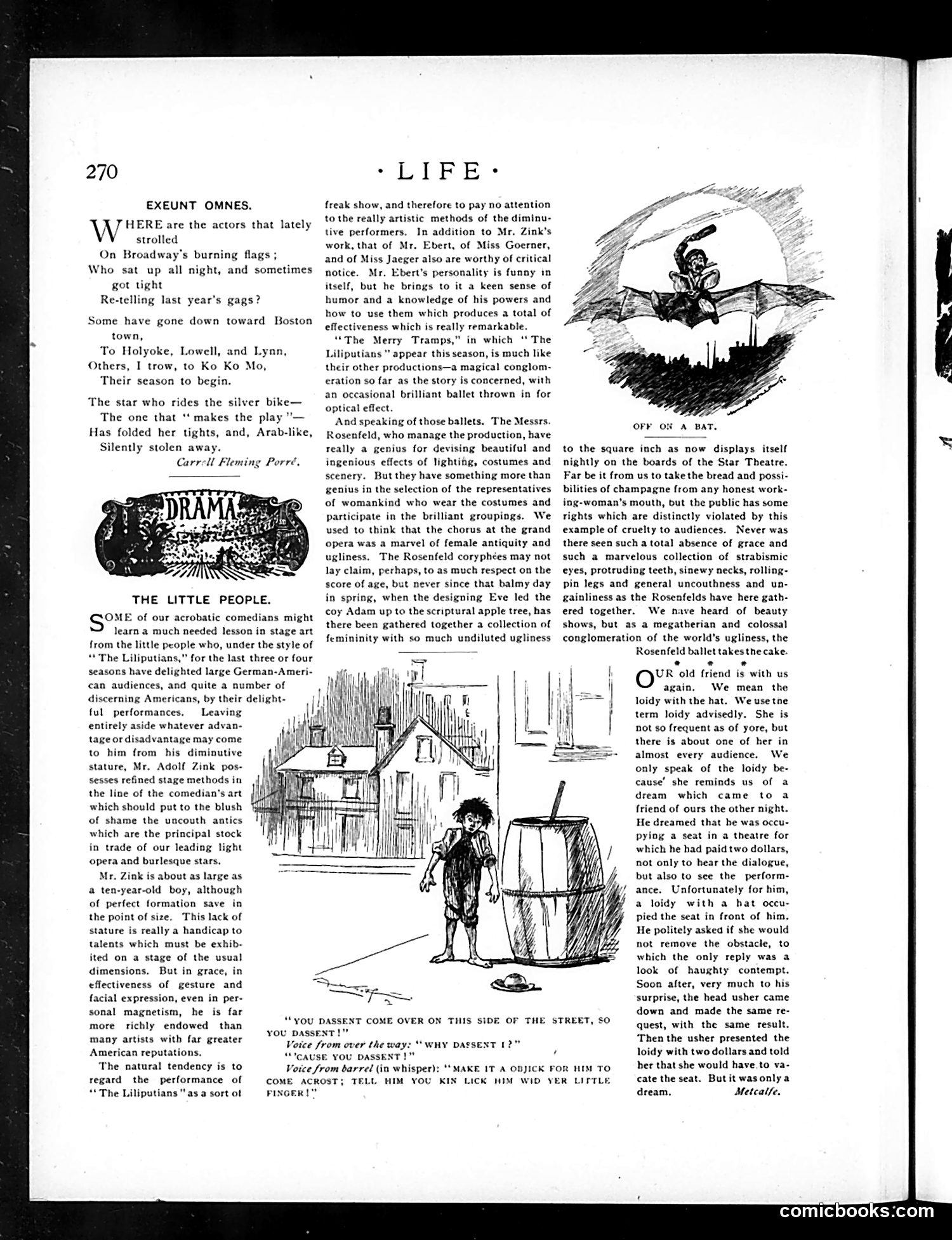
This page contains theater criticism, not political cartoons. The main content discusses Broadway performances, particularly praising Mr. Zink's comedic talents and the production "The Merry Tramps" featuring "The Lilliputians." The illustrations show: 1. **"The Little People"** section critiques a German-American theatrical troupe performing under that name. The sketch depicts a small-statured performer in exaggerated costume, illustrating the article's point about their "colossal conglomeration of worldly ugliness." 2. A street scene showing a dialogue between figures, with one appearing to be a performer or street character. The satire targets the theatrical conventions of the era—specifically mocking both the "freak show" novelty acts and elaborate, ungraceful costume design practices of early 20th-century American theater.
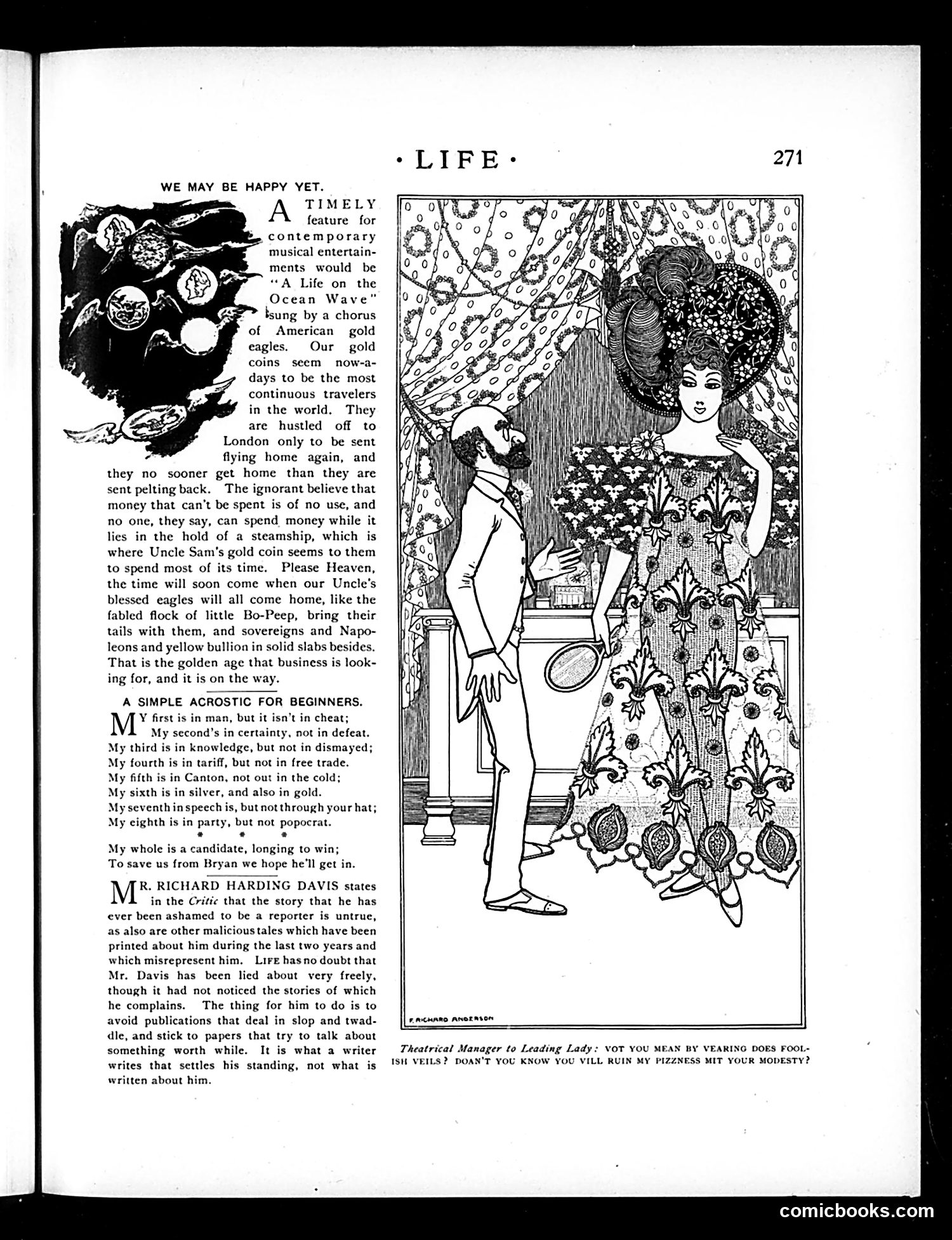
This page contains three distinct sections rather than a unified cartoon: 1. **"We May Be Happy Yet"** - A satirical piece about American gold coins traveling abroad and being sent back home, suggesting wealth circulation and international commerce concerns. 2. **An illustration** showing a woman in classical/theatrical dress with ornate background, accompanied by a caption about a "Theatrical Manager to Leading Lady," mocking vanity and false modesty in theater circles. 3. **"A Simple Acrostic for Beginners"** - A word puzzle about a political candidate seeking office. 4. **Richard Harding Davis defense** - Commentary defending the journalist Davis against false stories printed about him, advocating that writers should focus on substantive issues rather than gossip and slander. The page reflects early 20th-century concerns: international finance, theatrical pretension, and press ethics.
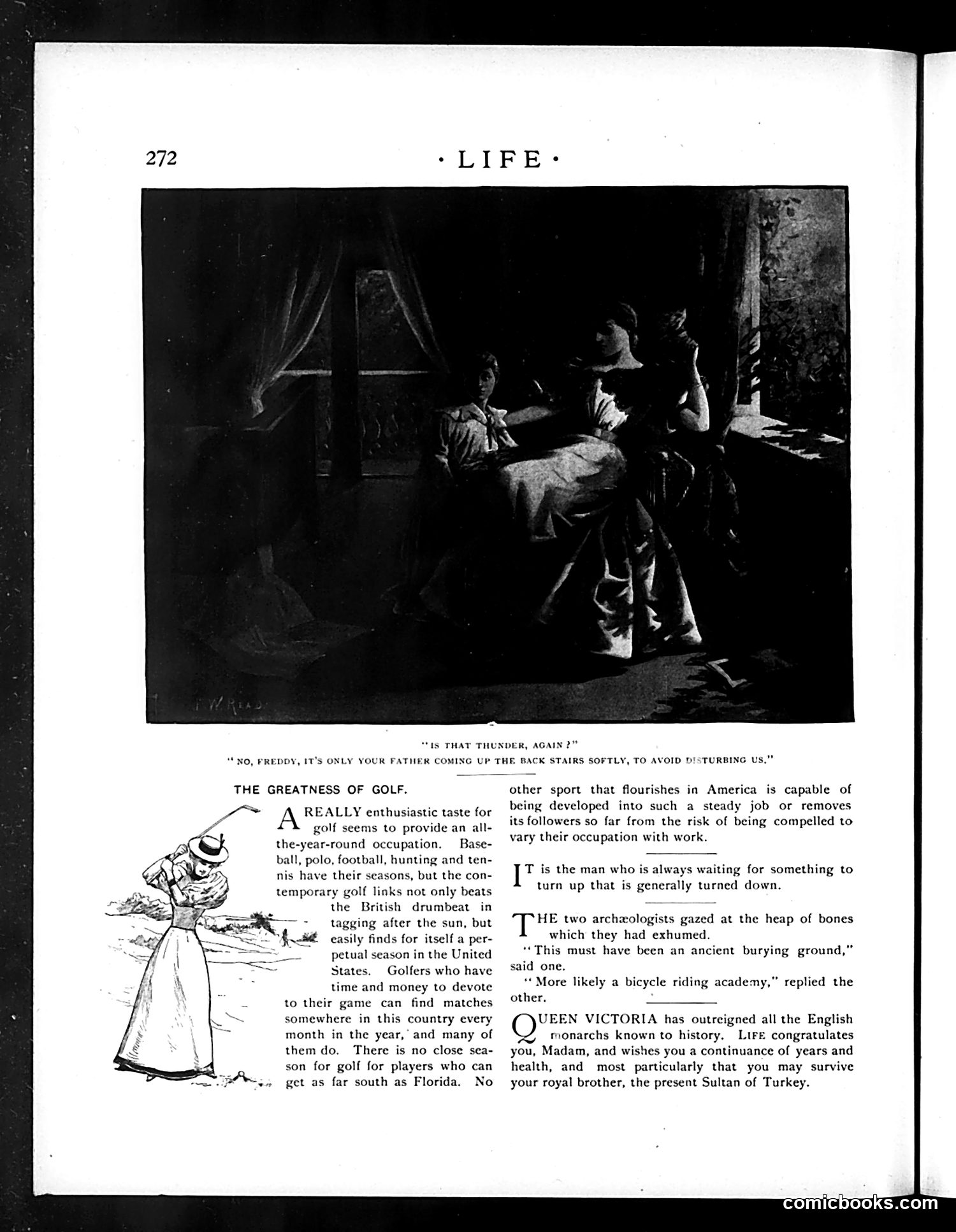
This page contains three distinct satirical pieces: 1. **Top illustration**: A domestic scene where a father sneaks upstairs during a thunderstorm. The joke plays on marital anxiety—the child mistakes the father's cautious footsteps for something frightening, suggesting the father is deliberately being quiet, perhaps to avoid his wife's disapproval or attention. 2. **"The Greatness of Golf"**: A social satire mocking golf's obsessive popularity among wealthy Americans. The piece criticizes how golf provides a year-round excuse for the idle rich to avoid actual work, contrasting it unfavorably with sports that have defined seasons. The accompanying illustration shows a fashionably-dressed golfer. 3. **Three brief comedic snippets**: Including archaeologists mistaking modern bicycle-riding grounds for ancient burial sites (physical humor), and a congratulatory note to Queen Victoria that darkly jokes about her outliving her "royal brother, the present Sultan of Turkey"—likely referencing Ottoman political instability or mortality rates. The overall tone satirizes upper-class leisure, domestic dynamics, and contemporary events.
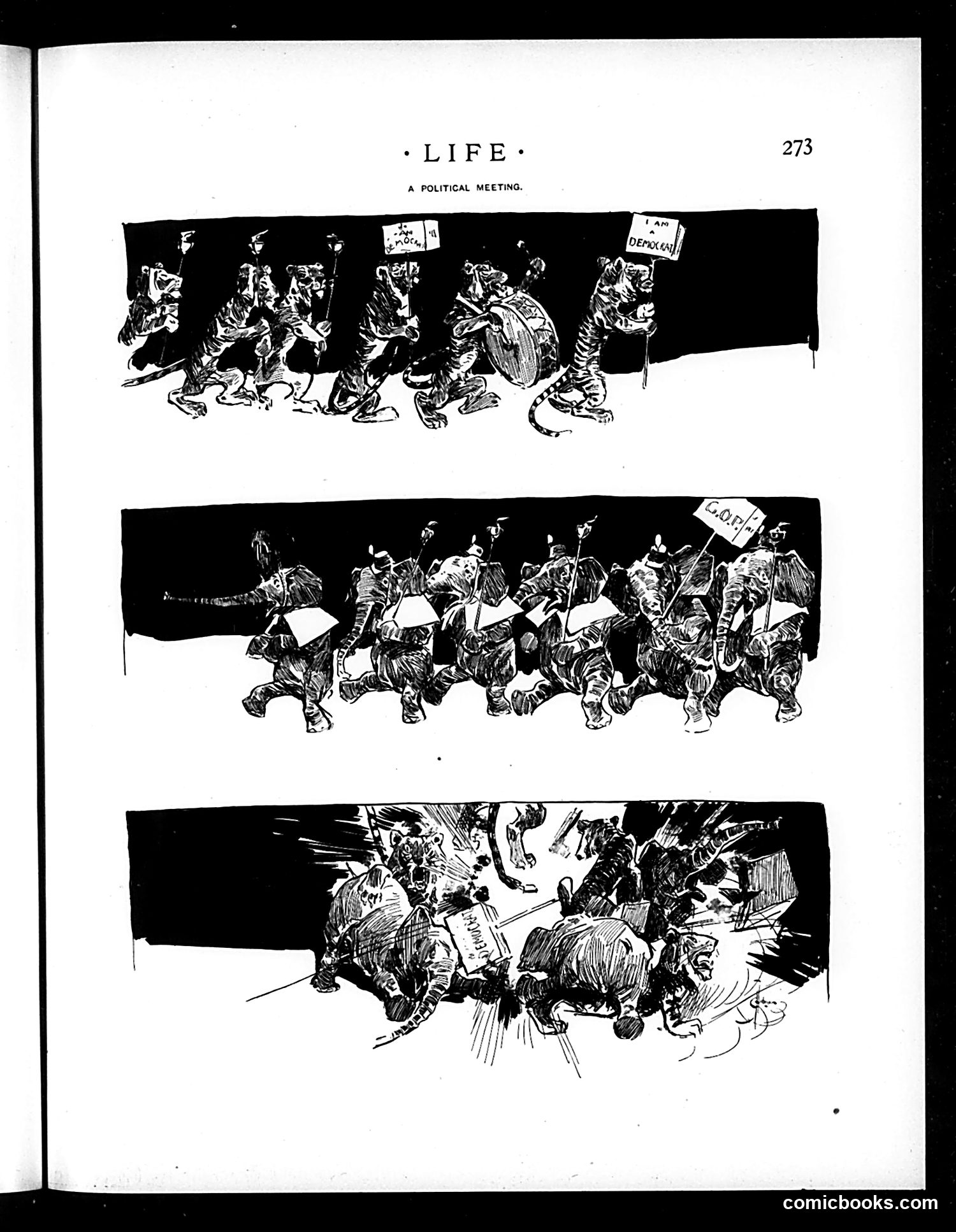
This three-panel cartoon satirizes a political meeting through caricature of animal-like figures (likely representing political parties or factions). In the **top panel**, figures hold signs reading "CHEAP" and what appears to be a Democratic symbol, suggesting criticism of Democratic political messaging or promises. The **middle panel** shows more organized figures holding blank signs, implying empty rhetoric or lack of substantive platform. The **bottom panel** depicts chaos and conflict among the figures, suggesting political infighting or discord. The overall satire appears to mock political meetings as disorganized, filled with cheap slogans, and ultimately fractious—a commentary on the ineffectiveness or duplicitousness of political discourse. The animal caricatures suggest dehumanization of political actors. The specific historical context and targeted politicians remain unclear without additional attribution.
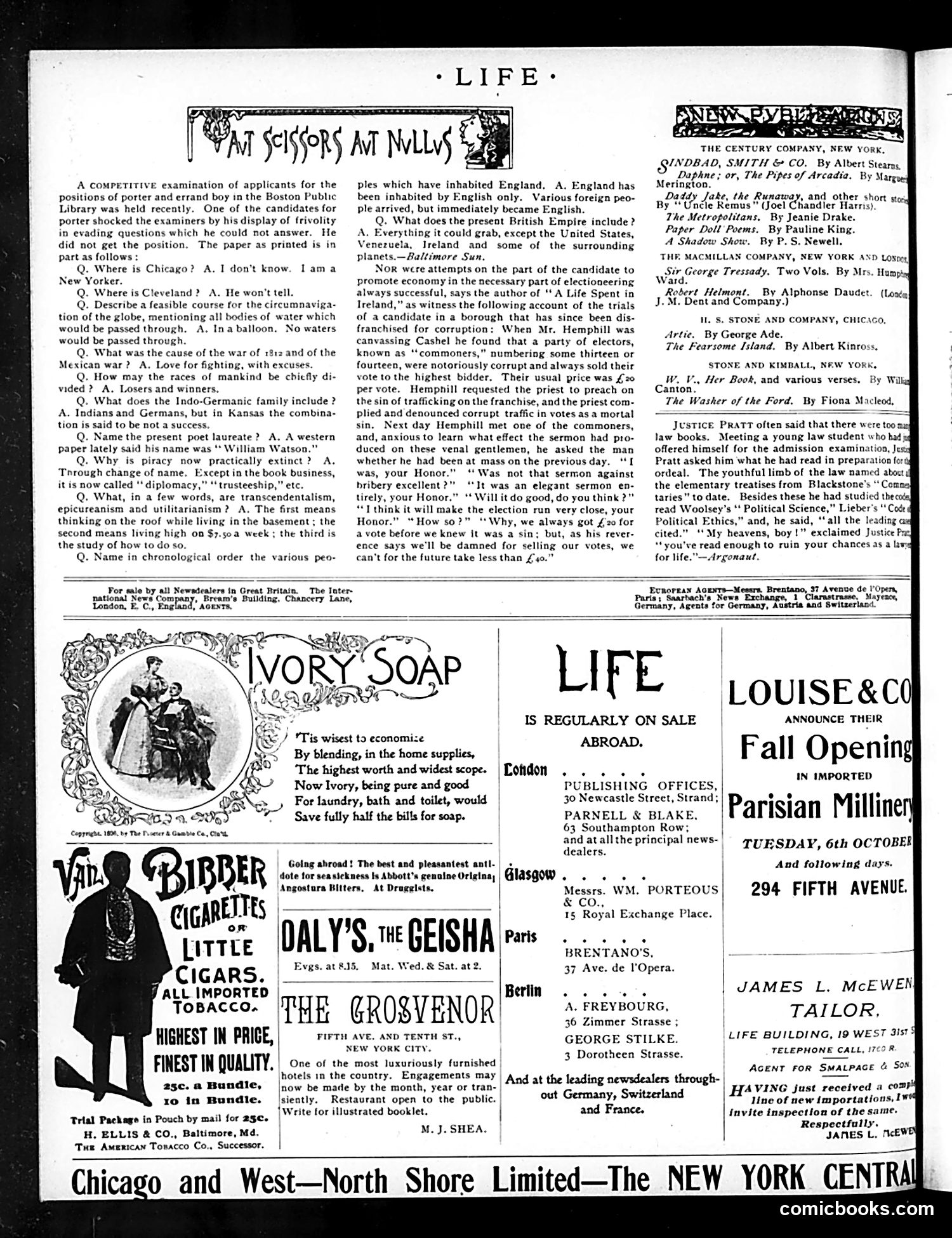
This page contains two separate satirical pieces examining human foolishness through examination questions. **"Scissors at Nulls"** presents a competitive exam for a Boston Public Library porter position. The candidate deliberately gives absurd answers—claiming Chicago's location is unknown, that Cleveland "won't tell," that circumnavigation requires a balloon (so no water is crossed), and defining races as "losers and winners." The satire mocks both the candidate's flippant incompetence and implicitly critiques the exam system itself. The final answers about transcendentalism and British Empire expansion ("everything it could grab") suggest that educated people are equally foolish. **The second piece** recounts an Irish election bribery story where a priest sermonizes against vote-selling as sinful. The ironic payoff: the corrupt electors agree the sermon was "elegant"—but now demand double their usual bribe (£40 instead of £20) because they'll face damnation for the sin anyway, so they need extra compensation. Both pieces use exaggeration and logical absurdity to satirize human nature: institutional incompetence, moral hypocrisy, and how people rationalize corruption.
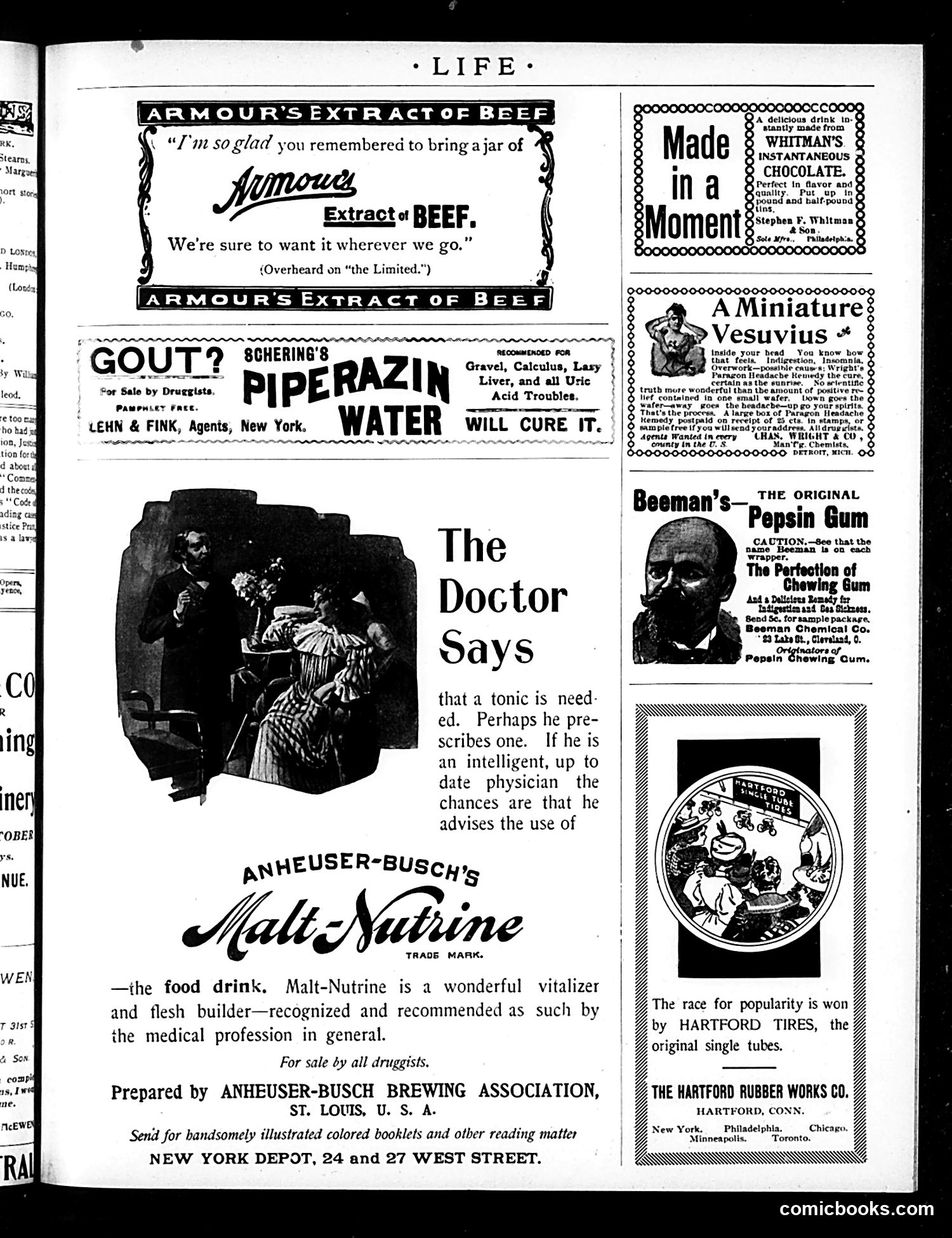
This page is **primarily advertising**, not satire or editorial content. It showcases patent medicines and consumer products typical of early 20th-century American marketing. The central image—"The Doctor Says"—features a physician recommending Anheuser-Busch's Malt-Nutrine as a medicinal tonic. This reflects the era when breweries marketed beer as health products, claiming nutritional and medicinal benefits. The "doctor endorsement" was a common advertising strategy before modern FDA regulations. Surrounding ads promote now-dubious remedies: Schering's Piperazin Water for gout and kidney troubles, Wright's Paragon Headache Remedy, Beeman's Pepsin Gum for digestion, and Whitman's instant chocolate. The Hartford Tires ad alone offers genuine consumer goods. **For modern readers**: This page reveals how unregulated patent medicine marketing exploited medical authority. Alcohol and untested compounds were sold as cure-alls without scientific evidence—practices that would be illegal today. The ads reflect genuine period beliefs in "tonics" and "vitalization" that lack modern pharmacological basis.
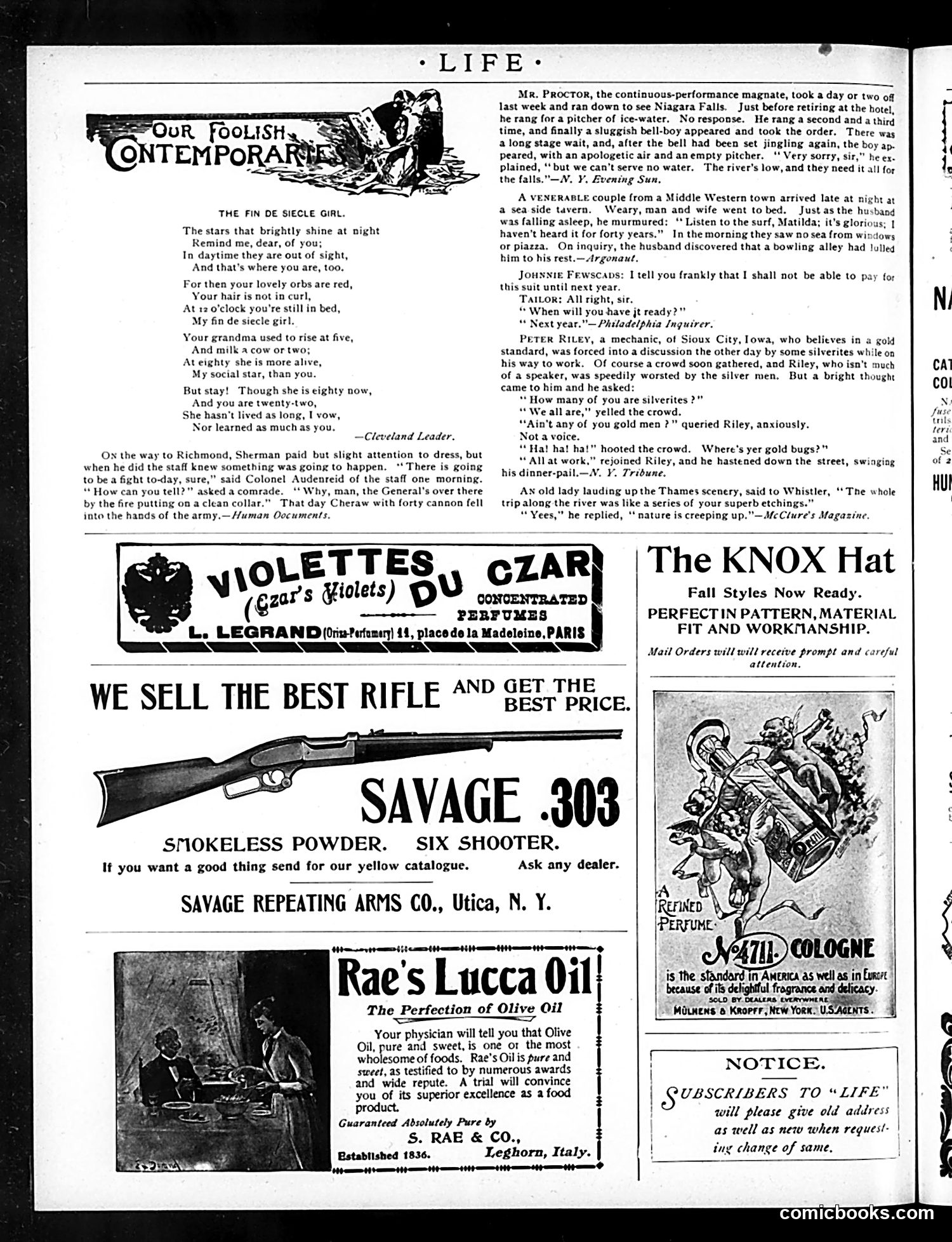
This page is primarily **advertisements and humorous anecdotes**, not political cartoons. The text content includes several short jokes: - **"The Fin de Siècle Girl"** satirizes the modern "New Woman" of the 1890s—specifically her laziness and lack of industriousness compared to previous generations. The poem contrasts the young woman who sleeps until noon with her grandmother, who worked hard but lived more fully despite being elderly. - Anecdotes mock various situations: a hotel unable to provide water during low season, a man mistaking bowling alley noise for ocean surf, and a mechanic's witty comeback in a gold-versus-silver currency debate (referencing the monetary controversy of the 1890s). The page primarily features **product advertisements** for rifles, perfume, hats, and olive oil—typical period magazine content. The "Fin de Siècle Girl" poem represents the page's only sustained satirical commentary, critiquing contemporary femininity and leisure culture.
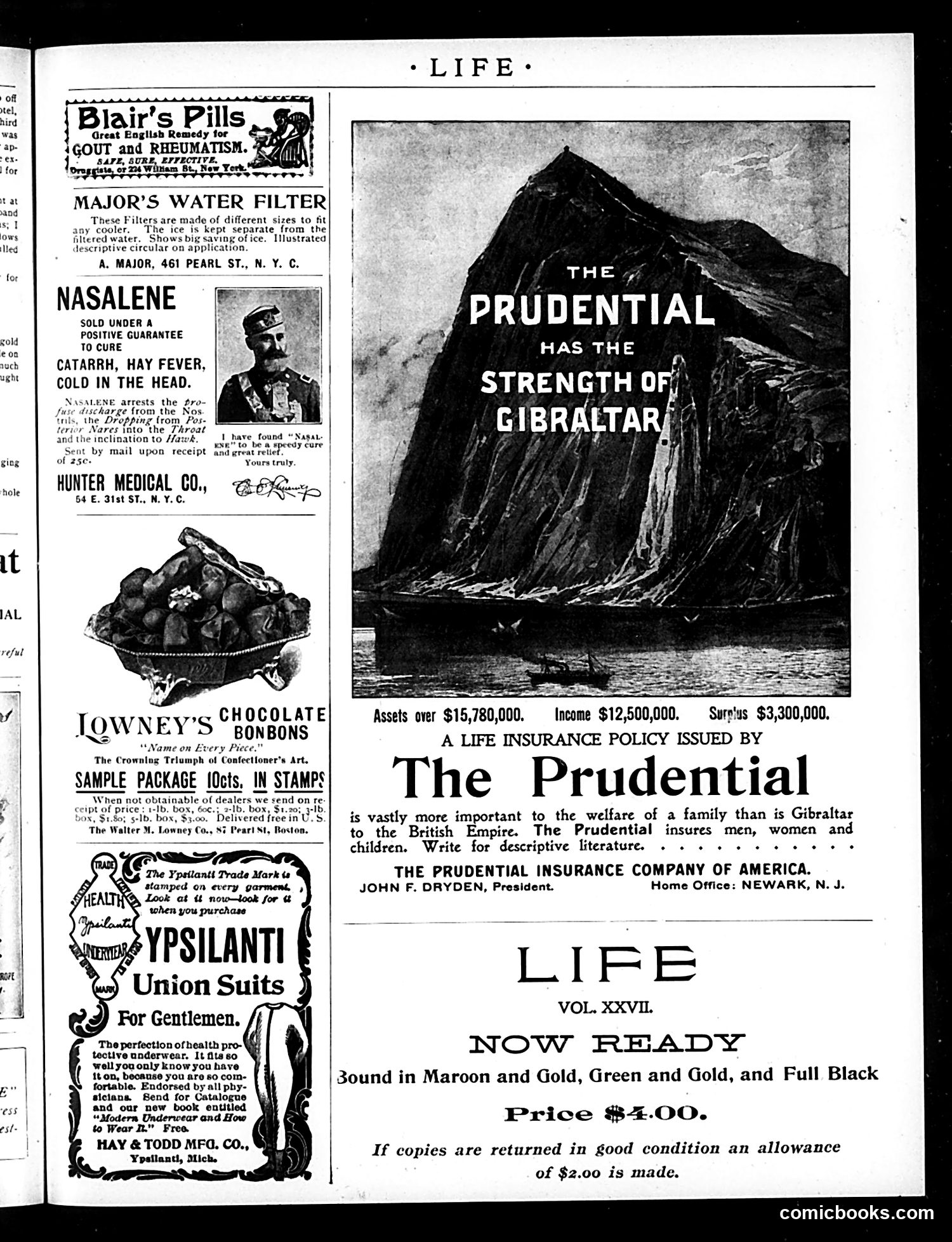
This is primarily an **advertising page** rather than editorial content or political satire. The page features various patent medicines and commercial products typical of early 20th-century American marketing. The main visual element is a **Prudential Insurance advertisement** comparing life insurance to Gibraltar—the famous Rock of Gibraltar. The ad uses Gibraltar as a metaphor for strength and permanence, arguing that life insurance is equally vital to families as this strategic British fortress is to the Empire. This reflects the era's imperial confidence and suggests insurance provides comparable security and protection. The surrounding advertisements hawking "Nasalene" for catarrh, "Blair's Pills" for gout, water filters, chocolate bonbons, and union suits represent typical patent medicine and consumer goods marketing—many making dubious health claims that would later be regulated by the FDA. The page concludes with an announcement of **Life magazine's bound volume XXVII**, priced at $4.00 with a $2.00 return allowance.
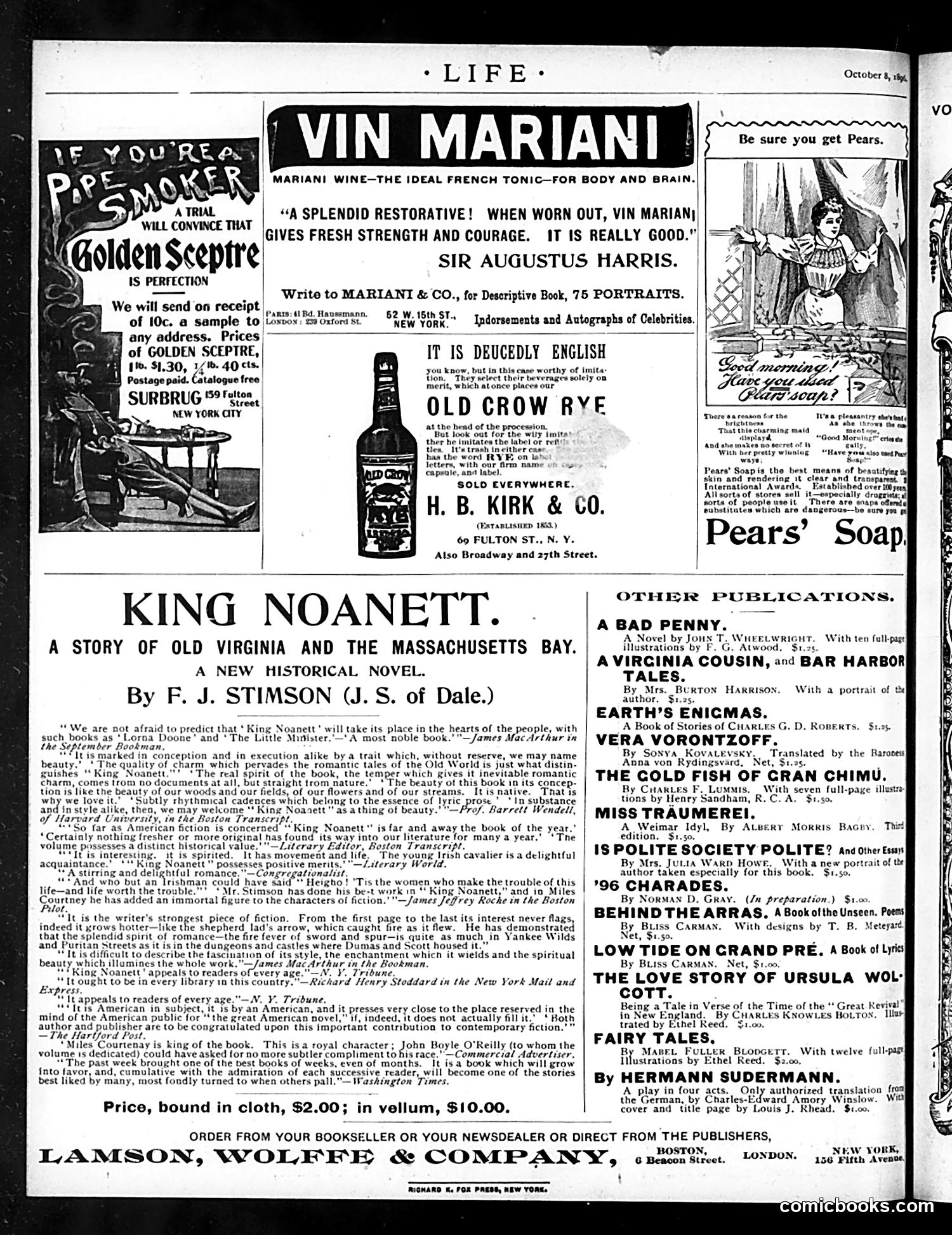
This page is primarily **advertising**, not political satire. It contains multiple product endorsements typical of early 1900s magazines: **Upper advertisements** promote: - **Golden Sceptre** pipe tobacco ("perfection") - **Vin Mariani** wine—a French "tonic" endorsed by "Sir Augustus Harris" as restorative for body and brain - **Old Crow Rye** whiskey, advertised as "deucedly English" - **Pears' Soap** (with period illustration of woman bathing) The Vin Mariani ad is notable: this was a cocaine-containing wine marketed as medicinal—legal and fashionable in this era, though we'd recognize it today as a dangerous drug product. **Lower section** advertises a new historical novel, *King Noanett* by F.J. Stimson, with extensive positive reviews praising its romantic narrative about Virginia and Massachusetts Bay. The page reflects early 1900s consumer culture where patent medicines, spirits, and tobacco were advertised alongside literature, often with dubious health claims.