
Life, 1896-10-08 · page 10 of 18
Life — October 8, 1896 — page 10: what you’re looking at
What you’re looking at
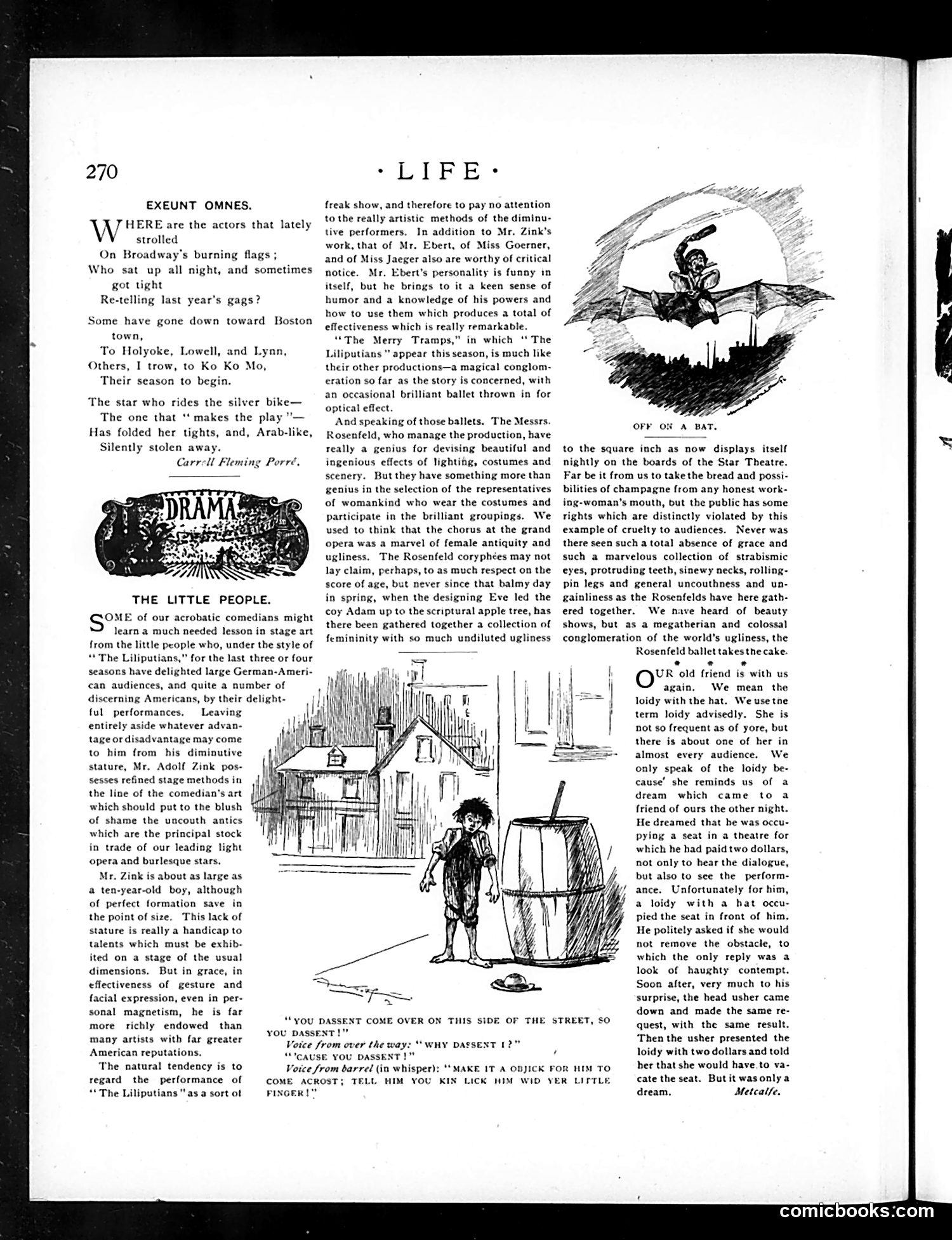
This page contains theater criticism, not political cartoons. The main content discusses Broadway performances, particularly praising Mr. Zink's comedic talents and the production "The Merry Tramps" featuring "The Lilliputians." The illustrations show: 1. **"The Little People"** section critiques a German-American theatrical troupe performing under that name. The sketch depicts a small-statured performer in exaggerated costume, illustrating the article's point about their "colossal conglomeration of worldly ugliness." 2. A street scene showing a dialogue between figures, with one appearing to be a performer or street character. The satire targets the theatrical conventions of the era—specifically mocking both the "freak show" novelty acts and elaborate, ungraceful costume design practices of early 20th-century American theater.
📄 Transcribed text from this page (OCR, searchable)
Machine-transcribed from the original scan — historical spelling and the odd misread are preserved.
270 EXEUNT OMNES. HERE are the actors that lately V strolled On Broadway's burning flags ; Who sat up all night, and sometimes got tight Re-telling last year’s gags? Some have gone down toward Boston town, To Holyoke, Lowell, and Lynn, Others, I trow, to Ko Ko Mo, Their season to begin. The star who rides the silver bike— The one that ‘makes the play "— Has folded her tights, and, Arab-like, Silently stolen away. Carrell Fleming Porré, THE LITTLE PEOPLE. OME of our acrobatic comedians might learn a much needed lesson in stage art from the little people who, under the style of “* The Liliputians,” for the last three or four seasons have delighted large German-Ameri- can audiences, and quite a number of discerning Americans, by their delight- ful performances. Leaving entirely aside whatever advan- tage or disadvantage may come to him from his diminutive stature, Mr. Adolf Zink pos- sesses refined stage methods in the line of the comedian’s art which should put to the blush of shame the uncouth antics which are the principal stock in trade of our leading light opera and burlesque stars, Mr, Zink is about as large as a ten-year-old boy, although of perfect formation save in the point of size. This lack of stature is really a handicap to talents which must be exhib- ited on a stage of the usual dimensions. But in grace, in effectiveness of gesture and facial expression, even in per- sonal magnetism, he is far more richly endowed than many artists with far greater American reputations. The natural tendency is to regard the performance of ** The Liliputians "asa sort of you pa: “you Das: > LIFE: freak show, and therefore to pay no attention to the really artistic methods of the diminu- tive performers. In addition to Mr. Zink’s work, that of Mr. Ebert, of Miss Goerner, and of Miss Jaeger also are worthy of critical notice. Mr. Ebert's personality is funny in itself, but he brings to it a keen sense of humor and a knowledge of his powers and how to use them which produces a total of effectiveness which is really remarkable. “The Merry Tramps,” in which ‘ The Liliputians " appear this season, is much like their other productions—a magical conglom- eration so far as the story is concerned, with an occasional brilliant ballet thrown in for optical effect. And speaking of those ballets. The Messrs. Rosenfeld, who manage the production, have really a genius for devising beautiful and ingenious effects of lighting, costumes and scenery. But they have something more than genius in the selection of the representatives of womankind who wear the costumes and participate in the brilliant groupings. We used to think that the chorus at the grand opera was a marvel of female antiquity and ugliness, The Rosenfeld coryphées may not lay claim, perhaps, to as much respect on the score of age, but never since that balmy day in spring, when the designing Eve led the coy Adam up to the scriptural apple tree, has there been gathered together a collection of femininity with so much undiluted ugliness T COME OVER ON THIS SIDE OF THE Voice from over the way: “WHY DASSENT 1?” "CAUSE YOU DAs: voice from barrel (in whisper) COME ACROST; TELL FINGER!" TI" HIM you STREET, SO MAKE IT A ODJICK FOR HIM TO KIN LICK WIM WID YER LIPTLE A BAT. to the square inch as now displays itself nightly on the boards of the Star Theatre. Far be it from us to take the bread and pos: bilities of champagne from any honest work- ing-woman’s mouth, but the public has some rights which are distinctly violated by this example of cruelty to audiences. Never was there seen such a total absence of grace and such a marvelous collection of strabismic eyes, protruding teeth, sinewy necks, rolling- pin legs and general uncouthness and un- gainliness as the Rosenfelds have here gath- ered together. We nave heard of beauty shows, but as a megatherian and colossal conglomeration of the world’s ugliness, the Rosenfeld ballet takes the cake. . * * UR old friend is with us again. We mean the loidy with the hat. We usetne term loidy advisedly. She not so frequent as of yore, but there is about one of her in almost every audience. We only speak of the loidy be- cause’ she reminds us of a dream which came to a friend of ours the other night. He dreamed that he was occu- pying a seat in a theatre for which he had paid two dollars, not only to hear the dialogue, but also to see the perform- ance. Unfortunately for him, a loidy with a hat occu- pied the seat in front of him. He politely asked if she would not remove the obstacle, to which the only reply was a look of haughty contempt. Soon after, very much to his surprise, the head usher came down and made the same re- quest, with the same result. ‘Then the usher presented the loidy with two dollars and told her that she would have.to va- cate the seat. But it wasonlya dream, Metcalfe. OFF Oo: comicbooks:com