
Life, 1896-10-08 · page 4 of 18
Life — October 8, 1896 — page 4: what you’re looking at
What you’re looking at
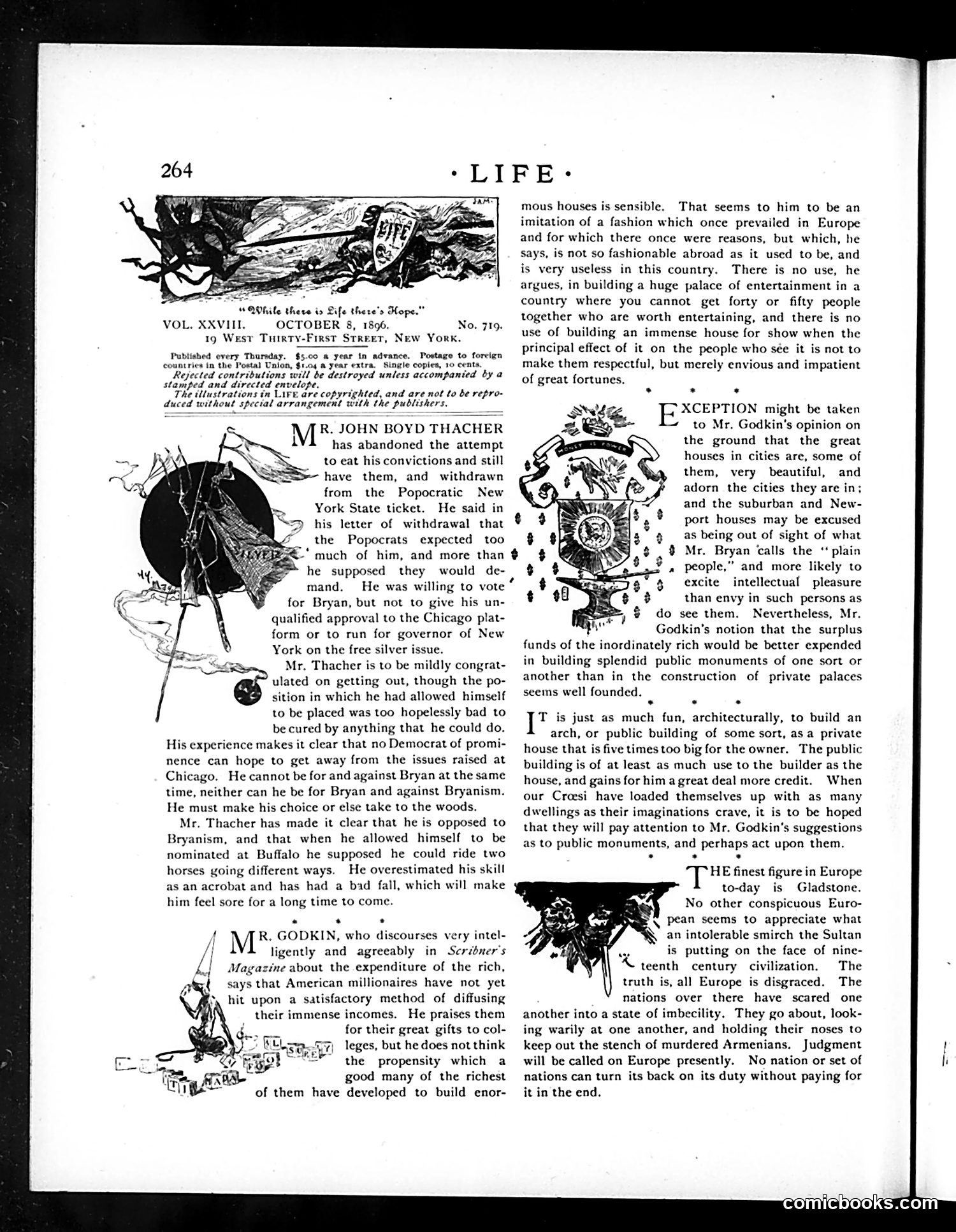
This page contains commentary on wealthy Americans' spending habits, specifically critiquing John Boyd Thacher's withdrawal from New York Democratic politics and discussing Mr. Godkin's views on how the rich display their wealth. The text satirizes American millionaires' tendency to build enormous private mansions rather than fund public monuments. Godkin argues that while Europeans appreciate grand public architecture, wealthy Americans waste resources constructing ostentatious private palaces that generate envy rather than respect. The final section references European political turmoil—specifically "the Sultan...putting on the face of nineteenth century civilization," appearing to critique Ottoman Empire policies (likely Armenian massacres of 1894-96). The passage suggests Europe itself is morally compromised and cannot judge others. The page uses text-based satire rather than prominent political cartoons to deliver its social criticism.
📄 Transcribed text from this page (OCR, searchable)
Machine-transcribed from the original scan — historical spelling and the odd misread are preserved.
While there is Life there’s Hope.” VOL. XXVIIL. OCTOBER 8, 1896. d 1g West Tuirty-First Street, New York. Published every Thursday. $5.00 a year in advance. Postage to foreign countries in the Postal Union, $1.04 @ year extra. Single copies, 10 cents. Rejected contributions will be destroyed unless accompanied by a stamped and directed envelope. The illustrations tn LAFE are copyrighted, and are not to be repro- duced without special arrangement with the publishers. R. JOHN BOYD THACHER has abandoned the attempt to eat his convictions and still have them, and withdrawn from the Popocratic New York State ticket. He said in his letter of withdrawal that the Popocrats expected too ~* much of him, and more than he supposed they would de- mand. for Bryan, but not to give his un- qualified approval to the Chicago plat- form or to run for governor of New York on the free silver issue. GS Mr. Thacher is to be mildly congrat- ulated on getting out, though the po- ry sition in which he had allowed himself to be placed was too hopelessly bad to be cured by anything that he could do. His experience makes it clear that no Democrat of promi- nence can hope to get away from the issues raised at Chicago. He cannot be for and against Bryan at the same time, neither can he be for Bryan and against Bryanism. He must make his choice or else take to the woods. Mr. Thacher has made it clear that he is opposed to Bryanism, and that when he allowed himself to be nominated at Buffalo he supposed he could ride two horses going different ways. He overestimated his skill as an acrobat and has had a bad fall, which will make him feel sore for a long time to come. - . . R. GODKIN, who discourses very intel- IVI jigently and agreeably in Serabner's yal Magazine about the expenditure of the rich, byt says that American millionaires have not yet \. hit upon a satisfactory method of diffusing their immense incomes. He praises them for their great gifts to col- leges, but he does not think the propensity which a good many of the richest of them have developed to build enor- He was willing to vote ’ mous houses is sensible. That seems to him to be an imitation of a fashion which once prevailed in Europe and for which there once were reasons, but which, he says, is not so fashionable abroad as it used to be, and is very useless in this country. There is no use, he argues, in building a huge palace of entertainment in a country where you cannot get forty or fifty people together who are worth entertaining, and there is no use of building an immense house for show when the principal effect of it on the people who sée it is not to make them respectful, but merely envious and impatient of great fortunes. . . . Ste, EXCEPTION might be taken 2 to Mr. Godkin's opinion on - the ground that the great houses in cities are, some of them, very beautiful, and adorn the cities they are in; and the suburban and New- port houses may be excused as being out of sight of what Mr. Bryan calls the ‘plain people,” and more likely to excite intellectual pleasure than envy in such persons as $ do see them. Nevertheless, Mr. Godkin's notion that the surplus funds of the inordinately rich would be better expended in building splendid public monuments of one sort or another than in the construction of private palaces seems well founded. . . . I’ is just as much fun, architecturally, to build an arch, or public building of some sort, as a private house that is five times too big for the owner. The public building is of at least as much use to the builder as the house, and gains for him a great deal more credit. When our Crovsi have loaded themselves up with as many dwellings as their imaginations crave, it is to be hoped that they will pay attention to Mr. Godkin’s suggestions as to public monuments, and perhaps act upon them. . . . THE finest figure in Europe to-day is Gladstone. No other conspicuous Euro- \ pean seems to appreciate what an intolerable smirch the Sultan is putting on the face of nine- teenth century ci truth is, all Europe is disgraced. The nations over there have scared one another into a state of imbecility. They go about, look- ing warily at one another, and holding their noses to keep out the stench of murdered Armenians. Judgment will be called on Europe presently. No nation or set of nations can turn its back on its duty without paying for it in the end.