
A complete issue · 18 pages · 1896
Life — August 13, 1896
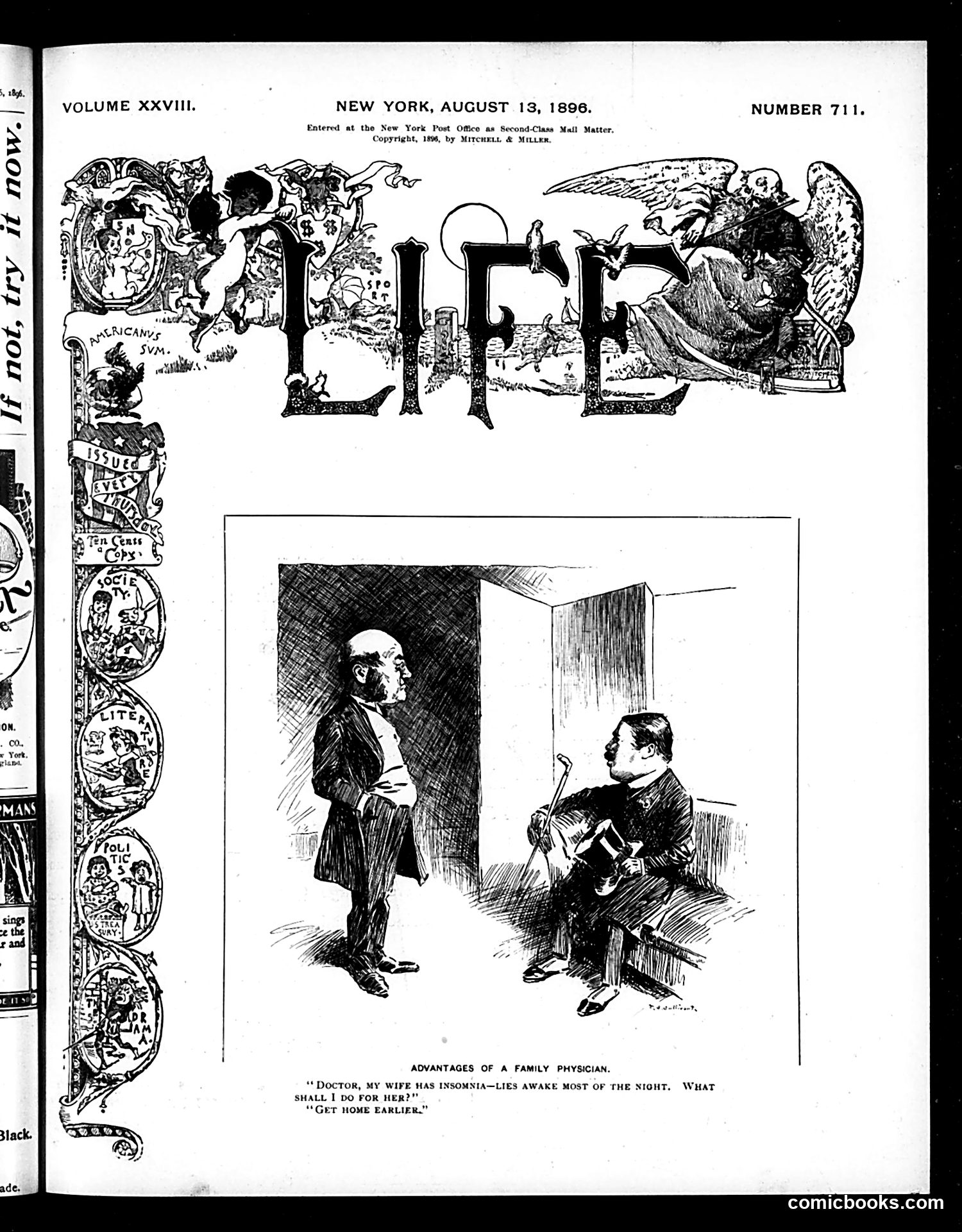
The cartoon titled "Advantages of a Family Physician" depicts a domestic scene where a husband asks his doctor for help with his wife's insomnia, then receives the blunt advice: "Get home earlier." The satire targets late-night social habits among men of this era—particularly staying out at clubs, bars, or other venues while wives remained home. The "family physician" serves as a voice of domestic common sense, suggesting the husband's own absence is causing the wife's sleeplessness, likely from worry or loneliness. The joke critiques both the husband's obliviousness to his wife's emotional needs and the era's acceptance of men's nocturnal social lives as normal, while positioning the doctor as moral arbiter of family responsibility.
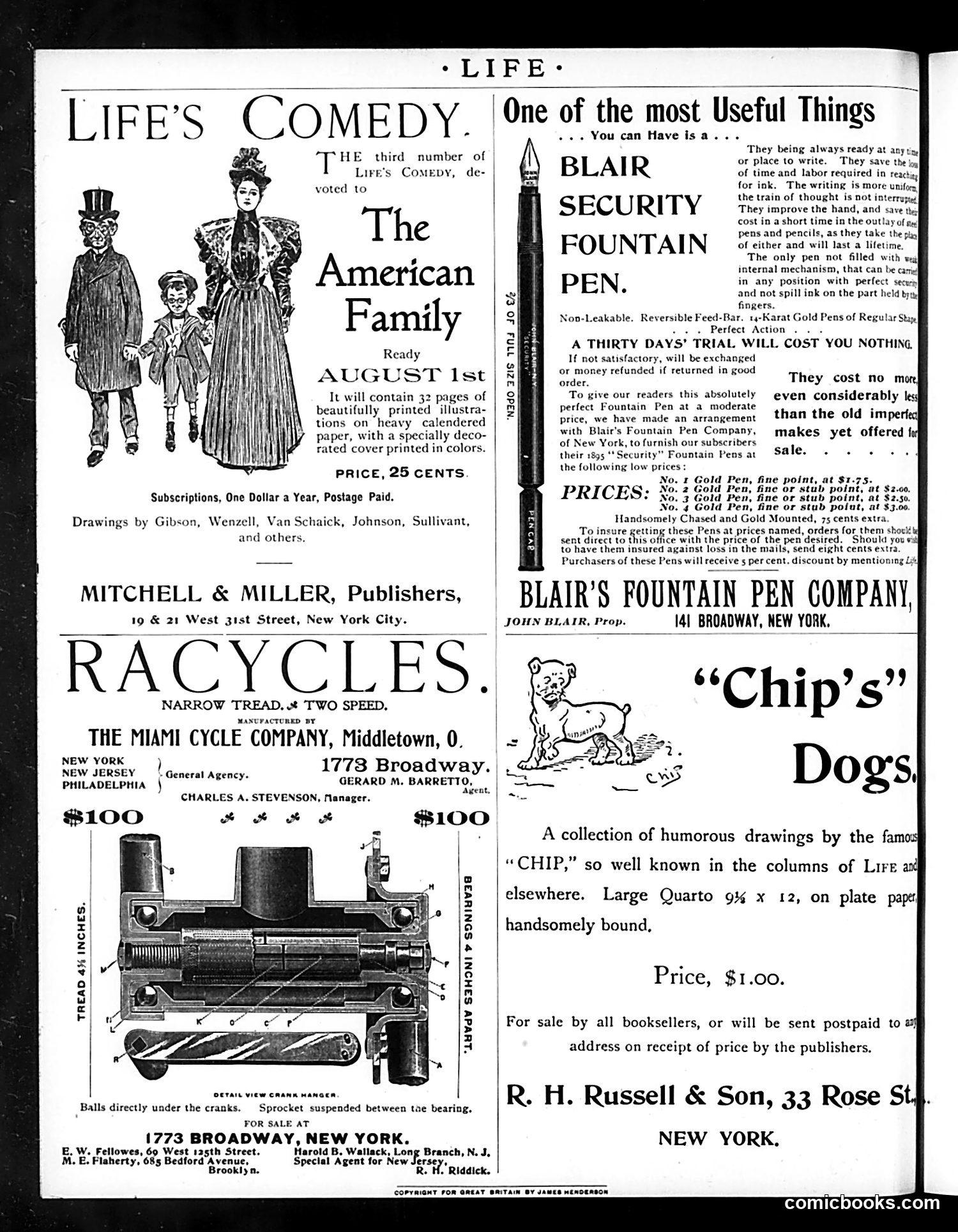
This page is primarily **advertising**, not political satire. The main content promotes: 1. **Life's Comedy #3**: "The American Family" — a humor publication available August 1st for 25 cents, featuring drawings by prominent illustrators (Gibson, Wendell, Van Schaick, Johnson, Sullivan). 2. **Blair Security Fountain Pen** — advertised as "one of the most useful things," with a 30-day free trial and prices ranging from $1.75 to $3.00. 3. **Miami Cycle Company Racycles** — bicycles priced at $100, featuring a technical diagram. 4. **"Chip's" Dogs** — a humorous illustrated book ($1.00) collecting cartoons by "Chip," a cartoonist known in Life's columns. The page reflects early 1900s consumer culture, with no apparent political commentary—primarily marketing leisure products and publications to affluent readers.
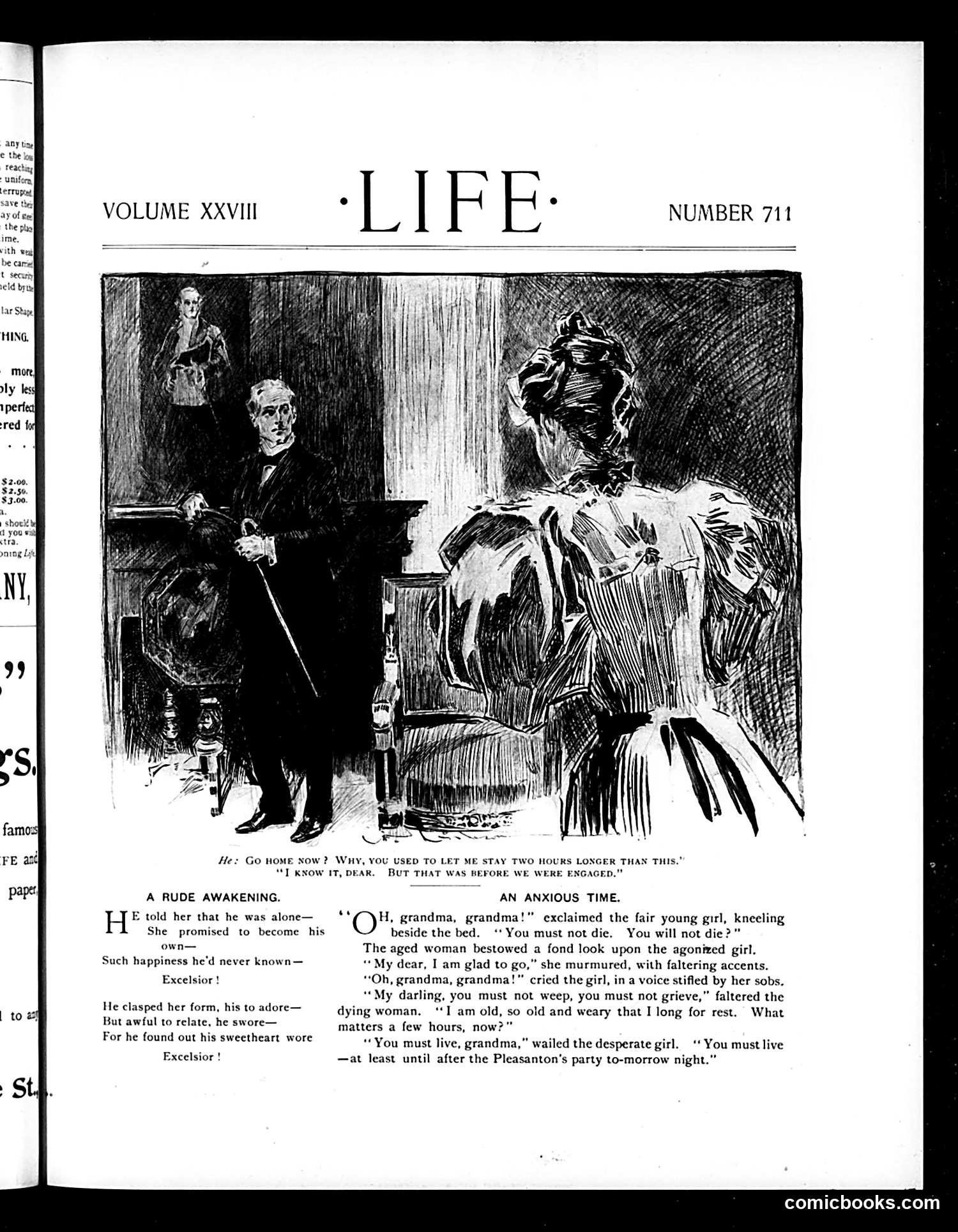
This page contains two narrative illustrations with accompanying poetry, not political satire. The sketches depict romantic melodrama: **"A Rude Awakening"** shows a man confronting a woman about infidelity—he claims she promised exclusivity before engagement, but now suspects she entertained other suitors longer in their courtship. **"An Anxious Time"** depicts a granddaughter at a dying grandmother's bedside. The girl begs her elderly relative not to die, while the grandmother urges her to live—specifically to attend the Pleasanton's party tomorrow night, suggesting the young woman shouldn't let grief prevent social engagement. Both pieces satirize contemporary domestic relationships and social priorities through sentimental, dramatic verse. The humor relies on period attitudes about courtship, mortality, and society obligations rather than political commentary.
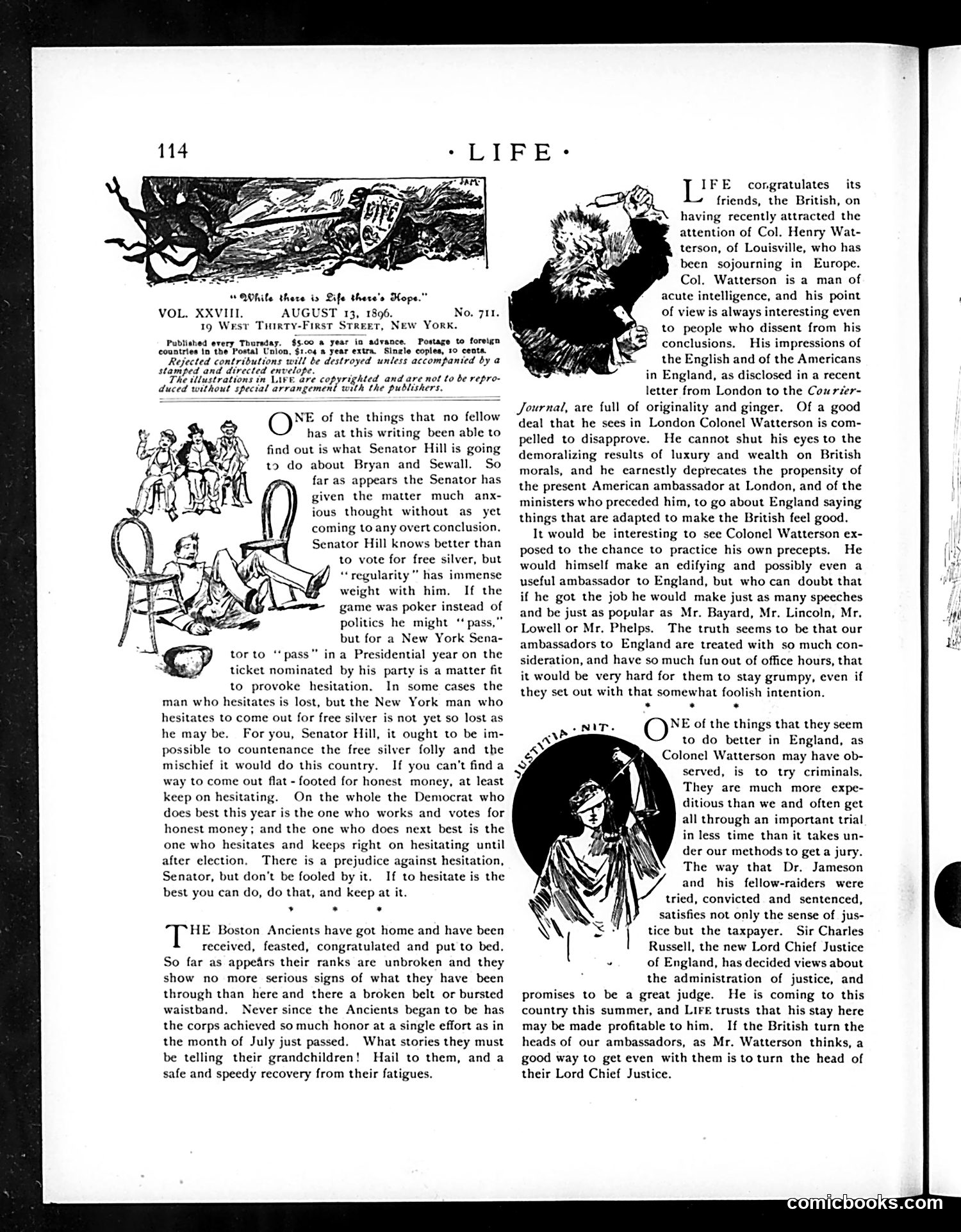
The main cartoon depicts **Senator Hill** (likely David B. Hill of New York) in a poker game, labeled as someone uncertain about voting for "free silver"—a major 1896 election issue. The satire criticizes Hill for political cowardice: he won't commit to either position on currency policy, the text explains, making him unreliable during a presidential election year. The article also praises **Col. Henry Watterson** (a prominent journalist) for his observations about British attitudes toward American wealth and morality. A secondary section discusses **Dr. Jameson's trial** (the failed 1895 Jameson Raid in South Africa) and mentions **Sir Charles Russell**, the new Lord Chief Justice of England, suggesting British legal reforms. The satire targets political indecision and inconsistency.
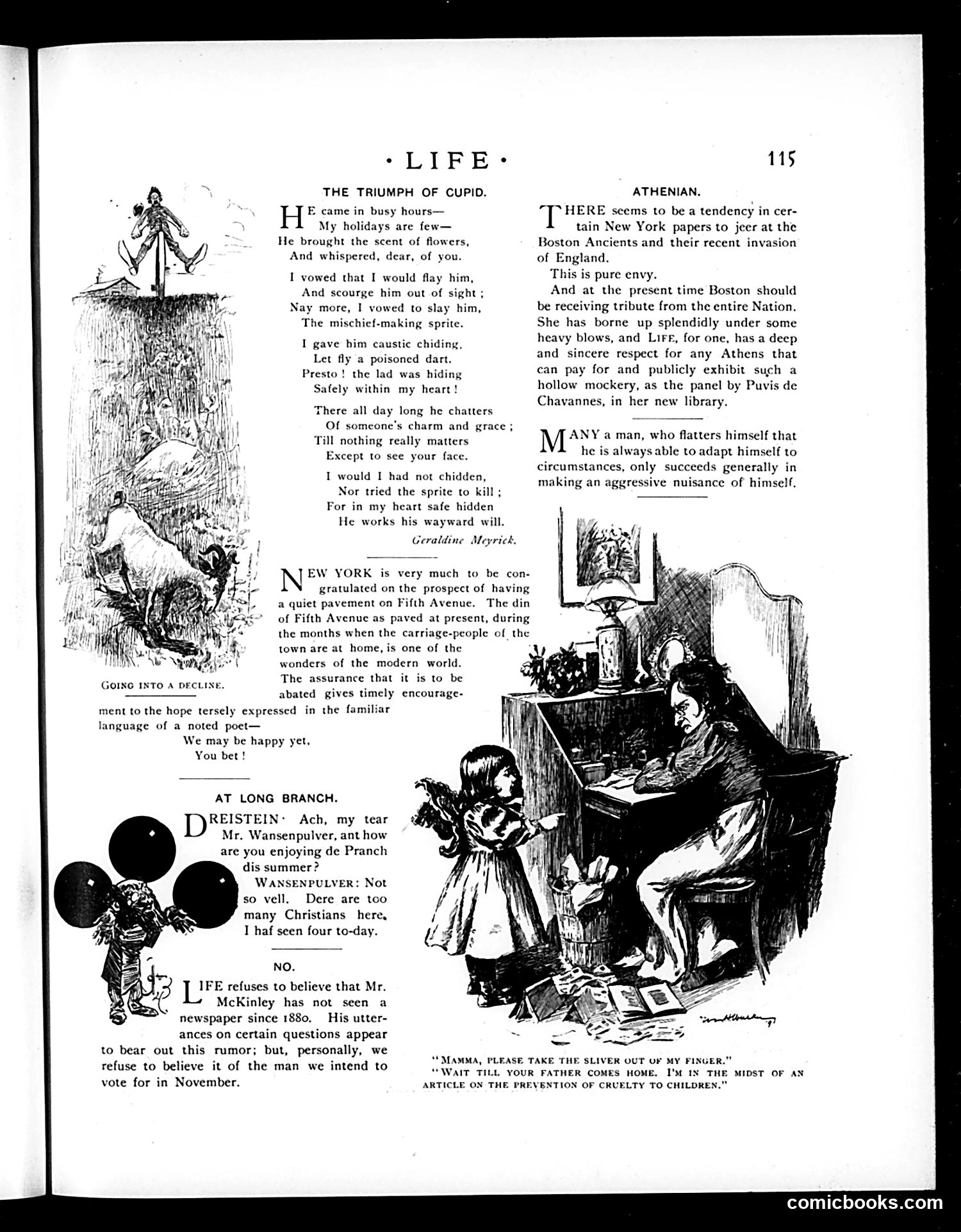
This page contains several satirical pieces typical of Life magazine's social commentary: **"The Triumph of Cupid"** (left poem): A sentimental poem about romantic longing, illustrated with a classical Cupid figure. **"Athenian"** (top right): Mocks New York papers' criticism of Boston's recent prominence, expressing that Boston deserves national recognition for its cultural achievements and library acquisitions. **"At Long Branch"** (middle): A dialogue where Dreistein asks Wansupulver about enjoying the branch this summer. Wansupulver complains about too many Christians present—likely an antisemitic reference reflecting period prejudices. **"No"** (bottom): References Mr. McKinley not being seen in newspapers since 1880, dismissing rumors about him as unreliable gossip before an upcoming November election (likely 1896). The illustration shows a domestic scene of a woman and child with reading material.
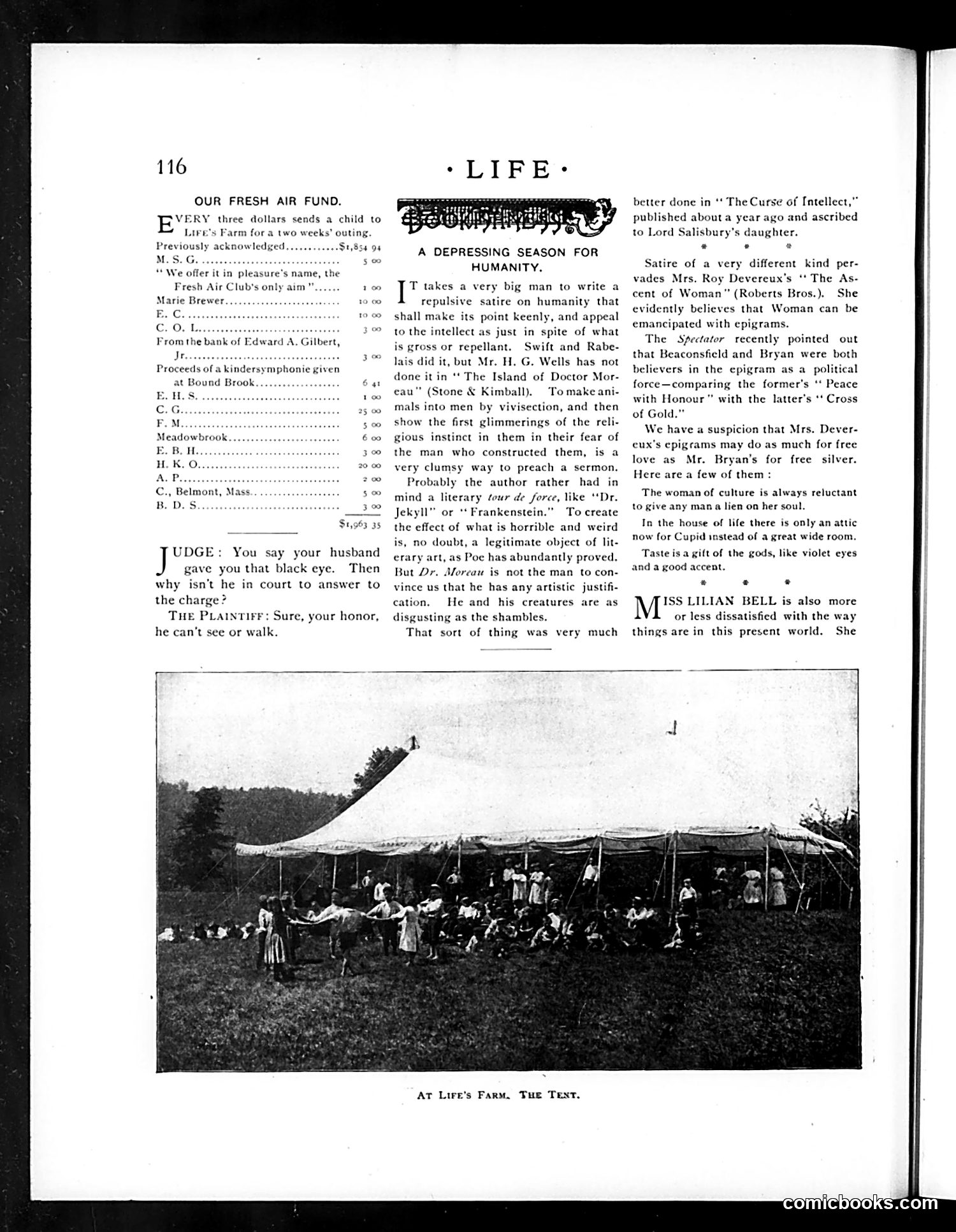
This page from *Life* magazine contains literary criticism rather than political cartoons. The main article, "A Depressing Season for Humanity," reviews H.G. Wells's *The Island of Doctor Moreau*, criticizing Wells for creating grotesque, morally unjustifiable creatures without proper literary purpose. The author argues that unlike Swift or Rabelais, Wells hasn't earned the right to depict such horrors through satire. The page also includes a brief humor piece about a judge questioning why a plaintiff can't appear in court due to a black eye—a simple joke about domestic violence presented as comedy, reflecting period attitudes. The photograph shows "At Life's Farm. The Tent"—appears to be a recreational facility or fair, unrelated to the text above it.
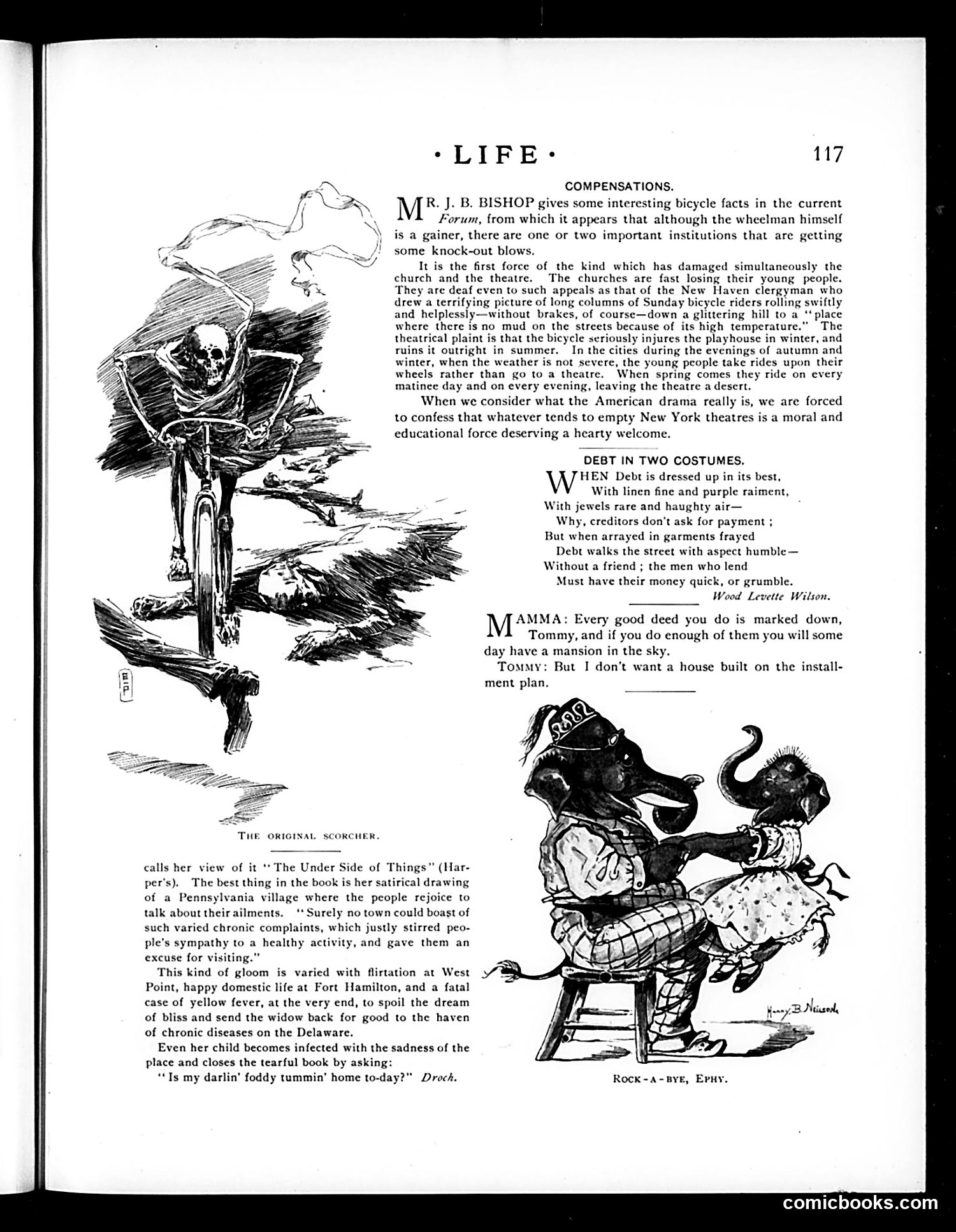
This page contains three distinct satirical pieces: 1. **"Compensations"** - Critiques how bicycles damage theaters and playhouses, especially in winter, as young people prefer riding bicycles to attending shows. The satire targets bicycles' negative cultural impact on theatrical attendance. 2. **"Debt in Two Costumes"** - A poem (attributed to Wood Lovette Wilson) contrasting wealthy debt (dressed in "linen fine and purple raiment") with impoverished debt (walking streets "without a friend"). The satire critiques class disparities in how financial hardship is experienced. 3. **"Rock-a-bye, Ephy"** - A cartoon showing a figure on a rocking chair appearing to rock a small creature. The exact satirical target is unclear from the visible text. The illustrations are period ink sketches typical of early 20th-century satirical magazines.
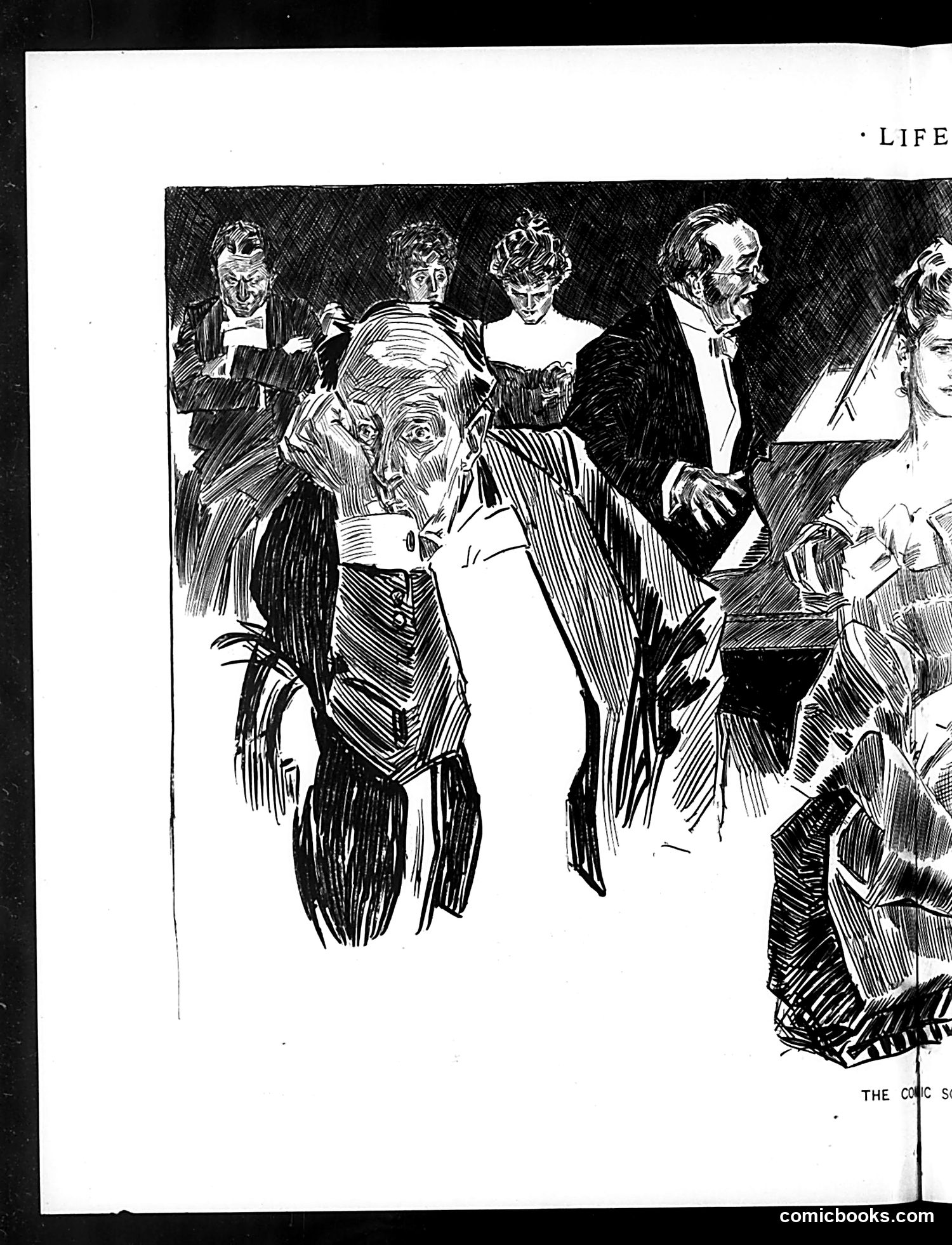
This appears to be a satirical illustration from *Life* magazine depicting a formal social gathering, likely from the early 20th century based on the artistic style and formal attire. The central figure is a gaunt, skeletal man in formal dress (tuxedo with white shirt front) who appears to be the focal point of the scene. He's surrounded by well-dressed socialites and gentlemen in the background. The exaggerated skeletal features and hollow appearance of the main character suggest social satire—possibly mocking a wealthy but emaciated figure, or perhaps someone known for excessive behavior or moral decay despite outward respectability. Without visible text identifying the specific subject or date, the precise political or social target remains unclear, though the contrast between formal elegance and the grotesque physical characterization indicates commentary on hypocrisy or moral emptiness among the upper classes.
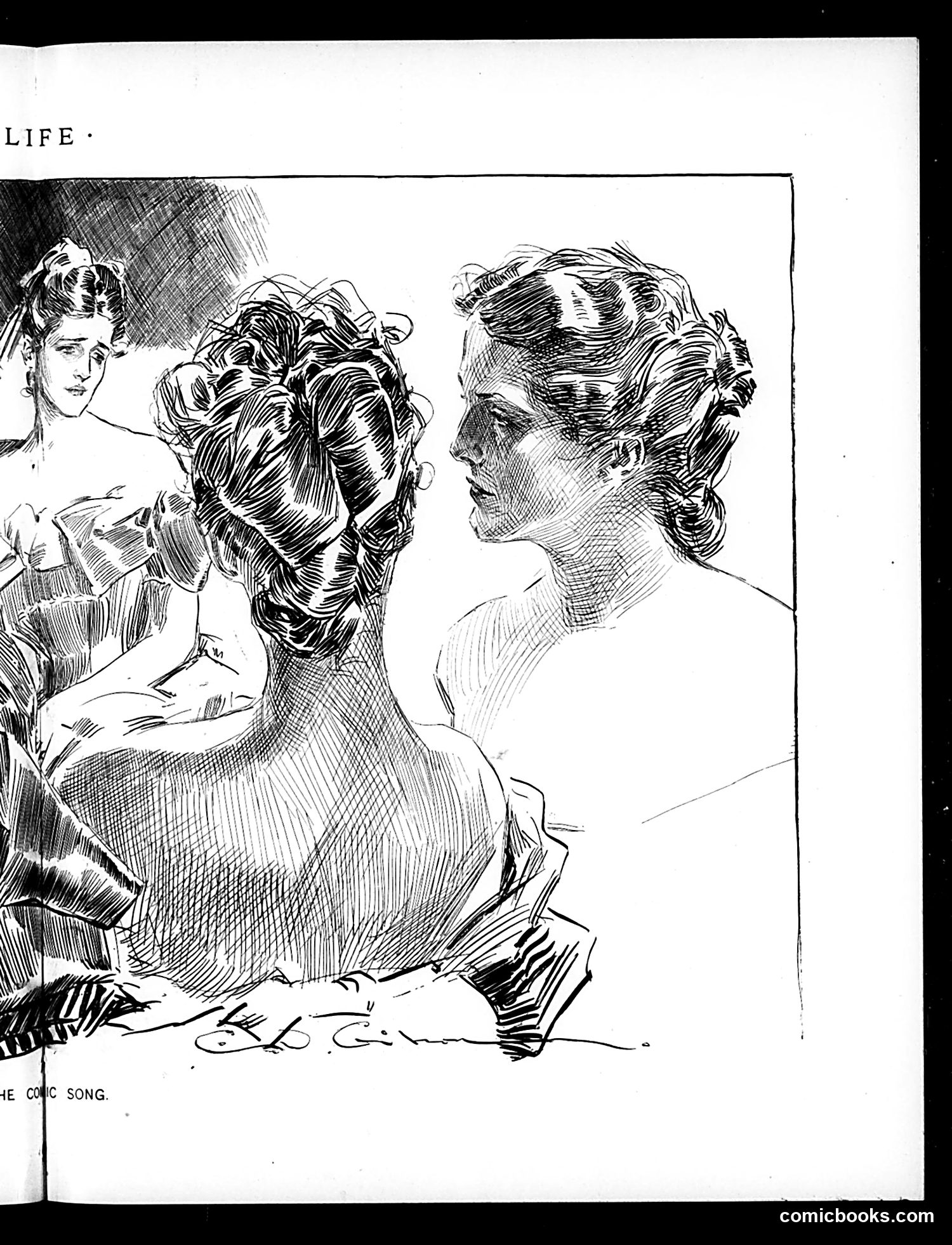
This page from *Life* magazine shows an ink sketch illustration labeled "THE COMIC SONG" (visible at bottom left). The drawing depicts two women in profile with elaborate upswept hairstyles characteristic of early 20th-century fashion. The figure on the right is rendered in greater detail and appears to be the primary subject. Without additional context or visible caption text, the specific satirical point remains unclear. The title "The Comic Song" suggests this may illustrate a humorous musical number or theatrical performance, possibly commentary on popular entertainment, fashion, or social trends of the era. The careful attention to elaborate hairstyling might be the comedic focus, though the exact nature of the satire is not evident from the image alone.
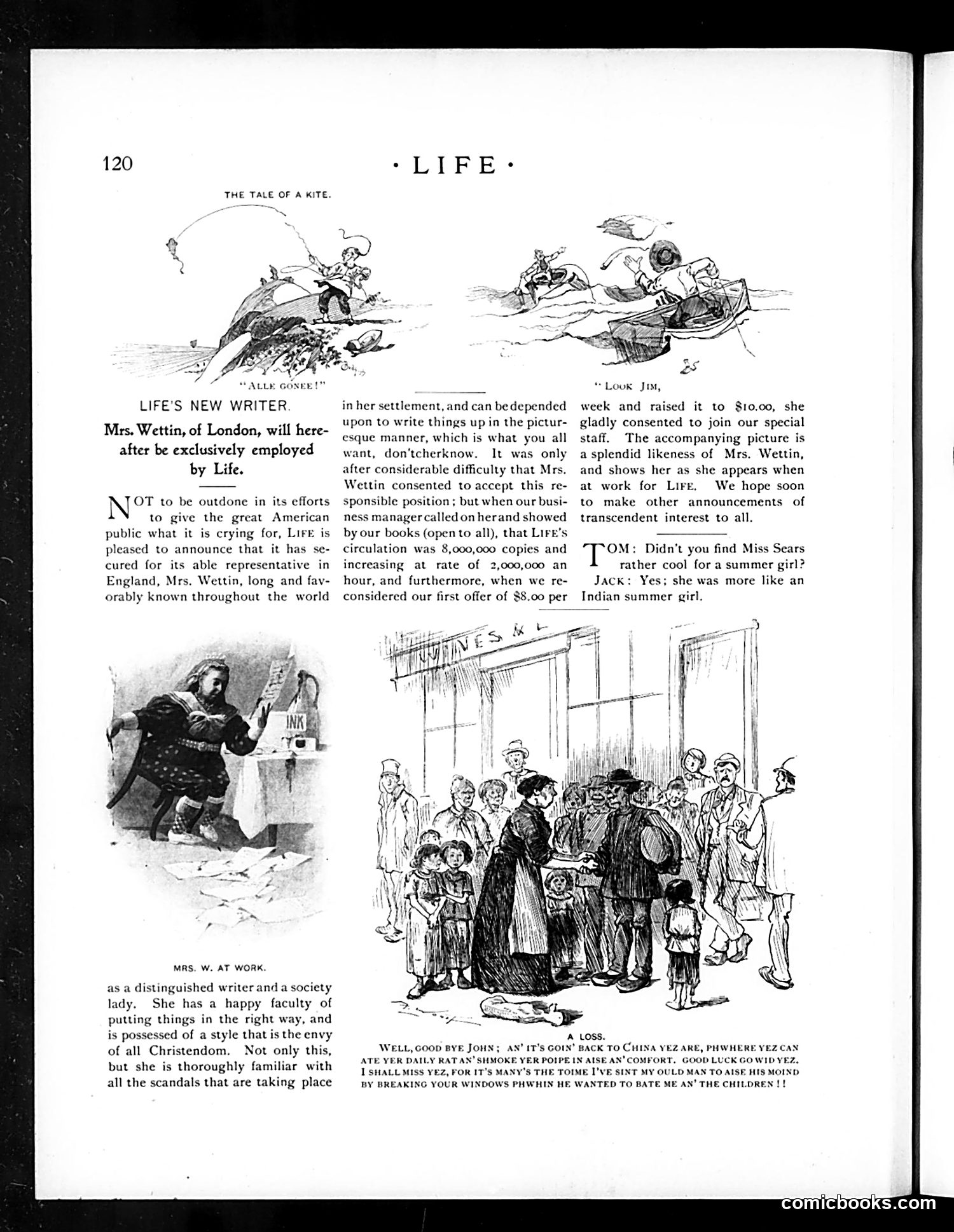
This page announces Mrs. Wettin of London as Life magazine's new exclusive writer. The article boasts that Life has achieved enormous circulation (8,000,000 copies, increasing at 2,000,000 per hour) and can now afford distinguished contributors. The satirical point appears to be about Mrs. Wettin's qualifications: she's described as "a distinguished writer and a society lady" who is "thoroughly familiar with all the scandals that are taking place." The humor lies in suggesting her value lies primarily in gossiping about high-society scandals rather than serious literary merit. The accompanying illustrations show humorous domestic and social scenes typical of Life's satirical style, though the specific references to "Miss Sears" and "Indian summer girl" in the dialogue remain unclear without additional context.
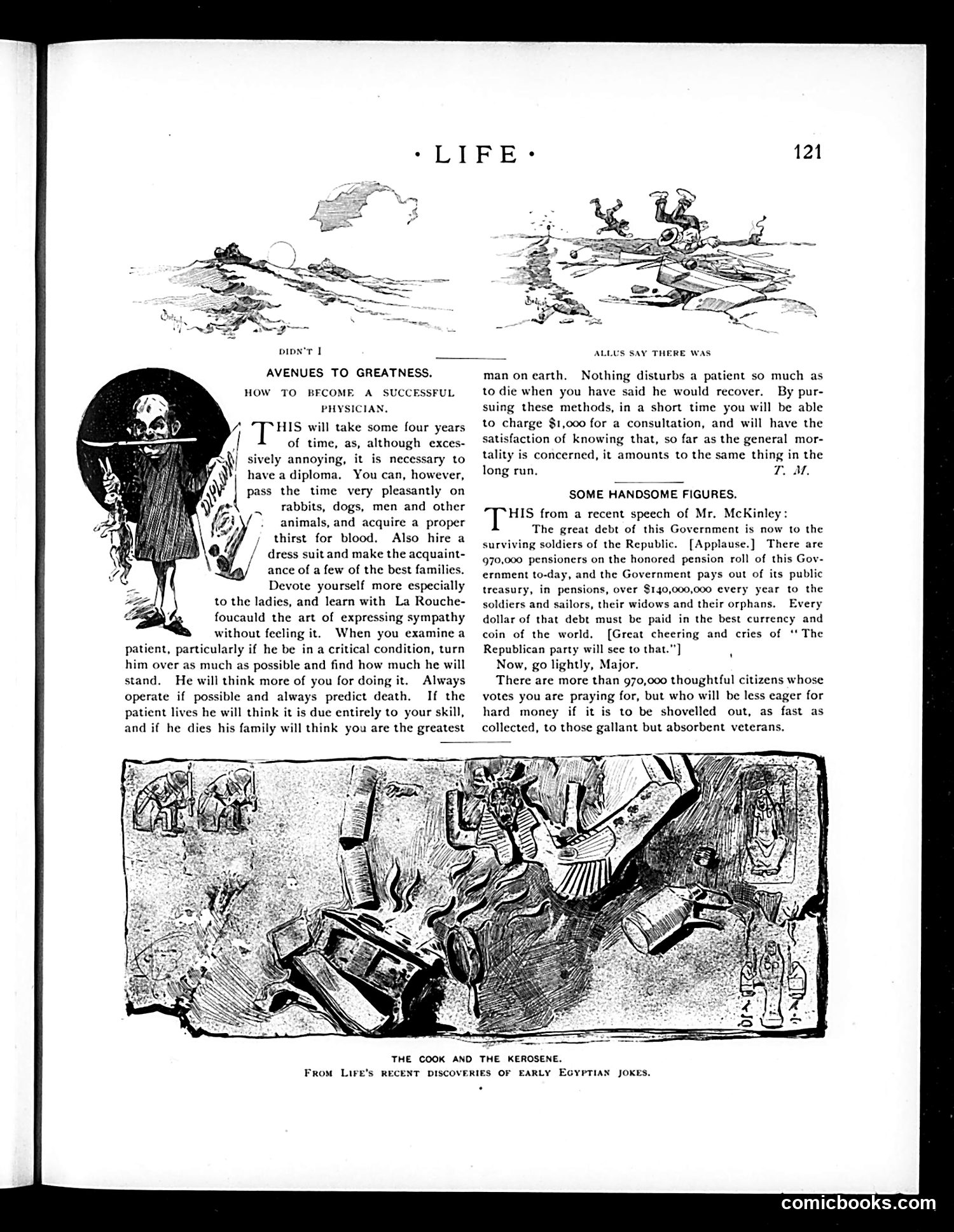
This page contains satirical advice and commentary rather than a political cartoon. The main article, "Avenues to Greatness: How to Become a Successful Physician," mocks medical practice by suggesting doctors can succeed by practicing on animals first, hiring fashionable dress and acquaintances, and learning to express sympathy without caring. The joke targets physician pretension and profit-seeking. A second section titled "Some Handsome Figures" quotes McKinley-era Republican rhetoric about pension debt to Civil War veterans (970,000 pensioners costing $140 million annually). The satire appears to criticize the party's boasting about soldier pensions while criticizing government spending. The bottom illustration, "The Cook and the Kerosene," references early Egyptian jokes—likely a nonsensical punchline typical of period humor.
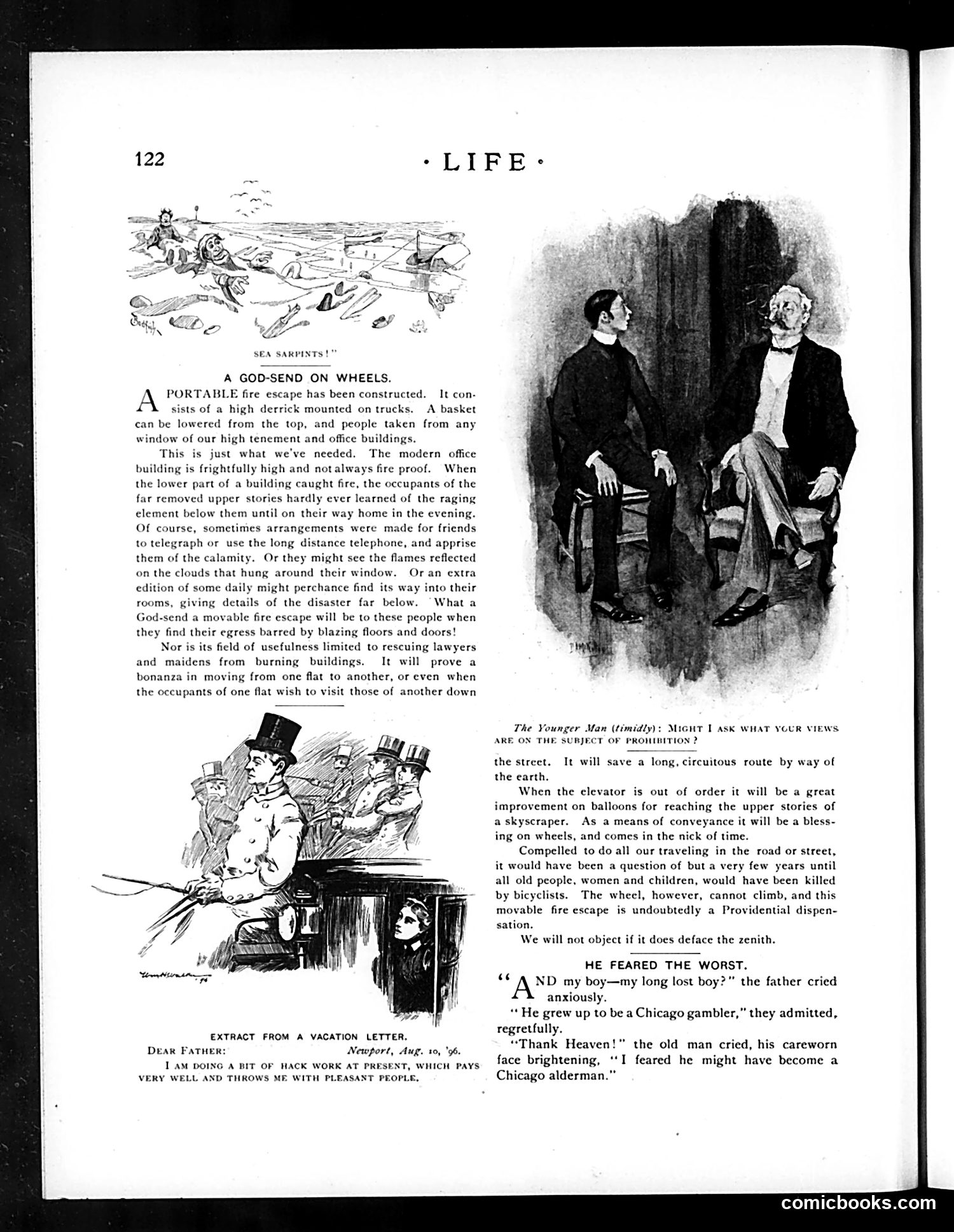
This page from *Life* satirizes contemporary urban concerns through multiple cartoons: **"A God-Send on Wheels"** mocks the hazards of tall office buildings and modern city life. The article describes a portable fire escape on wheels with heavy sarcasm—praising how occupants of upper floors wouldn't even know their building was burning until evening. The satire targets inadequate building safety and the absurdity of relying on newspapers or telephone calls to learn of disasters. It extends the joke by suggesting the device could serve as cheap moving equipment or a substitute for broken elevators. **"He Feared the Worst"** presents a darker joke: a father reunites with his long-lost son, dreading what profession he might have adopted. The punchline reveals the son became a "Chicago gambler"—bad enough—but the father is *relieved*, saying "Thank Heaven" he didn't become a "Chicago alderman." This satirizes Chicago politics and government corruption as worse than gambling, suggesting aldermen were viewed as criminals or moral failures. The caption implies municipal corruption was rampant and notorious.
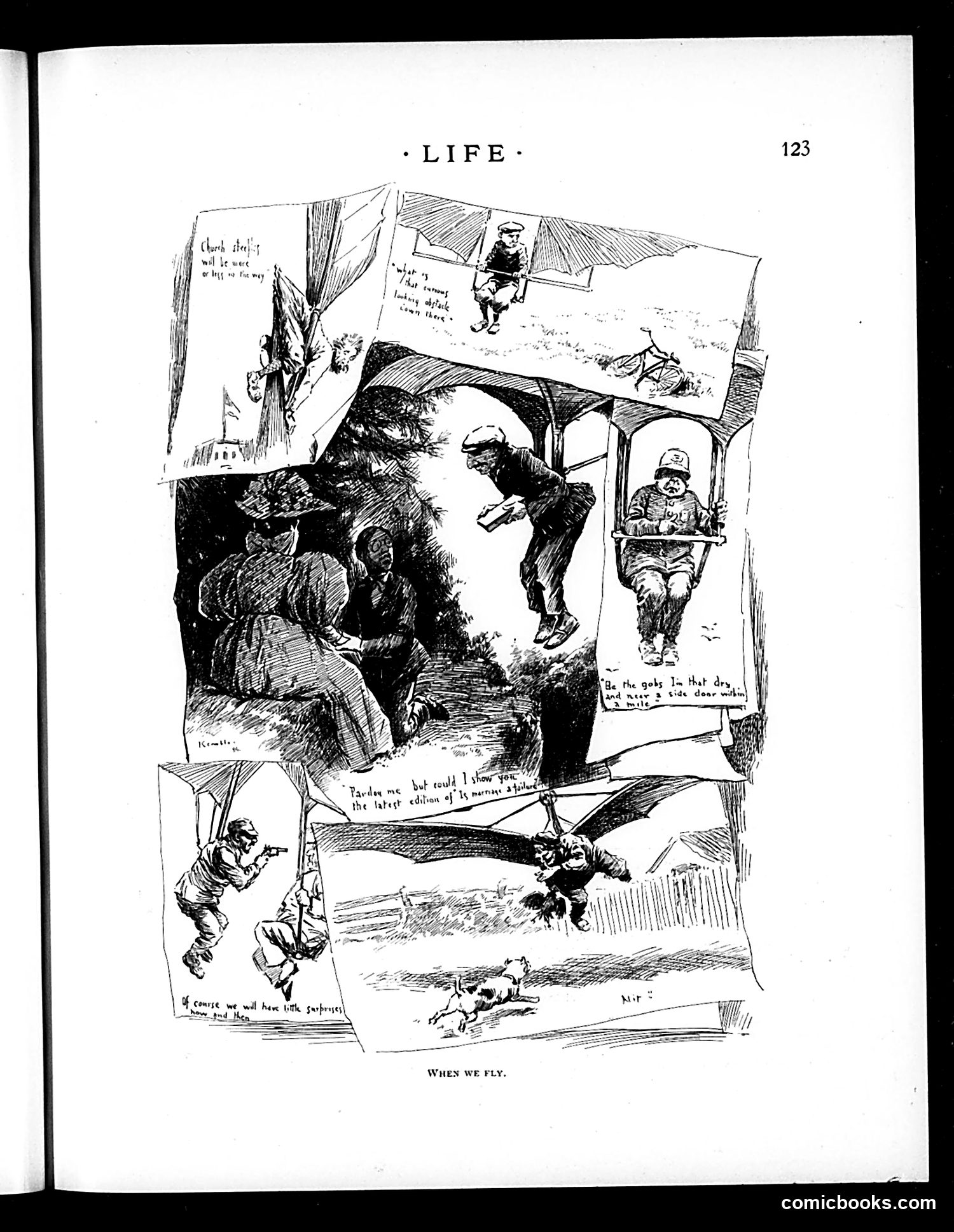
This page from *Life* magazine presents a satirical comic strip about aviation, titled "When We Fly." The sketches show children engaged in imaginative flying scenarios using homemade equipment—kites, makeshift wings, and improvised contraptions. The humor appears to target early aviation enthusiasm and children's earnest attempts to replicate flight. The OCR text is fragmentary, but phrases like "the latest edition" suggest mockery of contemporary aviation claims or technology. The strip satirizes both childish imitation of adults and possibly the broader early-20th-century obsession with aviation as the frontier of modern achievement. The crude drawings contrast innocent childhood play with grandiose adult ambitions around flight technology.
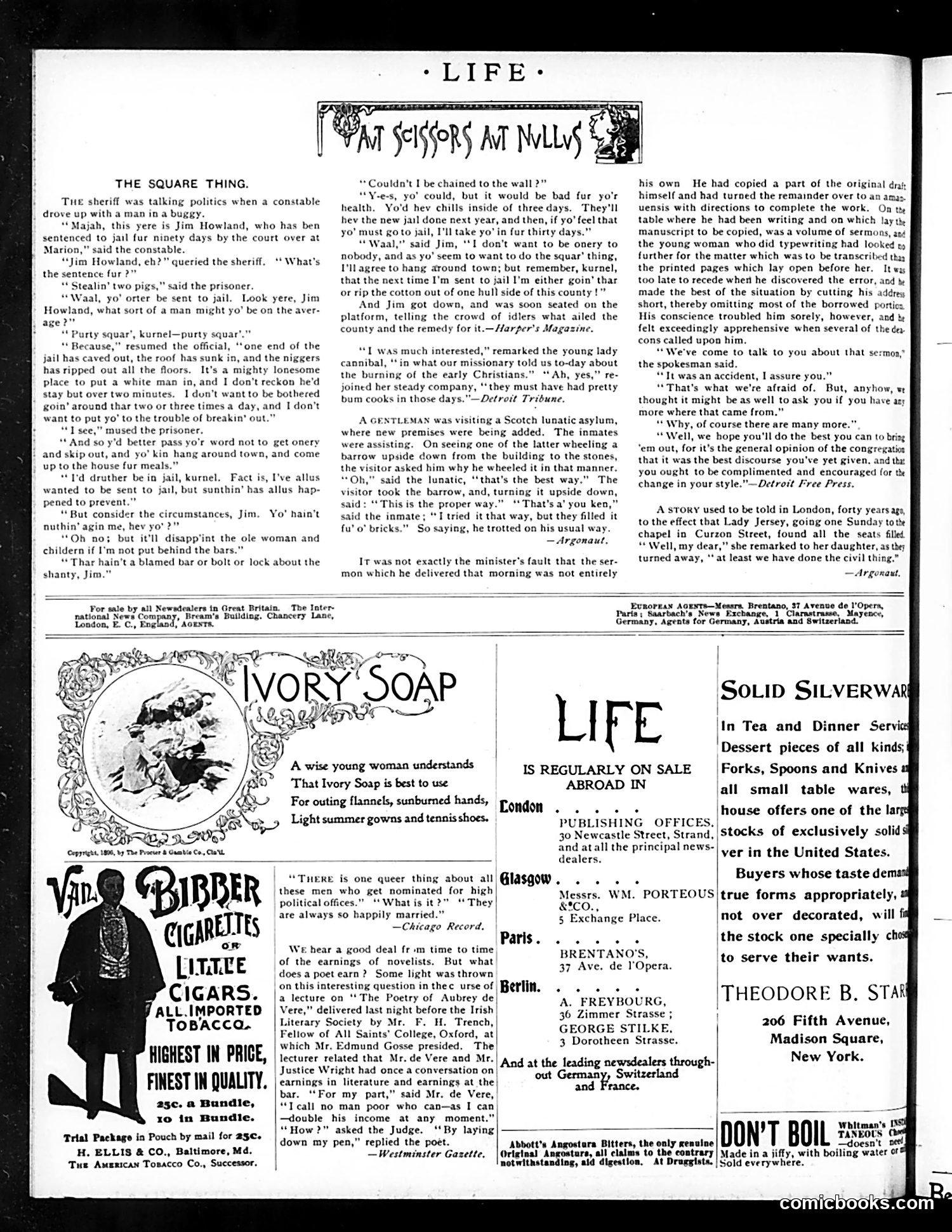
This page contains humorous anecdotal stories typical of Life's satirical humor. The main cartoon story depicts a rural Southern sheriff offering a convicted pig thief (Jim Howland) an informal arrangement: instead of jail time in a decrepit, unusable facility, the man can remain free in town on his "word" as a "square" person, returning only for meals. The satire targets the informal, honor-based justice system of the rural South—where a prisoner's reputation for being "square" (honest/trustworthy) substitutes for actual incarceration. The sheriff essentially admits the jail is uninhabitable and trusts the criminal on his character rather than enforcing legal consequences. Other brief jokes mock religious hypocrisy (a cannibal praising Christian martyrs' poor cooking) and Scottish asylum logic (an inmate's backwards wheelbarrow method). The page also contains period advertisements for Ivory Soap and Van Bibber Cigarettes, typical of magazine content from this era.
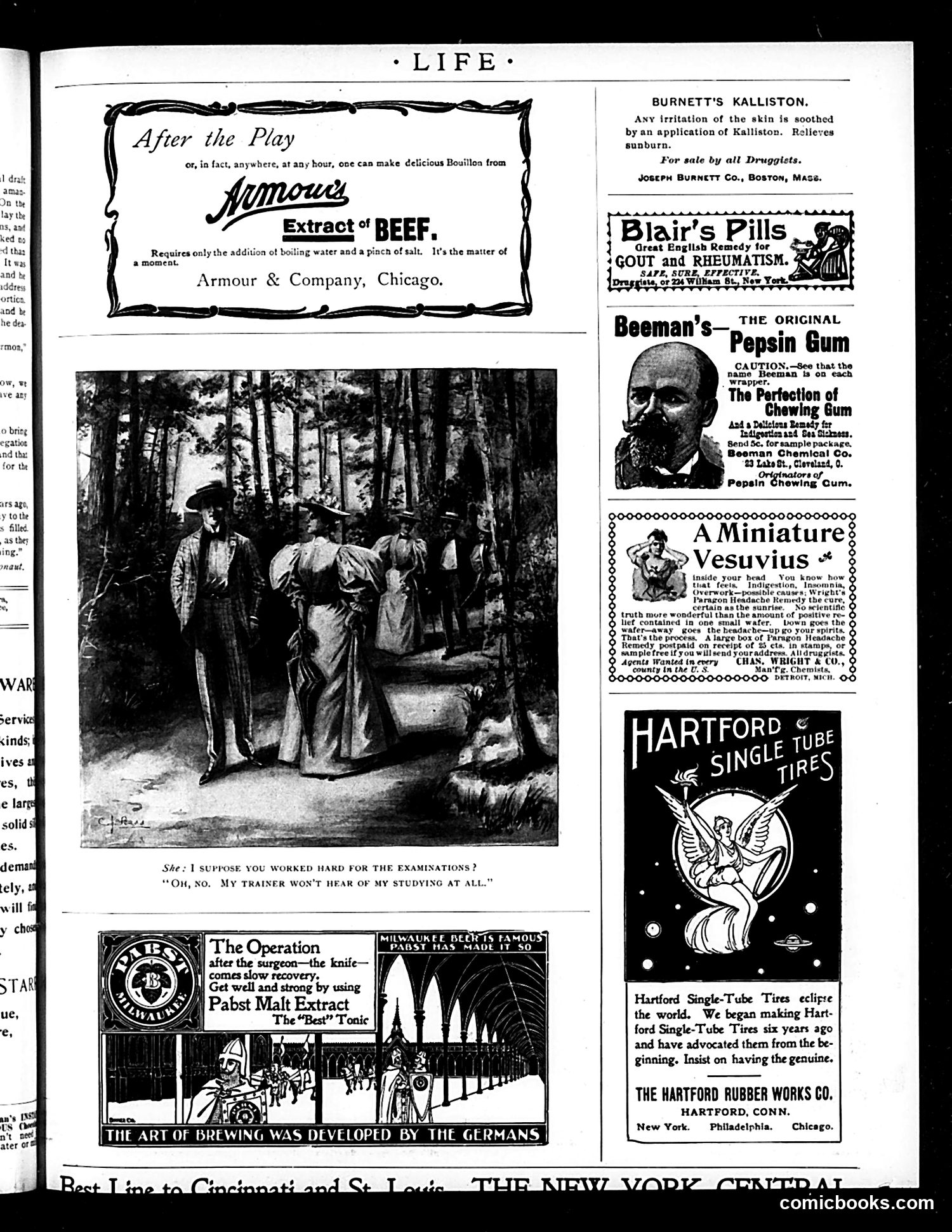
This page is primarily **advertising**, not satirical content. The main cartoon depicts a post-theater conversation between a man and woman. When he asks if she studied hard for examinations, she replies that her trainer forbids it—a joke suggesting she's an athlete (likely a boxer or similar competitor) rather than a student, subverting the expected academic context. The page is dominated by early 1900s patent medicine and consumer product ads: beef extract, malt extract tonics, pills for gout and rheumatism, pepsin chewing gum (marketed as digestive aid), headache remedies, and tire advertisements. These ads reflect the era's widespread promotion of dubious medicinal products before FDA regulations. The humor is minimal; the page functions as commercial space with one light social joke about athletic training culture.
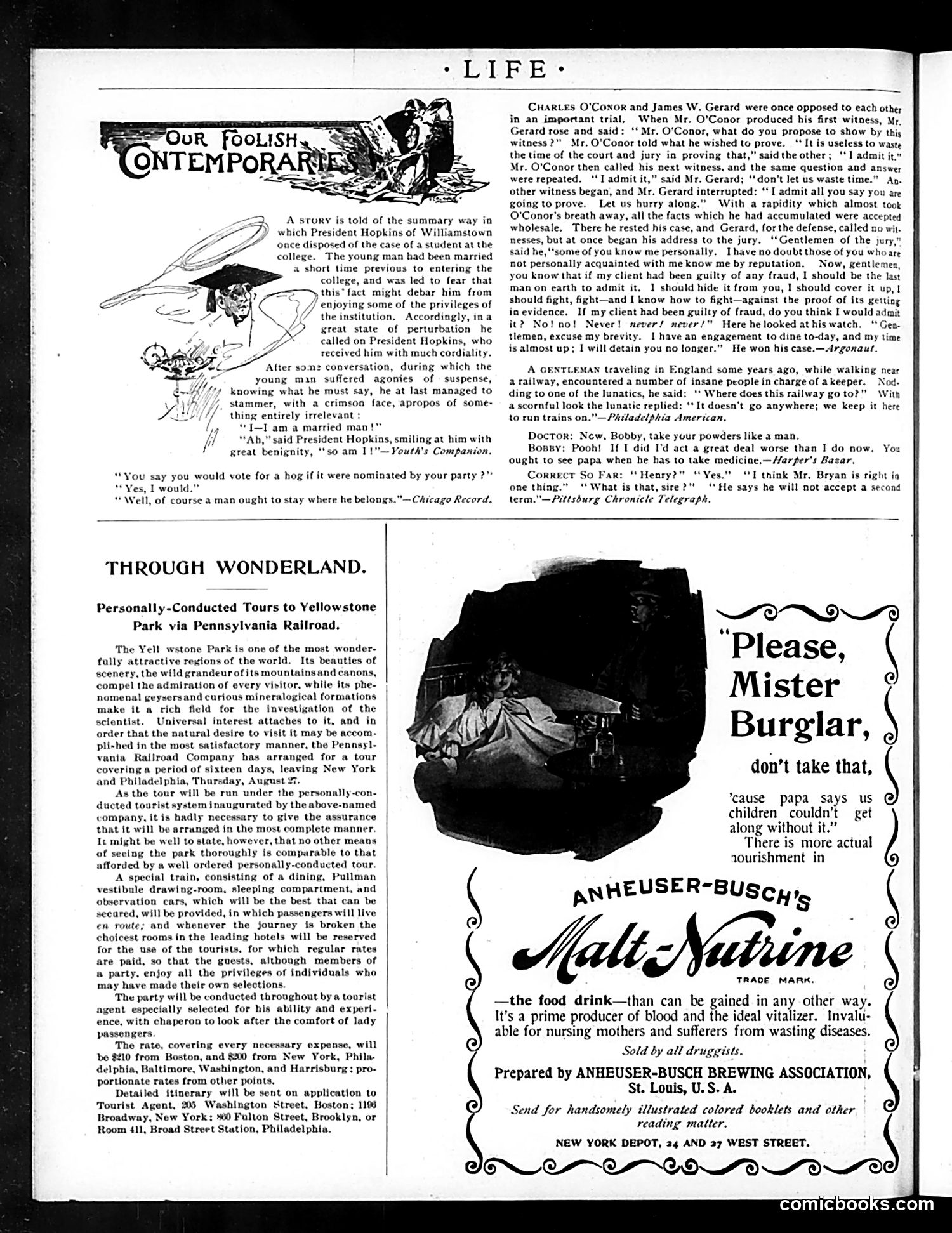
This page from *Life* magazine collects humorous anecdotes mocking human folly and legal/political absurdity. The main cartoon (top left) illustrates a college president's equanimous response to a student's anxiety about being married—a light domestic humor piece. The larger satirical content ridicules: 1. **Blind partisanship**: A voter admitting he'd vote for "a hog" if nominated by his party—critique of mindless party loyalty. 2. **Legal theater**: A detailed anecdote about lawyer James W. Gerard admitting all opposing facts, then dismissing his own client's case due to time constraints—mocking lawyers' performative grandstanding and the absurdity of courtroom procedure. 3. **Institutional lunacy**: Various brief jokes about education, medicine, and politics, including a reference to William Jennings Bryan declining another political term. The page's title "Our Foolish Contemporaries" signals *Life*'s satirical purpose: exposing contemporary American social, legal, and political pretension through humorous anecdotes that reveal contradiction and vanity.
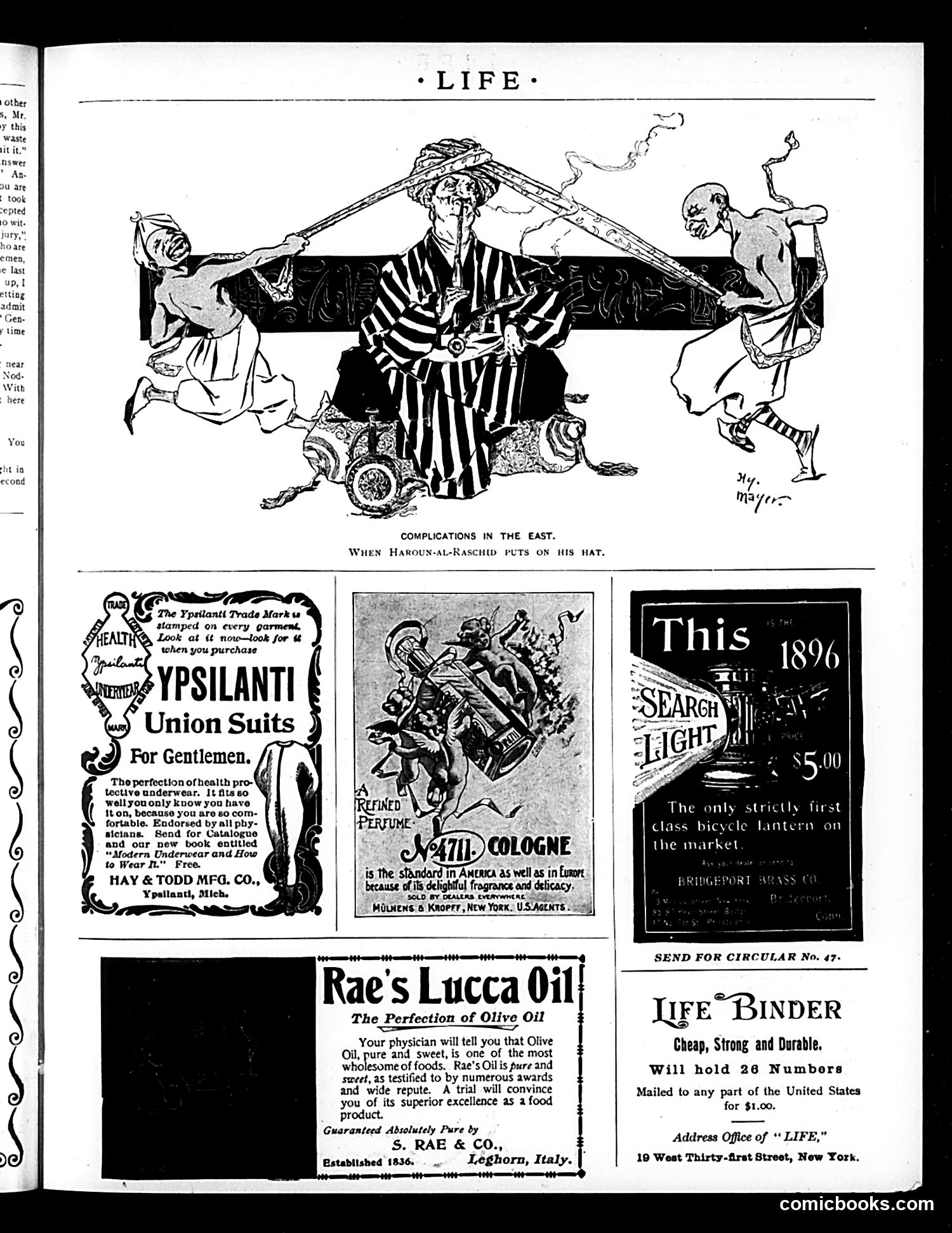
The main cartoon depicts a figure labeled "Haroun-al-Raschid" (the legendary Caliph from *Arabian Nights*) as a central character surrounded by dancing, scheming figures. The title references him "putting on his hat"—suggesting diplomatic posturing or political maneuvering. This appears to satirize **late-19th-century Middle Eastern politics**, likely Ottoman Empire affairs or colonial complications in the region. "Haroun-al-Raschid" is used as a stand-in for Eastern rulers, while the surrounding figures probably represent European powers or regional actors intriguing around him. The "complications" referenced are geopolitical entanglements typical of the era's imperial competition in Asia and the Middle East. The exaggerated, caricatured style emphasizes Western satirical mockery of Eastern politics as chaotic and theatrical. The page is primarily **advertisements** (union suits, cologne, oil, bicycle lanterns), with the cartoon as the featured editorial content.
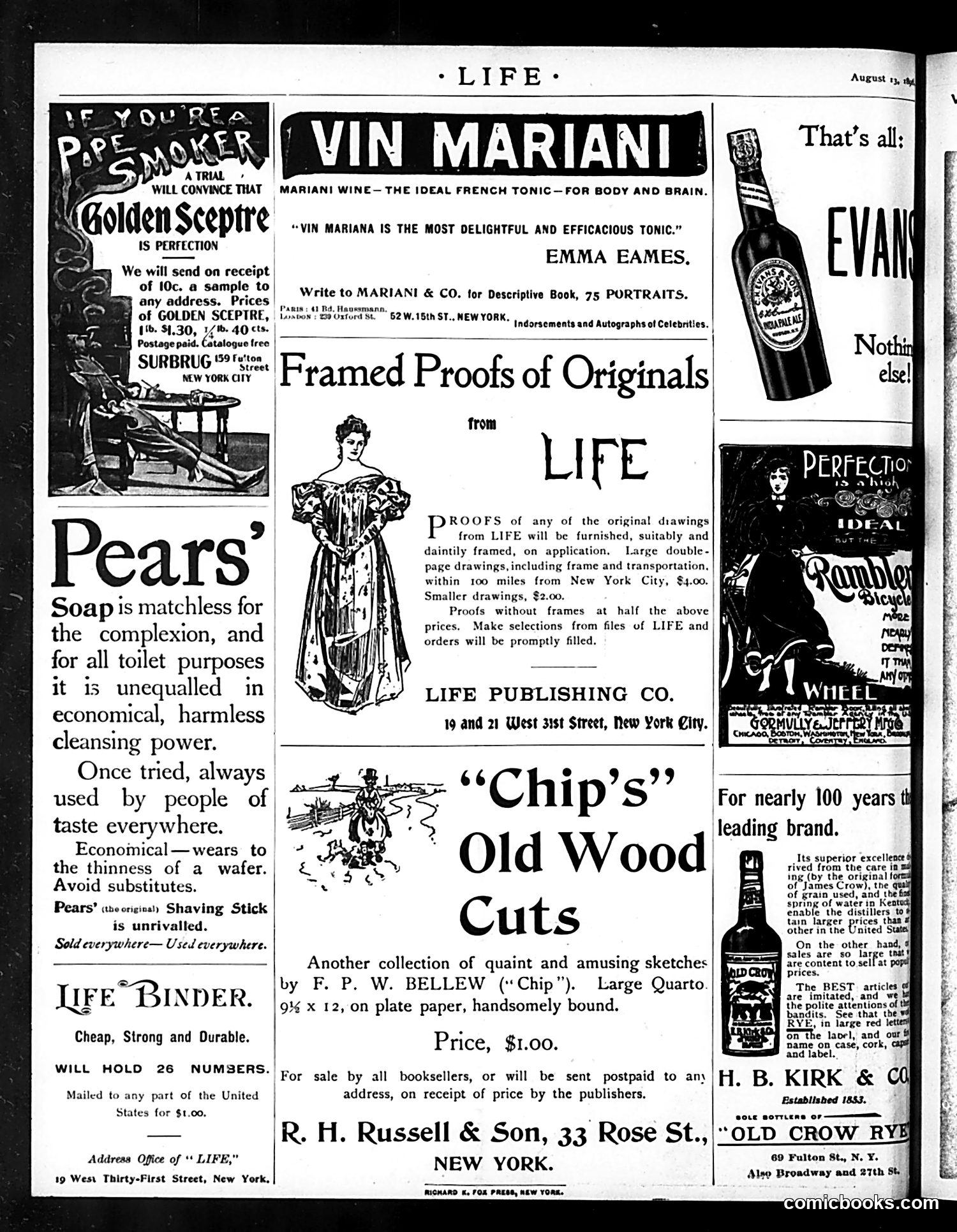
This is primarily an **advertising page** from Life magazine (date visible: August 23). Rather than satirical content, it features commercial advertisements typical of early 20th-century publications. **Key advertisements:** - **Vin Mariani wine**: A "French tonic" claimed to benefit "body and brain," endorsed by opera singer Emma Eames. This reflects the era's widespread marketing of wine and patent medicines as health tonics—practices that would later face regulation. - **Pears' Soap**: Emphasizes complexion improvement and economical use, appealing to aspirational consumers. - **Life Publishing offerings**: The magazine itself sold framed artwork proofs and bound collections of back issues. - **Whiskey and other spirits** (right side): Old Crow Rye and similar products advertised with claims of quality and longevity. The page reveals how early 20th-century Life functioned as an advertising vehicle alongside editorial content, and how unregulated health claims were standard commercial practice.