
Life, 1896-08-13 · page 4 of 18
Life — August 13, 1896 — page 4: what you’re looking at
What you’re looking at
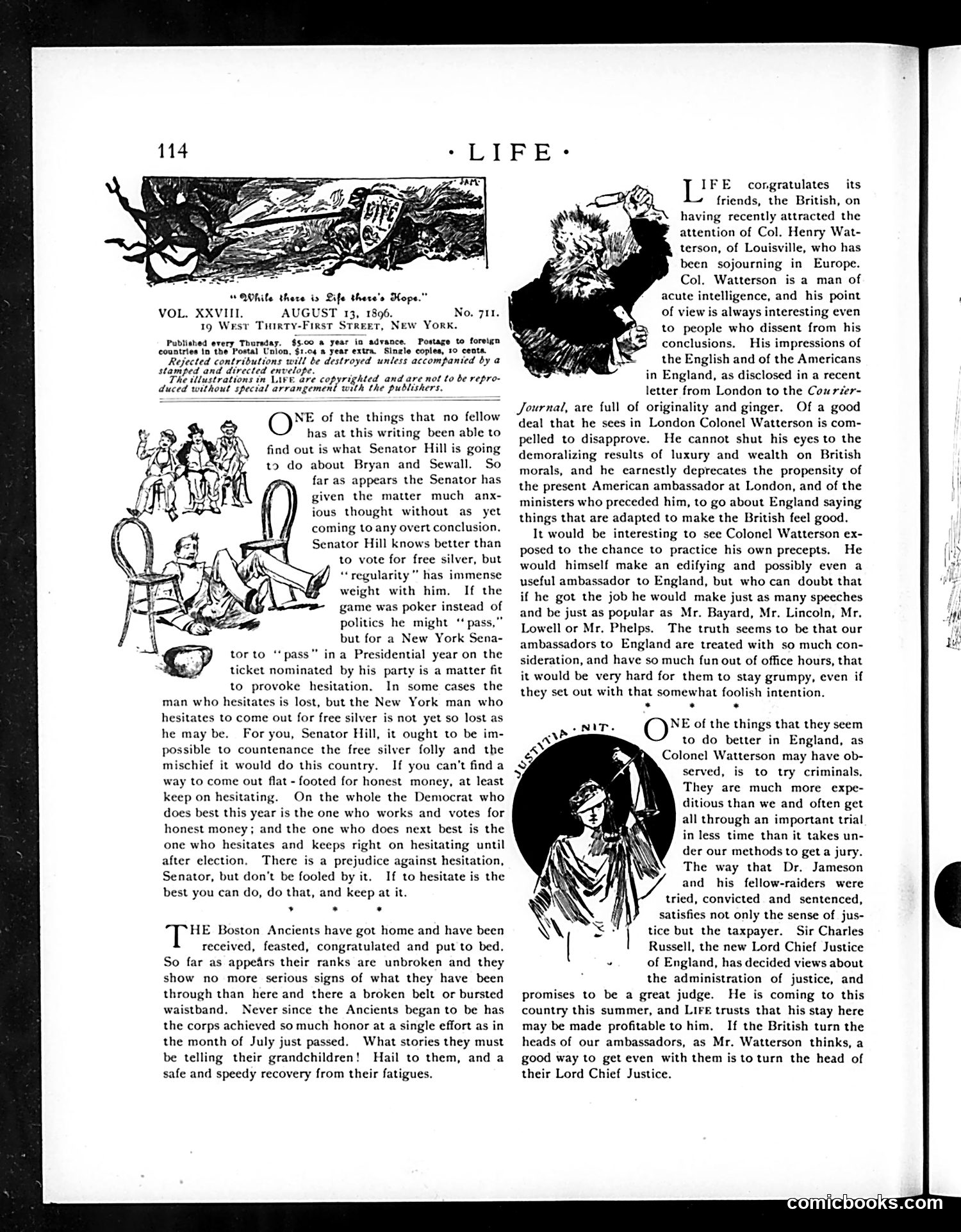
The main cartoon depicts **Senator Hill** (likely David B. Hill of New York) in a poker game, labeled as someone uncertain about voting for "free silver"—a major 1896 election issue. The satire criticizes Hill for political cowardice: he won't commit to either position on currency policy, the text explains, making him unreliable during a presidential election year. The article also praises **Col. Henry Watterson** (a prominent journalist) for his observations about British attitudes toward American wealth and morality. A secondary section discusses **Dr. Jameson's trial** (the failed 1895 Jameson Raid in South Africa) and mentions **Sir Charles Russell**, the new Lord Chief Justice of England, suggesting British legal reforms. The satire targets political indecision and inconsistency.
📄 Transcribed text from this page (OCR, searchable)
Machine-transcribed from the original scan — historical spelling and the odd misread are preserved.
“QWVhile there is Life there's Hope.” VOL. XXVIII AUGUST 13, 1896. 19 West Twirty-First STREE Published every Thursday. $5.00 a year in advance. Postage to foreign countries In the Postal Union, $1.04 a year extra. Single coples, 10 cents. Rejected contributions twill be destroyed unless accompanied by a stamped and directed envelope. The illustrations in LA¥E are copyrighted and are not to be repro- duced without special arrangement with the publishers, NE of the things that no fellow has at this writing been able to find out is what Senator Hill is going to do about Bryan and Sewall. So far as appears the Senator has given the matter much anx- ious thought without as yet coming to any overt conclusion. Senator Hill knows better than to vote for free silver, but “regularity” has immense weight with him, If the game was poker instead of politics he might ‘‘ pass,” but for a New York Sena- torto ‘‘pass” ina Presidential year on the ticket nominated by his party is a matter fit to provoke hesitation. In some cases the man who hesitates is lost, but the New York man who hesitates to come out for free silver is not yet so lost as he may be. For you, Senator Hill, it ought to be im- possible to countenance the free silver folly and the mischief it would do this country. If you can't finda way to come out flat - footed for honest money, at least keep on hesitating. On the whole the Democrat who does best this year is the one who works and votes for honest money; and the one who does next best is the one who hesitates and keeps right on hesitating until after election, There is a prejudice against hesitation, Senator, but don’t be fooled by it. If to hesitate is the best you can do, do that, and keep at it. HE Boston Ancients have got home and have been received, feasted, congratulated and put to bed. So far as appears their ranks are unbroken and they show no more serious signs of what they have been through than here and there a broken belt or bursted waistband. Never since the Ancients began to be has the corps achieved so much honor at a single effort as in the month of July just passed. What stories they must be telling their grandchildren! Hail to them, and a safe and speedy recovery from their fatigues. IFE congratulates _ its friends, the British, on having recently attracted the attention of Col. Henry Wat- terson, of Louisville, who has been sojourning in Europe. Col. Watterson is a man of acute intelligence, and his point of view is always interesting even to people who dissent from his conclusions, His impressions of the English and of the Americans in England, as disclosed in a recent letter from London to the Courier- Journal, are full of originality and ginger. Of a good deal that he sees in London Colonel Watterson is com- pelled to disapprove. He cannot shut his eyes to the demoralizing results of luxury and wealth on British morals, and he earnestly deprecates the propensity of the present American ambassador at London, and of the ministers who preceded him, to go about England saying things that are adapted to make the British feel good. It would be interesting to see Colonel Watterson ex- posed to the chance to practice his own precepts. He would himself make an edifying and possibly even a useful ambassador to England, but who can doubt that if he got the job he would make just as many speeches and be just as popular as Mr. Bayard, Mr. Lincoln, Mr. Lowell or Mr. Phelps. The truth seems to be that our ambassadors to England are treated with so much con- sideration, and have so much fun out of office hours, that it would be very hard for them to stay grumpy, even if they set out with that somewhat foolish intention. . . . NE of the things that they seem to do better in England, as Colonel Watterson may have ob- served, is to try criminals. They are much more expe- ditious than we and often get all through an important trial in less time than it takes un- der our methods to get a jury. The way that Dr. Jameson and his fellow-raiders were tried, convicted and sentenced, satisfies not only the sense of jus- tice but the taxpayer. Sir Charles Russell, the new Lord Chief Justice of England, has decided views about the administration of justice, and promises to be a great judge. He is coming to this country this summer, and LIFE trusts that his stay here may be made profitable to him. If the British turn the heads of our ambassadors, as Mr. Watterson thinks, a good way to get even with them is to turn the head of their Lord Chief Justice. -NIT.