
A complete issue · 20 pages · 1896
Life — July 16, 1896
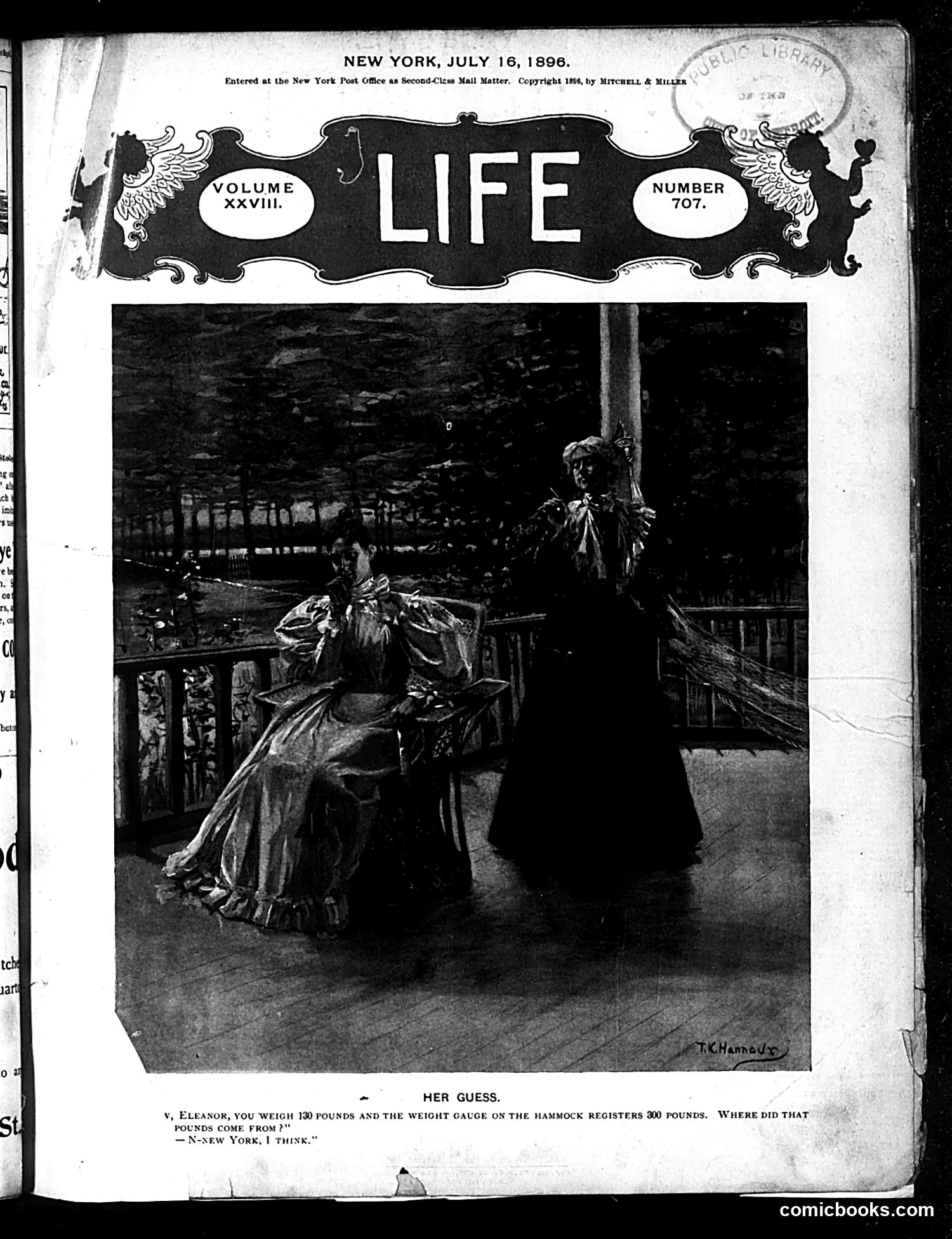
This satirical illustration titled "Her Guest" depicts a social commentary on wealth and class. The caption presents a dialogue where "Eleanor" is questioned about weighing 130 pounds while a weight gauge registers 200 pounds—with the punchline attributing the discrepancy to a hammock's weight. The cartoon satirizes the pretensions of wealthy women of the 1890s. The elaborate dress, leisured pose in a hammock, and the suggestion that a guest's true "weight" (financial burden or social liability) exceeds appearances mock the superficiality of high society. The humor hinges on the gap between self-presentation and reality—a common theme in Gilded Age satire about aristocratic excess and social climbing.
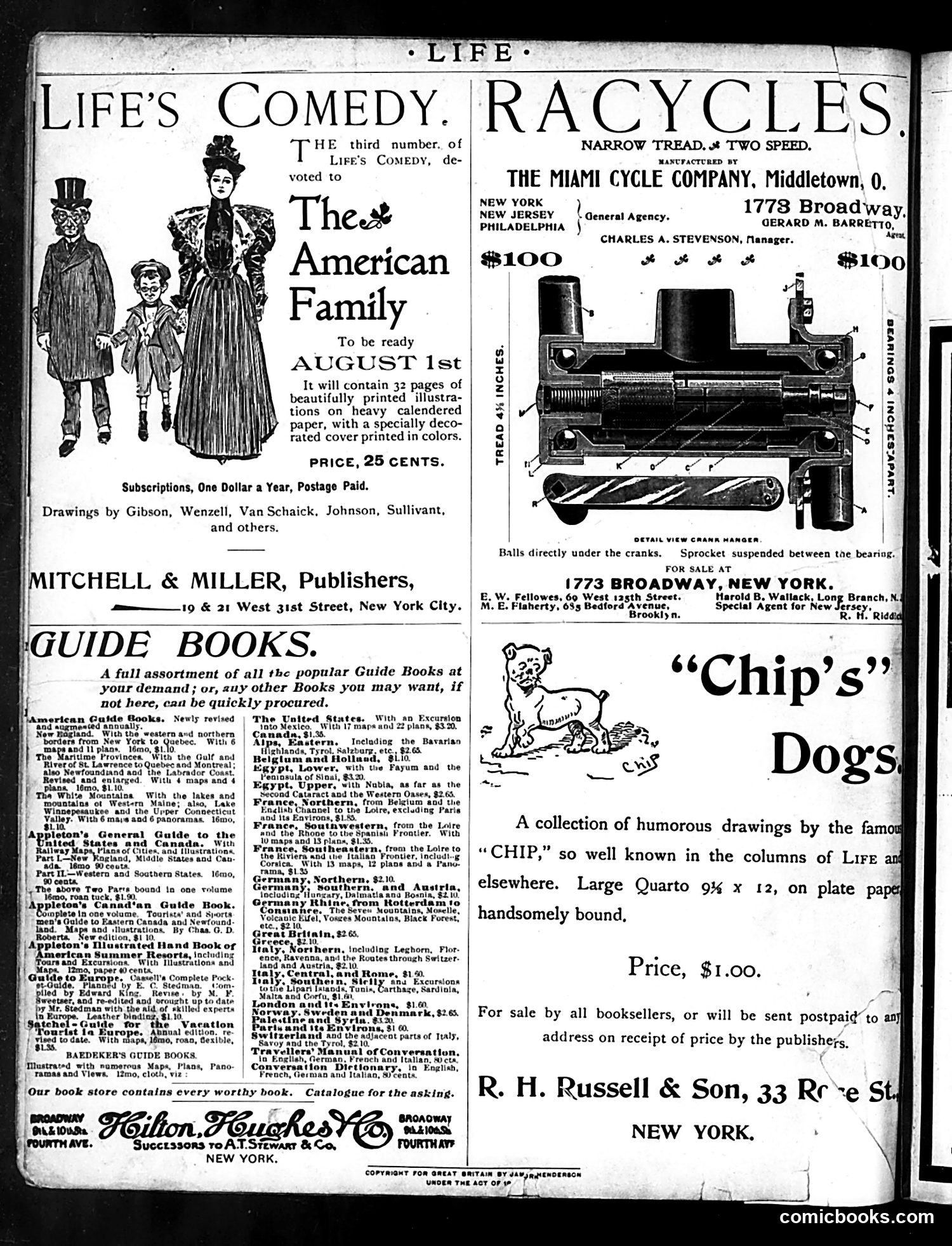
This page is primarily **advertising**, not political satire. The left side advertises "Life's Comedy: The American Family," the third issue of Life's Comedy series—a 32-page illustrated publication priced at 25 cents, ready August 1st, featuring drawings by Gibson, Wendell, Van Schaick, Johnson, and Sullivan. The right side contains ads for Miami Cycle Company's "Racycles" ($100) and an advertisement for "Chip's Dogs," a collection of humorous drawings by the cartoonist "Chip," well-known in Life magazine, priced at $1.00. The left illustration shows a fashionable family group in period dress, likely representing the kind of domestic humor that would appear in Life's Comedy publication.
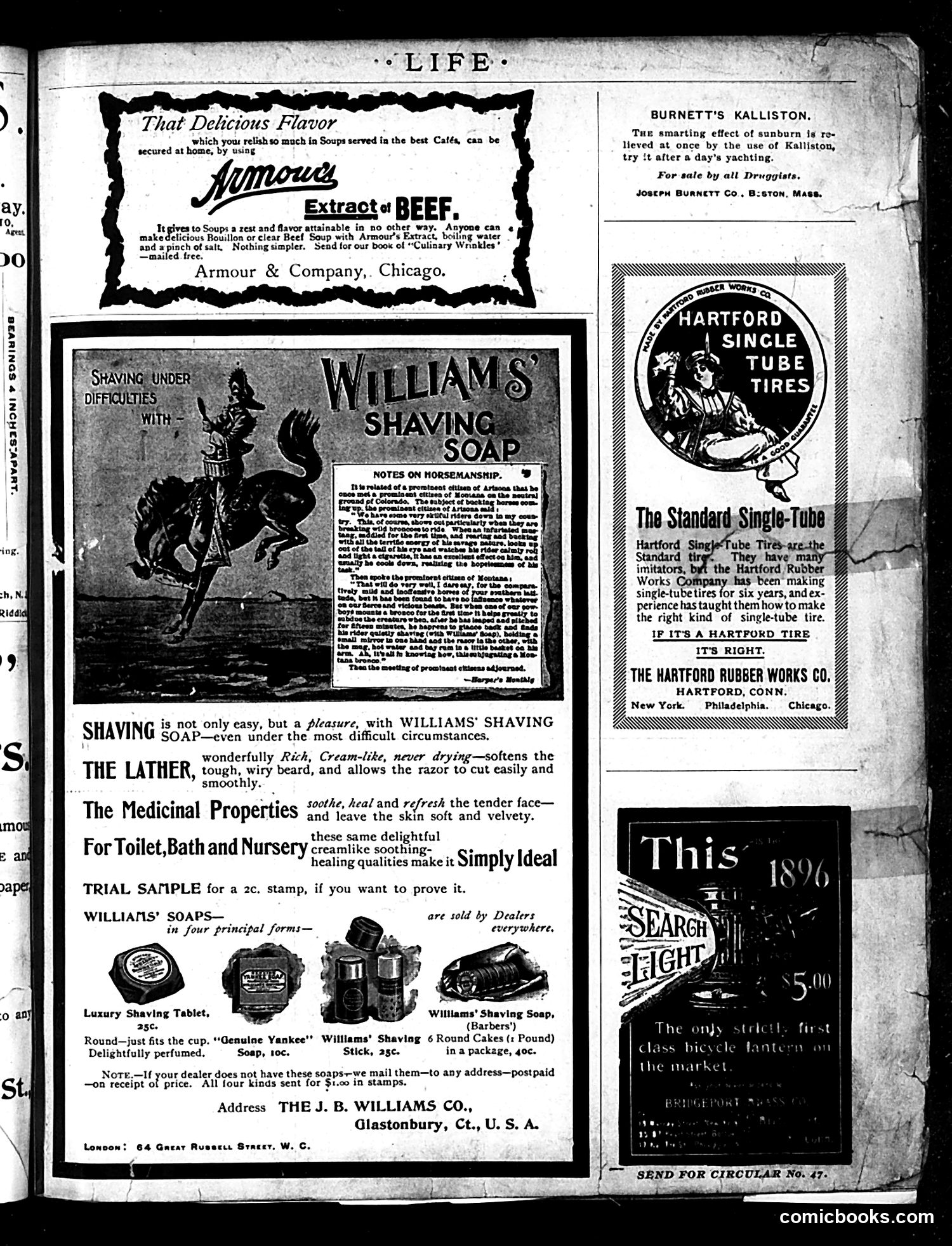
This page is **primarily advertising**, not satirical content. It contains four commercial advertisements from the 1890s: 1. **Armour's Extract of Beef** - promoting soup flavoring 2. **Williams' Shaving Soap** - emphasizing its lather and medicinal properties for sensitive skin 3. **Hartford Single-Tube Tires** - claiming superiority over imitators, positioning themselves as the original maker 4. **Search Light Bicycle Lantern** (1896) - advertising "the only strict, first class bicycle lantern on the market" The only illustration with narrative content is the Williams' Soap ad, which shows a man on horseback having shaving difficulties—used to demonstrate the product's effectiveness. This is straightforward product marketing rather than political or social satire. The page reflects typical late-19th-century *Life* magazine content mixing humor with commercial advertisements.
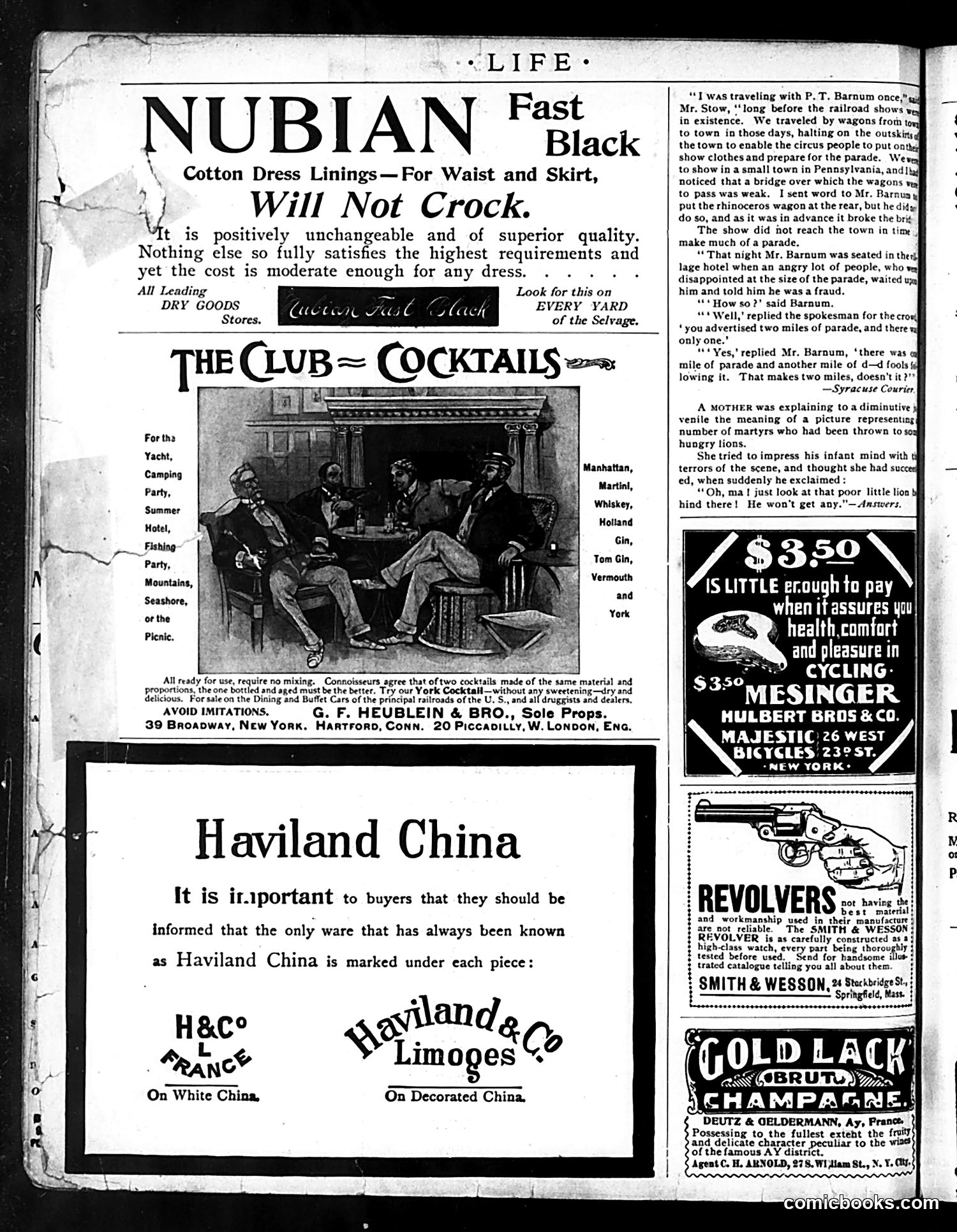
This page is primarily **advertising**, not political satire. The main content includes: 1. **Nubian Fast Black** - a cotton fabric advertisement emphasizing durability for dress linings 2. **The Club Cocktails** - an illustration showing men in what appears to be a social/drinking establishment, advertising various cocktail ingredients (Manhattan, Martini, Whiskey, etc.) 3. **Haviland China** - promoting authentic porcelain marked with specific maker's marks 4. **Secondary ads** - for bicycles (Messinger), revolvers (Smith & Wesson), and champagne (Gold Lack) The cocktail illustration reflects early 20th-century leisure culture and social drinking among gentlemen. There is **no apparent political cartoon or satire** on this page—it represents typical commercial content from Life magazine's advertising-heavy format during this era.
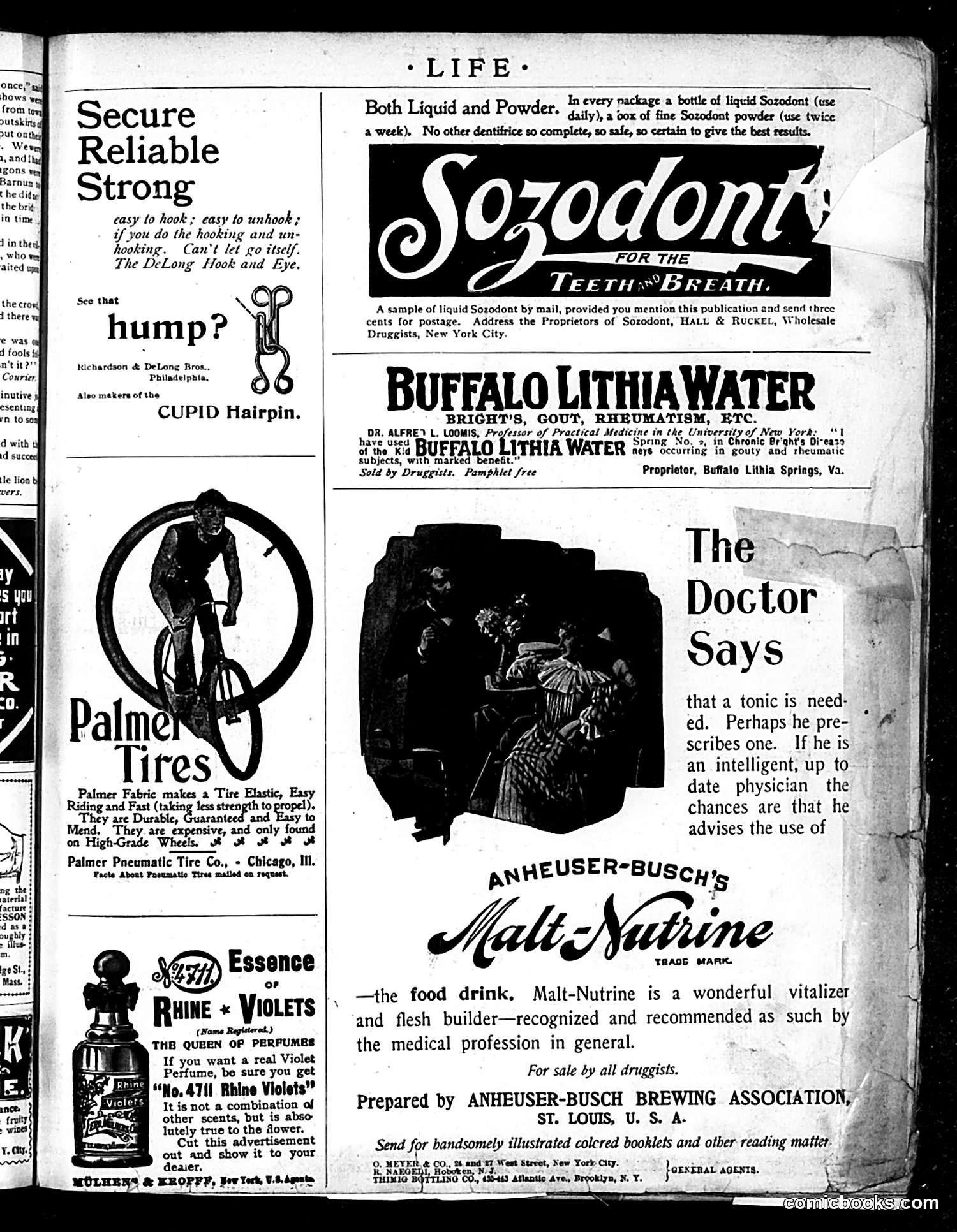
This page is primarily **advertisements**, not editorial cartoons or satire. The content includes: 1. **Sozodont** (teeth/breath product) - standard product ad 2. **Buffalo Lithia Water** - mineral water marketed for gout and rheumatism, endorsed by a doctor 3. **Palmer Tires** - bicycle tire advertisement 4. **Essence of Rhine Violets** - perfume ad 5. **Anheuser-Busch Malt-Nutrine** - a "food drink" marketed as a health tonic and "flesh builder," endorsed by the medical profession The ads reflect early 20th-century patent medicine marketing, where products made broad health claims (some dubious by modern standards). "The Doctor Says" framing was common to lend medical credibility. These represent the era's unregulated advertising landscape, before FDA restrictions on health claims. **No political cartoons or satire appear on this page.**
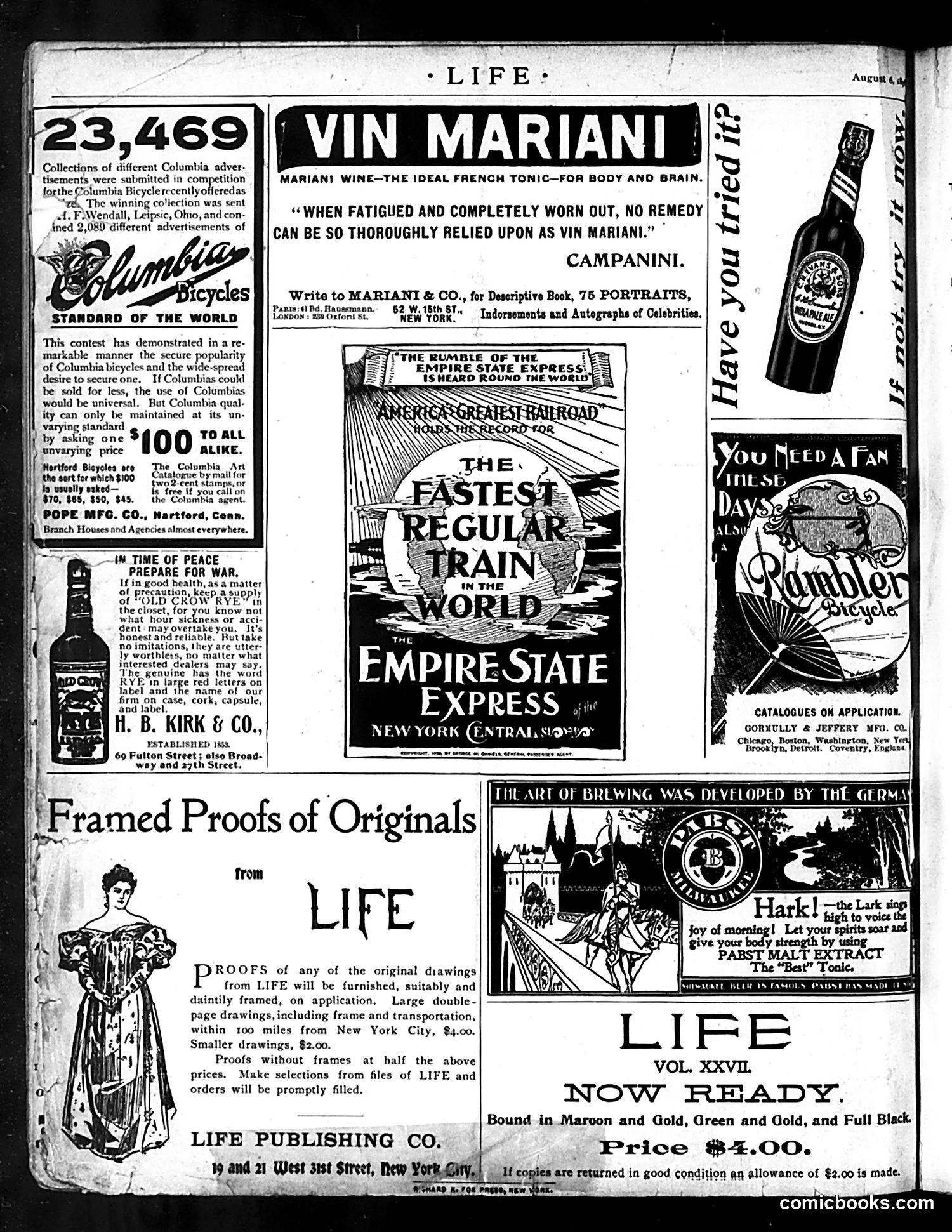
This page is **primarily advertising**, not political satire. It contains commercial advertisements for various products: - **Columbia Bicycles**: A contest awarding 23,469 bicycles, emphasizing the brand's universal quality at a fixed "$100 to all alike" price point. - **Vin Mariani**: A French tonic wine marketed as remedy for fatigue, with an attributed endorsement from "Campanini" (likely an opera singer). - **Empire State Express train**: Advertisement for "the fastest regular train in the world." - **Rambler bicycle**: A competing bicycle brand. - **Pabst Malt Extract**: A German-developed brewing product. The only non-advertising content is LIFE Publishing's offer to sell framed proofs of original drawings from the magazine. The page reflects early 1900s consumer culture and marketing strategies.
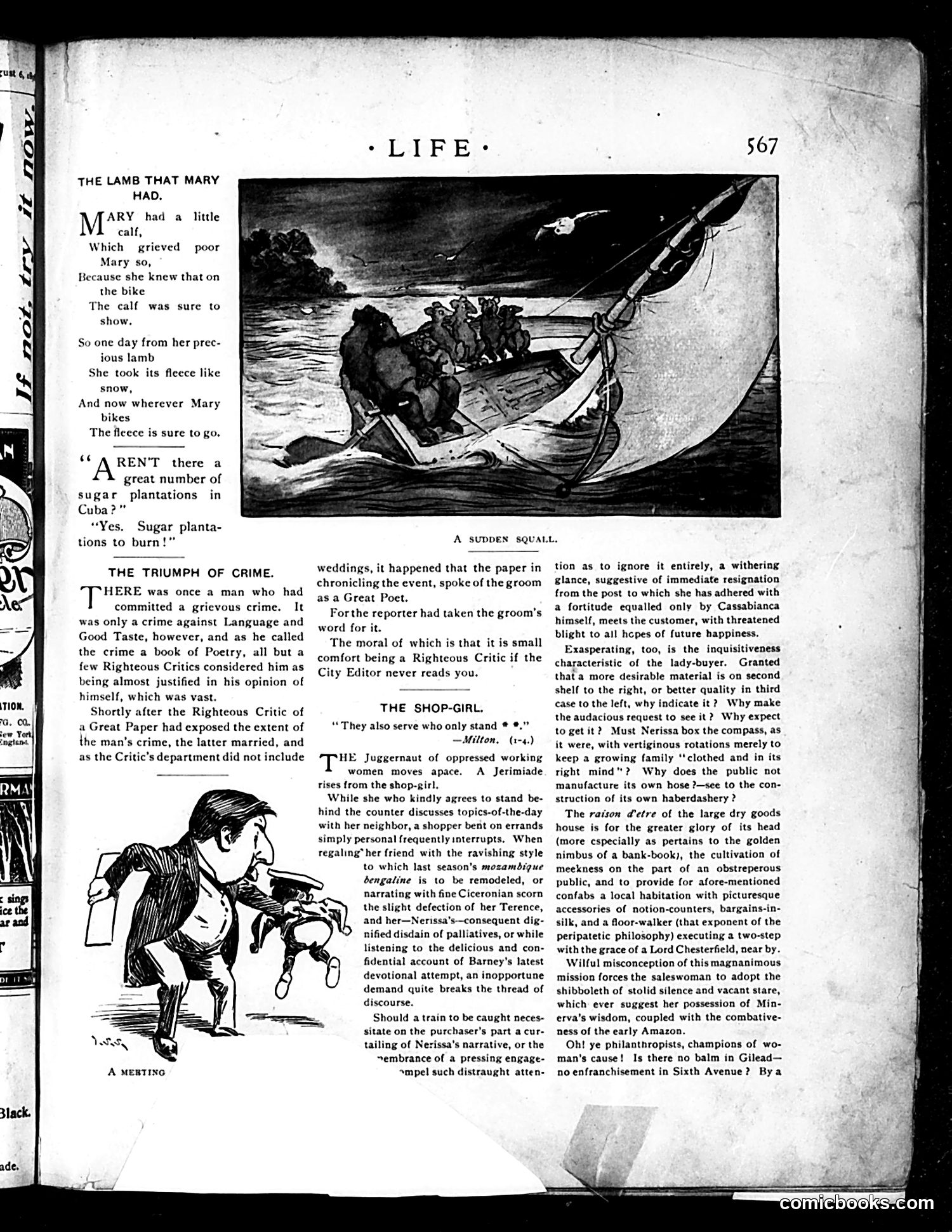
This page contains three distinct pieces: 1. **"The Lamb That Mary Had"** - A humorous poem playing on the nursery rhyme, suggesting Mary's lamb's fleece is so white it shows on her bicycle. 2. **"The Triumph of Crime"** - Satirizes literary and journalistic pretension. It mocks a newspaper's groom, described as a "Great Poet," for penning flowery wedding coverage. The satire targets self-important critics and editors who mistake sentimental writing for genuine literary merit. 3. **"The Shop-Girl"** - A cartoon about working women's lives, depicting a shop assistant juggling daily irritations: customer interactions, maintaining appearances, and the social expectation to appear cheerful. The illustration by Cesare shows her carrying parcels while navigating urban social constraints. The page reflects early 20th-century class commentary on labor, gender roles, and literary pretension.
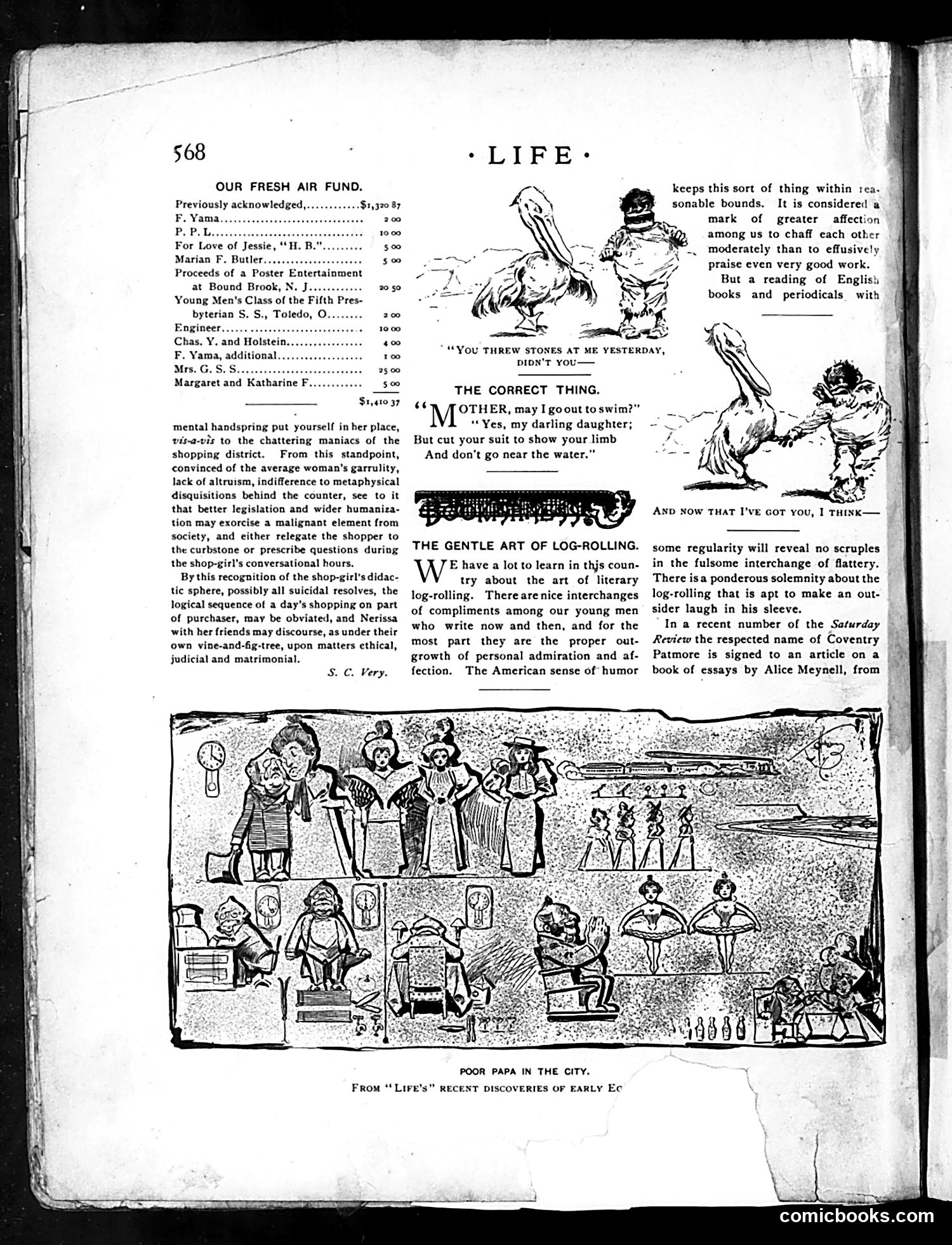
This page from *Life* magazine contains satirical commentary and illustrations about social behavior. "The Correct Thing" depicts a mother instructing her daughter not to swim near water—absurd advice that mocks overly cautious parenting norms of the era. "The Gentle Art of Log-Rolling" discusses literary reciprocal praise among writers, suggesting they artificially promote each other's work. The author S.C. Very criticizes this practice as unethical favoritism masking as genuine admiration. The bottom illustration labeled "Poor Papa in the City" appears to be from ancient Egyptian art, likely used humorously to comment on modern urban life by contrast—though the specific satirical point isn't entirely clear from the visible text. Overall, the page targets social pretension and dishonest literary practices.
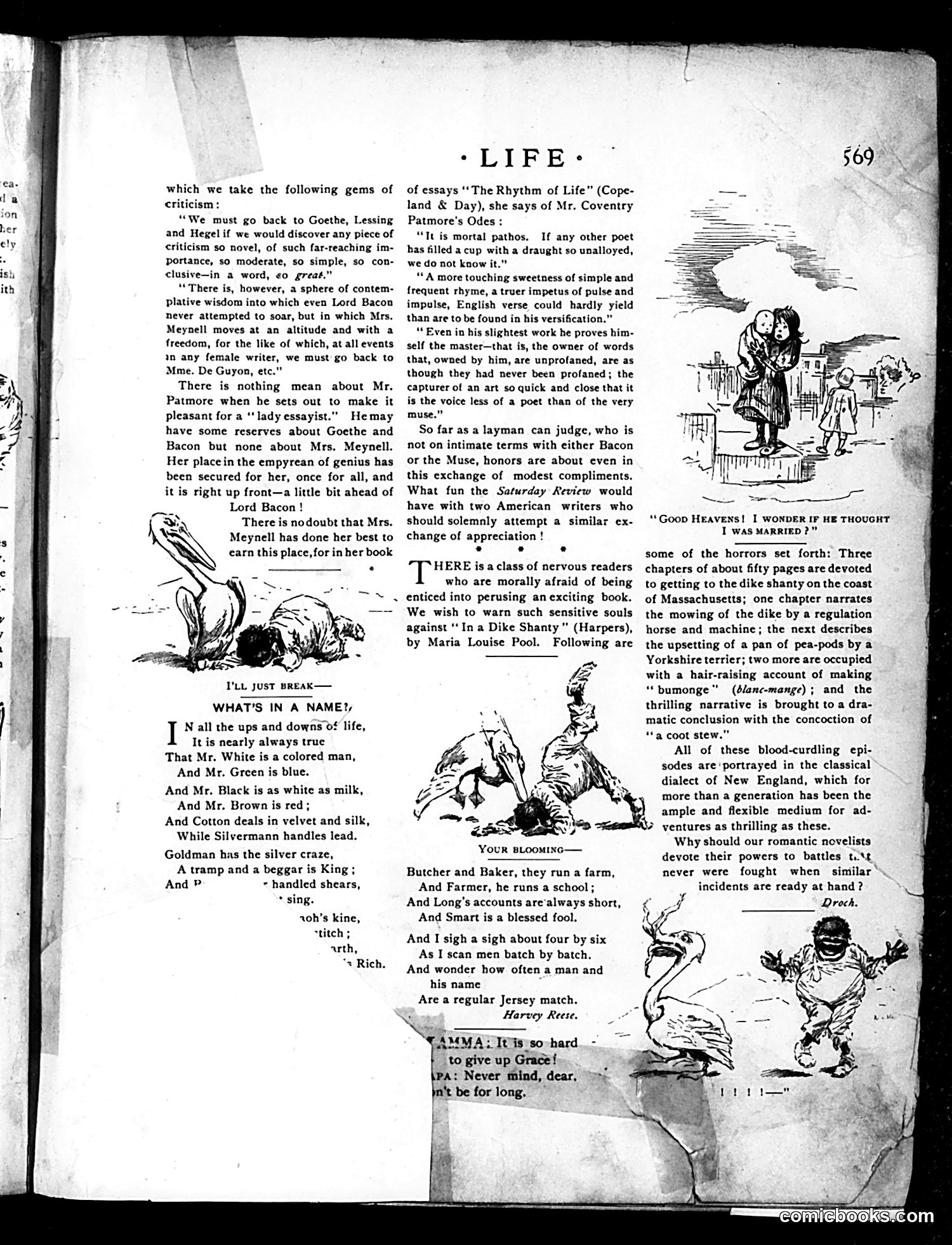
This page contains literary criticism and humor rather than political cartoons. The main section critiques Mrs. Meynell's essay collection, praising her place in English letters while noting she avoids the ambitious soaring of Goethe or Bacon. Below is a humorous poem titled "What's in a Name?" playing on name-based wordplay—Mr. White being colored, Mr. Green being blue, Cotton dealing in silk, etc. This is gentle Victorian-era humor exploiting contradictions between names and attributes. The right side discusses a thriller novel "In a Dike Shanty" by Maria Louise Pool, noting its sensational horror content (dikes, pea-pods, hair-raising scenes, blood-curdling episodes). The cartoon illustrations appear to be generic decorative vignettes rather than satirical commentary.
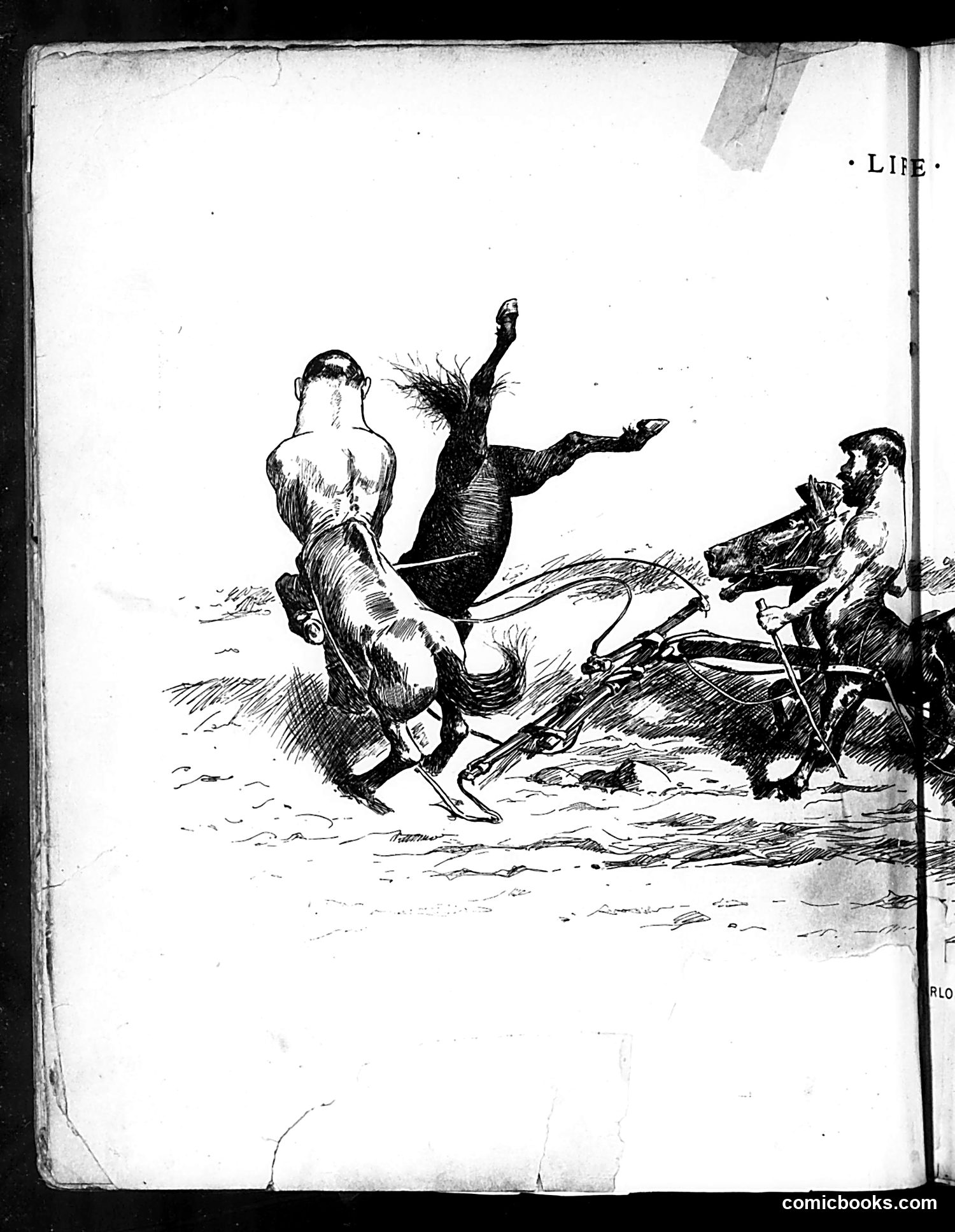
This appears to be a satirical cartoon from *Life* magazine showing a man being thrown or falling backward dramatically while two other figures watch from the right side. The central figure's exaggerated pose—legs and arms splayed—suggests violent expulsion or defeat. Without visible text identifying the specific figures or historical moment, I cannot definitively name who these characters represent or what political/social event this references. The style and composition suggest early 20th-century American political satire, likely mocking a public figure's downfall or embarrassing situation. The cartoon's humor relies on physical comedy and caricature typical of *Life*'s satirical approach, but the specific historical context—which politician, scandal, or event is depicted—remains unclear from the image alone.
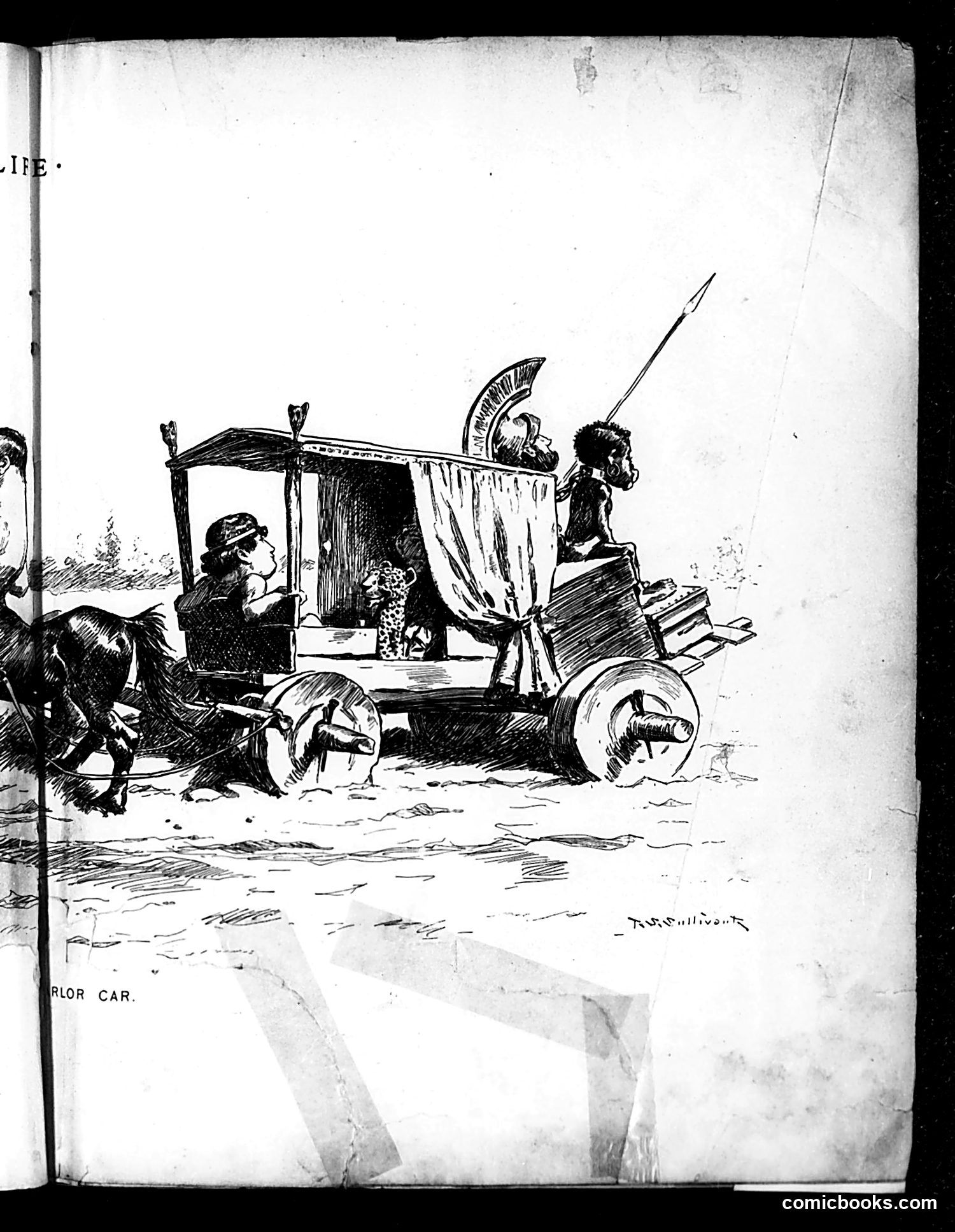
This appears to be a satirical illustration titled "PARLOR CAR" (visible at bottom left). The image depicts an elaborate, ornate horse-drawn carriage or "parlor car" with decorative elements including what looks like a military helmet or crown on top and draped fabric. Two figures operate it—one driving and one appearing to stand as a guard with a spear. The satire likely mocks excessive luxury or pretension in transportation, possibly referencing contemporary debates about wealth display or extravagant travel accommodations. The juxtaposition of primitive horse-drawn transport dressed up with grand "parlor" styling suggests ridicule of superficial sophistication or absurd ostentation. Without additional context from the surrounding page, the specific target remains unclear, though it appears to critique class pretension or wasteful indulgence common in Gilded Age satire.
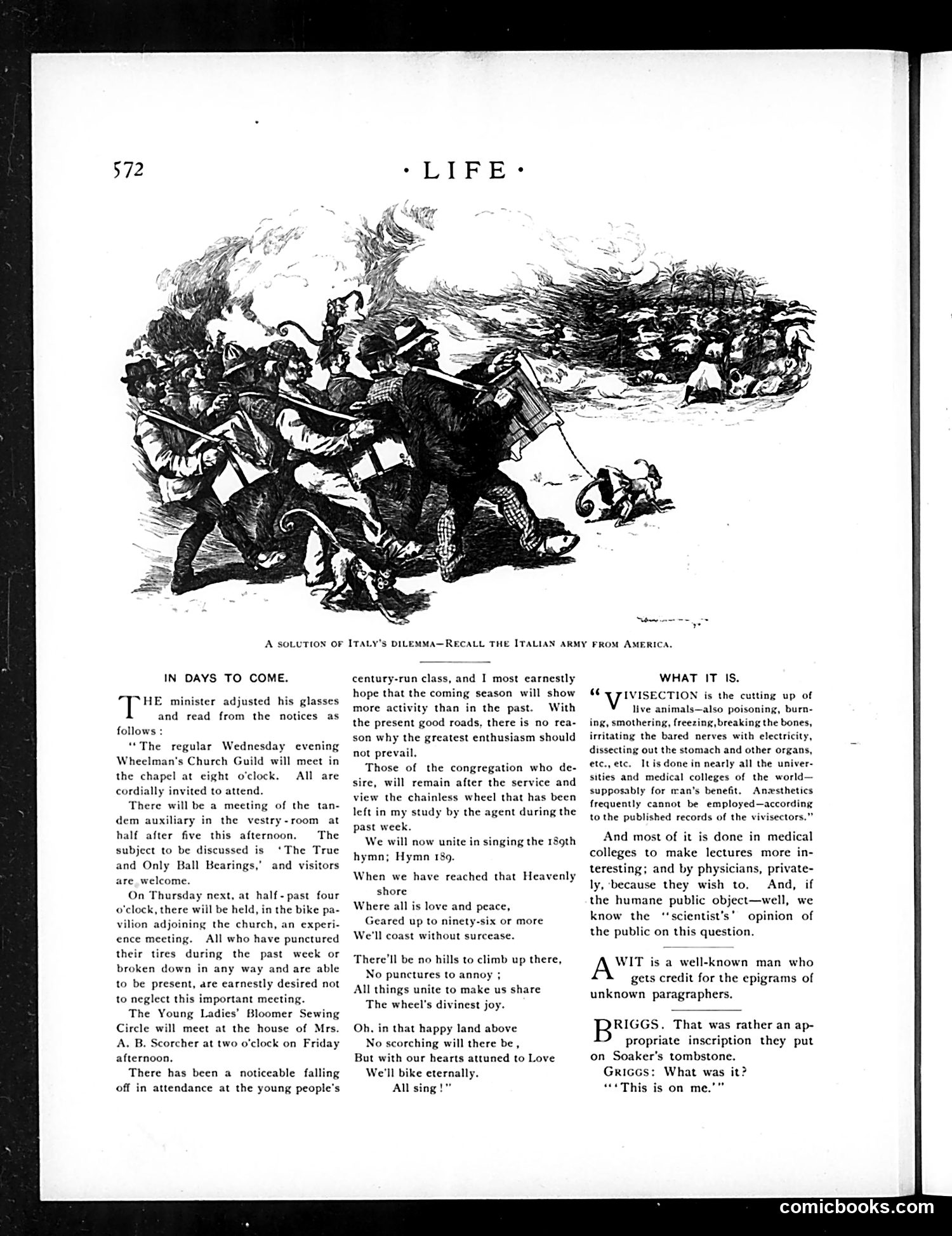
**The Main Cartoon** depicts Italy's military dilemma—a chaotic scene showing Italian soldiers in disarray, labeled "A Solution of Italy's Dilemma—Recall the Italian Army from America." This appears to mock Italy's military involvement or presence in America during a period of international tension (likely early 20th century), suggesting their forces are comically ineffectual or their presence problematic. **"In Days to Come"** satirizes the bicycle craze's dominance in American culture. The minister's church announcements are entirely bicycle-centric—meetings about "ball bearings," "tandem auxiliaries," and a hymn celebrating eternal biking. The satire mocks how completely the bicycle fad had infiltrated even religious institutions, replacing traditional spiritual focus with mechanical obsession. **The right column** discusses vivisection (animal experimentation), presenting anti-vivisection arguments, while the bottom contains brief humorous anecdotes about wit and wordplay—typical Life magazine filler content. The page reflects turn-of-the-century American concerns: international politics, consumer crazes, and animal welfare debates.
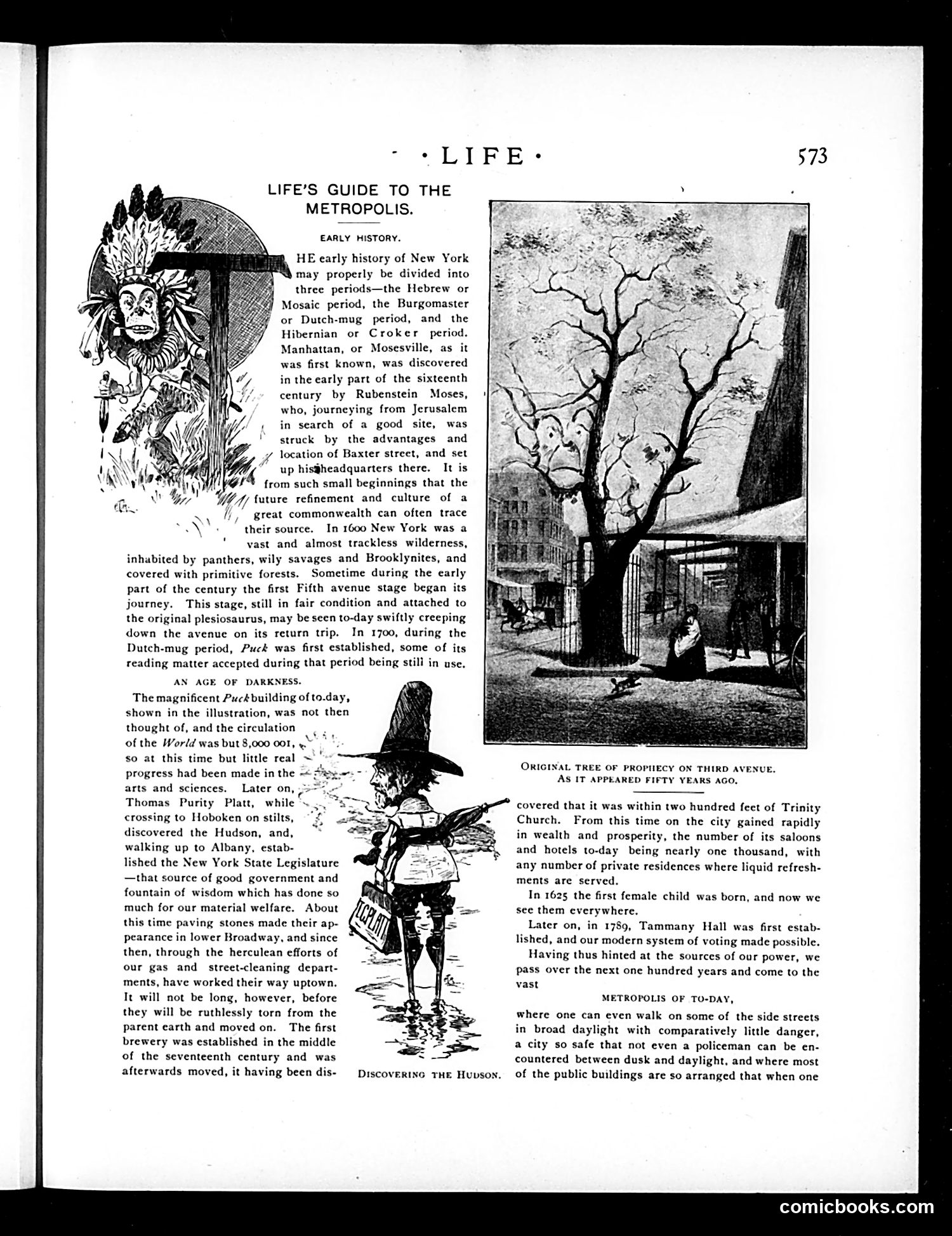
This is a humorous mock-historical article mocking New York City's early development and contemporary politics. Key satirical elements: **The "Three Periods"** parody ethnic stereotypes: "Hebrew or Mosaic period" (Jews), "Dutch-mug period" (Dutch settlers), and "Hibernian or Croker period" (Irish—likely referencing Richard Croker, Tammany Hall boss). **The Illustrations** include caricatured figures representing these groups, rendered in period costume with exaggerated features typical of 19th-century satirical cartooning. **The Jokes** mock: - Tammany Hall's political control ("our modern system of voting") - New York's proliferation of bars and saloons - Corrupt or ineffective city services (street cleaning, paving) - Police absence from streets at night **The Tree Image** humorously documents Third Avenue's decay over fifty years. The overall tone satirizes how different immigrant groups shaped the city while critiquing contemporary urban corruption and mismanagement—common targets of Life magazine's political satire.
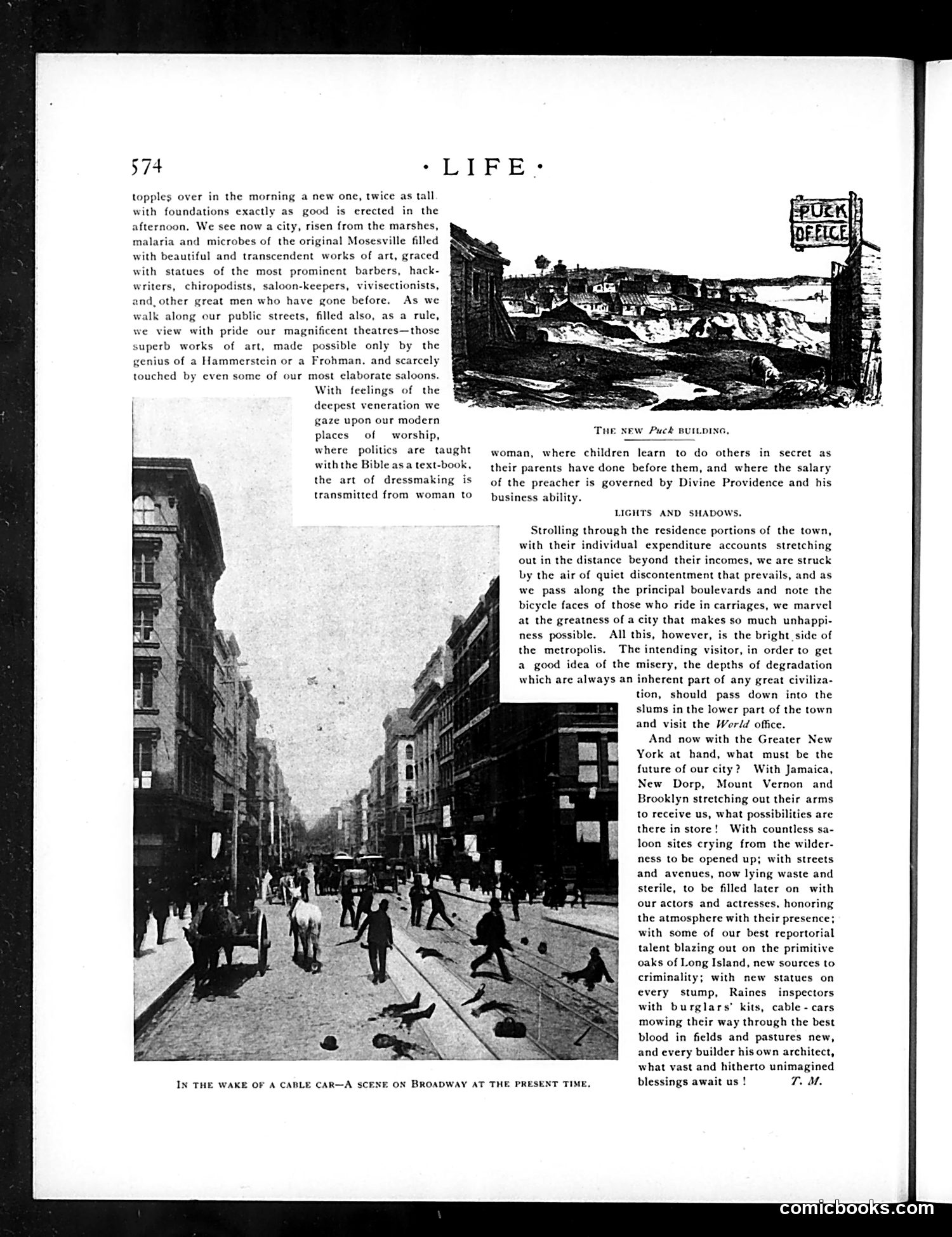
This page satirizes rapid urban development and moral corruption in rapidly expanding New York City. The text mocks the city's pretension: monuments erected to "prominent barbers, hack-writers, chiropodists, saloon-keepers" rather than genuine civic leaders. Churches are ridiculed as places where "politics are taught with the Bible as a text-book." The author sarcastically portrays wealth inequality—residents living "beyond their incomes"—and suggests visiting the "World office" (the newspaper) to witness urban misery and degradation. The photograph of Broadway with cable cars illustrates the chaotic modernization. The concluding passage drips with irony, listing supposed "blessings" of expansion: new criminality, corrupt "Raines inspectors with burglars' kits," and cable cars "mowing their way through the best blood." The satire attacks both commercial excess and institutional hypocrisy during New York's Gilded Age growth.
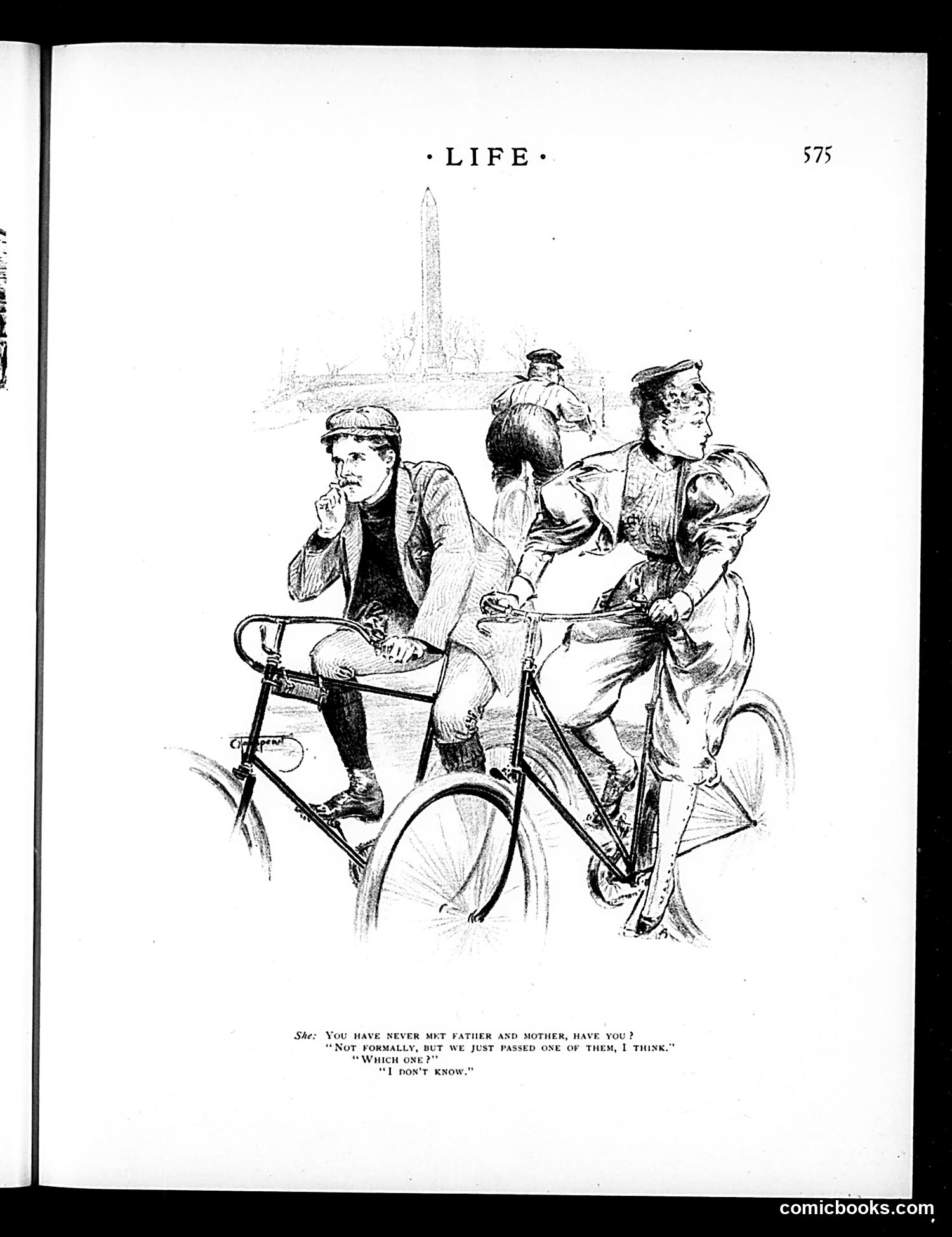
This is a humorous cartoon about cyclists passing each other on a street (with what appears to be a monument in the background). The joke plays on the ambiguity of identifying people while riding bicycles. One cyclist asks another if they've met the other's parents, and the response suggests they *may* have just passed one of them—but can't tell which parent it was, or even confirm it was a parent at all. The satire likely mocks the casual, hurried nature of urban social encounters and the difficulty of recognizing acquaintances in passing. The bicycle setting reflects the bicycle-craze popularity of the late 19th/early 20th century. It's gentle comedy about social awkwardness rather than political satire.
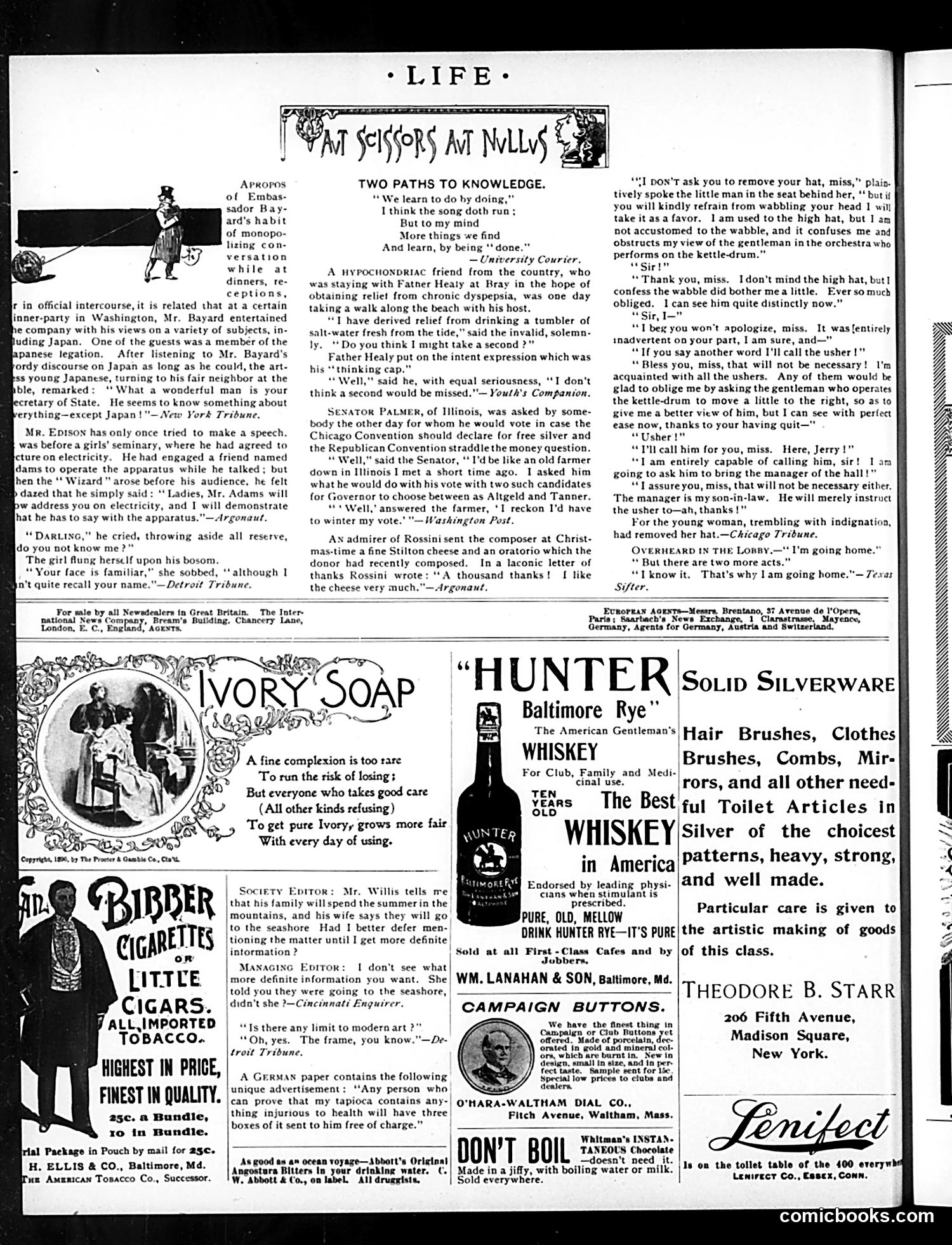
This page is primarily **advertisements interspersed with humorous anecdotes**, not political cartoons. The jokes mock prominent figures through brief stories: 1. **Ambassador Bayard** — Secretary of State notorious for monopolizing conversations. A Japanese diplomat quips that Bayard knows about everything "except Japan," satirizing his verbose pontification on subjects outside his expertise. 2. **Mr. Epison** — A would-be lecturer on electricity so nervous he delegates his own speech to an assistant, poking fun at stage fright and incompetence. 3. **Senator Palmer** — Faced with choosing between two unsatisfactory political candidates, he'll "winter" his vote (hold it), a rural metaphor for indecision. The remaining items are mild domestic humor (an embarrassing theater seat conversation, a man unrecognized by his romantic interest). **The satire targets**: pompous officialdom, public incompetence, and political uncertainty—typical turn-of-century Life magazine fare mocking America's elite and their pretensions.
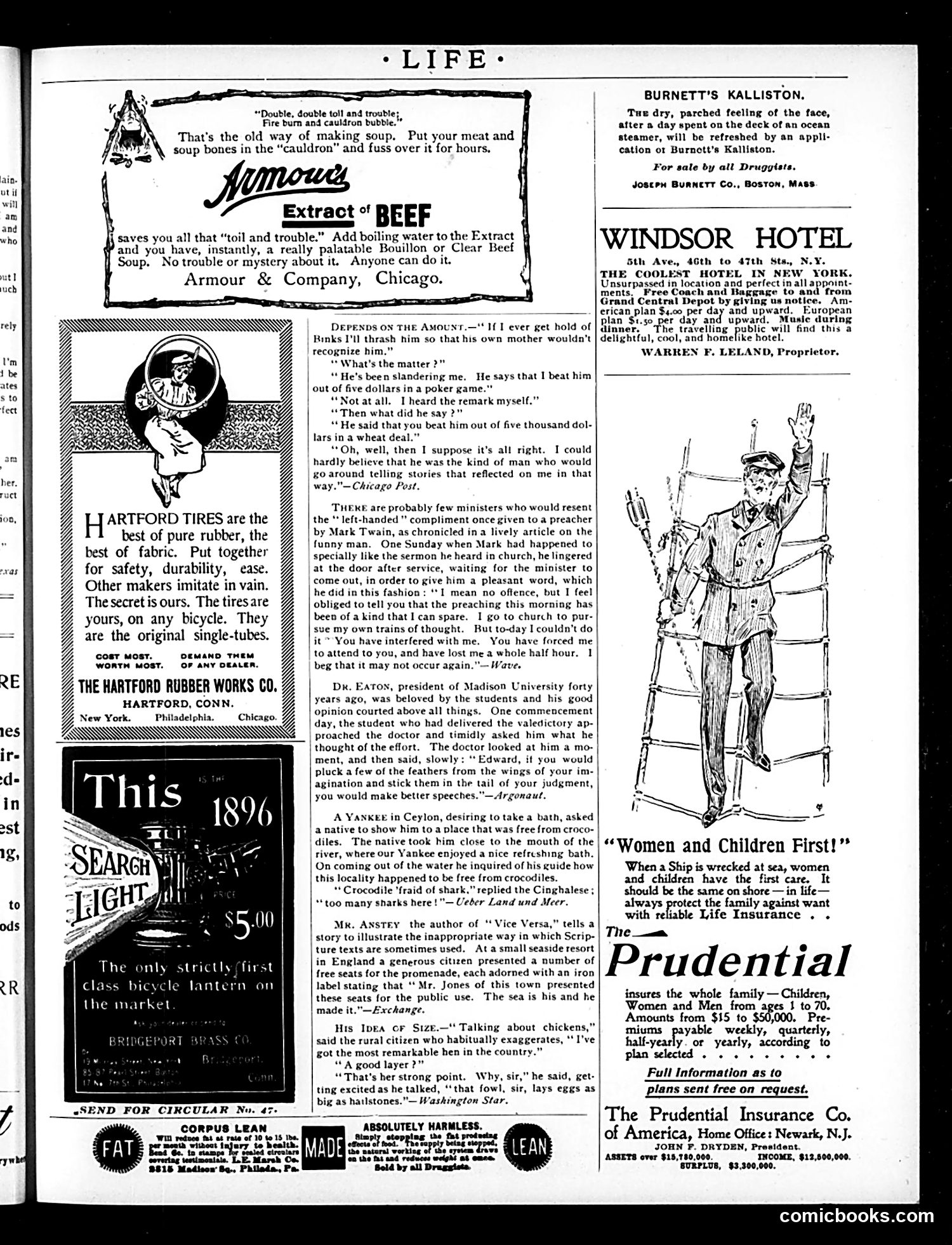
This page is primarily **advertising**, with several brief humorous anecdotes rather than political cartoons. The main illustrated content shows a man in period dress gesturing expressively—likely accompanying one of the humor pieces about compliments and insults. The anecdotes mock social pretense and hypocrisy: 1. **"Depends on the Amount"** jokes that a man excuses being cheated of $5,000 in wheat because he mistakenly believed it was only $5 in poker—revealing his low opinion of the other person's character. 2. **Mark Twain anecdote** satirizes backhanded compliments, with Twain "praising" a sermon while actually insulting the minister for interrupting his thoughts. 3. **Dr. Eaton story** mocks flowery praise disguised as criticism about "imagination" and "judgment." The humor targets Victorian-era social conventions around politeness masking real contempt. The page also advertises Armour beef extract, Hartford bicycle tires, Burnett's Kalliston skincare, Windsor Hotel, and Prudential Insurance.
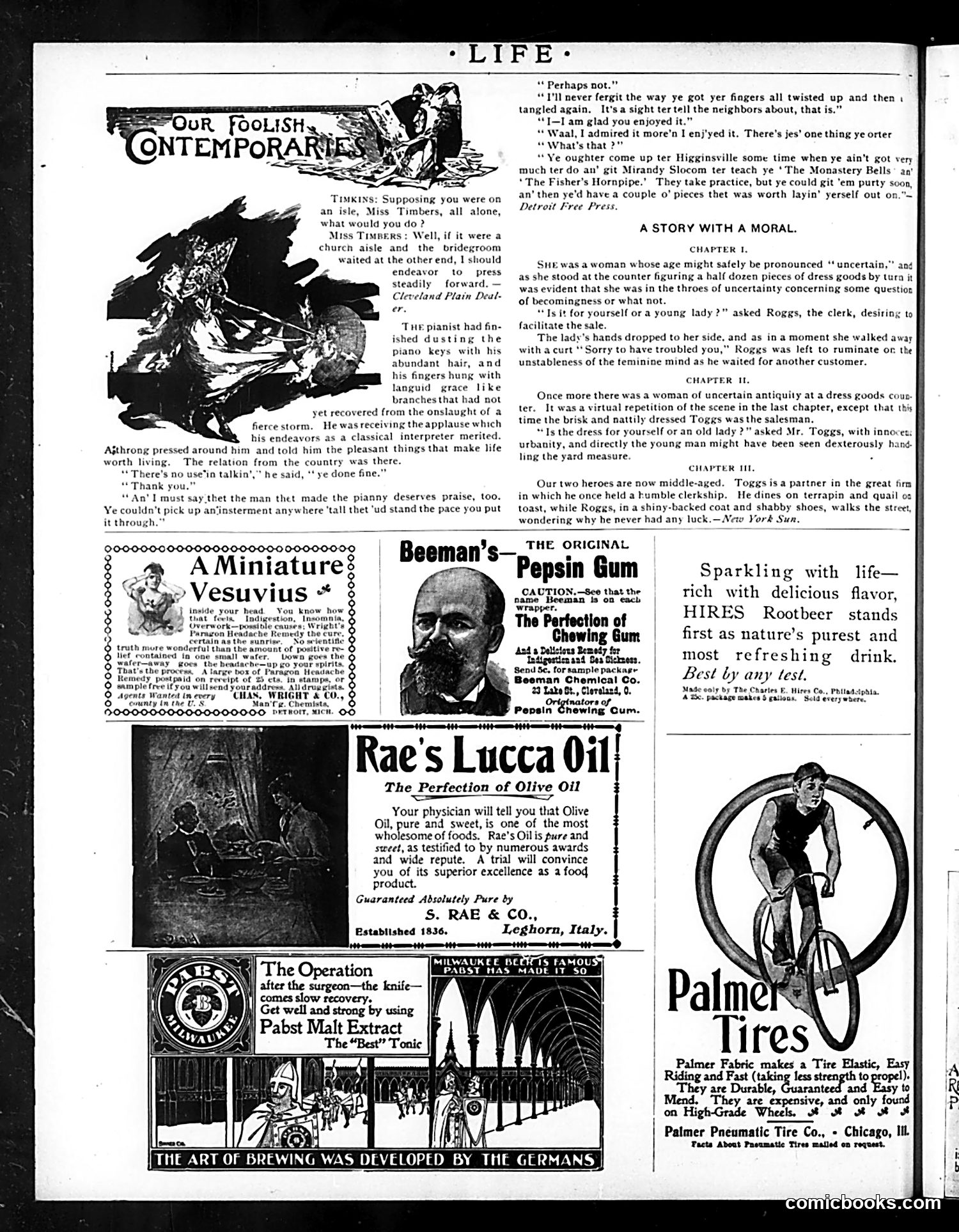
This page contains two main satirical pieces from Life magazine. **"Our Foolish Contemporaries"** is a humor column featuring brief anecdotes mocking social pretensions. One exchange ridicules a woman named Miss Timbers whose answer to a hypothetical desert-island scenario reveals her obsession with marriage—she'd wait at a church aisle for a bridegroom. The piano story mocks a self-important musician receiving unwarranted praise from admirers. **"A Story with a Moral"** presents a three-chapter narrative contrasting two clerks: Rogers, who rudely asks an older female customer if dress goods are "for yourself or an old lady," losing a sale; and Toggs, who asks the same question politely and successfully. The moral is transparent—courtesy and tact in business succeed where rudeness fails. The page also contains period advertisements (Pepsin Gum, Lucca Oil, Palmer Tires) typical of early 20th-century magazines, with no apparent political content.
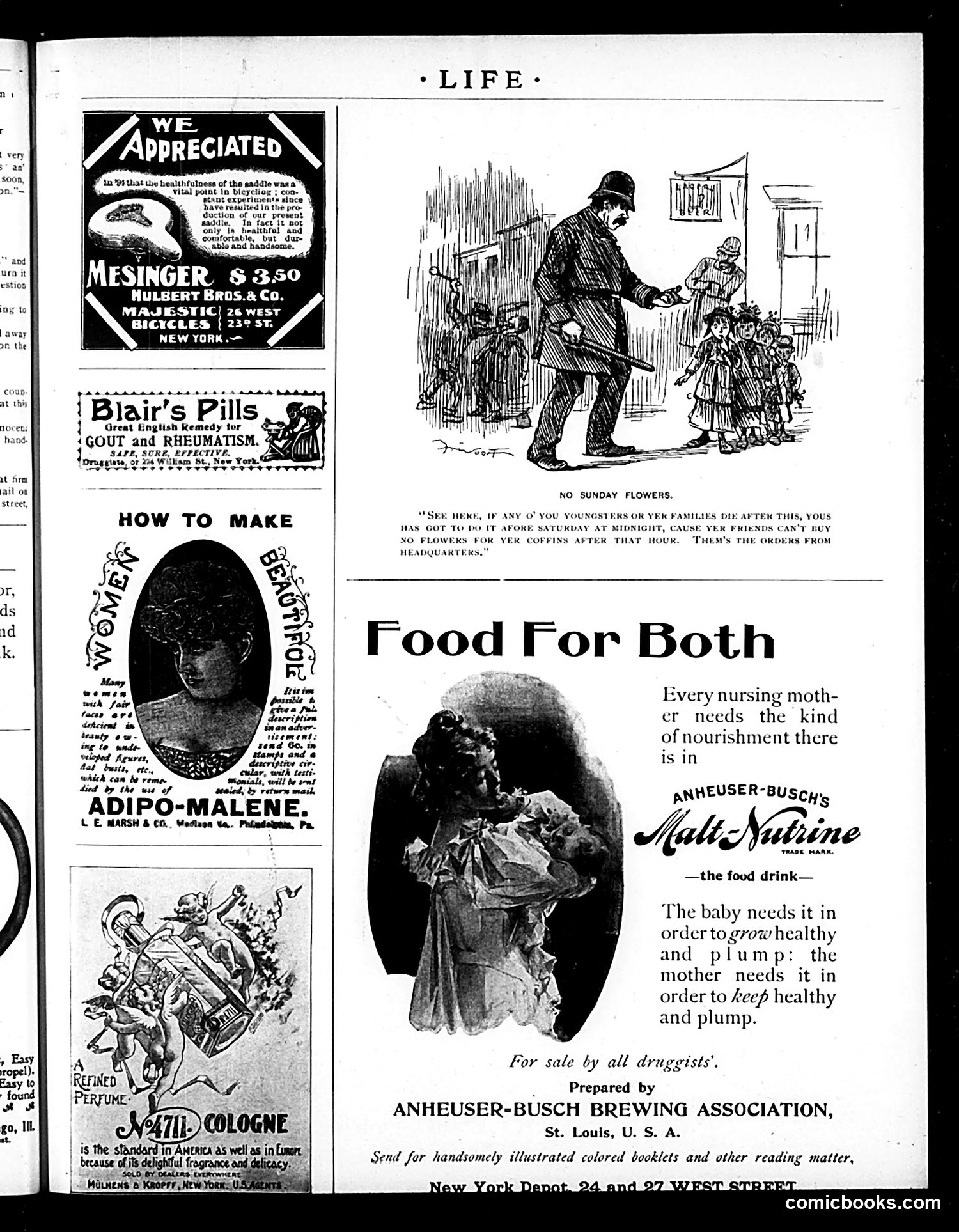
The cartoon depicts a policeman instructing children that flowers cannot be purchased for funerals after midnight on Saturday, due to headquarters orders. This satirizes **strict Sunday closing laws** enforced in early 20th-century America. Many states and cities prohibited commercial transactions on Sundays for religious reasons. The joke's dark humor: if someone dies Saturday night, grieving families cannot buy flowers for the funeral service because flower shops must close by midnight and remain closed all Sunday. The rule creates an absurd situation where religious observance prevents a basic funeral practice. The character's dialect ("yous," "yer") marks him as a working-class Irish or Italian immigrant cop—typical of urban police forces. The cartoon mocks the inflexibility of Sunday laws and their real human consequences, using this impossible scenario to criticize excessive religious regulation of commerce. The surrounding page contains period advertisements (Anheuser-Busch malt drink, patent medicines, bicycle saddles), typical of *Life* magazine's revenue model.
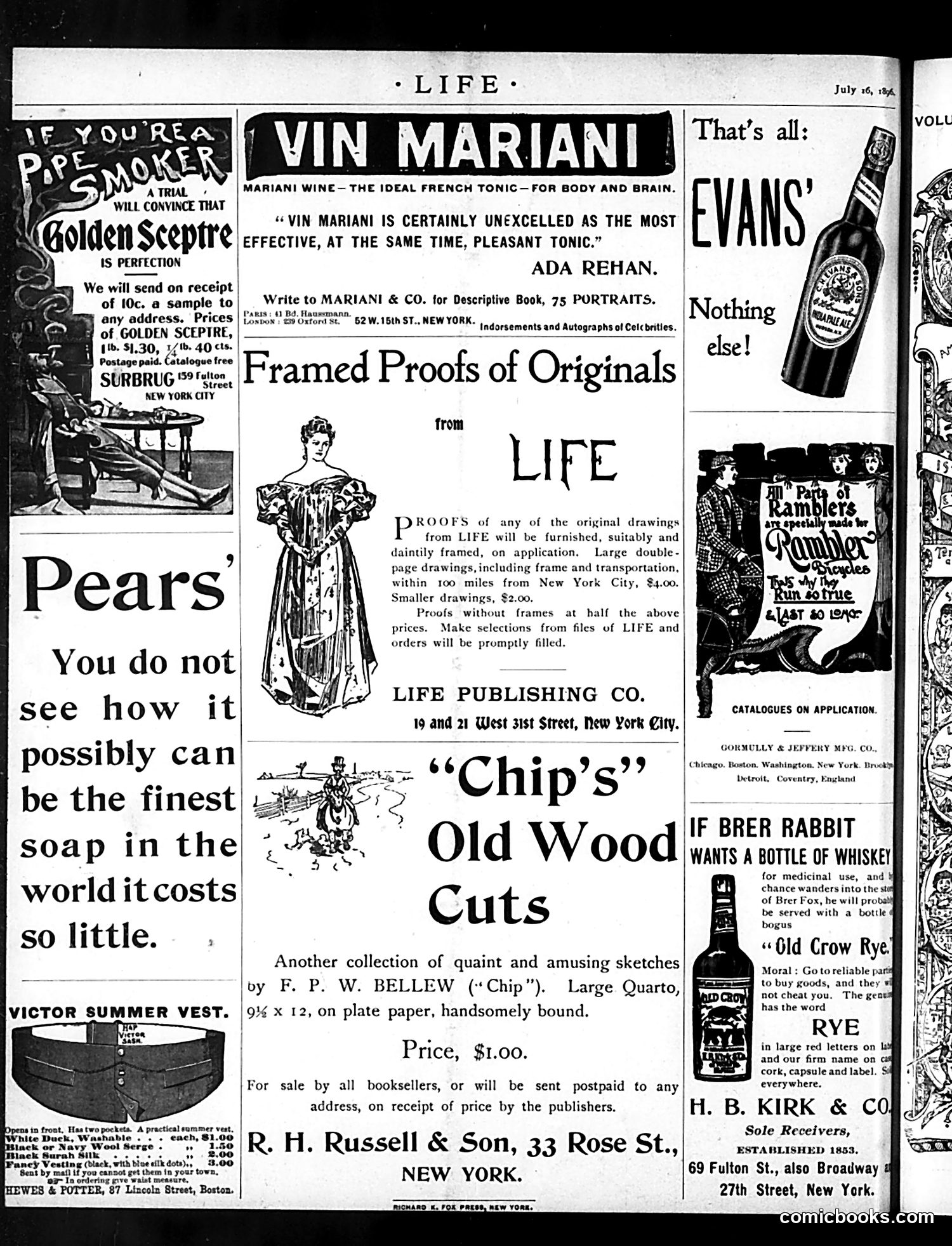
This is primarily an **advertising page**, not a political cartoon page, from Life magazine (July 16, 1894—note the date is 1894, not 1854). The ads promote various patent medicines and products typical of the Gilded Age: - **Vin Mariani**: A cocaine-laced French wine marketed as a "tonic for body and brain," endorsed by actress Ada Rehan. Such tonics were legal and widely advertised before drug regulation. - **Golden Sceptre**: A pipe tobacco claiming superiority despite low cost. - **Pears' Soap**: A luxury soap emphasizing its unexpectedly affordable price. - **"Chip's Old Wood Cuts"**: A book of sketches by F.P.W. Bellew. - **Old Crow Rye Whiskey**: A humorous ad using a folk-tale reference (Brer Rabbit/Fox) to warn consumers against counterfeits, emphasizing the genuine product's name on the label. The **Brer Rabbit ad** likely references Joel Chandler Harris's popular Uncle Remus stories, using familiar characters for commercial purposes—unremarkable marketing at the time.