
Life, 1896-07-16 · page 13 of 20
Life — July 16, 1896 — page 13: what you’re looking at
What you’re looking at
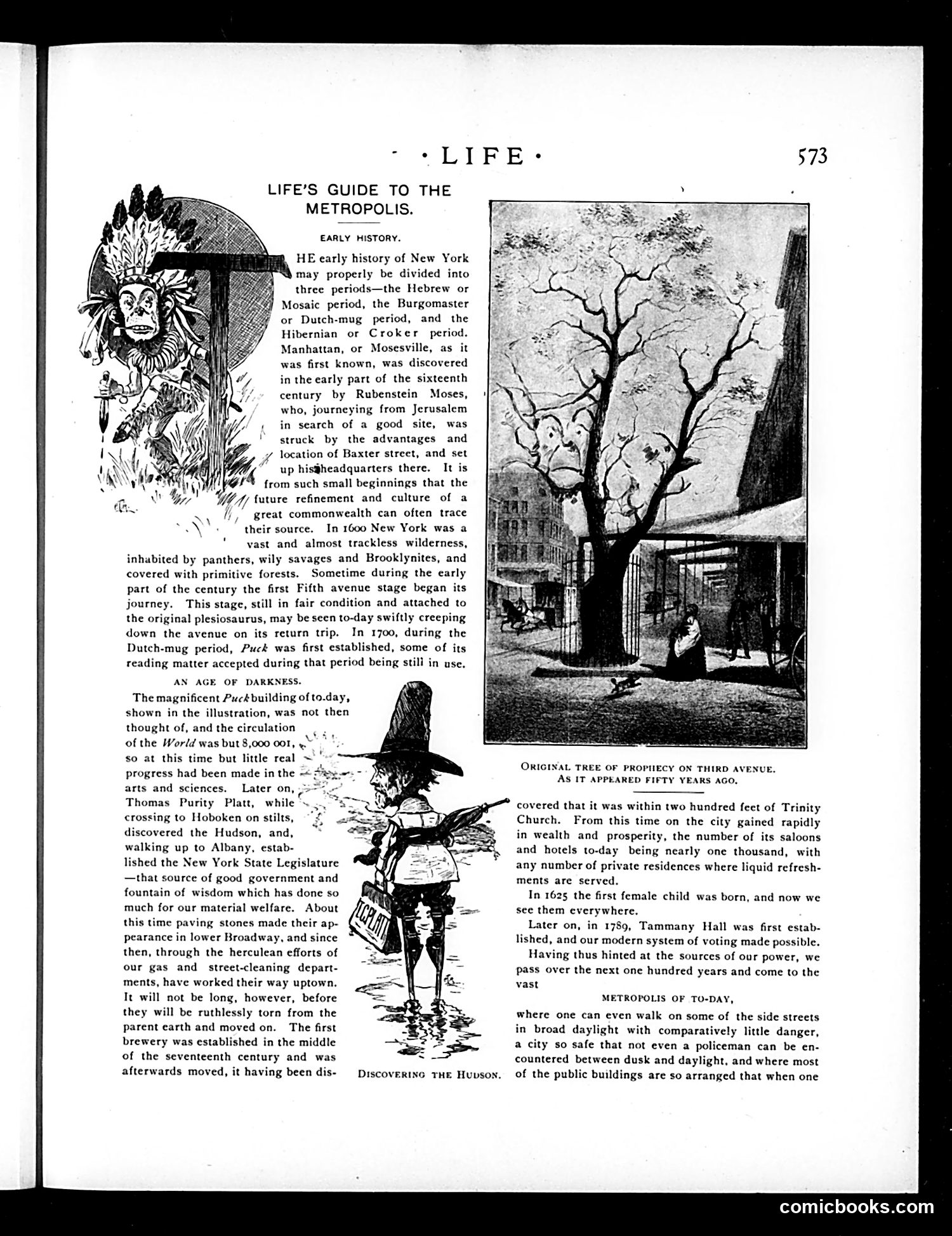
This is a humorous mock-historical article mocking New York City's early development and contemporary politics. Key satirical elements: **The "Three Periods"** parody ethnic stereotypes: "Hebrew or Mosaic period" (Jews), "Dutch-mug period" (Dutch settlers), and "Hibernian or Croker period" (Irish—likely referencing Richard Croker, Tammany Hall boss). **The Illustrations** include caricatured figures representing these groups, rendered in period costume with exaggerated features typical of 19th-century satirical cartooning. **The Jokes** mock: - Tammany Hall's political control ("our modern system of voting") - New York's proliferation of bars and saloons - Corrupt or ineffective city services (street cleaning, paving) - Police absence from streets at night **The Tree Image** humorously documents Third Avenue's decay over fifty years. The overall tone satirizes how different immigrant groups shaped the city while critiquing contemporary urban corruption and mismanagement—common targets of Life magazine's political satire.
📄 Transcribed text from this page (OCR, searchable)
Machine-transcribed from the original scan — historical spelling and the odd misread are preserved.
‘LIFE: LIFE’S GUIDE TO THE METROPOLIS. EARLY HISTORY. \ HE early history of New York may properly be divided into three periods—the Hebrew or Mosaic period, the Burgomaster or Dutch-mug period, and the Hibernian or Croker period. Manhattan, or Mosesville, as it was first known, was discovered in the early part of the sixteenth century by Rubenstein Moses, who, journeying from Jerusalem in search of a good site, was struck by the advantages and yj location of Baxter street, and set up his@headquarters there. It is is from such small beginnings that the ‘fy future refinement and culture of a //,” great commonwealth can often trace their source. In 1600 New York was a vast and almost trackless wilderness, inhabited by panthers, wily savages and Brooklynites, and covered with primitive forests. Sometime during the early part of the century the first Fifth avenue stage began its journey. This stage, still in fair condition and attached to the original plesiosaurus, may be seen to-day swiftly creeping down the avenue on its return trip. In 1700, during the Dutch-mug period, Puck was first established, some of its reading matter accepted during that period being still in use, AN AGE OF DARKNESS. The magnificent Puck building of to.day, shown in the illustration, was not then thought of, and the circulation of the World was but 8,000 001, x. so at this time but little real progress had been made in the arts and sciences. Later on, /> Thomas Purity Platt, while crossing to Hoboken on stilts, discovered the Hudson, and, walking up to Albany, estab- lished the New York State Legislature —that source of good government and fountain of wisdom which has done so much for our material welfare. About this time paving stones made their ap- pearance in lower Broadway, and since then, through the herculean efforts of our gas and street-cleaning depart- ments, have worked their way uptown. Tt will not be long, however, before they will be ruthlessly torn from the parent earth and moved on. The first brewery was established in the middle of the seventeenth century and was ORIGINAL TREE OF PROPUECY ON THIRD AVENUE. AS IT APPEARED FIFTY YEARS AGO. covered that it was within two hundred feet of Trinity Church. From this time on the city gained rapidly in wealth and prosperity, the number of its saloons and hotels to-day being nearly one thousand, with any number of private residences where liquid refresh- ments are served. In 1625 the first female child was born, and now we see them everywhere, Later on, in 1789, Tammany Hall was first estab- lished, and our modern system of voting made possible. Having thus hinted at the sources of our power, we Pass over the next one hundred years and come to the vast METROPOLIS OF TO-DAY, where one can even walk on some of the side streets in broad daylight with comparatively little danger, a city so safe that not even a policeman can be en- countered between dusk and daylight, and where most afterwards moved, it having been dis- — Discovertno tHE Huvsox. of the public buildings are so arranged that when one comicbooks.com