
Life, 1896-07-16 · page 7 of 20
Life — July 16, 1896 — page 7: what you’re looking at
What you’re looking at
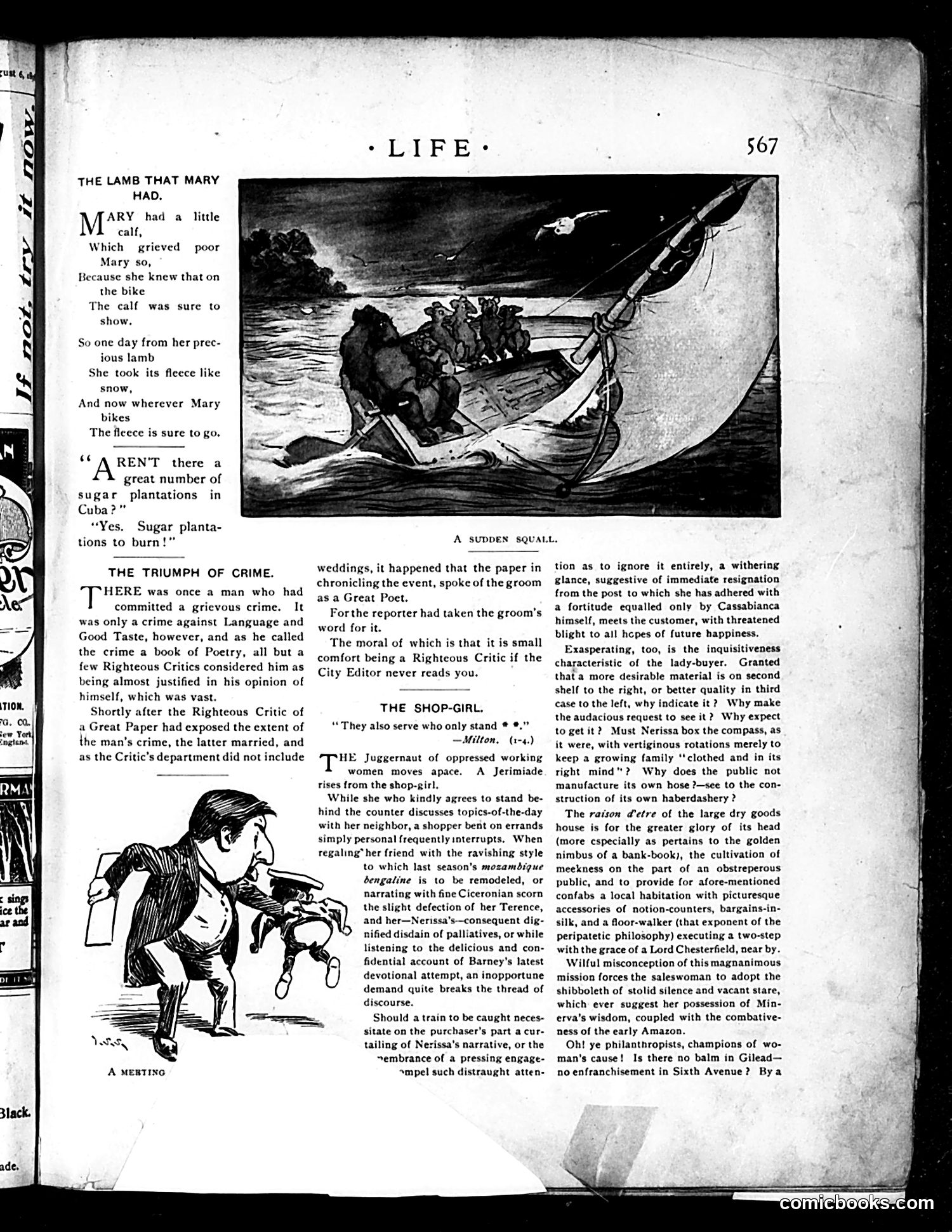
This page contains three distinct pieces: 1. **"The Lamb That Mary Had"** - A humorous poem playing on the nursery rhyme, suggesting Mary's lamb's fleece is so white it shows on her bicycle. 2. **"The Triumph of Crime"** - Satirizes literary and journalistic pretension. It mocks a newspaper's groom, described as a "Great Poet," for penning flowery wedding coverage. The satire targets self-important critics and editors who mistake sentimental writing for genuine literary merit. 3. **"The Shop-Girl"** - A cartoon about working women's lives, depicting a shop assistant juggling daily irritations: customer interactions, maintaining appearances, and the social expectation to appear cheerful. The illustration by Cesare shows her carrying parcels while navigating urban social constraints. The page reflects early 20th-century class commentary on labor, gender roles, and literary pretension.
📄 Transcribed text from this page (OCR, searchable)
Machine-transcribed from the original scan — historical spelling and the odd misread are preserved.
THE LAMB THAT MARY HAD. M*®s, had a little calf, Which grieved poor Mary so, Because she knew that on the bike The calf was sure to show, So one day from her prec- ious lamb She took its fleece like snow, And now wherever Mary bikes The ficece is sure to go. *€ A REN'T there a great number of sugar plantations in Cuba?" “Yes. Sugar planta- tions to burn!" THE TRIUMPH OF CRIME. HERE was once a man who had committed a grievous crime. It was only a crime against Language and Good Taste, however, and as he called the crime a book of Poetry, all but a few Righteous Critics considered him as being almost justified in his opinion of himself, which was vast. Shortly after the Righteous Critic of a Great Paper had exposed the extent of the man's crime, the latter married, and as the Critic's department did not include A MERTING weddings, it happened that the paper in chronicling the event, spoke of the groom as a Great Poet. Forthe reporter had taken the groom's word for it. The moral of which is that it is small comfort being a Righteous Critic if the City Editor never reads you. THE SHOP-GIRL, “They also serve who only stand * *,"" —Milton, (1-4.) HE Juggernaut of oppressed working women moves apace. A Jerimiade rises from the shop-girl. While she who kindly agrees to stand be- hind the counter discusses topics-of-the-day with her neighbor, a shopper bent on errands simply personal frequently interrupts. When regaling*her friend with the ravishing style to which last season's mozambigue bengaline is to be remodeled, or narrating with fine Ciceronian scorn the slight defection of her Terence, and her—Nerissa's—consequent dig- nified disdain of palliatives, or while listening to the delicious and con- fidential account of Barney's latest devotional attempt, an inopportune demand quite breaks the thread of discourse. Should a train to be caught neces- sitate on the purchaser's part a cur- tailing of Nerissa's narrative, or the ~embrance of a pressing engage- ompel such distraught atten- tion as to ignore it entirely, a withering glance, suggestive of immediate resignation from the post to which she has adhered with a fortitude equalled only by Cassabianca himself, meets the customer, with threatened blight to all hopes of future happiness. Exasperating, too, is the inquisitiveness characteristic of the lady-buyer. Granted thata more desirable material is on second shelf to the right, or better quality in third case to the left, why indicate it? Why make the audacious request to see it? Why expect to get it? Must Nerissa box the compass, as it were, with vertiginous rotations merely to keep a growing family “clothed and in i right mind"? Why does the public not manufacture its own hose ?—see to the con- struction of its own haberdashery ? The raison d'etre of the large dry goods house is for the greater glory of its head (more especially as pertains to the golden nimbus of a bank-book), the cultivation of meekness on the part of an obstreperous public, and to provide for afore-mentioned confabs a local habitation with picturesque accessories of notion-counters, bargains-in- silk, and a floor-walker (that exponent of the peripatetic philosophy) executing a two-step with the grace of a Lord Chesterfield, near by. Wilful misconception of this magnanimous mission forces the saleswoman to adopt the shibboleth of stolid silence and vacant stare, which ever suggest her possession of Min- erva's wisdom, coupled with the combative- ness of the early Amazon. Oh! ye philanthropists, champions of wo- man's cause! Is there no balm in Gilead— no enfranchisement in Sixth Avenue? By a St mCOMICDOOKS#com