
Life, 1896-07-16 · page 8 of 20
Life — July 16, 1896 — page 8: what you’re looking at
What you’re looking at
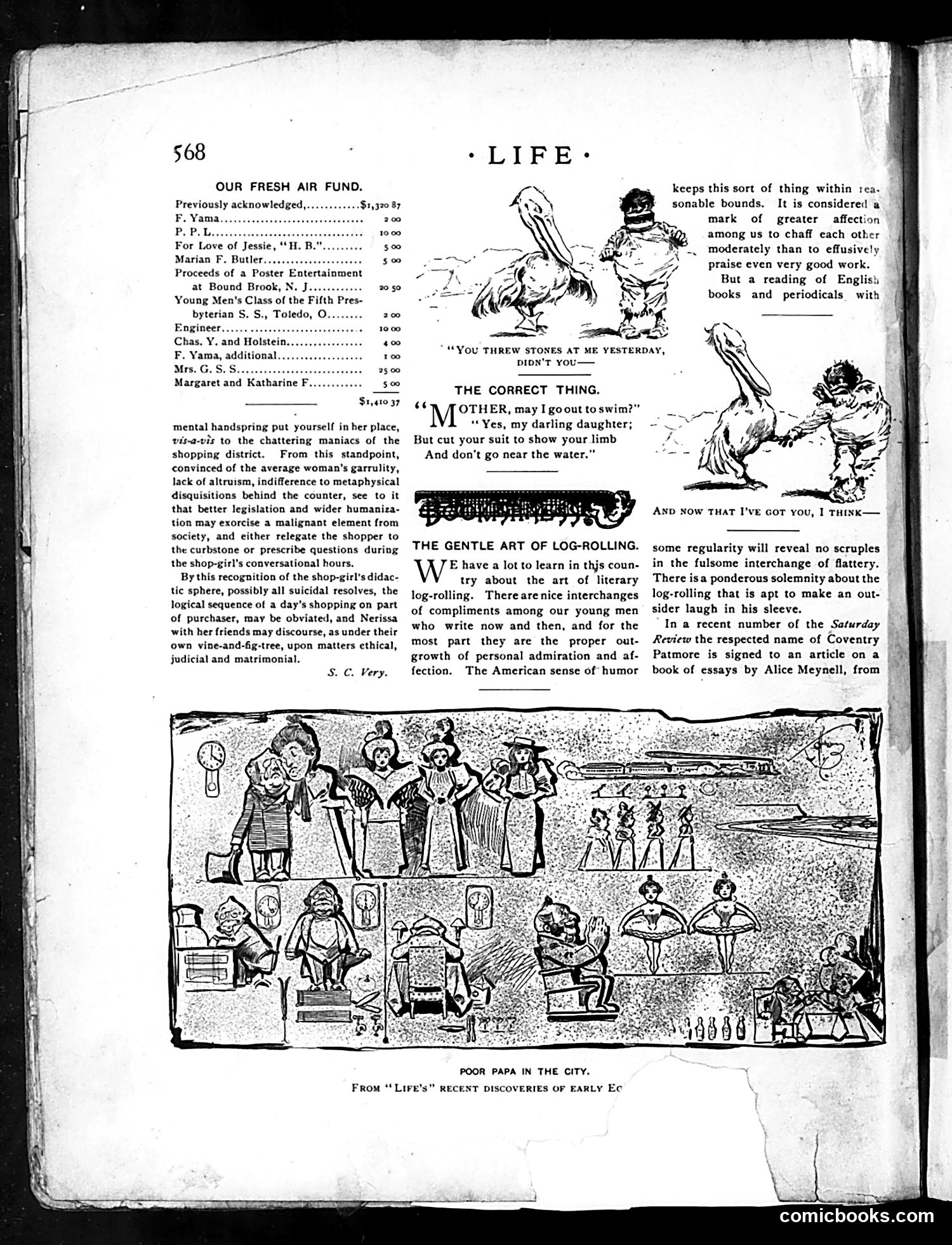
This page from *Life* magazine contains satirical commentary and illustrations about social behavior. "The Correct Thing" depicts a mother instructing her daughter not to swim near water—absurd advice that mocks overly cautious parenting norms of the era. "The Gentle Art of Log-Rolling" discusses literary reciprocal praise among writers, suggesting they artificially promote each other's work. The author S.C. Very criticizes this practice as unethical favoritism masking as genuine admiration. The bottom illustration labeled "Poor Papa in the City" appears to be from ancient Egyptian art, likely used humorously to comment on modern urban life by contrast—though the specific satirical point isn't entirely clear from the visible text. Overall, the page targets social pretension and dishonest literary practices.
📄 Transcribed text from this page (OCR, searchable)
Machine-transcribed from the original scan — historical spelling and the odd misread are preserved.
568 OUR FRESH AIR FUND. ++-$1)320 87 200 Previously acknowledged, . F, Yama. P.P.L. For Love of Jessi Marian F. Butler... sees Proceeds of a Poster Entertainment at Bound Brook, N. J Young Men's Class of the byterian S. S., Toledo, O Engineer. 1000 $00 $00 20 50 400 100 2500 500 F. Yama, add Mrs. G. Margaret and Katharine $1,410 37 mental handspring put yourself in her place, vis-a-vis to the chattering maniacs of the shopping district. From this standpoint, convinced of the average woman's garrulity, lack of altruism, indifference to metaphysical disquisitions behind the counter, see to it that better legislation and wider humaniza- tion may exorcise a malignant element from society, and either relegate the shopper to the curbstone or prescribe questions during the shop-girl’s conversational hours. By this recognition of the shop-girl’s didac- tic sphere, possibly all suicidal resolves, the logical sequence of a day’s shopping on part of purchaser, may be obviated, and Nerissa with her friends may discourse, as under their own vine-and-fig-tree, upon matters ethical, judicial and matrimonial. S.C. Very. keeps this sort of thing within :ca- sonable bounds. It is considered a mark of greater affection among us to chaff cach other moderately than to effusively praise even very good work. But a reading of Englist books and periodicals with “YOU THREW STONES AT ME YESTERDAY, DIDN'T You— THE CORRECT THING. «s OTHER, may I goout to swim?” “Yes, my darling daughter; But cut your suit to show your limb And don’t go near the water.” THE GENTLE ART OF LOG-ROLLING. E have a lot to learn in thjs coun- try about the art of literary log-rolling. There are nice interchanges of compliments among our young men who write now and then, and for the most part they are the proper out- growth of personal admiration and af- fection. The American sense of humor POOR PAPA IN THE CITY. From “* Lire’s” RECENT DISCOVERIES OF EARLY Ec some regularity will reveal no scruples in the fulsome interchange of flattery. There isa ponderous solemnity about the © log-rolling that is apt to make an out- sider laugh in his sleeve. In a recent number of the Saturday Review the respected name of Coventry Patmore is signed to an article on a book of essays by Alice Meynell, from comicbooks.com