
A complete issue · 20 pages · 1896
Life — May 21, 1896
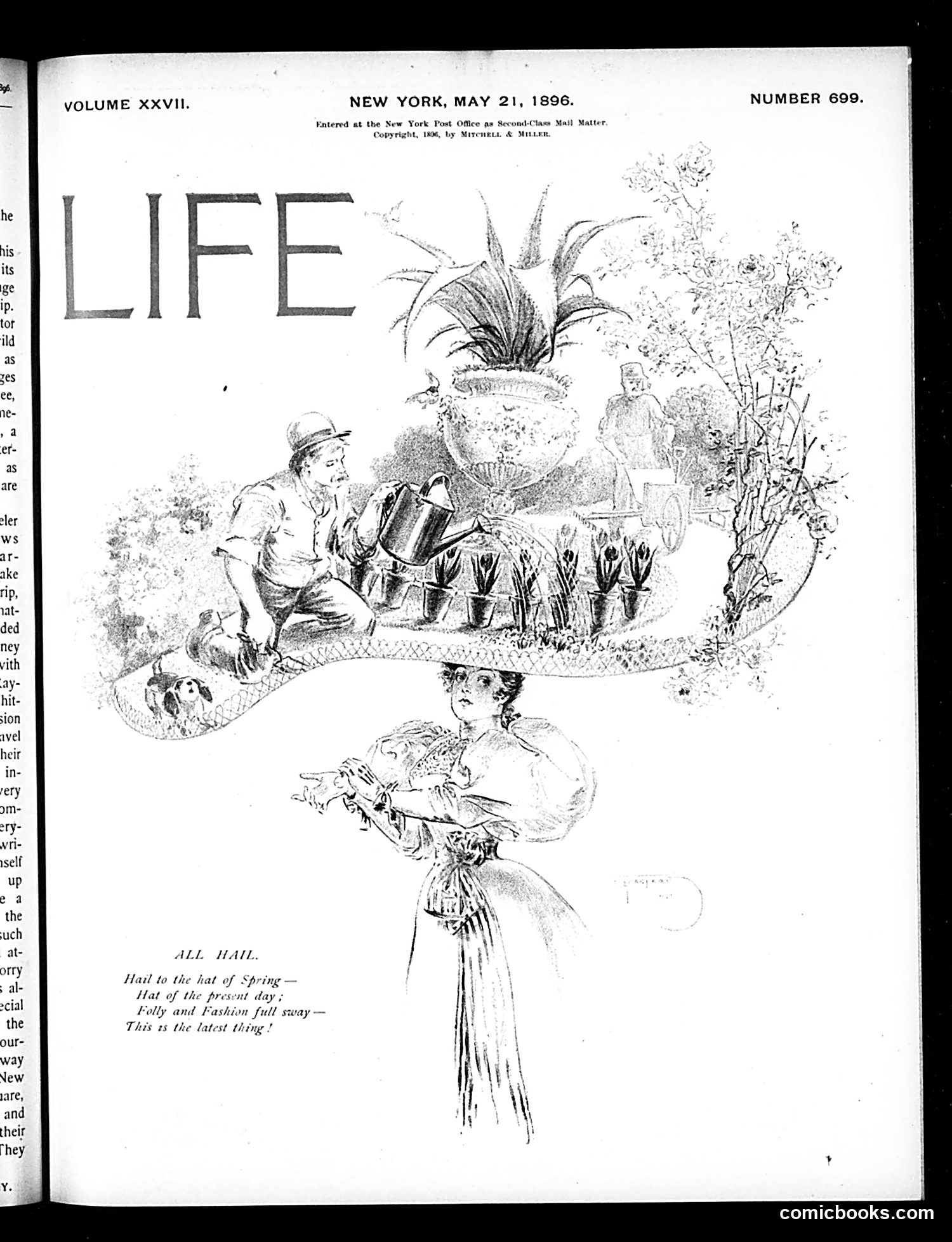
This cover celebrates the arrival of spring and fashionable spring clothing. The main illustration shows a gardener watering potted plants, while a fashionably dressed woman holding flowers stands below. The accompanying verse—"ALL HAIL" / "Hail to the hat of Spring— / that of the present day; / Folly and Fashion full sway— / This is the latest thing!"—is satirical commentary on seasonal fashion trends. The satire targets the frivolity of spring fashion, particularly women's hats and clothing styles. By personifying spring fashion as absurd ("Folly and Fashion full sway"), the magazine mocks how eagerly consumers adopt new styles regardless of practicality. The gardening scene reinforces this theme: while practical cultivation occurs, fashion-conscious society pursues only superficial beauty and novelty. The satire is gentle but pointed—spring fashion deserves mockery for its extravagance and irrationality.
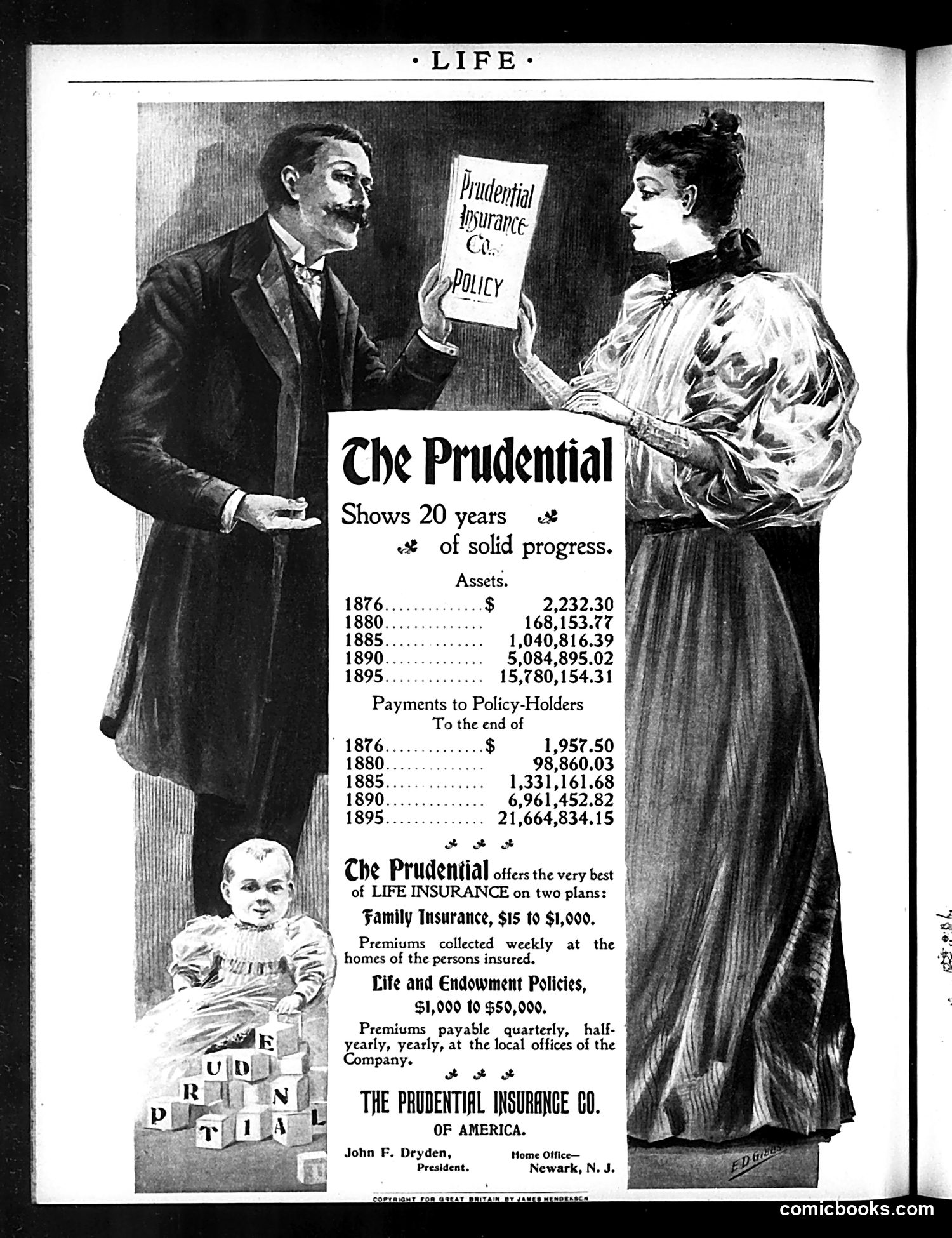
This is primarily a **Prudential Insurance Company advertisement**, not satire. The page shows a well-dressed man and woman examining an insurance policy document. The "PRUDENTIAL" text and baby with building blocks spelling "PRUDENTIAL" reinforce the company's branding. The advertisement emphasizes the company's financial growth over 20 years (1876-1895), displaying increasing assets and policy payouts. It promotes two insurance plans: family insurance ($15-$1,000) with weekly premium collection at customers' homes, and life/endowment policies ($1,000-$50,000) with flexible payment schedules. The gentleman appears to be a sales representative presenting the policy to a prospective female customer—reflecting late-Victorian marketing conventions. This is commercial promotion, not political commentary.
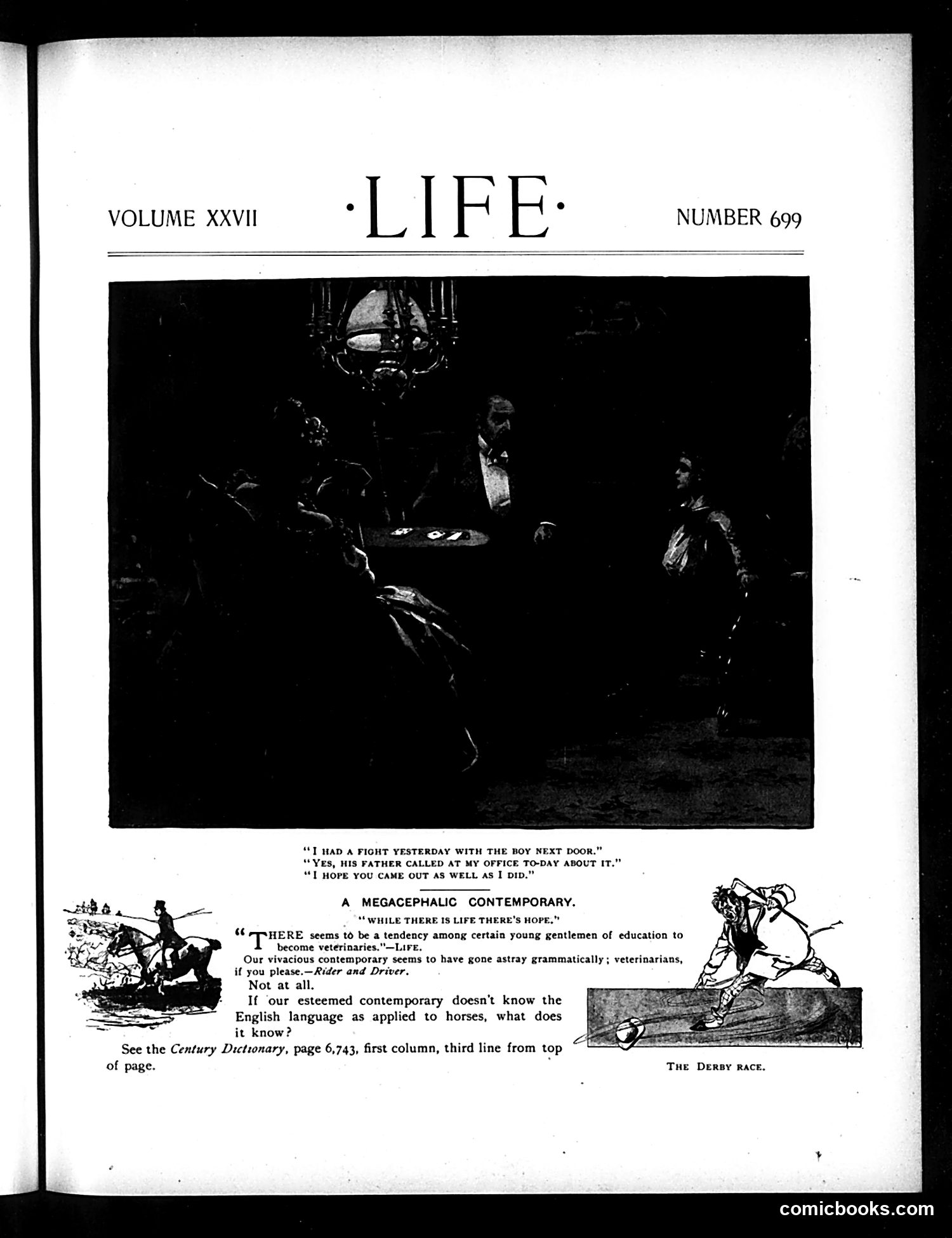
This page satirizes "contemporary" young educated gentlemen who misuse English grammar when discussing horses. The article humorously suggests these men don't understand proper equestrian terminology despite their education. The dark photograph at top shows what appears to be an indoor social scene, illustrating the "megacephalic contemporary" type being mocked. The dialogue quotes reference a fight between neighbors' sons—likely ordinary domestic drama treated with mock-serious tone. The sidebar illustrations show horseback riding and "The Derby Race," supporting the horse-related humor. The piece directs readers to consult the Century Dictionary for proper horse terminology, implying these educated men should know better. The satire targets pretentious young men of means whose grammatical errors reveal their actual ignorance despite claims to education.
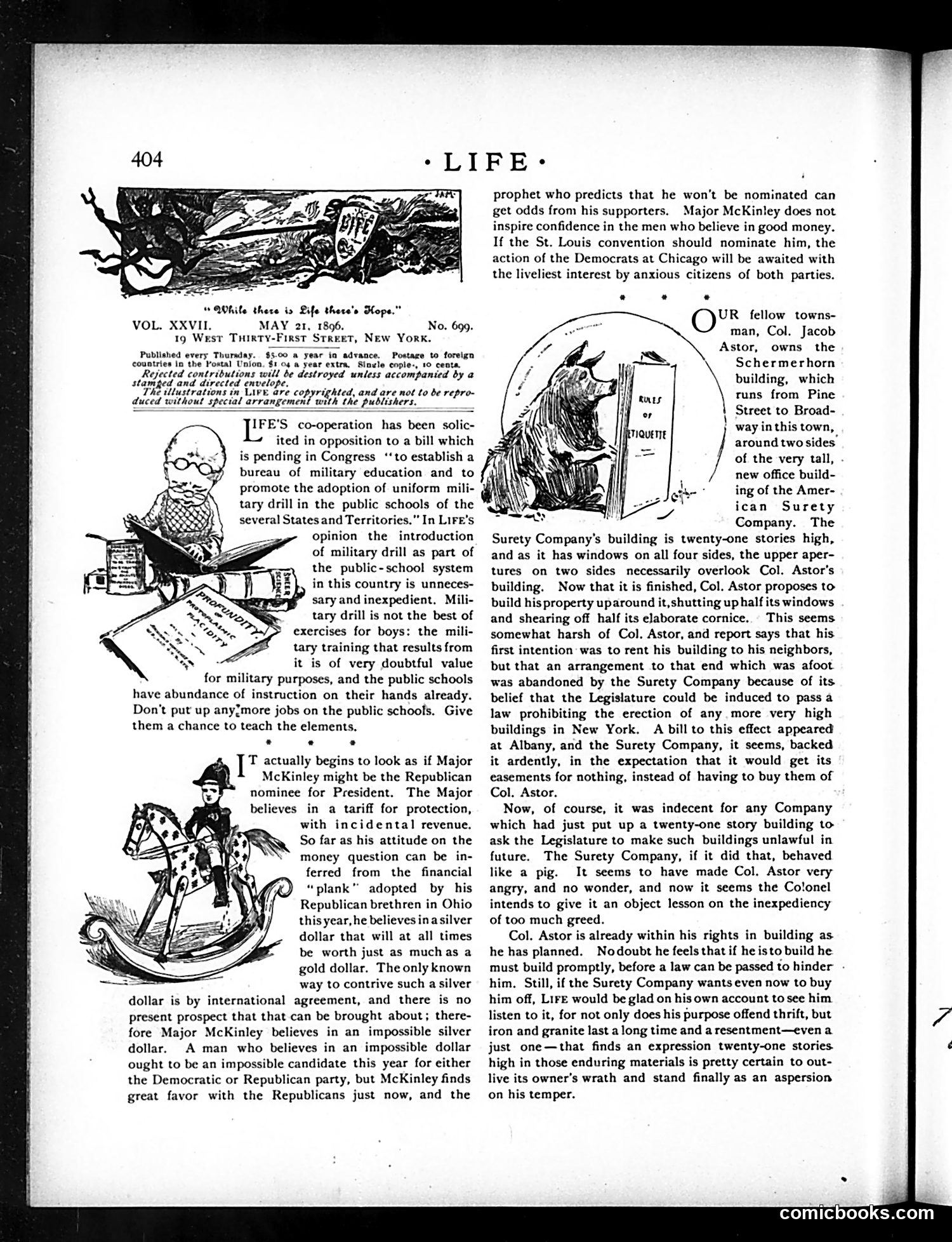
**The Cartoons:** The left illustration shows a figure (likely representing the common man or taxpayer) overwhelmed by military drill equipment and paperwork, opposing a Congressional bill to introduce mandatory military drill in public schools. Life argues this wastes school resources and burdens already-overburdened teachers. The right illustration depicts a horse-mounted figure (unclear who specifically) on a rocking horse, satirizing Major McKinley's potential Presidential candidacy. The text criticizes McKinley's protectionist tariff stance and suggests he represents wealthy Republican interests rather than sound fiscal policy. **The Point:** Life uses these cartoons to critique Republican political priorities—militarization of schools and protectionist economics—positioning them as ill-conceived or self-serving policies benefiting the wealthy over ordinary citizens.
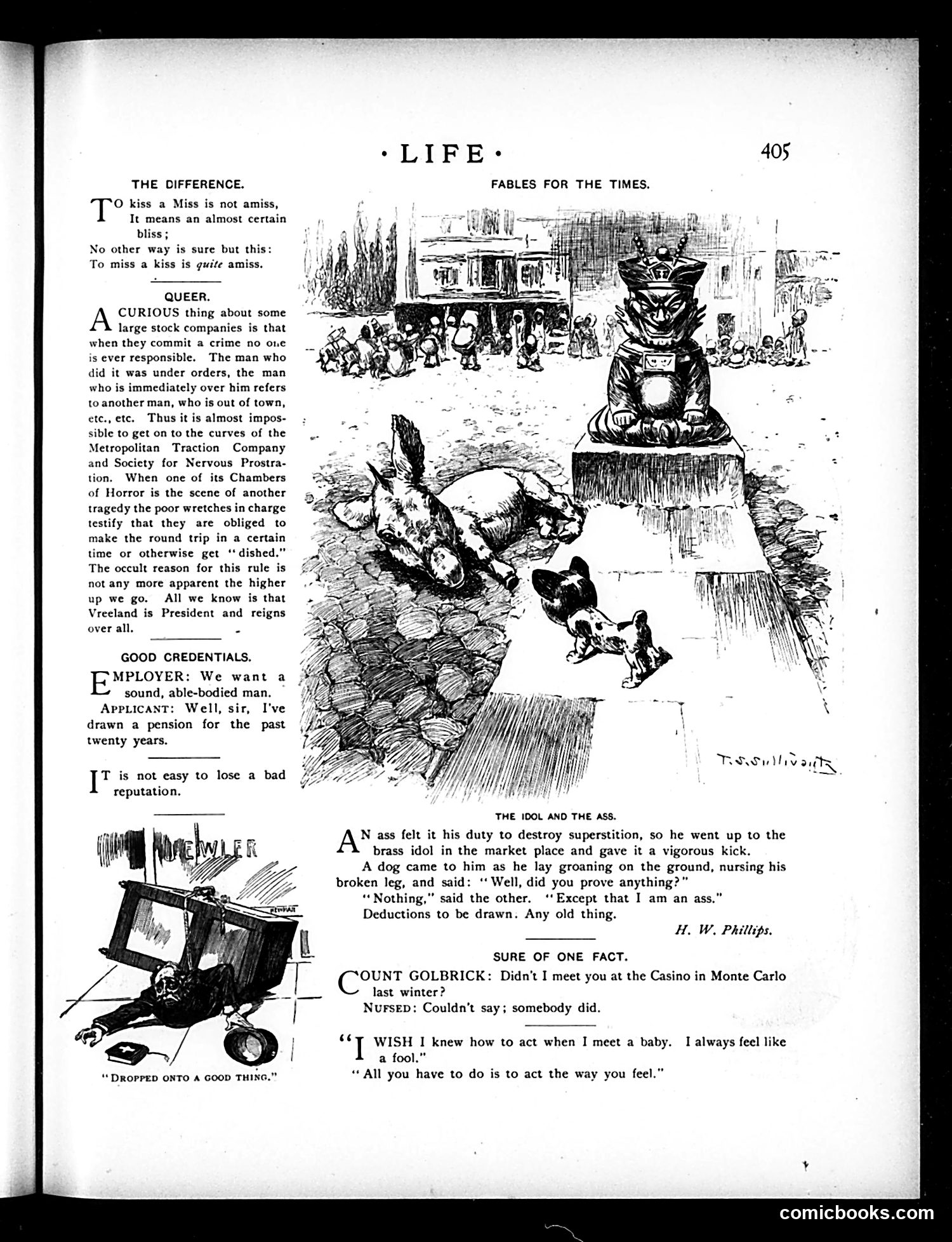
This page contains several brief satirical pieces and illustrations typical of Life's humor section. **"Fables for the Times"** features a large illustration of a cat idol being kicked by a man, with a dog observing. The accompanying fable "The Idol and the Ass" satirizes blind superstition—the man destroys a brass idol to disprove superstition, but a dog mocks his effort, suggesting people cling to false beliefs regardless of evidence. **Other sections** include short jokes about corporate accountability ("Queer"), employment credentials ("Good Credentials"), and social awkwardness with babies ("Sure of One Fact"). A small cartoon labeled "Dropped onto a Good Thing" depicts a figure that appears to have fallen into machinery. The page exemplifies Life's style: brief, punchy social satire through dialogue and illustration, targeting contemporary attitudes and human folly.
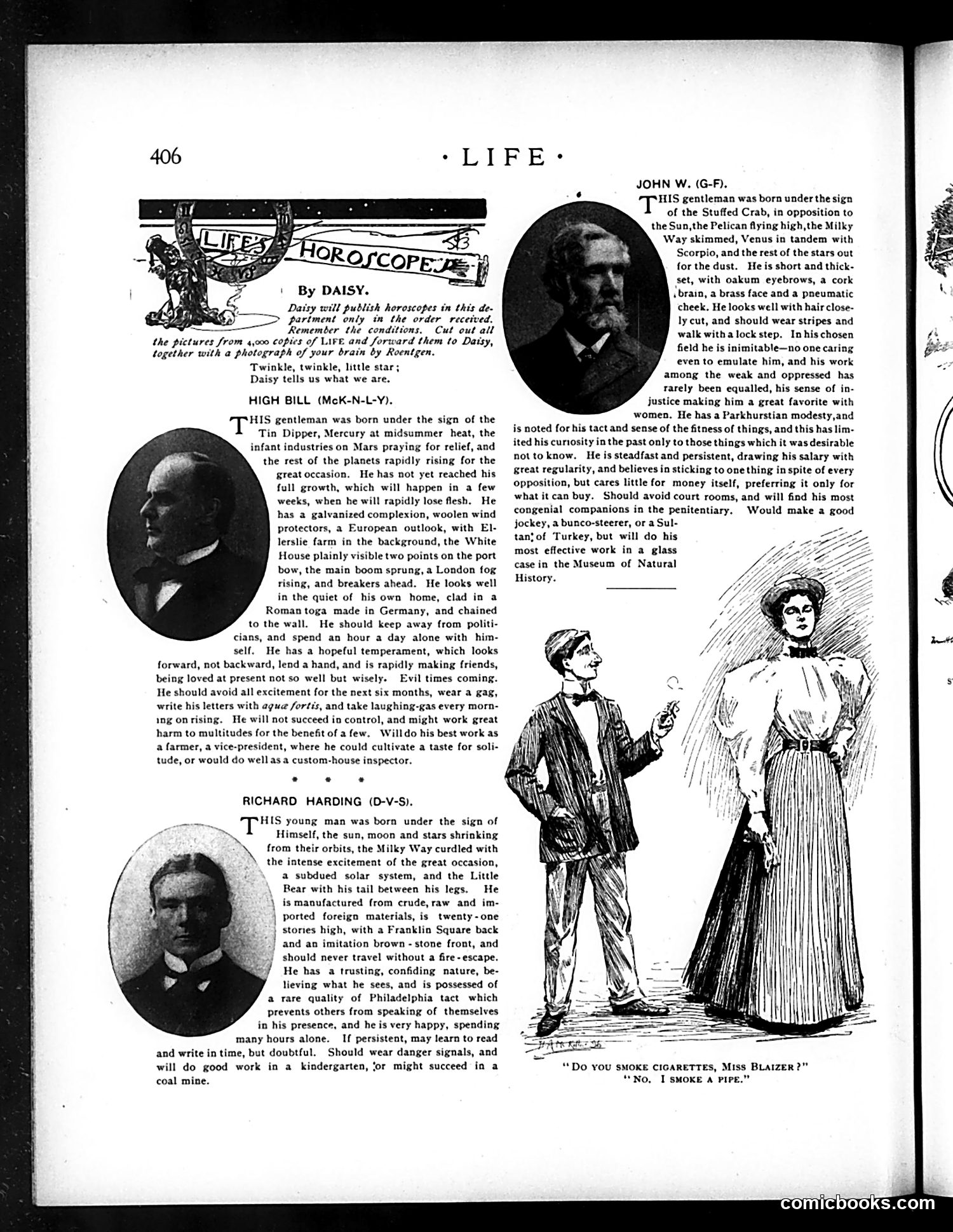
This page contains horoscope-style character sketches rather than political cartoons. Under the heading "HOROSCOPE," Daisy provides astrological personality profiles for three individuals: **High Bill (McKinley)** — a Taurus born under industrial hardship, described as having European outlook and temperament suited to farming or politics. **John W. (G.F.)** — a Crab sign native, characterized as tactful, justice-minded, and effective in museum work or similar refined positions. **Richard Harding (D-V-S)** — a Himenel sign young man suited for kindergarten or coal mining work. The bottom illustration shows a dialogue joke: "Do you smoke cigarettes, Miss Blazier?" / "No, I smoke a pipe." The satirical intent appears gentle—mocking astrological personality typing as entertainment rather than serious commentary.
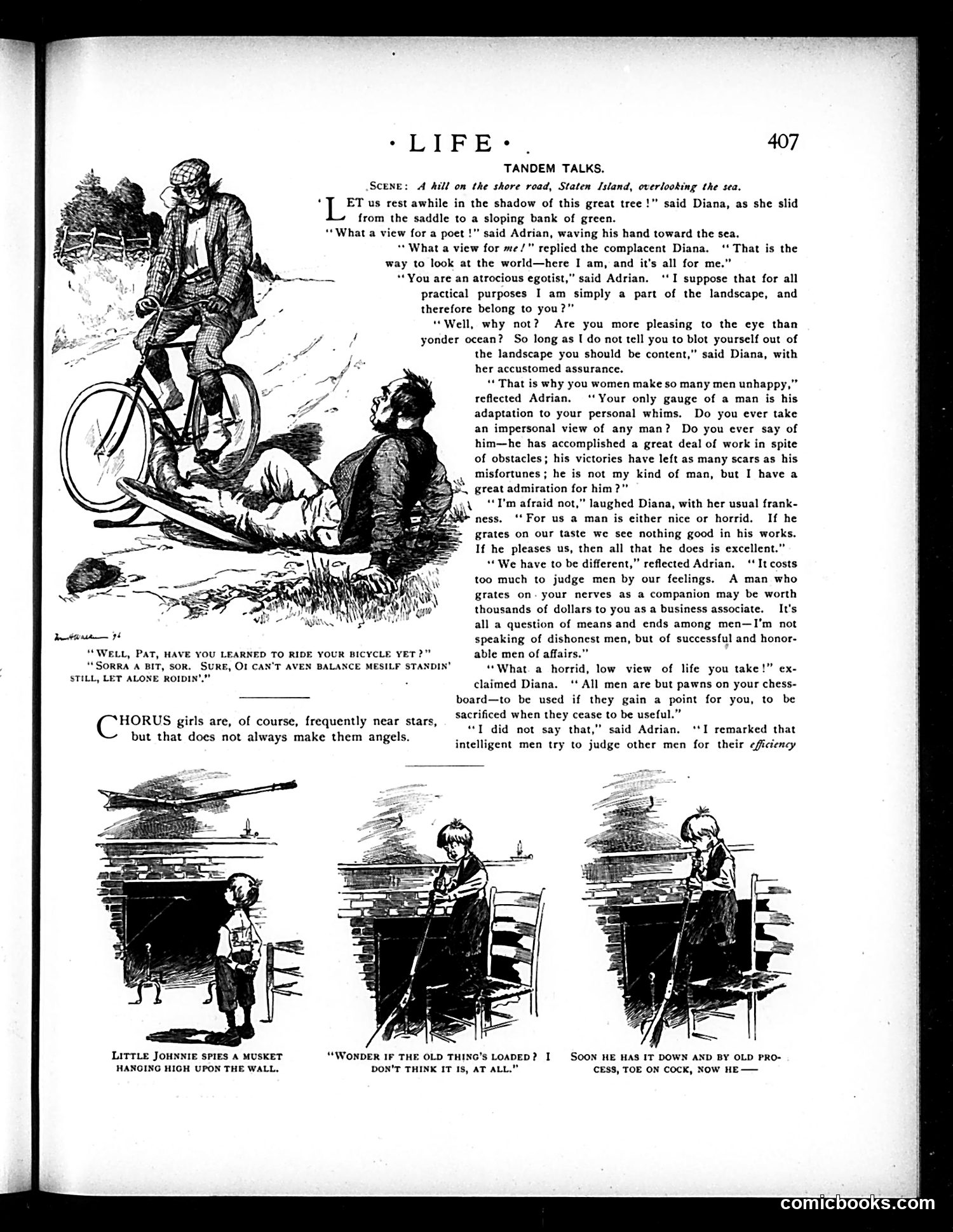
This page contains a philosophical dialogue between two characters, Diana and Adrian, who rest by a tree overlooking Staten Island's shore. Adrian, depicted riding a bicycle, engages Diana in debate about aesthetics and male achievement. The satire targets two things: first, **pedantic male intellectualism**—Adrian condescendingly lectures Diana about judging men's accomplishments while she advocates for simpler, more personal values. Second, it mocks **self-important men** who measure themselves through grand deeds and business success rather than character. Diana's responses mock this pretension with wit and "usual frankness," suggesting the cartoon critiques masculine arrogance and the era's competitive ethos among ambitious men. The lower cartoons appear unrelated comic vignettes about children.
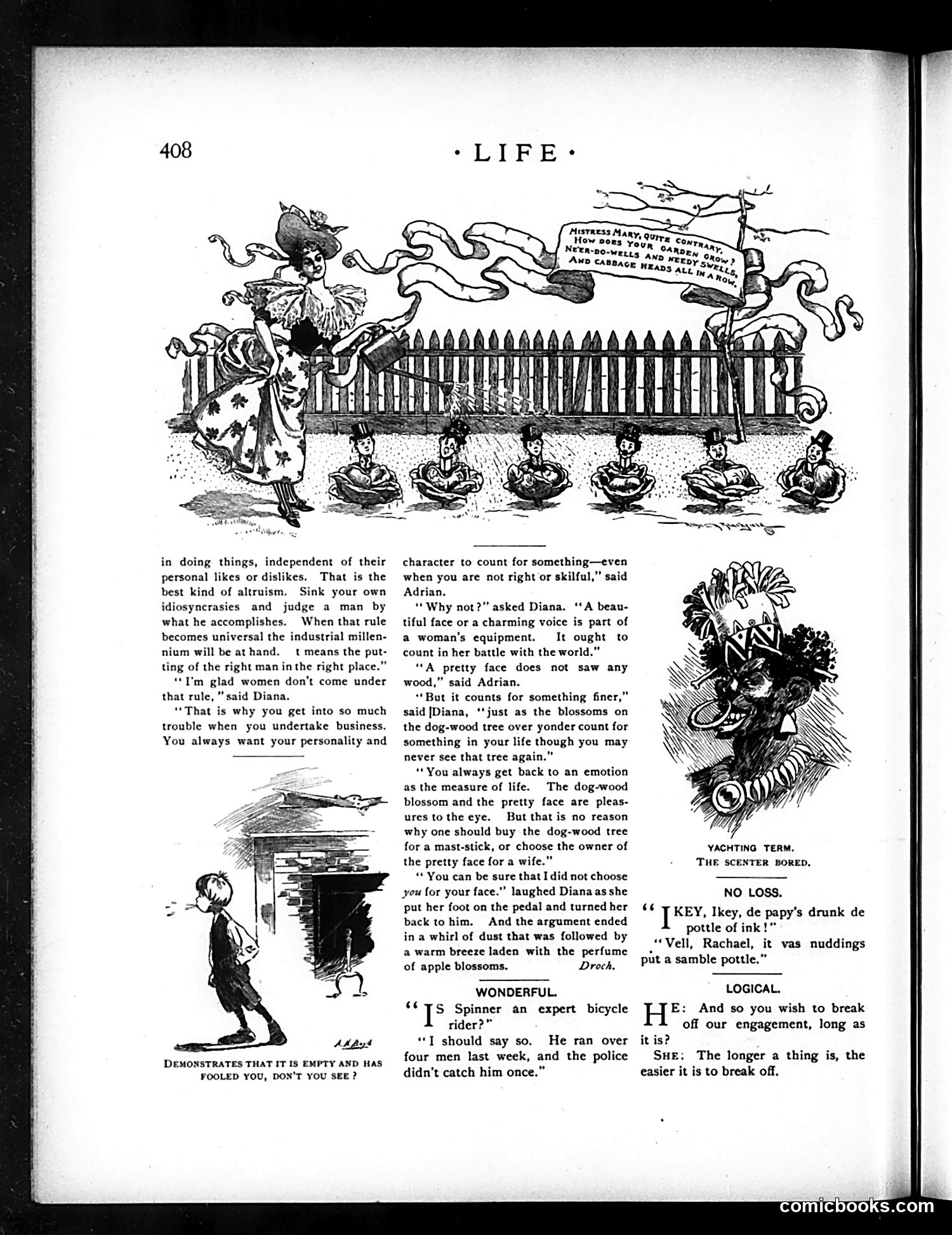
This page from *Life* magazine contains several brief humorous sketches rather than a single political cartoon. The main content includes: 1. **Top illustration**: A decorative header with a woman and tentacled serpent, referencing "Mistress Mary, Quite Contrary"—a nursery rhyme about growing a garden. This appears to be satirical commentary on women's domestic/gardening roles. 2. **Lower sections**: Three short joke dialogues labeled "Wonderful," "Yachting Term," and "Logical"—light social humor about bicycles, maritime terminology, and engagement breakups. 3. **Small illustrations**: Sketches accompanying these jokes, including one captioned "Demonstrates that it is empty and has fooled you, don't you see!" The page is primarily entertainment-focused satire rather than political commentary, typical of *Life*'s popular humor content from the early 20th century.
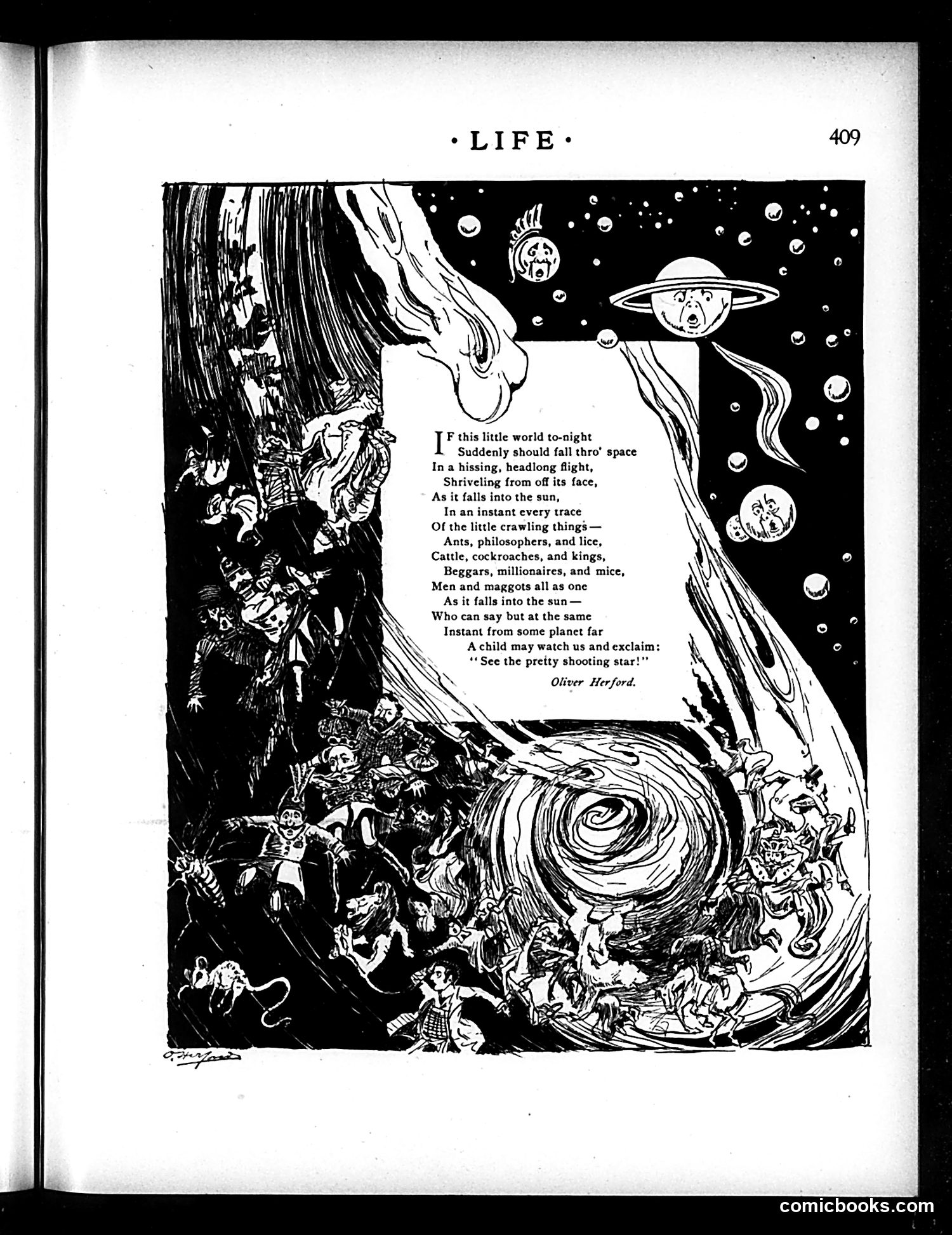
This is a satirical illustration by Oliver Herford accompanying his poem about Earth's destruction. The artwork depicts a cosmic scene where our planet falls into the sun, shown as a spiraling vortex at the bottom. The top features alarmed celestial bodies (planets with face caricatures) observing Earth's demise. The left side teems with detailed illustrations of all Earth's inhabitants—humans, animals, insects, and social classes—tumbling together into oblivion. The satire's point: the poem mocks human social hierarchies and distinctions (beggars, millionaires, kings, ants) by imagining their simultaneous, undifferentiated destruction. Herford uses cosmic catastrophe as dark humor to suggest that death equalizes all beings regardless of status or species—a memento mori commentary on human pretension.
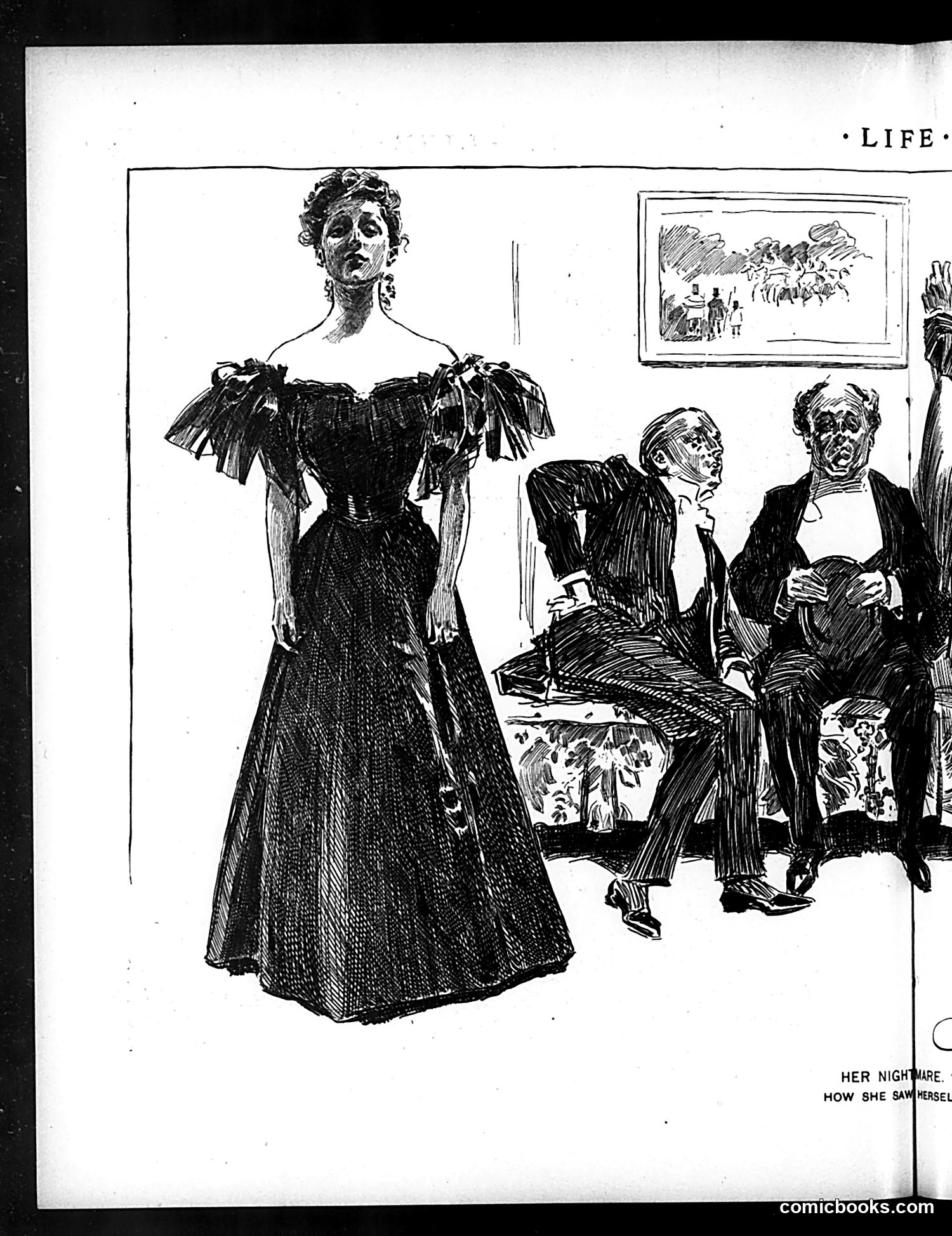
This appears to be a satirical illustration from *Life* magazine depicting a social scenario titled "HER NIGHTMARE: HOW SHE SAW HERSELF." The image shows a woman in an elegant off-shoulder evening gown standing prominently on the left, while three men in formal attire sit together on the right, appearing to converse or react. The woman's expression and posture suggest confidence or pride in her appearance. The caption indicates this represents a woman's "nightmare"—likely satirizing female vanity or anxiety about social perception. The contrast between her idealized self-image (standing alone, formally dressed) and the men's apparent indifference or critical observation suggests the joke concerns the gap between how women imagine themselves being perceived versus reality. This reflects early-to-mid 20th-century satirical commentary on women's self-consciousness regarding appearance and social judgment.
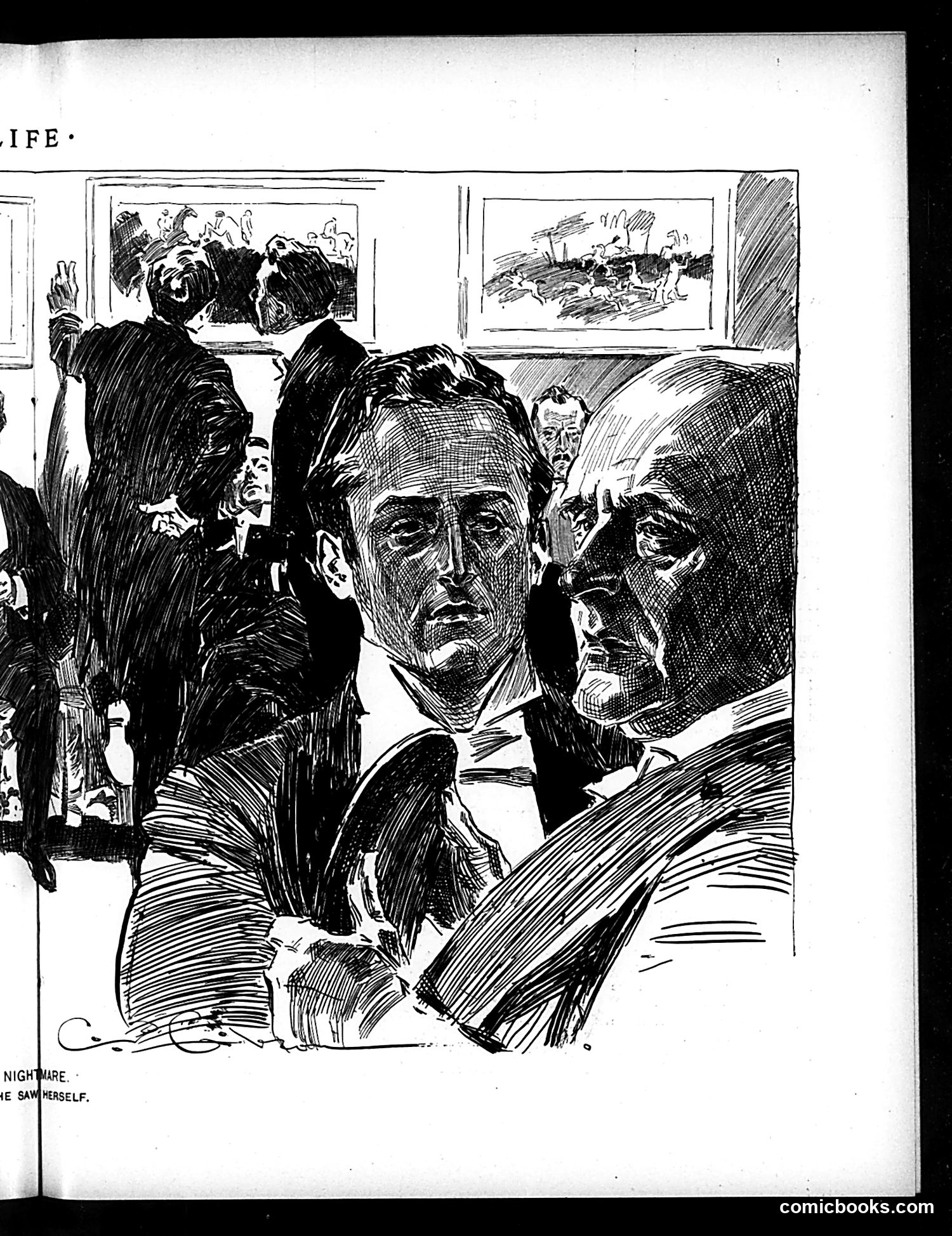
This is a satirical sketch from Life magazine showing several well-dressed men in what appears to be an art gallery or exhibition space. Two paintings hang on the wall behind them. The men in the foreground are rendered with distinctive facial features in an expressive ink-sketch style. The visible OCR text fragments ("NIGHTMARE" and "HE SAW HERSELF") suggest this cartoon comments on viewing or perception, possibly critiquing how certain figures see themselves or are perceived by others. However, **without identifying marks, dates, or complete caption text**, I cannot definitively identify which specific historical figures are caricatured here or what particular political/social event this references. The style and paper quality suggest early-to-mid 20th century, but the specific satirical target remains unclear from the image alone.
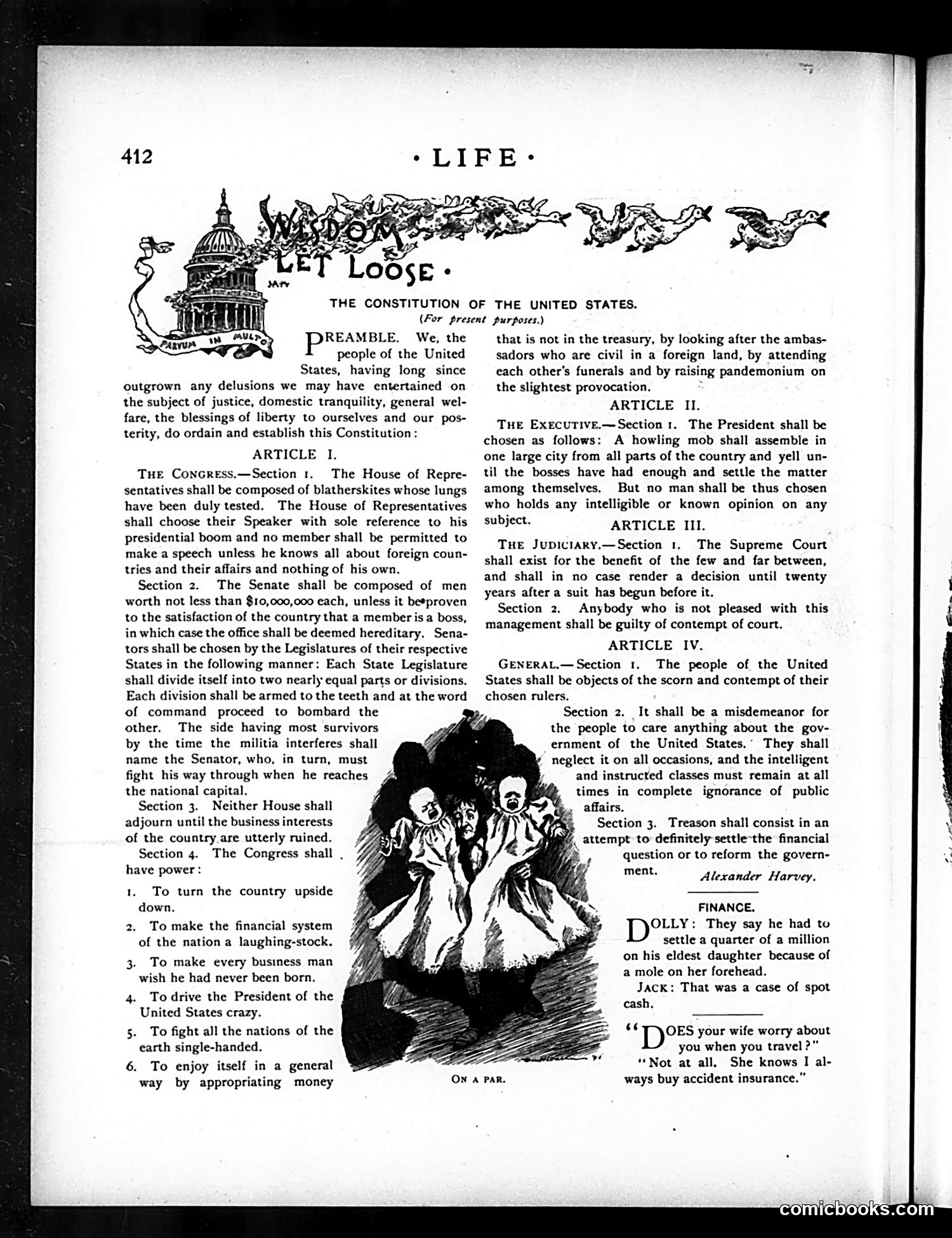
This is a **mock constitution** savagely criticizing contemporary American politics. Life magazine presents a "rewritten" Constitution claiming to reveal government's true, cynical operating principles. The satire attacks: - **Congress as incompetent**: Representatives chosen for lung capacity, senators must be millionaires (or political "bosses"), chosen through violent state legislature battles - **Executive branch**: Presidents selected by howling mobs of bosses, not informed citizens - **Judiciary**: Deliberately slow (20-year delays), contempt for public input - **General corruption**: Citizens are objects of "scorn and contempt"; caring about government is criminalized; financial/reform attempts are "treason" The central cartoon shows politicians as predatory birds or demons descending on the populace—visualizing the savage extraction of power. The page suggests American democracy has become a facade masking oligarchic control by wealthy elites and political machines. The crude humor masks genuine critique of Gilded Age corruption, boss rule, and citizen disempowerment.
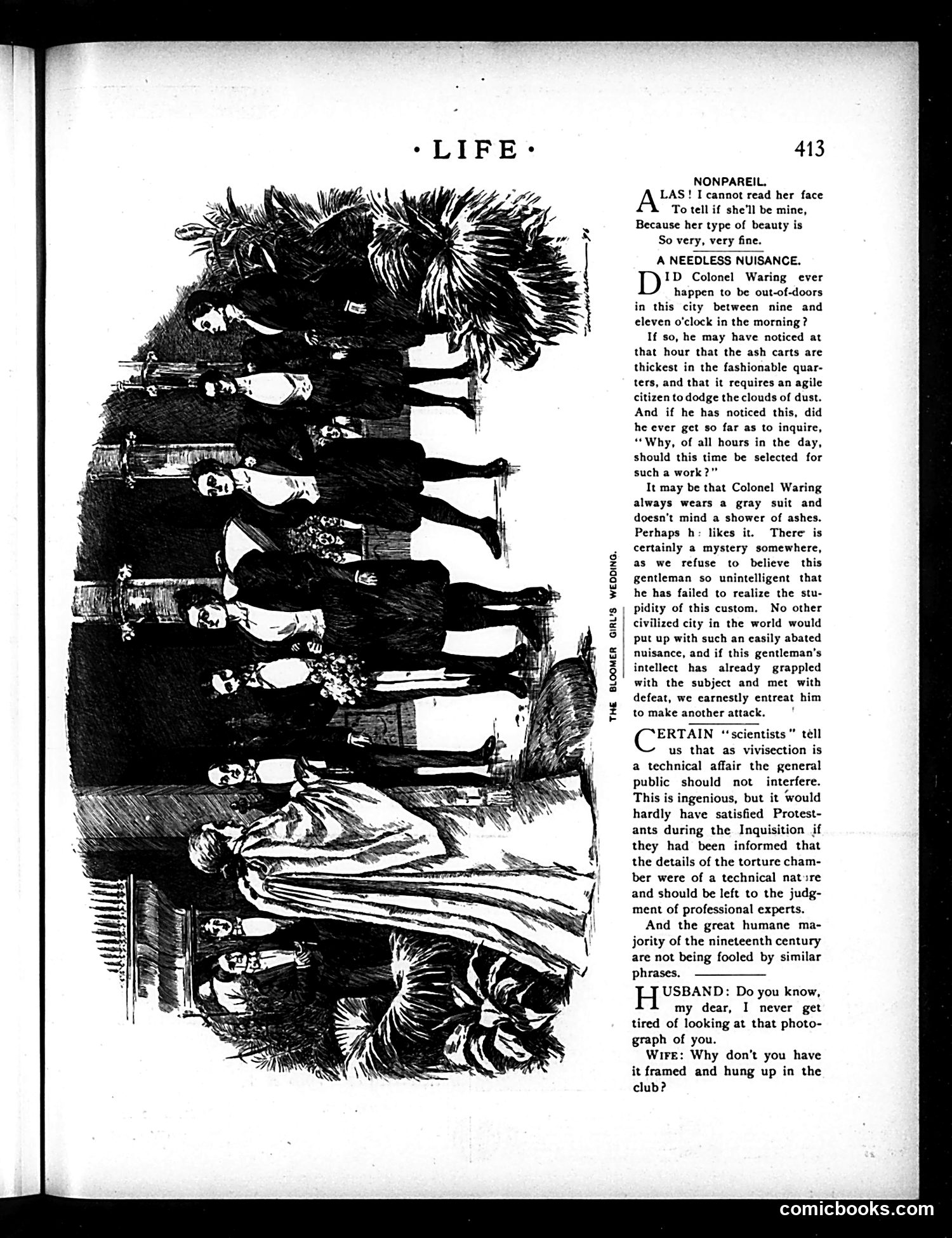
This page contains three distinct satirical pieces from *Life* magazine (likely late 19th century, given references to Colonel Waring). **"A Needless Nuisance"** criticizes Colonel Waring, New York's street-cleaning commissioner, for scheduling garbage collection during peak morning hours (9-11 AM) in fashionable neighborhoods, creating dust clouds. The satire argues this is illogical and that no other civilized city tolerates such poor planning—a veiled criticism of municipal incompetence. **The vivisection piece** uses an analogy: just as scientists claim vivisection (animal testing) should be left to experts and public shouldn't interfere, this mirrors how the Inquisition defended torture as "technical." The satire defends public moral authority over supposedly "expert" practices. **The husband-wife joke** offers light domestic humor: a husband admires his wife's photograph so much she sarcastically suggests he display it at his club instead of looking at her in person—a jab at male distraction or vanity. The ornate illustration appears to show fashionable Victorian-era figures, likely depicting the ash-cart chaos referenced.
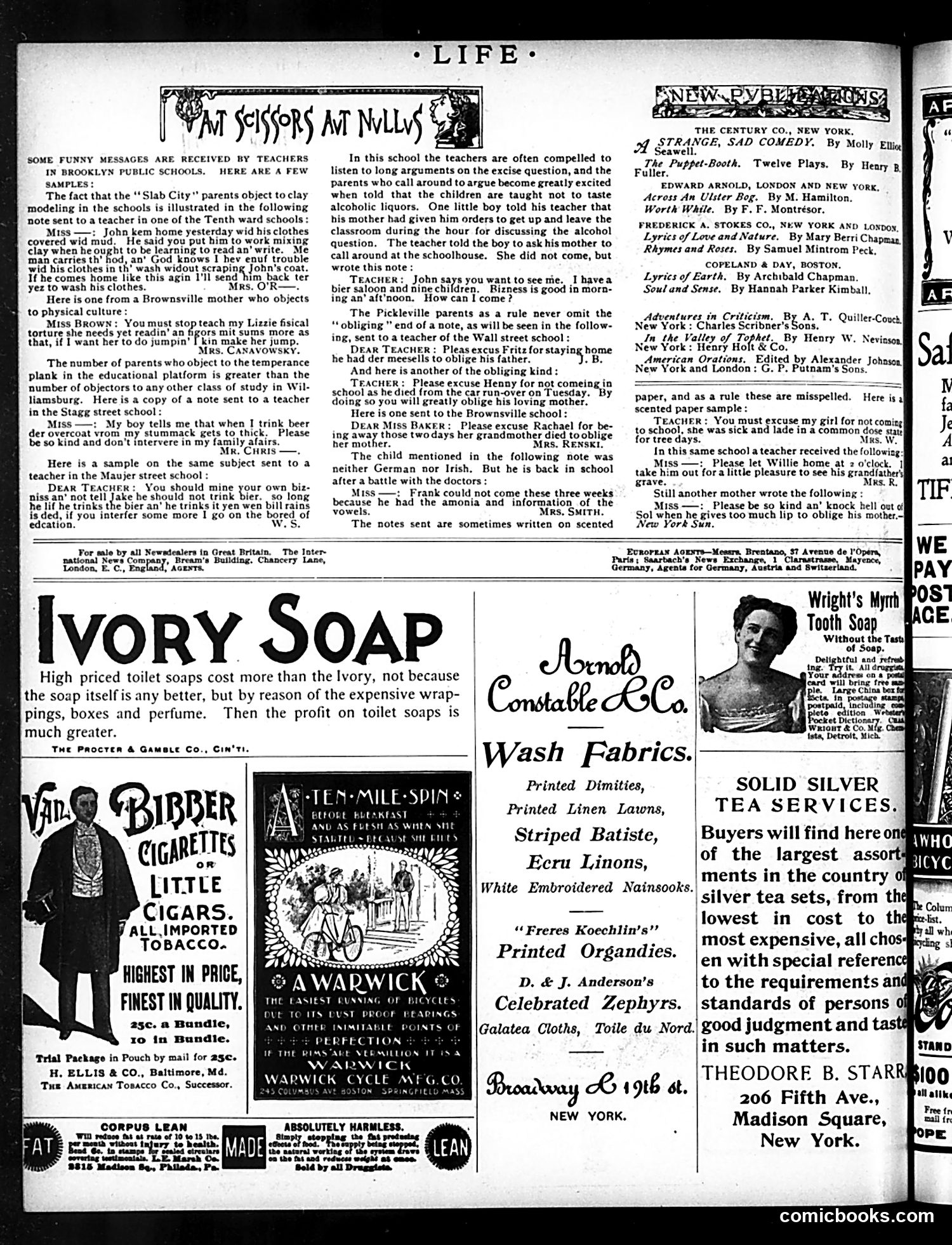
This satirical piece mocks immigrant parents in Brooklyn public schools through their written notes to teachers—presented in heavy dialect and fractured English. The humor targets: **The Parents:** Depicted as working-class immigrants (Irish, German, Jewish names evident) who object to modern educational innovations—clay modeling, physical education, temperance instruction—viewing them as wastes of time or interference in family affairs. **The Satire:** The piece ridicules both parental attitudes and their written communication. Notes contain malapropisms ("amonia and information of the vowels," "ear run-over"), misspellings, and logic absurdities ("he died from the ear run-over...by doing so you will greatly oblige his loving mother"). **The Context:** Early 1900s America saw tensions between Progressive educational reforms and working-class immigrant resistance. Teachers' frustration with parental objections—especially to temperance lessons—reflects period anxieties about assimilation and modernization. The piece embodies period xenophobia, presenting immigrants as ignorant obstacles to progress, though it simultaneously critiques their legitimate class concerns about schooling's relevance.
This page is **primarily advertising**, not satirical content. It dates from early 1896 based on the Republic newspaper circulation claims. The only potential cartoon is a small silhouette labeled "The Republic," appearing twice—comparing the newspaper's advertising columns to competitors. This is self-promotional advertising rather than satire. The bulk of the page consists of commercial advertisements for luxury goods (Armour's Extract of Beef, Tiffany & Co.'s safe deposit vaults, wedding silverware, fine leather goods) and practical items (Columbia bicycles, sheet music folios, instructional books). An advertisement for Penn Mutual Life Insurance claims that common assumptions about insurance "may be wrong." There is no identifiable political satire or social commentary on this page. It represents typical turn-of-the-century *Life* magazine advertising mixed with one self-promotional newspaper claim about market dominance.
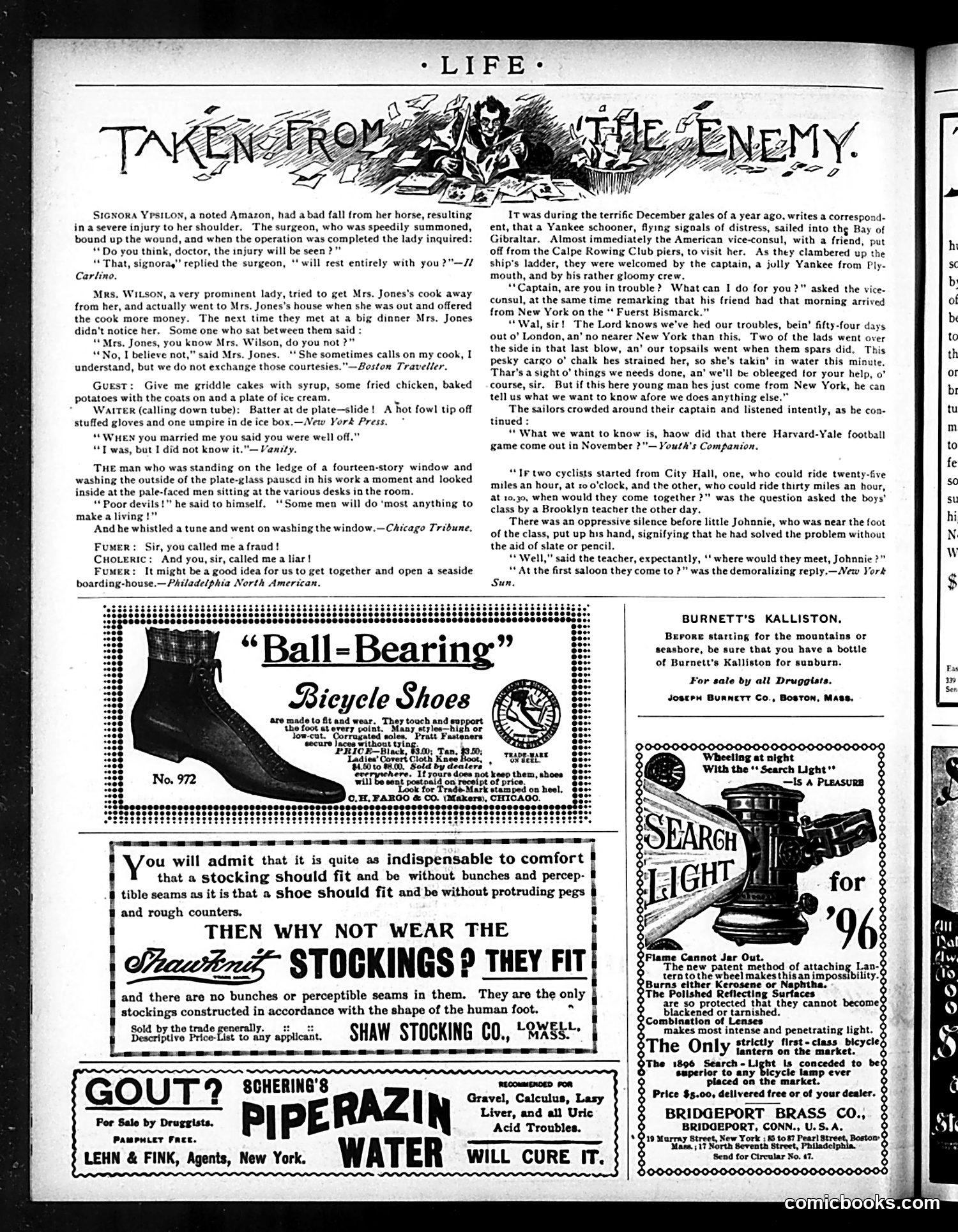
This page from *Life* magazine contains six humorous anecdotes satirizing social pretension and human nature: 1. **"Taken from the Enemy"**: A shipwrecked captain prioritizes learning the Harvard-Yale football game result over rescue assistance—mocking Americans' obsession with sports over practical concerns. 2. **Mrs. Wilson anecdote**: Satirizes social rudeness disguised as indifference when Mrs. Wilson poaches Mrs. Jones's cook, then gets coldly snubbed in return. 3. **Restaurant dialogue**: A waiter translates the guest's order into baseball terminology ("batter at de plate"), satirizing how baseball jargon permeates American culture. 4. **Window washer observation**: Darkly humorous: a window cleaner pities office workers toiling indoors while he works outdoors, mocking modern office drudgery. 5. **Liar/fraud dialogue**: Two men insulting each other decide to open a seaside boarding house together—absurdly illogical behavior satirizing human irrationality. 6. **Math problem**: A struggling student solves a complex cyclist problem instantly, mocking how standardized education fails bright minds. The page also contains period advertisements for shoes and remedies.
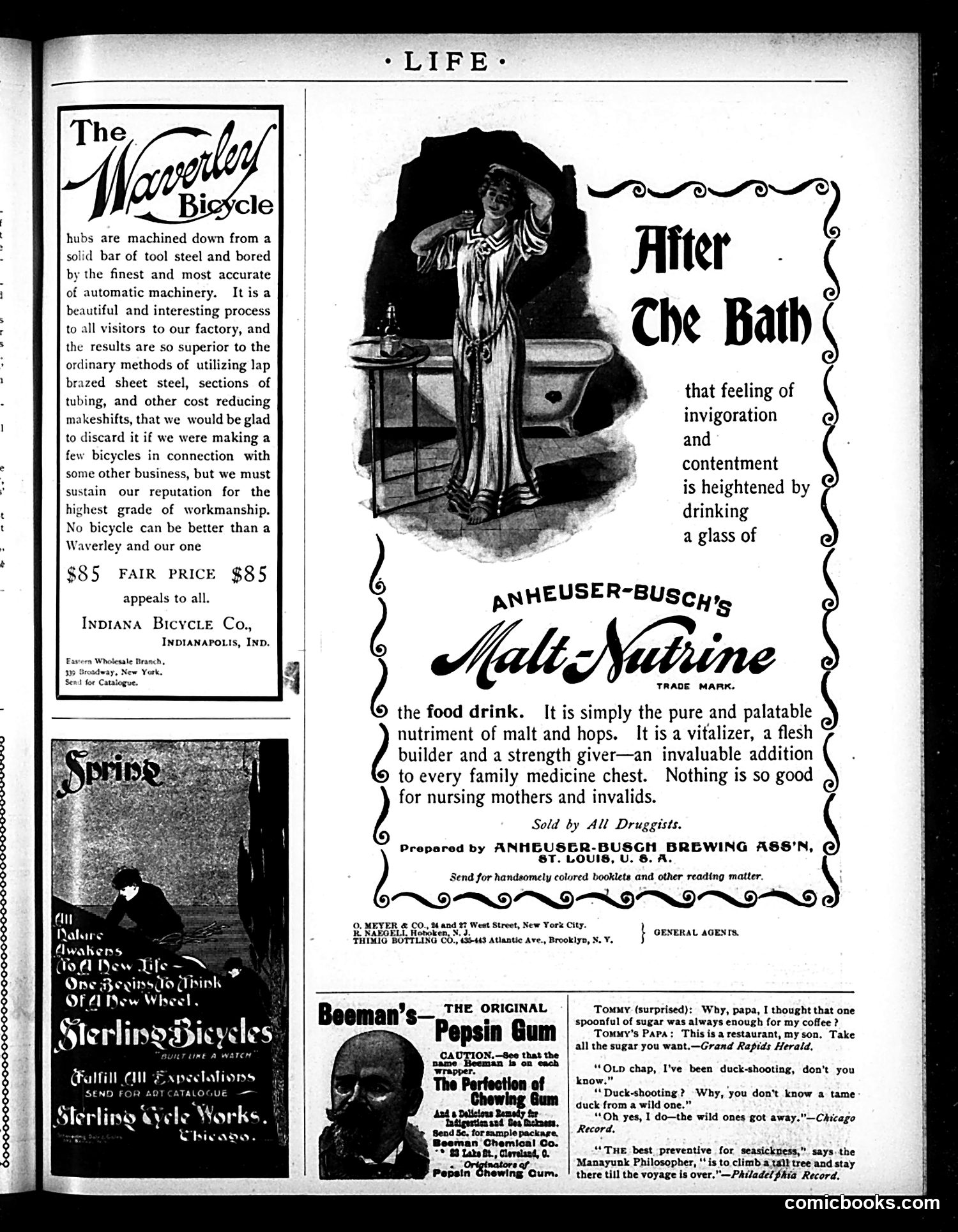
This page is primarily **advertising**, not political satire. It contains four product advertisements typical of early 1900s magazines: 1. **Waverley Bicycle** — promotes manufacturing quality, emphasizing steel hubs machined with precision machinery; priced at $85. 2. **Anheuser-Busch's Malt-Nutrine** — the main illustrated ad features a woman at a bathtub, marketing malt drink as a health tonic for "nursing mothers and invalids," reflecting the era's acceptance of beer/malt as medicinal. 3. **Sterling Bicycles** — brief competing bicycle ad. 4. **Beeman's Popsin Gum** — advertises chewing gum with three humorous anecdotes about sugar consumption, duck-hunting confusion, and seasickness remedies—light humor typical of period advertising copy. The page reflects early 20th-century consumer culture: bicycles were novelty items, malt beverages were marketed as health products (before Prohibition), and manufacturers used jokes to build brand appeal. No political commentary is present.
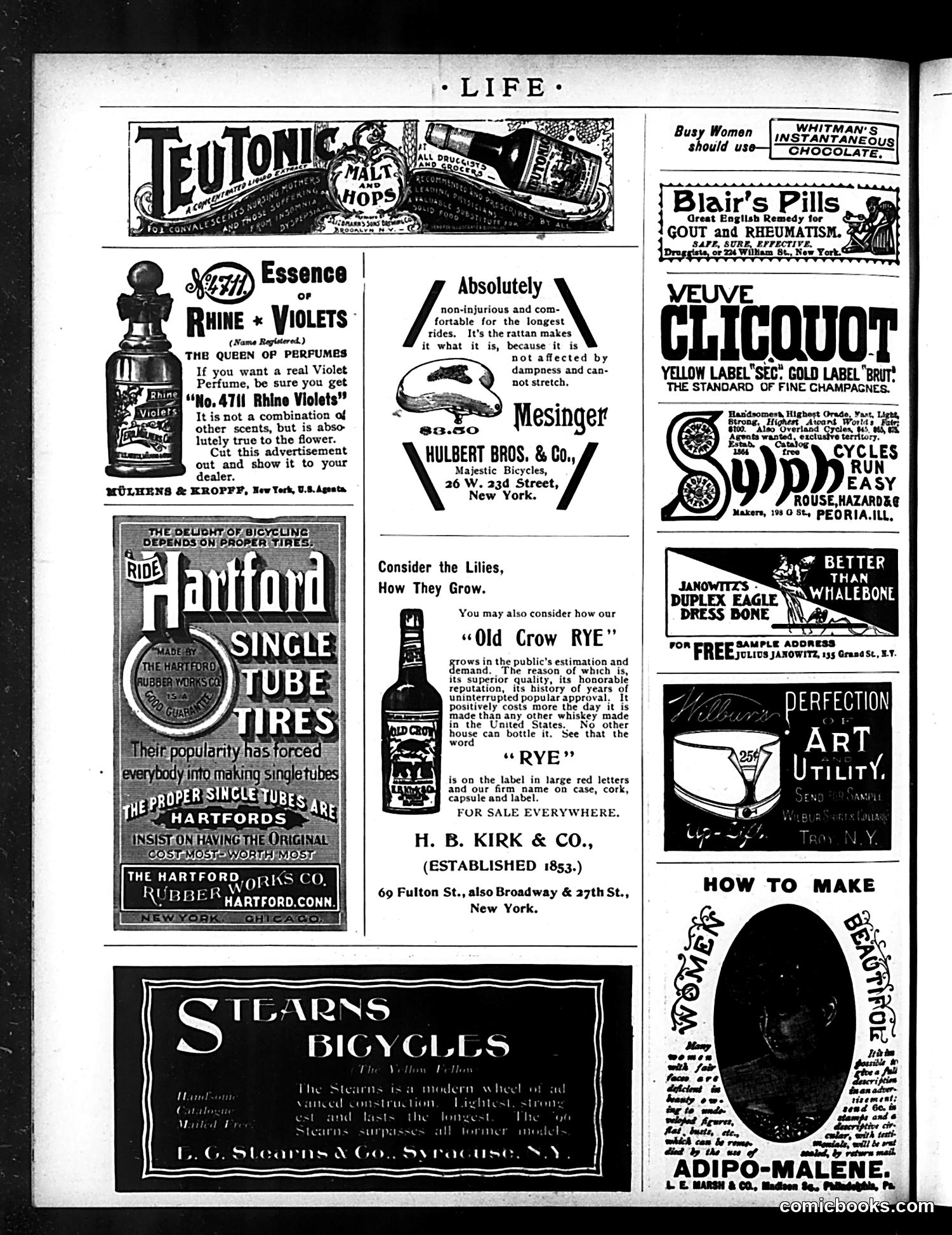
This is primarily a **product advertisement page** from *Life* magazine, not a political cartoon. It contains no satire or social commentary—just vintage advertising from the early 1900s. The page features remedies and luxury goods marketed to affluent readers: perfume (4711 Rhine Violets), patent medicines (Blair's Pills for gout/rheumatism), whiskey ("Old Crow Rye"), bicycles (Stearns, Hartford, Mesinger brands), tires (Hartford rubber), champagne (Veuve Clicquot), chocolate (Whitman's), and corsetry (Janowitz's Duplex Eagle Dress Bone). The "Consider the Lilies, How They Grow" section uses biblical language as a whimsical hook to sell whiskey—contrasting natural growth with Old Crow's "superior quality" and higher cost. These ads reflect Gilded Age consumer culture: medical quackery, conspicuous consumption, and gendered marketing ("Busy Women should use...Chocolate").
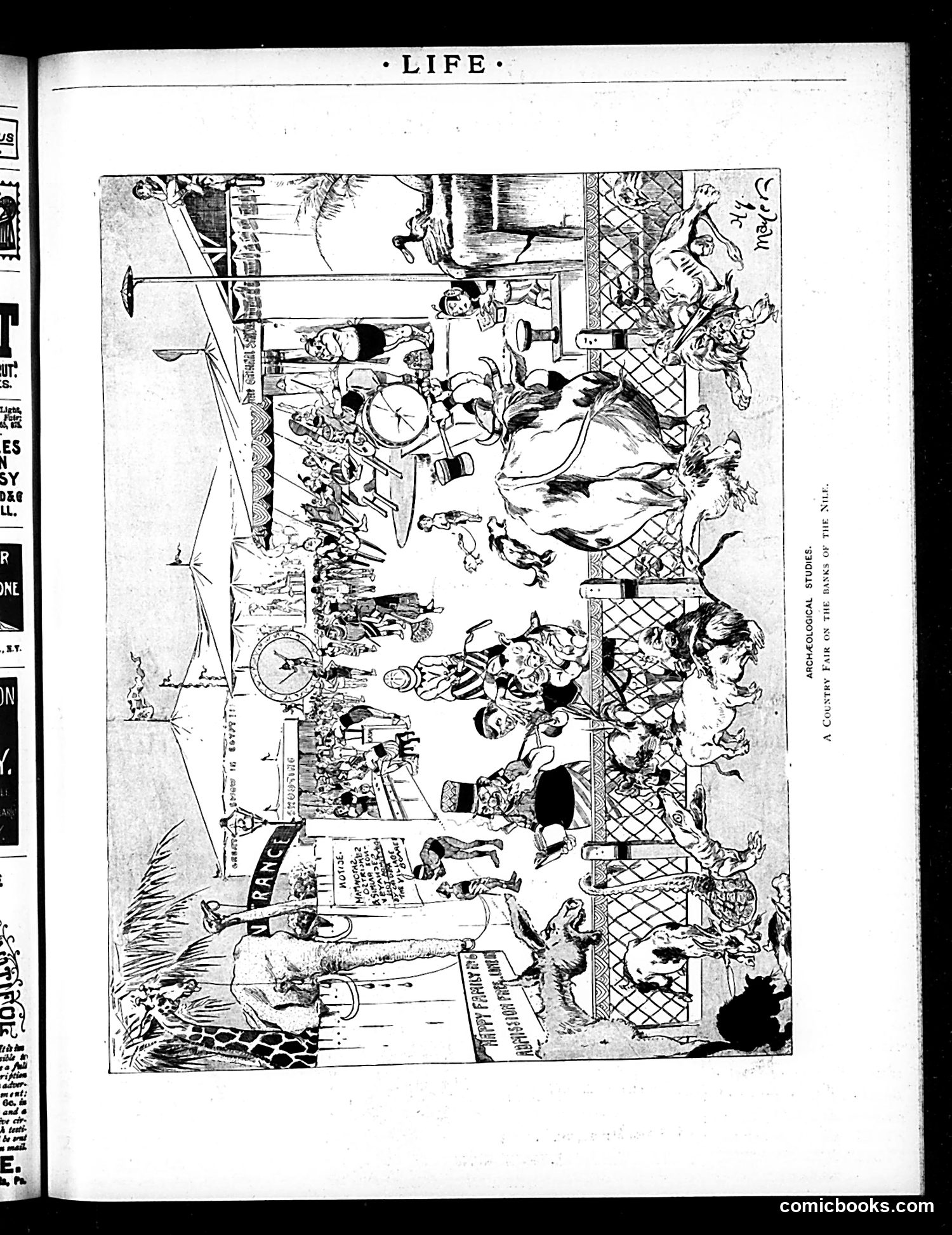
The OCR text is too corrupted to read reliably. However, examining the image itself: this appears to be a satirical cartoon printed sideways (meant to be rotated 90 degrees to read properly). It depicts a crowded scene with multiple figures in what looks like a social gathering or public space. The style and composition suggest early-to-mid 20th century Life magazine satire, likely commenting on contemporary social behavior, leisure activities, or public conduct. Without legible text, I cannot identify specific individuals being caricatured or determine the precise political or social commentary intended. The cartoon's detailed line work and busy composition are typical of Life's sophisticated visual humor from this era.
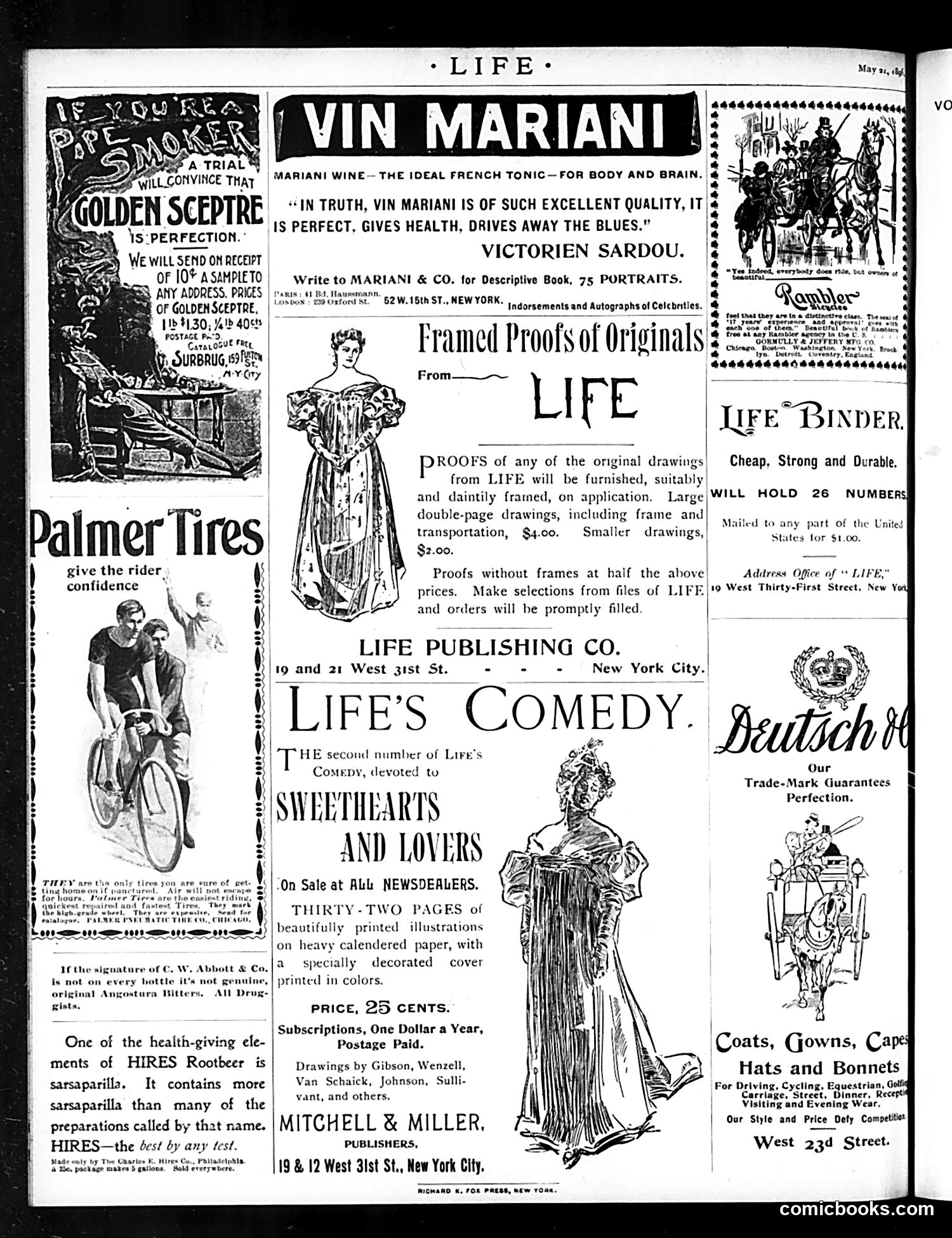
This page is primarily **advertising and promotional content** rather than political satire or editorial cartooning. It showcases various commercial advertisements interspersed with Life Publishing Company's own promotional materials. Key content includes ads for **Vin Mariani** (a wine tonic claiming health benefits, endorsed by playwright Victorien Sardou), **Palmer Tires**, **Golden Sceptre** cigars, **Hires Rootbeer**, and **Angostura Bitters**—all products marketed with exaggerated health claims typical of early 20th-century patent medicine advertising. Life Publishing advertises its own products: framed artwork proofs from Life magazine contributors (Gibson, Wenzell, Sullivant), a "Life's Comedy" publication featuring "Sweethearts and Lovers," a Life Binder for collecting issues, and a Deutsch clothing shop. The illustrations are decorative rather than satirical—fashion sketches and product imagery. This represents a common magazine format of the era: editorial content subsidized through dense advertising pages.