
Life, 1896-05-21 · page 4 of 20
Life — May 21, 1896 — page 4: what you’re looking at
What you’re looking at
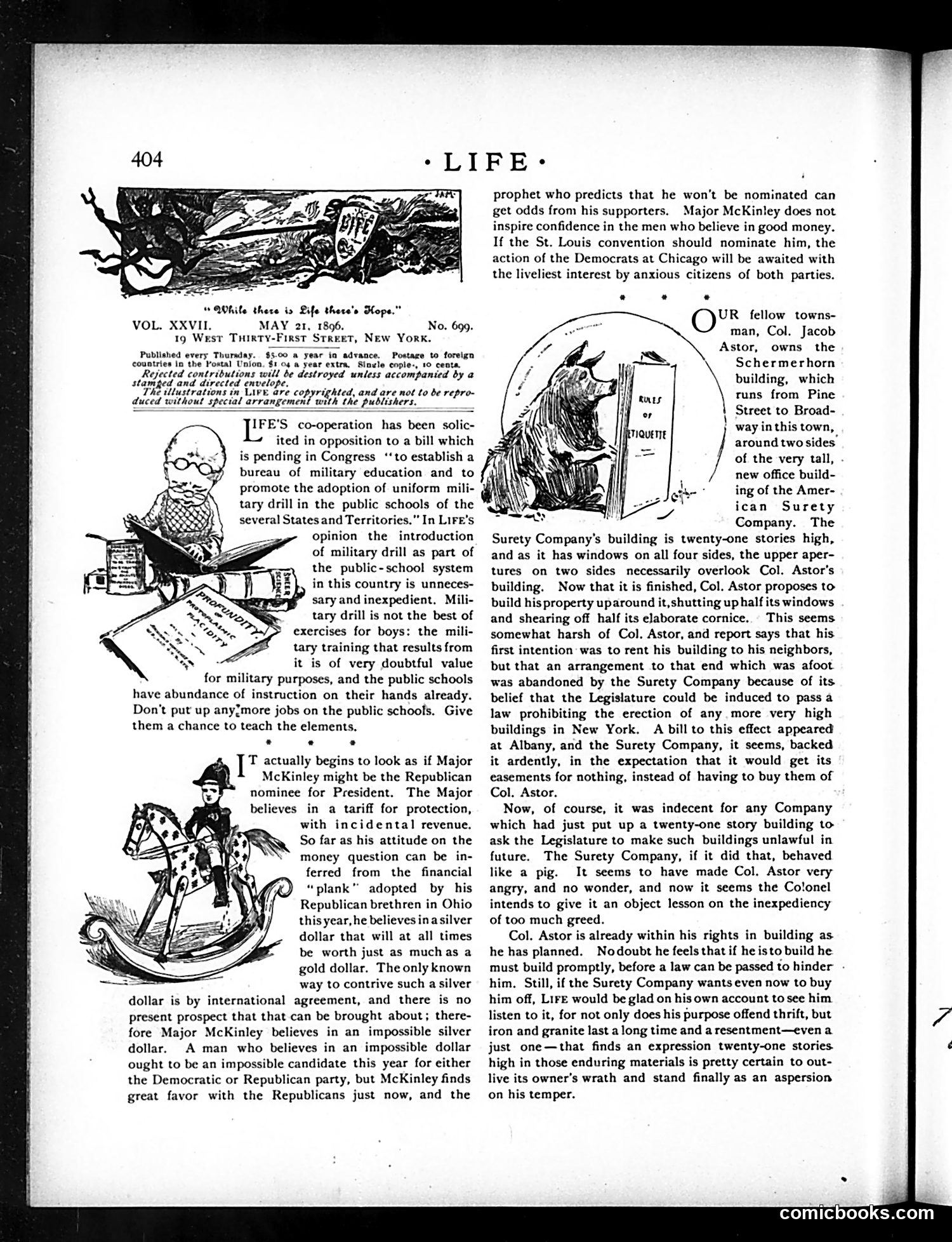
**The Cartoons:** The left illustration shows a figure (likely representing the common man or taxpayer) overwhelmed by military drill equipment and paperwork, opposing a Congressional bill to introduce mandatory military drill in public schools. Life argues this wastes school resources and burdens already-overburdened teachers. The right illustration depicts a horse-mounted figure (unclear who specifically) on a rocking horse, satirizing Major McKinley's potential Presidential candidacy. The text criticizes McKinley's protectionist tariff stance and suggests he represents wealthy Republican interests rather than sound fiscal policy. **The Point:** Life uses these cartoons to critique Republican political priorities—militarization of schools and protectionist economics—positioning them as ill-conceived or self-serving policies benefiting the wealthy over ordinary citizens.
📄 Transcribed text from this page (OCR, searchable)
Machine-transcribed from the original scan — historical spelling and the odd misread are preserved.
-LI “While there is Life there's Hope.” VOL. XXVII. MAY 21, 1896. No. 699. 19 West THirty-First Street, NEw York. Published every Thursday. $5.00 a year in advance. Postage to foreign couatries in the Postal Union. $1 04 a year extra, Sinule enple-, 10 centa, Rejected contributions will be destroyed unless accompanied by a stamped and directed envelope. The illustrations in Live are copyrighted, and are not to be repro- duced without spec Bem rh the publishers, LF co-operation has been solic- ited in opposition to a bill which is pending in Congress ‘‘to establish a bureau of military education and to promote the adoption of uniform mili- tary drill in the public schools of the several States and Territories.” In LiFe's opinion the introduction of military drill as part of the public-school system in this country is unneces- sary and inexpedient. Mili- tary drill is not the best of exercises for boys: the mili- tary training that results from * it is of very doubtful value for military purposes, and the public schools have abundance of instruction on their hands already. Don't put up anyzmore jobs on the public schools. Give them a chance to teach the elements, . . . [= actually begins to look as if Major McKinley might be the Republican nominee for President. The Major believes in a tariff for protection, with incidental revenue. So far as his attitude on the money question can be in- ferred from the financial ) “plank” adopted by his Republican brethren in Ohio this year, he believes inasilver dollar that will at all times be worth just as muchas a gold dollar. The only known way to contrive such a silver dollar is by international agreement, and there is no present prospect that that can be brought about; there- fore Major McKinley believes in an impossible silver dollar. A man who believes in an impossible dollar ought to be an impossible candidate this year for either the Democratic or Republican party, but McKinley finds great favor with the Republicans just now, and the FE- prophet who predicts that he won't be nominated can get odds from his supporters. Major McKinley does not inspire confidence in the men who believe in good money. If the St. Louis convention should nominate him, the action of the Democrats at Chicago will be awaited with the liveliest interest by anxious citizens of both parties. * . UR fellow towns- man, Col. Jacob Astor, owns the Schermerhorn building, which runs from Pine Street to Broad- way in this town, around two sides’ of the very tall, new office build- ing of the Amer- ican Surety Company. The Surety Company’s building is twenty-one stories high, and as it has windows on all four sides, the upper aper- tures on two sides necessarily overlook Col. Astor's building. Now that it is finished, Col. Astor proposes to build his property uparound it,shutting up half its windows and shearing off half its elaborate cornice. This seems somewhat harsh of Col. Astor, and report says that his first intention was to rent his building to his neighbors, but that an arrangement to that end which was afoot was abandoned by the Surety Company because of its belief that the Legislature could be induced to pass a law prohibiting the erection of any more very high buildings in New York. A bill to this effect appeared at Albany, and the Surety Company, it seems, backed it ardently, in the expectation that it would get its easements for nothing, instead of having to buy them of Col. Astor. Now, of course, it was indecent for any Company which had just put up a twenty-one story building to ask the Legislature to make such buildings unlawful in future. The Surety Company, if it did that, behaved like a pig. It seems to have made Col. Astor very angry, and no wonder, and now it seems the Colonel intends to give it an object lesson on the inexpediency of too much greed. Col. Astor is already within his rights in building as he has planned. Nodoubt he feels that if he isto build he must build promptly, before a law can be passed to hinder - him. Still, if the Surety Company wants even now to buy him off, L1FE would be glad on his own account to see him listen to it, for not only does his purpose offend thrift, but iron and granite last a long time and a resentment—even a just one—that finds an expression twenty-one stories. high in those enduring materials is pretty certain to out- live its owner’s wrath and stand finally as an aspersion on his temper. comicbooks.com