
A complete issue · 32 pages · 1896
Life — April 2, 1896
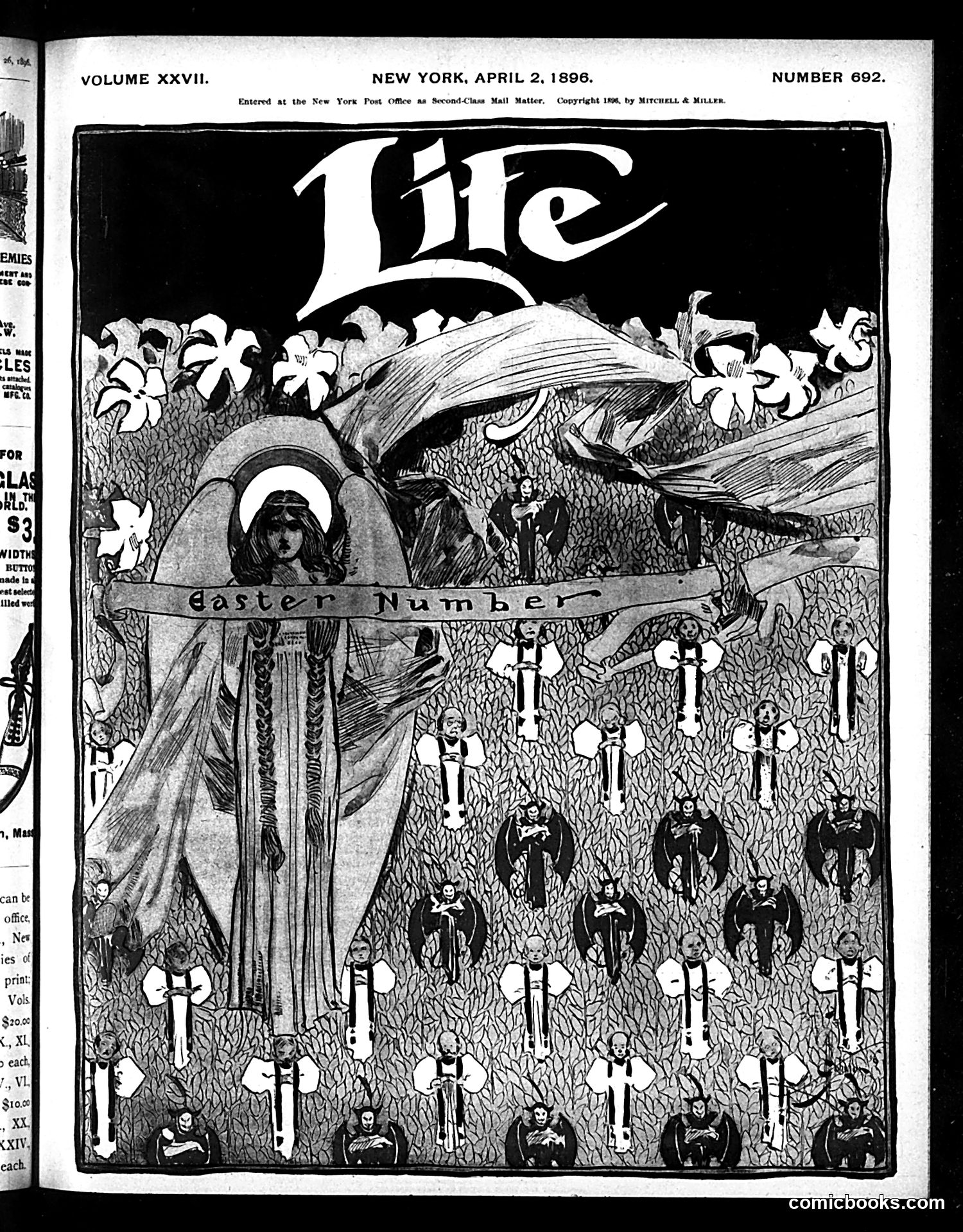
This is the cover illustration for Life's Easter issue. The artwork depicts a religious allegory: a robed angel or Christ-like figure with a halo hovers above a cemetery scene filled with crosses. Lilies bloom at the top, traditional Easter flowers symbolizing resurrection and purity. The image uses Christian imagery to mark the Easter holiday—combining the crucifixion (crosses) with themes of spiritual renewal (the angel, lilies, and halo). The "Easter Number" banner identifies this as a special holiday issue. This appears to be straightforward religious/seasonal illustration rather than political satire, typical of how Life magazine marked major holidays. The artistic style is ornate Art Nouveau, popular in 1890s design.
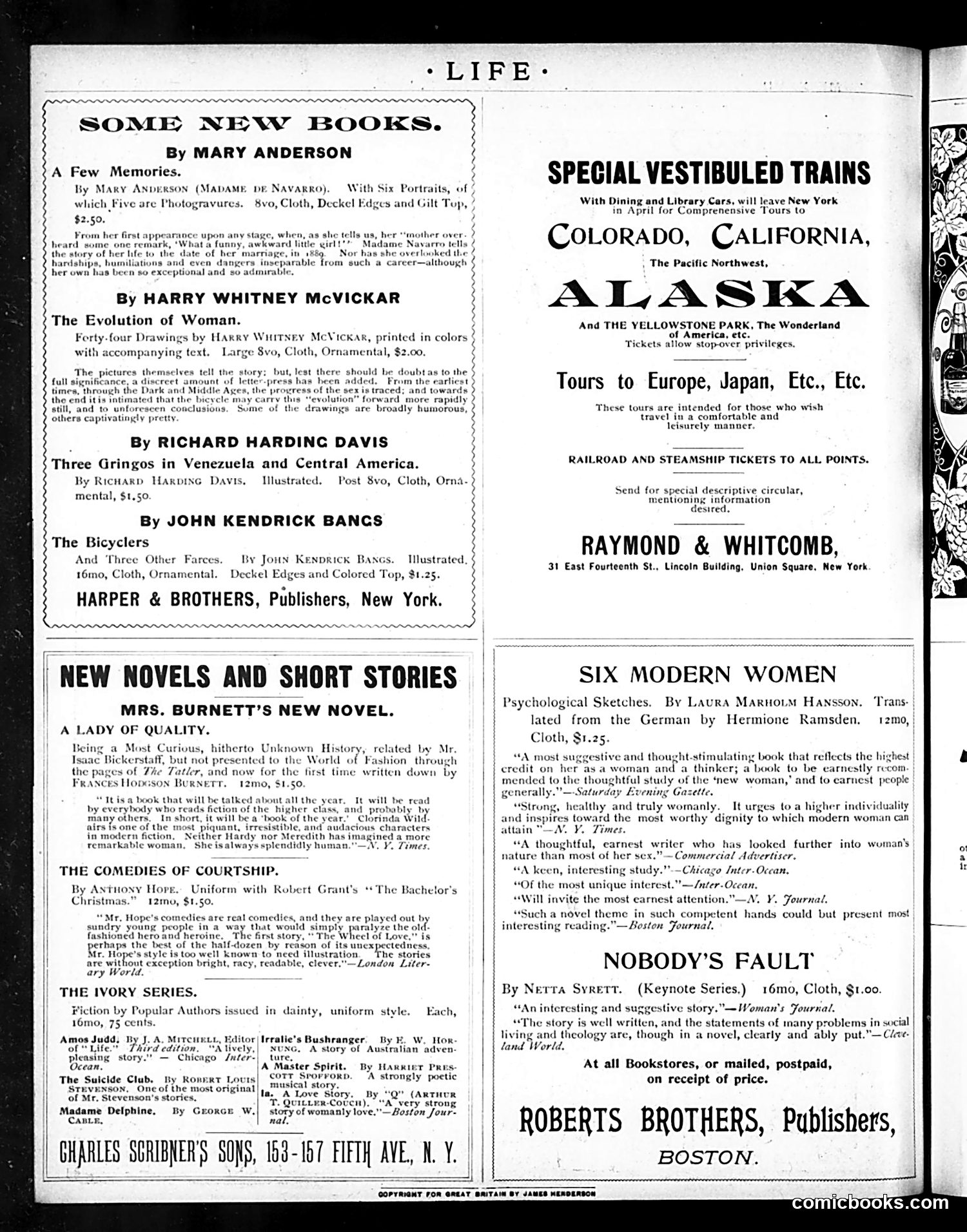
This page is primarily advertising for books and travel services, with no political cartoons or satirical content visible. The left column advertises new books by Mary Anderson, Harry Whitney McVickar, Richard Harding Davis, and John Kendrick Bangs through Harper & Brothers Publishers. Below that are announcements for new novels and short stories, including works by Mrs. Burnett and Robert Grant, published by Charles Scribner's Sons. The right side features travel advertisements for "Special Vestibuled Trains" to Colorado, California, Alaska, and other destinations, plus tours to Europe and Japan offered by Raymond & Whitcomb. The bottom right advertises books including "Six Modern Women" and "Nobody's Fault," published by Roberts Brothers in Boston. This is a commercial page with no satirical political content.
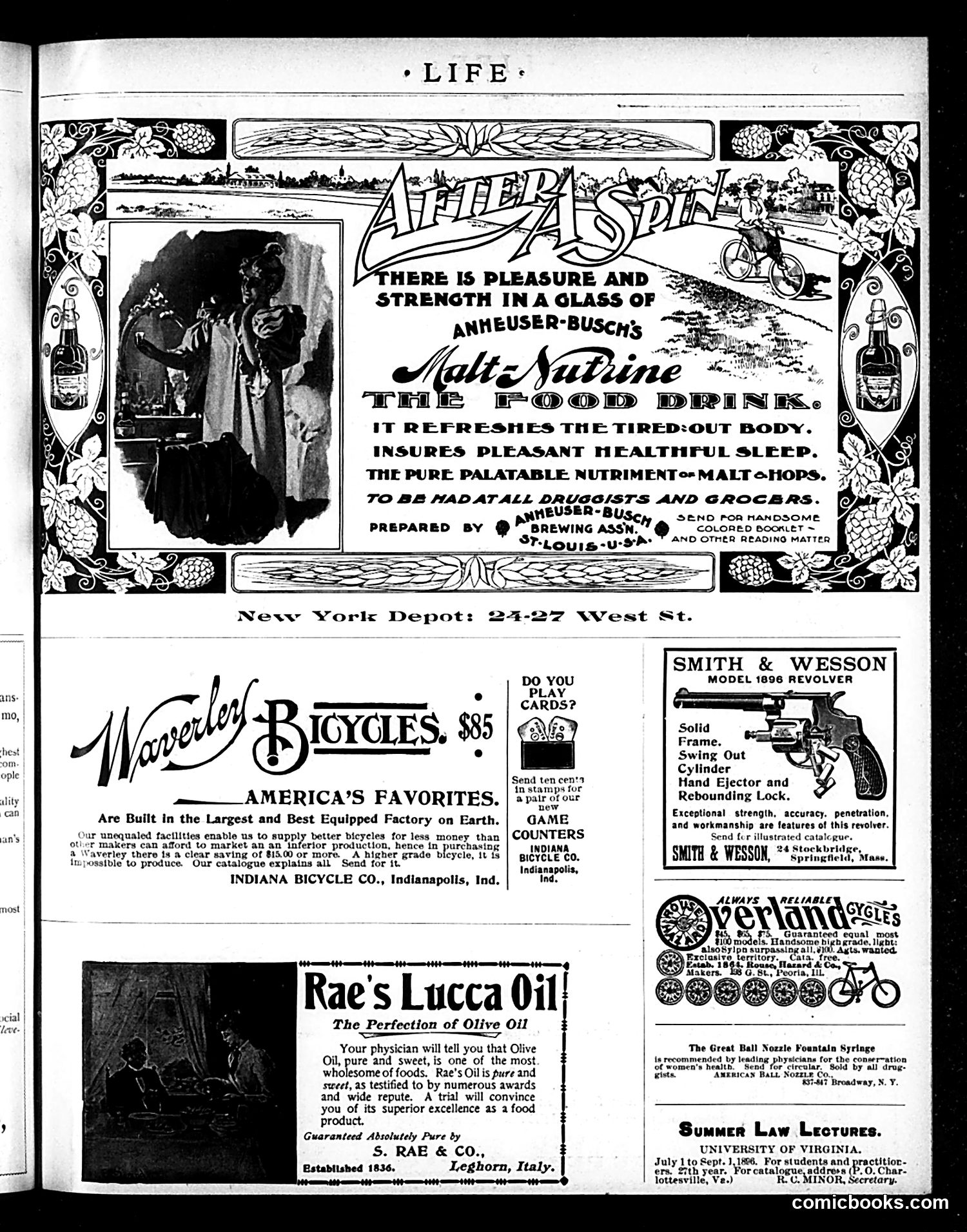
This page is **primarily advertising**, not political satire. The main content features ads for: - **Anheuser-Busch's Malt Nuttine** ("the food drink") — promoting malt beverages as nutritious and healthful - **Waverly Bicycles** ($85, made by Indianapolis Bicycle Co.) - **Smith & Wesson Model 1896 Revolver** - **Rae's Lucca Oil** (olive oil from Italy) - **Cycles** (wheel/bicycle ad) - **Summer Law Lectures** at University of Virginia The only illustrative element is a period photograph showing what appears to be a woman in classical dress, used decoratively for the Anheuser-Busch ad. There is **no political cartoon or satire visible** on this page — it's a standard early 20th-century magazine advertising layout with ornamental borders typical of *Life* magazine's commercial pages.
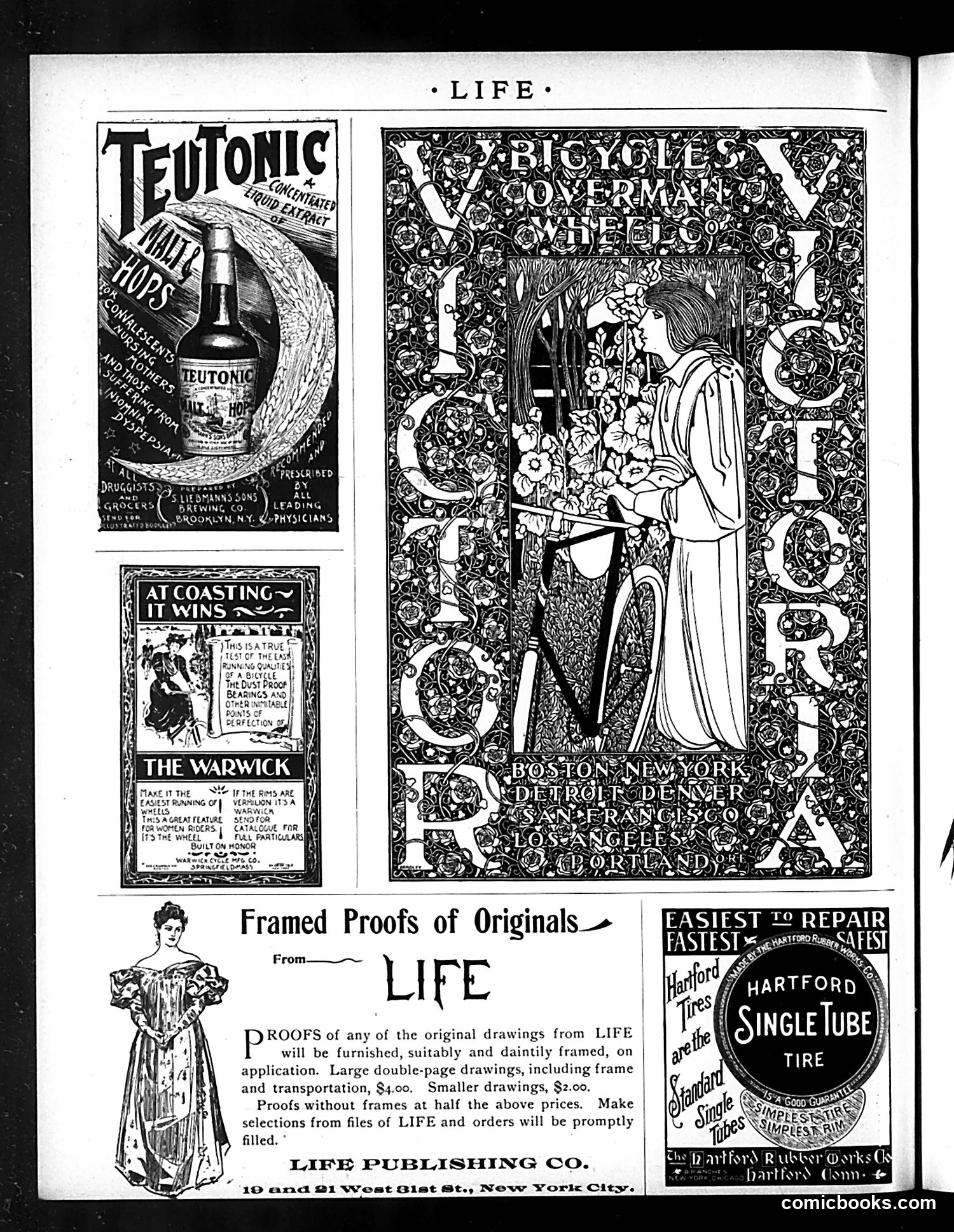
This page is primarily **advertising content** from *Life* magazine, not political satire. The left side contains two product advertisements: one for Teutonic Malt Hops (a beverage ingredient), and one for "The Warwick" film. The dominant right-side image is a decorative advertisement for bicycles with ornamental lettering spelling "BICYCLES OVERMAN HELLO" framing a stylized figure. The figure appears to be a woman in classical dress with a bicycle, set against an elaborate patterned background. Below is promotional text from Life Publishing Co. offering "Framed Proofs of Originals" for sale, and a Hartford Single Tube Tire advertisement. The page reflects early 20th-century consumer culture, showcasing products marketed to middle-class readers—bicycles, tires, and malt beverages—rather than containing political commentary or satire.
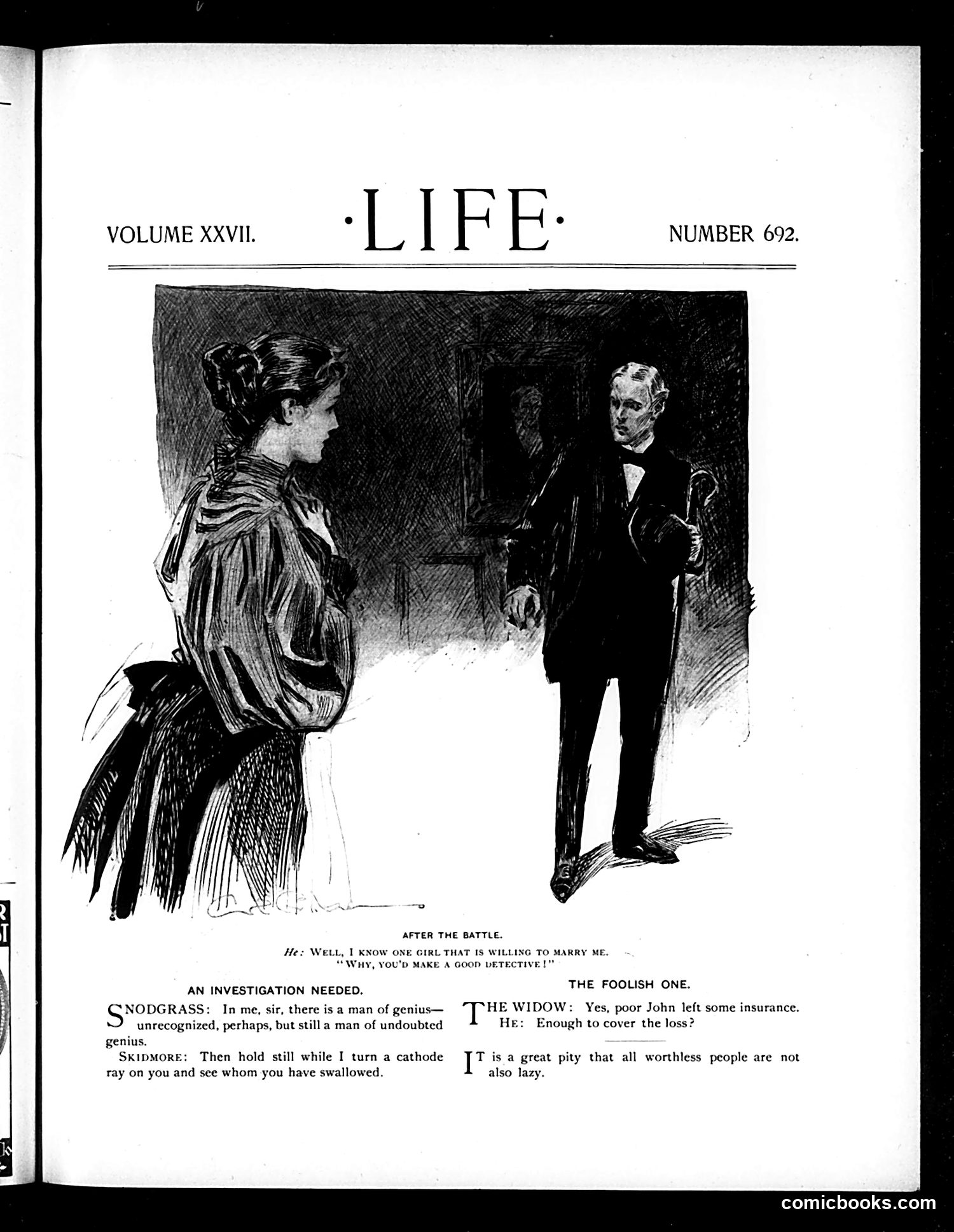
This page contains three brief comedic sketches satirizing romantic and social situations, typical of Life magazine's humor format. **"After the Battle"** depicts a man proposing to a woman, with the joke being his practical motivation: he wants her to become a detective and help him identify a woman he's already involved with. **"An Investigation Needed"** shows two men discussing a supposed "man of genius" — the punchline being a suggestion to use a cathode ray to discover whom this supposed genius has actually absorbed or plagiarized from. **"The Foolish One"** presents a widow and man discussing insurance after her husband's death, with the final joke sardonically commenting that worthless people tend not to be lazy — suggesting the deceased was both worthless and industrious. All three sketches employ cynical humor about relationships, ambition, and character.
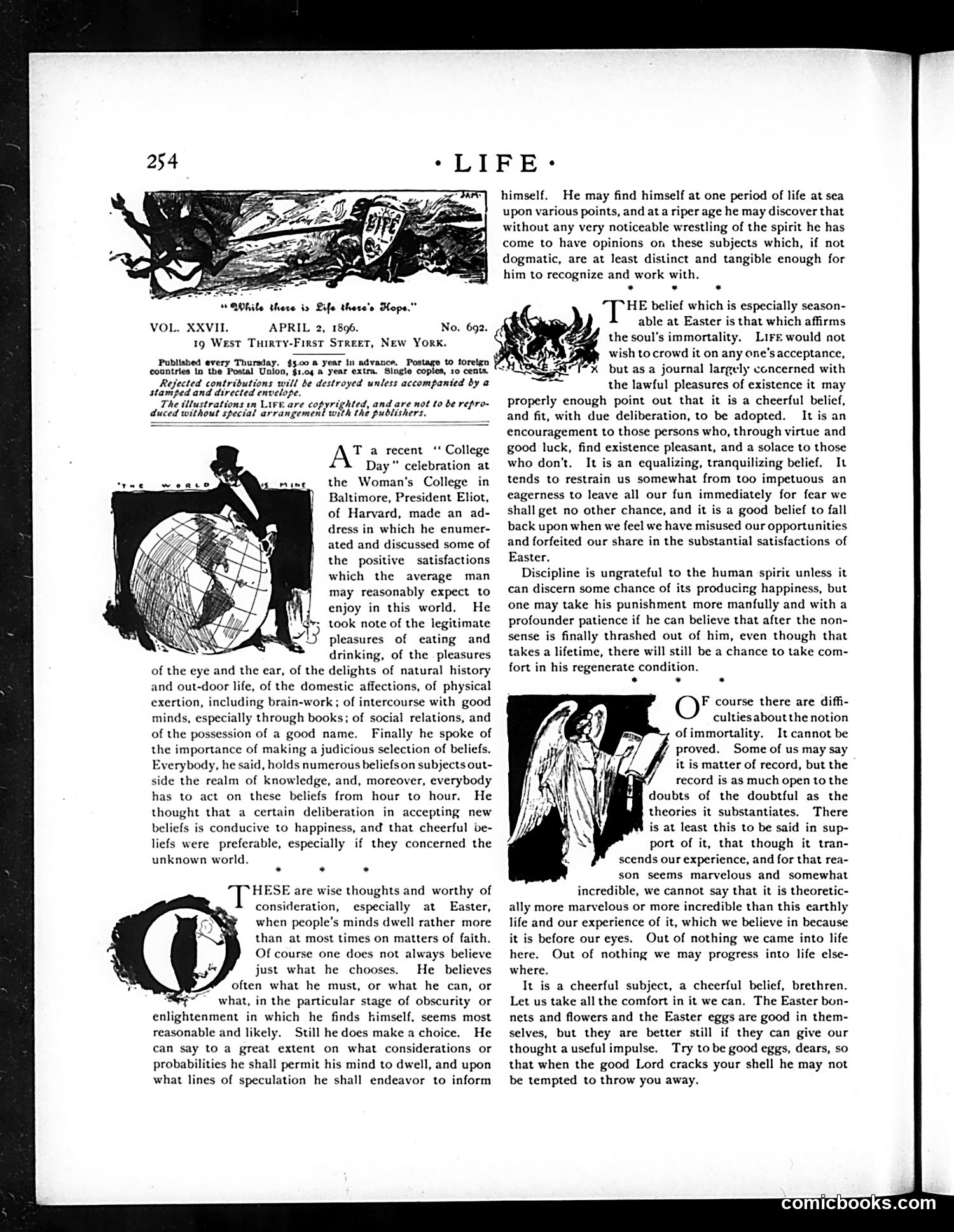
This page contains editorial commentary on Easter beliefs rather than political satire. The text discusses the "soul's immortality" and defends Easter as offering comfort and hope—a "cheerful belief" that encourages people to find life's pleasures pleasant and meaningful. The illustrations are decorative rather than satirical: an angel reading (top right) and a figure sitting on a globe (left) are generic religious/philosophical imagery supporting the essay's theme about faith and human experience. The main argument criticizes excessive skepticism about immortality, arguing that belief in an afterlife—even if unprovable—produces happiness and serves a social purpose. This reflects early 20th-century *Life* magazine's genteel editorial voice addressing readers' spiritual concerns rather than lampooning specific figures or events.
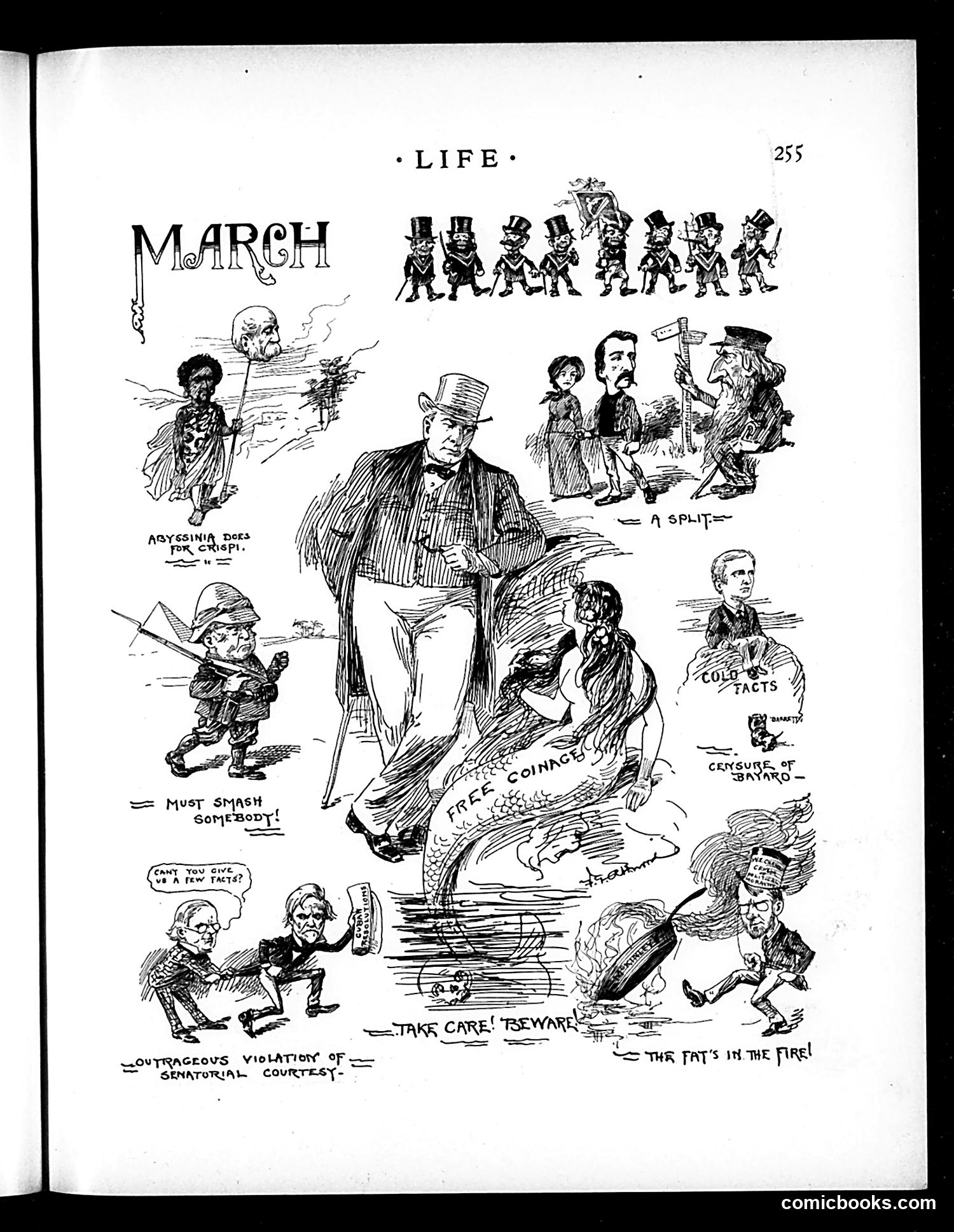
This is a satirical cartoon about March political events, depicting various controversies and conflicts. The central figure appears to be a politician or public figure being attacked from multiple directions, labeled with issues like "Free Coinage" (monetary policy debate), "A Split" (party division), and "Cold Facts" (uncomfortable truths). Surrounding vignettes mock different March-related political scandals: "Abyssinia Does Its Crisp" (likely international relations), "Must Smash Somebody" (militarism), "Outrageous Violation of Senatorial Courtesy" (congressional misconduct), and "The Fat's in the Fire" (scandal). The cartoon satirizes the chaotic, contentious nature of American politics that month, with various factions attacking the establishment figure from all sides—a common Life magazine approach to contemporary political turmoil.
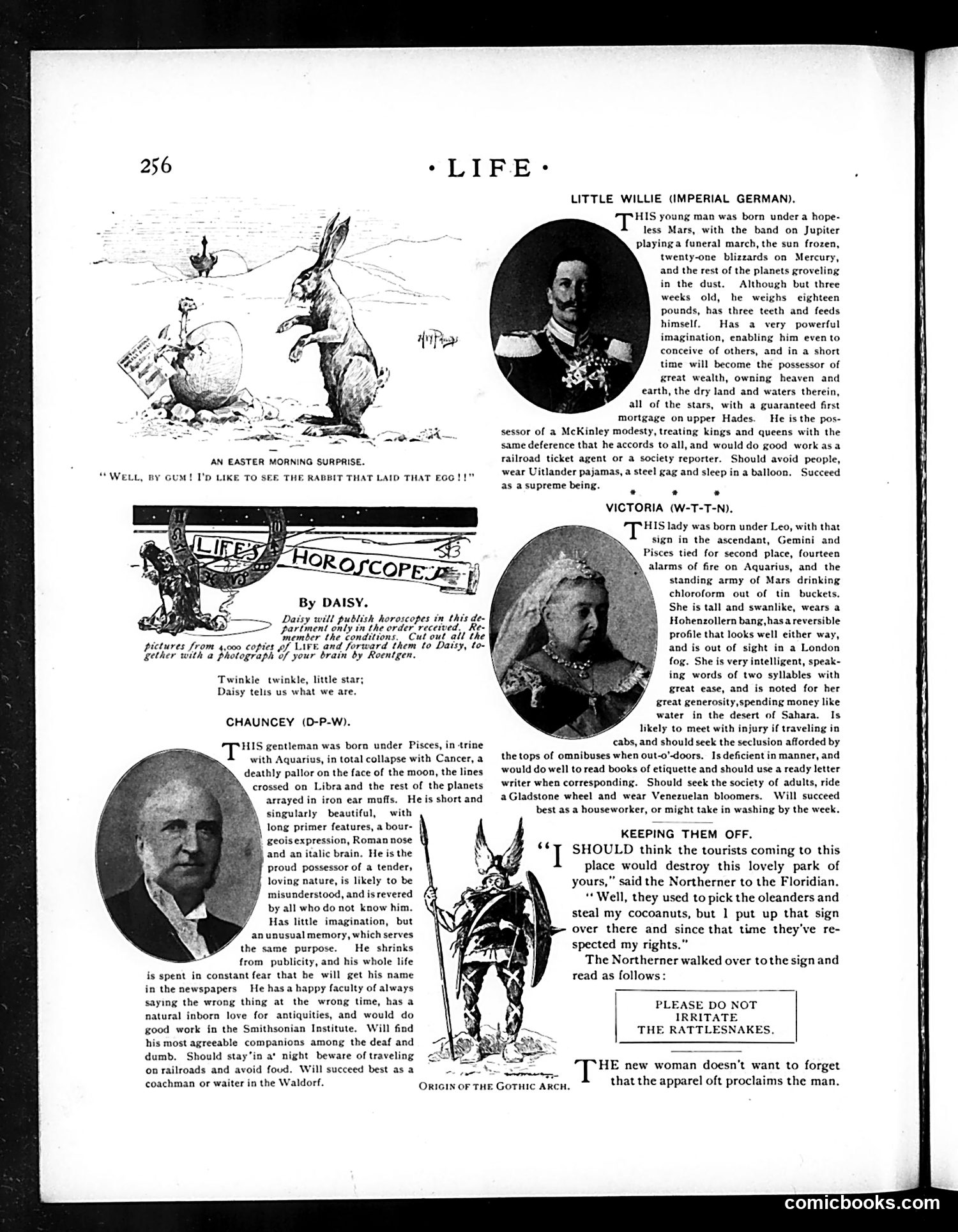
This page contains satirical character sketches with astrological themes. "Little Willie (Imperial German)" depicts a young man imagined as possessing grand ambitions—the text mockingly describes him as destined to become wealthy and powerful, owning "heaven and earth." The satire appears to reference German imperial aspirations, particularly Kaiser Wilhelm II's expansionism. "Victoria (W-T-T-N)" is an astrological profile of a woman born under Leo, described with satirical traits including intelligence but also impetuousness and poor judgment about money. "Chauncey (D-P-W)" profiles a gentleman born under Pisces, characterized as beautiful but ineffectual, misunderstood, and prone to unemployment—typical of Life's humorous character assassination. The remaining content includes illustrations and editorial commentary about park maintenance and rattlesnakes.
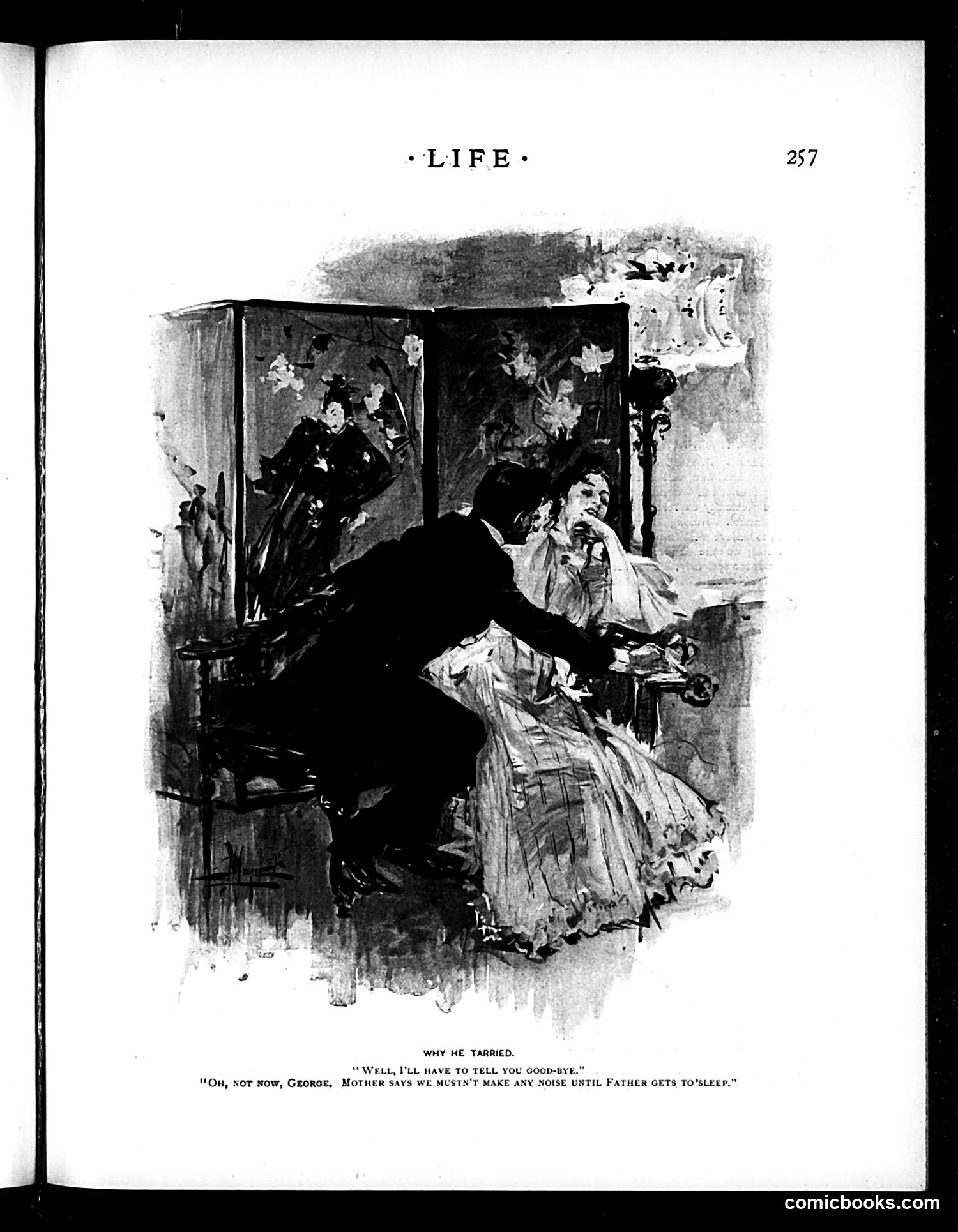
This illustration depicts a domestic scene titled "Why He Tarried," showing a man in dark clothing leaning toward a woman in an elaborate light-colored dress. The caption reads: "Well, I'll have to tell you good-bye." "Oh, not now, George. Mother says we mustn't make any noise until Father gets to sleep." The satire targets married life and household dynamics of the era. The joke hinges on domestic constraints: a husband's attempt to leave (or depart intimately) is thwarted not by his wife's unwillingness, but by practical household rules enforced by her mother—he must wait until the father-in-law falls asleep to avoid disturbing him. It mocks both interfering in-laws and the lack of privacy in shared households, common domestic frustrations for the period's readers.
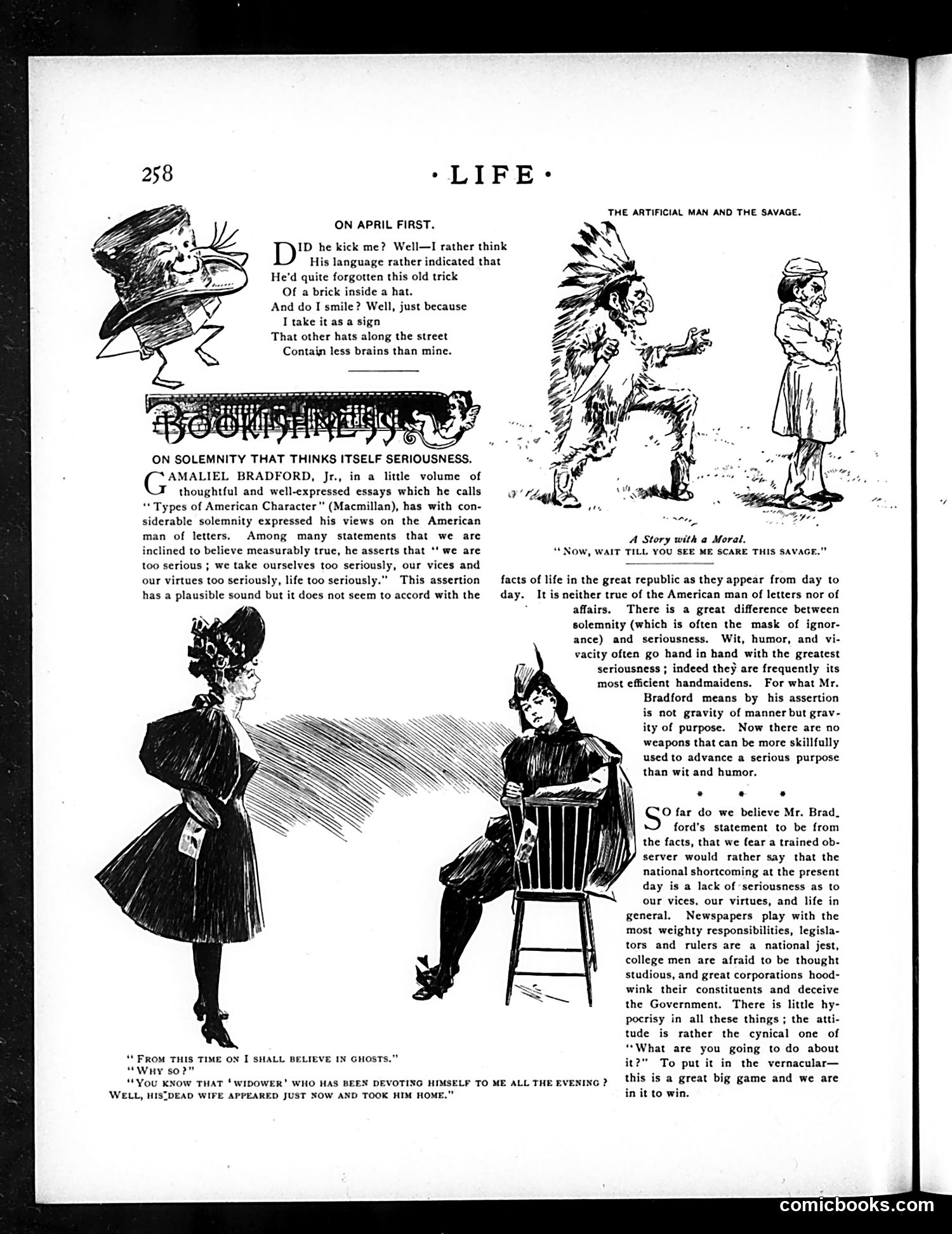
This page contains three satirical cartoons and accompanying commentary on American seriousness and humor. **"On April First"** (top left): A man kicks another, claiming he's "forgotten his old trick / Of a brick inside a hat." The joke relies on April Fools' Day pranks. **"The Artificial Man and the Savage"** (top right): A Native American figure confronts a formally-dressed man. The caption "Now, wait till you see me scare this savage" suggests ironic commentary on stereotypes and colonial attitudes. **"From This Time On I Shall Believe in Ghosts"** (bottom): A woman tells her husband she believes in ghosts because his "widow" has been comforting him all evening—implying marital infidelity through supernatural jest. The article criticizes excessive American solemnity, arguing wit and humor are undervalued tools for serious purposes.
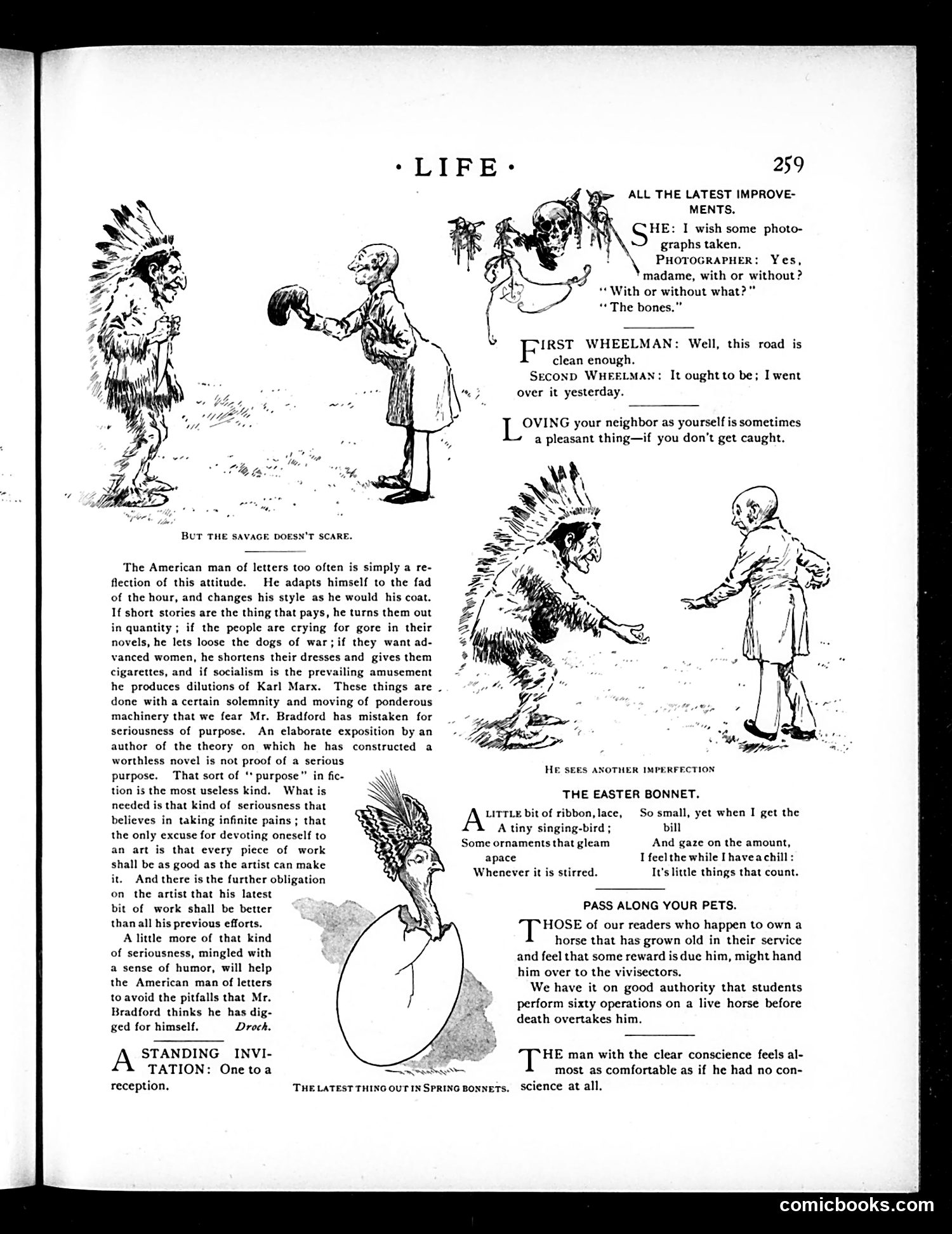
This page contains several unrelated satirical items typical of Life's humor format: **"But the Savage Doesn't Scare"** depicts a Native American figure encountering a photographer, with text playing on the idea that Indigenous peoples weren't intimidated by modern technology—a common early-20th-century joke playing on racial stereotypes about "savages." **"The Easter Bonnet"** is a light poem mocking women's elaborate spring hats, suggesting they're expensive and impractical. The remaining items—about wheelmen (cyclists), neighborly behavior, horse vivisection, and clear consciences—are brief, disconnected joke items. The page appears designed as a humor miscellany rather than cohesive commentary, reflecting Life's typical satirical magazine format of the era.
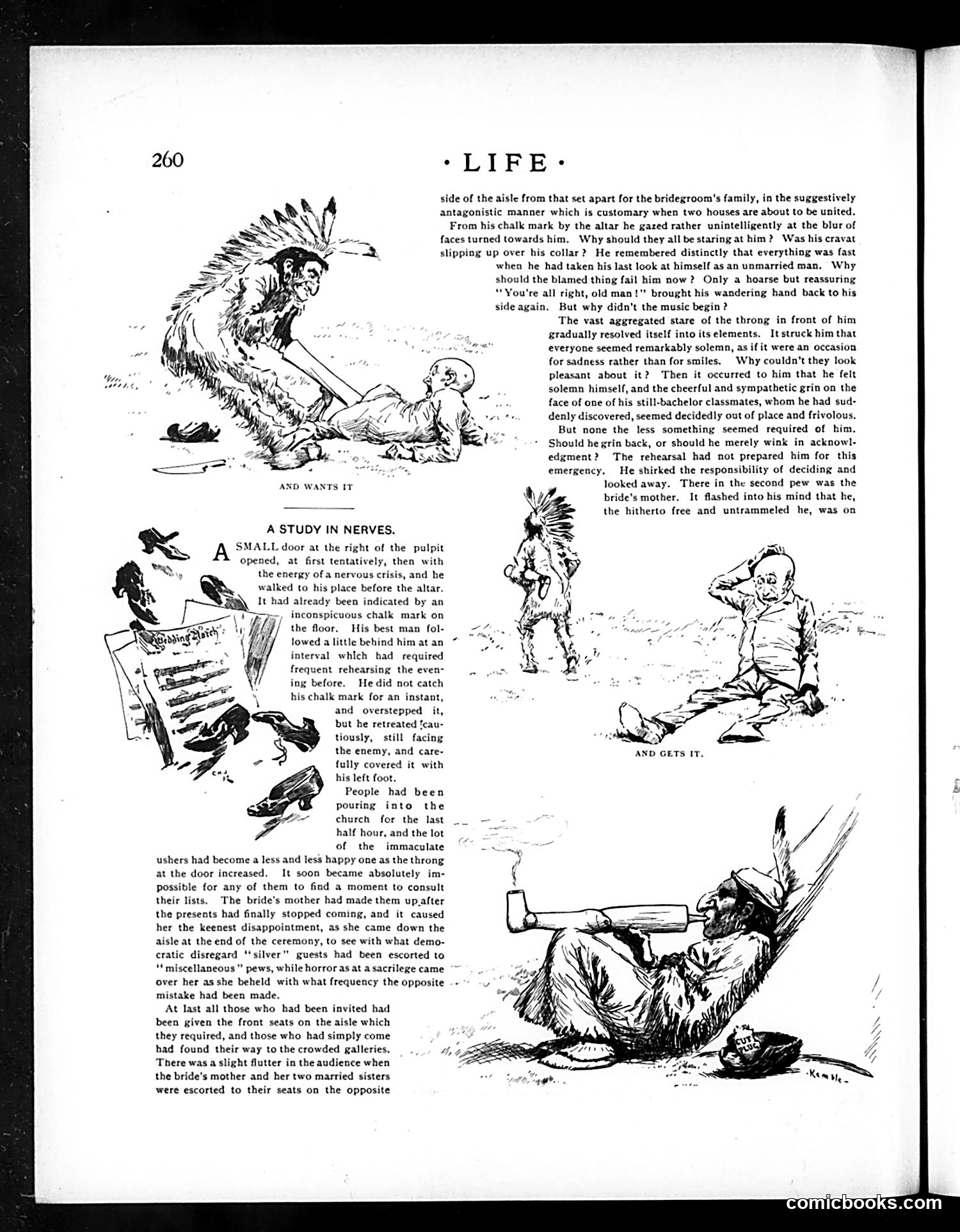
This satirical story (with accompanying comic illustrations) depicts a groom's anxiety on his wedding day. The narrative follows his nervous internal monologue as he stands at the altar—worrying about his appearance, confused by everyone's solemn stares, and uncertain how to behave. The accompanying cartoons show the groom's escalating panic through exaggerated physical comedy: he's depicted as increasingly disheveled and anxious, culminating in him appearing to lose control of his limbs. The satire targets masculine anxiety about marriage and social ritual. The text also mocks the bride's mother's obsession with seating hierarchy—her disappointment that "silver" gifts weren't seated in appropriate pews, suggesting class-conscious pretension. The humor lies in contrasting the supposedly momentous occasion with petty social concerns and the groom's complete inability to maintain composure, presenting marriage as an ordeal rather than a celebration.
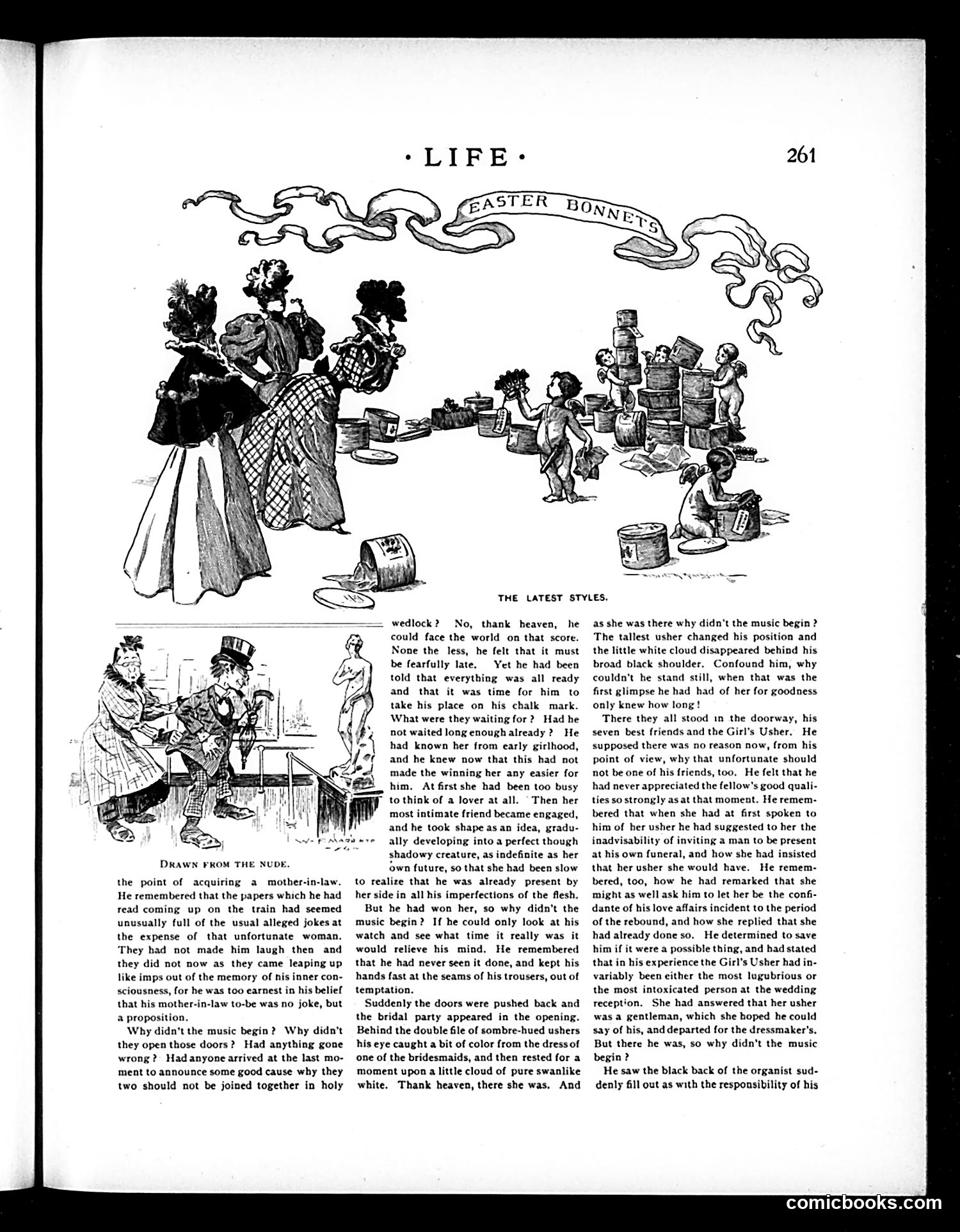
This page contains two illustrated stories from Life magazine. The upper cartoon, titled "Easter Bonnets," depicts fashionable women displaying elaborate spring headwear—a commentary on the extravagant millinery trends of the era. The longer narrative piece, "Drawn from the Nude," illustrates a groom's mounting anxiety on his wedding day. The bridegroom obsesses over trivial delays—why hasn't the music started? why can't he see his bride?—while his mind races with petty grievances, including resentment toward the "Girl's Usher" (the bride's male attendant, apparently a common practice then). The satire targets masculine insecurity and the absurdity of wedding-day nervousness. The groom's inability to simply accept the moment—fixating instead on minor social irritations and the mother-in-law stereotype—mocks the shallow concerns occupying men's minds during major life events.
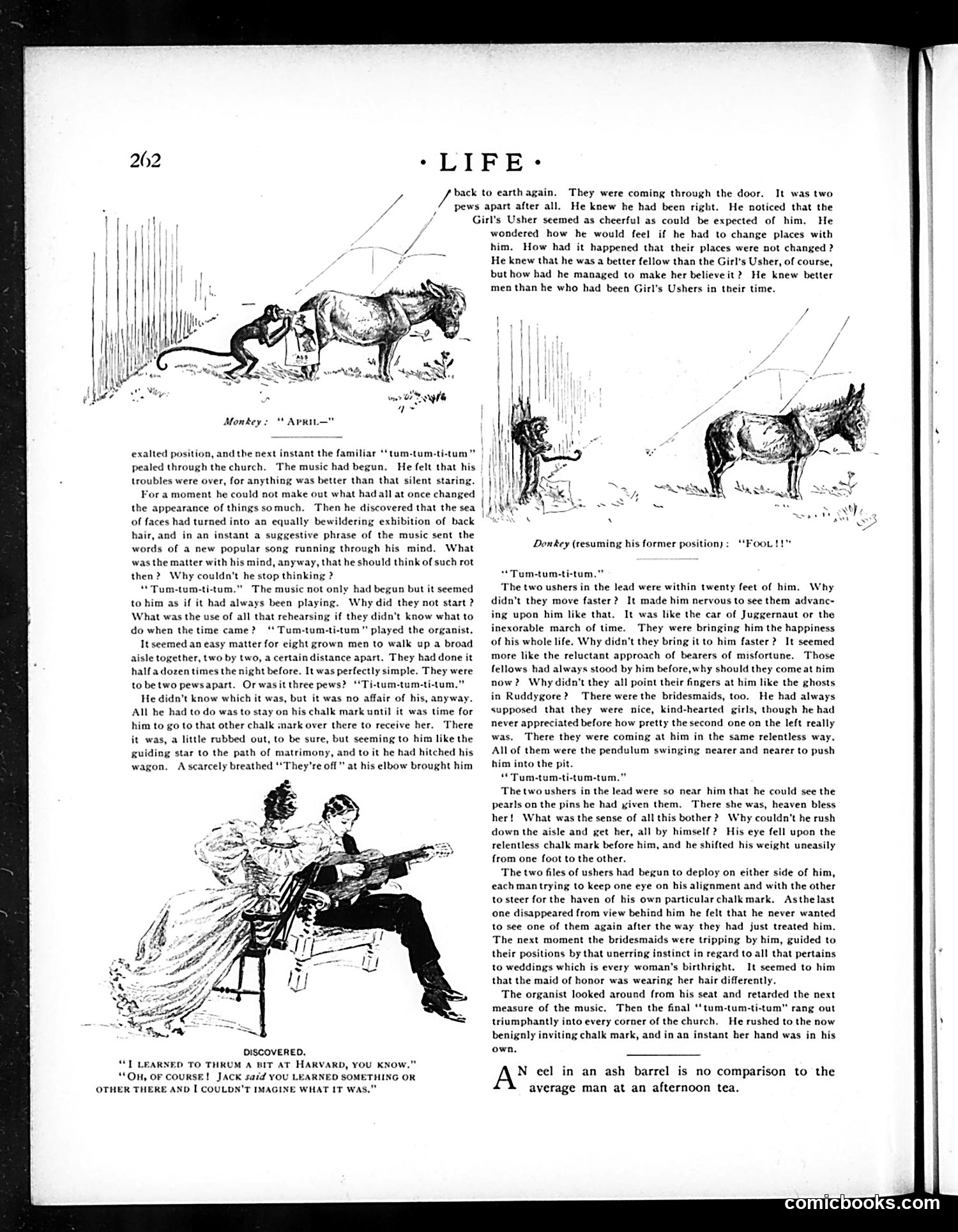
This page depicts a groom's anxiety during his wedding ceremony, rendered as satirical interior monologue. The main cartoon shows a nervous bridegroom fixating on trivial details—the spacing between ushers ("two pews apart"), the organ music's repetitive "tum-tum-ti-tum" pattern, and chalk marks on the floor marking his position. The satire mocks male wedding jitters through exaggerated catastrophizing: he imagines the approaching wedding party as an "inexorable march" like the "car of Juggernaut," compares himself unfavorably to other men, and obsesses over whether bridesmaids are pretty. The small illustrations of animals ("April," a donkey) and the bottom panel showing someone claiming to have "learned to thrum a bit at Harvard" suggest accompanying visual jokes about pretense and incompetence. The humor targets masculine anxiety about commitment and the gap between actual stakes (getting married) and petty concerns (chalk marks, pew spacing) that preoccupy the groom.
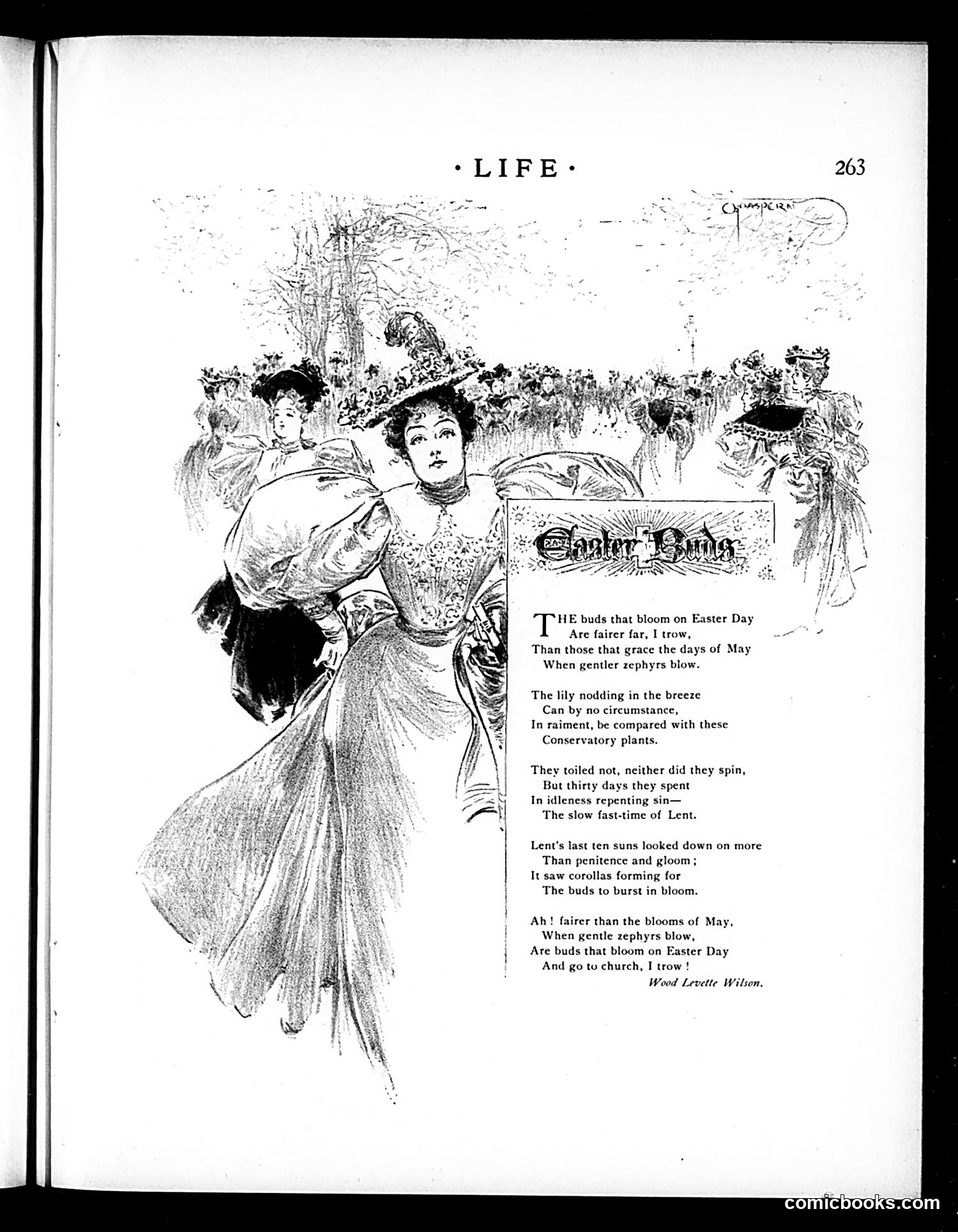
This page presents a poem titled "Easter Finery" by Wood Levette Wilson, accompanied by an illustration of an elegantly dressed woman in an elaborate gown and hat, surrounded by admirers. The satire is social rather than political: it mocks the tradition of wearing new, expensive clothing to Easter church services. The poem cleverly compares Easter flowers to fashionable women attending church, suggesting that like lilies that spent Lent in conservatories being carefully cultivated, wealthy women spend the Lenten season preparing their wardrobes and appearance for Easter display. The joke targets vanity and materialism—the implication that Easter attendance is as much about exhibiting fine clothing as genuine religious devotion. The illustration's focus on the woman's elaborate dress, jewelry, and feathered hat reinforces this critique of conspicuous consumption disguised as religious observance, a common target of *Life* magazine's social satire during the early 20th century.
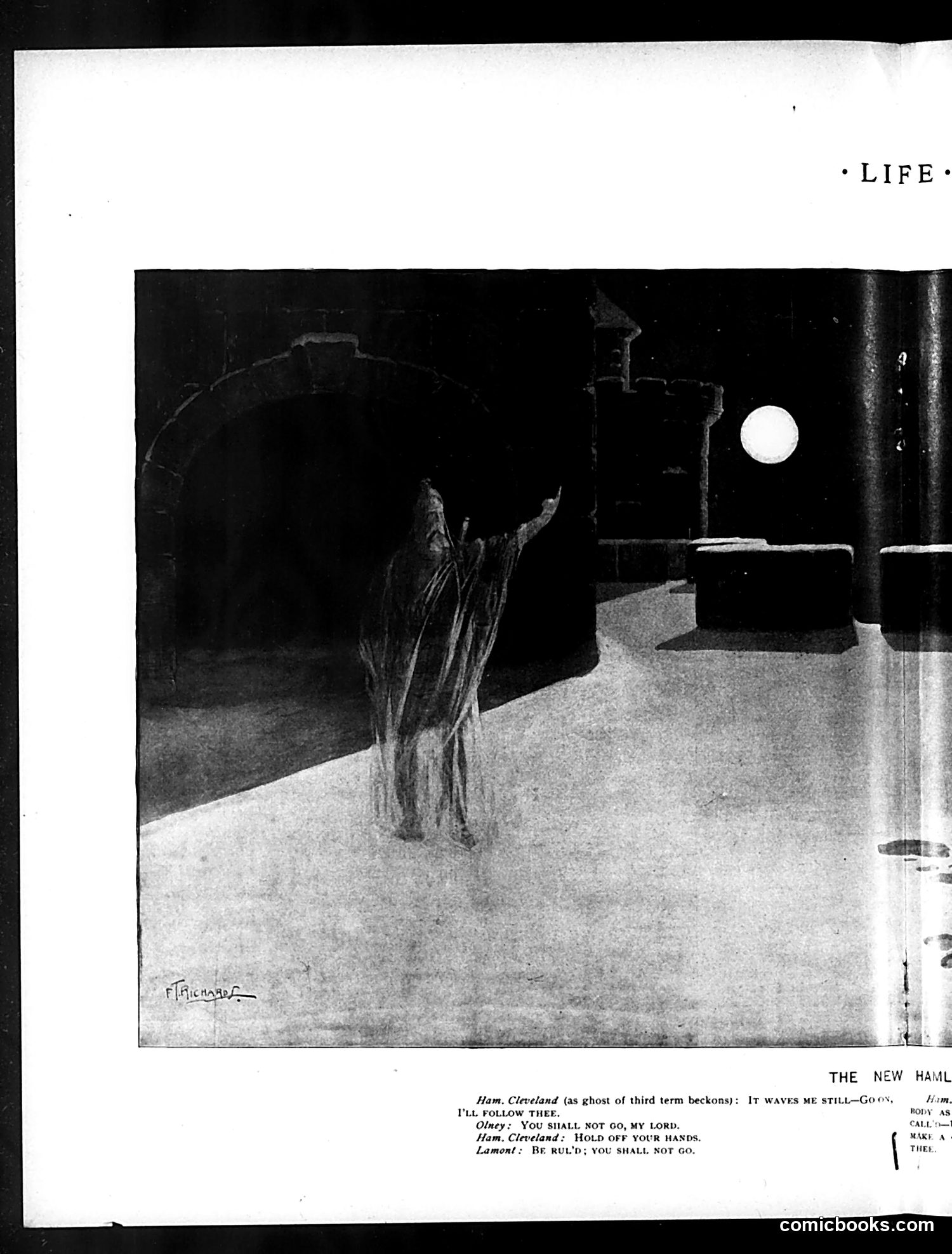
This cartoon references Hamlet to satirize President Grover Cleveland's political situation. Cleveland (depicted as Hamlet's ghost) is tempted by the specter of a third presidential term—a controversial prospect since George Washington established the two-term tradition. His advisors Olney (Secretary of State) and Lamont (Secretary of Treasury) physically restrain him, echoing Hamlet's struggle with his father's ghost. The satire mocks Cleveland's apparent temptation toward seeking another term despite constitutional precedent and his advisors' opposition. The Shakespearean parallel elevates the political drama while suggesting Cleveland's potential candidacy is a haunting temptation he should resist—much like Hamlet must resist his father's spectral demands.
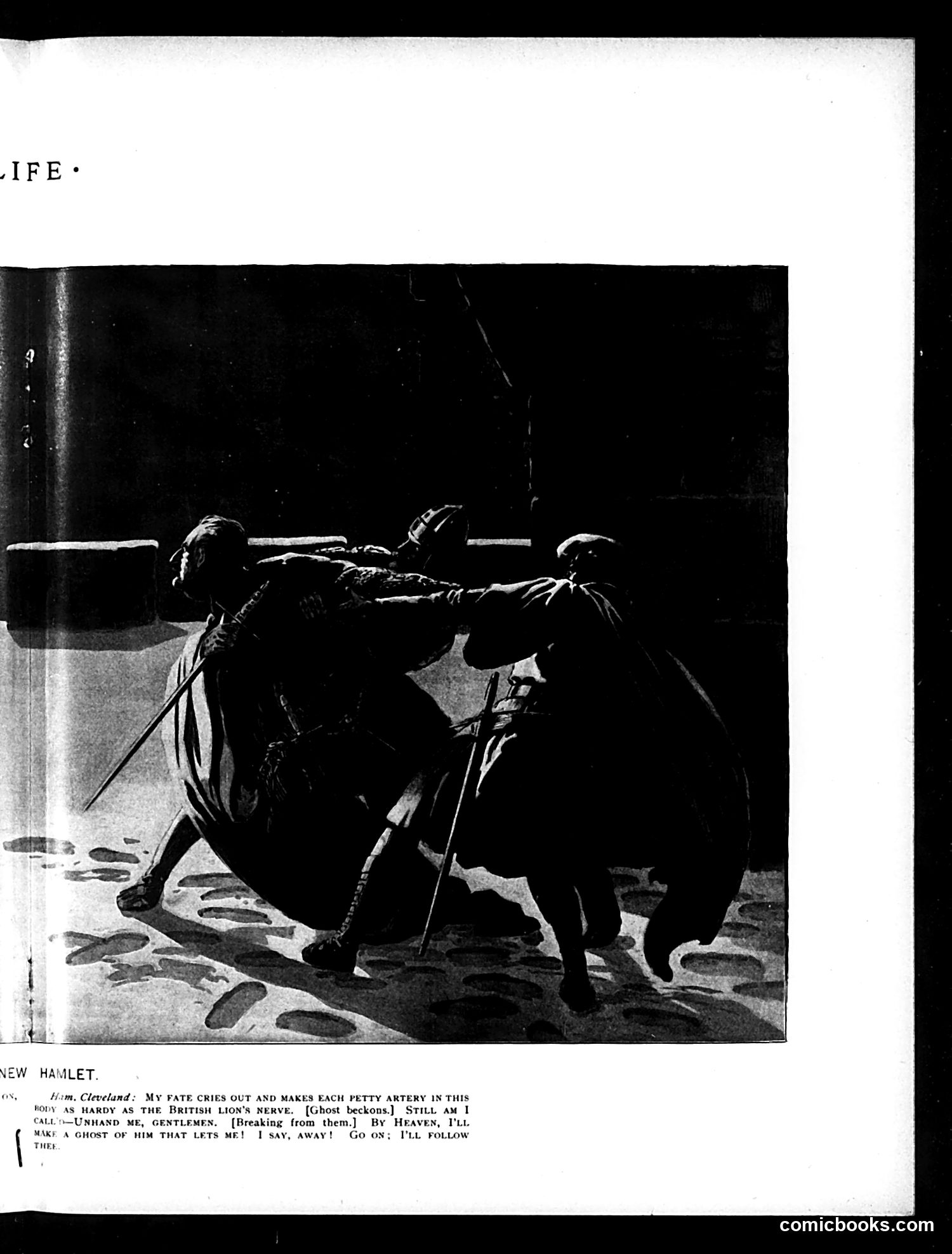
This is a theatrical satire based on Shakespeare's *Hamlet*. The image shows a figure (labeled as "Ham, Cleveland") in dramatic pose, quoting Hamlet's ghost scene. The OCR'd text presents scrambled Shakespearean dialogue. "Cleveland" likely refers to **Grover Cleveland**, U.S. President (1885-1889, 1893-1897). The satire appears to invoke *Hamlet*'s famous indecision and supernatural haunting to mock Cleveland's political hesitation or his response to some pressing issue requiring decisive action—the "ghost" possibly representing past political obligations or criticism. The phrase about "British Lion's nerve" suggests the cartoon critiques Cleveland's handling of American-British relations, perhaps during a trade dispute or foreign policy crisis. The theatrical language mocks what Life's editors saw as Cleveland's overwrought, ineffectual response to political pressure. Without the publication date visible, the specific crisis remains unclear, but the intent is clear: ridicule through Shakespearean parody.
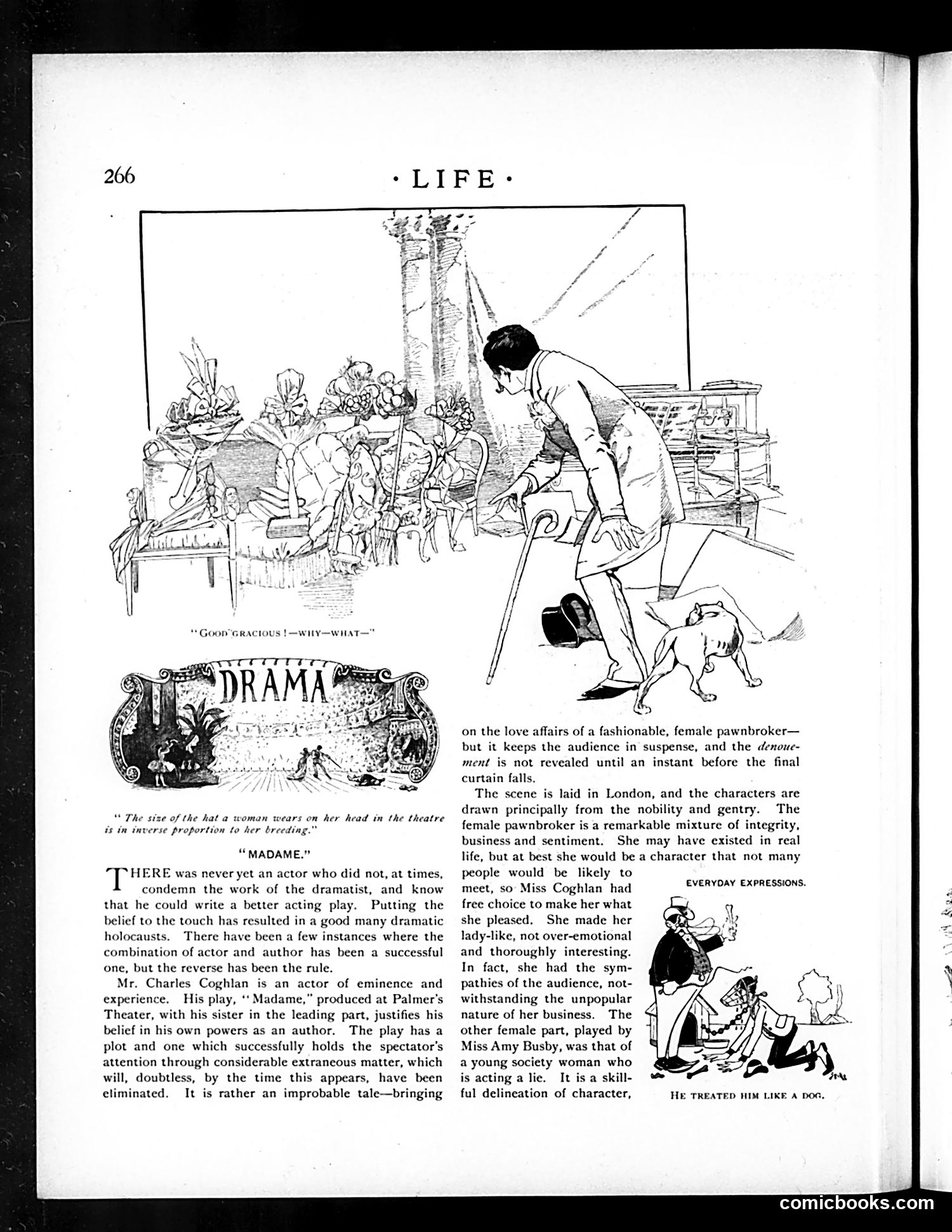
This page reviews a theatrical play called "Madame," written by and starring actor Charles Coghlan. The main cartoon depicts a scene from the play: a fashionable female pawnbroker (the "Madame" character) conducts business while a man kneels before her in a comedic posture, captioned "HE TREATED HIM LIKE A DOG." The satire mocks both the improbable plot—a noblewoman running a pawn shop—and the exaggerated theatrical conventions of the era. The text notes the play combines "considerable extraneous matter" to hold audience attention. The smaller cartoon above criticizes actors who also write plays, suggesting Coghlan succeeded more as an author than his theatrical peers typically do. The humor targets Victorian-era melodrama's artificial plots and overwrought sentimentality.
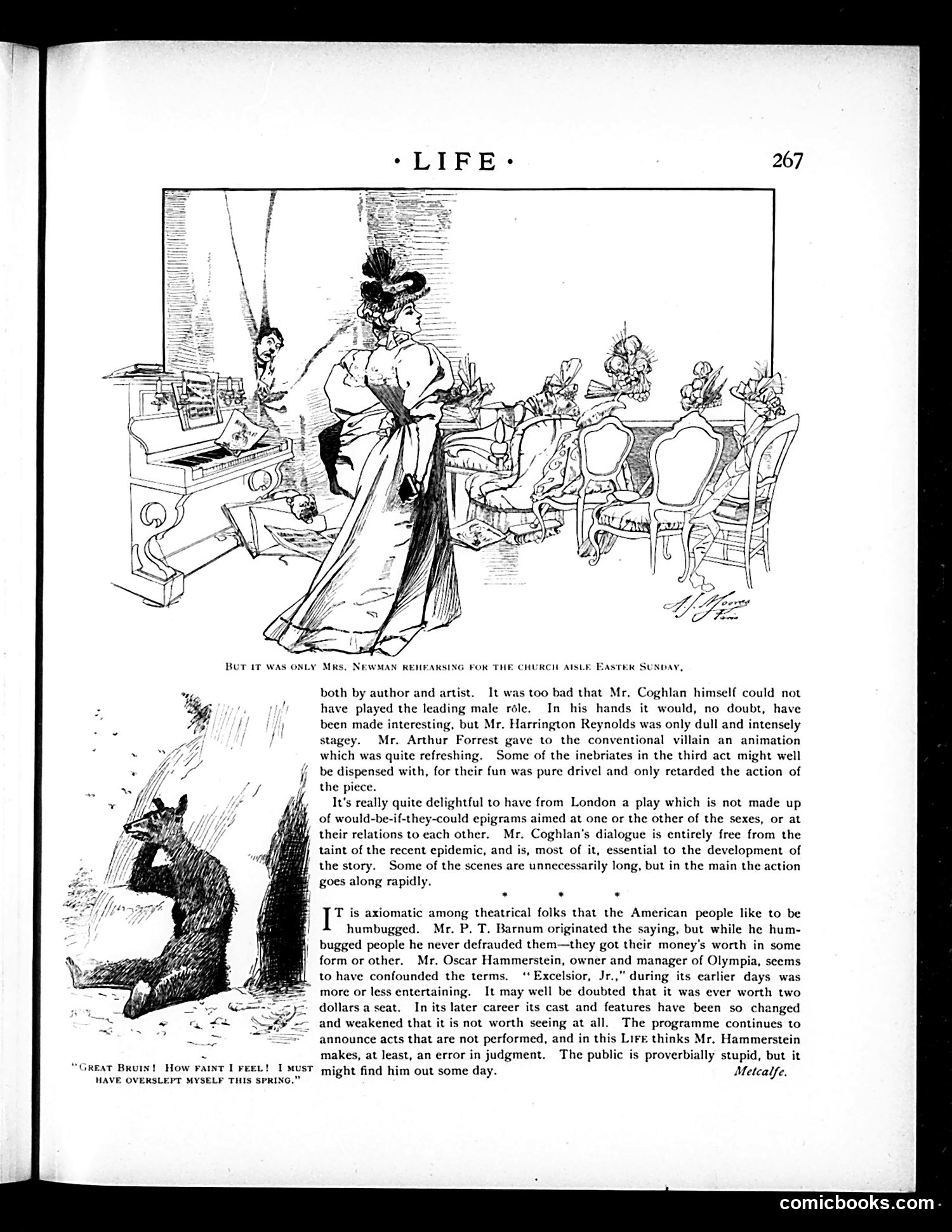
This page contains theatrical reviews. The top illustration shows a woman (likely actress Rose Coghlan, referenced in the text) rehearsing with an ensemble cast for an Easter Sunday church production. The review praises Coghlan's adaptation but criticizes male lead Harrington Reynolds as "dull and intensely stagey," while commending villain Arthur Forrest. The critic appreciates the play's dialogue as free from contemporary witty sex-based epigrams—suggesting this was a fashionable but tired theatrical trend. The second section critiques Oscar Hammerstein's management of the Olympia theater, specifically his production "Excelsior, Jr." The reviewer accuses Hammerstein of deliberately deceiving audiences (unlike P.T. Barnum, who at least delivered entertainment value). The complaint: the program advertises acts never actually performed, which the critic calls fraudulent, though he acknowledges the public may eventually discover this deception. The small cartoon shows a character exhausted from oversleeping—likely satirizing spring lethargy.
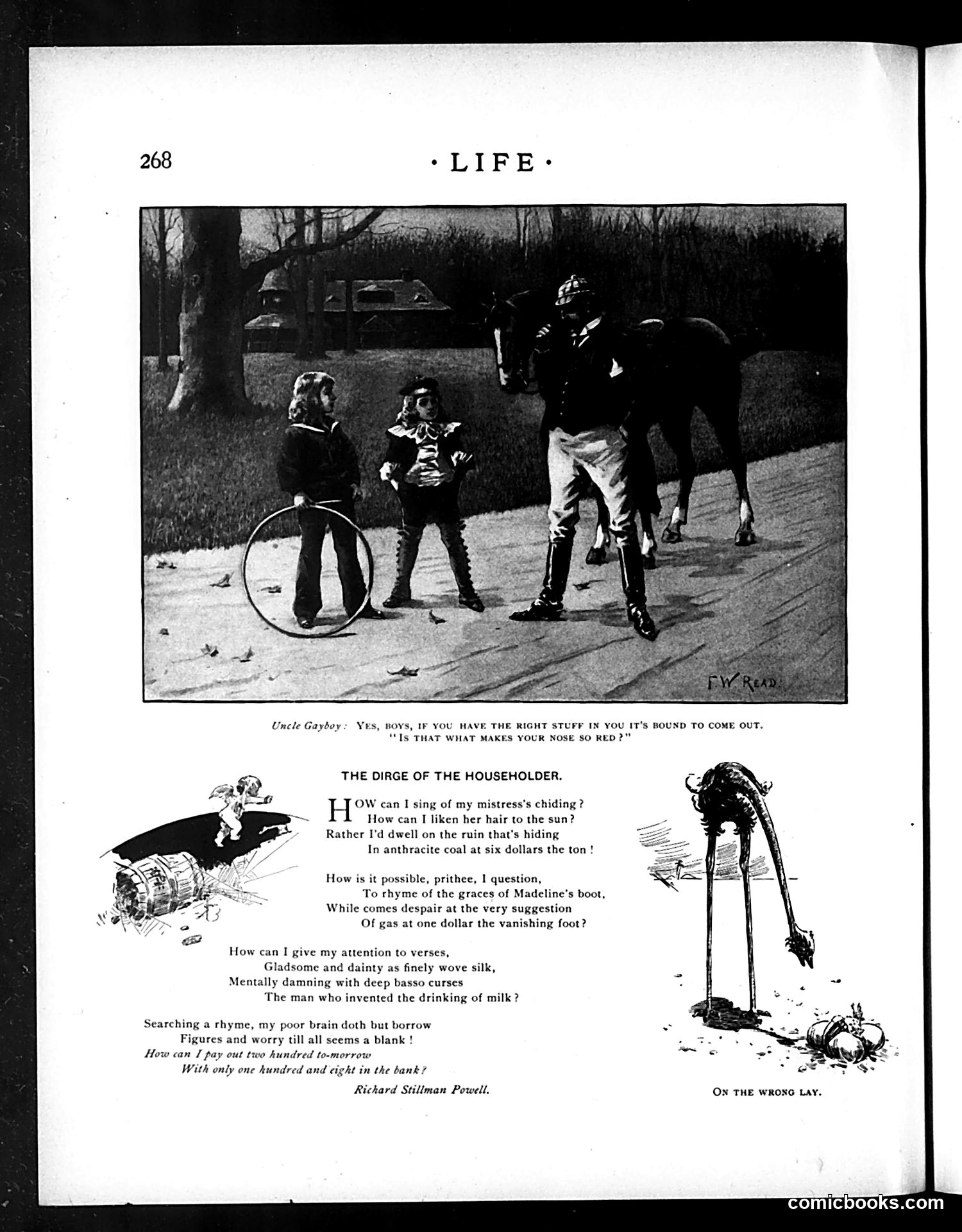
**Top cartoon**: Uncle Gayboy (a character dispensing folksy advice) tells boys their inner qualities will emerge. A child with a red nose replies, "Is that what makes your nose so red?"—a joke suggesting either the boy's nose is naturally red or he's been drinking, undercutting the uncle's sanctimonious advice. **Bottom poem**: "The Dirge of the Householder" satirizes the financial anxieties of middle-class American life. The householder laments he cannot compose romantic poetry because he's consumed by practical worries: coal costs ($6/ton), gas expenses, milk prices, and a personal financial crisis (needing to pay $200 but having only $108 in the bank). The satire mocks both the idealized literary traditions (Romantic verse about women's beauty) and the modern economic pressures that make such pursuits impossible for ordinary people. It's a commentary on working-class financial strain during what appears to be a period of inflation or economic hardship, likely early 20th century.
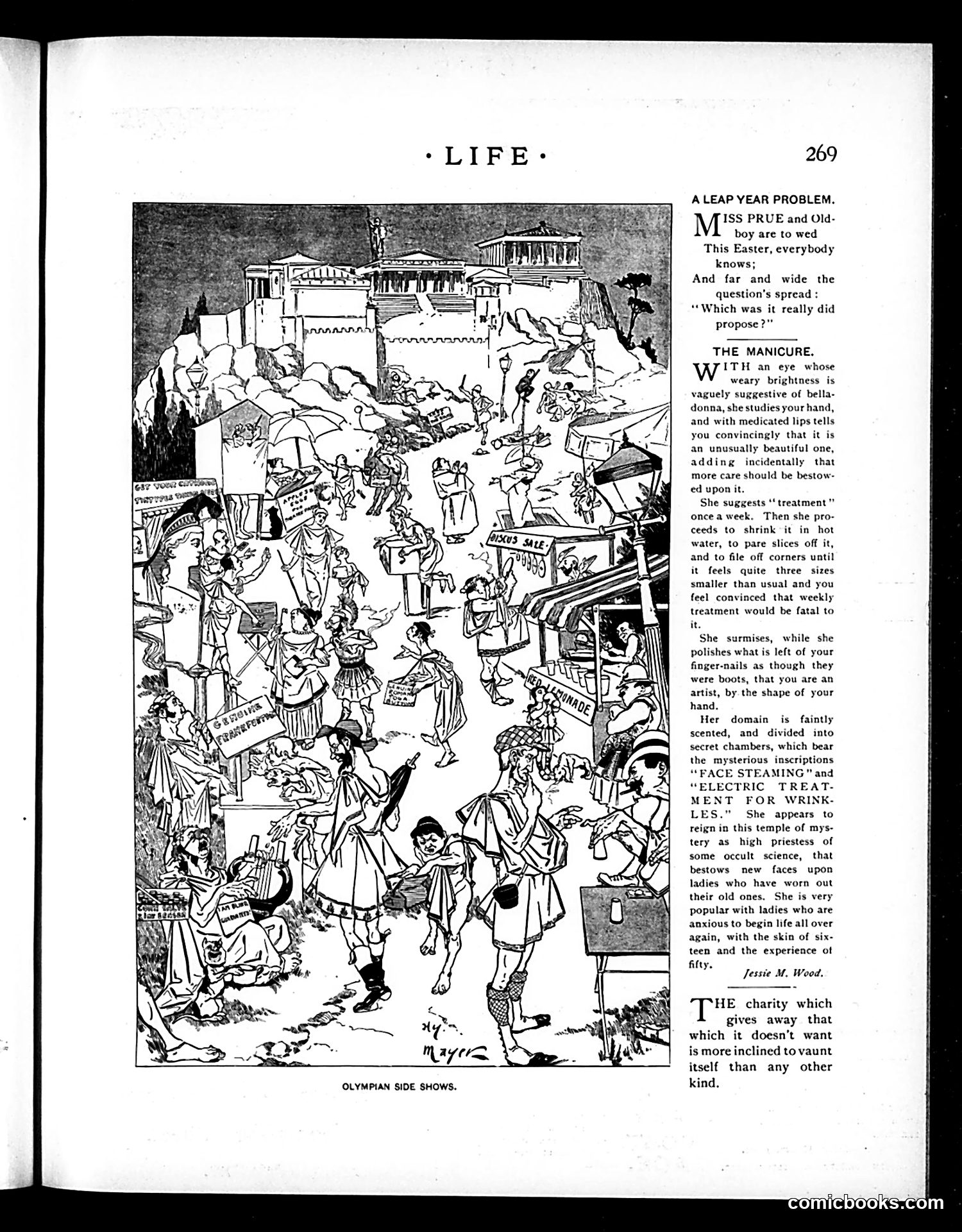
This page contains two satirical pieces from *Life* magazine: **"Olympian Side Shows"** (the large illustration): A crowded, chaotic scene depicting various beauty and leisure services at what appears to be a fashionable resort or spa. The satire mocks the commercialization of beauty treatments and self-improvement marketed to wealthy women. **"A Leap Year Problem"**: A brief joke referencing the tradition that women could propose to men during leap years. The humor lies in uncertainty about which partner initiated the engagement between "Miss Prue" and "Old-boy." **"The Manicure"** (by Jessie M. Wood): The longest piece satirizes manicurists' manipulative sales tactics. It mocks how they flatter clients ("unusually beautiful hand"), oversell unnecessary treatments, and create mystique around beauty procedures. The critique extends to women desperate to recapture youth—wanting "skin of sixteen and the experience of fifty." The final paragraph warns against ostentatious charity. Overall, the page satirizes commercialized beauty culture and gender dynamics of the era, targeting both the services exploiting women and women's anxieties about appearance and aging.
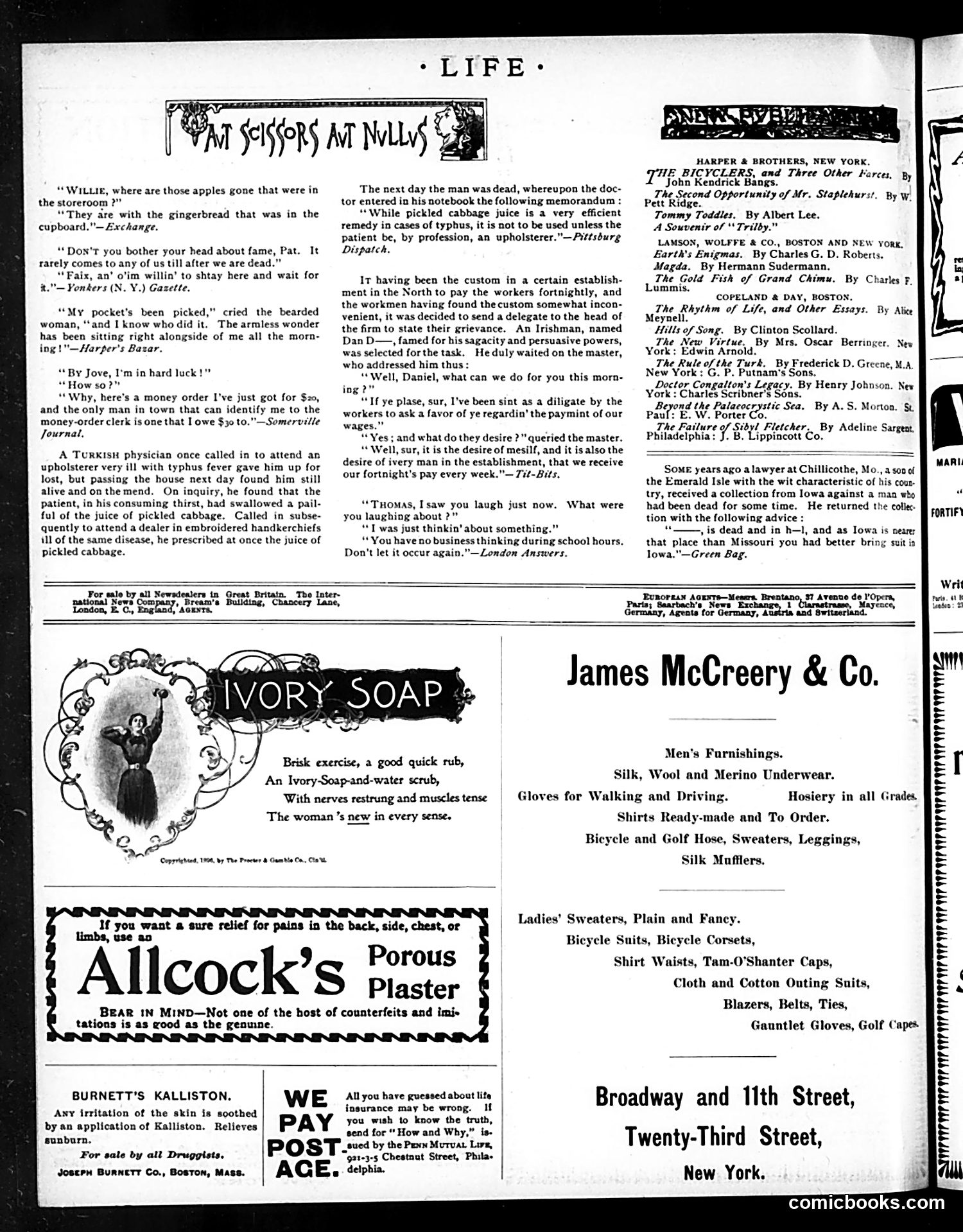
This page from *Life* magazine presents humorous anecdotes and jokes typical of late-19th-century American satire. The humor relies on wordplay, Irish stereotypes, and absurdist logic. Key jokes include: a missing-apples riddle, an Irish character (Pat) willing to wait until death for fame, a bearded woman accusing an armless performer of picketing, and a man caught between a money order and a debt. The most elaborate piece features an Irish delegate named Dan D— negotiating with his employer for weekly rather than fortnightly pay—a satire on labor negotiations. Another anecdote mocks medical practice through a Turkish doctor who prescribes pickled cabbage juice, which works for an upholsterer but kills an embroiderer, leading to the absurd conclusion that the remedy's efficacy depends on the patient's profession. The page also includes book advertisements and product ads (Ivory Soap, Allcock's Porous Plaster), typical of the era's magazine format.
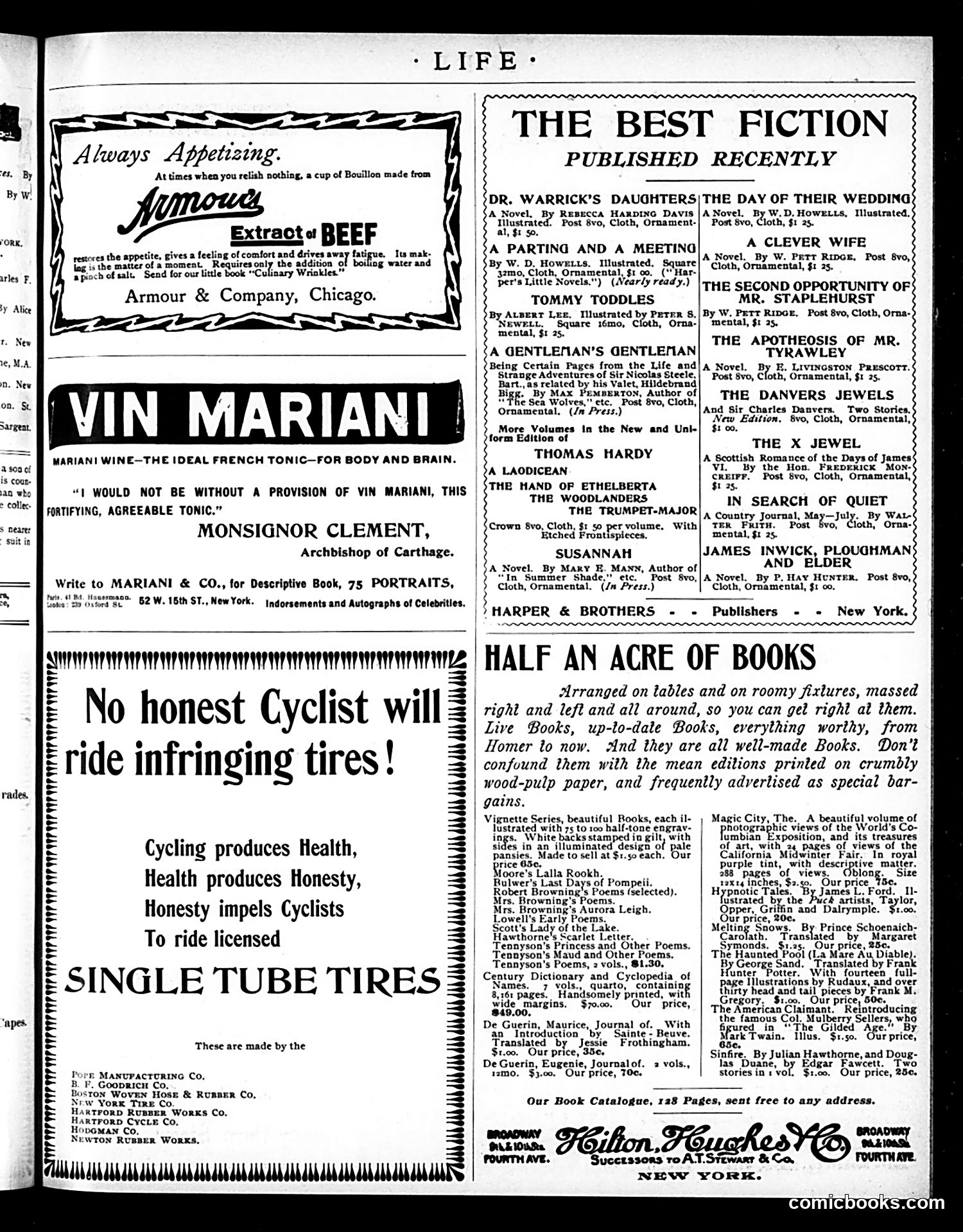
This page is primarily **advertising and book listings**, not satirical content. The advertisements promote consumer products: Armour's beef extract (promising appetite restoration), Vin Mariani (a "tonic" endorsed by an Archbishop), and notably, a campaign for "Single Tube Tires" claiming that honest cyclists ride licensed, non-infringing tires—implying competitors sold counterfeit products. The bulk of the page consists of **book advertisements** from Harper & Brothers publishers, listing recently published novels by authors including Thomas Hardy, W.D. Howells, and Rebecca Harding Davis, with prices and ornamental binding details. The single editorial element is the tire manufacturer's moralistic claim that "Cycling produces Health, / Health produces Honesty, / Honesty impels Cyclists / To ride licensed" tires—a somewhat heavy-handed corporate appeal to consumer ethics during the bicycle boom era.
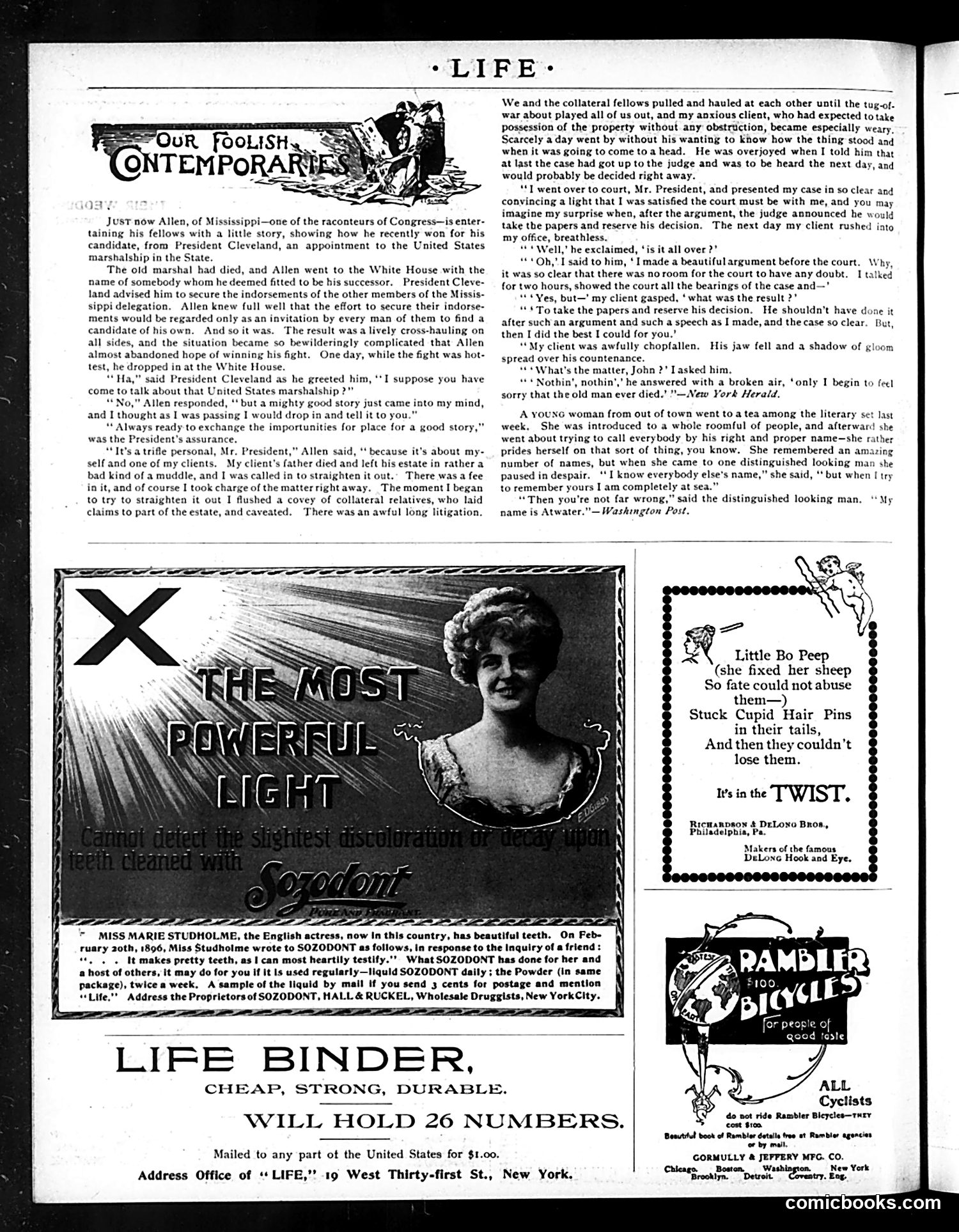
This page presents a humorous anecdote about Congressman Allen of Mississippi, told to President Cleveland to distract from political patronage pressure. **The Story's Point:** Allen uses a lengthy legal anecdote as a clever deflection. When seeking a federal marshalship appointment, instead of pestering Cleveland with arguments, Allen entertains him with a story about a client so frustrated with prolonged litigation that he regrets his father's death—implying the endless case was worse than bereavement. **The Satire:** The joke satirizes both congressional favor-seeking (Allen's transparent dodge) and bureaucratic inefficiency. By entertaining rather than demanding, Allen supposedly wins favor—but the story itself illustrates the futility of legal processes and governmental appointments, which drag on interminably while supplicants grow desperate. **Historical Context:** This reflects Gilded Age patronage politics, where federal appointments went to political allies rather than merit, and congressmen routinely leveraged personal connections with the president to secure positions for constituents.
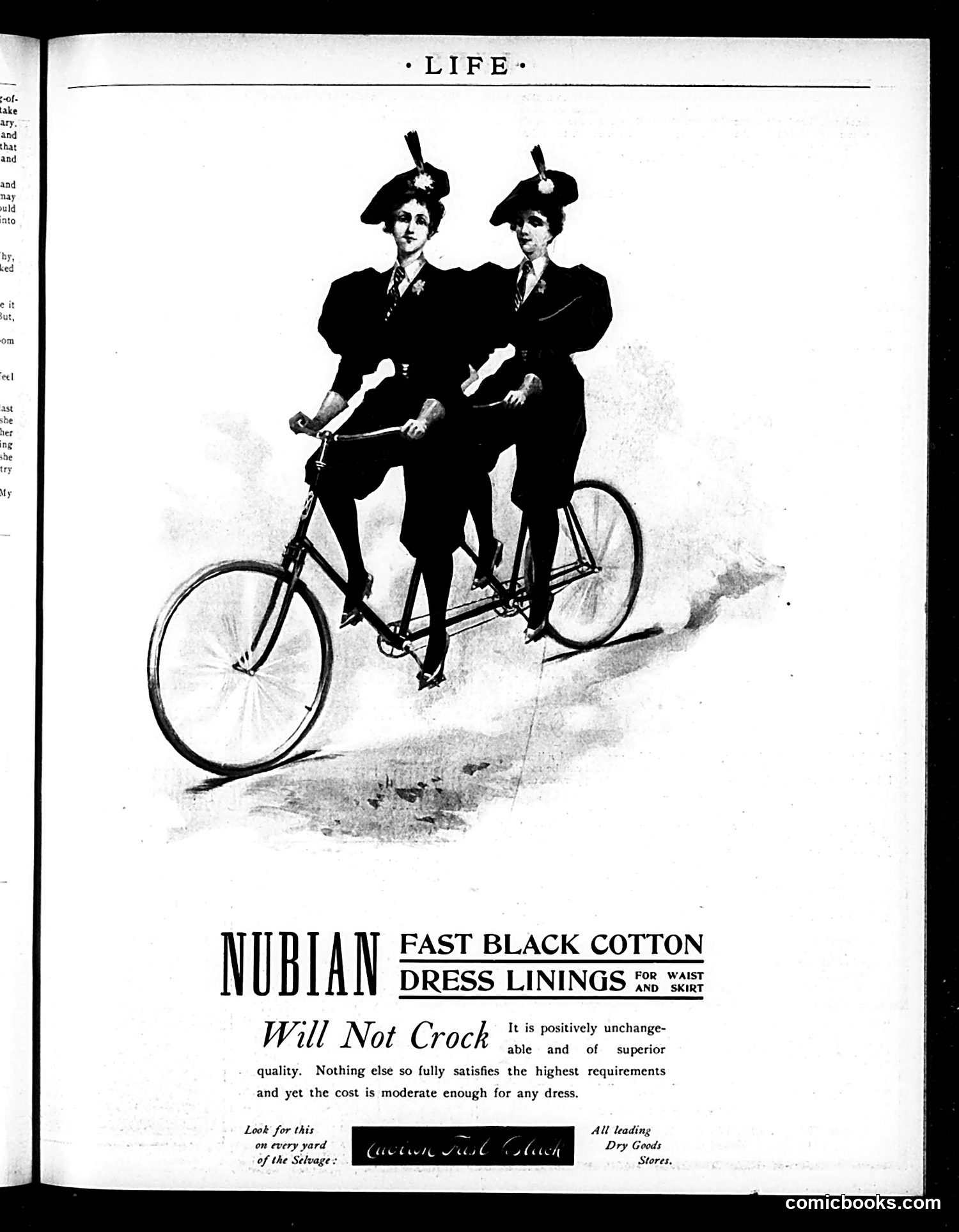
This is a **product advertisement**, not political satire. It appears in *Life* magazine and promotes Nubian brand fast black cotton dress linings. The image shows two women in early 1900s attire (high-collared black dresses, feathered hats) sharing a tandem bicycle, illustrating the modern, active lifestyle the product enables. The advertisement emphasizes that the lining "Will Not Crock"—meaning it won't transfer black dye onto the wearer's skin or outer garments, a common problem with inferior dyes of the era. The ad's appeal to middle-class women highlights that quality materials were now affordable ("moderate enough for any dress"), positioning this textile as combining durability and economy. The phrase "All leading Dry Goods Stores" indicates widespread retail availability. This is straightforward commercial messaging typical of *Life*'s advertising content.
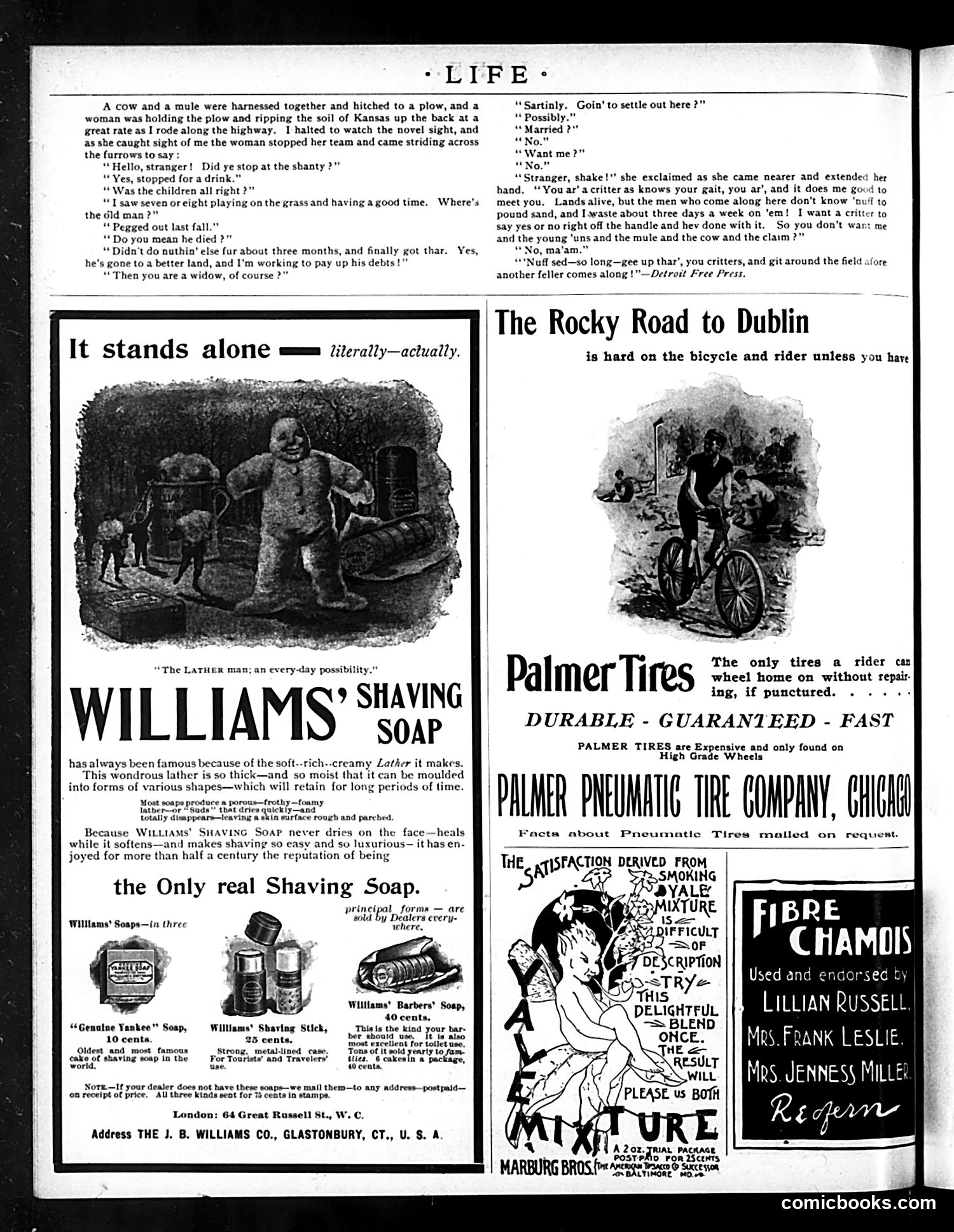
This page is primarily **advertisements** interspersed with a short satirical story. The main narrative (top) is a humorous frontier dialogue from the *Detroit Free Press*. A widow on the Kansas prairie, managing a farm solo after her husband's death, proposes marriage to a passing stranger with blunt practicality—she needs labor to manage her claim, livestock, and debts. The joke lies in her matter-of-fact, transactional approach to matrimony and her frank assessment that most men lack basic competence ("don't know 'nuff to pound sand"). The satire reflects **late 19th-century attitudes** about: - Frontier hardship and women's labor - Class skepticism toward male usefulness - Practical frontier marriage as economic partnership rather than romance The advertisements below—for Williams' Shaving Soap, Palmer Tires, and Fibre Chamois cloth—are period product pitches using celebrity endorsements and pseudo-scientific claims about lather and durability, typical of the era's marketing approach.
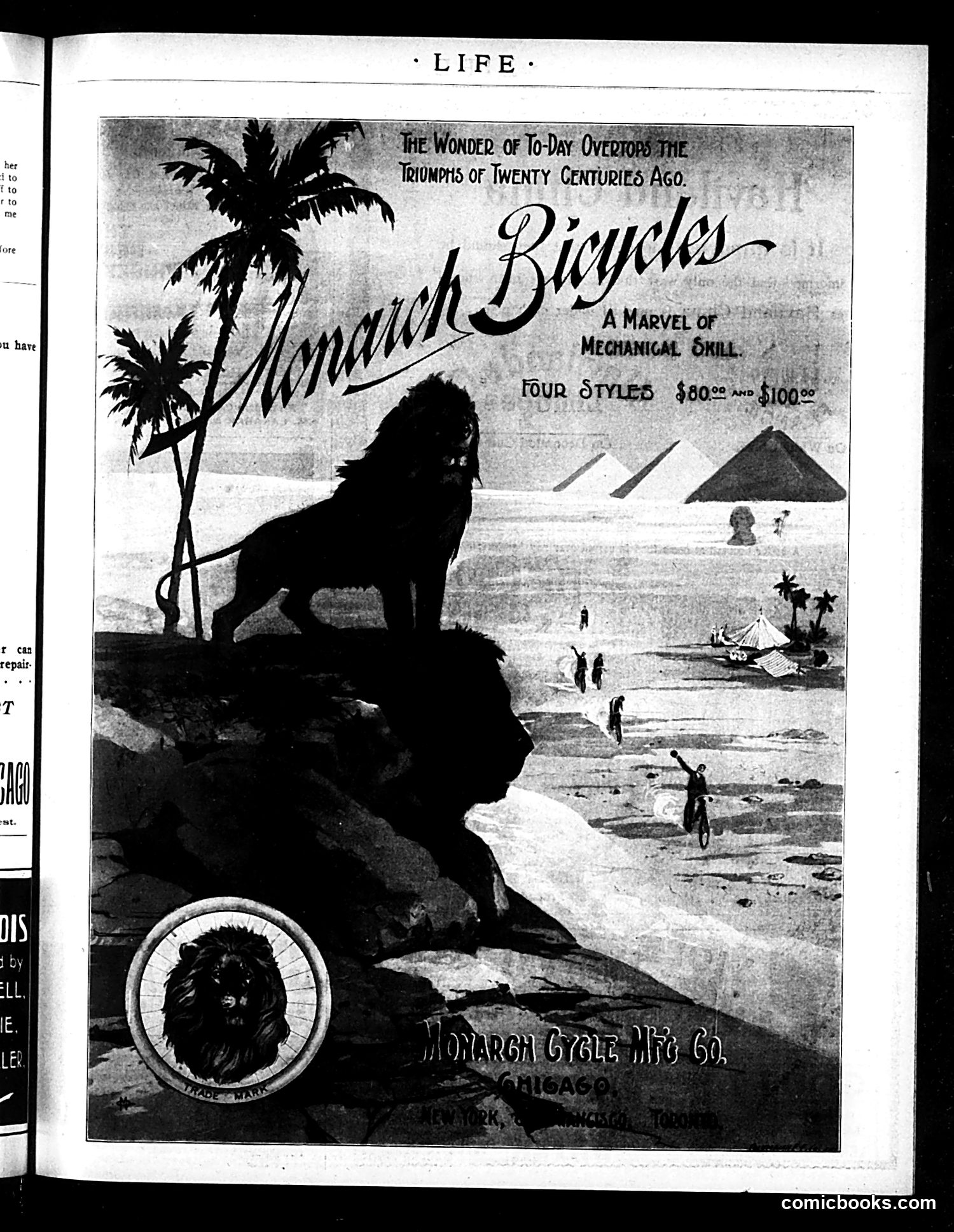
This page is primarily **advertising copy**, not editorial content or satire. It promotes "Monarch Bicycles" manufactured by the Monarch Cycle Mfg Co. of Chicago. The ad uses orientalist imagery—a sphinx, pyramids, palm trees, and Egyptian figures—to evoke exotic travel and adventure. The headline claims bicycles are "A Marvel of Mechanical Skill" that eclipse "Triumphs of Twenty Centuries Ago," comparing modern bicycles favorably to ancient Egyptian monuments. The juxtaposition suggests bicycles enable exploration and discovery comparable to ancient wonders. Four styles are advertised at $80 and $100—premium prices suggesting aspirational, upper-class consumers. This reflects late-19th/early-20th-century advertising rhetoric linking consumer products to progress, modernity, and imperial adventure.
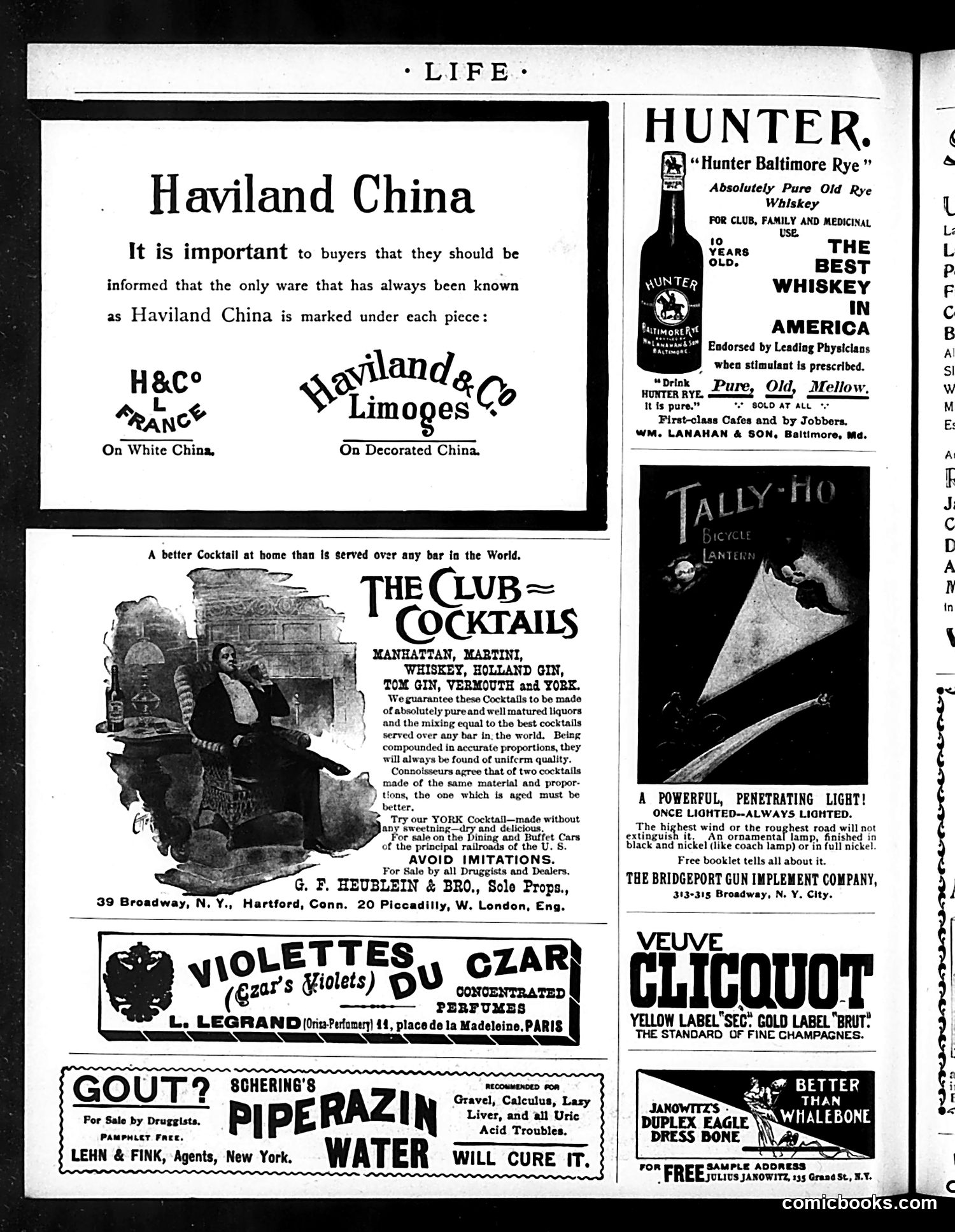
This is primarily an **advertisement page**, not a satirical cartoon page. It contains no political satire or commentary. The page showcases late 19th/early 20th-century consumer goods marketed to affluent readers: Haviland fine china (French porcelain), pre-mixed cocktails sold via railroad dining cars, French perfumes, and patent medicines (Piperazin for gout). Notable is the **medicinal whiskey advertisement**—Hunter Baltimore Rye is explicitly "endorsed by leading physicians" for medical use. This reflects the pre-Prohibition era when alcohol was legally marketed as medicine, a common practice before modern pharmaceutical regulation. The ads collectively reveal period consumption patterns: European luxury goods were prestigious; cocktail culture was emerging among the wealthy; and unregulated patent medicines with vague curative claims were standard commerce. The page documents consumer culture before FDA regulations and Prohibition fundamentally altered American advertising practices.
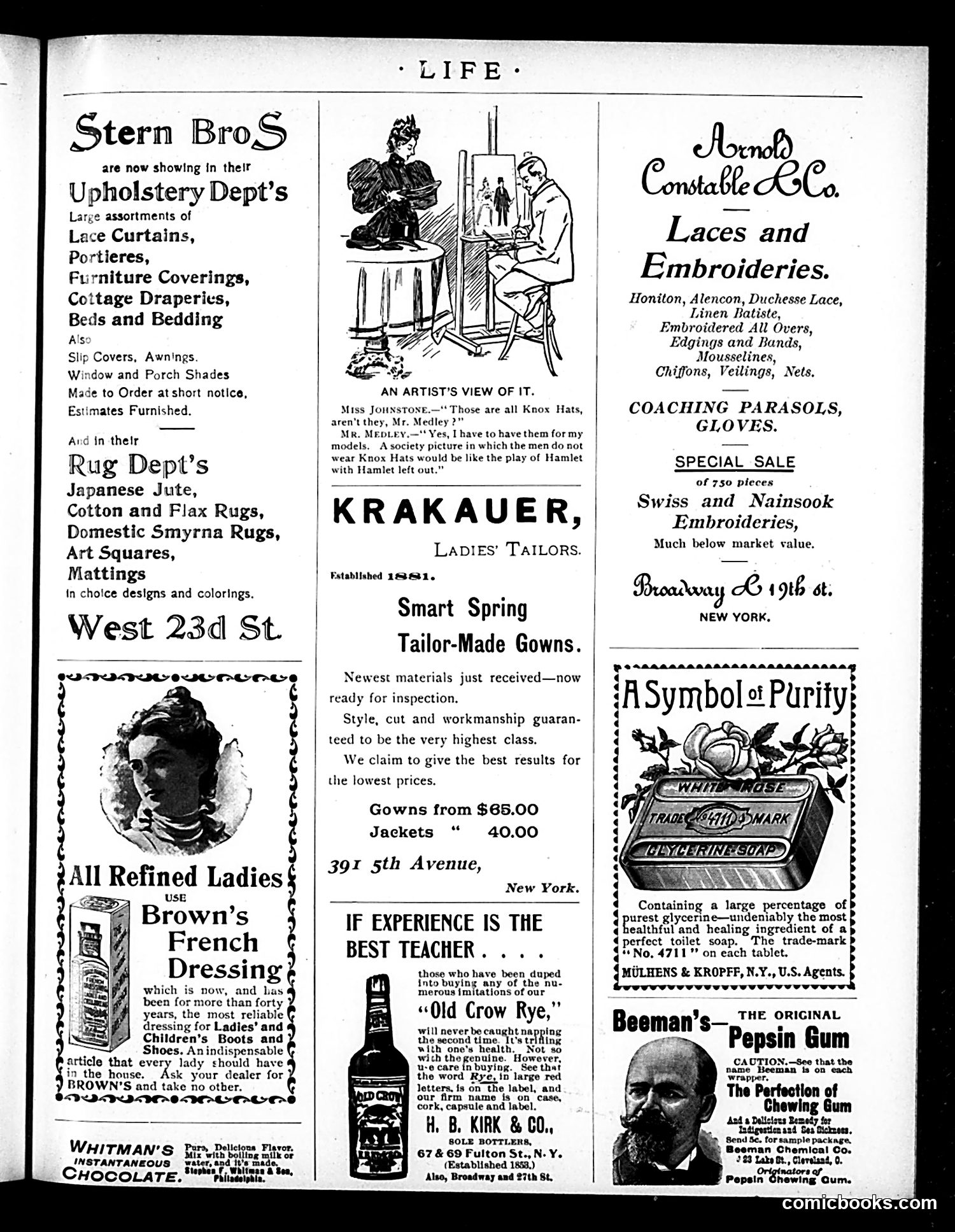
This is primarily an **advertising page** from Life magazine, not a political cartoon. The page features multiple commercial advertisements for early 1900s products and services. The single **cartoon element** appears near the top: titled "An Artist's View of It," it shows a conversation between two men—one appears to be a society painter (Mr. Medley) and presumably a client or associate. The joke concerns **Knox Hats**: Medley claims he must use Knox Hats for all his society portrait models because omitting them would be "like the play of Hamlet with Hamlet left out." This is **product-placement satire**—the cartoonist mocks how ubiquitous and essential Knox Hats had become in fashionable society portraits. The Hamlet reference suggests Knox Hats were so central to depicting gentlemen that their absence would be as absurd as performing Hamlet without the protagonist. The remaining content consists of advertisements for clothing, home furnishings, soaps, liquor, and other goods typical of the era.
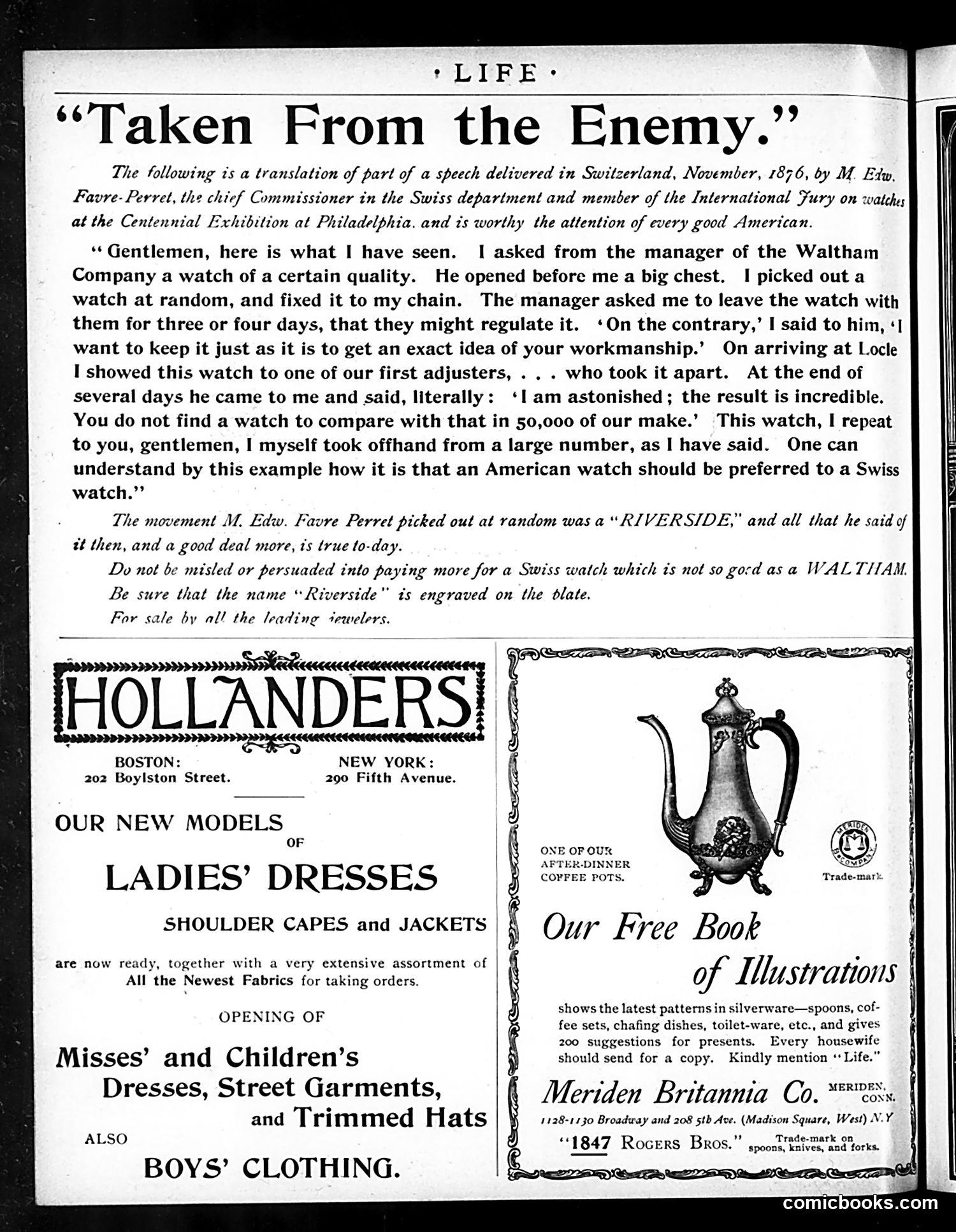
This *Life* page celebrates American manufacturing superiority over Swiss competitors. The featured article translates a speech by a Swiss official who tested a randomly selected Waltham watch against Swiss products and found it superior—so exceptional that Swiss adjusters claimed they'd never seen its equal among 50,000 of their own makes. The satire is implicit: a Swiss authority conceding American excellence is framed as evidence "taken from the enemy." In the 1876 Centennial Exhibition context (post-Civil War American industrial pride), this quote serves as advertising for Waltham watches and the "Riverside" model specifically, validating American manufacturing quality against established European tradition. The remainder of the page consists of period advertisements for clothing and housewares, typical of *Life*'s mixed editorial-commercial format. The piece essentially weaponizes foreign testimony to market American goods—a credibility tactic that wouldn't require explanation to contemporary readers already invested in demonstrating American industrial prowess.
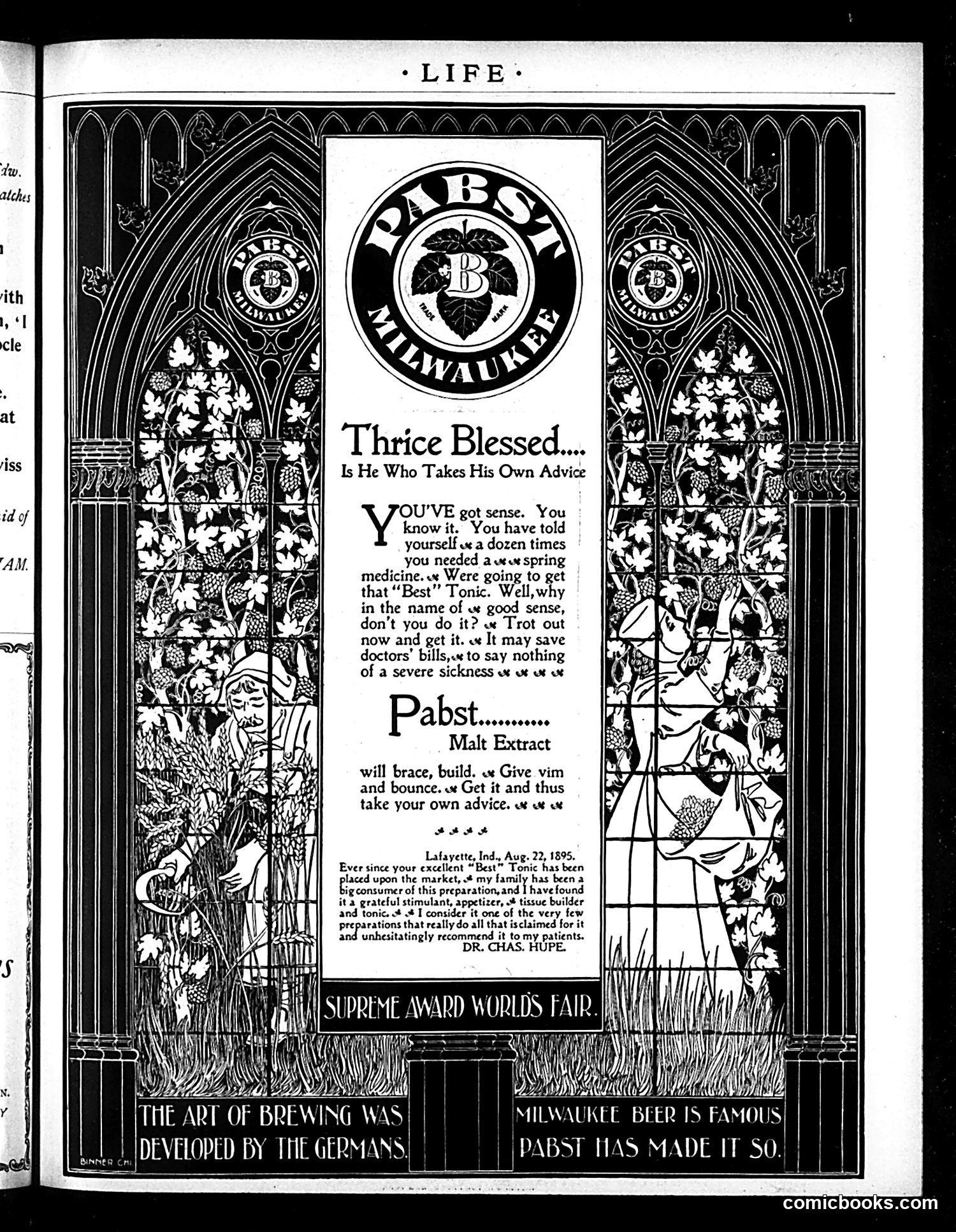
This is a **Pabst Malt Extract advertisement**, not satire or political commentary. The page uses the motto "Thrice Blessed is He Who Takes His Own Advice" to pitch self-help logic: the reader knows they need a spring tonic, so why not buy Pabst? The text humorously suggests it will save on doctor's bills and severe illness while building vim and bounce. The ornate gothic border and classical design aim for prestige. A testimonial letter from Lafayette, Indiana (dated Aug. 22, 1895) claims the product is a "grateful stimulant, appetizer, tissue builder and tonic." The bottom banners assert German brewing expertise, positioning Pabst as the legitimate heir to that tradition. This is **pure advertising**, leveraging pseudo-scientific health claims common to patent medicines and tonics of the 1890s era—before FDA regulation.
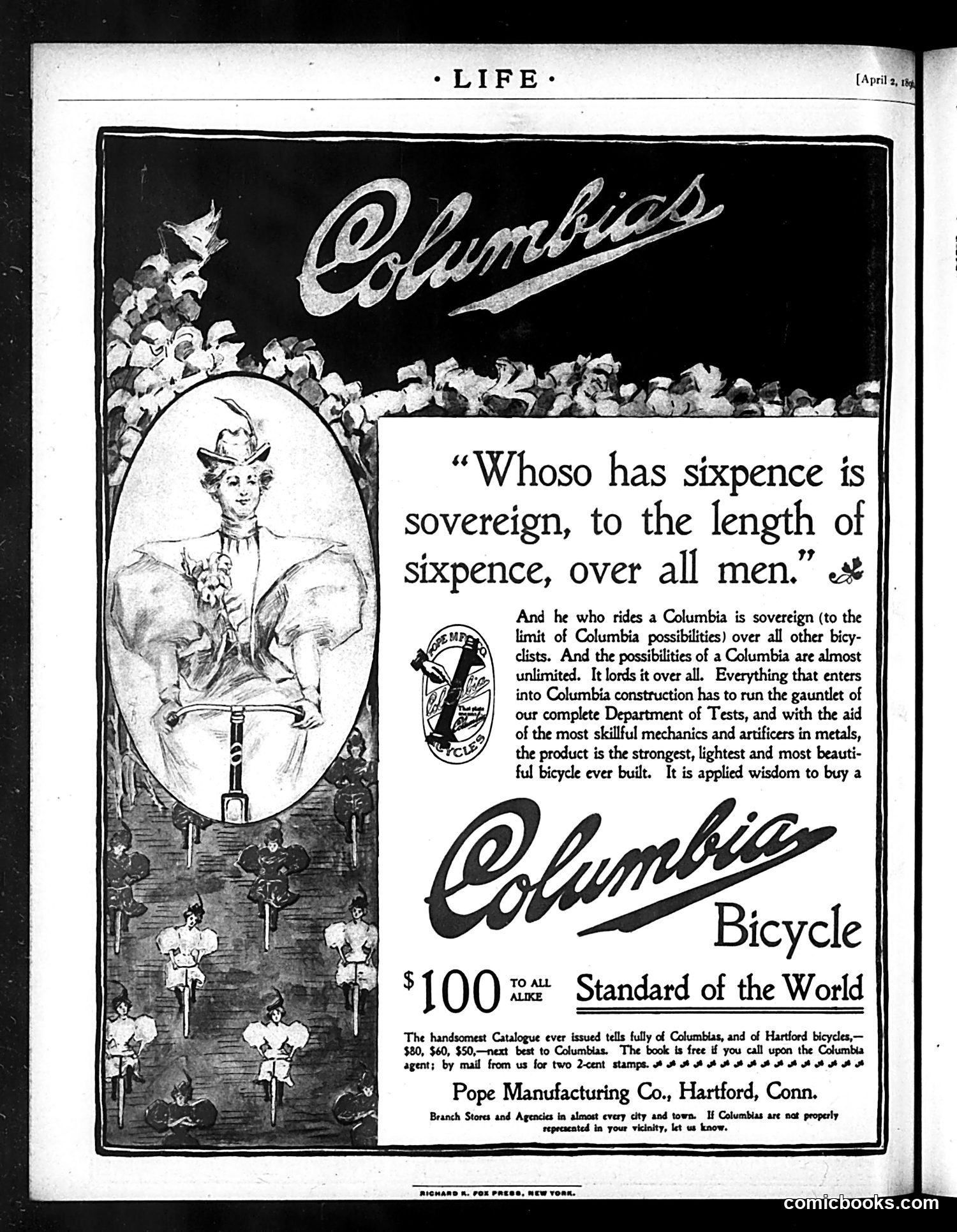
This is primarily a **product advertisement**, not political satire, though it uses clever wordplay. The ad plays on a Shakespeare quote ("Whoso has sixpence is sovereign") to argue that owning a Columbia bicycle grants the rider superiority over other cyclists. The left side shows an ornate illustration of a well-dressed woman on a bicycle, surrounded by admirers—depicting the bicycle as a status symbol. The ad promises that Columbia bicycles are the strongest, lightest, and most beautiful available, having passed rigorous testing. Priced at $100 (expensive for the era), it positions Columbia as "Standard of the World." The Pope Manufacturing Co. (Hartford, Connecticut) also sold cheaper Hartford brand bicycles ($50-80) as secondary options. This reflects the late 19th-century bicycle craze, when bicycles represented freedom, modernity, and social status—particularly for women entering public spaces independently.