
Life, 1896-04-02 · page 11 of 32
Life — April 2, 1896 — page 11: what you’re looking at
What you’re looking at
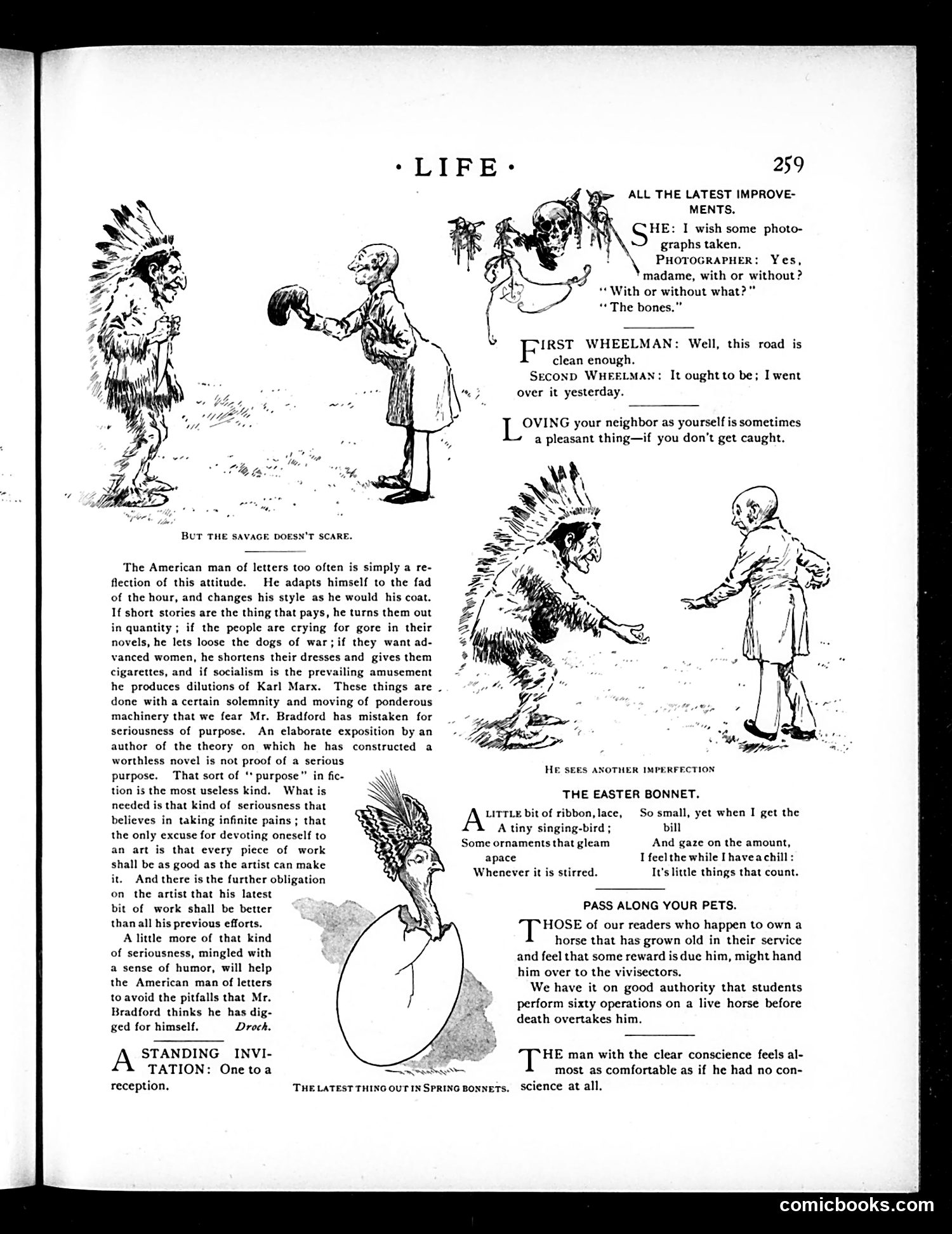
This page contains several unrelated satirical items typical of Life's humor format: **"But the Savage Doesn't Scare"** depicts a Native American figure encountering a photographer, with text playing on the idea that Indigenous peoples weren't intimidated by modern technology—a common early-20th-century joke playing on racial stereotypes about "savages." **"The Easter Bonnet"** is a light poem mocking women's elaborate spring hats, suggesting they're expensive and impractical. The remaining items—about wheelmen (cyclists), neighborly behavior, horse vivisection, and clear consciences—are brief, disconnected joke items. The page appears designed as a humor miscellany rather than cohesive commentary, reflecting Life's typical satirical magazine format of the era.
📄 Transcribed text from this page (OCR, searchable)
Machine-transcribed from the original scan — historical spelling and the odd misread are preserved.
BUT THE SAVAGE DOESN'T SCARE. The American man of letters too often is simply a re- flection of this attitude. He adapts himself to the fad of the hour, and changes his style as he would his coat. If short stories are the thing that pays, he turns them out in quantity ; if the people are crying for gore in their novels, he lets loose the dogs of war;if they want ad- vanced women, he shortens their dresses and gives them cigarettes, and if socialism is the prevailing amusement he produces dilutions of Karl Marx. These things are done with a certain solemnity and moving of ponderous machinery that we fear Mr. Bradford has mistaken for seriousness of purpose. An elaborate exposition by an author of the theory on which he has constructed a worthless novel is not proof of a serious purpose. That sort of ‘* purpose” in fic- tion is the most useless kind. What is needed is that kind of seriousness that believes in taking infinite pains ; that S\ A the only excuse for devoting oneself to an art is that every piece of work shall be as good as the artist can make it. And there is the further obligation on the artist that his latest bit of work shall be better than all his previous efforts. A little more of that kind of seriousness, mingled with a sense of humor, will help the American man of letters to avoid the pitfalls that Mr. Bradford thinks he has dig- ged for himself. Droch. STANDING INVI- TATION: One toa pean Some ornaments that gleam apace Whenever it is stirred. 259 ALL THE LATEST IMPROVE- MENTS. HE: I wish some photo- graphs taken. PHOTOGRAPHER: Yes, madame, with or without? “With or without what?” ‘* The bones.” Fist WHEELMAN: Well, this road is clean enough, SECOND WHEELMAN: It oughtto be; I went over it yesterday. OVING your neighbor as yourself is sometimes a pleasant thing—if you don’t get caught. HE SEES ANOTHER IMPERFECTION THE EASTER BONNET. LITTLE bit of ribbon, lace, So small, yet when I get the A tiny singing-bird ; bill And gaze on the amount, I feel the while [haveachill: It's little things that count. PASS ALONG YOUR PETS. HOSE of our readers who happen to own a horse that has grown old in their service and feel that some reward is due him, might hand him over to the vivisectors, We have it on good authority that students perform sixty operations on a live horse before death overtakes him. HE man with the clear conscience feels al- most as comfortable as if he had no con- reception, THE LATEST THING OUT IN SPRING BoxNETs. Science at all. comicbooks.com