
Life, 1896-04-02 · page 6 of 32
Life — April 2, 1896 — page 6: what you’re looking at
What you’re looking at
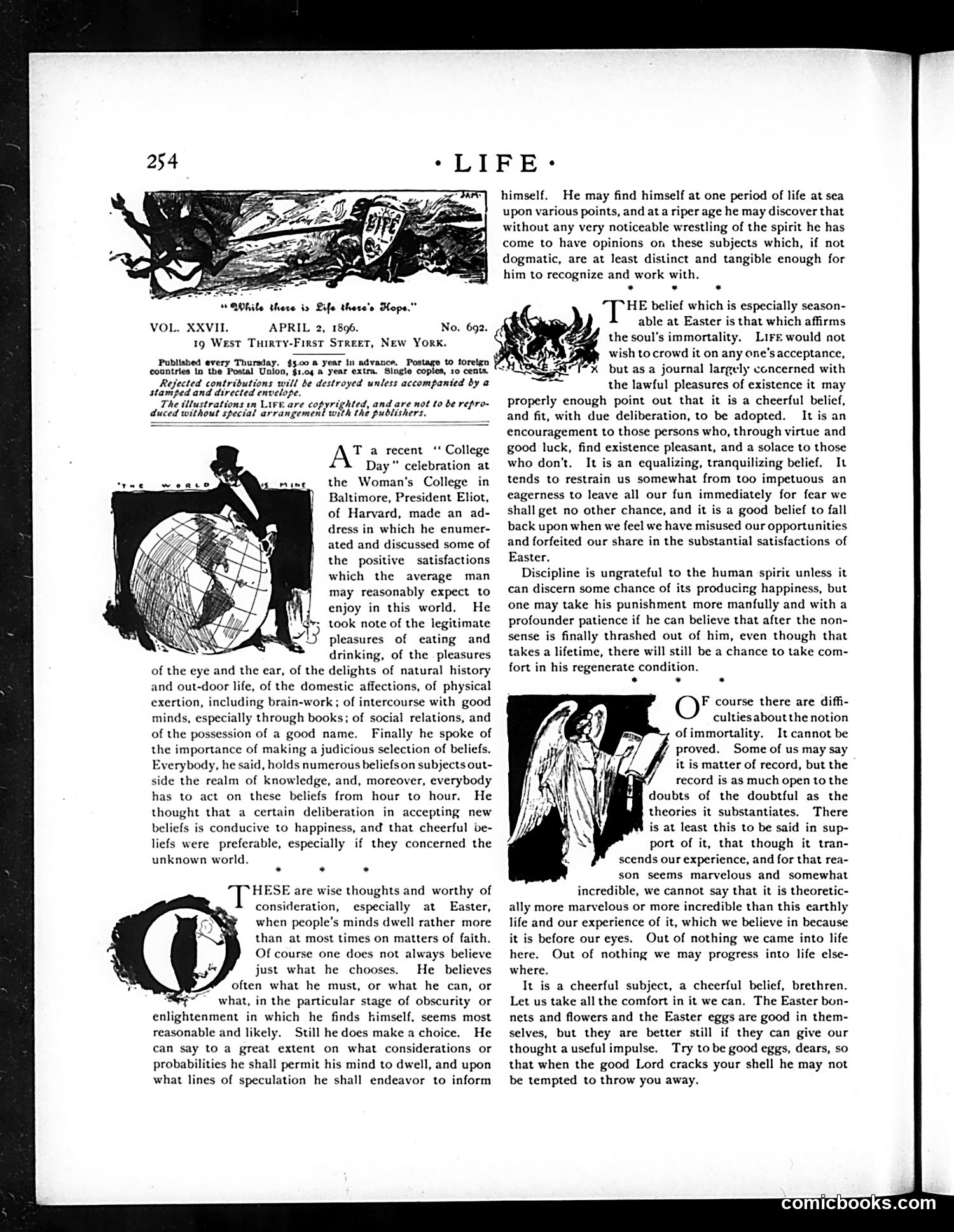
This page contains editorial commentary on Easter beliefs rather than political satire. The text discusses the "soul's immortality" and defends Easter as offering comfort and hope—a "cheerful belief" that encourages people to find life's pleasures pleasant and meaningful. The illustrations are decorative rather than satirical: an angel reading (top right) and a figure sitting on a globe (left) are generic religious/philosophical imagery supporting the essay's theme about faith and human experience. The main argument criticizes excessive skepticism about immortality, arguing that belief in an afterlife—even if unprovable—produces happiness and serves a social purpose. This reflects early 20th-century *Life* magazine's genteel editorial voice addressing readers' spiritual concerns rather than lampooning specific figures or events.
📄 Transcribed text from this page (OCR, searchable)
Machine-transcribed from the original scan — historical spelling and the odd misread are preserved.
*LIFE: VOL. XXVII. APRIL 2, 1896. No. 692. 19 West Tuirty-First Street, New York. Published every Thursday. $5.00 a year in advance. Postage to foreign countries in the Postal Union, $1.04 @ year extra. Single copies, 10 cents. Rejected contributions will be destroyed unless accompanied by a stamped and directed envelope. The iltustrations m LIFE are copyrighted, and are not t0 be repro- duced without special arrangement wi 1th the publishers. T a recent ‘ College Day" celebration at the Woman's College in Baltimore, President Eliot, of Harvard, made an ad- dress in which he enumer- ated and discussed some of the positive satisfactions which the average man may reasonably expect to enjoy in this world, He took note of the legitimate pleasures of eating and drinking, of the pleasures of the eye and the ear, of the delights of natural history and out-door life, of the domestic affections, of physical exertion, including brain-work ; of intercourse with good minds, especially through books; of social relations, and of the possession of a good name. Finally he spoke of the importance of making a judicious selection of beliefs. Everybody, he said, holds numerous beliefs on subjects out- side the realm of knowledge, and, moreover, everybody has to act on these beliefs from hour to hour. He thought that a certain deliberation in accepting new beliefs is conducive to happiness, and that cheerful ve- liefs were preferable, especially if they concerned the unknown world. . . HESE are wise thoughts and worthy of consideration, especially at Easter, when people's minds dwell rather more than at most times on matters of faith. Of course one does not always believe just what he choos He believes AY often what he must, or what he can, or “Sy~" what, in the particular stage of obscurity or enlightenment in which he finds himself, seems most reasonable and likely. Still he does make a choice. He can say to a great extent on what considerations or probabilities he shall permit his mind to dwell, and upon what lines of speculation he shall endeavor to inform himself. He may find himself at one period of life at sea upon various points, and at a riper age he may discover that without any very noticeable wrestling of the spirit he has come to have opinions on these subjects which, if not dogmatic, are at least distinct and tangible enough for him to recognize and work with, . . « HE belief which is especially season- able at Easter is that which affirms the soul's immortality. Lire would not wish to crowd it on any one’s acceptance, X butasa journal largely concerned with the lawful pleasures of existence it may properly enough point out that it is a cheerful belief, and fit, with due deliberation, to be adopted. It is an encouragement to those persons who, through virtue and good luck, find existence pleasant, and a solace to those who don't. It is an equalizing, tranquilizing belief. It tends to restrain us somewhat from too impetuous an eagerness to leave all our fun immediately for fear we shall get no other chance, and it is a good belief to fall back upon when we feel we have misused our opportunities and forfeited our share in the substantial satisfactions of Easter. Discipline is ungrateful to the human spiric unless it can discern some chance of its producing happiness, but one may take his punishment more manfully and with a profounder patience if he can believe that after the non- sense is finally thrashed out of him, even though that takes a lifetime, there will still be a chance to take com- fort in his regenerate condition. . . F course there are diffi- cultiesabout the notion ofimmortality. It cannot be proved. Some of us may say it is matter of record, but the record is as much open to the doubts of the doubtful as the theories it substantiates. There is at least this to be said in sup- port of it, that though it tran- scends our experience, and for that rea- son seems marvelous and somewhat incredible, we cannot say that it is theoretic- ally more marvelous or more incredible than this earthly life and our experience of it, which we believe in because it is before our eyes, Out of nothing we came into life here. Out of nothing we may progress into life else- where. It is a cheerful subject, a cheerful belief, brethren. Let us take all the comfort in it we can. The Easter bon- nets and flowers and the Easter eggs are good in them- selves, but they are better still if they can give our thought a useful impulse. Try to be good eggs, dears, so that when the good Lord cracks your shell he may not be tempted to throw you away. comicbooks.com