
A complete issue · 20 pages · 1896
Life — March 19, 1896
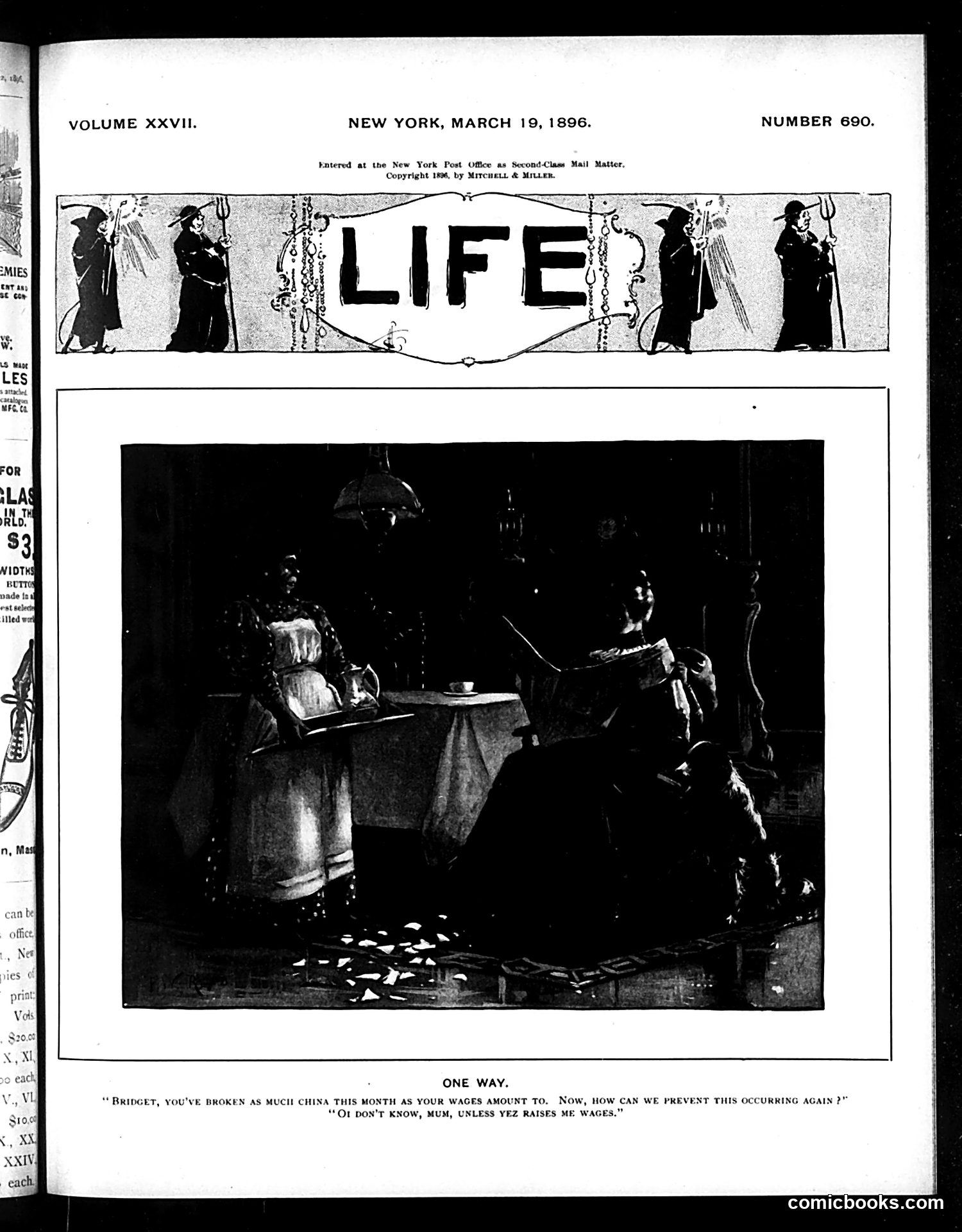
This cartoon satirizes working-class economic struggle. The image shows two figures in conversation at a table in what appears to be a modest domestic setting. The caption presents dialogue between a working man ("Bridget") and apparently his employer or wife discussing broken household items. The satire addresses the cruel logic of wage suppression: the worker has broken dishes worth money equivalent to his monthly wages, yet cannot afford replacement. The employer/questioner asks how to prevent future breakage, and the answer "unless yez raises me wages" exposes the ironic bind—workers earning subsistence wages cannot absorb basic domestic losses. This reflects late-19th-century labor conditions where workers had no financial cushion for accidents or damage.
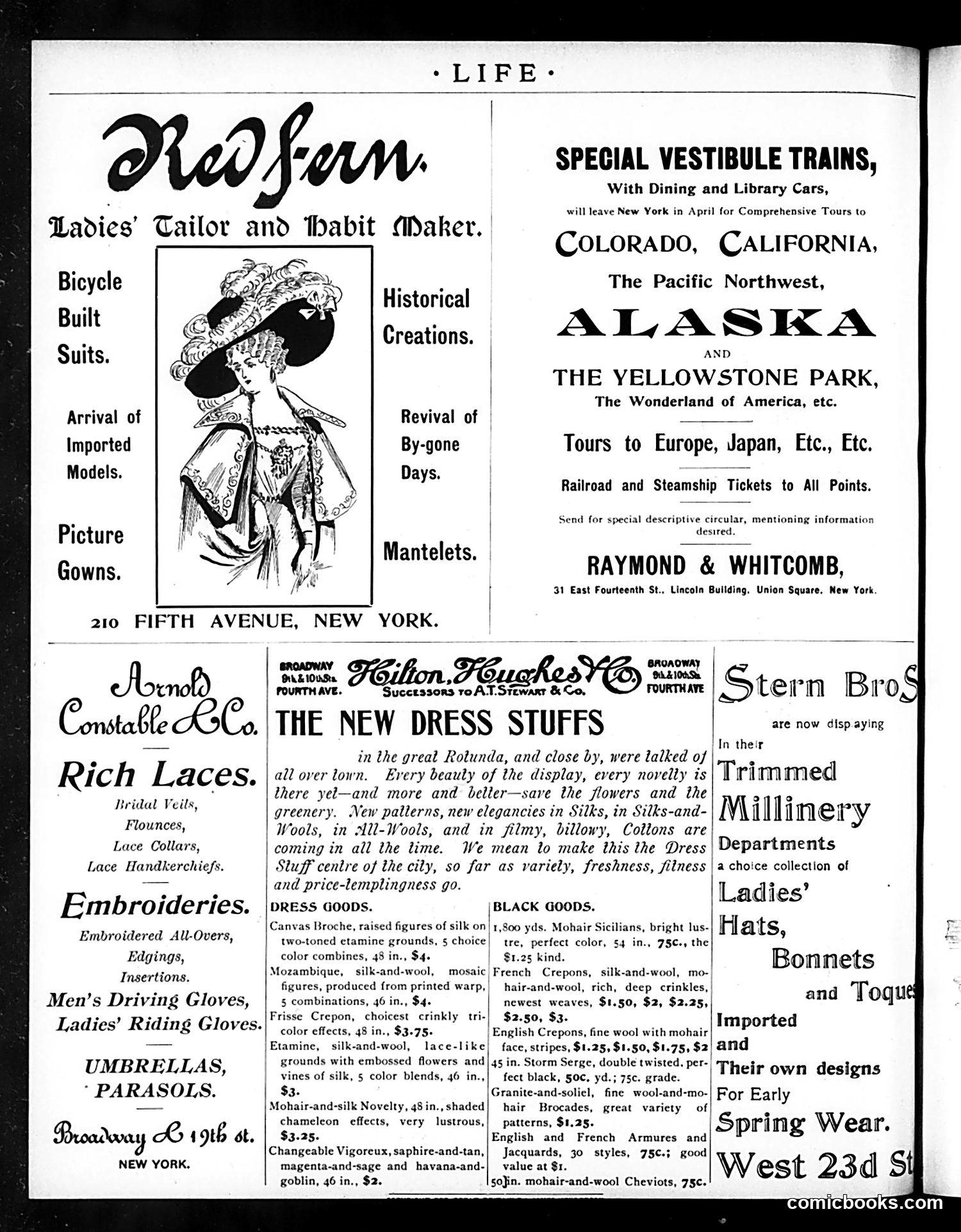
This page is **primarily advertising**, not satire or political commentary. The left side features an advertisement for **Red Fern, a ladies' tailor and habit maker** at 210 Fifth Avenue, New York, showcasing fashionable women's clothing including bicycle suits, imported models, picture gowns, and historical creations. The central and right portions contain advertisements for: - **Raymond & Whitcomb travel agency** offering tours to Colorado, California, Alaska, Yellowstone, Europe, and Japan - **Hilton, Hoag & Co.** promoting new dress fabrics and textiles - **Stern Bros.** displaying trimmed millinery (hats, bonnets, and toques) for spring wear The illustration of an elegantly dressed woman in a large hat is a **fashion advertisement**, not political satire. This appears to be a standard magazine page from the early 1900s focused entirely on retail promotion.
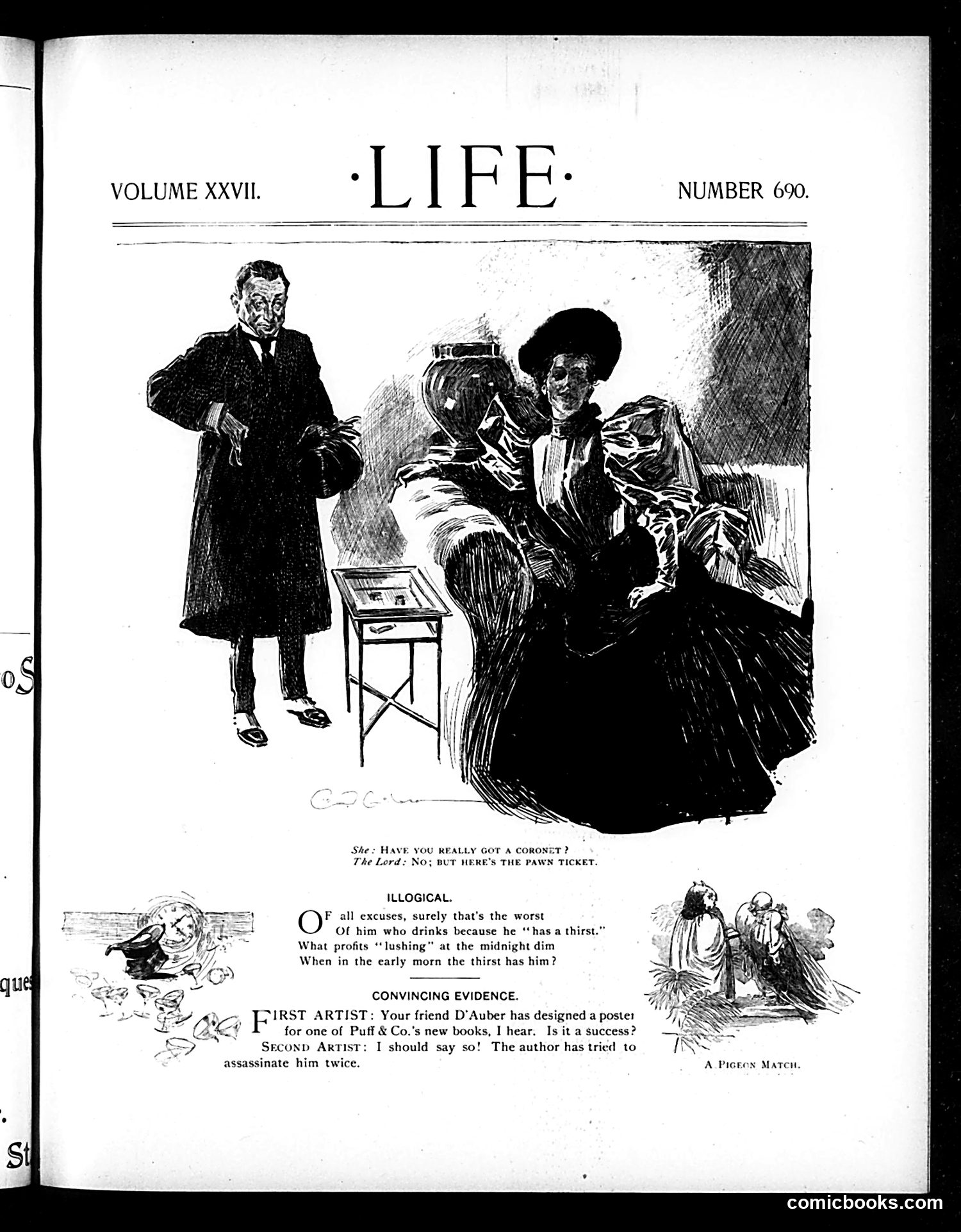
This page contains three separate satirical items: 1. **Top cartoon**: A woman asks a man about a "coronet," and he responds with a pawn ticket—satirizing financial hardship where even valuable items are pawned. 2. **"Illogical"**: A joke about a drinker with perpetual thirst, mocking the contradiction of drinking to satisfy thirst that returns by morning. 3. **"Convincing Evidence"**: Two artists discuss a poster designer whose work is so bad that the author attempted suicide twice—dark satire on artistic failure and publisher Puff & Co.'s books. The page also includes small decorative illustrations labeled "A Pigeon's Match." The overall tone reflects early 20th-century American humor, mixing social commentary on poverty and drinking culture with art-world satire.
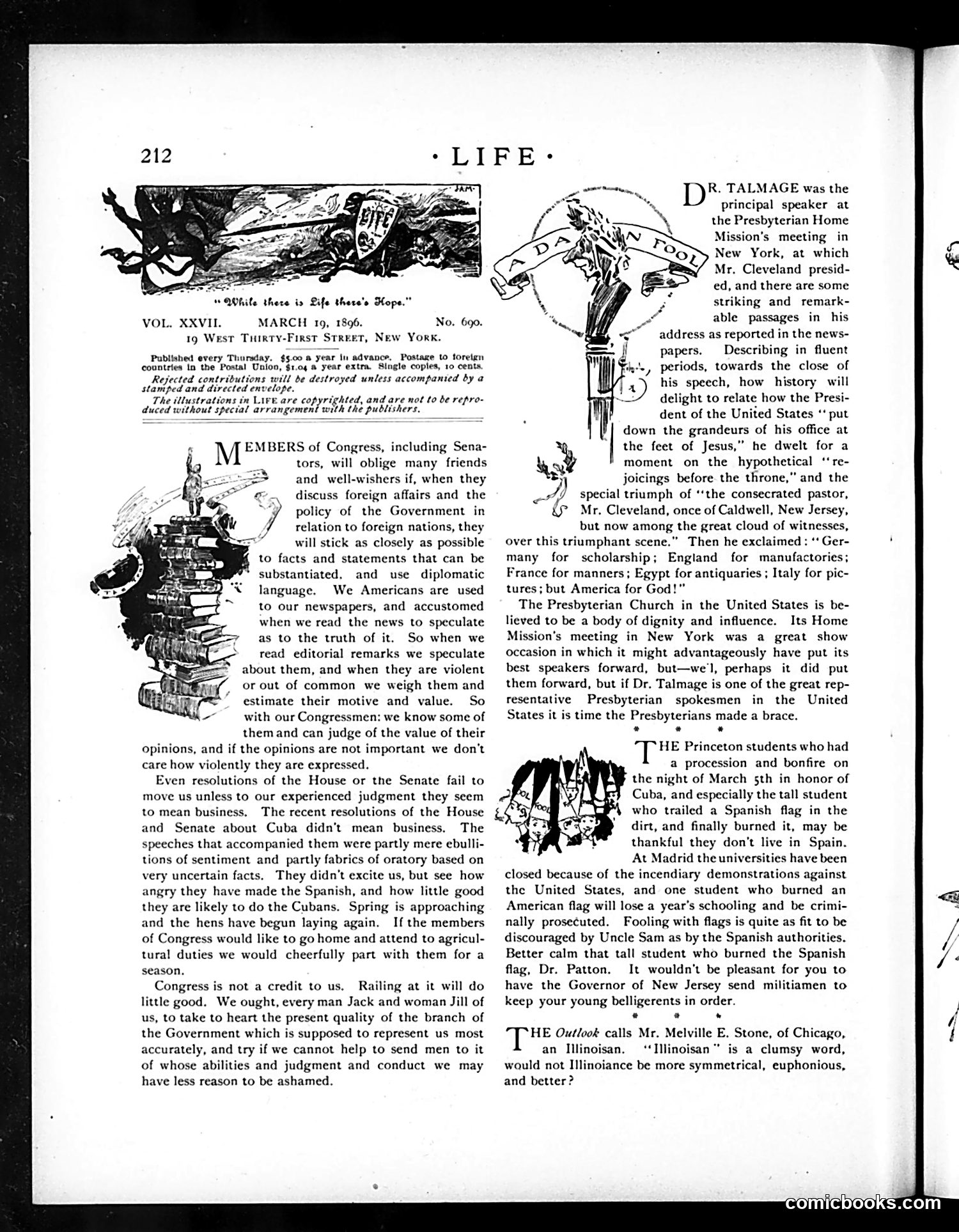
The page contains editorial commentary on Congress's foreign policy, particularly regarding Cuba and Spain. The text criticizes Members of Congress for speculating about foreign affairs based on uncertain facts, arguing they should stick to verifiable information before forming opinions. A specific complaint targets Congressional speeches about Cuba that "didn't mean business"—the resolutions accompanying them were described as "partly mere ebullitions of sentiment" based on "very uncertain facts." The page also mocks Princeton students who held a bonfire burning a Spanish flag to protest Spanish rule in Cuba, calling such flag-burning "quite as fit to be discouraged by Uncle Sam as by the Spanish authorities." Overall, the satire criticizes both reckless Congressional bluster and youthful anti-Spanish demonstrations regarding the Cuban conflict.
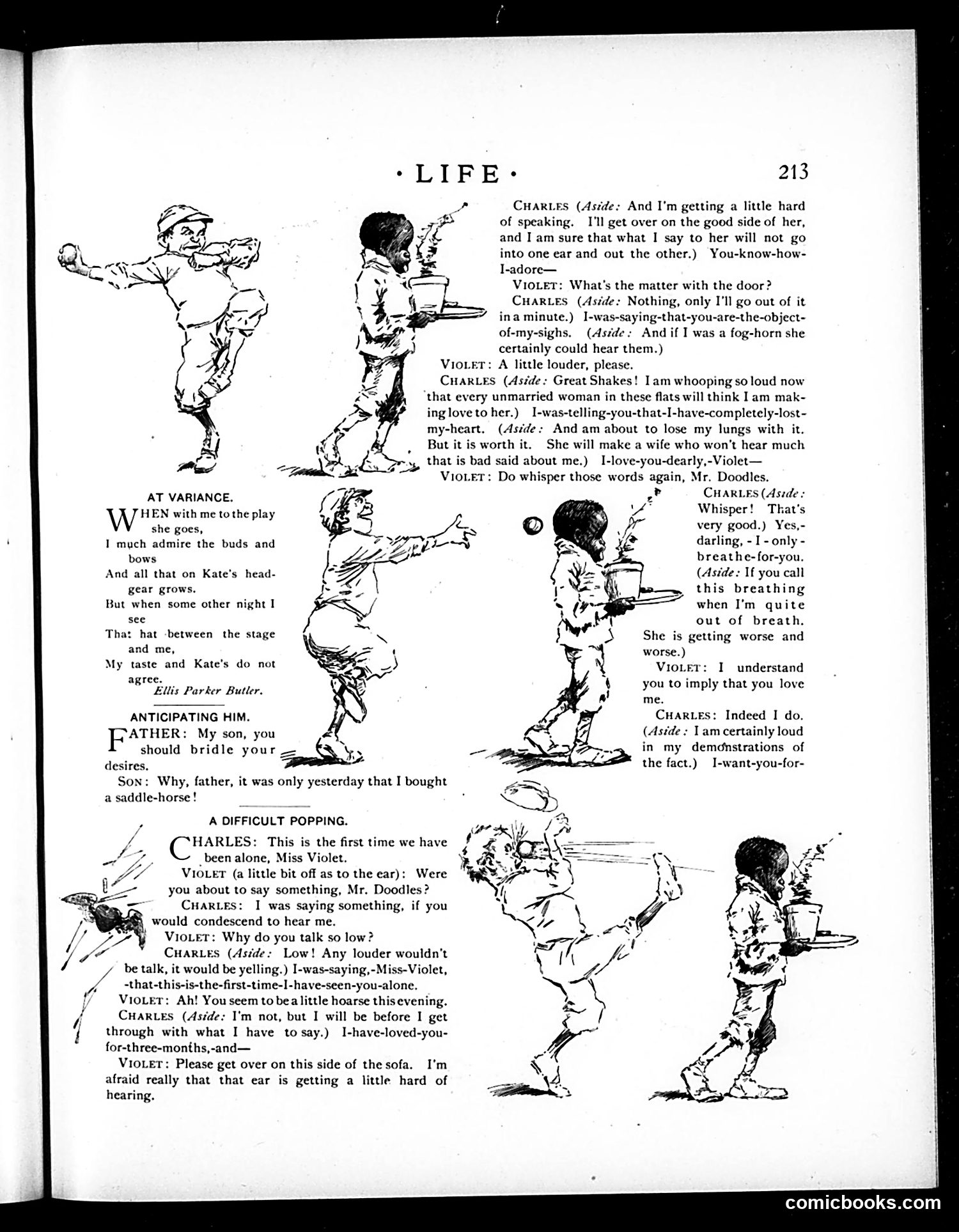
This page contains theatrical humor sketches and dialogue involving characters named Charles and Violet. The sketches depict physical comedy and romantic tension typical of early 20th-century stage farce. The illustrated scenes show exaggerated body positions and gestures—characters leaping, gesturing dramatically, and posturing—characteristic of vaudeville and stage comedy. The dialogue reveals Charles attempting romantic declarations while Violet repeatedly interrupts, asks him to speak more quietly, and complains about his dramatic delivery. The humor derives from the disconnect between Charles's theatrical intensity and Violet's practical annoyance. The sketches labeled "At Variance," "Anticipating Him," and "A Difficult Popping" reference stage situations and romantic mishaps, mocking both theatrical conventions and courtship rituals of the era. No specific political figures or events appear referenced here.
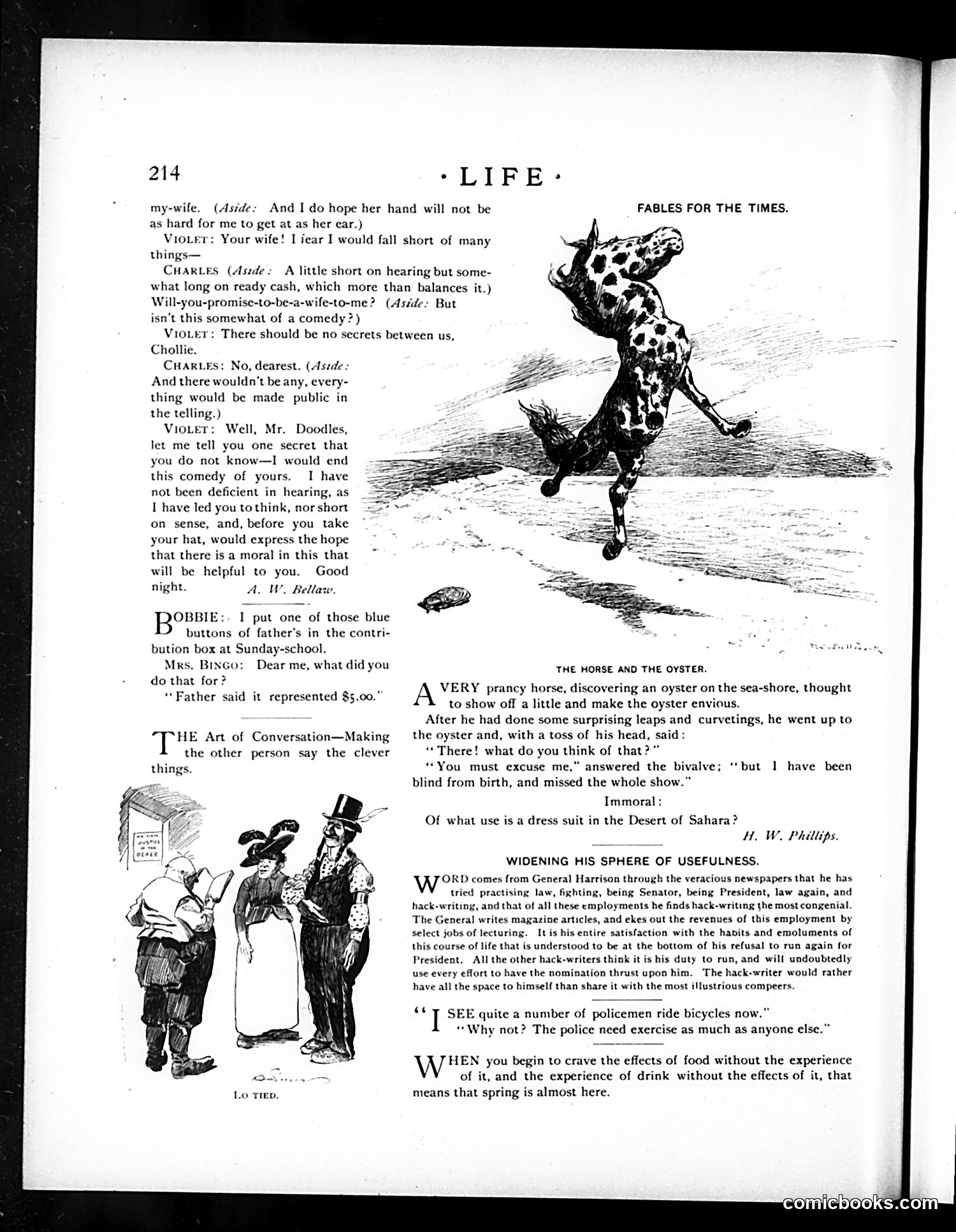
This page from *Life* magazine contains several satirical pieces: **"The Horse and the Oyster"** (fable): A prancing horse performs tricks to impress an oyster on the beach. The oyster, unmoved, admits it's been "blind from birth" and missed the whole show. The joke satirizes wasted effort—trying to impress someone incapable of appreciation. **"Widening His Sphere of Usefulness"**: A brief item about General Harrison's newspaper hack-writing abilities. It mocks his willingness to perform various writing tasks (articles, essays, lectures) for compensation, portraying him as intellectually promiscuous rather than principled. **The illustration** (captioned "Lo Tied") shows three figures in period dress—likely depicting a social or political scenario, though its specific reference is unclear without additional context. These pieces exemplify *Life's* characteristic irreverent humor targeting public figures and human folly.
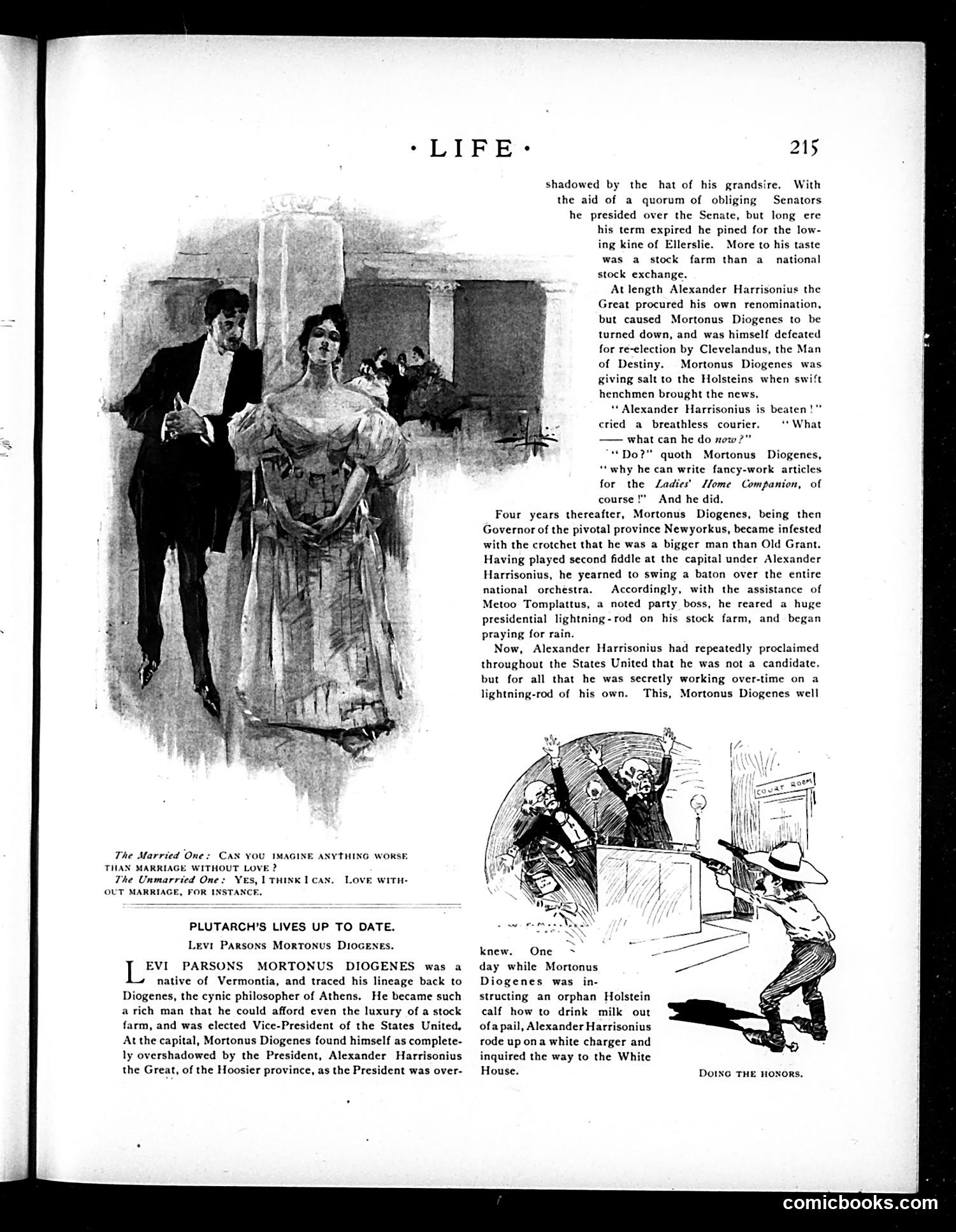
This page satirizes **Levi Parsons Mortorious Diogenes**, a fictional Vice-President character who embodies incompetence and delusion. The satire depicts him as overshadowed by President **Alexander Harrisonius** (a thinly-veiled reference to a U.S. President, likely Harrison). The humor centers on Diogenes's absurd ambitions: after failing at politics, he attempts increasingly ridiculous feats—writing for women's magazines, conducting orchestras, and constructing a "presidential lightning-rod" on his farm to summon rain. The cartoon mocks political figures who overestimate their abilities and waste time on vanity projects rather than governance. The bottom illustration shows Diogenes instructing an orphan, labeled "Doing the honors"—suggesting his incompetence extends even to simple tasks.
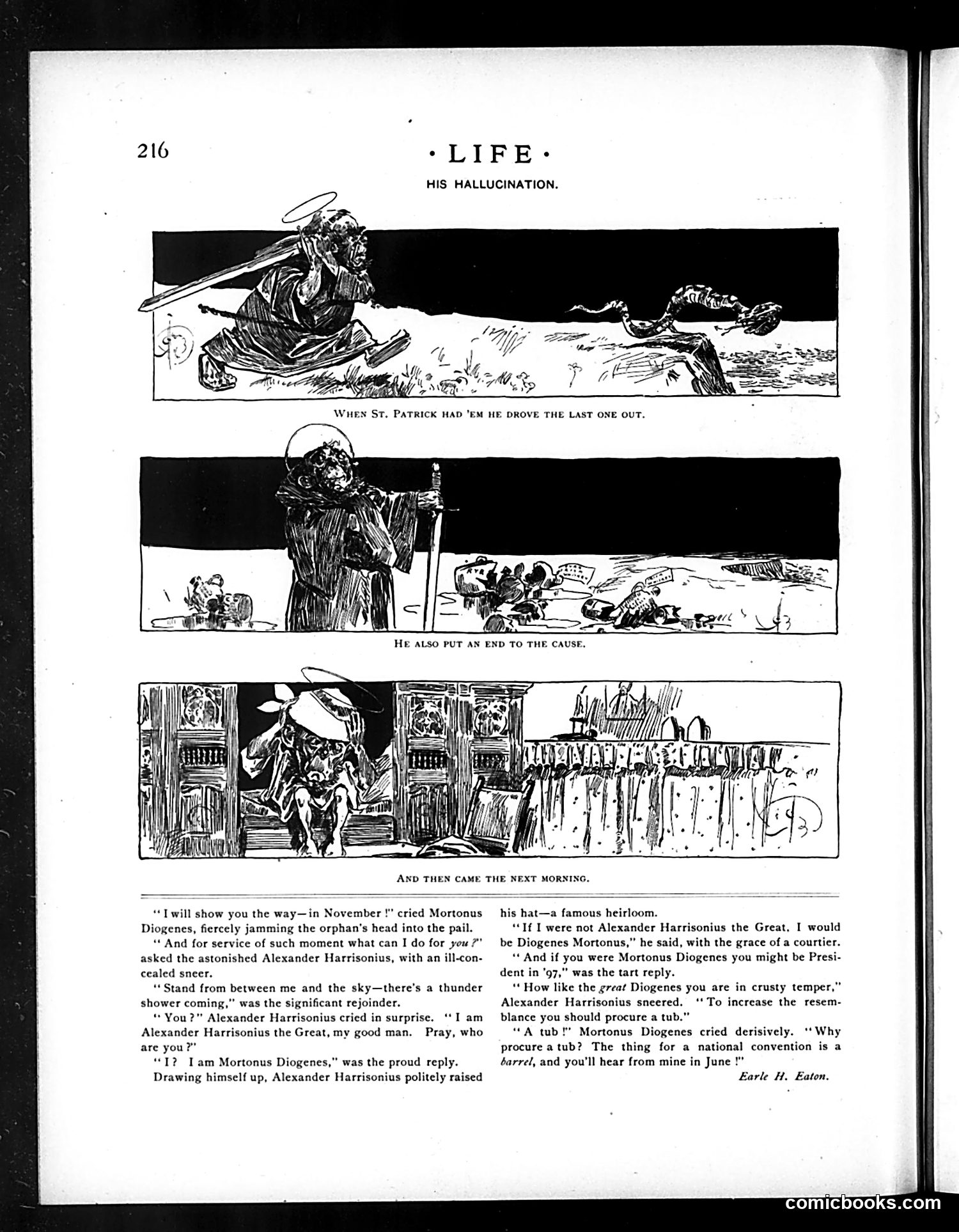
This page satirizes **Alexander Harrisonius the Great** (a fictional or thinly-veiled caricature), who appears to be a pompous historical or political figure. The three-panel cartoon depicts: 1. St. Patrick driving out snakes while Harrisonius watches 2. Harrisonius attempting similar heroics with a sword 3. Harrisonius indoors, suggesting his "hallucination" of grandeur The accompanying text shows Harrisonius boastfully comparing himself to Alexander the Great and claiming credit for defeating "Mortonus Diogenes." The humor lies in his delusion of importance and his ridiculous proposal of a "barrel" as a national convention item—likely mocking his pretensions and absurd ideas. The satire targets personal vanity and self-aggrandizement.
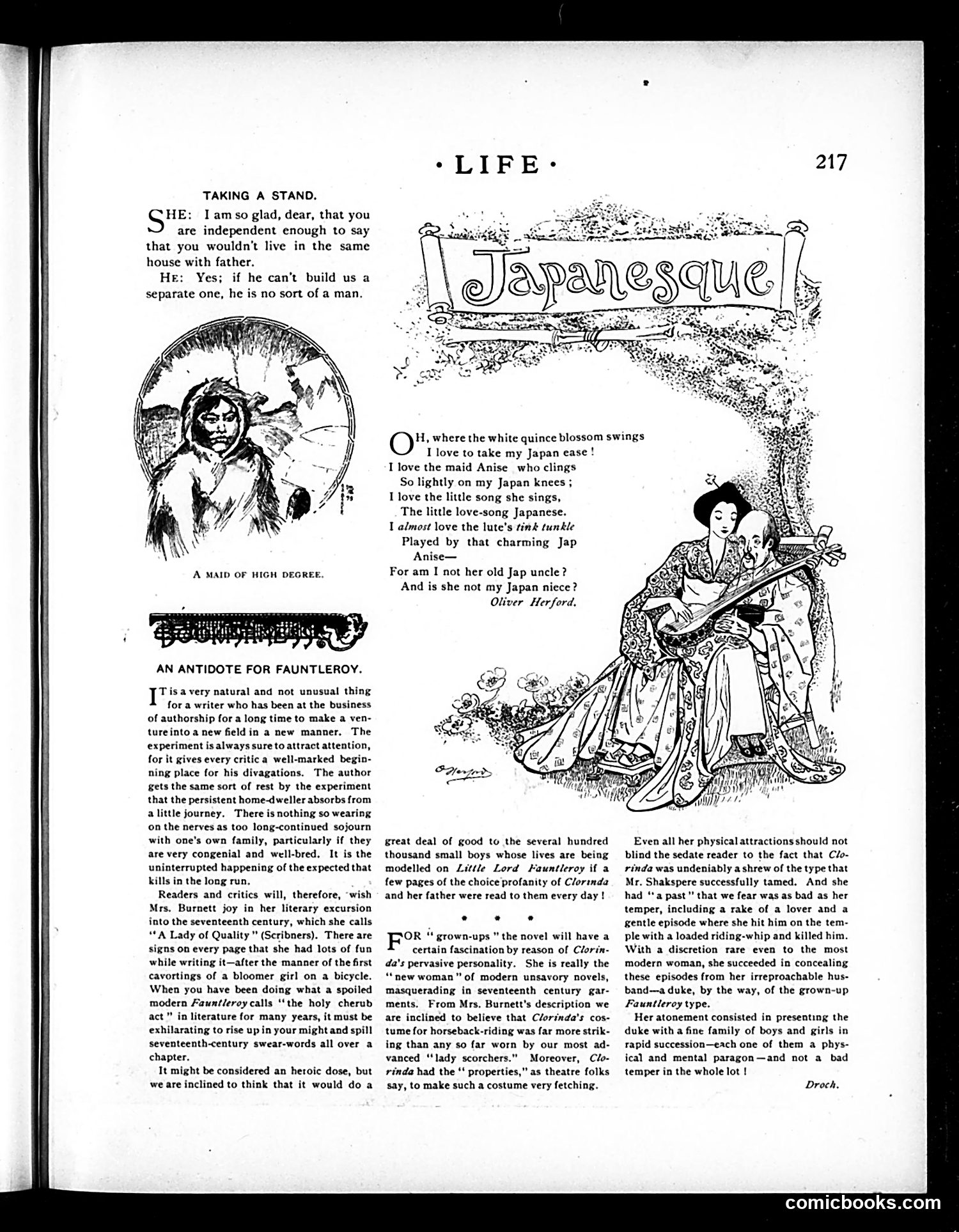
This page combines literary criticism with decorative Japanese-themed illustrations. The main content discusses how venturing into new literary fields (like writing novels) can benefit tired writers—using the example of Mrs. Burnett's shift to fiction. The illustrated section titled "Japanesque" features a poem by Oliver Herford celebrating a Japanese maid or companion ("Anise"), reflecting the late 19th-century Western fascination with Japanese aesthetics and culture. The artwork depicts a woman in Japanese dress with traditional instruments. The satirical element appears subtle here—mainly critiquing outdated literary conventions and perhaps gently mocking the era's romanticized "Japanophilia." The dialogue at top ("Taking a Stand") humorously addresses gender independence, suggesting women's autonomy was still contentious.
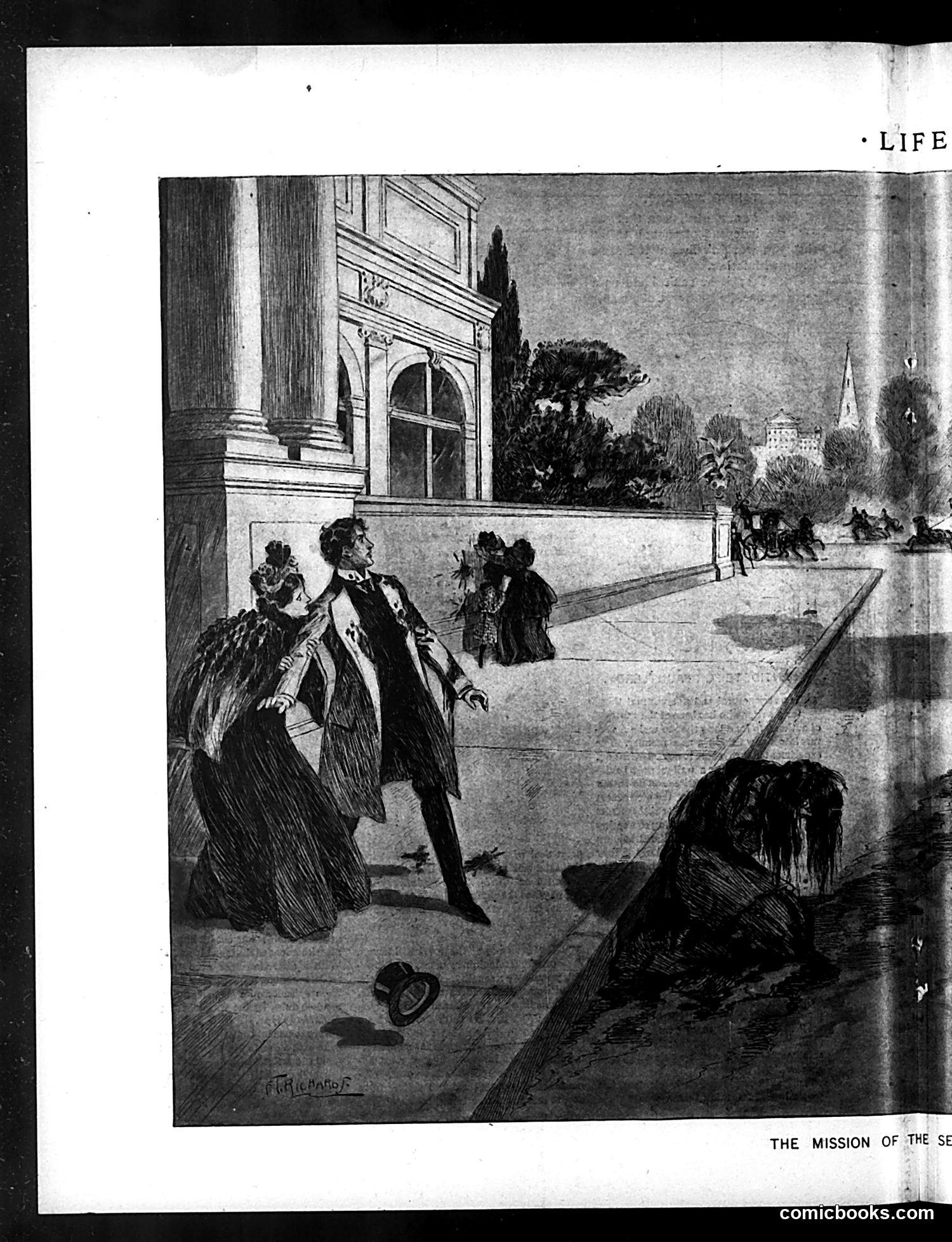
This appears to be a satirical illustration from *Life* magazine titled "The Mission of the Se[nate]" (title cut off). The cartoon depicts a well-dressed man in formal attire gesturing dismissively toward a kneeling or crouching figure in the foreground, suggesting rejection or refusal of some petition or request. The setting appears to be an ornate government building (likely meant to represent the U.S. Senate), with columns and elegant architecture. Other formally-dressed figures observe in the background near water and landscaped grounds. The cartoon likely satirizes Senate indifference or inadequate response to some contemporary political issue or constituent plea. Without the complete title and publication date visible, the specific political grievance remains unclear, though the visual hierarchy—powerful official above, supplicant below—clearly critiques governmental dismissal of public concerns.
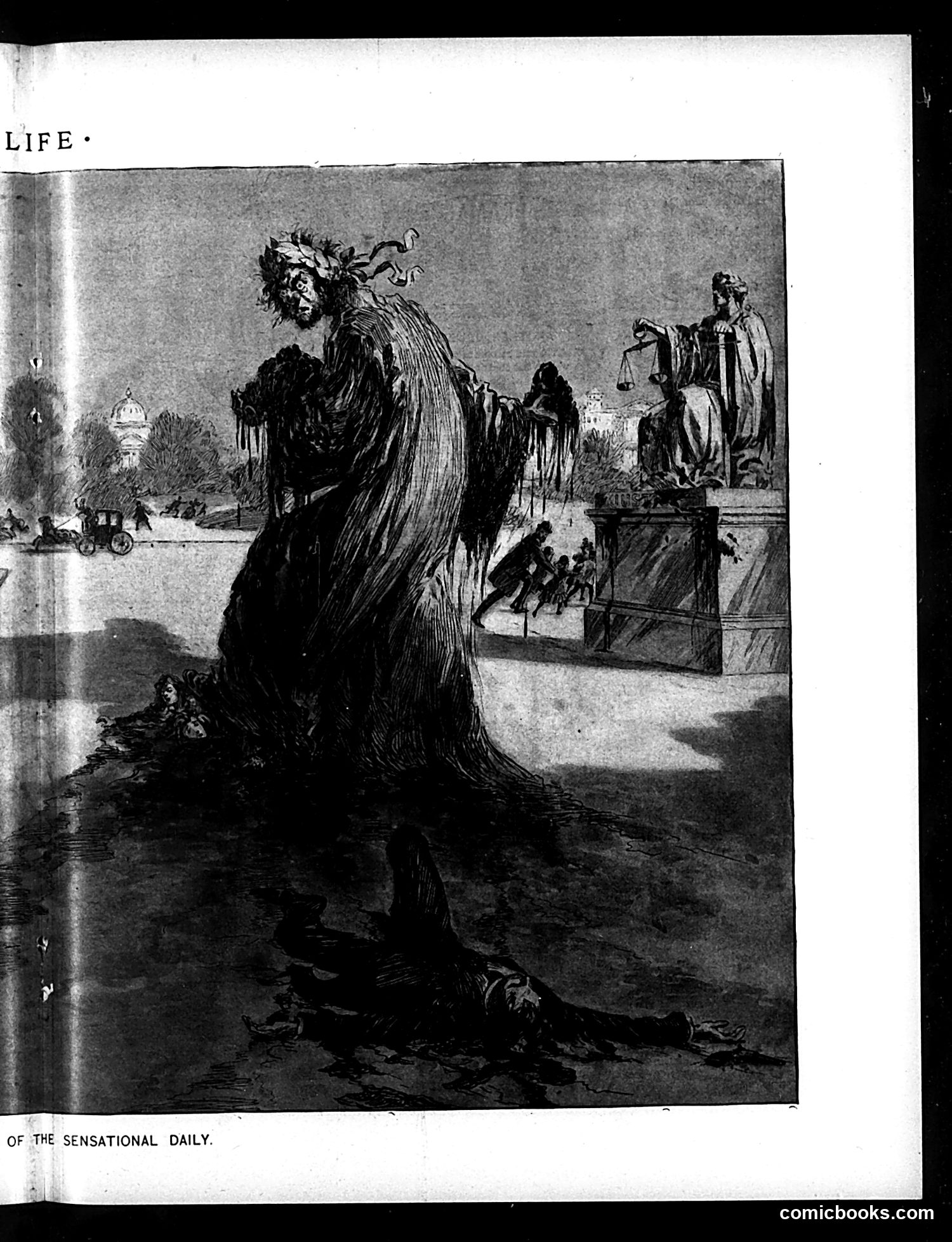
This appears to be a satirical illustration titled "Life of the Sensational Daily," depicting the personified concept of sensationalism in journalism. The central figure is a grotesque, death-like or demonic entity with a skeletal head and flowing dark robes, suggesting corruption or moral decay. The figure stands in what appears to be a public square or civic space, with a statue of Justice visible on the right. Small human figures and vehicles populate the background, implying that this force of sensationalism looms over everyday urban life. The satire critiques how sensational journalism dominates public discourse—presenting it as a malevolent, death-dealing force that corrupts society and justice itself. The image suggests that "the sensational daily" (likely referring to tabloid newspapers) represents something monstrous and destructive to civic life.
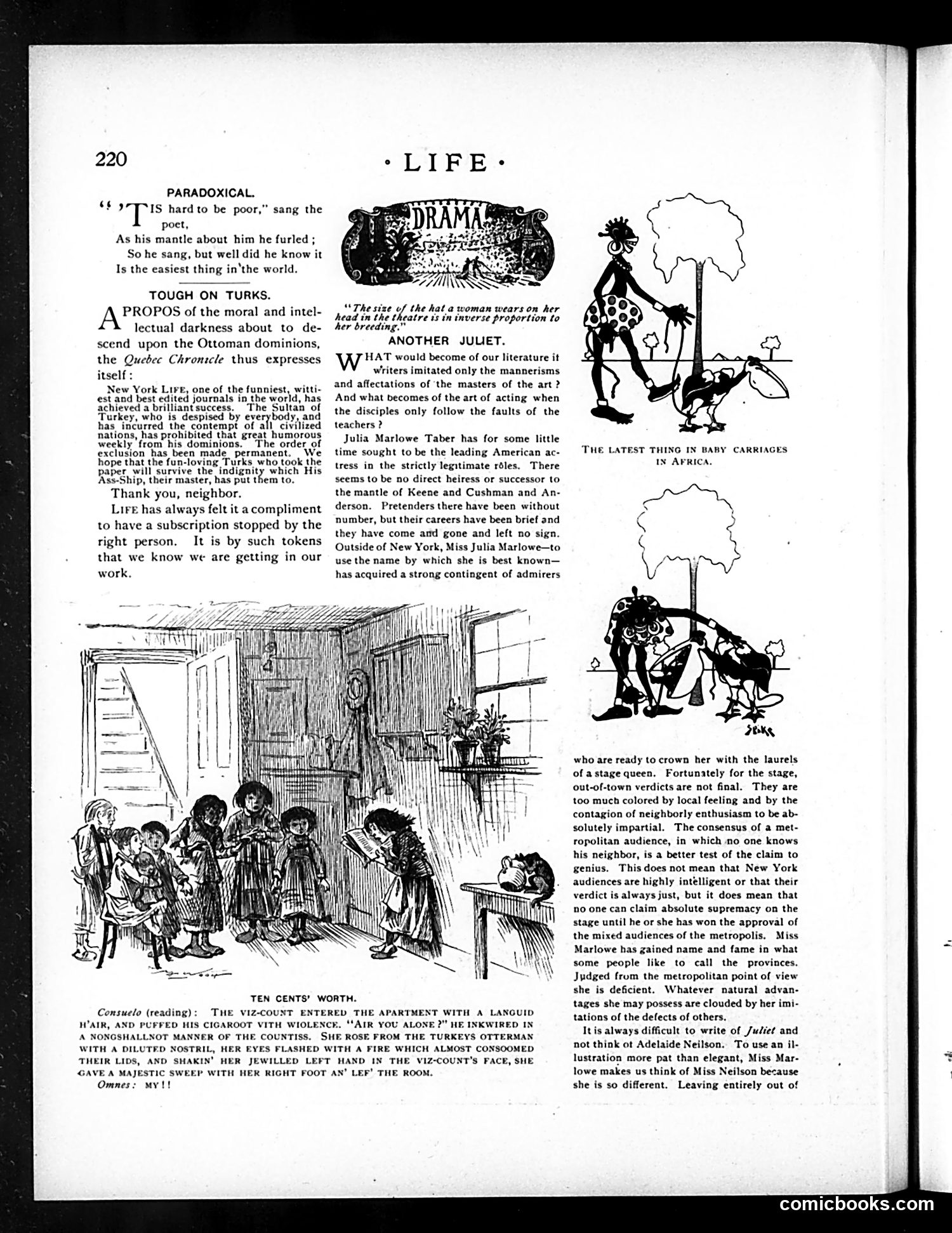
This page contains several unrelated satirical pieces typical of Life's format: **"Tough on Turks"** mocks the Ottoman Sultan for banning *Life* magazine from his dominions. The piece celebrates this as a compliment—*Life* takes pride in being censored by despots, viewing it as proof their satire hits targets of power. The derisive language ("His Ass-Ship") reflects 19th-century Western contempt for Ottoman leadership. **"Another Juliet"** critiques actress Julia Marlowe Taber for imitating the *faults* rather than the genius of great predecessors like Adelaide Neilson. The article argues that provincial (out-of-town) success doesn't validate talent—only Metropolitan New York audiences provide legitimate judgment, since they judge without local bias. **"Ten Cents' Worth"** is a brief joke about women's theater hats being inversely proportional to breeding (social refinement). **"Latest Thing in Baby Carriages in Africa"** appears to be a humorous illustration (text unclear) likely mocking colonial-era absurdities. The cartoons and snippets reflect Life's role as sophisticated urban satire targeting both politics and social pretension.
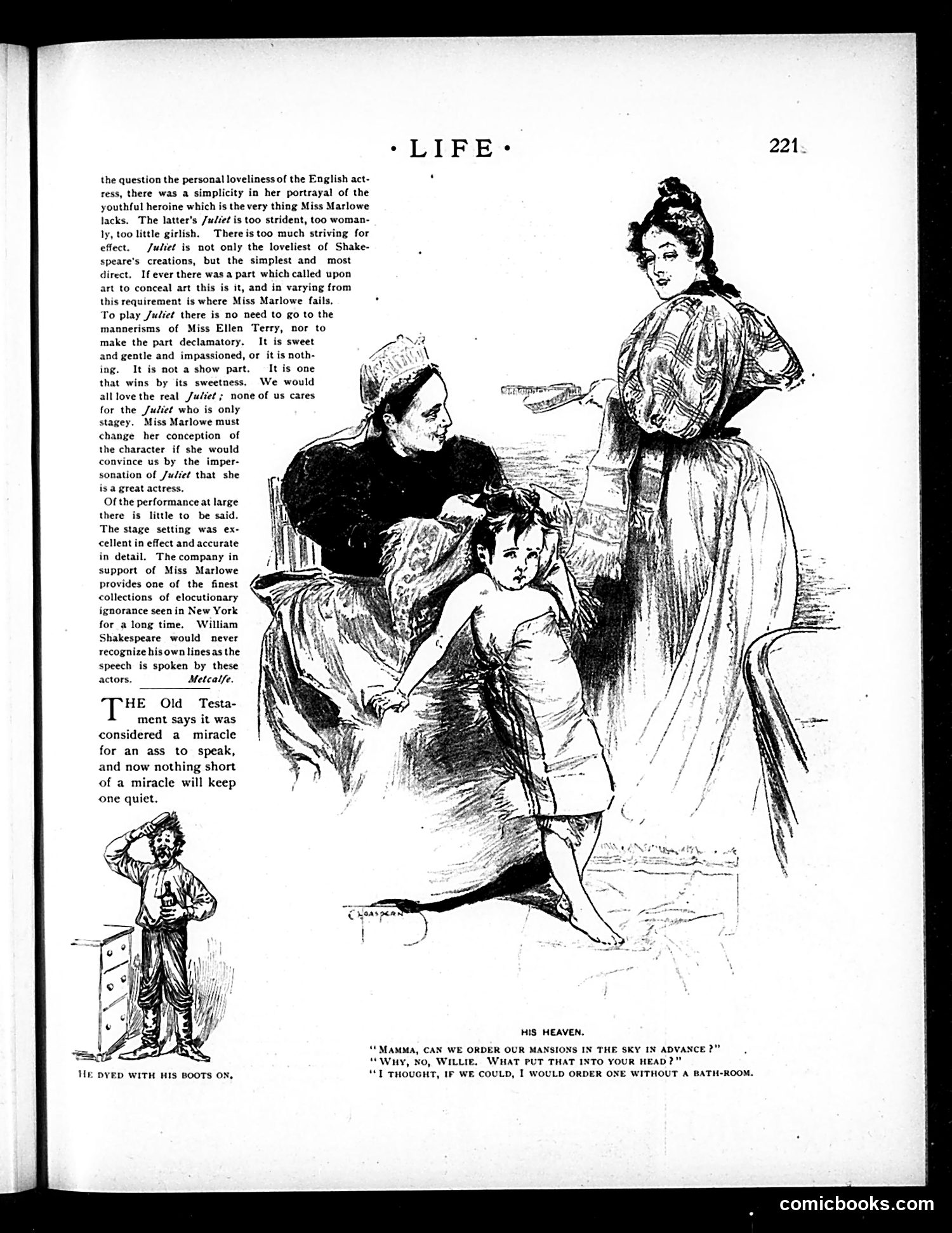
This page contains theatrical criticism and two separate cartoons. **Upper section:** A review of actress Julia Marlowe's performance as Juliet in Shakespeare's *Romeo and Juliet*. The critic (signed Metcalfe) argues Marlowe plays the role too theatrically—too strident and affected—when Juliet should be simple, sweet, and gentle. He also mocks the supporting cast's poor diction, suggesting Shakespeare wouldn't recognize his own lines. **Lower cartoons:** 1. **"He Dyed With His Boots On"**: A wordplay joke where "dyed" (colored) replaces "died," showing a man in boots standing by furniture—likely making fun of someone's fashion choices or stubbornness. 2. **"His Heaven"**: A child asks his mother if they can pre-order mansions in heaven. When she asks why, he reveals he wants one *without* a bathroom—satirizing wealthy people's excessive consumption and materialism, suggesting even in paradise a child finds bathing undesirable.
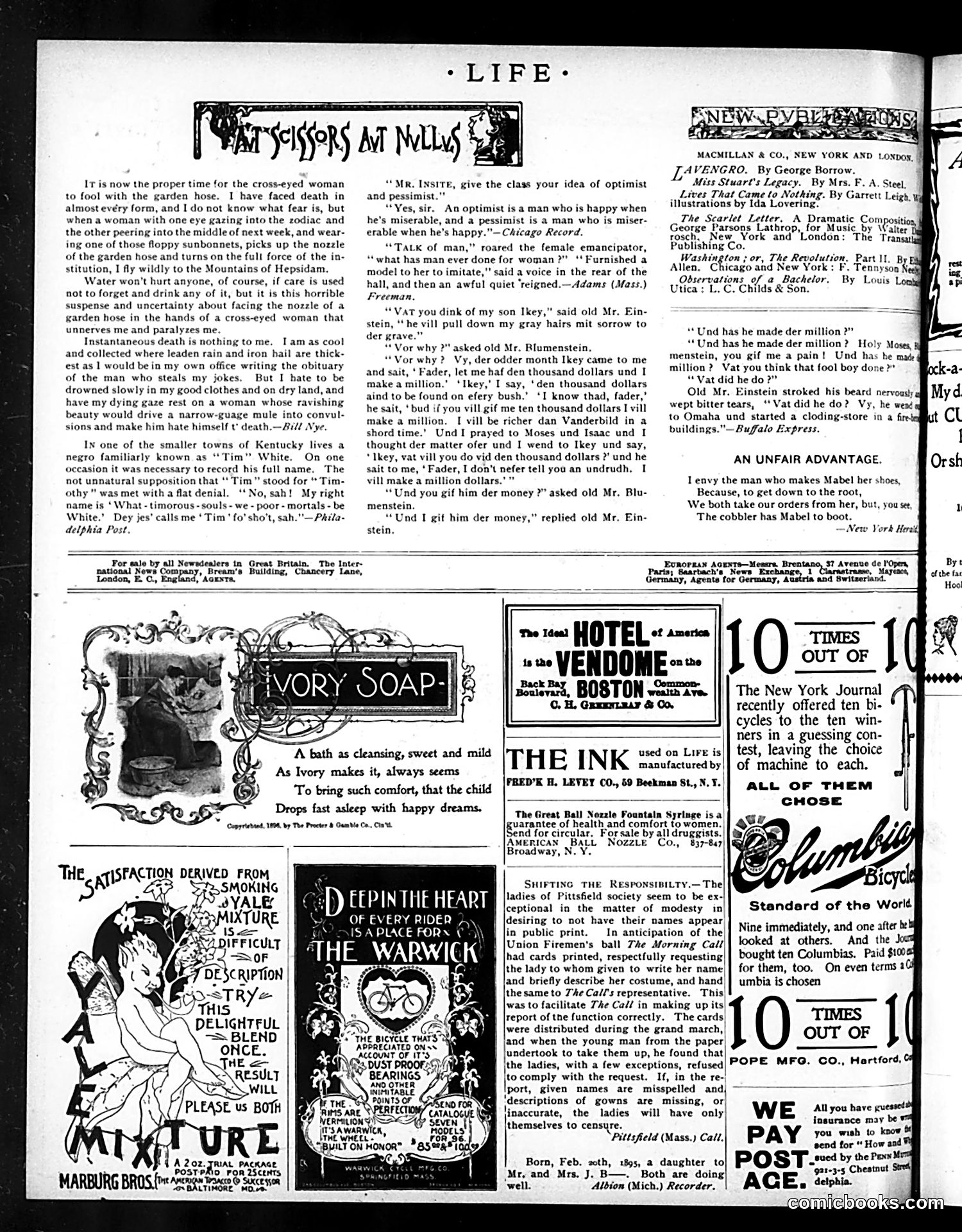
This page contains several humorous anecdotes typical of Life's satirical humor circa early 1900s: **"Cross-Eyed Woman" piece**: A comedic complaint about an incompetent cross-eyed woman operating a garden hose—satirizing both the narrator's exaggerated cowardice and, implicitly, women's unfitness for practical tasks (reflecting period gender stereotypes). **"Tim White" anecdote**: A brief dialect humor piece about a Black man named "What-timorous-souls-we-poor-mortals-be White," shortened to "Tim." This reflects the era's casual racial stereotyping through phonetic dialect humor. **"Ikey and the Million Dollars"**: A lengthy Yiddish-dialect story about a Jewish immigrant father lending his son money for a business venture that apparently fails. The humor derives from exaggerated accent and the father's befuddlement—typical of period ethnic comedy relying on stereotyped speech patterns. These represent common Life magazine humor: physical mishaps, ethnic and racial stereotypes rendered through dialect, and generational/class conflicts—all reflecting the prejudices and comedic conventions of early 20th-century American publications.
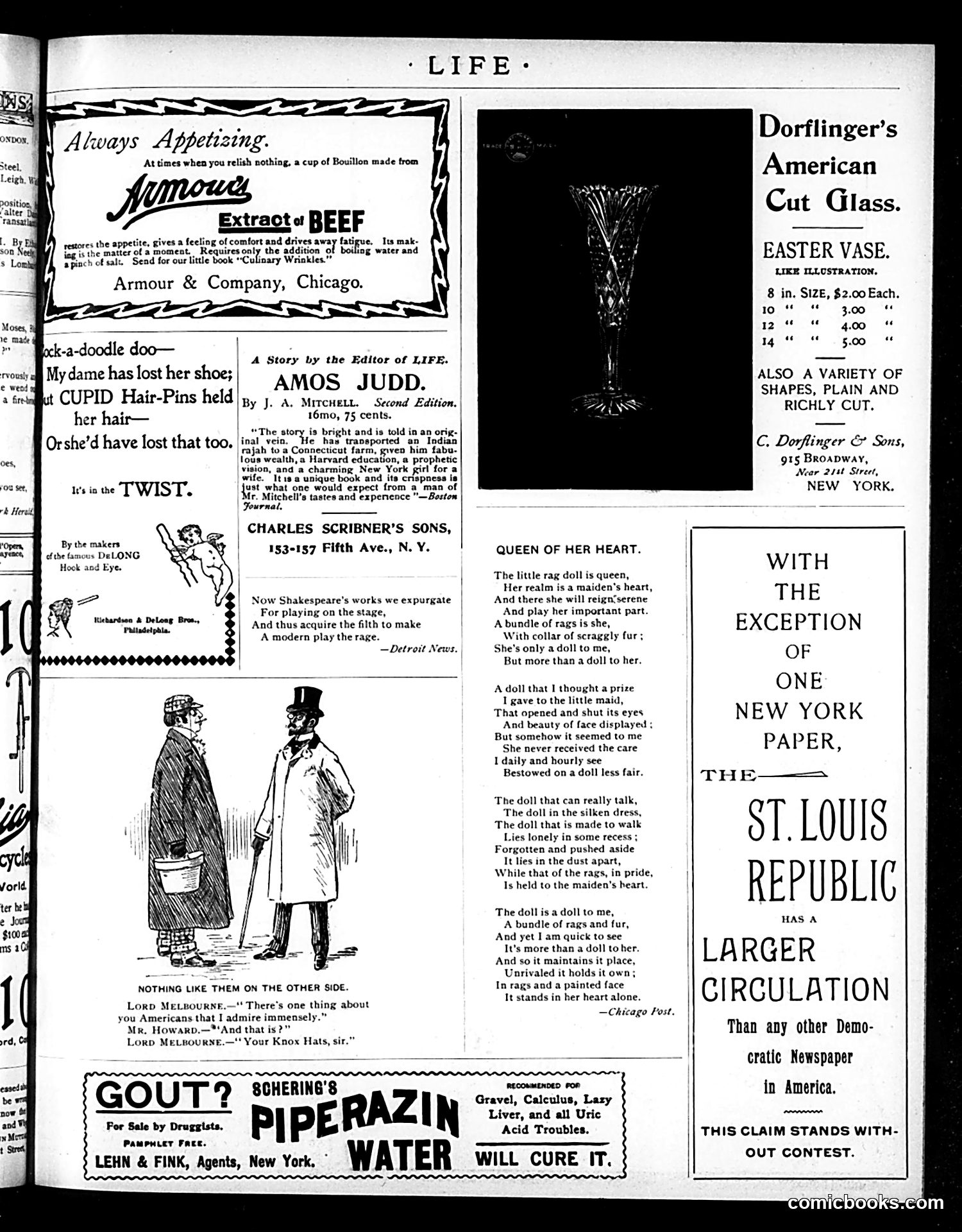
This page mixes advertising with light satirical content typical of *Life* magazine's format. **The main cartoon** ("Nothing Like Them on the Other Side") shows a dialogue between an American gentleman and a British lord about Knox Hats—a genteel advertisement disguised as humor. The joke plays on American commercial superiority: even English aristocrats admire American products, reversing the typical European condescension toward American goods. **"Queen of Her Heart"** is sentimental verse about a child preferring a simple rag doll to an expensive mechanical one—likely appealing to middle-class anxieties about materialism and childhood innocence. **Minor content** includes a story advertisement (*Amos Judd*), a brief satirical couplet mocking theatrical "expurgation" of Shakespeare, and the nursery rhyme fragment "My dame has lost her shoe." **The rest is advertising**: Armour beef extract, hair-pins, cut glass, digestive remedies (Piperazin Water for gout), and a self-promotional advertisement for the *St. Louis Republic* newspaper claiming superior circulation among Democratic papers.
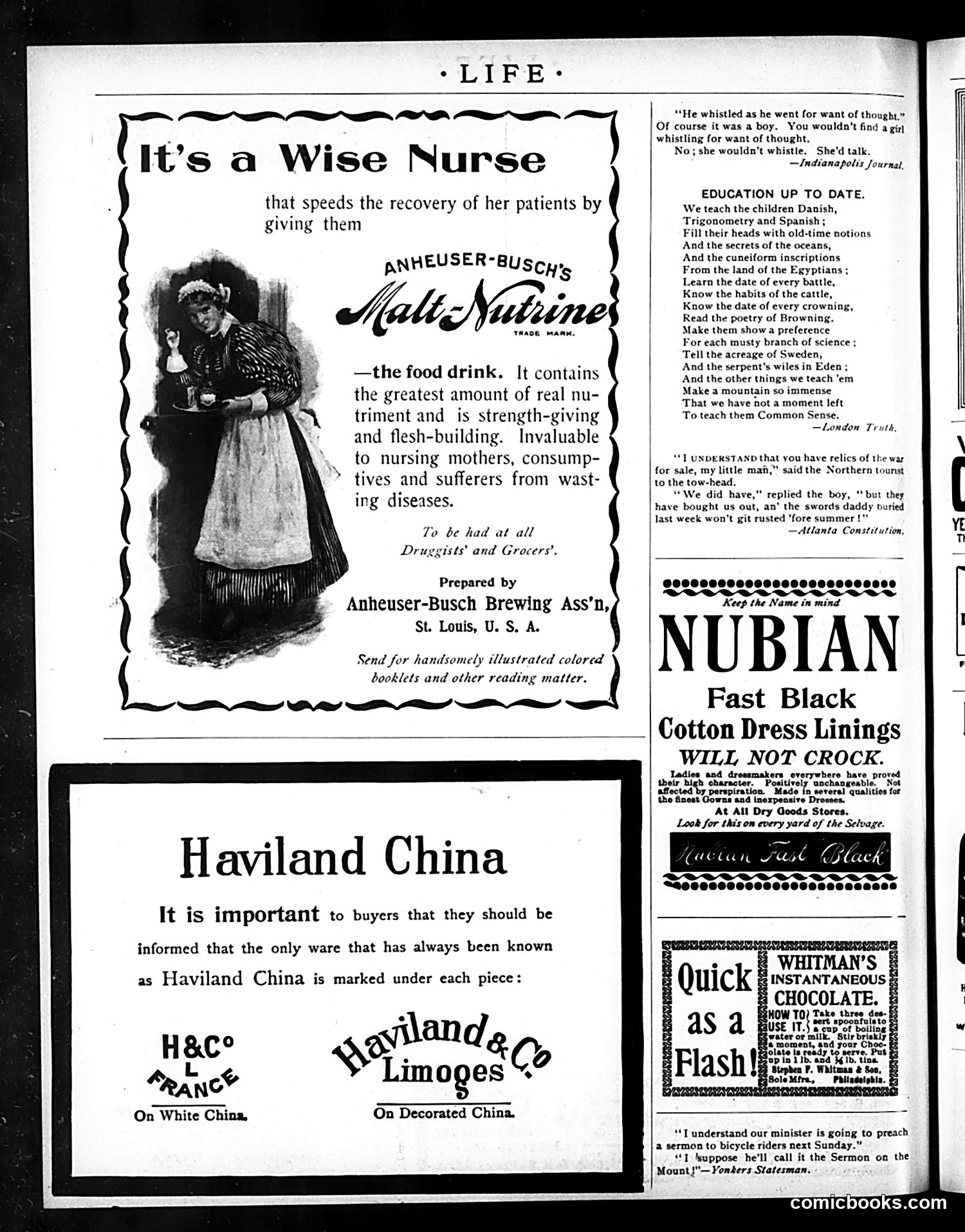
This page combines **advertisements with satirical humor pieces**, typical of Life's early format. The main advertisement promotes **Anheuser-Busch's Malt Nutrine** as a medicinal beverage for nursing mothers and the infirm—reflecting an era when breweries marketed malt drinks as nutritional tonics rather than alcohol. The humor pieces include: 1. **"He whistled as he went for want of thought"**—a joke contrasting boys' thoughtlessness with girls' tendency to talk excessively. 2. **"Education Up to Date"**—satirizes overstuffed curricula teaching obscure facts (Egyptian inscriptions, Swedish acreage) while neglecting practical "Common Sense." 3. **Civil War relic anecdote**—a Southern boy tells a Northern tourist that local families have sold off their war relics, and buried swords won't rust by summer—dark humor about the aftermath of American conflict. 4. **"Sermon on the Mount"**—a bicycle-themed pun. The page also advertises Haviland China, Nubian dress linings, and Whitman's chocolate.
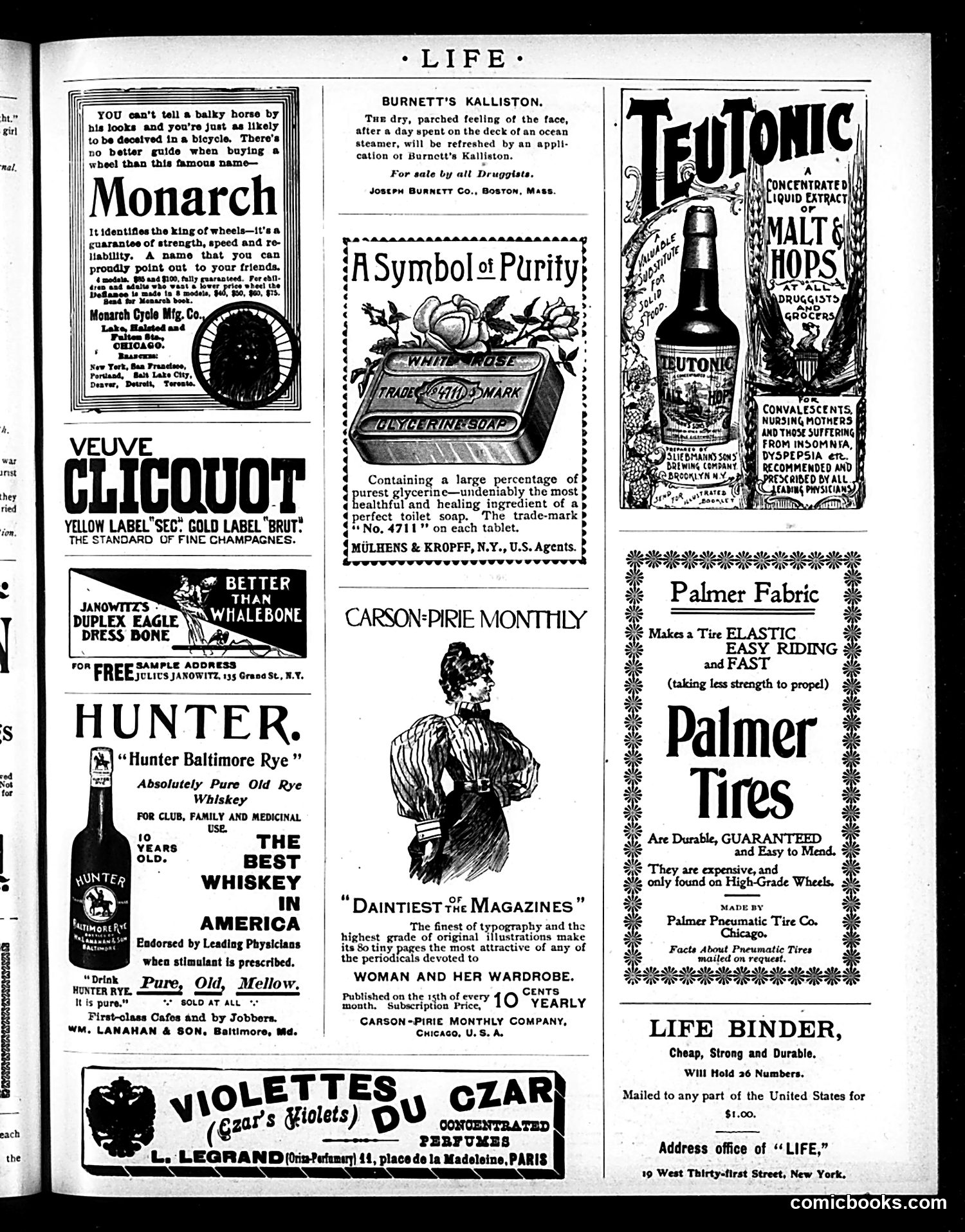
This is primarily an **advertising page** from Life magazine, not a political cartoon. It contains no satire or editorial content—just commercial advertisements typical of early 20th-century publications. The ads promote luxury and patent medicines now considered dubious: **Hunter Rye whiskey** (endorsed by physicians for "medicinal use"), **Burnett's Kalliston** (a facial treatment), **Teutonic Malt & Hops** extract (claimed to aid digestion and sleep), and **White Rose glycerine soap**. These represent the era when alcohol and unregulated tonics were marketed as health solutions. The page also advertises practical goods: **Monarch bicycles**, **Palmer pneumatic tires**, **Clicquot champagne**, and **Carson-Pirie Monthly** magazine for women's fashion. The repeated emphasis on purity, scientific endorsement, and health benefits reflects turn-of-the-century marketing conventions—before FDA regulations and advertising standards. Modern readers would recognize these as promoting products of questionable efficacy or safety.
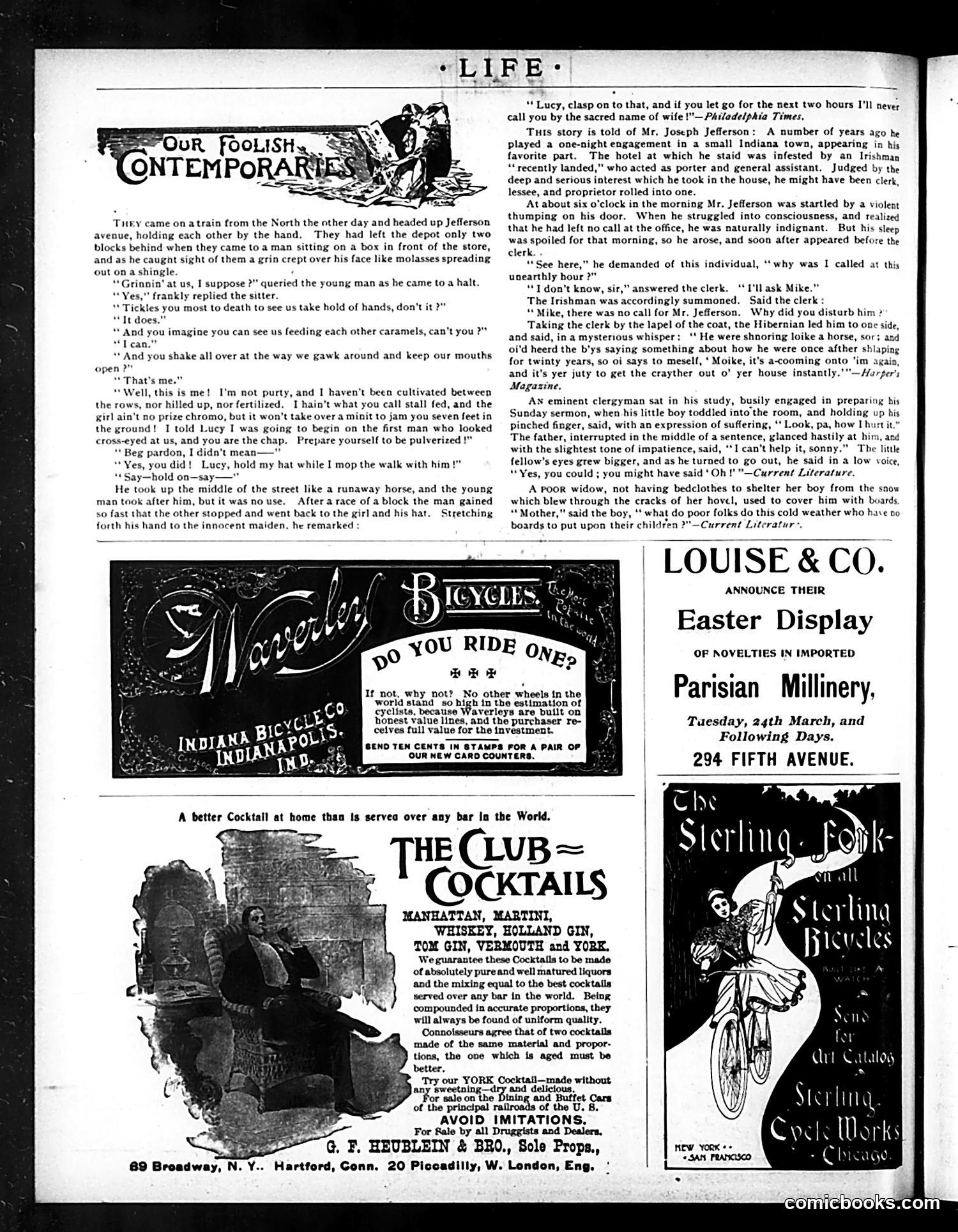
This page from *Life* magazine contains three humorous anecdotes satirizing rural/small-town American manners and social pretension: 1. **The first story** mocks small-town nosiness: A young couple holding hands is gawked at by a loafer, who receives a comedic comeuppance—threatened with violence by the protective boyfriend. 2. **The Joseph Jefferson anecdote** satirizes Irish immigrant servants' malapropisms and misguided logic. An Irishman named Mike wakes the famous actor Jefferson at dawn, fearing he's experiencing a relapse of a twenty-year sleep (likely referencing Rip Van Winkle), despite no evidence this is happening. 3. **The clergyman story** gently mocks ministerial impatience: a pastor dismisses his son's hurt finger with "I can't help it, sonny," missing the child's implicit point that the father *could* help if he chose compassion over sermon-writing. The humor relies on period stereotypes about rural Americans, Irish immigrants, and clerical absent-mindedness.
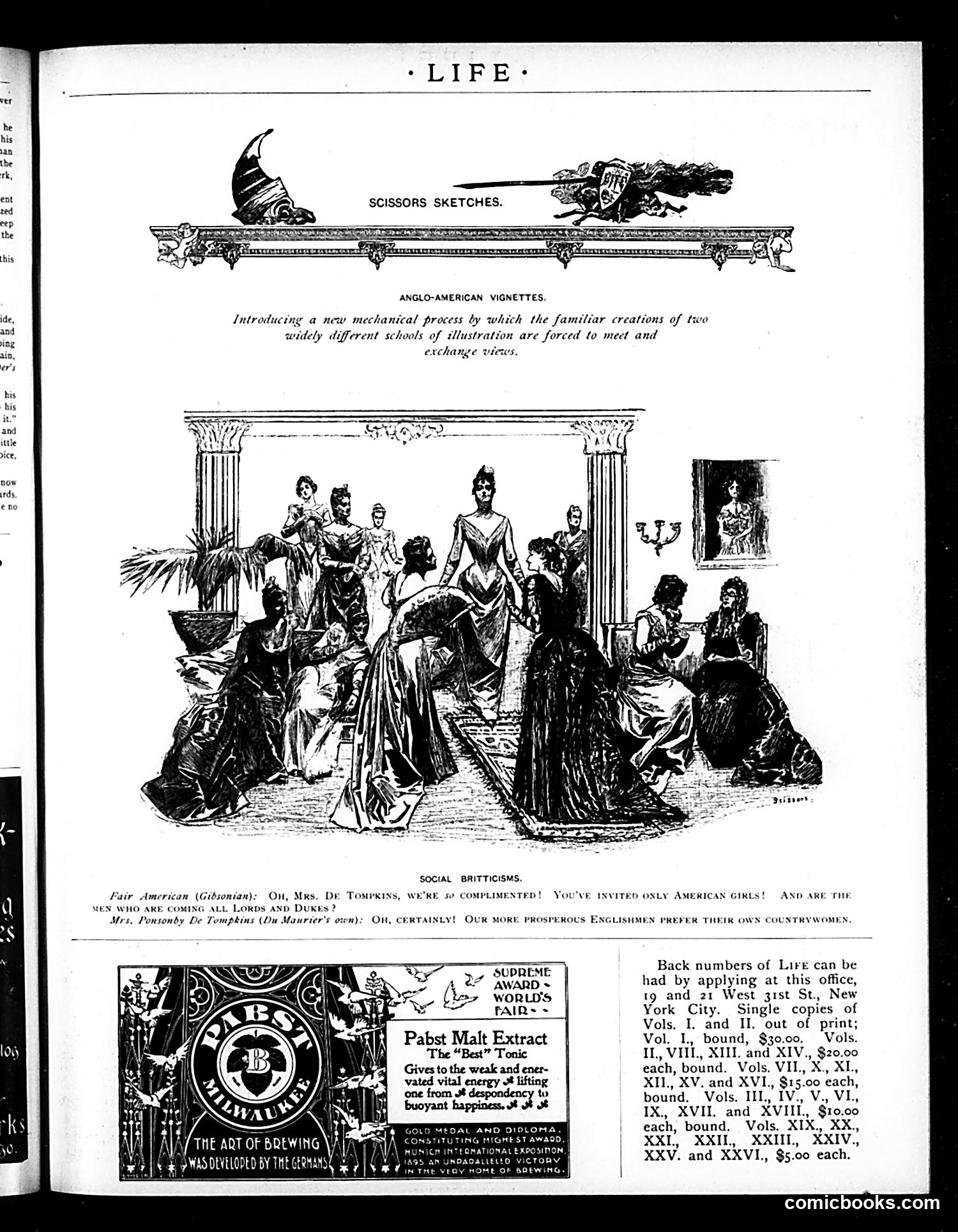
This page presents a satirical comparison between American and British illustration styles. The main cartoon depicts a social scene where an American hostess (drawn in the "Gibsonian" style—referencing Charles Dana Gibson's idealized American women) hosts British aristocrats. The joke hinges on class and national stereotypes: The American woman is shocked that a British society hostess invited only American girls to meet visiting English lords and dukes. Mrs. De Tompkins replies that wealthy Englishmen actually prefer British women for courtship. The satire mocks both cultures: it suggests American women eagerly pursue British titles, while implying British men find American women less desirable despite their wealth. The "mechanical process" subtitle indicates Life is deliberately juxtaposing two distinct artistic traditions—Gibson's American style with Du Maurier's British style—to highlight cultural differences between the two nations during an era of significant Anglo-American social interaction.
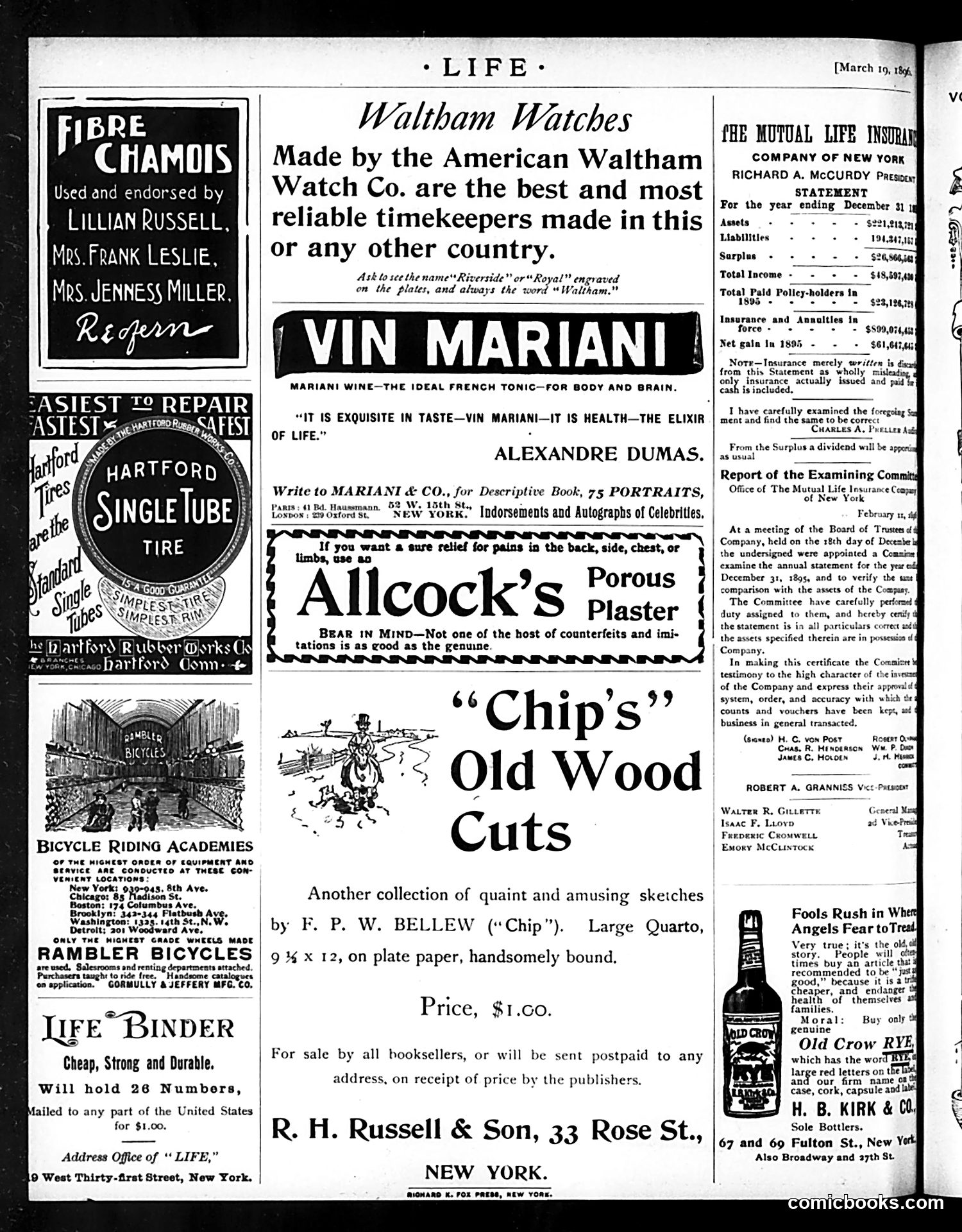
This page is **primarily advertisements** rather than editorial content or political cartoons. The advertisements reflect late-19th-century consumer products and endorsements: **Key Content:** - **Fibre Chamois** endorsed by celebrity women (Lillian Russell, etc.)—a beauty/grooming product - **Waltham Watches**—emphasizing American manufacturing reliability - **Vin Mariani**—a French wine tonic endorsed by Alexandre Dumas, marketed as a health elixir ("elixir of life") - **Allcock's Porous Plaster**—a medical pain-relief product with a warning against counterfeits - **"Chip's" Old Wood Cuts**—a book of sketches by illustrator F.P.W. Bellew - **Mutual Life Insurance financial statement** **Social Context:** These ads reveal period consumer culture—patent medicines, endorsement marketing by celebrities, and emerging American manufacturing competing with European imports. The repeated warnings about counterfeits suggest widespread product fraud was a genuine concern. No political satire is evident on this page.