
Life, 1896-03-19 · page 4 of 20
Life — March 19, 1896 — page 4: what you’re looking at
What you’re looking at
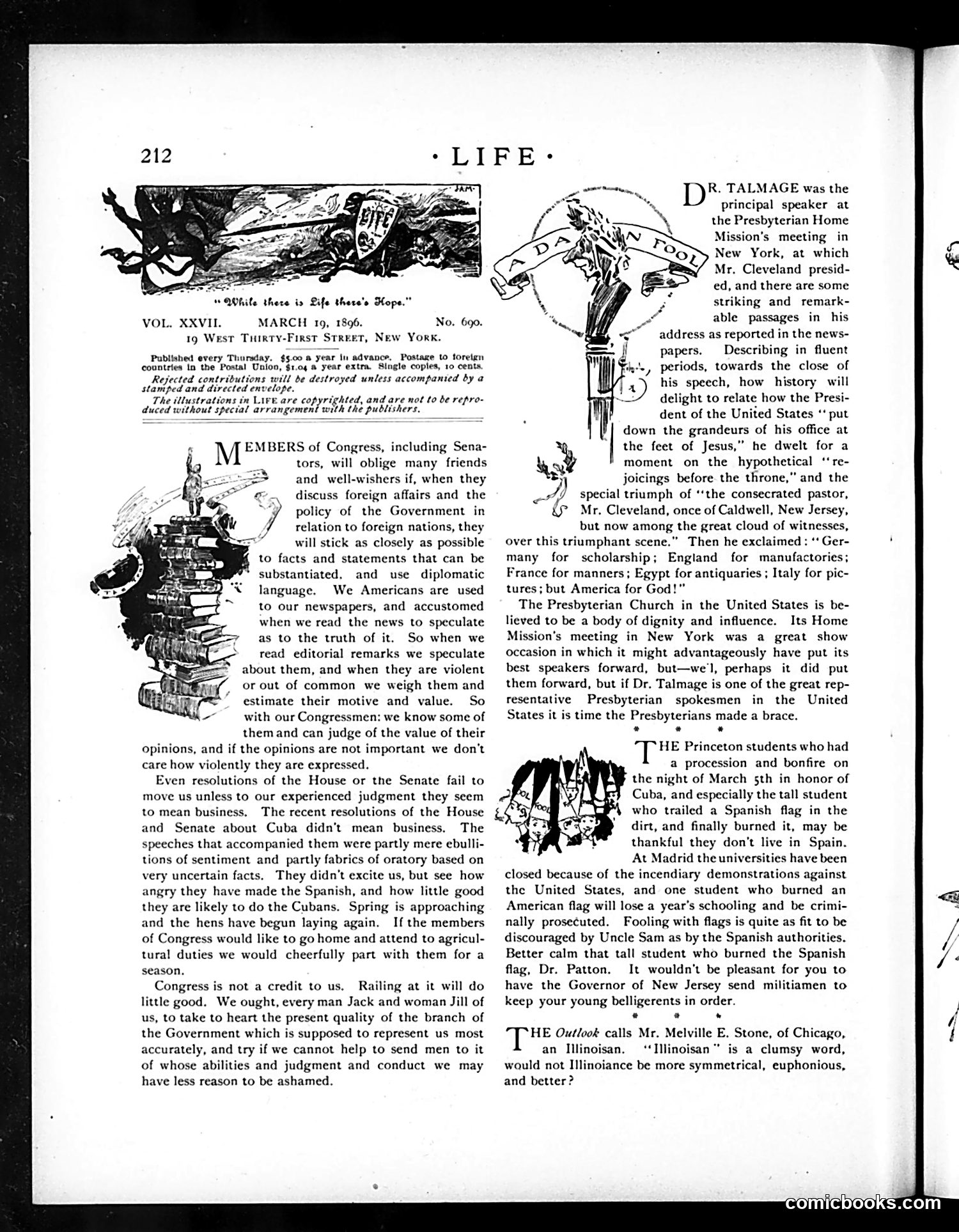
The page contains editorial commentary on Congress's foreign policy, particularly regarding Cuba and Spain. The text criticizes Members of Congress for speculating about foreign affairs based on uncertain facts, arguing they should stick to verifiable information before forming opinions. A specific complaint targets Congressional speeches about Cuba that "didn't mean business"—the resolutions accompanying them were described as "partly mere ebullitions of sentiment" based on "very uncertain facts." The page also mocks Princeton students who held a bonfire burning a Spanish flag to protest Spanish rule in Cuba, calling such flag-burning "quite as fit to be discouraged by Uncle Sam as by the Spanish authorities." Overall, the satire criticizes both reckless Congressional bluster and youthful anti-Spanish demonstrations regarding the Cuban conflict.
📄 Transcribed text from this page (OCR, searchable)
Machine-transcribed from the original scan — historical spelling and the odd misread are preserved.
Cen “While there is Life there's Hope.” VOL. XXVIL. MARCH 19, 1896. No. 690. 1g West Tuirty-First Street, New York. Published every Thursday. ¢$.00 @ year in advance, Postage to foreign countries In the Postal Union, $1.04 @ year extra. Single copies, 10 cents. Rejected contributions will be destroyed unless accompanied by a stamped and directed envelope. The illustrations in Lik are copyrighted, and are not to be repro- duced without special arrangement with the publishers. EMBERS of Congress, including Sena- tors, will oblige many friends and well-wishers if, when they discuss foreign affairs and the policy of the Government in relation to foreign nations, they will stick as closely as possible to facts and statements that can be substantiated. and use diplomatic language. We Americans are used to our newspapers, and accustomed when we read the news to speculate as to the truth of it. So when we read editorial remarks we speculate about them, and when they are violent or out of common we weigh them and estimate their motive and value. So with our Congressmen: we know some of them and can judge of the value of their opinions, and if the opinions are not important we don't care how violently they are expressed. Even resolutions of the House or the Senate fail to move us unless to our experienced judgment they seem to mean business. The recent resolutions of the House and Senate about Cuba didn’t mean business. The speeches that accompanied them were partly mere ebulli- tions of sentiment and partly fabrics of oratory based on very uncertain facts. They didn’t excite us, but see how angry they have made the Spanish, and how little good they are likely to do the Cubans. Spring is approaching and the hens have begun laying again. If the members of Congress would like to go home and attend to agricul- tural duties we would cheerfully part with them for a season, Congress is not a credit to us. Railing at it will do little good. We ought, every man Jack and woman Jill of us, to take to heart the present quality of the branch of the Government which is supposed to represent us most accurately, and try if we cannot help to send men to it of whose abilities and judgment and conduct we may have less reason to be ashamed. R. TALMAGE was the principal speaker at the Presbyterian Home Mission’s meeting in New York, at which Mr. Cleveland presid- ed, and there are some striking and remark- able passages in his address as reported in the news- papers. Describing in fluent periods, towards the close of his speech, how history will delight to relate how the Presi- dent of the United States ‘* put down the grandeurs of his office at the feet of Jesus,” he dwelt for a ya moment on the hypothetical ‘‘re- joicings before the throne,” and the ) special triumph of ‘‘the consecrated pastor, &® Mr. Cleveland, once of Caldwell, New Jersey, but now among the great cloud of witnesses, over this triumphant scene.” Then he exclaimed : ‘* Ger- many for scholarship; England for manufactories; France for manners ; Egypt for antiquaries ; Italy for pic- tures; but America for God!" The Presbyterian Church in the United States is be- lieved to be a body of dignity and influence. Its Home ion’s meeting in New York was a great show occasion in which it might advantageously have put its best speakers forward, but—we'l, perhaps it did put them forward, but if Dr. Talmage is one of the great rep- resentative Presbyterian spokesmen in the United States it is time the Presbyterians made a brace. * * * HE Princeton students who had a procession and bonfire on the night of March 5th in honor of Cuba, and especially the tall student who trailed a Spanish flag in the dirt, and finally burned it, may be thankful they don't live in Spain. At Madrid the universities have been closed because of the incendiary demonstrations against the United States, and one student who burned an American flag will lose a year’s schooling and be crimi- nally prosecuted. Fooling with flags is quite as fit to be discouraged by Uncle Sam as by the Spanish authorities. Better calm that tall student who burned the Spanish flag, Dr. Patton. It wouldn't be pleasant for you to have the Governor of New Jersey send militiamen to keep your young belligerents in order. * ° . HE Outlook calls Mr. Melville E. Stone, of Chicago, an Illinoisan. ‘‘Illinoisan” is a clumsy word, would not Illinoiance be more symmetrical, euphonious, and better?