
Life, 1896-03-19 · page 9 of 20
Life — March 19, 1896 — page 9: what you’re looking at
What you’re looking at
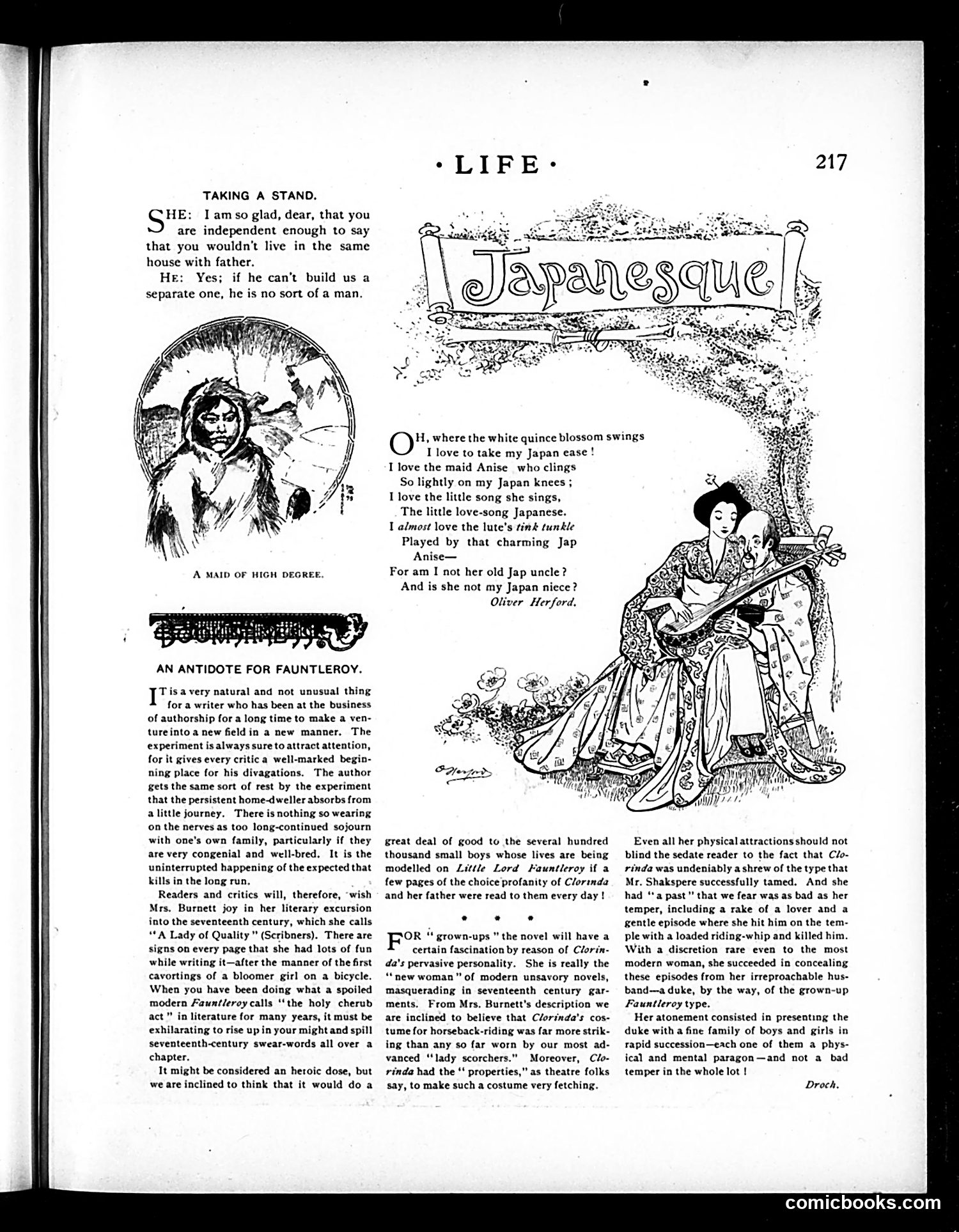
This page combines literary criticism with decorative Japanese-themed illustrations. The main content discusses how venturing into new literary fields (like writing novels) can benefit tired writers—using the example of Mrs. Burnett's shift to fiction. The illustrated section titled "Japanesque" features a poem by Oliver Herford celebrating a Japanese maid or companion ("Anise"), reflecting the late 19th-century Western fascination with Japanese aesthetics and culture. The artwork depicts a woman in Japanese dress with traditional instruments. The satirical element appears subtle here—mainly critiquing outdated literary conventions and perhaps gently mocking the era's romanticized "Japanophilia." The dialogue at top ("Taking a Stand") humorously addresses gender independence, suggesting women's autonomy was still contentious.
📄 Transcribed text from this page (OCR, searchable)
Machine-transcribed from the original scan — historical spelling and the odd misread are preserved.
TAKING A STAND. HE: I amso glad, dear, that you are independent enough to say that you wouldn’t live in the same house with father. He: Yes; if he can’t build us a separate one, he is no sort of a man. AN ANTIDOTE FOR FAUNTLEROY. J" is a very natural and not unusual thing for a writer who has been at the business of authorship for a long time to make a ven- tureinto a new field in a new manner, The experiment is always sure to attract attention, for it gives every critic a well-marked begin- ning place for his divagations. The author gets the same sort of rest by the experiment that the persistent home-dweller absorbs from alittle journey. There is nothing so wearing on the nerves as too long-continued sojourn with one’s own family, particularly if they are very congenial and well-bred, It is the uninterrupted happening of the expected that kills in the long run, Readers and critics will, therefore, “wish Mrs, Burnett joy in her literary excursion into the seventeenth century, which she calls “*A Lady of Quality" (Scribners). There are signs on every page that she had lots of fun while writing it—after the manner of the first cavortings of a bloomer girl on a bicycle. When you have been doing what a spoiled modern Fauntleroy calls ‘‘the holy cherub act” in literature for many years, it must be exhilarating to rise up in your might and spill seventeenth-century swear-words all over a chapter. It might be considered an heroic dose, but we are inclined to think that it would do a Bare H, where the white quince blossom swings I love to take my Japan ease ! I love the maid Anise who clings So lightly on my Japan knees ; I love the little song she sings, The little love-song Japanese. I almost love the lute's tink tunkle Played by that charming Jap Anise— For am I not her old Jap uncle? And is she not my Japan niece? Oliver Herford. great deal of good to the several hundred thousand small boys whose lives are being modelled on Little Lord Fauntleroy if a few pages of the choice profanity of Clorinda and her father were read to them every day ! ° . ° ‘OR “ grown-ups " the novel will have a certain fascination by reason of Clorin- da's pervasive personality. She is really the “new woman” of modern unsavory novels, masquerading in seventeenth century gar- ments. From Mrs. Burnett's description we are inclined to believe that Clorinda’s cos- tume for horseback-riding was far more strik- ing than any so far worn by our most ad- vanced “lady scorchers.” Moreover, Clo- rinda had the ‘ properties,” as theatre folks say, to make such a costume very fetching. Even all her physical attractions should not blind the sedate reader to the fact that C/o- rinda was undeniably a shrew of the type that Mr, Shakspere successfully tamed. And she had ‘a past" that we fear was as bad as her temper, including a rake of a lover and a gentle episode where she hit him on the tem- ple with a loaded riding-whip and killed him. With a discretion rare even to the most modern woman, she succeeded in concealing these episodes from her irreproachable hus- band—aduke, by the way, of the grown-up Fauntleroy type. Her atonement consisted in presenting the duke with a fine family of boys and girls in rapid succession—each one of them a phys- ical and mental paragon—and not a bad temper in the whole lot | Droch, comicbooks.com