
A complete issue · 20 pages · 1896
Life — March 12, 1896
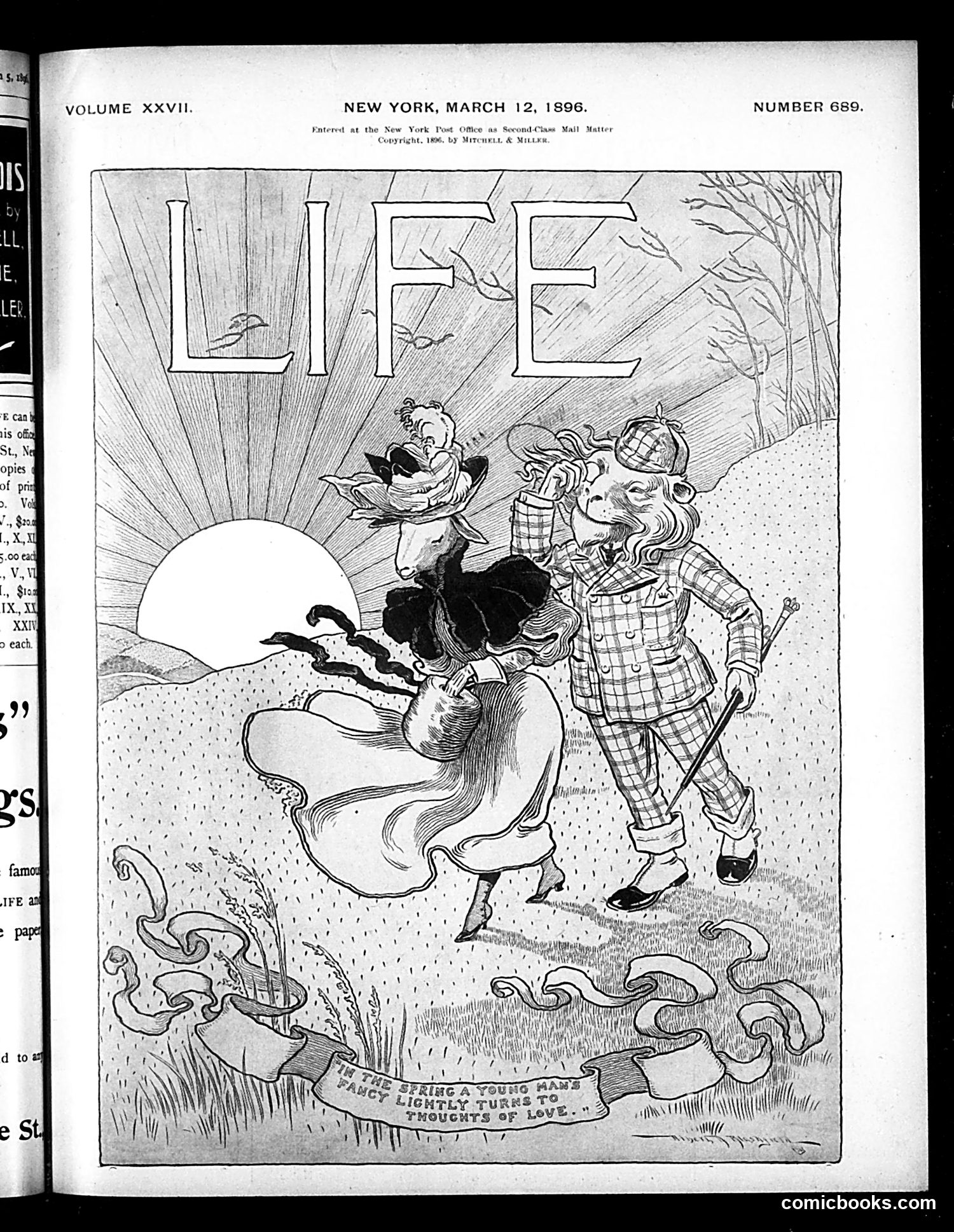
This cover illustration depicts "Life" personified as a woman with flowing hair, dancing or leaping joyfully at sunrise. She's accompanied by two figures in plaid clothing who appear to be celebrating alongside her. The banner caption reads: "THE SPRING A YOUNG FANCY LIGHTLY TURNS TO THOUGHTS OF LOVE." This is a straightforward seasonal satire referencing the classical literary trope (notably from Chaucer and later Tennyson) that springtime awakens romantic feelings. The illustration satirizes this conventional wisdom through the spirited, somewhat exaggerated portrayal of spring's arrival inspiring amorous thoughts. The plaid-clad companions and Life's animated pose emphasize the theme humorously—suggesting spring's universal effect on human behavior and sentiment, regardless of social station.
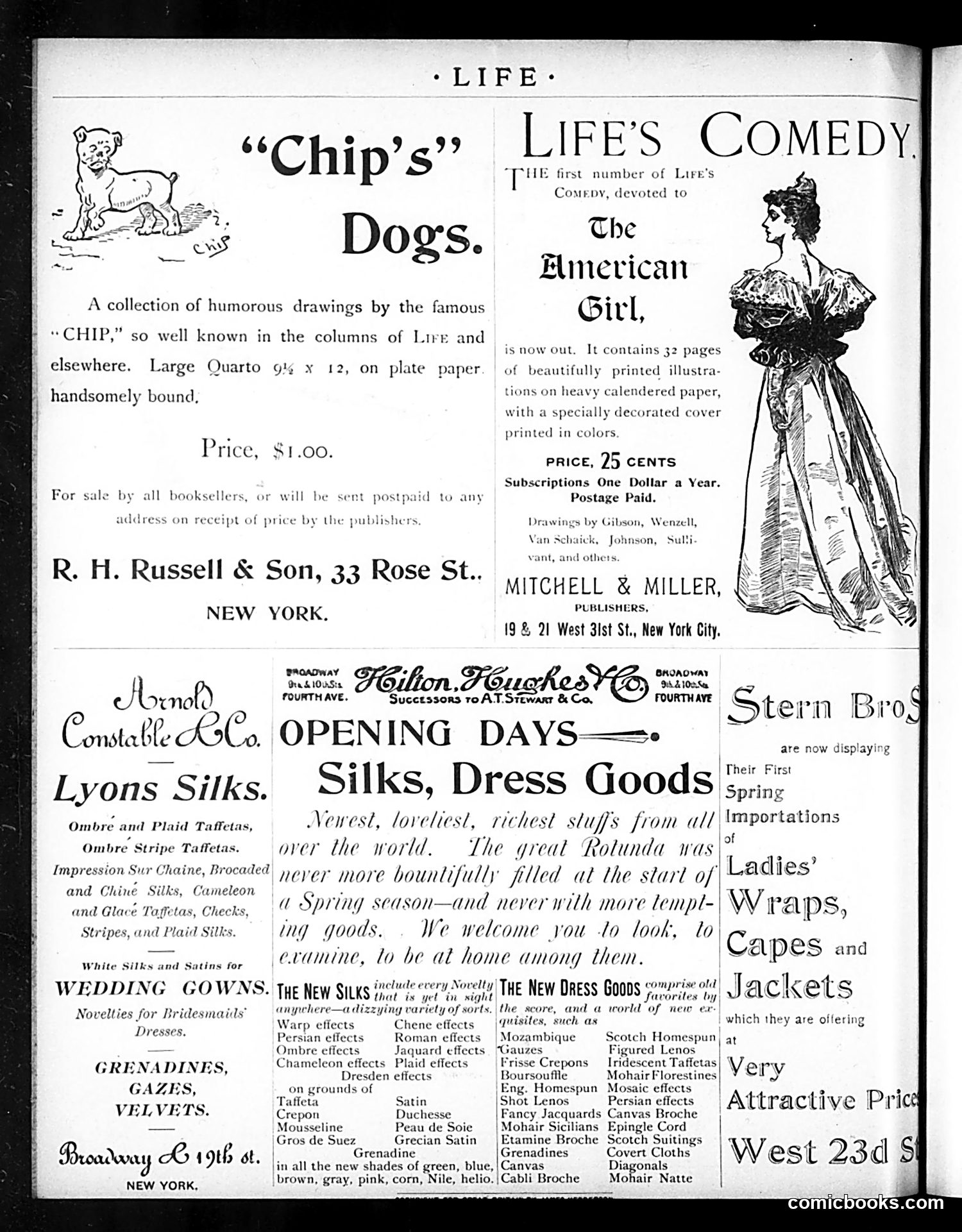
This page is primarily **advertising**, not political content. The left side advertises "Chip's Dogs"—a collection of humorous dog drawings by an artist known as "Chip" who contributed to Life magazine. The right side promotes Life's Comedy section featuring "The American Girl" (25 cents), alongside ads for silk goods, dress materials, and ladies' fashion items from retailers like Stern Bros. The small illustration of a puppy and the elegant drawing of a fashionable woman in period dress are commercial art, not satire. This appears to be from Life's early period when it functioned as both a humor magazine and a venue for advertisements targeting affluent, urban readers interested in fashion and entertainment.
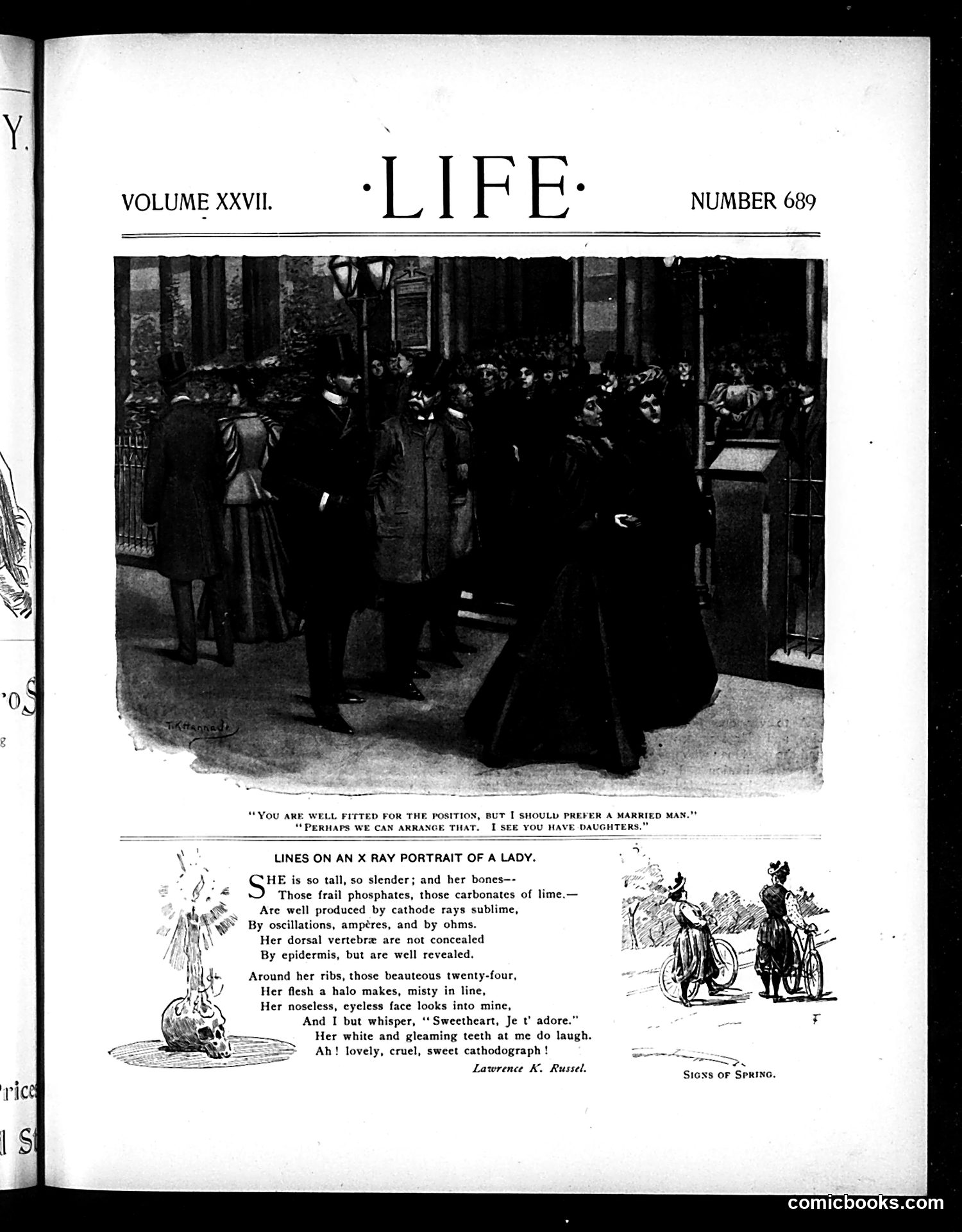
**Main Image:** A street scene showing a large crowd, apparently depicting a public gathering or protest. **Caption Exchange:** Two figures discuss hiring, with one stating "You are well fitted for the position, but I should prefer a married man" and the response "Perhaps we can arrange that. I see you have daughters." This satirizes **employment discrimination based on marital status**, a common practice in early 20th-century hiring. The joke's implication—that an unmarried man might pursue the employer's daughters—suggests anxieties about single men's behavior and moral character that influenced hiring decisions. **Lower Section:** "Lines on an X-Ray Portrait of a Lady" is a humorous poem by Lawrence K. Russel describing a woman's skeletal anatomy in romantic, flattering language despite the x-ray's clinical appearance. The accompanying illustration shows bicycle riders, captioned "Signs of Spring." The poem plays on the contrast between x-ray's unflattering reality and poetic idealization of female beauty.
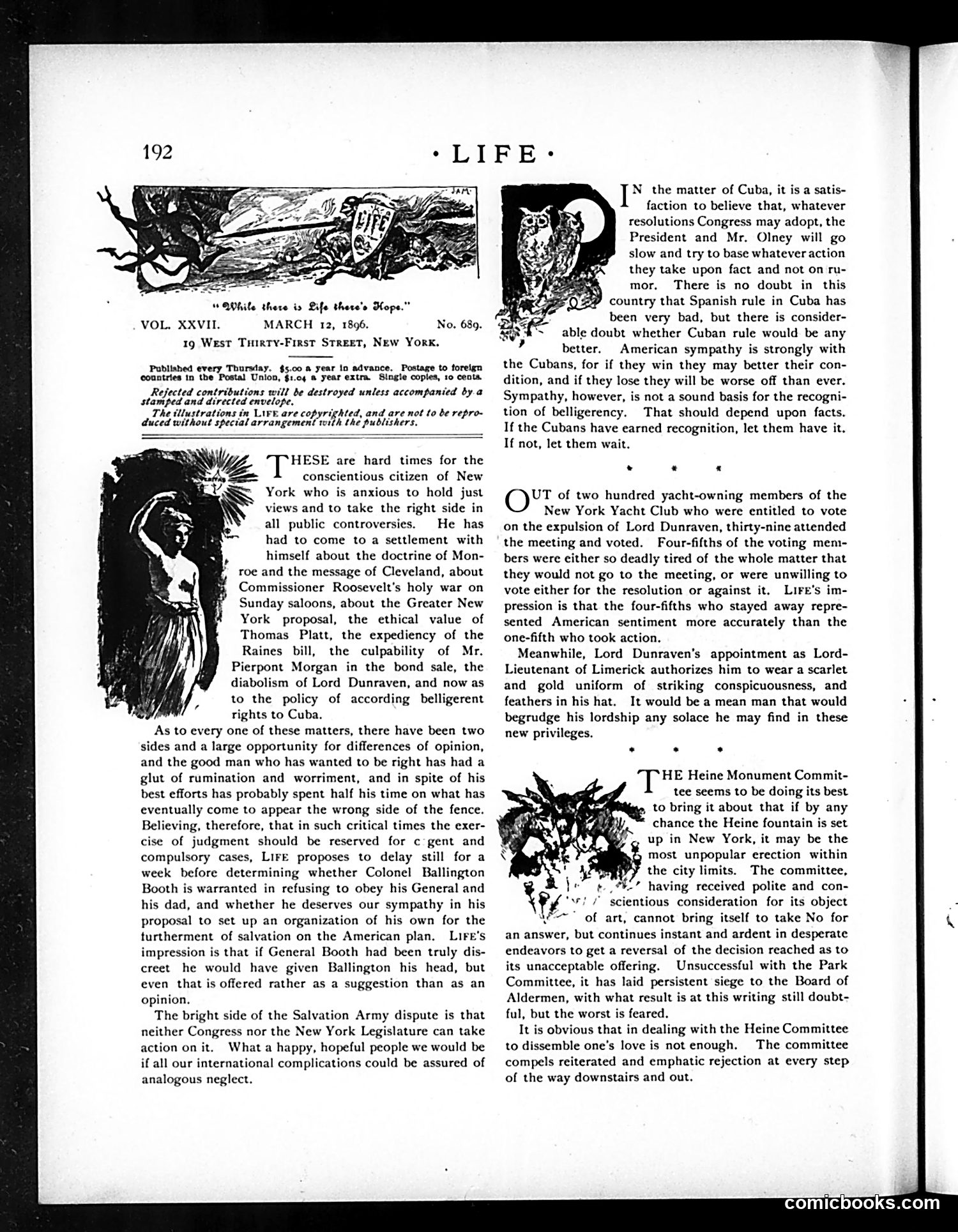
The page contains editorial commentary on several contemporary issues rather than traditional political cartoons. **Main topics discussed:** 1. **Cuba policy**: Criticism of American response to Cuban affairs, suggesting the U.S. should base decisions on facts rather than sentiment. 2. **New York Yacht Club expulsion**: Commentary on Lord Dunraven's expulsion, with the author noting that only three-fifths of voting members bothered attending—suggesting public apathy toward elite controversies. 3. **Heine Monument Committee**: Satirical coverage of the committee's struggle to install a Heine fountain in New York City. The text mocks their "reiterated and emphatic rejection at every step" by downtown interests, implying cultural philistinism and bureaucratic obstruction blocked the project. The decorative illustrations are generic period artwork rather than specific political caricatures.
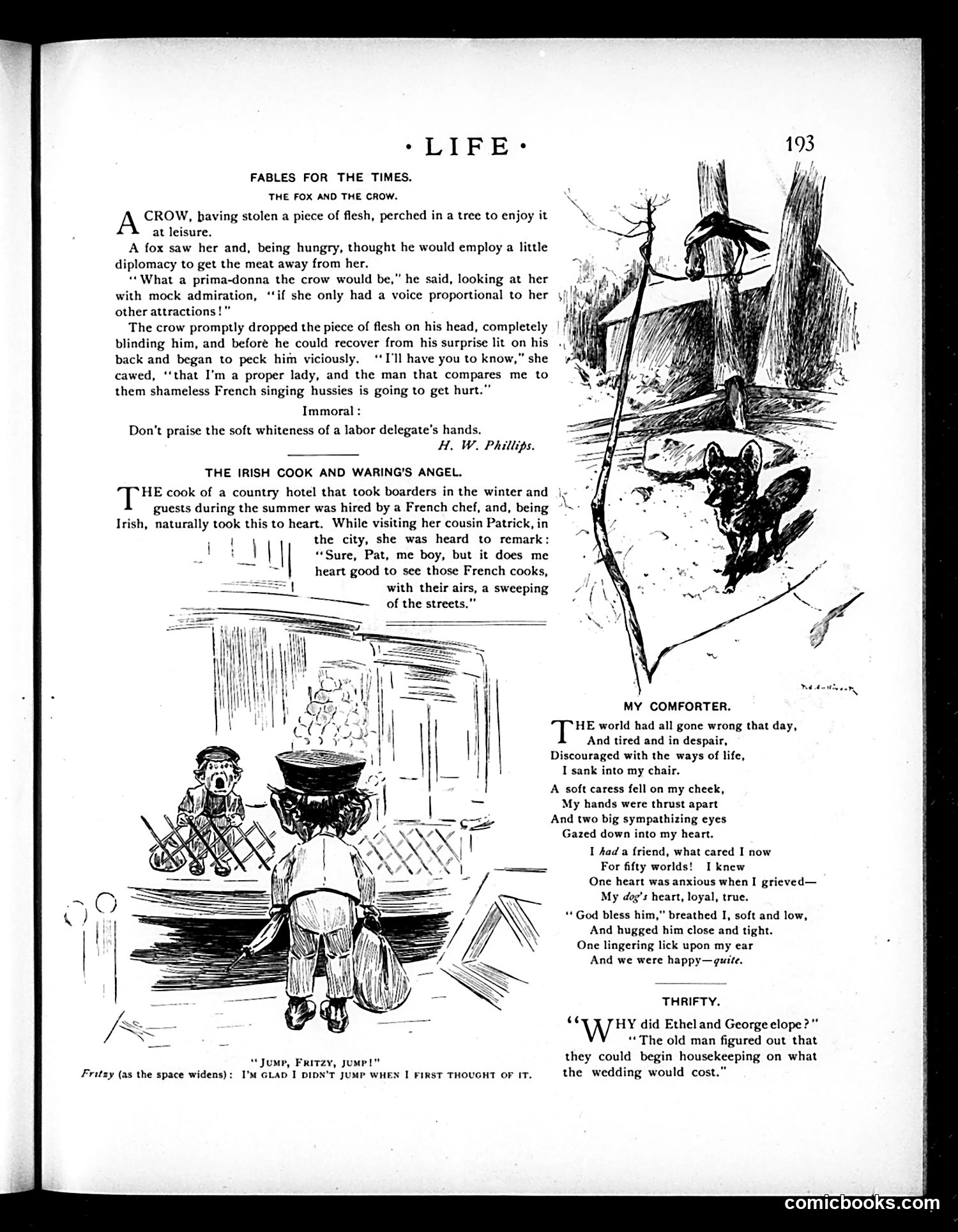
This page contains three separate satirical pieces: 1. **"The Fox and the Crow"** — A fable mocking flattery and vanity, with the crow dropping meat on the fox's head after being complimented about her voice. 2. **"The Irish Cook and Waring's Angel"** — Social satire about an Irish cook employed by a French chef who admires French culture over Irish workers. 3. **"My Comforter"** — A sentimental poem about finding solace in a loyal dog during hardship. 4. **"Thrifty"** — A brief joke about Ethel and George eloping to avoid wedding costs. The cartoons use visual humor and exaggerated characters (particularly the Irish cook illustration) typical of early-20th-century Life magazine's satirical approach to class, nationality, and domestic life. The content reflects period attitudes toward Irish immigrants and working-class domesticity.
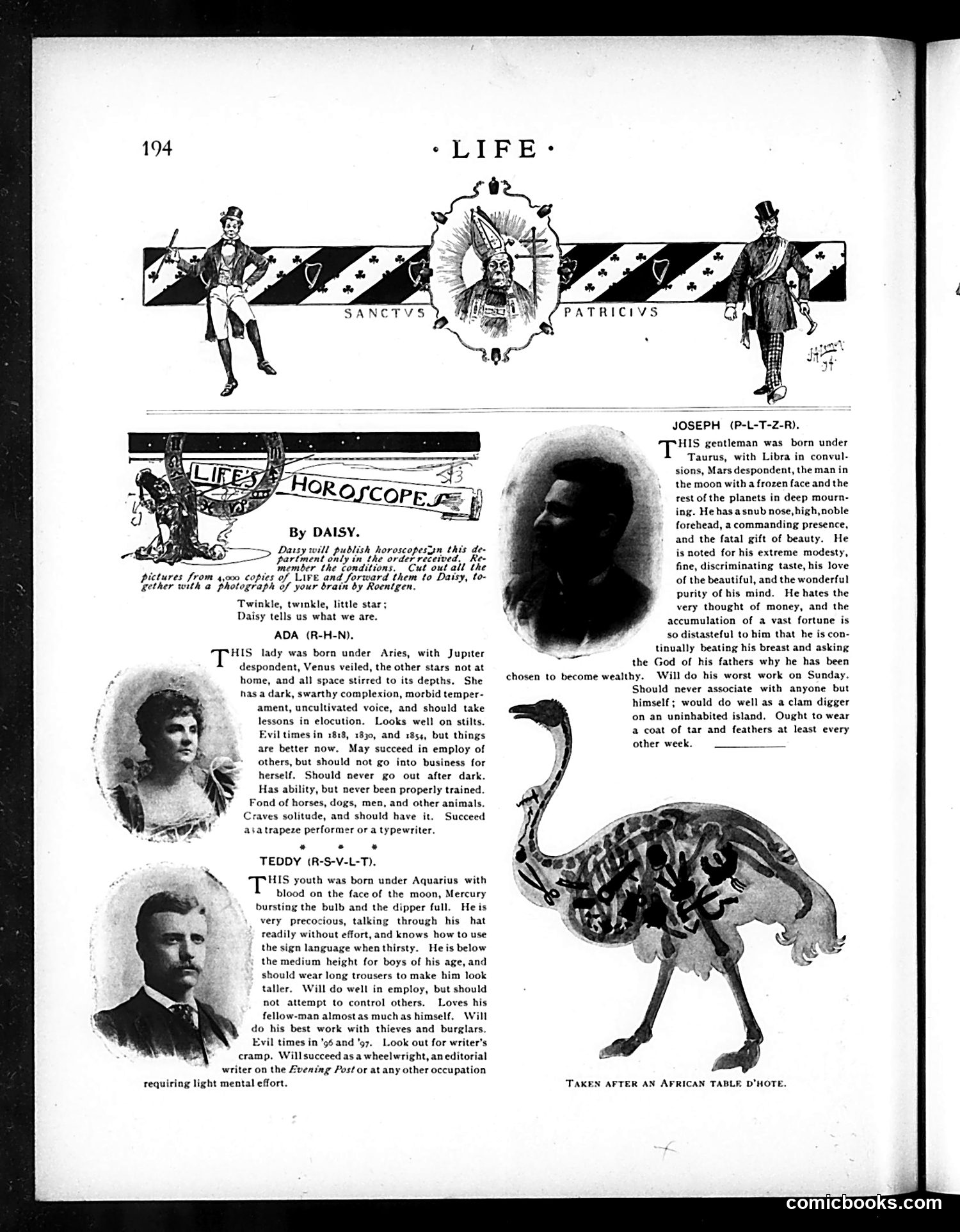
This page satirizes personality types through astrological signs. "Daisy" (Aries) is mocked as an uncultured, emotionally volatile woman unsuited for business—a sexist caricature typical of early 20th-century humor. "Teddy" (Aquarius) appears to be a generic everyman character described as moderately successful but pedestrian. The page's main satire targets astrology itself, presenting absurdly detailed personality predictions based on birth signs—a common target of skeptical humor. The ostrich illustration labeled "Takes After an African Table d'Hôte" makes a crude joke, though its exact satirical point remains unclear without additional context. The decorative header with "Sanctus Patricius" references St. Patrick, suggesting this may be from St. Patrick's Day-themed content.
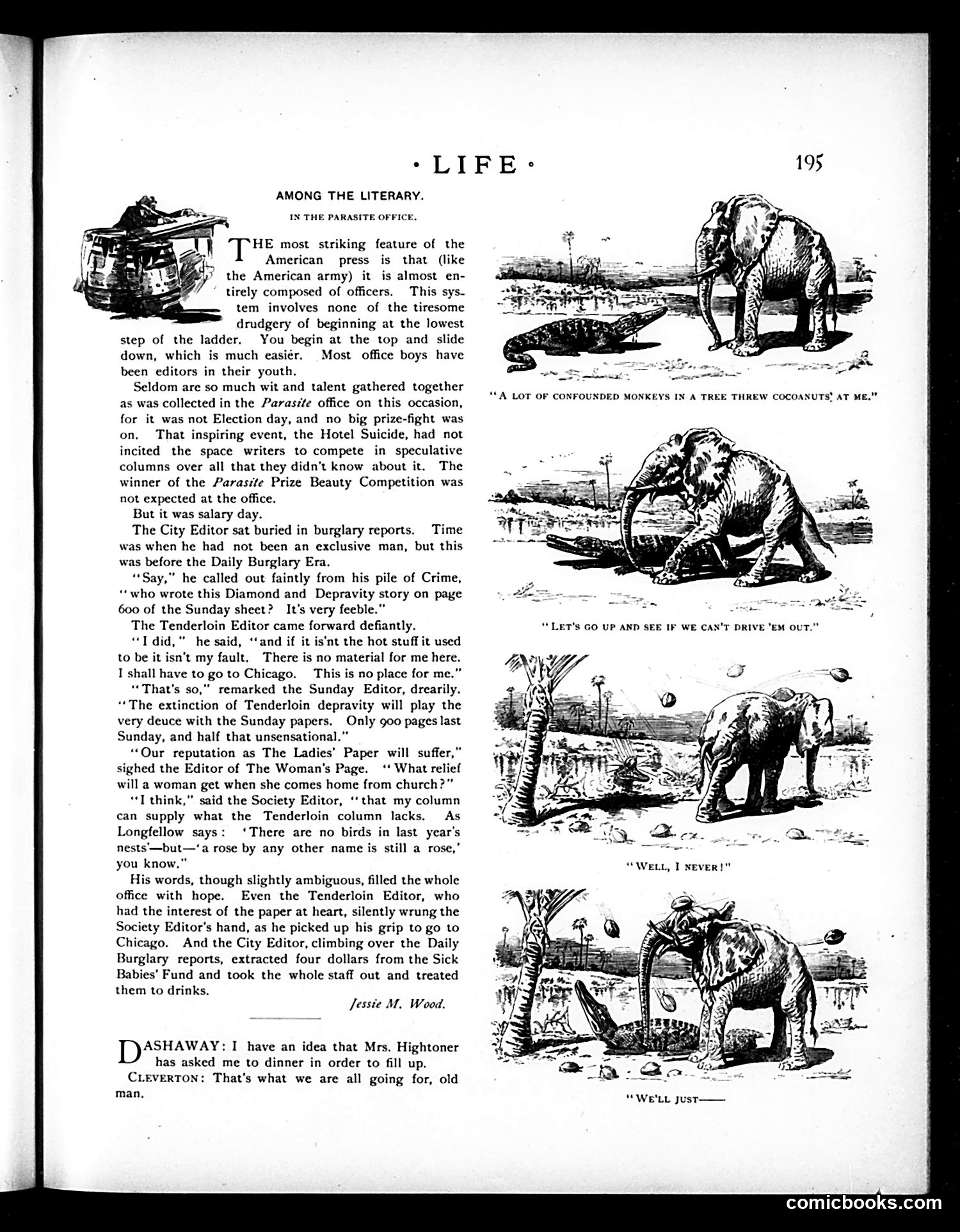
This satirical piece mocks the American newspaper industry's hierarchical structure, where editors climb from bottom to top rather than starting at entry level. The "Parasite office" refers to *Life* magazine's own editorial staff during what appears to be a slow news day (no elections or major events occurring). The humor centers on office gossip: editors discuss the *Parasite* Beauty Prize winner, various column controversies, and staff departures. The accompanying elephant cartoons (right) appear unrelated comic relief, showing animals in various predicaments with captions like "A lot of confounded monkeys in a tree threw cocoanuts at me." The piece satirizes newspaper office politics and the trivial concerns of literary staff during quiet news cycles.
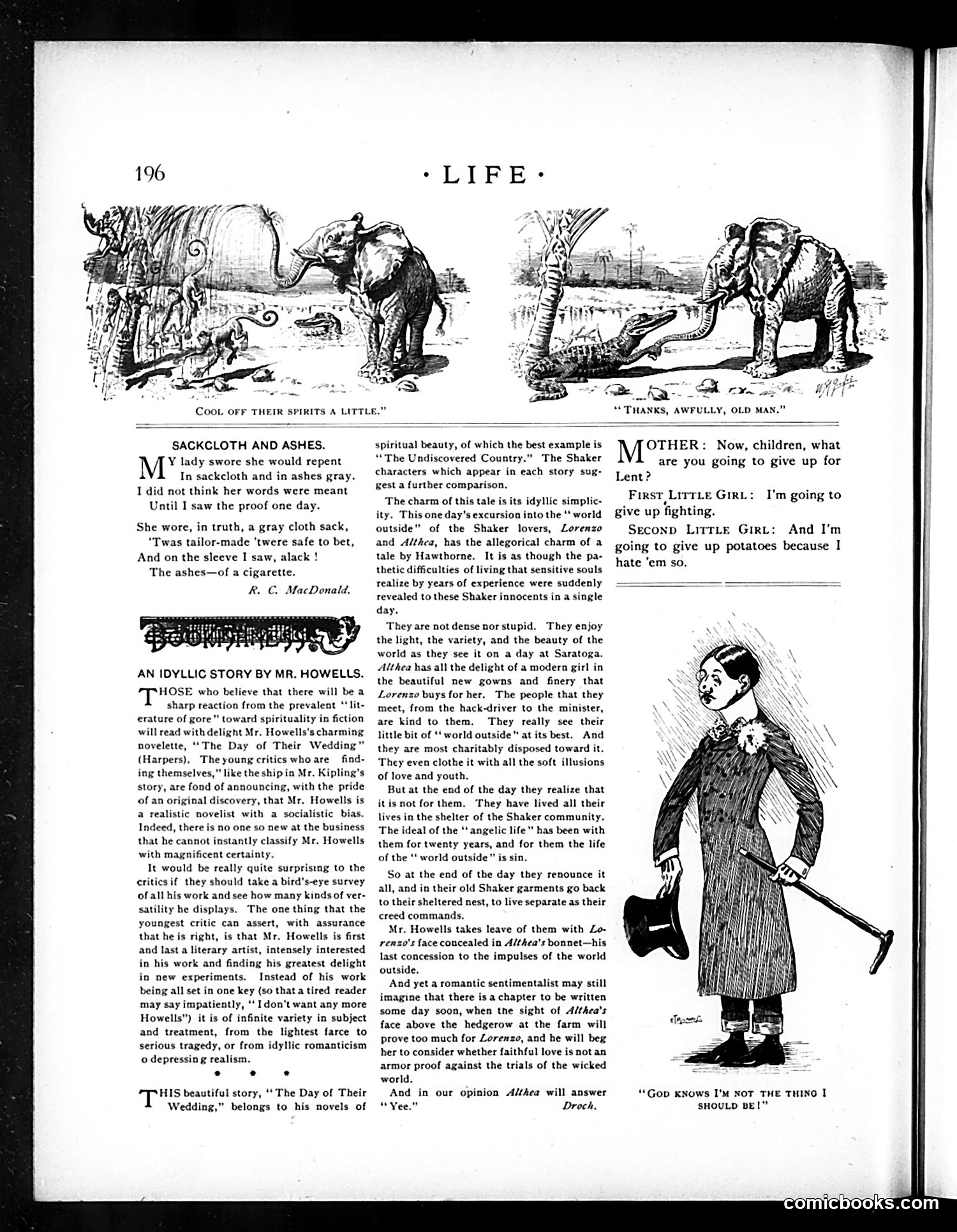
This page contains two distinct sections: **Top cartoons**: Two sketches depicting elephants interacting with crocodiles, captioned "Cool off their spirits a little" and "Thanks, awfully, old man." These appear to be generic humor illustrations rather than political satire—likely depicting animal encounters as comedy. **Main content**: A literary discussion by a critic reviewing Mr. Howells' short story "The Day of Their Wedding," praising his socialistic realism and character development. The critic notes Howells' skill at balancing literary artistry with social commentary. **Right side**: A dialogue between a Mother and two Little Girls about Lent and giving up things, illustrated with a sketch of a girl. This is religious/moral humor for family audiences. The page reflects turn-of-century Life magazine's mix of satirical cartoons, literary criticism, and genteel domestic humor.
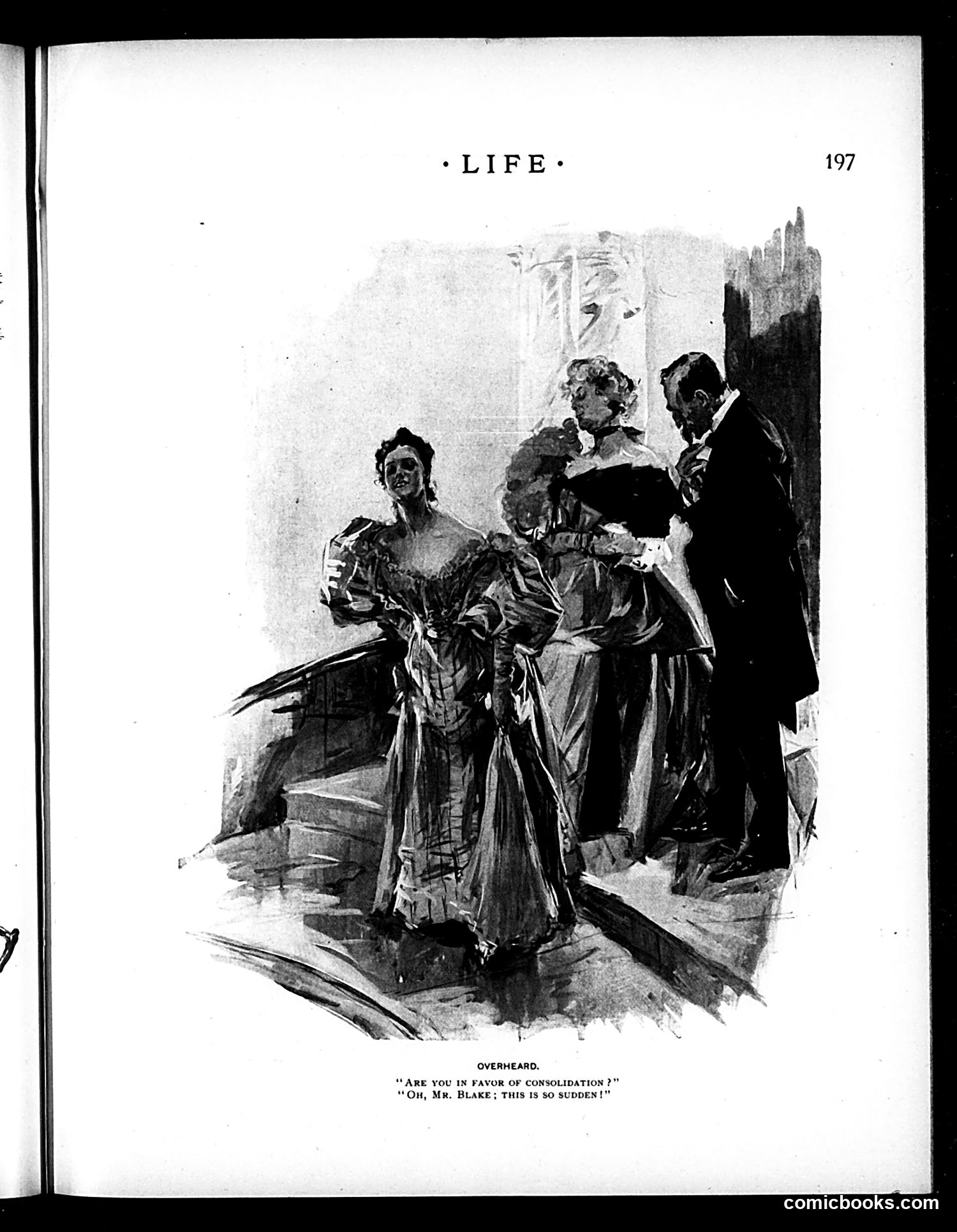
This cartoon depicts a social scene where a woman in an elegant dress stands before three men in formal attire. The caption reads: "ARE YOU IN FAVOR OF CONSOLIDATION?" with the response "OH, MR. BLAKE; THIS IS SO SUDDEN!" The humor relies on double meaning: the men appear to be discussing "consolidation" (likely a business or political matter of the era), but the woman interprets it as a marriage proposal. Her shocked, flustered response treats the business question as an unexpected romantic advance. This satirizes the tendency of men to discuss serious matters obliviously in mixed company, while women unexpectedly inject romantic implications into mundane conversation—a common trope of early 20th-century humor reflecting gender dynamics of the period.
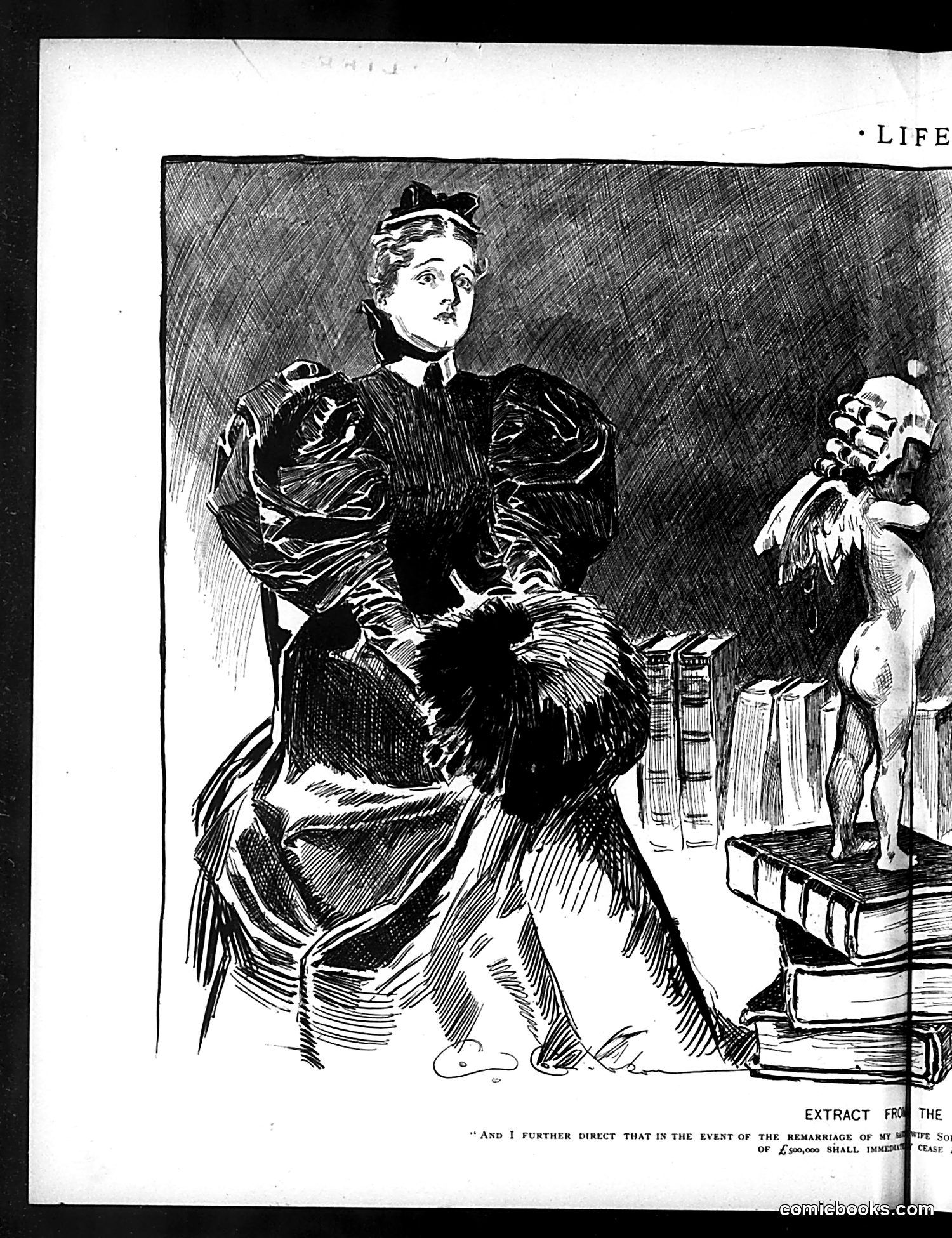
This appears to be a satirical illustration from Life magazine depicting a wealthy woman in fashionable 1890s dress (with distinctive puffy sleeves) seated among stacks of books. A cherub or cupid figure stands to the right, suggesting themes of love or romance. The partial caption references "the remarriage of my wife" and mentions "£250,000," indicating the cartoon satirizes wealthy women and marriage/divorce for financial gain. The books surrounding the figure may suggest either intellectual pretension or literary scandal. Without the full caption or date, the specific target is unclear—though this likely mocks either a particular socialite's remarriage or broader satirical commentary on wealthy women using marriage for financial advantage, a common Life magazine theme of that era.
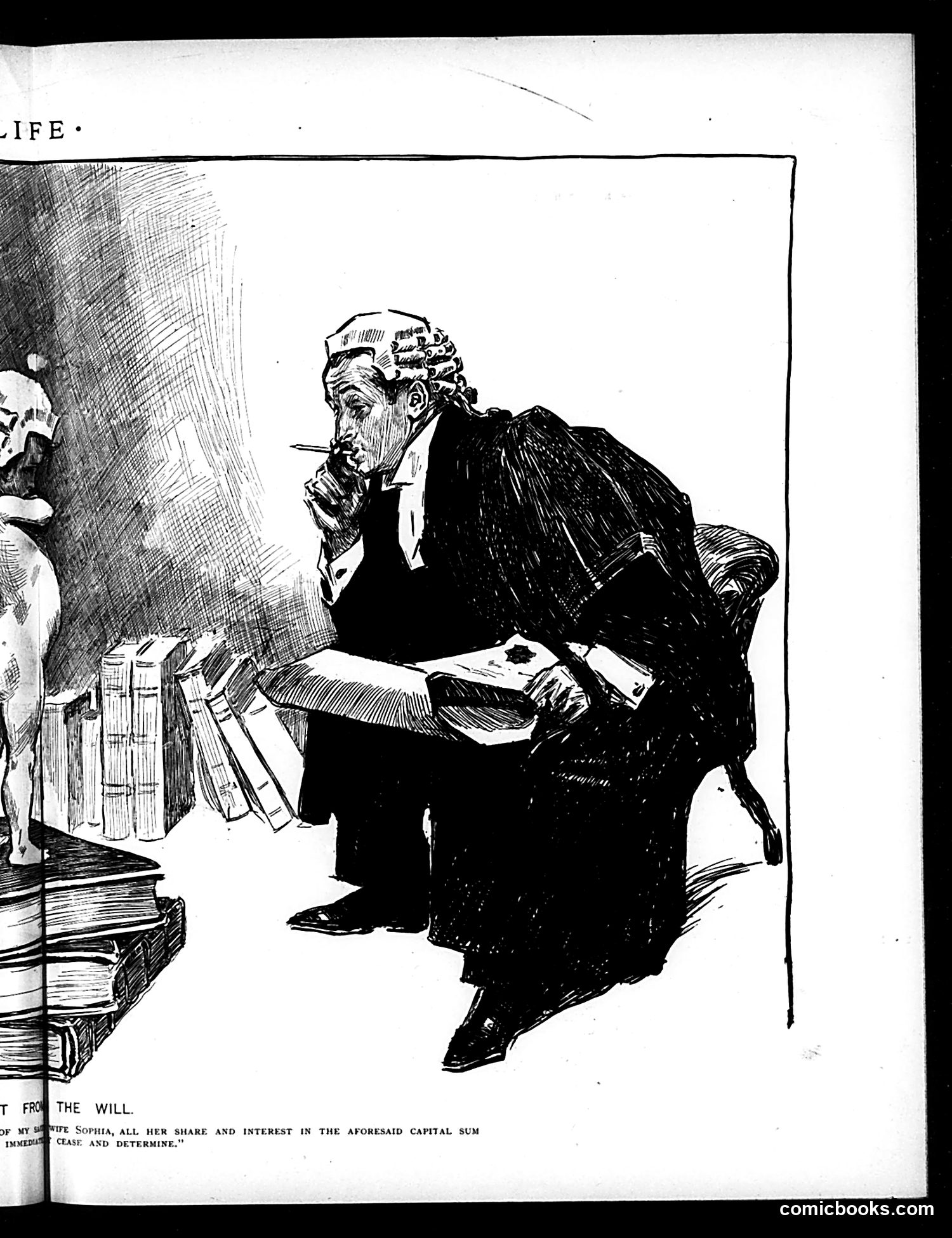
This page shows a legal/financial satirical cartoon. The central figure is an elderly man in formal attire, smoking a cigarette, reading or reviewing documents. He appears to be a lawyer or executor examining a will. The text references "MY WIFE SOPHIA, ALL HER SHARE AND INTEREST IN THE AFORESAID CAPITAL SUM CEASE AND DETERMINE" — suggesting the cartoon satirizes the legal complications of wills and inheritance, particularly regarding a wife's financial rights. Stacks of books visible on the left suggest legal precedents or documentation. The cartoon likely mocks the complexities of Victorian-era estate law and how such documents could be weaponized to control or limit women's access to inherited wealth — a genuine legal issue of that era. The specific identities of depicted figures remain unclear from the image alone.
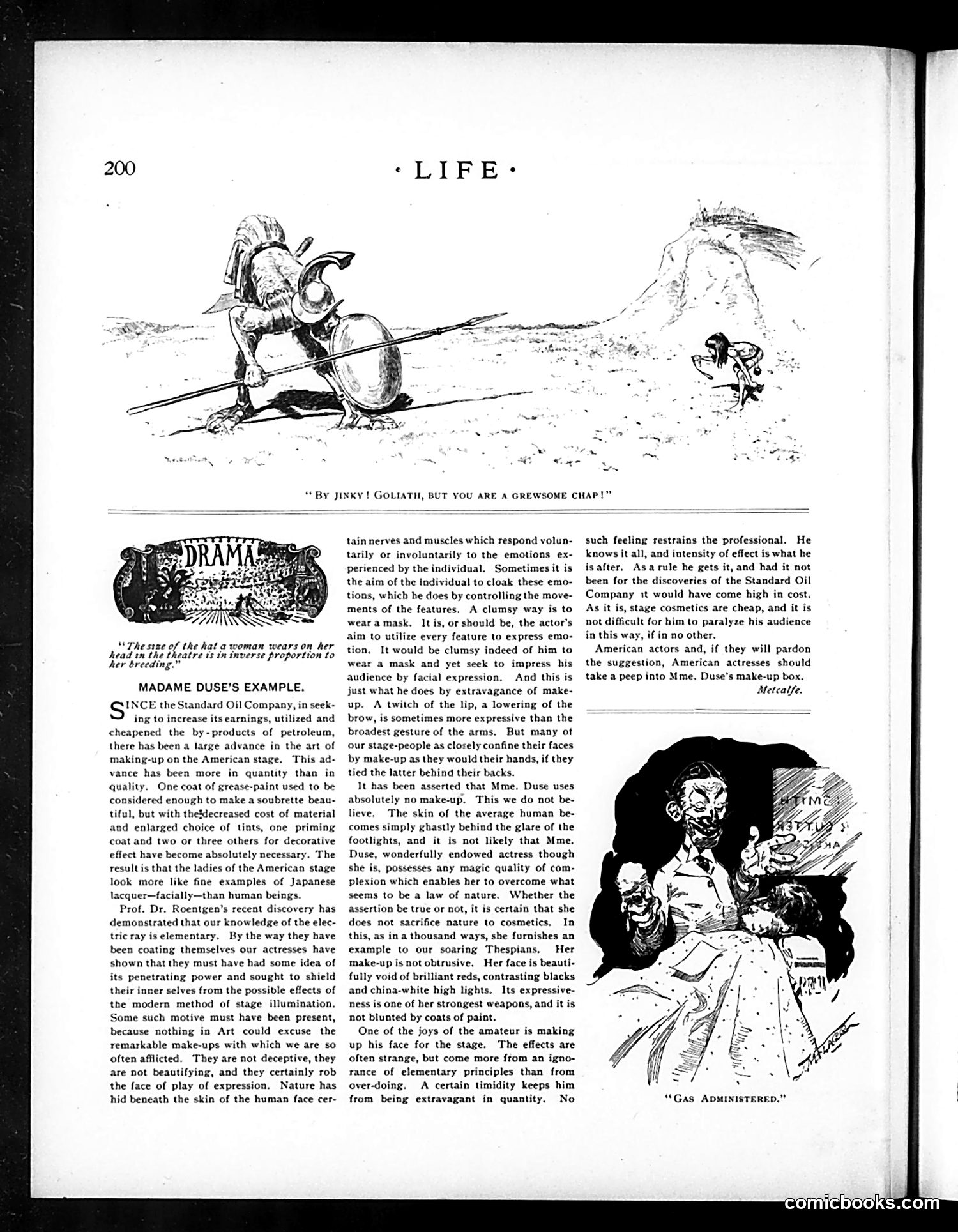
This page critiques excessive theatrical makeup on American stages circa early 1900s. The top cartoon shows David and Goliath, with the caption "By Jinky! Goliath, but you are a gruesome chap!"—a visual metaphor for how heavy makeup makes actors look monstrous. The article "Madame Duse's Example" contrasts American actresses with the Italian actress Eleonora Duse, who reportedly used minimal makeup. The author argues that excessive greasepaint (made affordable by petroleum by-products from Standard Oil) prevents actors from using facial expressions to convey emotion. Instead of subtle movements showing feeling, American actresses hide behind "Japanese lacquer"–like masks of paint, defeating the purpose of theatrical performance. The subheading about women's hats in theaters is a separate social observation about vanity. The satire targets professional actors' vanity and the false belief that more makeup equals better performance.
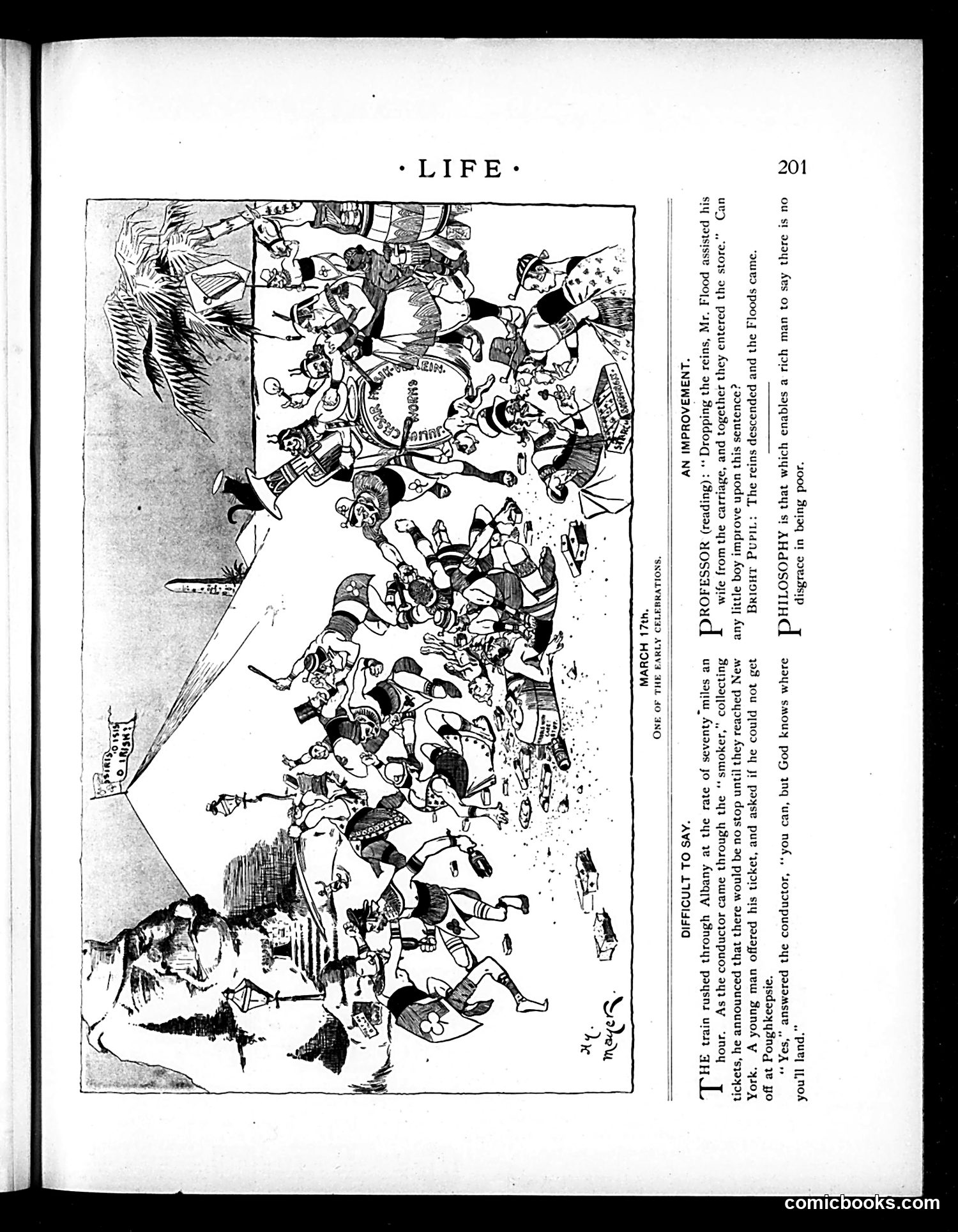
The OCR text is heavily corrupted and unreadable, making it impossible to determine the cartoon's specific content or message with confidence. However, examining the **image itself**: This appears to be a satirical cartoon showing a chaotic scene with multiple figures engaged in various activities—some appear to be fighting, collecting items, or in disarray. The style and composition suggest social or political satire typical of Life magazine's editorial cartoons. The page header reads "AN IMPROVEMENT" and references "Prosperity" and "Philosophy," suggesting the cartoon critiques economic or social conditions, likely contrasting claimed improvements with actual observable chaos or problems. **Without legible OCR text or visible attribution**, I cannot identify specific figures, historical events, or the precise satirical targets. To properly explain this cartoon's meaning to a modern reader, clearer source material or the cartoon's caption/title would be necessary.
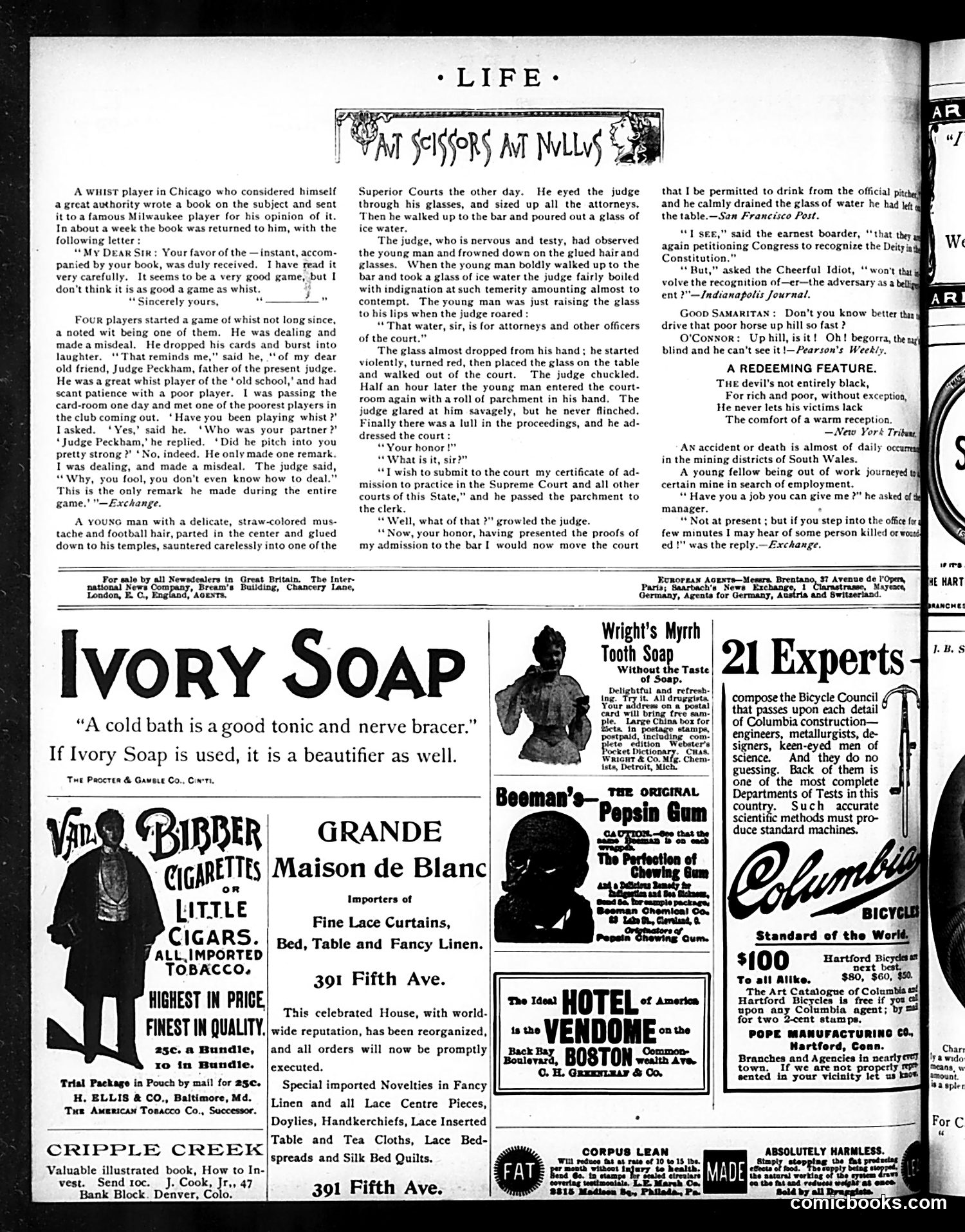
This page consists primarily of **humorous anecdotes about whist (a card game) and courtroom etiquette**, not political satire. The main stories mock social pretension and pomposity: 1. **The whist book anecdote**: A self-important Chicago player sends his book to a Milwaukee expert, who dismisses it with polite condescension—the humor lies in the expert's backhanded insult. 2. **Judge Peckham story**: A poor whist player is brutally insulted by Judge Peckham for a misdeal. Years later, a young lawyer deliberately drinks from the judge's water pitcher (reserved for court officers), gets reprimanded, then returns with his bar admission certificate to drink again—humbling the arrogant judge. The secondary anecdotes mock other social absurdities: a boarder's confusion about constitutional amendments, an Irishman driving a blind horse uphill. **The page is primarily advertising** (Ivory Soap, cigarettes, hotels, bicycles), with light social humor rather than political commentary. The satire targets individual foolishness and class pretension rather than broader political issues.
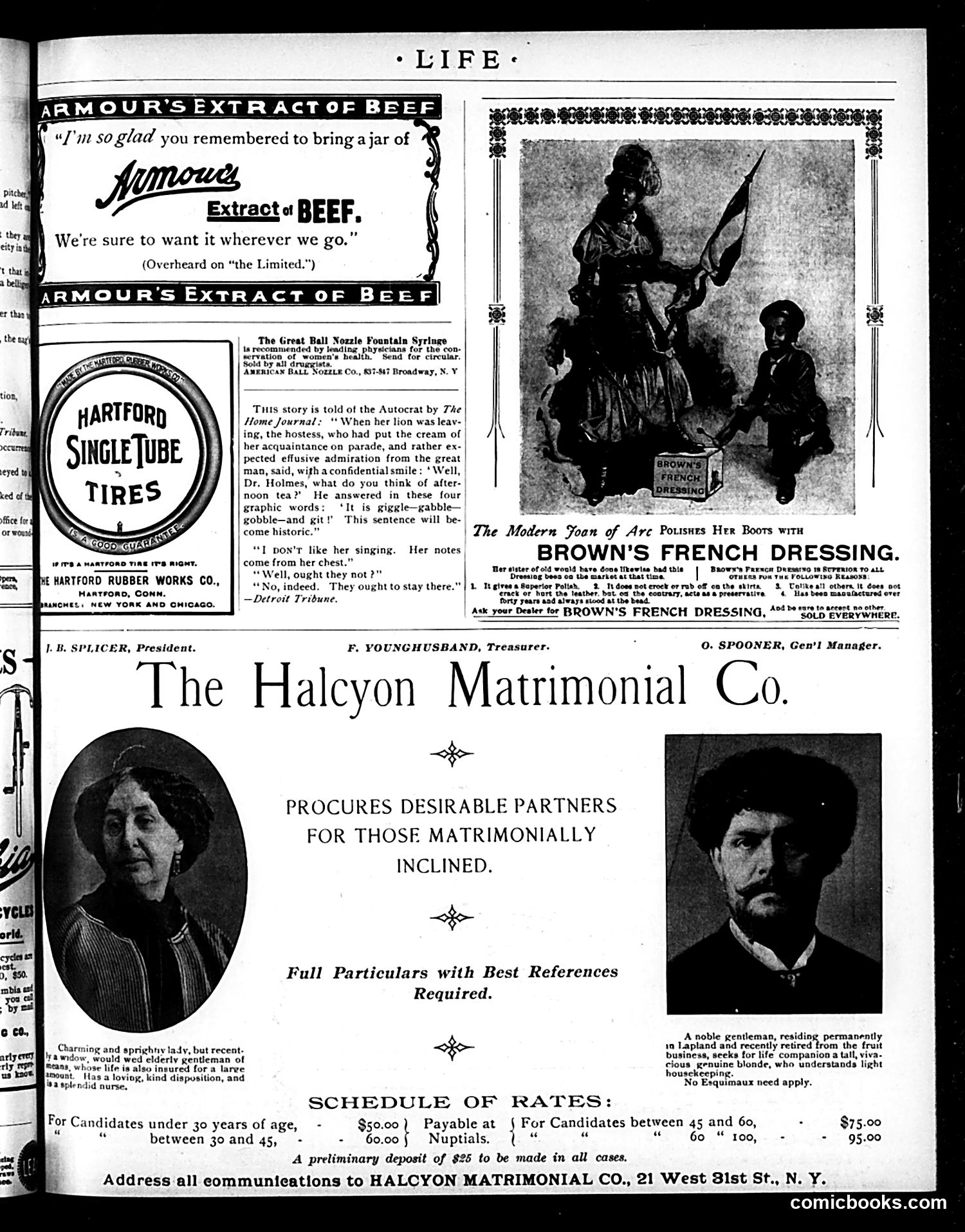
This is primarily an **advertising page** from an early Life magazine, mixing commercial ads with satirical humor typical of the publication. **Main Content:** The **Halcyon Matrimonial Co.** is a fake matchmaking service—a satirical jab at matrimonial agencies. The humor lies in the absurd client descriptions: a widow seeking an "elderly gentleman" with life insurance (implying mercenary motives), and a man in "Lapland" seeking a "tall, vivacious genuine blonde" with the punchline "No Esquimaux need apply" (a racist joke about avoiding Inuit women). **Side Cartoon:** "The Modern Joan of Arc Polishes Her Boots with Brown's French Dressing"—a joke about modern women adopting masculine behaviors (boot maintenance) rather than traditional femininity, paired with a product ad. **Upper Section:** An anecdote about Dr. Holmes (likely Oliver Wendell Holmes Sr., the famous physician/writer) dismissing afternoon tea as "giggle—gabble—gobble—and git." The page satirizes marriage-market commercialism, changing gender roles, and consumer culture through exaggerated advertisements.
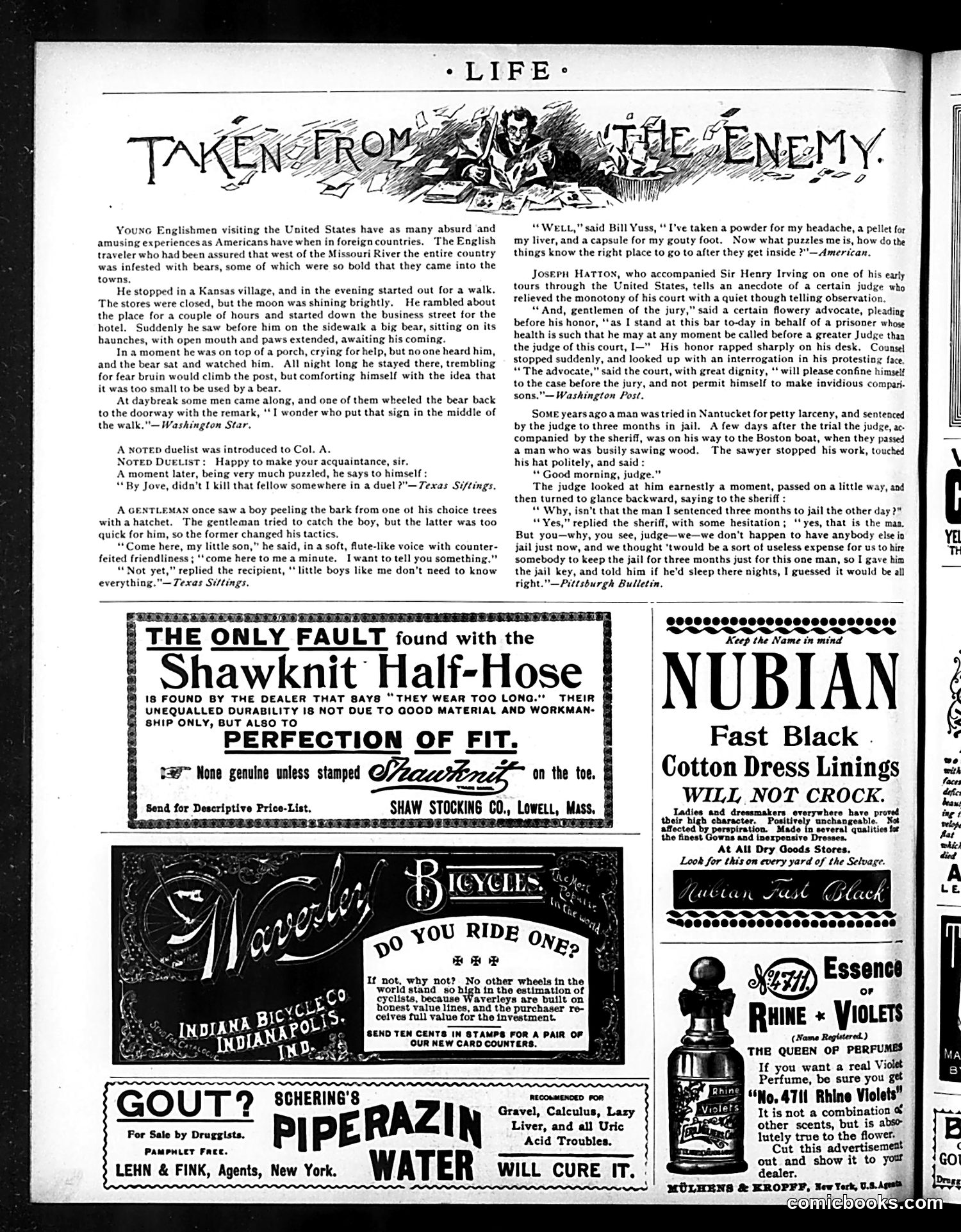
This page contains four humorous anecdotes mocking English visitors to America and various social absurdities: 1. **The Bear Sign**: An Englishman, warned of wild bears west of the Missouri, encounters what he thinks is a bear on a Kansas street and spends the night terrified on a porch—only to discover it was a store sign. 2. **The Duel Mix-up**: A noted duelist meets Colonel A and later realizes he may have killed him in a previous duel, creating an awkward social moment. 3. **The Boy and the Tree**: A gentleman attempts gentle persuasion after failing to catch a boy damaging his tree; the boy cheekily replies that boys "like me don't need to know everything." 4. **The Judge's Sermon**: An advocate pleading before a judge compares the defendant's mortality to "a greater Judge," prompting the irritated judge to demand counsel stick to the case rather than make grandiose comparisons. The satire targets pretension, obliviousness, and absurd social conventions of the era.
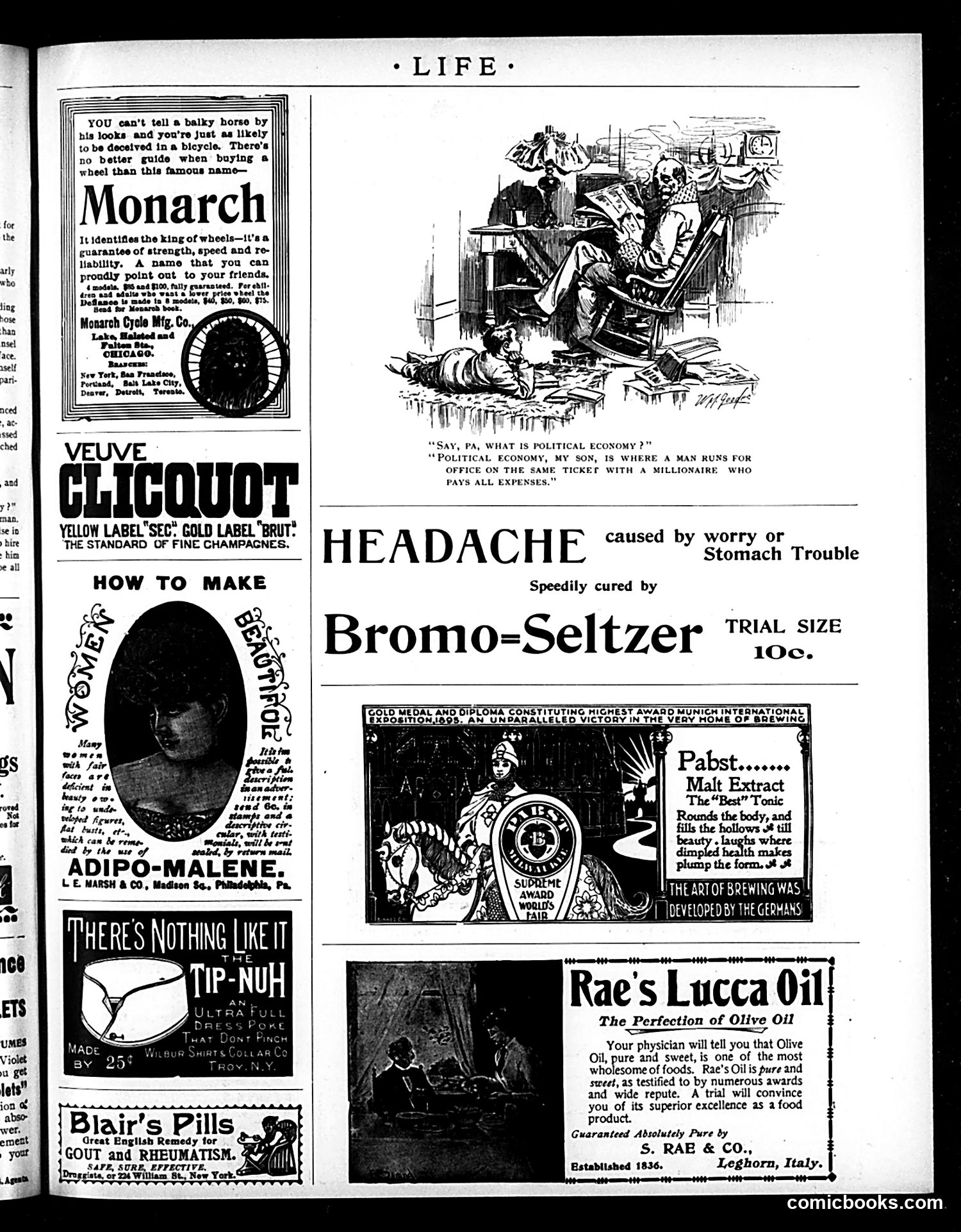
The main cartoon depicts a father and son, with the boy asking his father to define "political economy." The father's cynical answer—that it's when a candidate runs for office "on the same ticket with a millionaire who pays all expenses"—satirizes American electoral corruption of the era. The joke targets the practice of wealthy industrialists bankrolling political candidates, effectively purchasing political power. The father's matter-of-fact explanation to his innocent son suggests this corrupt arrangement was so openly accepted it could be explained as simply as a definition of economics. This reflects Progressive Era concerns (likely early 1900s) about the influence of big money on politics and democracy. The surrounding advertisements—for bicycles, champagne, patent medicines, and food products—are incidental; the page's real content is this sardonic commentary on how millionaires controlled American politics through campaign financing.
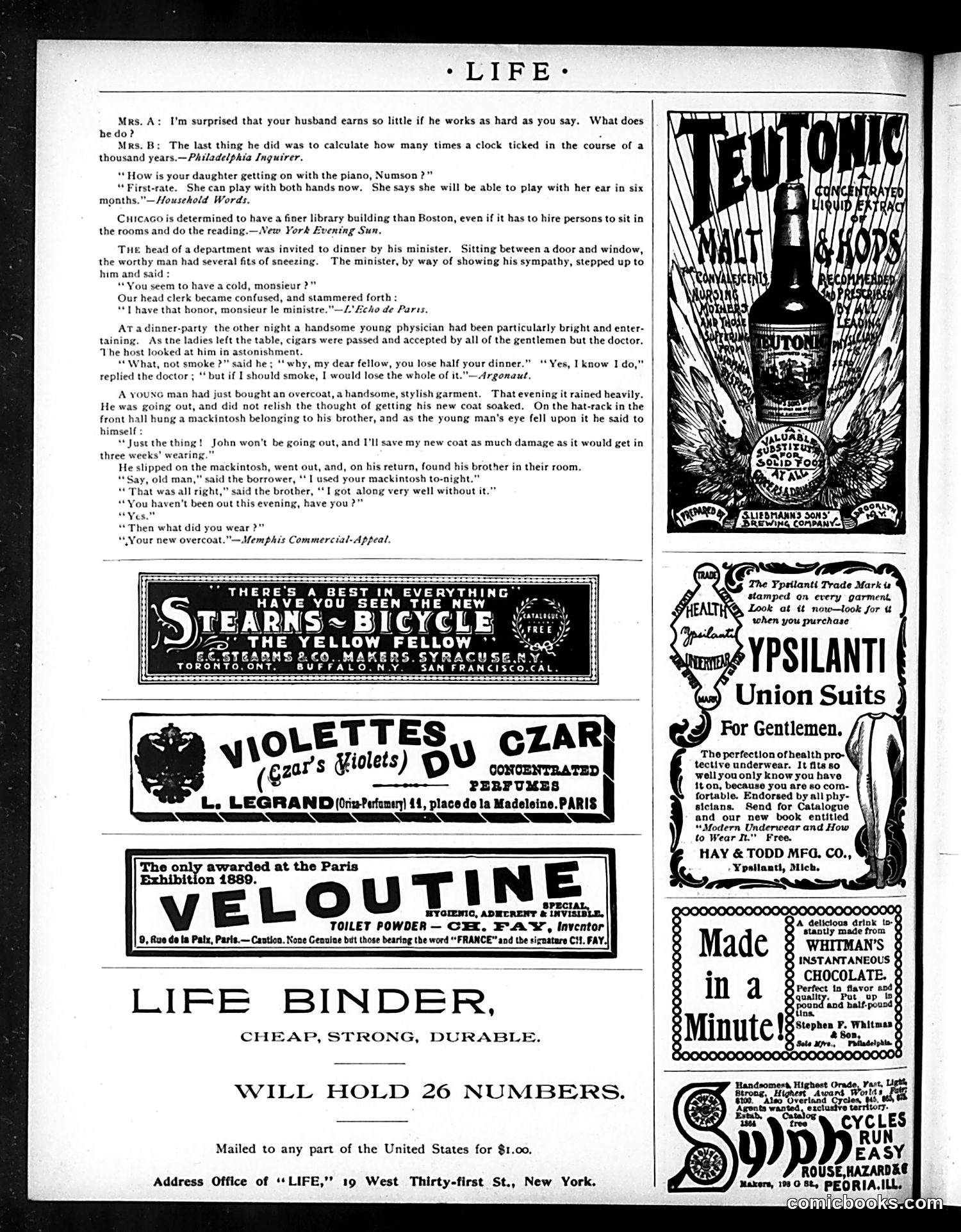
This page from *Life* magazine contains humorous anecdotes rather than a political cartoon. The jokes mock absurd logic and ironic human behavior: **Key jokes:** 1. A husband wastes time on meaningless calculations instead of earning properly. 2. A girl aims to eventually play piano with her ear (absurdly impractical). 3. Chicago hires people just to occupy a new library—mocking the city's competitive vanity with Boston. 4. A confused clerk accidentally tells a minister he has "the honor" of a cold. 5. A doctor refuses cigars after dinner because smoking ruins his appetite (self-defeating logic). 6. Two brothers unknowingly swap coats, each protecting the other's property by ruining his own—illustrating unintended consequences and ironic symmetry. The satire targets pretension, confusion, illogical reasoning, and human foolishness in everyday situations. These are gentle, observational jokes typical of *Life's* social humor. The page also contains period advertisements for bicycles, perfume, underwear, and chocolate.
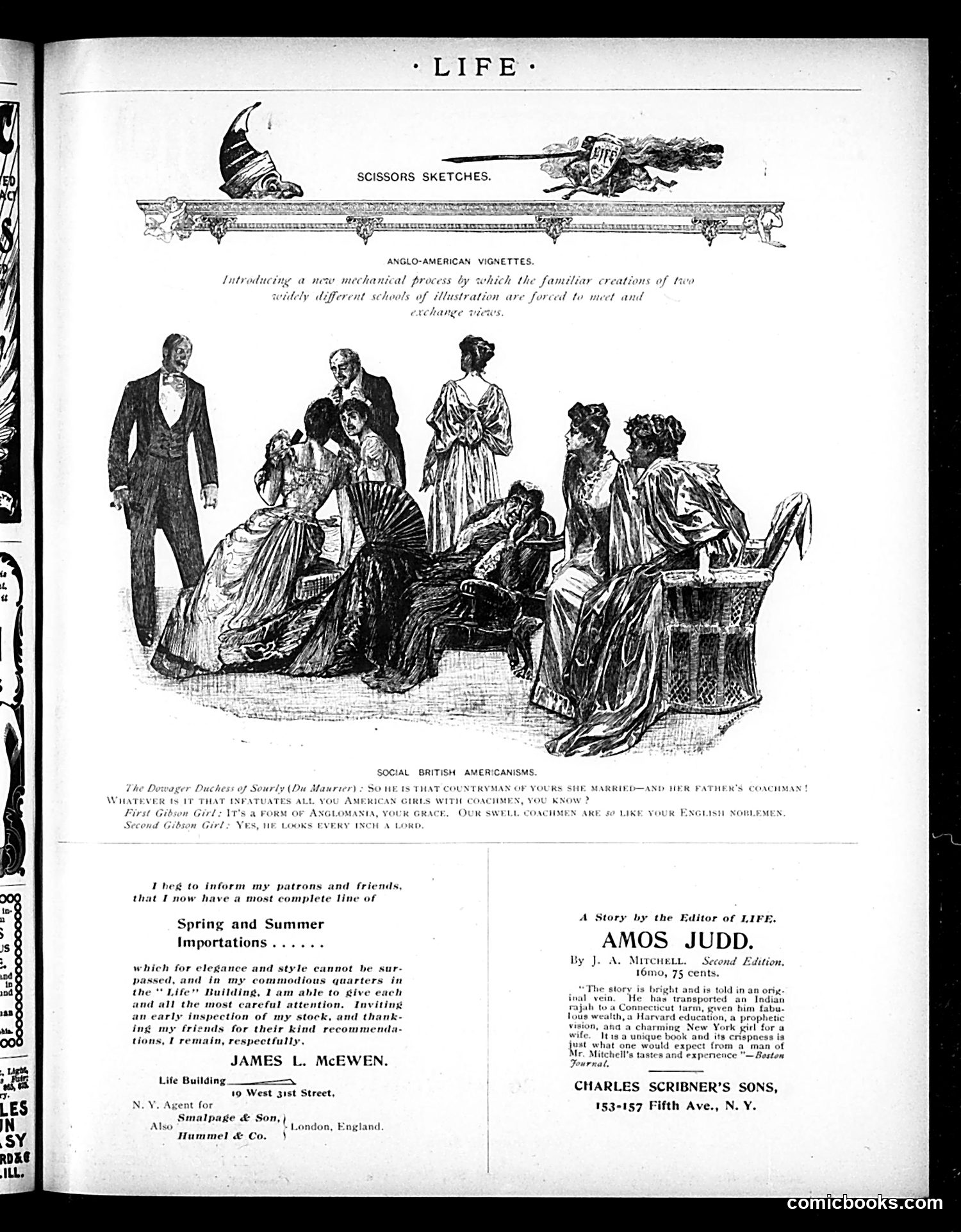
This page satirizes transatlantic cultural pretension through "Anglo-American Vignettes." The central cartoon mocks American women's infatuation with British aristocracy and affectation. The dialogue features a dowager duchess (referencing Du Maurier, the famous British illustrator) questioning why American girls are attracted to coachmen—implying they marry beneath their station. The "Gibson Girls" (American high-society women popularized in illustration) respond that they admire British mannerisms, claiming even coachmen "look every inch a lord." The satire targets American Anglomania: the aspirational mimicry of English nobility and style. The joke cuts both ways—mocking American social climbers who idealize British servants' bearing while also suggesting the superficiality of class distinctions. The page uses the "mechanical process" of combining Du Maurier's refined British illustration style with American Gibson Girl aesthetics to highlight cultural collision and snobbery on both sides of the Atlantic.
This page is **primarily advertising**, not satire or political commentary. It dates to March 1894 (visible in header). The notable content includes: **Left side**: An ad for "Golden Sceptre" pipe tobacco, using period pseudo-scientific claims about quality. **Center**: A large advertisement for **Mariani Wine**—a tonic wine claiming endorsement from "over 7,000 physicians" for fortifying and refreshing properties. This reflects the era when wines and patent medicines made unregulated health claims (Mariani's was a real cocaine-containing product popular in the 1890s, though the cocaine isn't mentioned here). **Right side**: Advertisements for bicycles, W.L. Douglas shoes, and the New York Central railroad. **Bottom**: Announcement that Life Vol. XXVI is now available for purchase ($5.00), and information about framed proofs of original Life artwork. The page shows **no political cartoons or satire**—it's a typical late-19th-century magazine layout mixing editorial matter with advertisements for consumer goods and patent medicines. The ads reflect contemporary attitudes toward health claims that would be illegal today.