
Life, 1896-03-12 · page 12 of 20
Life — March 12, 1896 — page 12: what you’re looking at
What you’re looking at
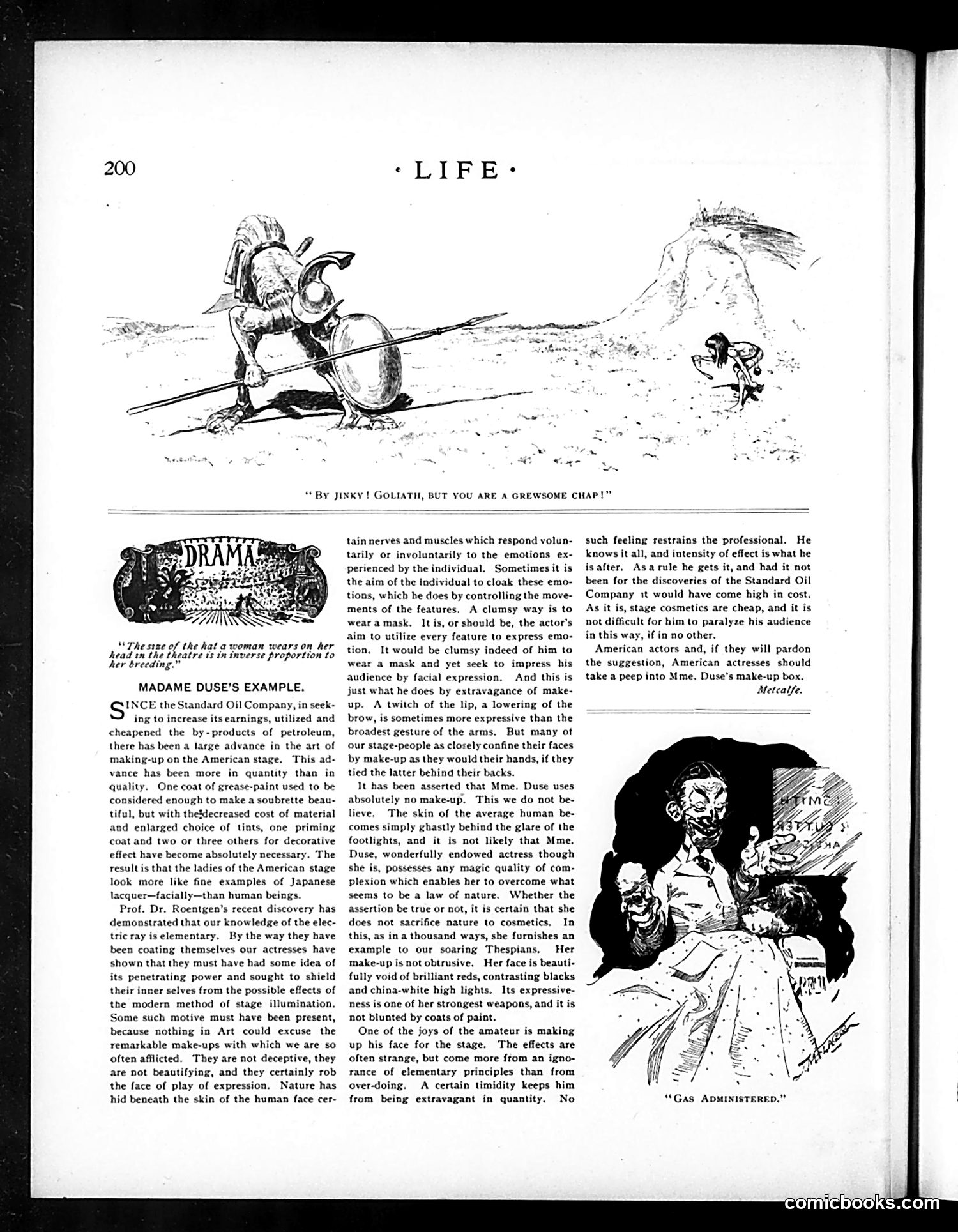
This page critiques excessive theatrical makeup on American stages circa early 1900s. The top cartoon shows David and Goliath, with the caption "By Jinky! Goliath, but you are a gruesome chap!"—a visual metaphor for how heavy makeup makes actors look monstrous. The article "Madame Duse's Example" contrasts American actresses with the Italian actress Eleonora Duse, who reportedly used minimal makeup. The author argues that excessive greasepaint (made affordable by petroleum by-products from Standard Oil) prevents actors from using facial expressions to convey emotion. Instead of subtle movements showing feeling, American actresses hide behind "Japanese lacquer"–like masks of paint, defeating the purpose of theatrical performance. The subheading about women's hats in theaters is a separate social observation about vanity. The satire targets professional actors' vanity and the false belief that more makeup equals better performance.
📄 Transcribed text from this page (OCR, searchable)
Machine-transcribed from the original scan — historical spelling and the odd misread are preserved.
“ By JINKy ! GOLIATH, BUT YOU ARE A GREWSOME CHAP!” “The stze of the hat a woman wears on her head in the theatre ts in inverse proportion to her breeding.” MADAME DUSE’S EXAMPLE. INCE the Standard Oil Company, in seek- ing to increase its earnings, utilized and cheapened the by-products of petroleum, there has been a large advance in the art of making-up on the American stage. This ad- vance has been more in quantity than in quality. One coat of grease-paint used to be considered enough to make a soubrette beau- tiful, but with theldecreased cost of material and enlarged choice of tints, one priming coat and two or three others for decorative effect have become absolutely necessary. The result is that the ladies of the American stage look more like fine examples of Japanese lacquer—facially—than human beings. Prof. Dr. Roentgen’s recent discovery has demonstrated that our knowledge of the elec- tric ray is elementary. By the way they have been coating themselves our actresses have shown that they must have had some idea of its penetrating power and sought to shield their inner selves from the possible effects of the modern method of stage illumination. Some such motive must have been present, because nothing in Art could excuse the remarkable make-ups with which we are so often afflicted. They are not deceptive, they are not beautifying, and they certainly rob the face of play of expression. Nature has hid beneath the skin of the human face cer- tain nerves and muscles which respond volun- tarily or involuntarily to the emotions ex- perienced by the individual. Sometimes it is the aim of the individual to cloak these emo- tions, which he does by controlling the move- ments of the features. A clumsy way is to wearamask. It is, or should be, the actor's aim to utilize every feature to express emo- tion, It would be clumsy indeed of him to wear a mask and yet seek to impress his audience by facial expression. And this is just what he does by extravagance of make- up. A twitch of the lip, a lowering of the brow, is sometimes more expressive than the broadest gesture of the arms, But many ot our stage-people as closely confine their faces by make-up as they would their hands, if they tied the latter behind their backs. It has been asserted that Mme. Duse uses absolutely no make-up. This we do not be- lieve. The skin of the average human be- comes simply ghastly behind the glare of the footlights, and it is not likely that Mme. Duse, wonderfully endowed actress though she is, possesses any magic quality of com- plexion which enables her to overcome what seems to be a law of nature. Whether the assertion be true or not, it is certain that she does not sacrifice nature to cosmetics. In this, as in a thousand ways, she furnishes an example to our soaring Thespians. Her make-up is not obtrusive. Her face is beauti- fully void of brilliant reds, contrasting blacks and china-white high lights. Its expressive- ness is one of her strongest weapons, and it is not blunted by coats of paint. One of the joys of the amateur is making up his face for the stage. The effects are often strange, but come more from an igno- rance of elementary principles than from over-doing. A certain timidity keeps him from being extravagant in quantity. No such feeling restrains the professional. He knows it all, and intensity of effect is what he isafter. Asarule he gets it, and had it not been for the discoveries of the Standard Oil Company it would have come high in cost. As it is, stage cosmetics are cheap, and it is not difficult for him to paralyze his audience in this way, if in no other. American actors and, if they will pardon the suggestion, American actresses should take a peep into Mme. Duse’s make-up box. Metcalfe. “Gas ADMINISTERED.”