
Life, 1896-03-12 · page 4 of 20
Life — March 12, 1896 — page 4: what you’re looking at
What you’re looking at
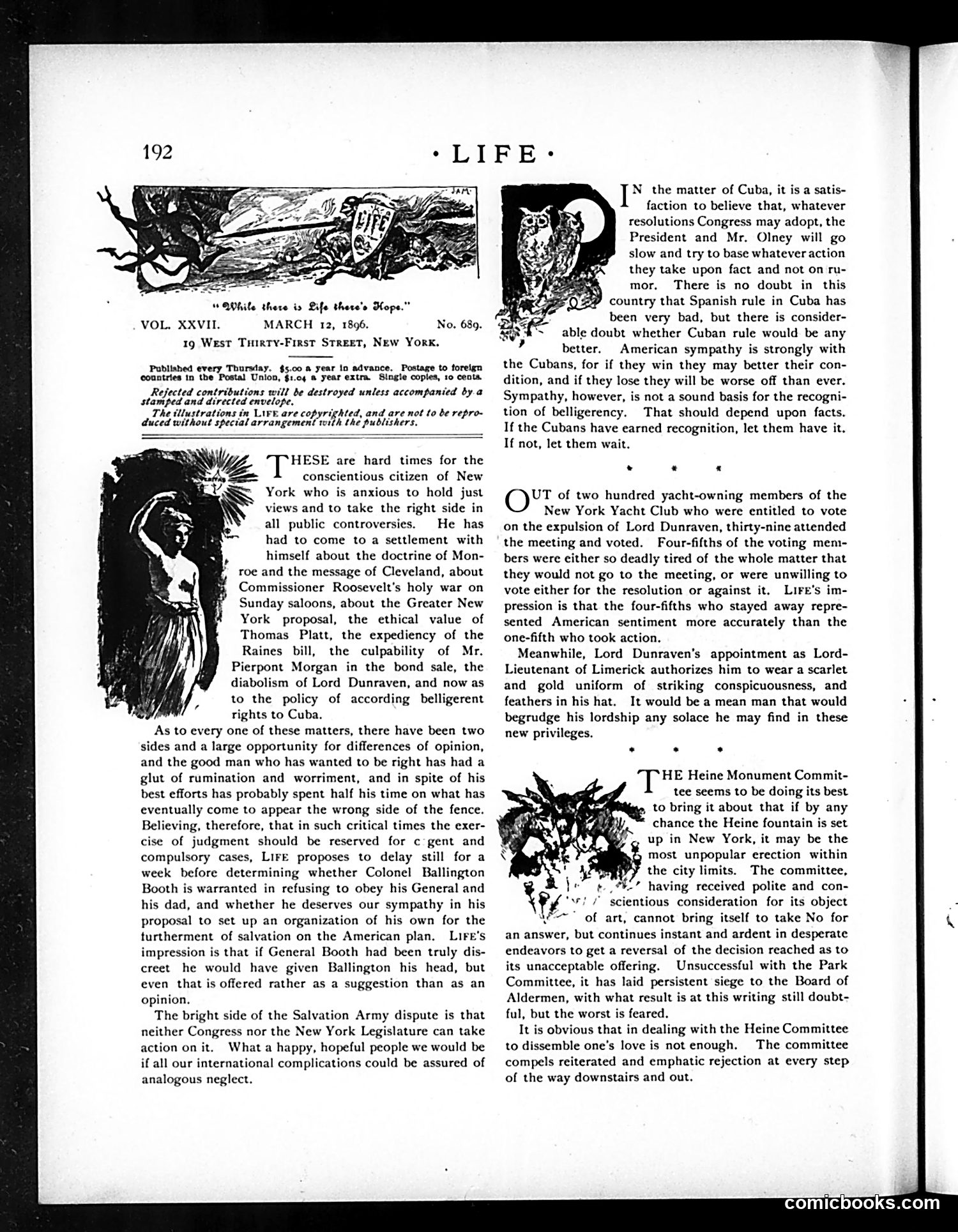
The page contains editorial commentary on several contemporary issues rather than traditional political cartoons. **Main topics discussed:** 1. **Cuba policy**: Criticism of American response to Cuban affairs, suggesting the U.S. should base decisions on facts rather than sentiment. 2. **New York Yacht Club expulsion**: Commentary on Lord Dunraven's expulsion, with the author noting that only three-fifths of voting members bothered attending—suggesting public apathy toward elite controversies. 3. **Heine Monument Committee**: Satirical coverage of the committee's struggle to install a Heine fountain in New York City. The text mocks their "reiterated and emphatic rejection at every step" by downtown interests, implying cultural philistinism and bureaucratic obstruction blocked the project. The decorative illustrations are generic period artwork rather than specific political caricatures.
📄 Transcribed text from this page (OCR, searchable)
Machine-transcribed from the original scan — historical spelling and the odd misread are preserved.
“QDhile there is Life there's Hope.” VOL, XXVII. MARCH 12, 1896. No. 689. 1g West Tirty-First Street, NEw YorK. Published every Thursday. $5.00 a year io advance. Postage to foreign countries in the Postal Union, $1.04 @ year extra. Single coples, 10 cents Rejected contributions will be destroyed unless accompanied bya stamped and directed envelope. The illustrations in Livk are copyrighted, and are not to be repro- duced without special arrangement with the publishers, HESE are hard times for the conscientious citizen of New York who is anxious to hold just views and to take the right side in all public controversies. He has had to come to a settlement with himself about the doctrine of Mon- roe and the message of Cleveland, about Commissioner Roosevelt's holy war on Sunday saloons, about the Greater New York proposal, the ethical value of Thomas Platt, the expediency of the Raines bill, the culpability of Mr. Pierpont Morgan in the bond sale, the diabolism of Lord Dunraven, and now as to the policy of according belligerent rights to Cuba. As to every one of these matters, there have been two sides and a large opportunity for differences of opinion, and the good man who has wanted to be right has had a glut of rumination and worriment, and in spite of his best efforts has probably spent half his time on what has eventually come to appear the wrong side of the fence. Believing, therefore, that in such critical times the exer- cise of judgment should be reserved for c gent and compulsory cases, LIFE proposes to delay still for a week before determining whether Colonel Ballington Booth is warranted in refusing to obey his General and his dad, and whether he deserves our sympathy in his proposal to set up an organization of his own for the turtherment of salvation on the American plan. LiFE's impression is that if General Booth had been truly dis- creet he would have given Ballington his head, but even that is offered rather as a suggestion than as an opinion, The bright side of the Salvation Army dispute is that neither Congress nor the New York Legislature can take action on it. What a happy, hopeful people we would be if all our international complications could be assured of analogous neglect. N the matter of Cuba, it is a satis- faction to believe that, whatever resolutions Congress may adopt, the President and Mr. Olney will go slow and try to base whatever action they take upon fact and not on ru- mor. There is no doubt in this country that Spanish rule in Cuba has been very bad, but there is consider- able doubt whether Cuban rule would be any better. American sympathy is strongly with the Cubans, for if they win they may better their con- dition, and if they lose they will be worse off than ever. Sympathy, however, is not a sound basis for the recogni- tion of belligerency. That should depend upon facts. If the Cubans have earned recognition, let them have it. Tf not, let them wait. . * « Or of two hundred yacht-owning members of the New York Yacht Club who were entitled to vote on the expulsion of Lord Dunraven, thirty-nine attended the meeting and voted. Four-fifths of the voting mem- bers were cither so deadly tired of the whole matter that they would not go to the meeting, or were unwilling to vote either for the resolution or against it. Lire’s im- pression is that the four-fifths who stayed away repre- sented American sentiment more accurately than the one-fifth who took action. Meanwhile, Lord Dunraven’s appointment as Lord- Lieutenant of Limerick authorizes him to wear a scarlet and gold uniform of striking conspicuousness, and feathers in his hat. It would be a mean man that would begrudge his lordship any solace he may find in these new privileges. HE Heine Monument Commit- tee seems to be doing its best. to bring it about that if by any chance the Heine fountain is set up in New York, it may be the .f most unpopular erection within y the city limits. The committee, _*%2” having received polite and con- / scientious consideration for its object ~" of art, cannot bring itself to take No for an answer, but continues instant and ardent in desperate endeavors to get a reversal of the decision reached as to its unacceptable offering. Unsuccessful with the Park Committee, it has laid persistent siege to the Board of Aldermen, with what result is at this writing still doubt- ful, but the worst is feared. It is obvious that in dealing with the Heine Committee to dissemble one’s love is not enough. The committee compels reiterated and emphatic rejection at every step of the way downstairs and out. ‘Comicbooks.com