
Life, 1896-03-12 · page 7 of 20
Life — March 12, 1896 — page 7: what you’re looking at
What you’re looking at
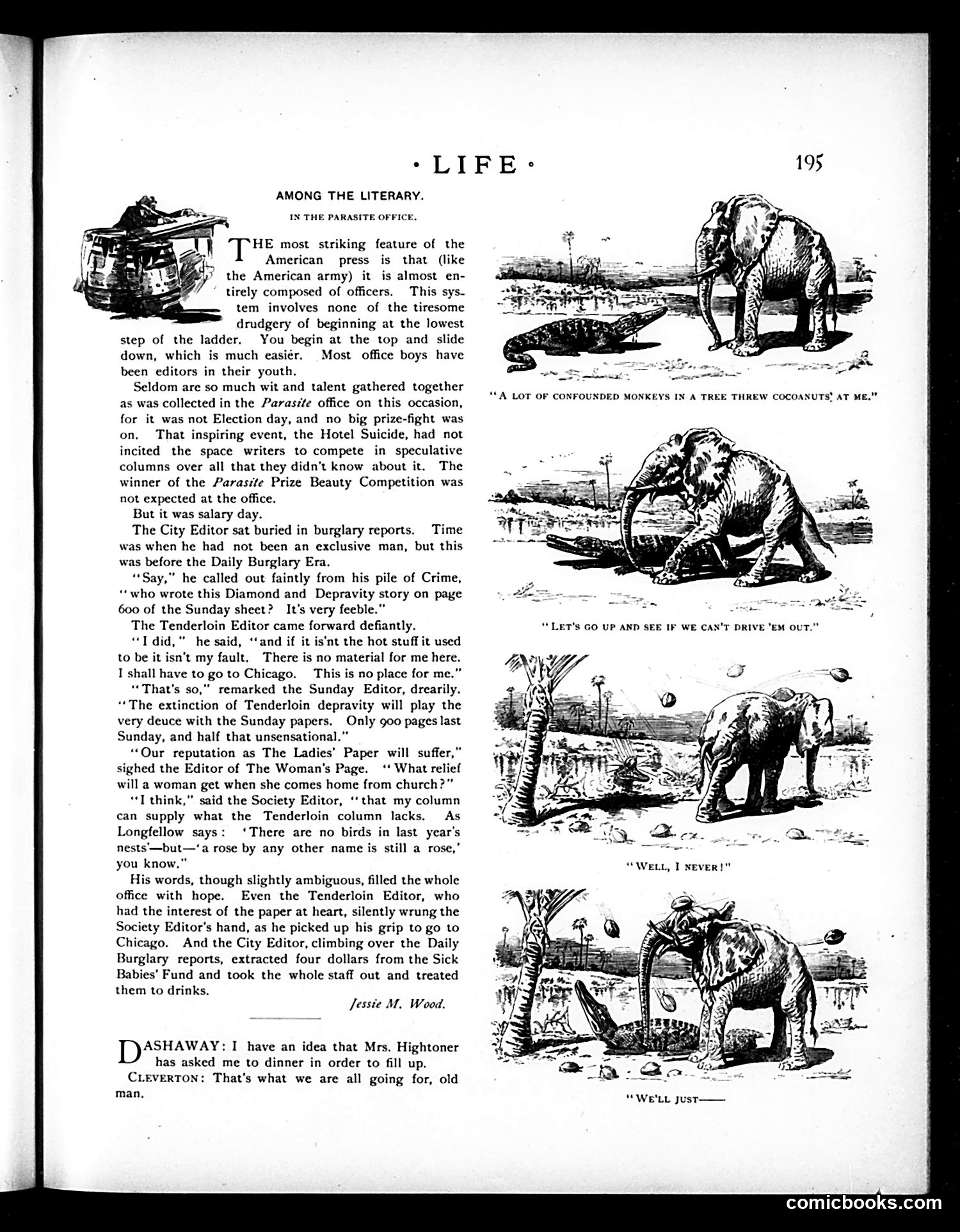
This satirical piece mocks the American newspaper industry's hierarchical structure, where editors climb from bottom to top rather than starting at entry level. The "Parasite office" refers to *Life* magazine's own editorial staff during what appears to be a slow news day (no elections or major events occurring). The humor centers on office gossip: editors discuss the *Parasite* Beauty Prize winner, various column controversies, and staff departures. The accompanying elephant cartoons (right) appear unrelated comic relief, showing animals in various predicaments with captions like "A lot of confounded monkeys in a tree threw cocoanuts at me." The piece satirizes newspaper office politics and the trivial concerns of literary staff during quiet news cycles.
📄 Transcribed text from this page (OCR, searchable)
Machine-transcribed from the original scan — historical spelling and the odd misread are preserved.
* LIFE: AMONG THE LITERARY. IN THE PARASITE OFFICE. HE most striking feature of the American press is that (like the American army) it is almost en- tirely composed of officers. This sys- tem involves none of the tiresome drudgery of beginning at the lowest step of the ladder. You begin at the top and slide down, which is much easiér. Most office boys have been editors in their youth, Seldom are so much wit and talent gathered together as was collected in the Parasrte office on this occasion, for it was not Election day, and no big prize-fight was on. That inspiring event, the Hotel Suicide, had not incited the space writers to compete in speculative columns over all that they didn’t know about it. The winner of the Paraszte Prize Beauty Competition was not expected at the office. But it was salary day. The City Editor sat buried in burglary reports. Time was when he had not been an exclusive man, but this was before the Daily Burglary Era. “Say,” he called out faintly from his pile of Crime, ‘‘who wrote this Diamond and Depravity story on page 600 of the Sunday sheet? It’s very feeble.” The Tenderloin Editor came forward defiantly. “I did,” he said, ‘‘and if it is'nt the hot stuff it used to be it isn’t my fault. There is no material for me here. I shall have to go to Chicago. This is no place for me.” “That's so,” remarked the Sunday Editor, drearily. “The extinction of Tenderloin depravity will play the very deuce with the Sunday papers. Only goo pages last Sunday, and half that unsensational.” “Our reputation as The Ladies’ Paper will suffer,” sighed the Editor of The Woman's Page. ‘* What relief will a woman get when she comes home from church?” “I think,” said the Society Editor, ‘that my column can supply what the Tenderloin column lacks. As Longfellow says: ‘There are no birds in last year’s nests'—but—‘a rose by any other name is still a rose,’ you know.” His words, though slightly ambiguous, filled the whole office with hope. Even the Tenderloin Editor, who had the interest of the paper at heart, silently wrung the Society Editor's hand, as he picked up his grip to go to Chicago. And the City Editor, climbing over the Daily Burglary reports, extracted four dollars from the Sick Babies’ Fund and took the whole staff out and treated them to drinks. Jessie M. Wood. ASHAWAY: I have an idea that Mrs. Hightoner has asked me to dinner in order to fill up. CLEVERTON: That's what we are all going for, old man, “WE'LL Jusr- comicbooks.com