
A complete issue · 20 pages · 1896
Life — March 5, 1896
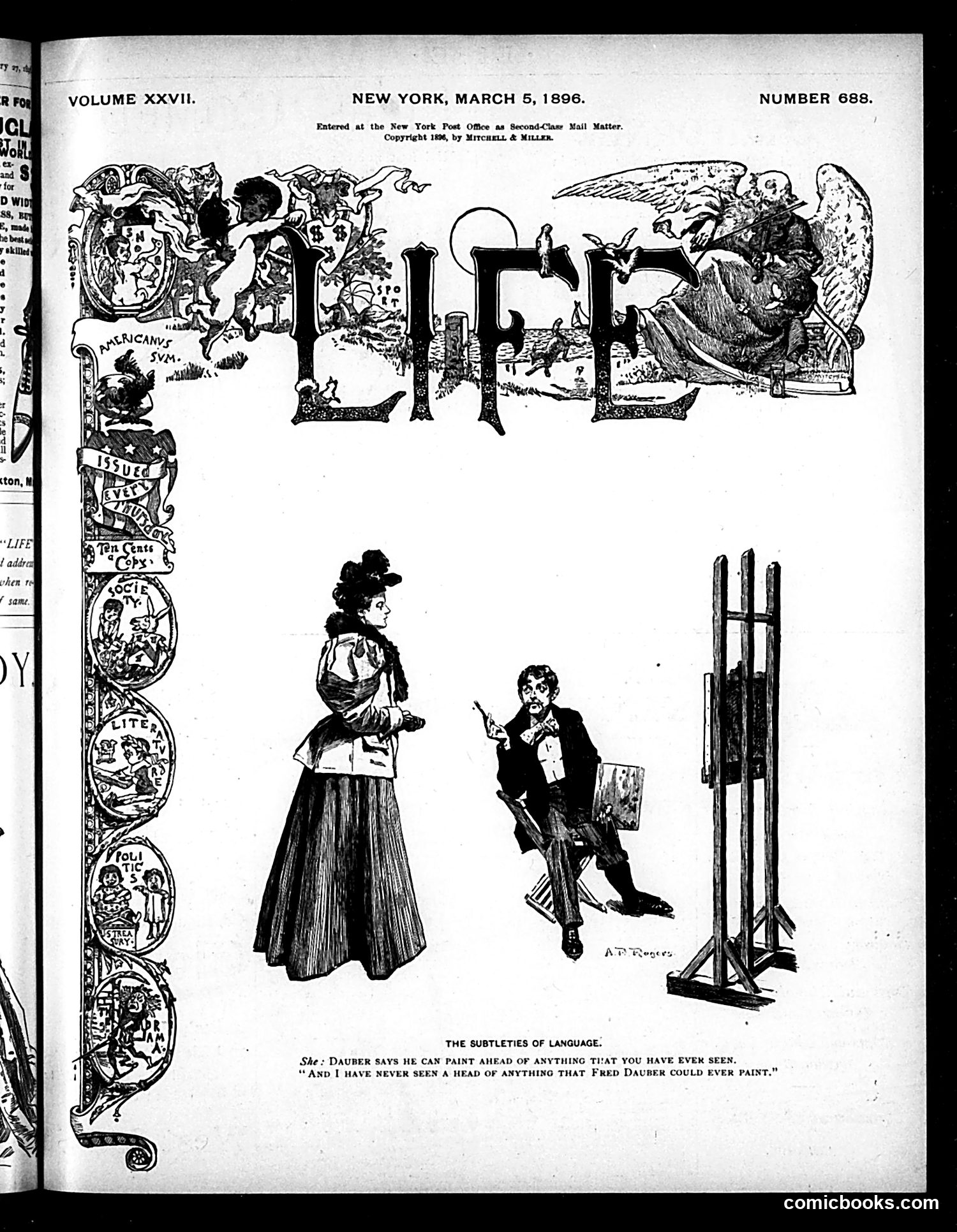
This page's central cartoon, titled "The Subtleties of Language," satirizes artistic pretension through dialogue between two figures—a well-dressed woman and a man holding a painting. The caption quotes the woman saying Dauber can "paint anything," while the man responds he's "never seen a head of anything that Fred Dauber could ever paint." The joke appears to mock a contemporary artist named Dauber for his inability to render heads competently—a fundamental artistic skill. This is satirical commentary on mediocre or fraudulent artists of the 1890s who nonetheless attracted wealthy patrons. The ornate decorative border and elaborate typography are characteristic of Life's high-quality design during this period.
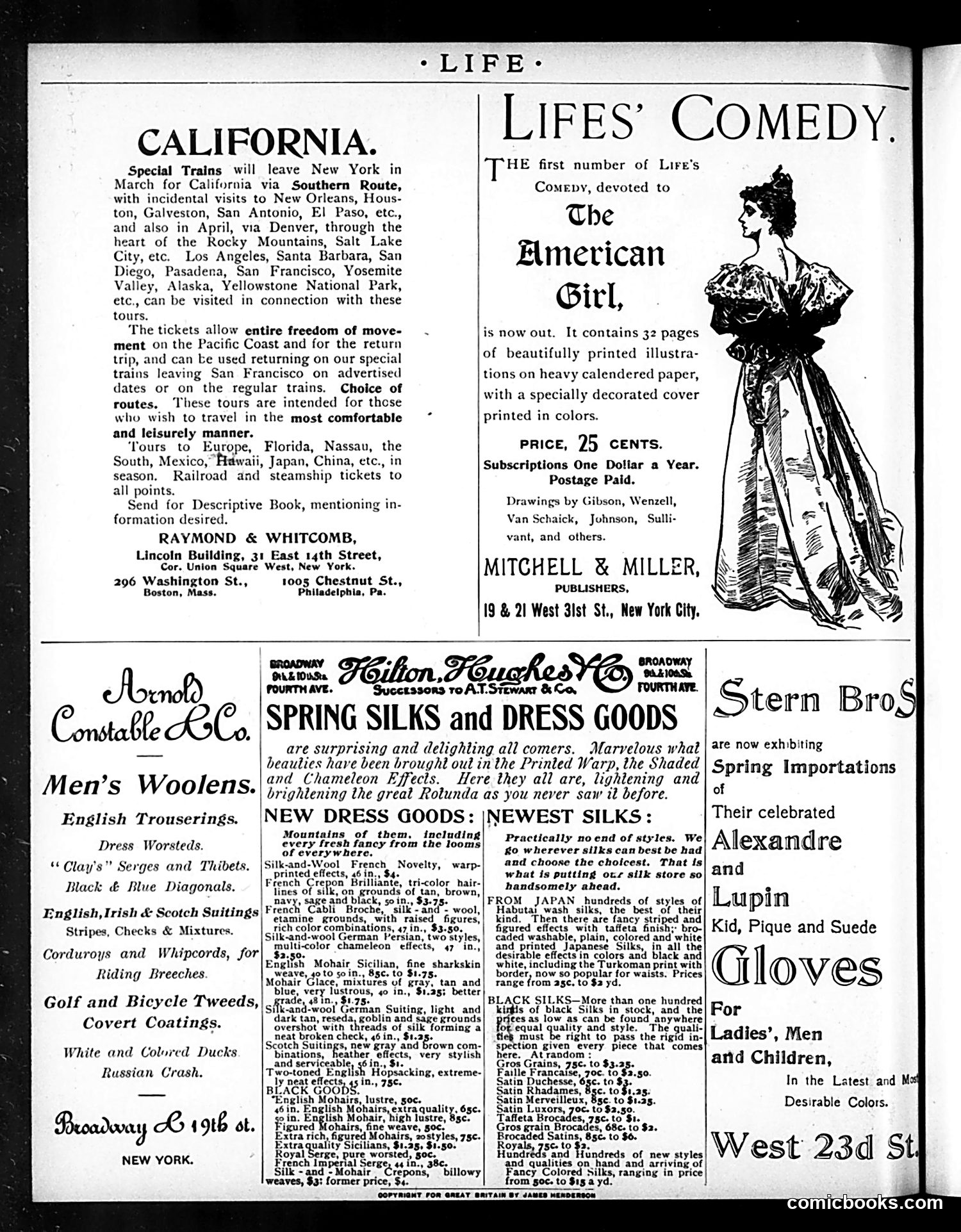
This page is **primarily advertising**, not political satire. The main content includes: 1. **"Life's Comedy" section** (top right): Announces the first issue of *Life*'s "Comedy" devoted to "The American Girl," a 32-page illustrated publication selling for 25 cents, with drawings by Gibson, Wendell, Van Schaick, Johnson, and others. 2. **Commercial advertisements** for: - Raymond & Whitcomb travel tours (California, Europe) - Arnold Constable & Co. (men's woolens) - Hilton Hughes & Co. (spring silks and dress goods) - Stern Bros. (spring clothing imports) The "American Girl" reference likely appeals to Gibson Girl imagery popular in the era, but this page functions as a magazine/merchandise catalog rather than political commentary.
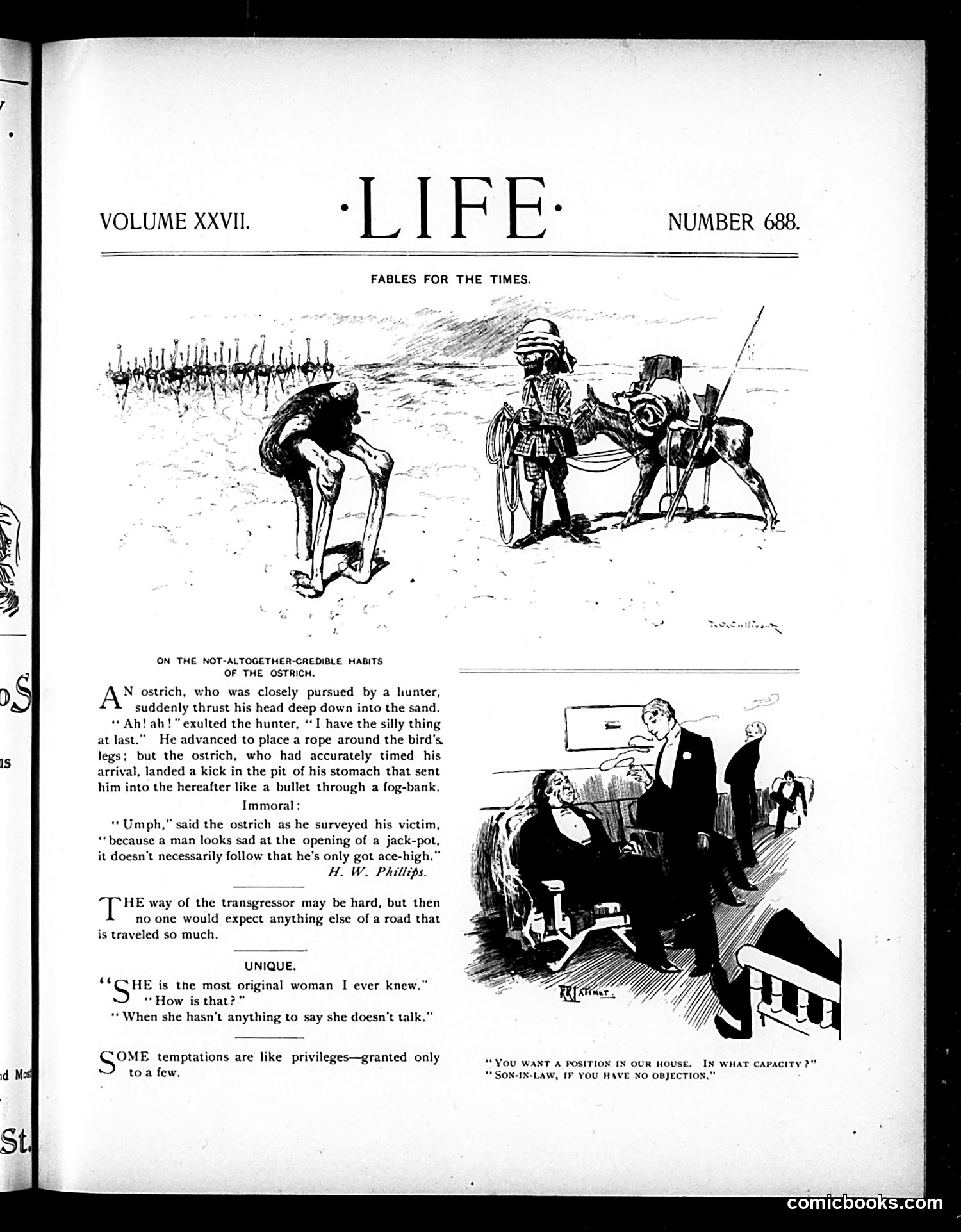
This page contains three separate satirical pieces: 1. **"On the Not-Altogether-Credible Habits of the Ostrich"** — A fable mocking the ostrich's supposed tendency to bury its head in sand when threatened. The hunter catches the bird by timing his arrival to when its head is down, then kicks it. The satire critiques willful ignorance as a failed survival strategy. 2. **"Unique"** — A brief joke about an "original" woman who stays silent when she has nothing to say—presented as paradoxically distinctive behavior. 3. **The cartoon** (right) depicts two well-dressed men interviewing a woman for a household position, asking what capacity she'd serve in. The satire targets either class assumptions about women's domestic roles or employment discrimination based on gender or status.
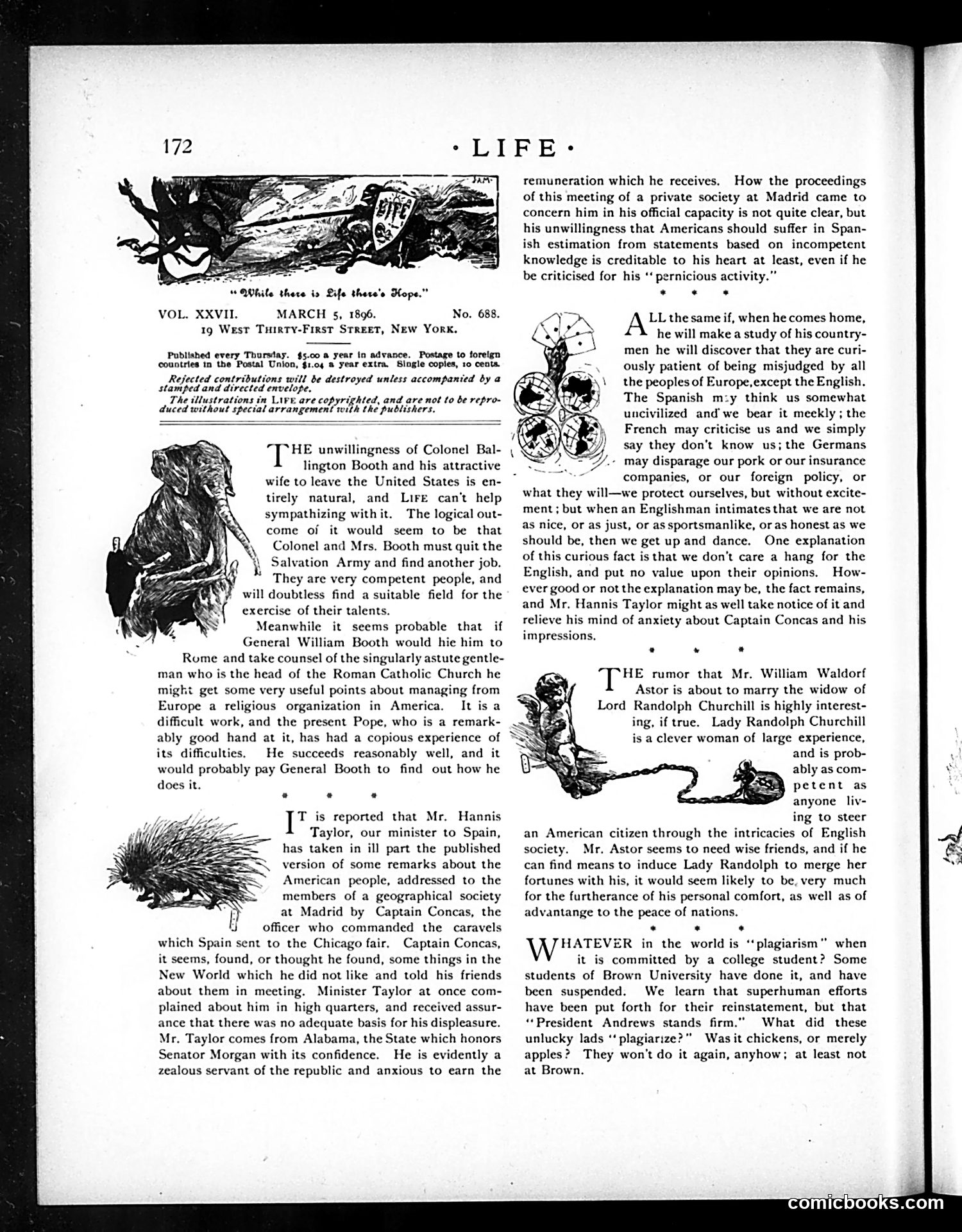
The page contains three satirical sketches accompanying text gossip items. The cartoons illustrate social commentary rather than specific named figures. **Top sketch**: Shows a disheveled man labeled "While there is Life there's Hope"—likely commenting on Colonel Ballington Booth's reluctance to leave the U.S., discussed in the text below. **Middle sketch**: Depicts a sleeping or drowsy figure, accompanying discussion of General William Booth and religious organization management in America. **Bottom sketch**: A spiky-haired creature, relating to gossip about plagiarism at Brown University and President Andrews's disciplinary decisions. The page's primary content is gossipy commentary on American public figures—politicians, religious leaders, and academics—with illustrations serving as visual commentary rather than portraiture. The cartoons use exaggeration and absurdist imagery typical of Life's satirical style.
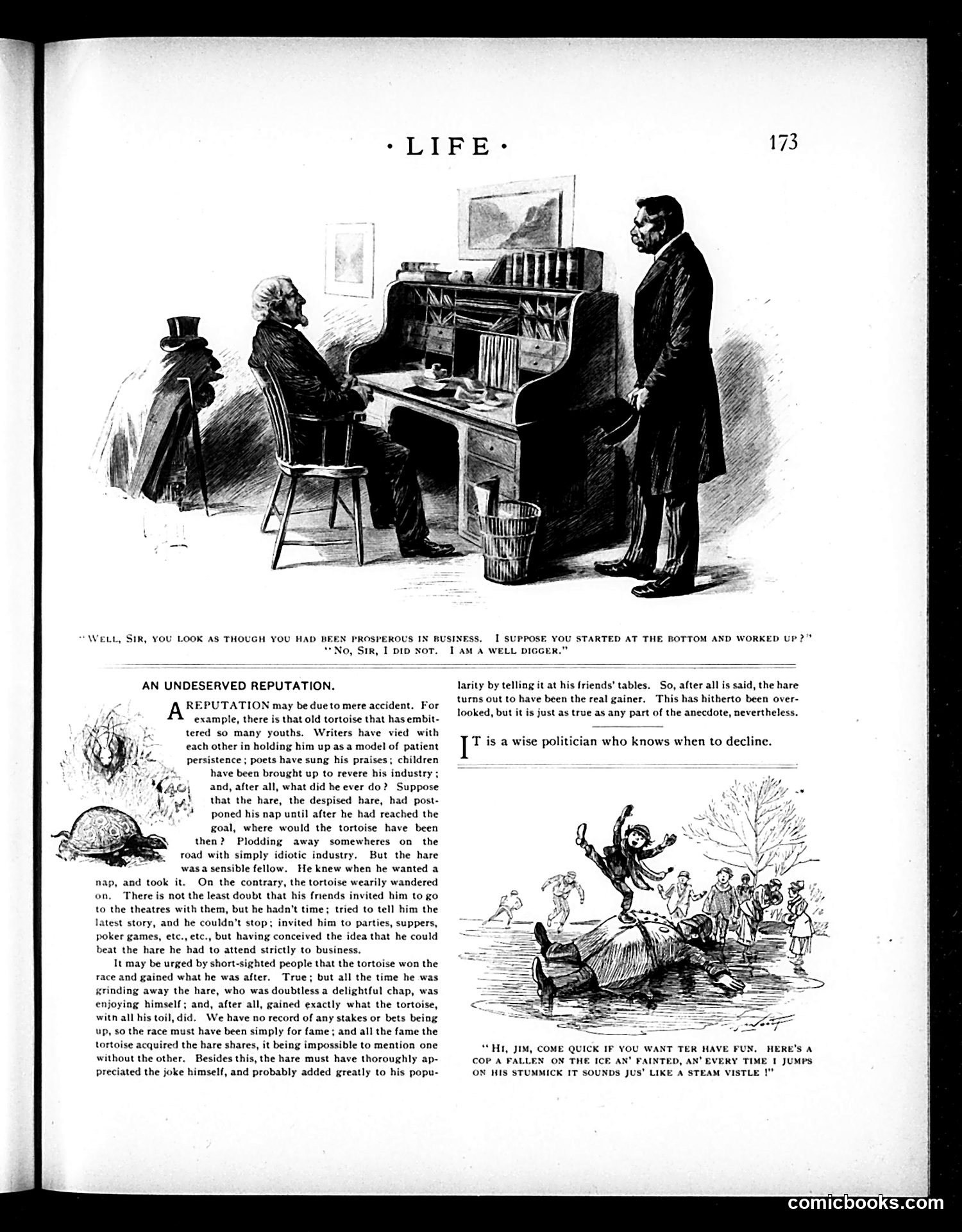
**Top Cartoon:** A business inquiry scene where a gentleman asks another how he achieved prosperity, expecting to hear he "started at the bottom and worked up." The response—"No, Sir, I did not. I am a well digger"—is the joke's punchline, playing on the literal meaning of "bottom" in an occupation that involves digging downward. This satirizes assumptions about social mobility and self-made success narratives. **"An Undeserved Reputation" Article:** The text discusses how reputations can result from accident rather than merit, using a tortoise and hare fable analogy. It suggests undeserved credit accumulates through social popularity and anecdotes rather than actual achievement—a critique of how fame functions independent of genuine accomplishment. **Bottom Cartoon:** Depicts children playing on ice, with text suggesting winter activities and potential danger.
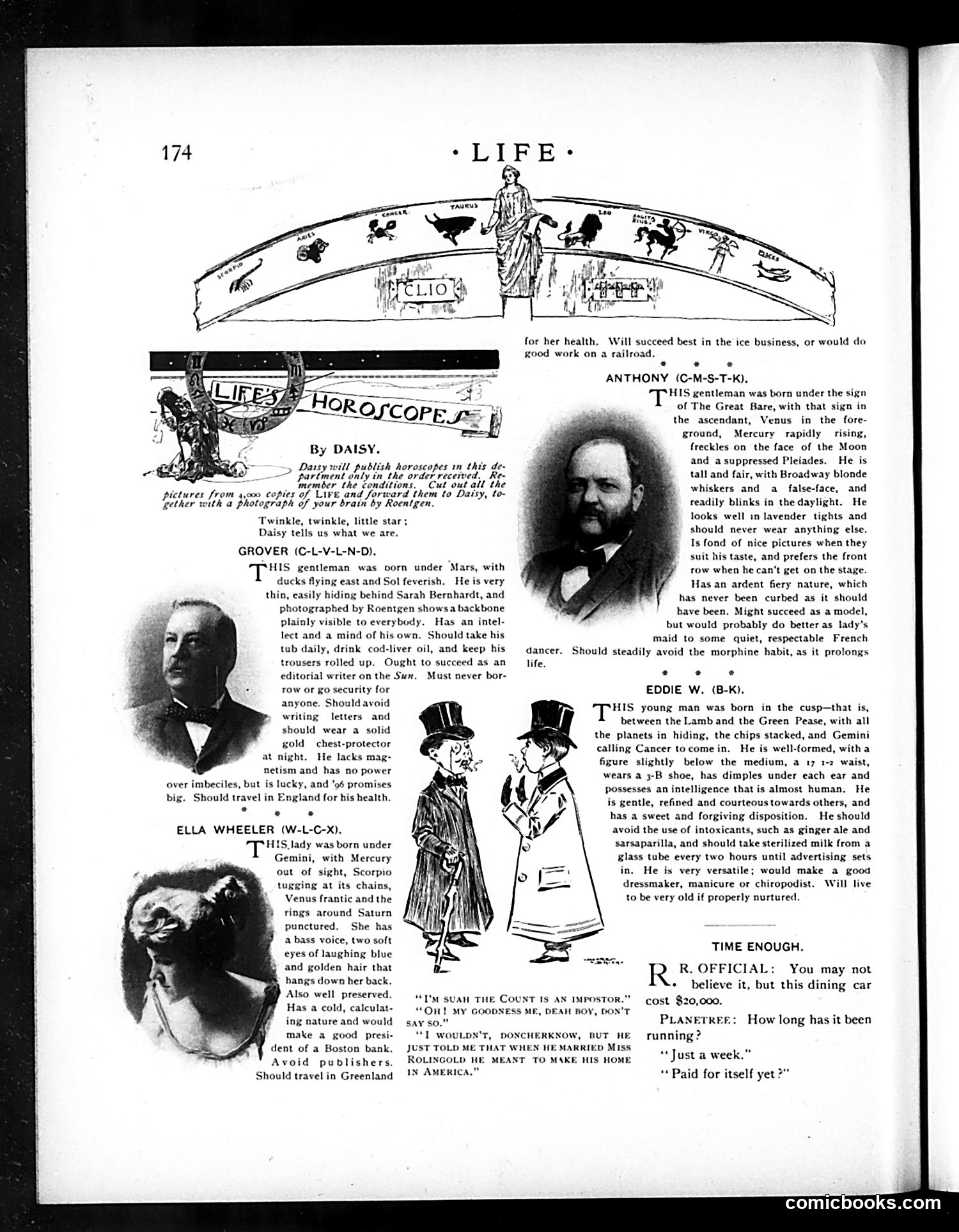
This page contains astrological character readings titled "Life's Horoscope" by Daisy, along with biographical sketches of three individuals: Grover, Ella Wheeler, and Anthony, plus Eddie W. The horoscope feature appears to be satirical character analysis based on birth signs—a popular entertainment form. Each person receives tongue-in-cheek personality assessments and life advice supposedly derived from their astrological sign. At bottom, a brief humor sketch titled "Time Enough" depicts two men discussing an expensive dining car ($20,000) that's been running only a week, questioning if it's "paid for itself yet"—likely satirizing American business optimism during the early 1900s. The page mixes popular pseudoscience (astrology) with social commentary typical of Life's satirical approach to American culture.
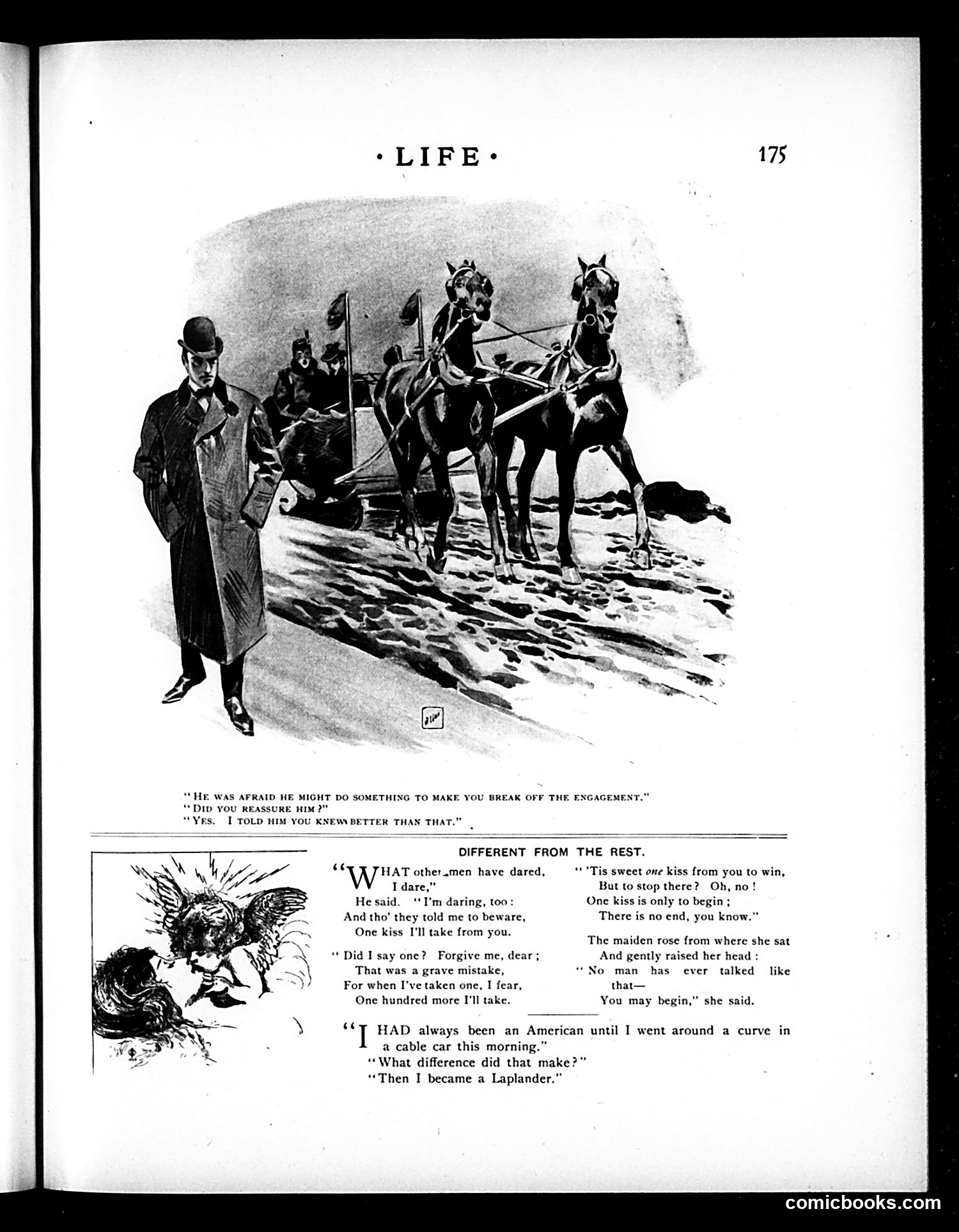
This page contains two distinct pieces of humor: **Top Cartoon:** Shows a well-dressed man observing military officers with a horse-drawn carriage. The caption suggests he feared doing something to break off an engagement—implying anxiety about a romantic commitment. **"Different from the Rest" Section:** A poem about romantic boldness, featuring a small illustration of cherubs/cupids. The poem plays on the conceit that kisses are progressive ("One kiss is only to begin"). **Bottom Anecdote:** A brief joke about American identity. Someone claims they "always been an American until I went around a curve in a cable car this morning," then became a "Laplander"—suggesting the violent motion made them seasick or disoriented, humorously questioning their national identity through physical distress. The humor relies on romantic conventions and wordplay typical of early 20th-century magazine satire.
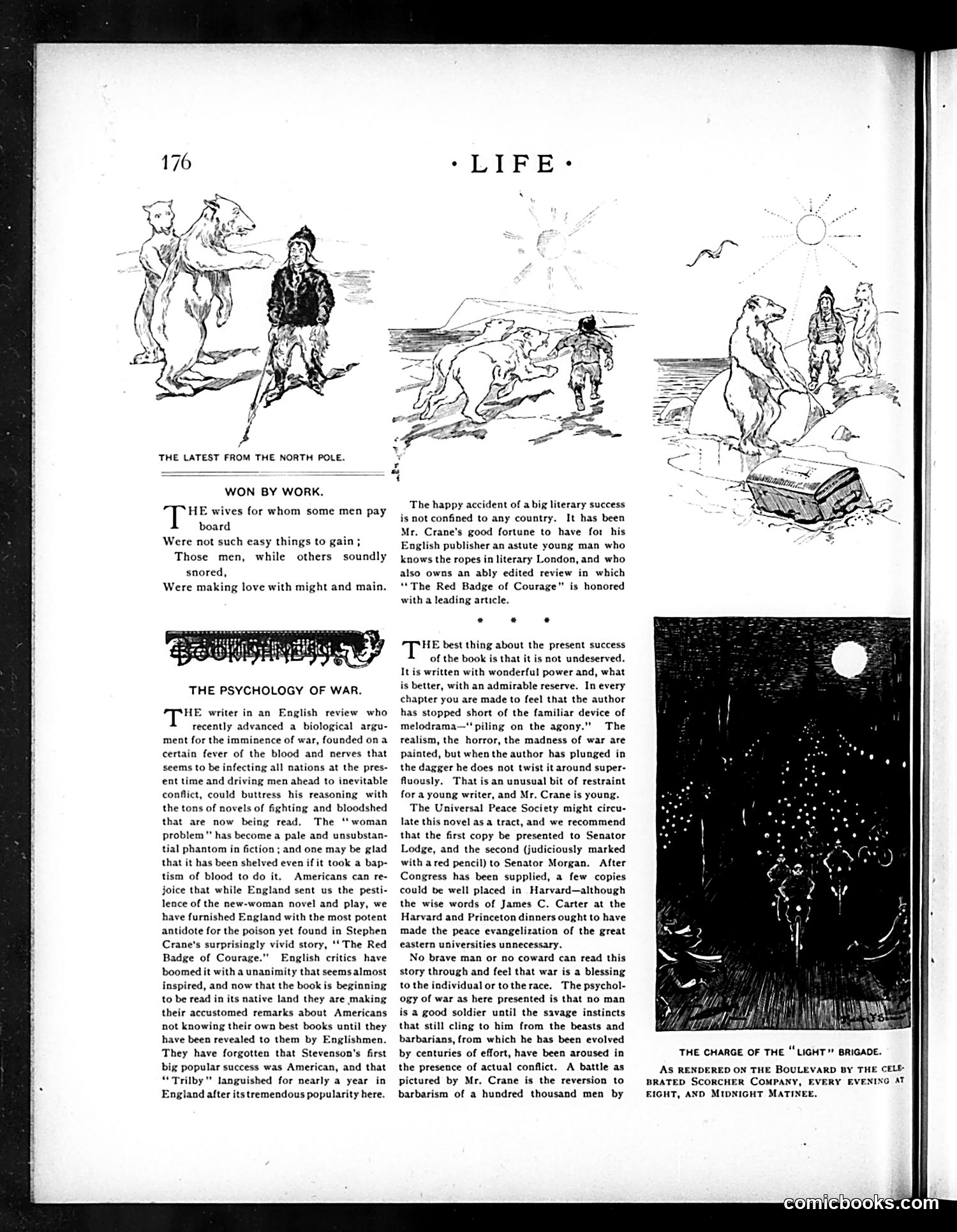
This page from *Life* magazine contains literary reviews and satirical illustrations rather than political cartoons. The top illustrations mock Arctic exploration ("The Latest from the North Pole") and appear to reference contemporary polar expeditions with exaggerated, comedic depictions of explorers. The main text reviews Stephen Crane's novel "The Red Badge of Courage," praising its psychological realism about war. The critic argues the book's power lies in showing war's dehumanizing effects—that combat awakens "savage instincts" in men, reducing them to beasts. The reviewer recommends distributing copies to Senator Lodge and other political figures as anti-war advocacy, suggesting the novel serves as a "peace evangelization" tract against militarism. The bottom illustration captioned "The Charge of the 'Light' Brigade" appears to satirize famous military engagements, rendered as absurdist theater.
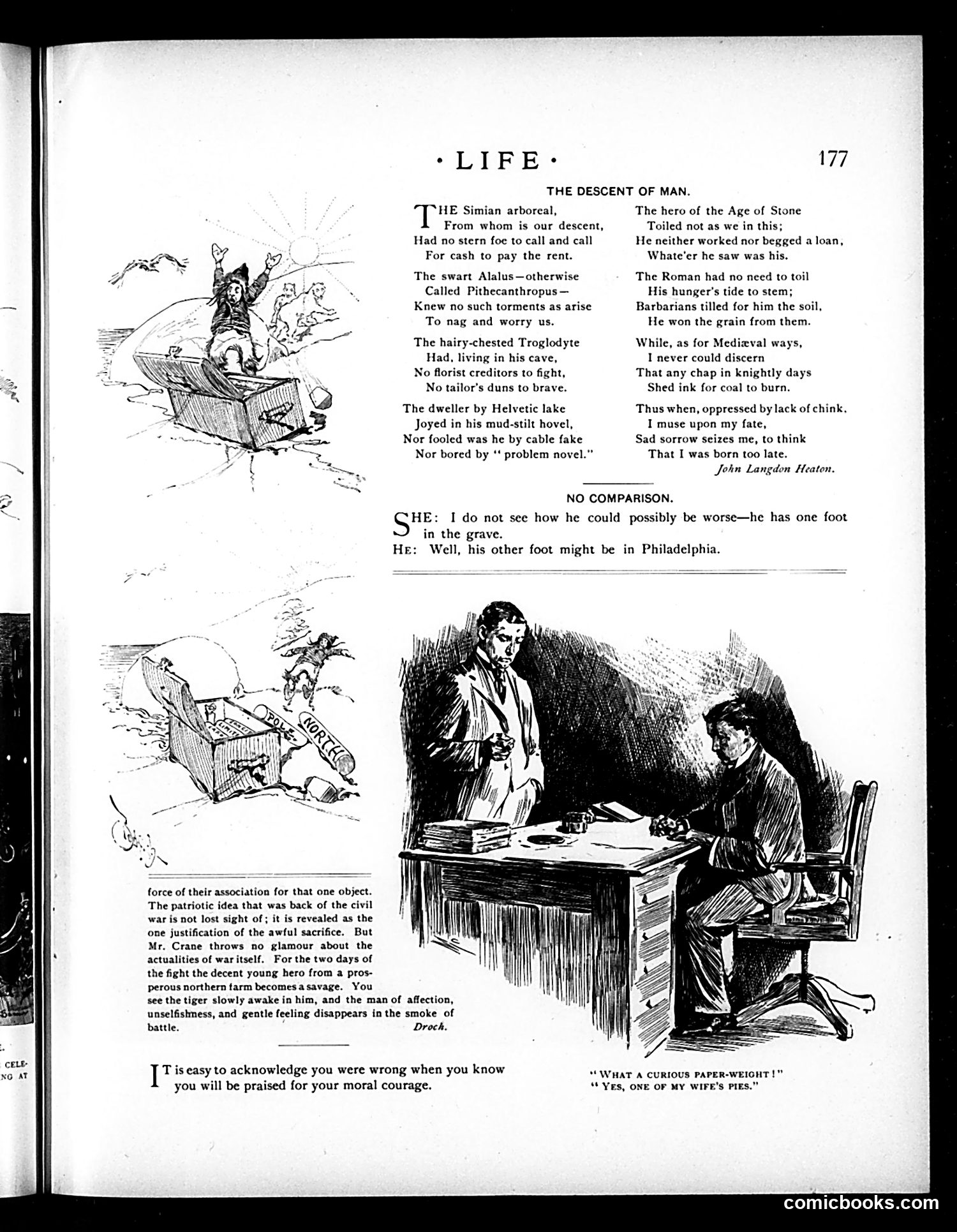
This page contains satirical humor about American social commentary. "The Descent of Man" is a mock-heroic poem mocking evolutionary theory and modern civilization, contrasting primitive ancestors (Simian arboreal, Pithecanthropus, Troglodyte) with contemporary struggles—debts, lack of labor-saving devices, and Medieval hardships. The dialogue joke "No Comparison" satirizes a couple's domestic complaint: one spouse's death would be preferable to Philadelphia (likely referencing the city's reputation or conditions at the time). The lower illustration shows two men at a desk with the caption "What a curious paper-weight!" / "Yes, one of my wife's pies"—a joke about the wife's terrible cooking, a common domestic humor trope of the era.
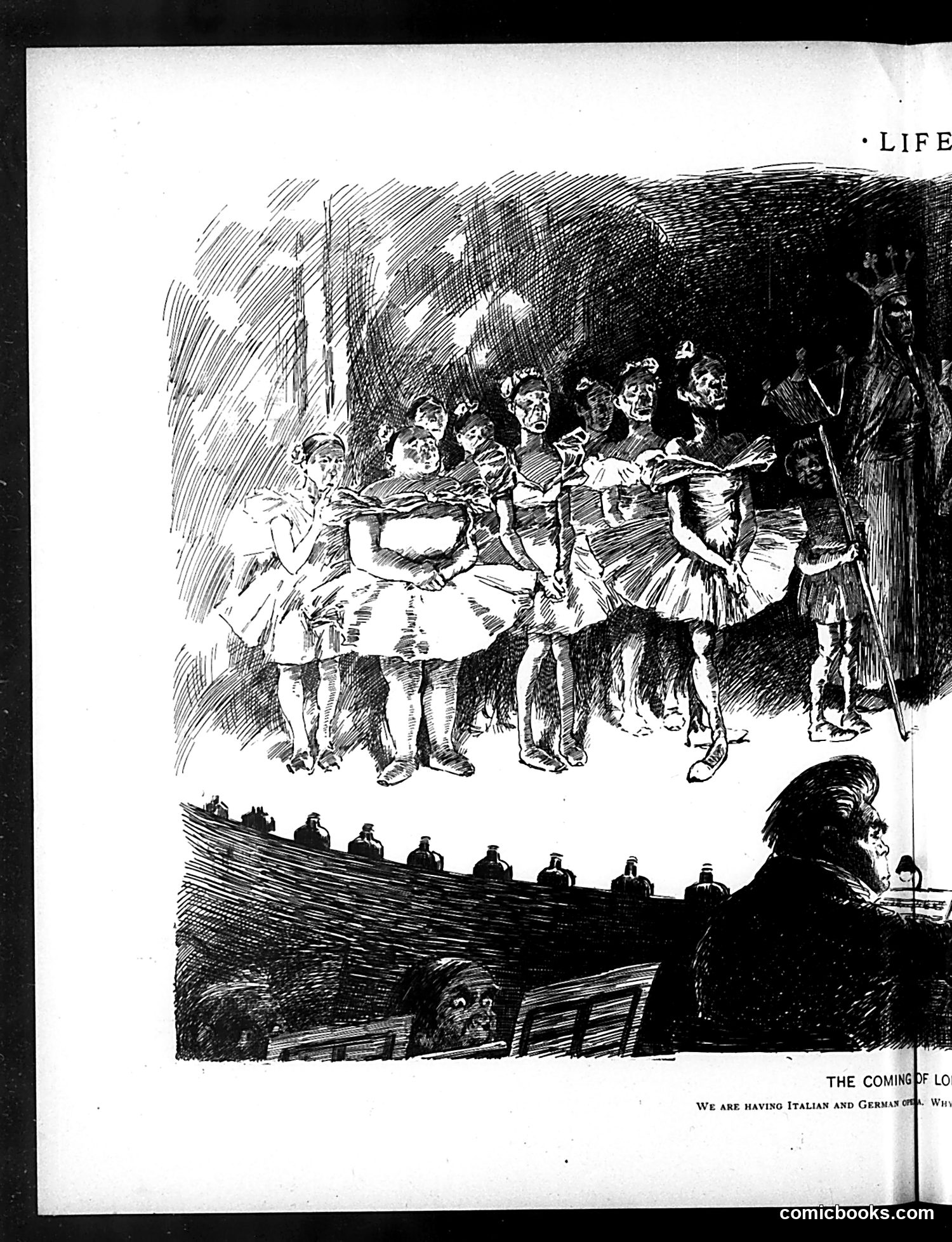
This appears to be a satirical illustration from *Life* magazine depicting a theatrical or operatic performance. The upper panel shows a line of ballet dancers or performers in tutus on stage, with an audience visible in shadow behind them. The lower panel shows an audience member in profile watching the performance. The partially visible text at bottom reads "THE COMING OF LO[?]" and mentions "Italian and German o[?]" suggesting this references European opera or classical performance. The caricatured style and theatrical subject matter are typical of *Life*'s early 20th-century satirical approach to high culture. Without the complete caption, the specific satirical point remains unclear—it may mock pretentious theater-goers, opera itself, or possibly contemporaneous European political/cultural figures, but the evidence visible here doesn't definitively support any single interpretation.
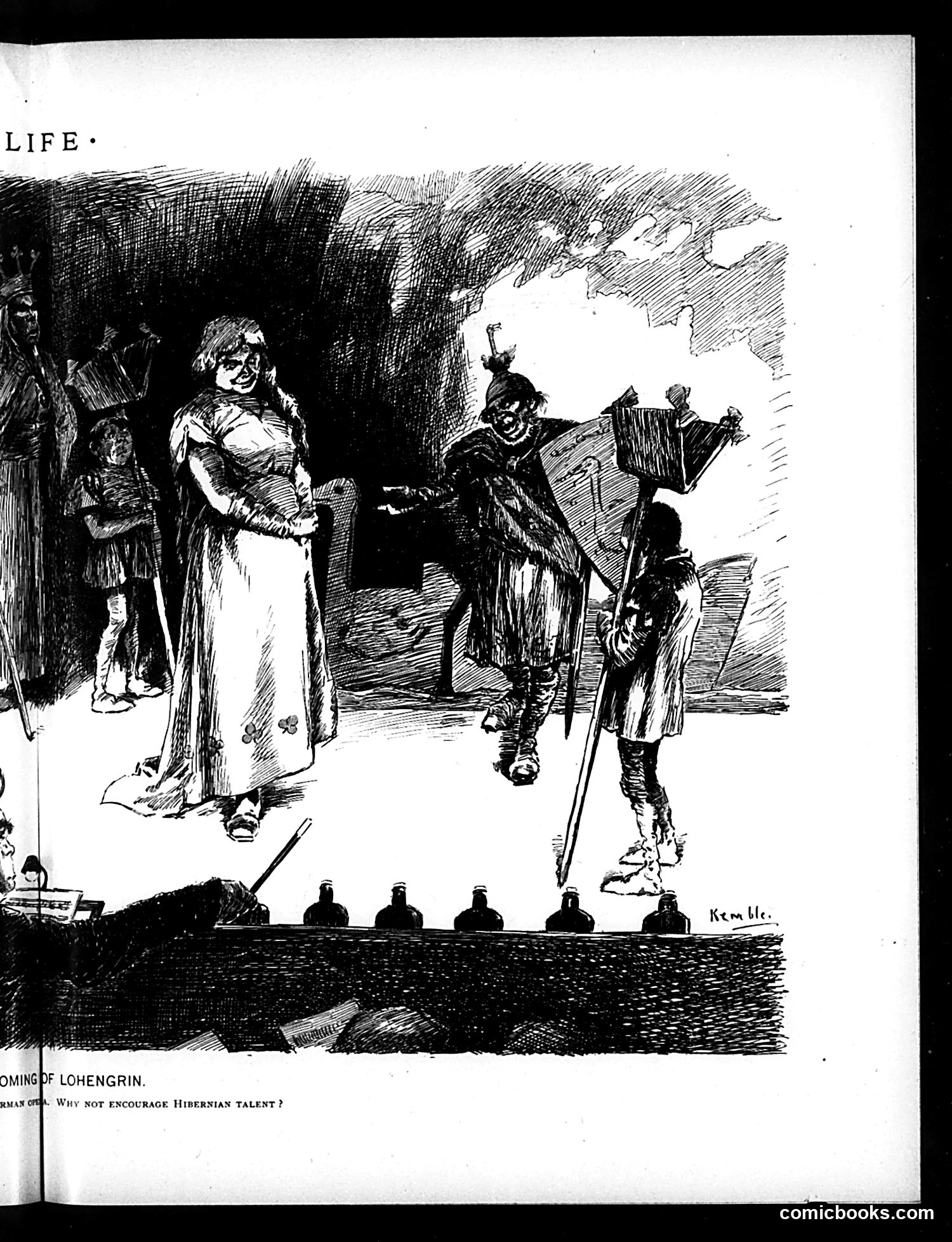
This cartoon appears to reference Wagner's opera "Lohengrin" (visible in the partial caption "OMING OF LOHENGRIN"). The scene depicts a dramatic operatic moment with figures in period costume—a woman in a long dress, soldiers or knights in military attire with swords, and what appears to be a swan boat or vessel at the bottom. The caption fragment reads "WHY NOT ENCOURAGE HIBERNIAN TALENT?" "Hibernian" refers to Irish people. The satire likely critiques either the operatic establishment's treatment of Irish artists, or makes a pointed comment about Irish cultural contributions being overlooked in favor of European (specifically German Wagner) works. The specific joke or political point remains unclear without the complete caption and publication date.
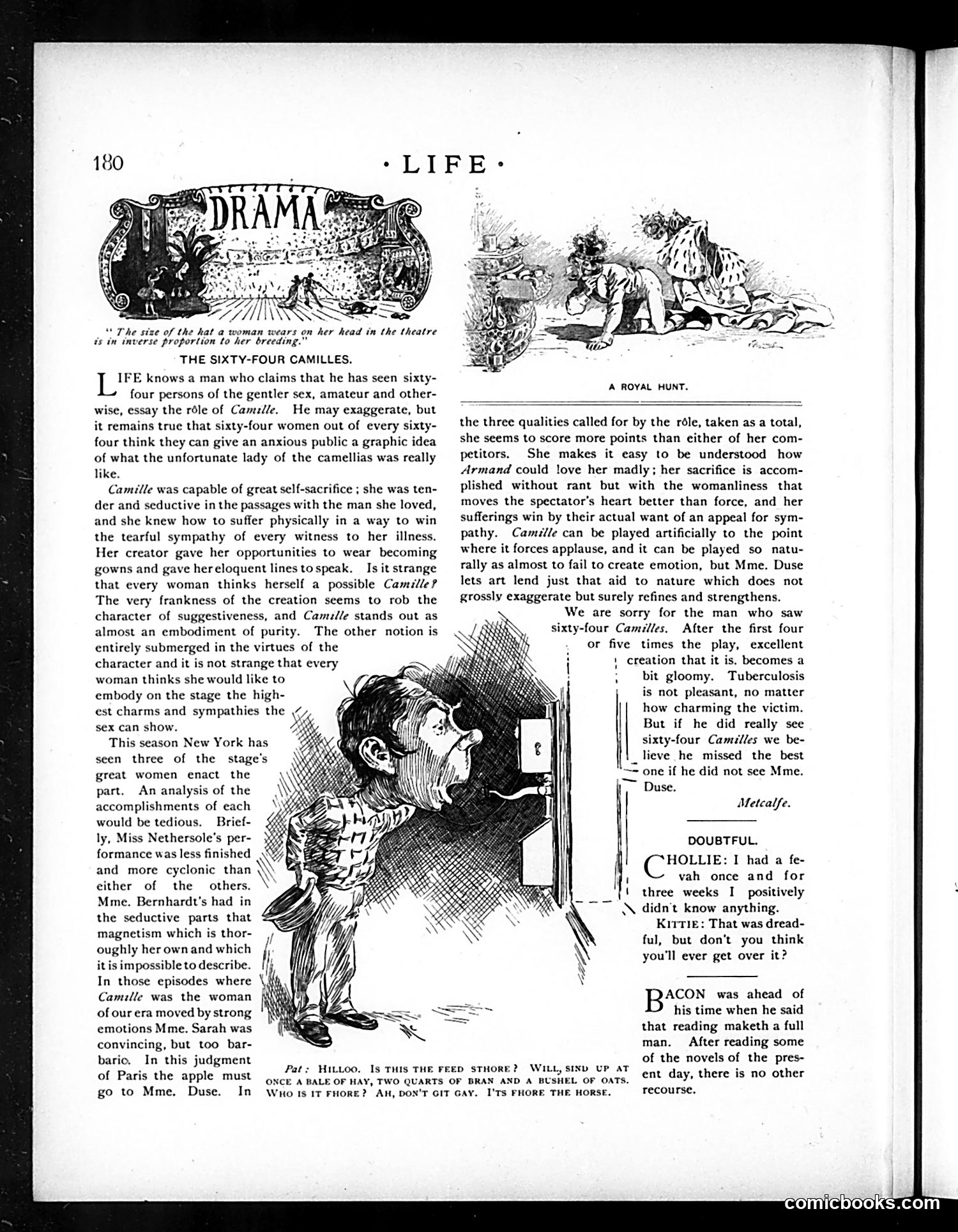
This page critiques three famous actresses performing *La Dame aux Camélias* ("Camille"), a popular 19th-century play. The main article compares performances by **Mme. Bernhardt, Miss Nethersole, and Mme. Duse**, awarding the "apple" (top prize) to Duse for balancing artifice with naturalism—she plays the tragic heroine without excessive emotion or coldness. The satire jokes that every woman believes she could play Camille, given the role's emotional appeal and beautiful costumes. The cartoons are unrelated comic vignettes: one depicts a confused Irish farmhand at a feed store (ethnic humor based on dialect), and another is a brief dialogue about forgetting illness. The opening epigraph mocks theater etiquette—women's oversized hats obstruct views, supposedly inversely proportional to their breeding/manners. A final note satirizes contemporary novels as unreadable.
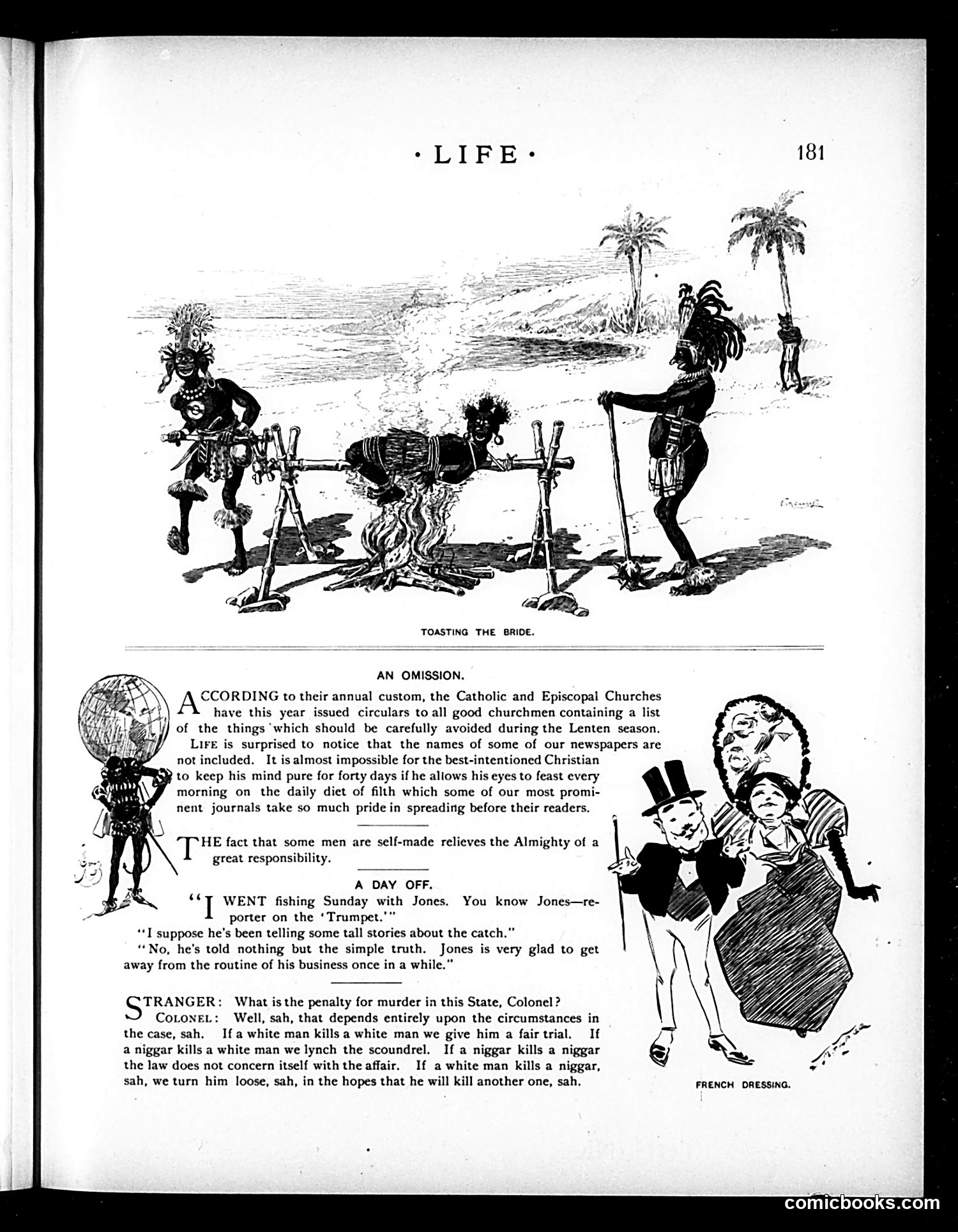
This 1900s *Life* magazine page contains three satirical pieces: **"Toasting the Bride"** (top cartoon): Shows Indigenous figures in an exaggerated, dehumanizing style roasting someone over a fire—a racist stereotype depicting non-Western peoples as cannibals. **"An Omission"**: Critiques newspapers for publishing sensationalist "filth" during Lent, while churches issue guidelines for moral behavior. The satire suggests newspapers should be included on lists of things to avoid. **"A Day Off"**: A brief joke mocking newspaper reporters as liars—the reporter can only tell "simple truth" when away from his job at the *Trumpet*. **The dialogue about murder penalties**: This is deeply disturbing by modern standards. A colonel describes a racist, lawless system where Black people can be lynched for killing whites, Black-on-Black violence is ignored, and white men killing Black people go free or are encouraged to kill more. This reflects the actual legal injustices of the Jim Crow era, presented here apparently as dark satire of Southern brutality.
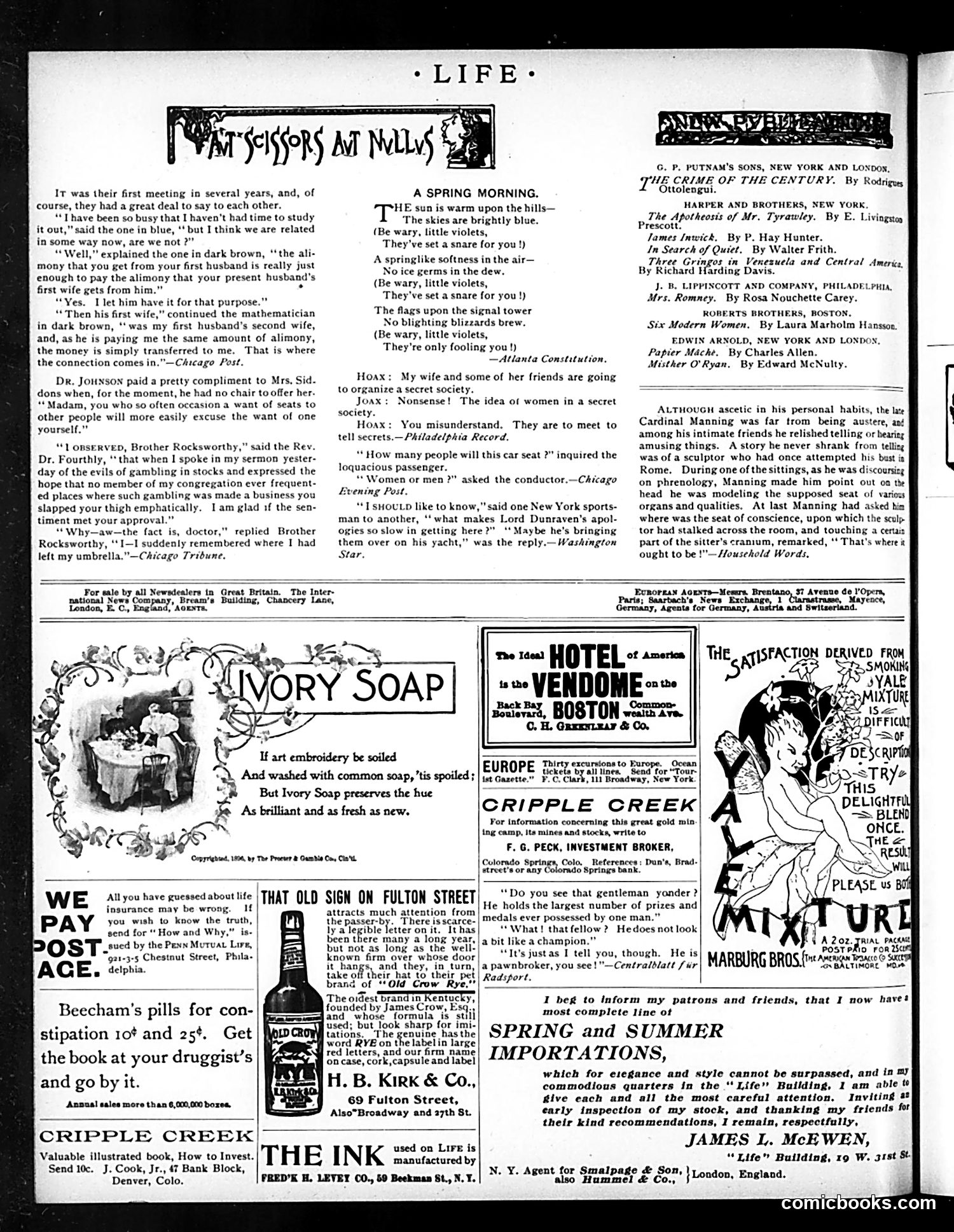
This page from *Life* magazine contains mostly **advertisements and literary notices** rather than political cartoons. The text includes several **humorous anecdotes** typical of the era's satirical humor: 1. **The "Alimony" joke**: Two women discuss their convoluted relationship through multiple marriages and alimony payments—satirizing the complexities (and apparent absurdity) of turn-of-century divorce and financial entanglements among the wealthy. 2. **The "Secret Society" joke**: Mocks women organizing a group that claims secrecy but will actually "meet to tell secrets"—a jab at female social organizations as inherently unable to keep confidential information. 3. **The "Spring Morning" poem**: Uses springtime's false beauty as metaphor for hidden danger ("snare"), though the specific reference is unclear without fuller context. The page is primarily **advertising space** (Ivory Soap, Beecham's Pills, hotels) with book advertisements, making it representative of *Life*'s mixed editorial-commercial format rather than a vehicle for pointed political satire.
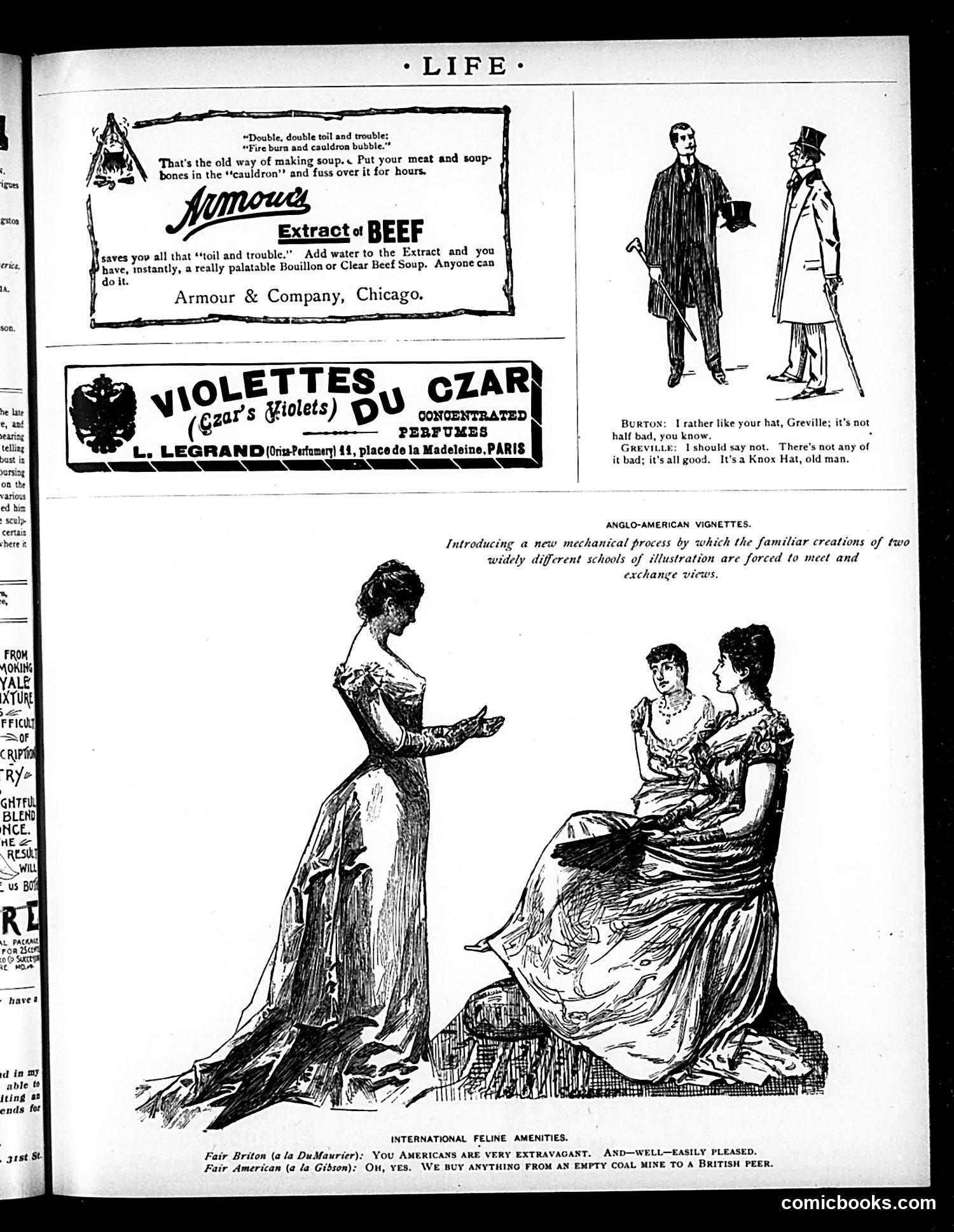
This page mixes **advertisements** with **satirical cartoons** about Anglo-American cultural differences. The top ads promote Armour beef extract (contrasting old tedious soup-making with instant modern convenience) and French perfumes and hats—typical early 20th-century luxury goods. The main cartoon, titled "Anglo-American Vignettes," depicts a social exchange between a British woman (drawn in the refined "DuMaurier" style) and an American woman (in the "Gibson Girl" style). The joke is a mutual stereotype: the Brit accuses Americans of being extravagant and easily impressed; the American retorts that Americans will buy *anything*—even worthless British exports like "an empty coal mine" or a "British peer" (implying British aristocrats are being imported as marriage prospects for wealthy American women). The satire reflects real Gilded Age anxieties about American wealth, transatlantic marriages, and cultural snobbery between nations.
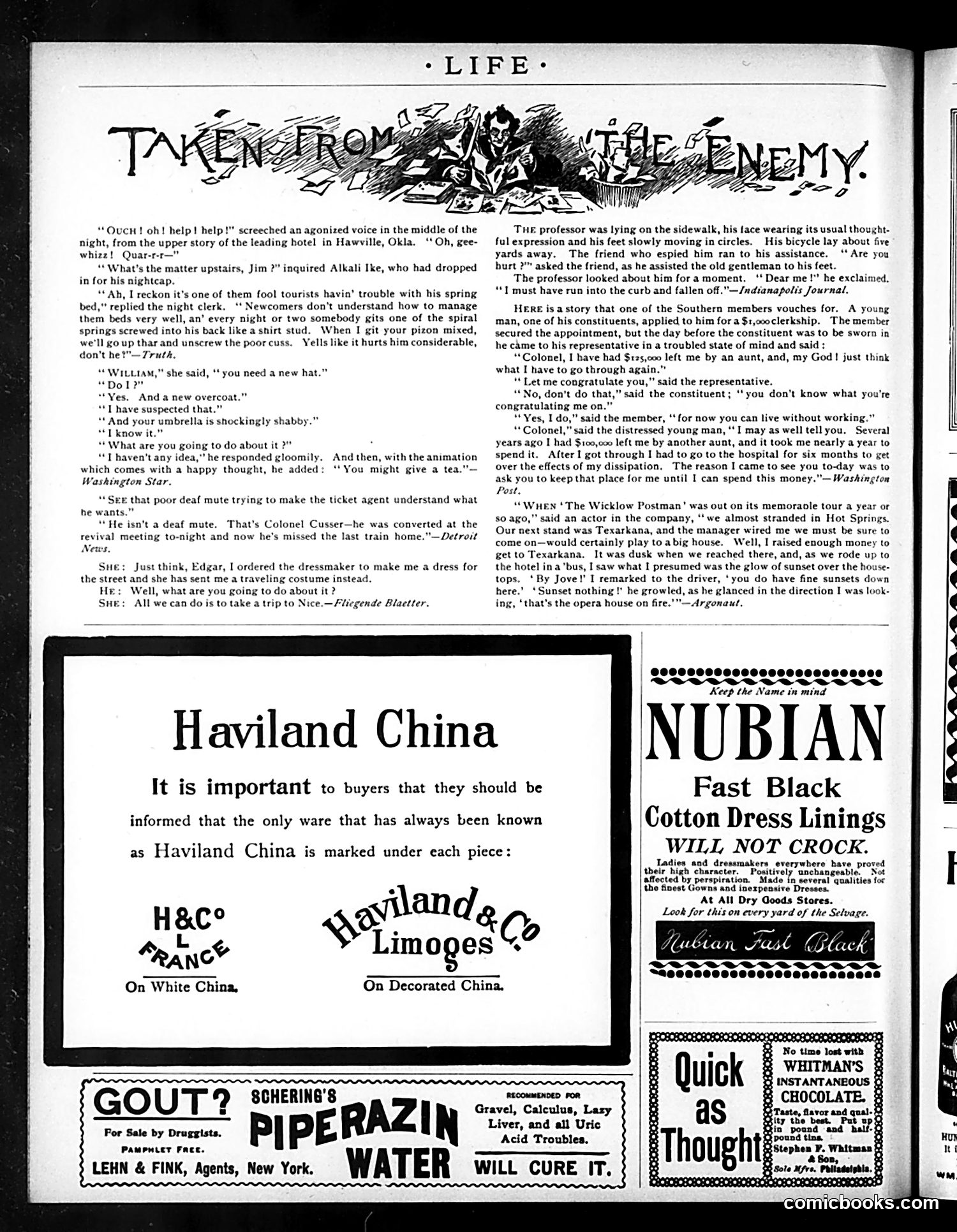
This page contains multiple short humorous anecdotes typical of Life magazine's satirical format. The main story concerns a tourist at a hotel in "Hawville, Okla" who gets a spring from a bed lodged in his back—a joke about newcomers' ignorance of how to operate unfamiliar furniture. Other brief jokes mock: a wife's hints about her husband needing new clothes; a man mistaken for a deaf-mute (actually a reformed drunkard who missed his train); a woman ordering a traveling costume instead of a street dress; an absent-minded professor who falls off his bicycle; and a young man troubled by inheriting sudden wealth. These sketches satirize middle-class anxieties, foolish behavior, and social pretension. The humor is gentle and domestic rather than political. The page also contains period advertisements for china, liniments, and fabric dyes.
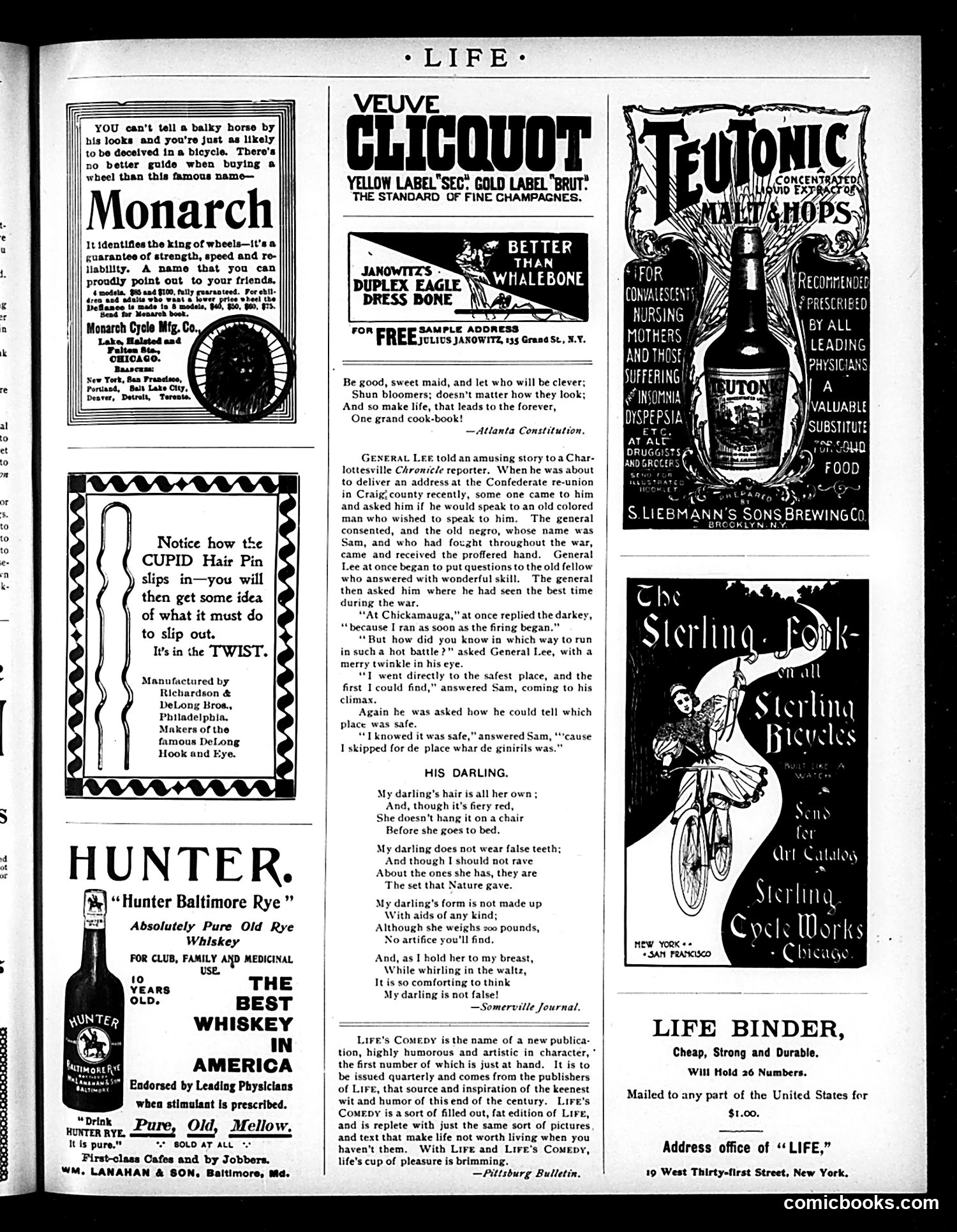
This is primarily an **advertising page** from Life magazine featuring various product endorsements and promotional content, interspersed with light editorial humor typical of the era. **Key Content:** The ads promote luxury goods: Monarch bicycles, Cliquot champagne, Hunter whiskey, and Sterling bicycles—products marketed to affluent readers. The "Cupid Hair Pin" ad uses a visual pun about slipping in and out. **Editorial Content:** A humorous anecdote attributes to General Lee a story about an enslaved man named "Sam" who claims he found safety during the Civil War by following where "the ginirals" (generals) ran away. The joke relies on racial stereotyping and dialect mockery common to the period. "His Darling" is sentimental verse praising a woman for being "natural" (not wearing false teeth or artificial aids), despite weighing 200 pounds—reflecting contemporary anxieties about female authenticity and artificiality. **Overall:** This page reflects Gilded Age consumer culture and period attitudes toward race and gender now considered offensive.
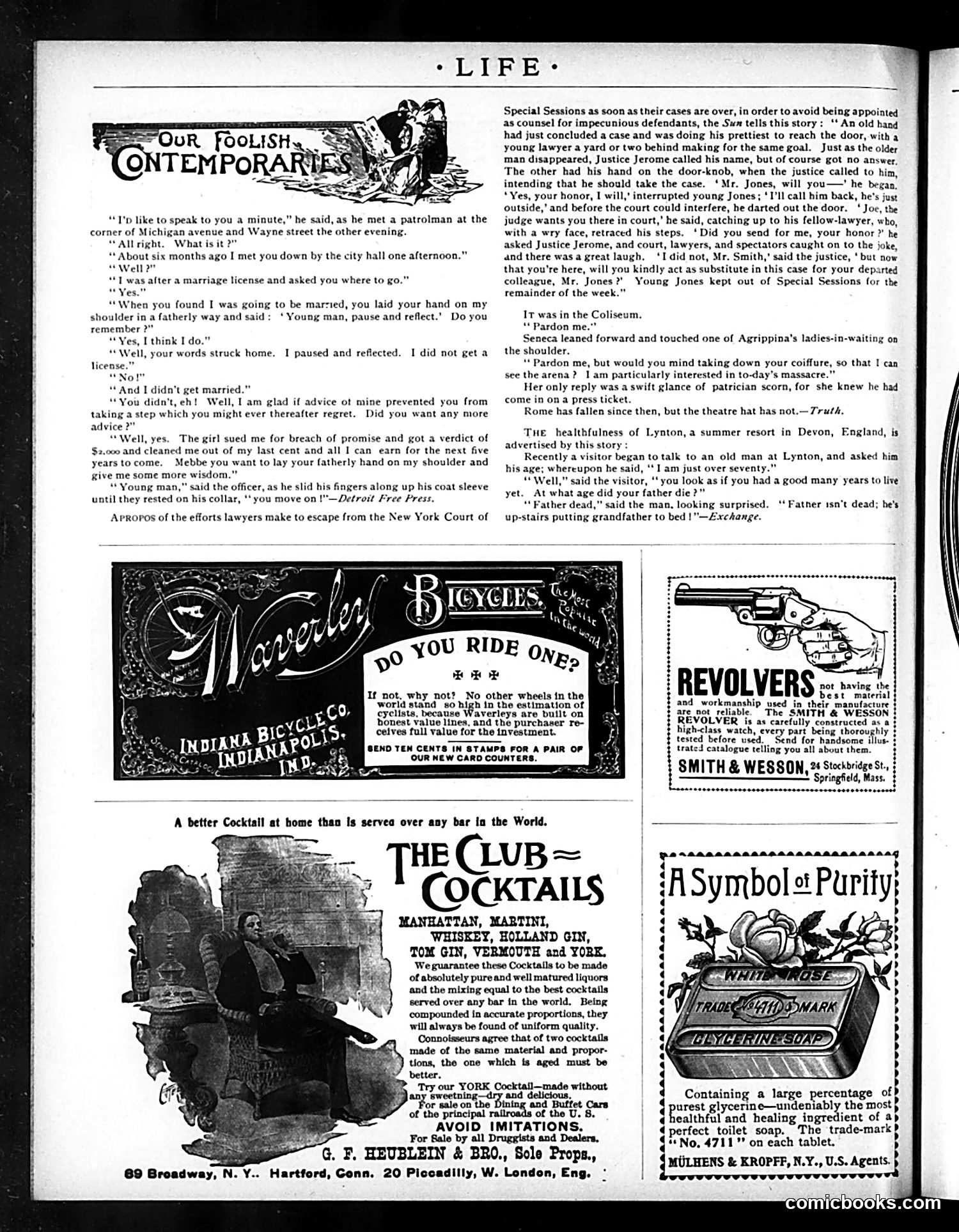
This page contains three humorous anecdotes satirizing American society: 1. **"Our Foolish Contemporaries"** (main cartoon): A man confronts a police officer who previously advised him against marriage. The officer's well-intentioned wisdom backfired—the man didn't marry, but was then sued for breach of promise and lost everything. The satire mocks the officer's attempt to reassert authority with physical intimidation ("move on!") rather than acknowledge his advice caused disaster. 2. **Legal Profession Joke**: Satirizes lawyers' desperation to avoid representing poor defendants in New York courts by showing a young lawyer's trick to foist an unwanted case onto a colleague. 3. **Theater Etiquette**: A Roman-era anecdote about a woman's elaborate hairstyle blocking the view—the final line "the theatre hat has not [fallen]" jokes that this vanity persists unchanged since ancient Rome. The advertisements (bicycles, cocktails, revolvers, soap) are period-typical. Overall, the page satirizes practical consequences of poor judgment and social pretension.
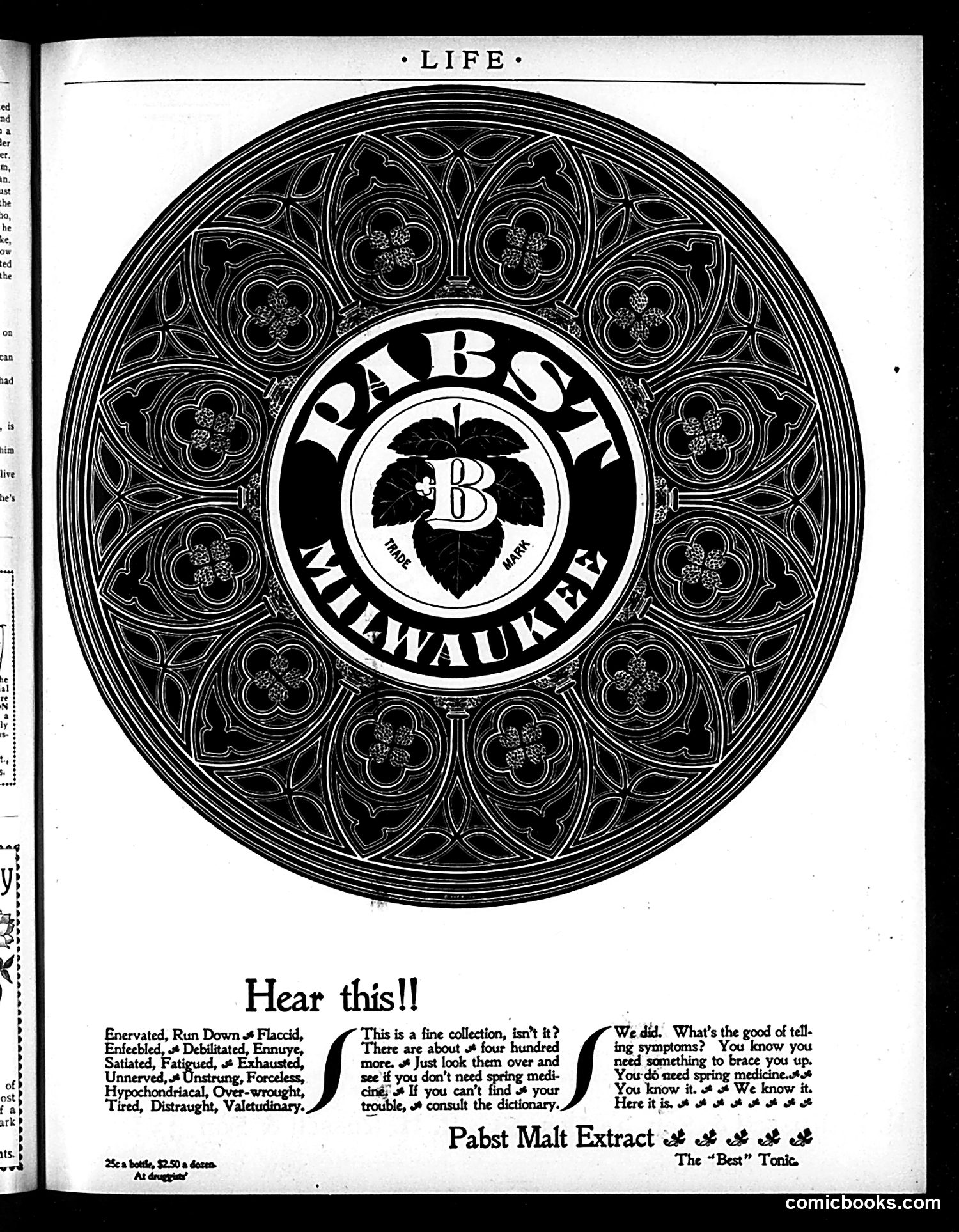
This is primarily a **patent medicine advertisement** rather than political satire. The page uses exaggerated medical language to mock hypochondriacs and those suffering from vague "modern ailments." The ornate circular design frames the Pabst Milwaukee beer logo. The text below lists afflictions in deliberately ridiculous fashion—"Enervated," "Flaccid," "Valetudinary"—suggesting weak, anxious men of the era. The conversational copy acknowledges readers already *know* they're sickly and need a tonic, using informal language ("You know you..."). **The satire targets**: Not politics, but consumer culture itself. It mocks both the proliferation of dubious "spring medicines" and the gullible patients who bought them. By explicitly stating "You know you need spring medicine," it's humorously acknowledging the absurdity of the patent medicine industry's manipulation—yet still selling the product as "The 'Best' Tonic." This reflects early 1900s skepticism toward unregulated medical claims, though Pabst Malt Extract was marketed as a legitimate health tonic (malt extract *was* used medicinally then).
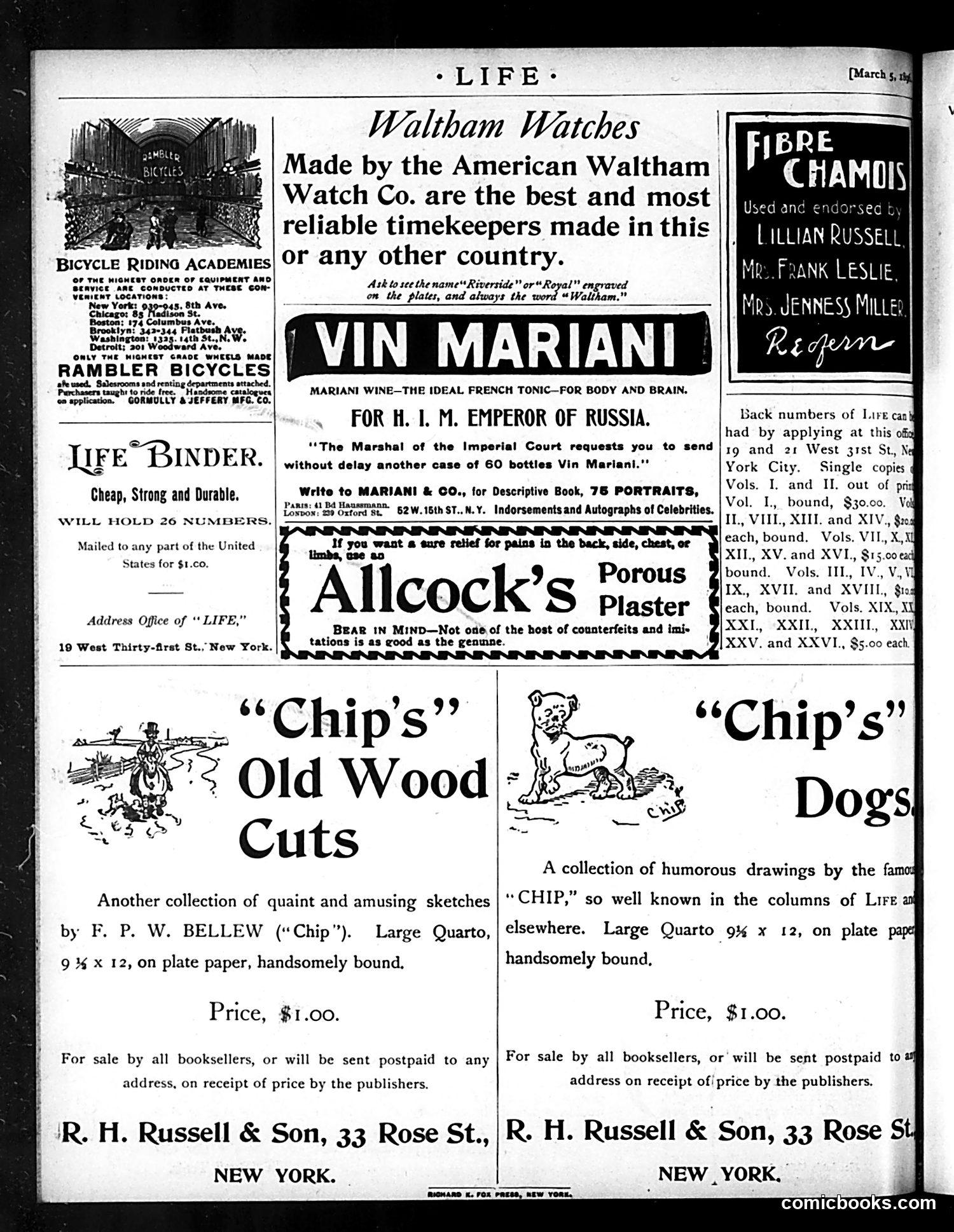
This is primarily an **advertising page** rather than editorial content. The advertisements reveal the commercial landscape and consumer culture of 1890s America: **Notable ads include:** - **Waltham Watches**: American-made timepieces marketed as superior to foreign competitors - **Vin Mariani**: A French wine tonic advertised with a conspicuous endorsement from the Russian Emperor's court—a striking international prestige claim - **Allcock's Porous Plaster**: Patent medicine claiming superiority over counterfeits - **"Chip's" cartoon collections**: Two volumes of humorous drawings by F.P.W. Bellew, a cartoonist for *Life* magazine itself The page also advertises *Life* back issues and a binder to collect them, indicating the magazine's establishment popularity. The **Vin Mariani ad** is most historically notable: the wine was a legitimate product containing coca leaf extract, marketed as a health tonic before cocaine regulation. The Russian imperial endorsement lent credibility in an era when celebrity/royal endorsements were newly powerful marketing tools.