
Life, 1896-03-05 · page 8 of 20
Life — March 5, 1896 — page 8: what you’re looking at
What you’re looking at
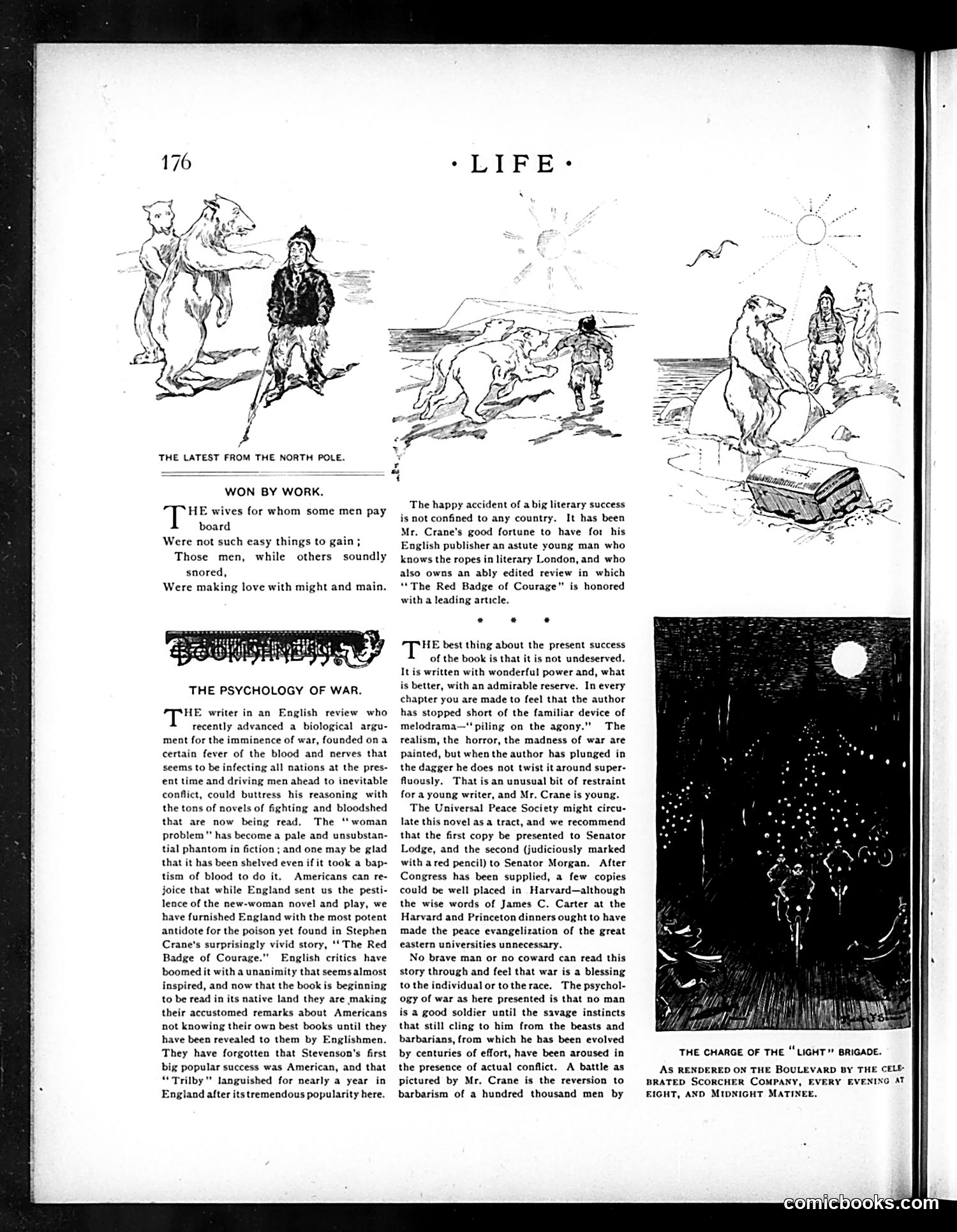
This page from *Life* magazine contains literary reviews and satirical illustrations rather than political cartoons. The top illustrations mock Arctic exploration ("The Latest from the North Pole") and appear to reference contemporary polar expeditions with exaggerated, comedic depictions of explorers. The main text reviews Stephen Crane's novel "The Red Badge of Courage," praising its psychological realism about war. The critic argues the book's power lies in showing war's dehumanizing effects—that combat awakens "savage instincts" in men, reducing them to beasts. The reviewer recommends distributing copies to Senator Lodge and other political figures as anti-war advocacy, suggesting the novel serves as a "peace evangelization" tract against militarism. The bottom illustration captioned "The Charge of the 'Light' Brigade" appears to satirize famous military engagements, rendered as absurdist theater.
📄 Transcribed text from this page (OCR, searchable)
Machine-transcribed from the original scan — historical spelling and the odd misread are preserved.
THE LATEST FROM THE NORTH POLE. WON BY WORK. HE wives for whom some men pay board Were not such easy things to gain; Those men, while others soundly snored, Were making love with might and main. THE PSYCHOLOGY OF WAR. HE writer in an English review who recently advanced a biological argu- ment for the imminence of war, founded on a certain fever of the blood and nerves that seems to be infecting all nations at the pres- ent time and driving men ahead to inevitable conflict, could buttress his reasoning with the tons of novels of fighting and bloodshed that are now being read, The “woman problem" has become a pale and unsubstan- tial phantom in fiction ; and one may be glad that it has been shelved even if it took a bap- tism of blood to do it. Americans can re- joice that while England sent us the pesti- lence of the new-woman novel and play, we have furnished England with the most potent antidote for the poison yet found in Stephen Crane's surprisingly vivid story, “The Red Badge of Courage.” English critics have boomed it with a unanimity that seemsalmost inspired, and now that the book is beginning to be read in its native land they are making their accustomed remarks about Americans not knowing their own best books until they have been revealed to them by Englishmen. They have forgotten that Stevenson's first big popular success was American, and that ““Trilby” languished for nearly a year in England after its tremendous popularity here. The happy accident of a big literary success is not confined to any country. It has been Mr. Crane's good fortune to have for his English publisher an astute young man who knows the ropes in literary London, and who also owns an ably edited review in which “The Red Badge of Courage” is honored with a leading article. . * * HE best thing about the present success of the book is that it is not undeserved. It is written with wonderful power and, what is better, with an admirable reserve. In every chapter you are made to feel that the author has stopped short of the familiar device of melodrama—" piling on the agon: The realism, the horror, the madness of war are painted, but when the author has plunged in the dagger he does not twist it around super- fluously. That is an unusual bit of restraint for a young writer, and Mr. Crane is young. The Universal Peace Society might circu- late this novel asa tract, and we recommend that the first copy be presented to Senator Lodge, and the second (judiciously marked with ared pencil) to Senator Morgan. After Congress has been supplied, a few copies could be well placed in Harvard—although the wise words of James C. Carter at the Harvard and Princeton dinners ought to have made the peace evangelization of the great eastern universities unnecessary. No brave man or no coward can read this story through and feel that war is a blessing to the individual or tothe race. The psychol- ogy of war as here presented is that no man is a good soldier until the savage instincts that still cling to him from the beasts and barbarians, from which he has been evolved by centuries of effort, have been aroused in the presence of actual conflict. A battle as pictured by Mr. Crane is the reversion to barbarism of a hundred thousand men by Hl ie tH Nt THE CHARGE OF THE “LIGHT” BRIGADE. AS RENDERED ON THE BOULEVARD BY THE CELE BRATED SCORCHER COMPANY, EVERY EVENING AT EIGHT, AND MIDNIGHT MATIN!