
Life, 1896-03-05 · page 4 of 20
Life — March 5, 1896 — page 4: what you’re looking at
What you’re looking at
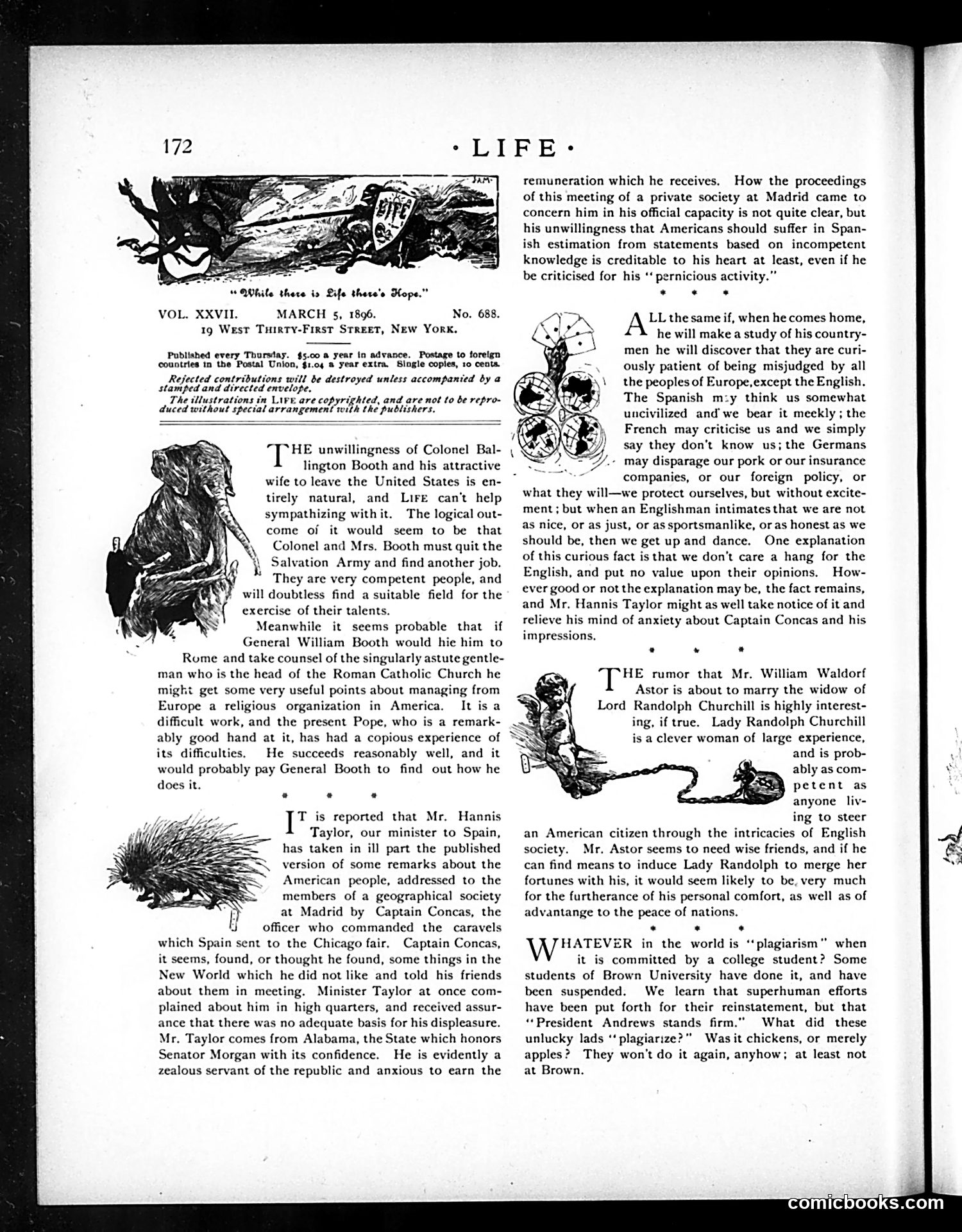
The page contains three satirical sketches accompanying text gossip items. The cartoons illustrate social commentary rather than specific named figures. **Top sketch**: Shows a disheveled man labeled "While there is Life there's Hope"—likely commenting on Colonel Ballington Booth's reluctance to leave the U.S., discussed in the text below. **Middle sketch**: Depicts a sleeping or drowsy figure, accompanying discussion of General William Booth and religious organization management in America. **Bottom sketch**: A spiky-haired creature, relating to gossip about plagiarism at Brown University and President Andrews's disciplinary decisions. The page's primary content is gossipy commentary on American public figures—politicians, religious leaders, and academics—with illustrations serving as visual commentary rather than portraiture. The cartoons use exaggeration and absurdist imagery typical of Life's satirical style.
📄 Transcribed text from this page (OCR, searchable)
Machine-transcribed from the original scan — historical spelling and the odd misread are preserved.
“OMhile there is Life there's Hope.” VOL. XXVII. MARCH 5, 1896. No. 688. 1g West Tuirty-First Street, NEw York. Published every Thurwiay. $5.00 a year in advance. Postage to foreign countries in the Postal Union, $1.04 @ year extra. Single copies, 10 cents. Rejected contributions will be destroyed unless accompanied by a stamped and directed envelope, The illustrations in Lue. are copyrighted, and are not to be repro- duced without special arrangement with the publishers. Tt unwillingness of Colonel Bal- lington Booth and his attractive wife to leave the United States is en- tirely natural, and Lire can't help sympathizing with it. The logical out- come of it would seem to be that Colonel and Mrs. Booth must quit the Salvation Army and find another job. They are very competent people, and will doubtless find a suitable field for the exercise of their talents. Meanwhile it seems probable that if General William Booth would hie him to Rome and take counsel of the singularly astute gentle- man who is the head of the Roman Catholic Church he might get some very useful points about managing from Europe a religious organization in America. It is a difficult work, and the present Pope, who is a remark- ably good hand at it, has had a copious experience of its difficulties. He succeeds reasonably well, and it would probably pay General Booth to find out how he does it. ° . * T is reported that Mr. Hannis Taylor, our minister to Spain, has taken in ill part the published version of some remarks about the American people, addressed to the members of a geographical society at Madrid by Captain Concas, the officer who commanded the caravels which Spain sent to the Chicago fair. Captain Concas, it seems, found, or thought he found, some things in the New World which he did not like and told his friends about them in meeting. Minister Taylor at once com- plained about him in high quarters, and received assur- ance that there was no adequate basis for his displeasure. Mr. Taylor comes from Alabama, the State which honors Senator Morgan with its confidence. He is evidently a zealous servant of the republic and anxious to earn the remuneration which he receives. How the proceedings of this meeting of a private society at Madrid came to concern him in his official capacity is not quite clear, but his unwillingness that Americans should suffer in Span- ish estimation from statements based on incompetent knowledge is creditable to his heart at least, even if he be criticised for his ‘‘ pernicious activity.” * «© « LL the same if, when he comes home, he will make a study of his country- men he will discover that they are curi- ously patient of being misjudged by all the peoples of Europe,except the English. The Spanish m:y think us somewhat uncivilized and’ we bear it meckly ; the French may criticise us and we simply say they don't know us; the Germans - may disparage our pork or our insurance companies, or our foreign policy, or what they will—we protect ourselves, but without excite- ment; but when an Englishman intimates that we are not as nice, or as just, or as sportsmanlike, or as honest as we should be, then we get up and dance. One explanation of this curious fact is that we don’t care a hang for the English, and put no value upon their opinions. How- ever good or not the explanation may be, the fact remains, and Mr. Hannis Taylor might as well take notice of it and relieve his mind of anxiety about Captain Concas and his impressions, * . * HE rumor that Mr. William Waldorf Astor is about to marry the widow of Lord Randolph Churchill is highly interest- ing, if true. Lady Randolph Churchill is a clever woman of large experience, and is prob- ably as com- petent as anyone liv- ing to steer an American citizen through the intricacies of English society. Mr. Astor seems to need wise friends, and if he can find means to induce Lady Randolph to merge her fortunes with his, it would seem likely to be, very much for the furtherance of his personal comfort, as well as of advantange to the peace of nations. . * . HATEVER in the world is “plagiarism” when it is committed by a college student? Some students of Brown University have done it, and have been suspended. We learn that superhuman efforts have been put forth for their reinstatement, but that “President Andrews stands firm.” What did these unlucky lads ‘‘ plagiarize?" Was it chickens, or merely apples? They won't do it again, anyhow; at least not at Brown.