
Life, 1896-03-05 · page 12 of 20
Life — March 5, 1896 — page 12: what you’re looking at
What you’re looking at
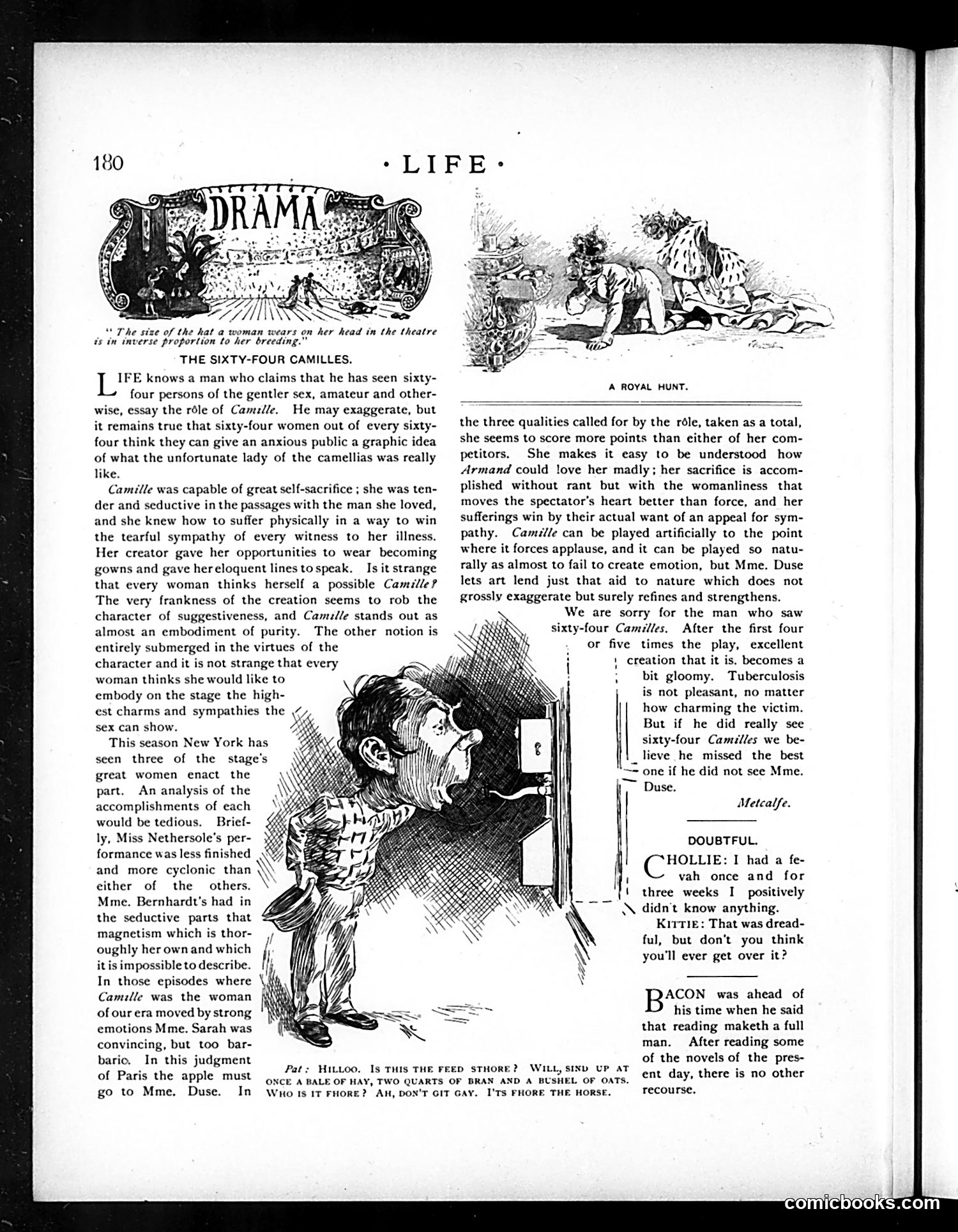
This page critiques three famous actresses performing *La Dame aux Camélias* ("Camille"), a popular 19th-century play. The main article compares performances by **Mme. Bernhardt, Miss Nethersole, and Mme. Duse**, awarding the "apple" (top prize) to Duse for balancing artifice with naturalism—she plays the tragic heroine without excessive emotion or coldness. The satire jokes that every woman believes she could play Camille, given the role's emotional appeal and beautiful costumes. The cartoons are unrelated comic vignettes: one depicts a confused Irish farmhand at a feed store (ethnic humor based on dialect), and another is a brief dialogue about forgetting illness. The opening epigraph mocks theater etiquette—women's oversized hats obstruct views, supposedly inversely proportional to their breeding/manners. A final note satirizes contemporary novels as unreadable.
📄 Transcribed text from this page (OCR, searchable)
Machine-transcribed from the original scan — historical spelling and the odd misread are preserved.
‘ The size of the hat a woman wears on her head in the theatre ts in inverse proportion to her breeding.” THE SIXTY-FOUR CAMILLES. E knows a man who claims that he has seen sixty- four persons of the gentler sex, amateur and other- wise, essay the role of Camzlle. He may exaggerate, but it remains true that sixty-four women out of every sixty- four think they can give an anxious public a graphic idea of what the unfortunate lady of the camellias was really like. Camille was capable of great self-sacrifice ; she was ten- der and seductive in the passages with the man she loved, and she knew how to suffer physically in a way to win the tearful sympathy of every witness to her illness. Her creator gave her opportunities to wear becoming gowns and gave her eloquent lines tospeak. Is it strange that every woman thinks herself a possible Camille? The very frankness of the creation seems to rob the character of suggestiveness, and Camu//e stands out as almost an embodiment of purity. The other notion is entirely submerged in the virtues of the character and it is not strange that every woman thinks she would like to embody on the stage the high- est charms and sympathies the “, sex can show. This season New York has seen three of the stage’s great women enact the part. An analysis of the accomplishments of each would be tedious. Brief- ly, Miss Nethersole’s per- formance was less finished and more cyclonic than either of the others. Mme. Bernhardt's had in the seductive parts that magnetism which is thor- oughly her ownand which it is impossible to describe. In those episodes where Camille was the woman of our era moved by strong emotions Mme. Sarah was convincing, but too bar- bario. In this judgment of Paris the apple must ONCE A BALE OF HAY, TW go to Mme. Duse. In Pat; HitLoo, Is THIS THE FEED STHORE? QUARTS OF BRAN AND A BUSHEL OF OATS. Who Is IT FHORE? AH, DON'T GIT Gay. I'TS FHORE THE HORSE. A ROYAL HUNT. the three qualities called for by the réle, taken as a total, she seems to score more points than cither of her com- petitors, She makes it easy to be understood how Armand could love her madly; her sacrifice is accom- plished without rant but with the womanliness that moves the spectator’s heart better than force, and her sufferings win by their actual want of an appeal for sym- pathy. Camille can be played artificially to the point where it forces applause, and it can be played so natu- rally as almost to fail to create emotion, but Mme. Duse lets art lend just that aid to nature which does not grossly exaggerate but surely refines and strengthens. We are sorry for the man who saw sixty-four Camilles. After the first four or five times the play, excellent ‘ creation that it is. becomes a bit gloomy. Tuberculosis is not pleasant, no matter how charming the victim. But if he did really see sixty-four Camilles we be- _ lieve he missed the best ~~ one if he did not see Mme. Duse. Metcalfe. DOUBTFUL. HOLLIE: I had a fe- vah once and for three weeks I positively ~~" \ didn't know anything. Kittie: That was dread- ful, but don’t you think you'll ever get over it? Becex was ahead of his time when he said that reading maketh a full man. After reading some of the novels of the pres- ent day, there is no other recourse, Witt, sip uP aT