
A complete issue · 20 pages · 1896
Life — February 27, 1896
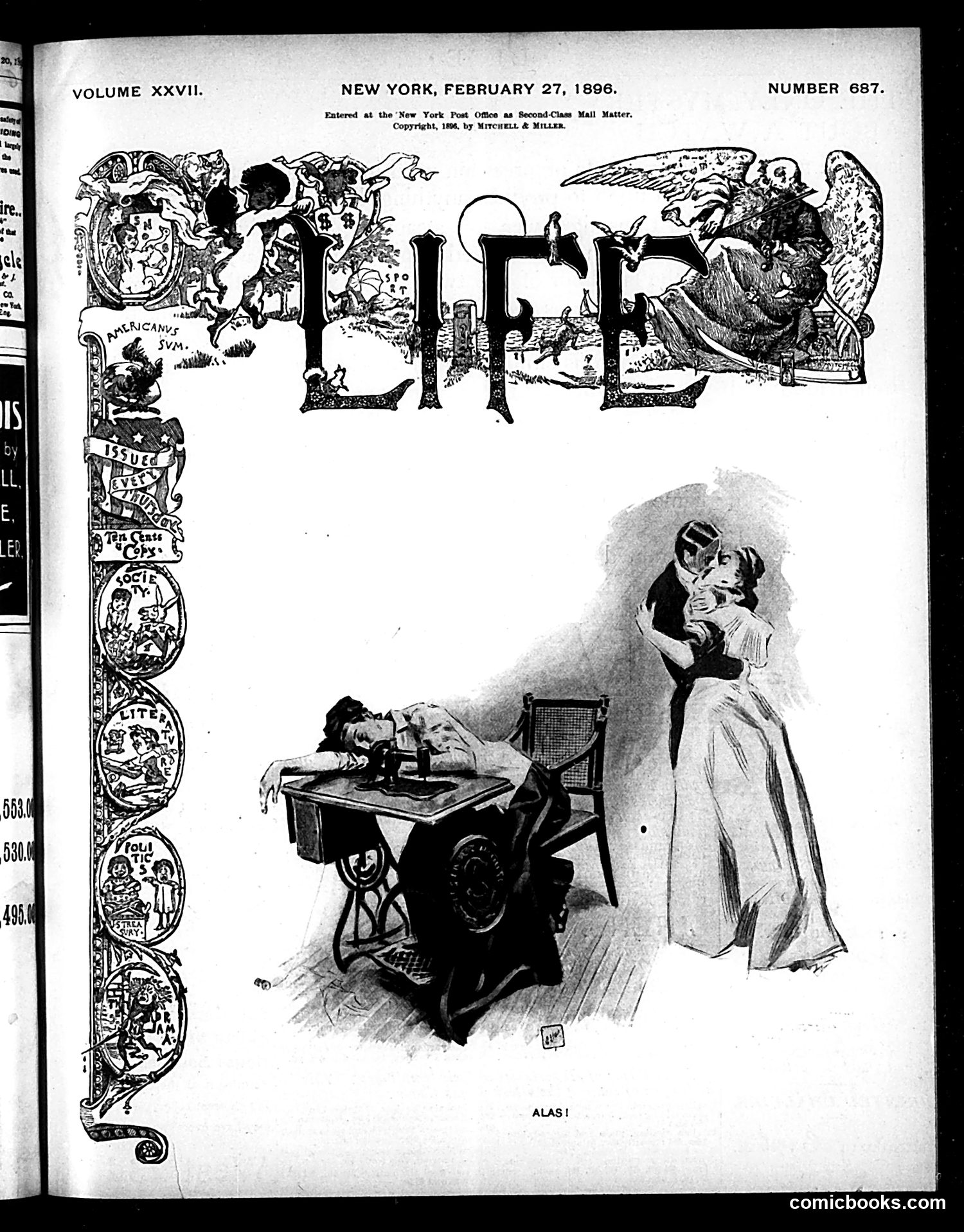
The main cartoon titled "ALAS!" depicts a romantic scene with a couple embracing while a man slumps unconscious or asleep at a desk. The image satirizes a common melodramatic scenario from period literature and theater—likely referencing infidelity or romantic betrayal, with the sleeping figure (perhaps a husband or rival) oblivious to the embrace occurring nearby. The ornate left border contains Life magazine's decorative masthead and advertising vignettes. The elaborate title treatment at top suggests this was Life's cover or feature page. Without additional context about specific 1896 events or public figures, the cartoon appears to be general social satire about romance and deception rather than political commentary. The theatrical staging and melodramatic composition were typical of Life's humorous approach to domestic scenarios.
This page is primarily **advertising content**, not editorial cartoons or satire. The dominant feature is a large advertisement for Waltham pocket watches, emphasizing their precision, simplicity, and affordability—marketed as an American innovation combining quality with reasonable pricing. Below this are numerous product advertisements from New York retailers: Arnold Constable & Co. (dress fabrics and mohairs), Hamilton Hawkes & Co. (popular books), Stern Bros (ladies' undergarments), and Broadway & 19th St. (printed challies). There are **no political cartoons or satirical content** visible. This is a standard commercial page from *Life* magazine's advertising section, reflecting early 20th-century retail offerings and consumer goods marketing.
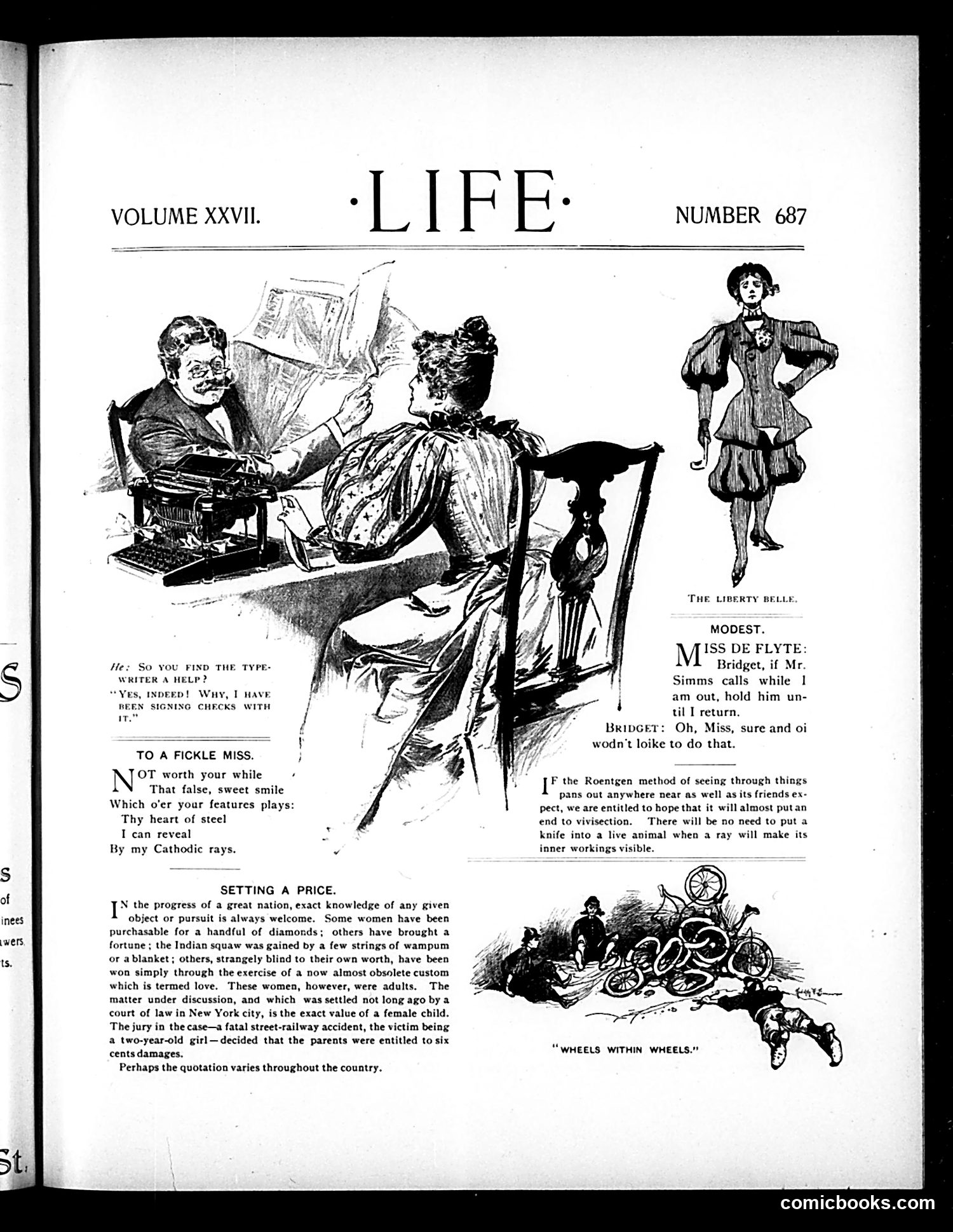
This page contains several satirical pieces typical of early 20th-century Life magazine: **Main Cartoon ("To a Fickle Miss")**: A poetic rebuke to a woman who smiles sweetly while her "heart of steel" reveals her true nature—satirizing female duplicity or romantic manipulation. **"Setting a Price"**: Social commentary on how women's monetary value varies by circumstance. It references a real New York court case valuing a child at six cents in damages from a street-railway accident, using this absurdity to critique how society assigns monetary worth to females. **Fashion Illustrations**: "The Liberty Belle" and "Modest" show contemporary women's clothing, likely satirizing evolving fashion or women's increasing public visibility. The humor relies on period assumptions about women's nature and social roles.
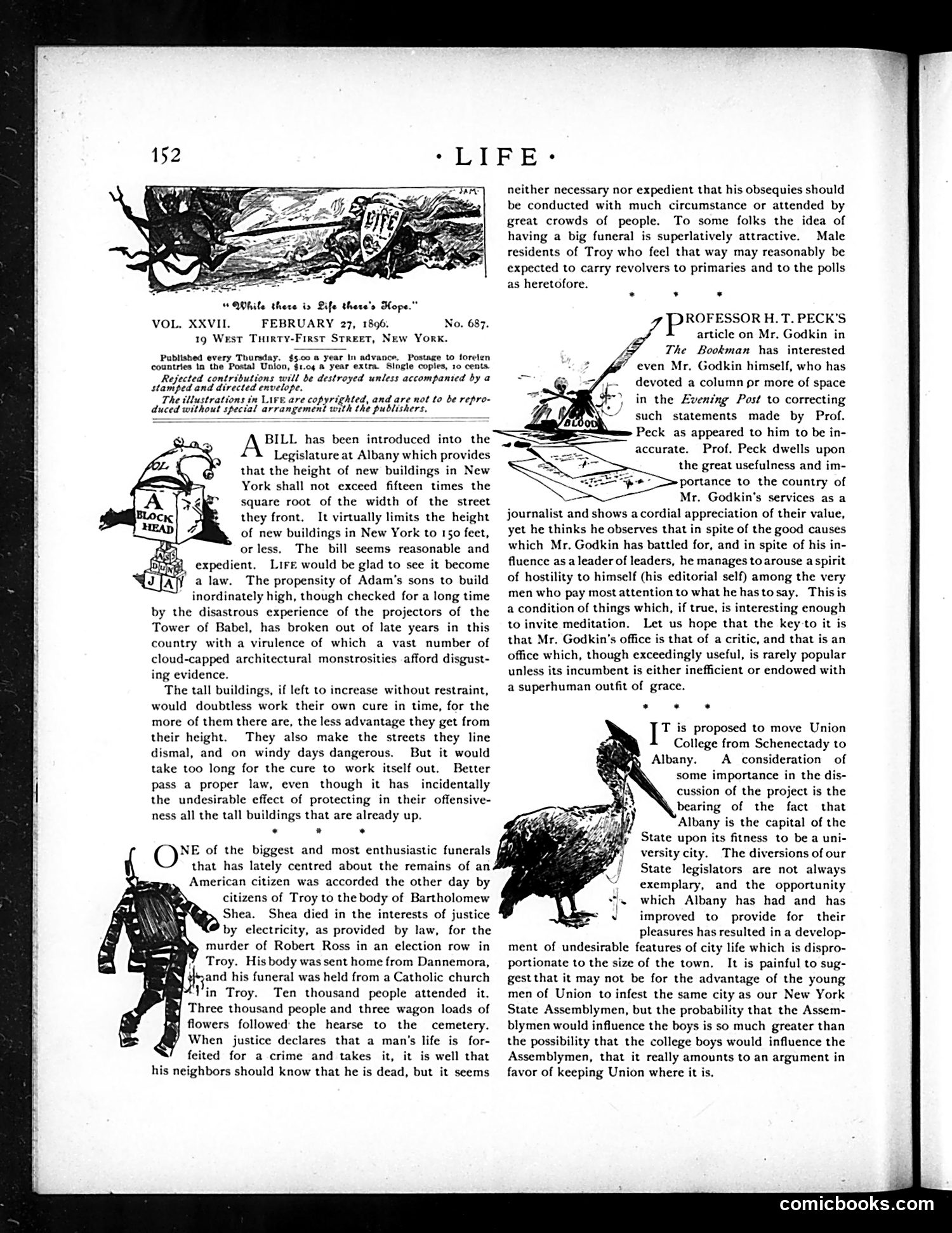
This page from *Life* (February 27, 1896) contains three separate satirical pieces: 1. **Building Height Bill**: Criticizes a proposed Albany law limiting New York building heights to fifteen times street width. The satire mocks the impracticality—suggesting it would stifle urban development while failing to address the actual problems tall buildings create (streets becoming "dismal" and "dangerous"). 2. **Godkin Editorial Critique**: References Professor H.T. Peck's article about Mr. Godkin (likely E.L. Godkin, editor of the *Evening Post*). The satire suggests Godkin's journalistic influence has made him hostile to editorial criticism, creating an unpopular office environment—a commentary on journalistic ego. 3. **Union College Relocation**: Discusses moving Union College from Schenectady to Albany. The satire argues Albany's status as state capital makes it a suitable university city, while questioning whether student influence would sway legislators' support.
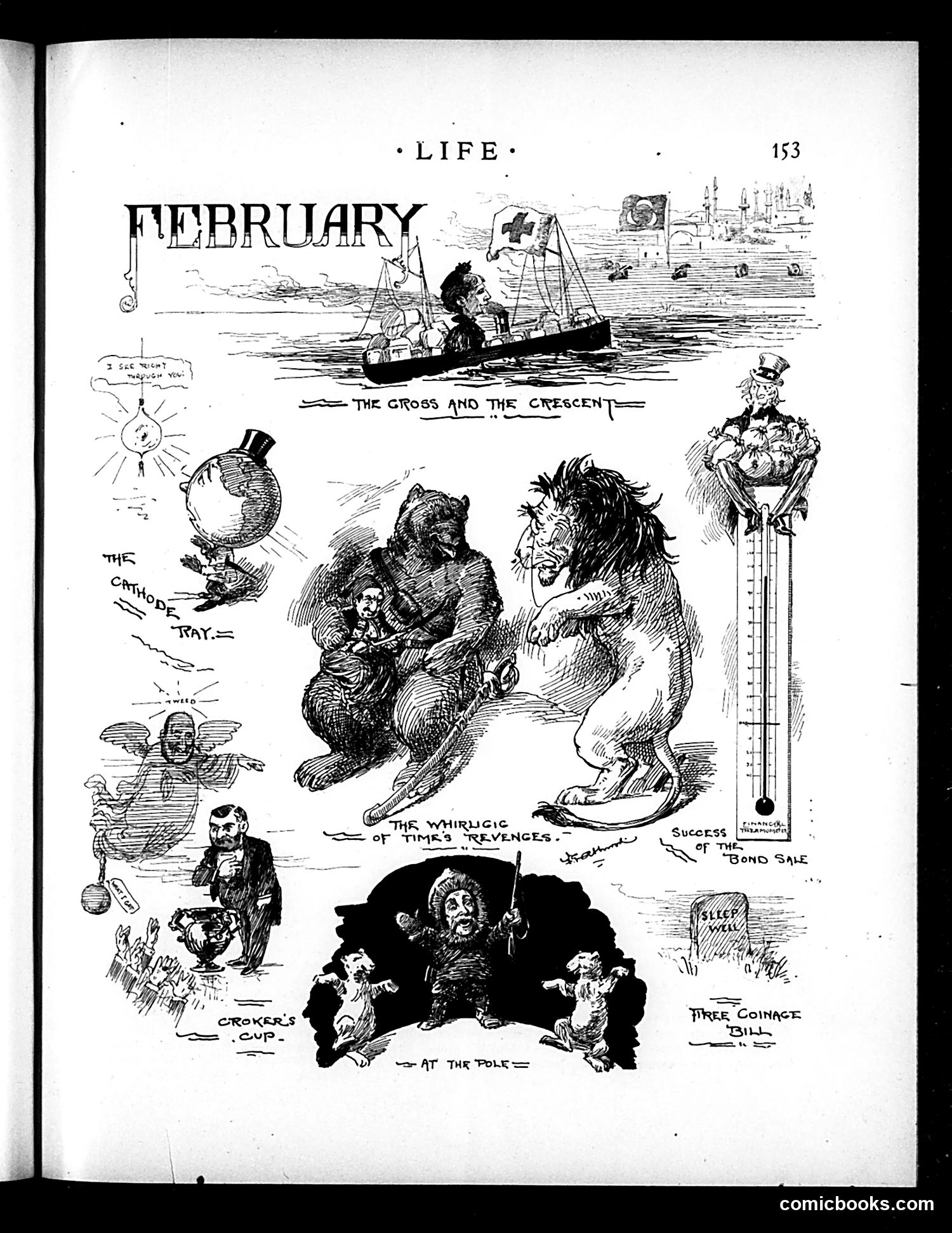
This page presents satirical commentary on early 1900s events through multiple vignettes: **"The Gross and the Crescent"** (top) depicts a ship, likely referencing tensions between Christian and Islamic powers—possibly the Russo-Japanese War or Balkan conflicts. **"The Cathode Ray"** and other scientific sketches suggest satire of new technologies and their social implications. **"The Whirligig of Time's Revenges"** shows figures being tossed about, mocking political upheaval or comeuppance. **"At the Pole"** references Arctic exploration fever of the era (Peary expeditions). **"Success of the Bond Sale"** and **"Croker's Cup"** appear to mock financial schemes and political corruption, possibly targeting Tammany Hall's Richard Croker. The cartoons employ exaggerated caricature typical of early 1900s satire, targeting political figures, corporate greed, and contemporary social anxieties.
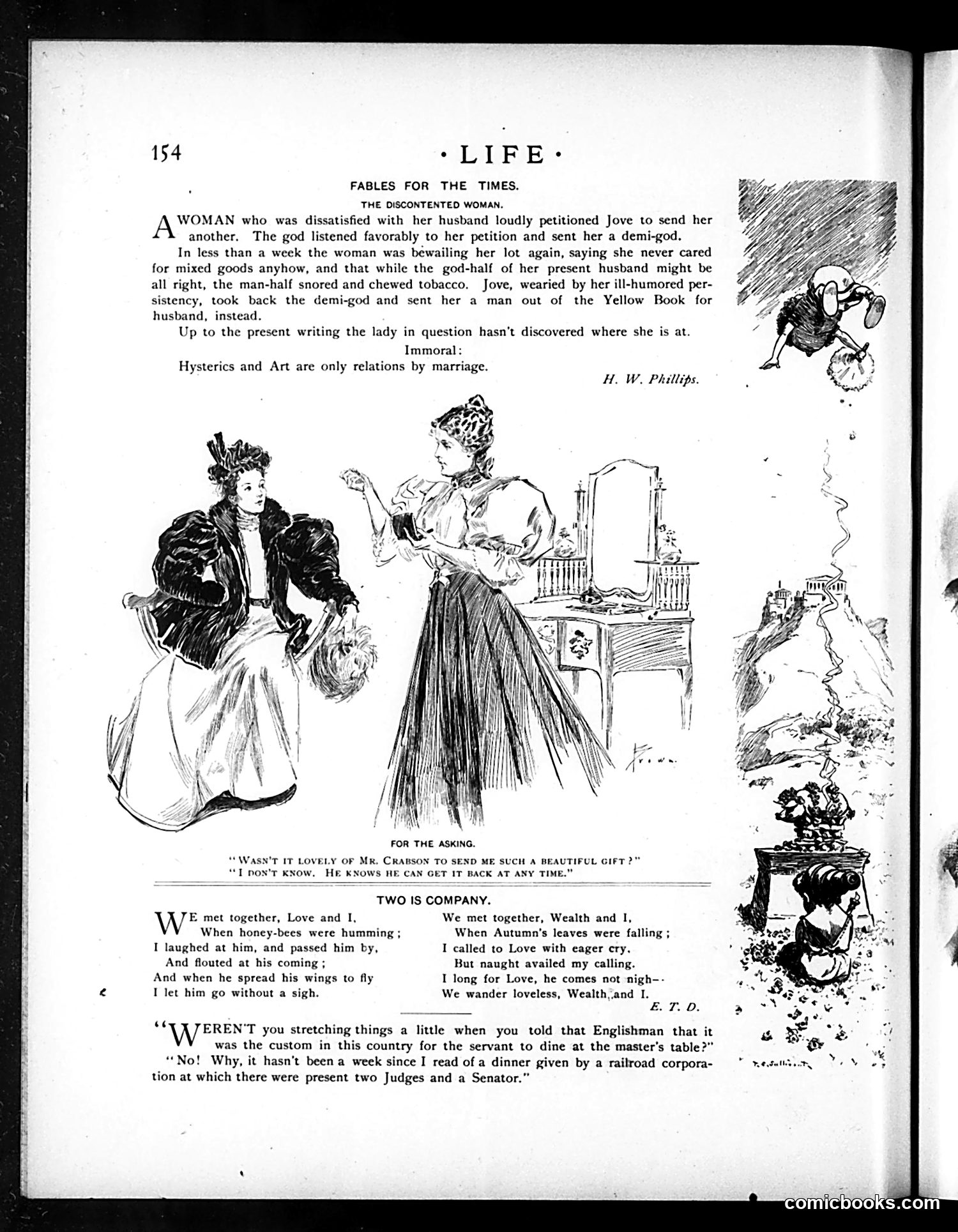
This page contains satirical content about gender relations and marriage in the early 1900s. **"The Discontented Woman"** fable mocks a wife who petitions a god for a lover because her husband ignores her. The satire suggests women's dissatisfaction with marriage is frivolous—the implied lesson being that women should accept their lot. **"For the Asking"** illustration depicts a woman at her vanity, with dialogue suggesting a man can easily reclaim an unwanted gift, implying casual attitudes toward women's value. **"Two is Company"** poem contrasts Love with Wealth as romantic pursuits, sarcastically suggesting both are equally unfulfilling. The final anecdote jokes about English servants dining at masters' tables—Americans apparently found this custom laughably improper, revealing class anxieties of the era.
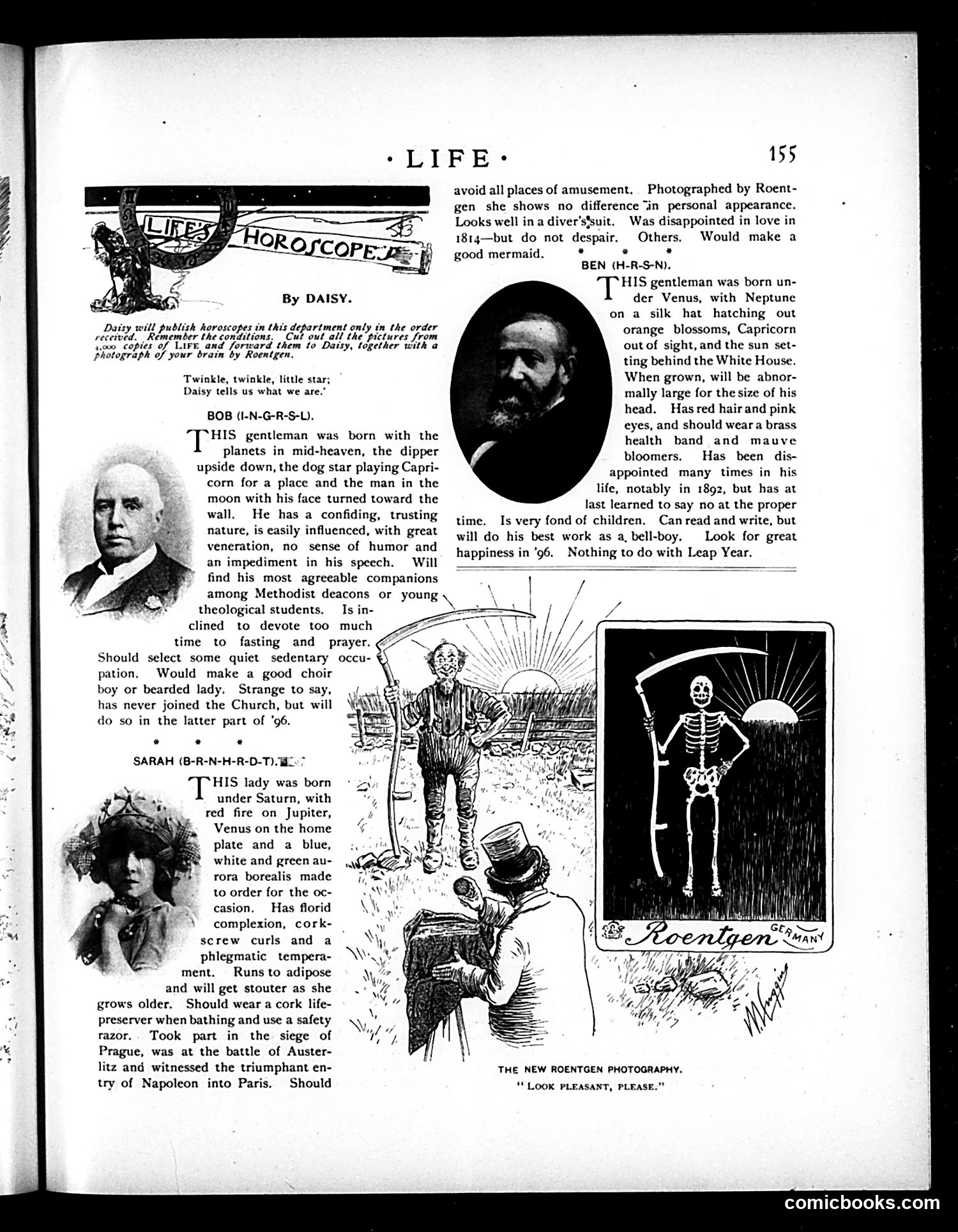
This is a satirical horoscope column by "Daisy" that humorously describes three people's astrological profiles and personalities. Each entry pairs astrological birth details with character traits presented as comic predictions. The three subjects are: - **Bob** (born under favorable planets): described as trusting but inarticulate, suited for Methodist deacon work - **Ben** (born under Venus/Neptune): predicted to become abnormally large-headed, fond of children, suitable as a bell-boy - **Sarah** (born under Saturn): characterized as temperamental with cork-screw curls, noted for witnessing Napoleon's entry into Paris The satire mocks both popular astrology's vagueness and the subjects themselves through absurd physical descriptions and lowly career predictions. The accompanying Roentgen photography cartoon (skeleton image) plays on contemporary fascination with new X-ray technology.
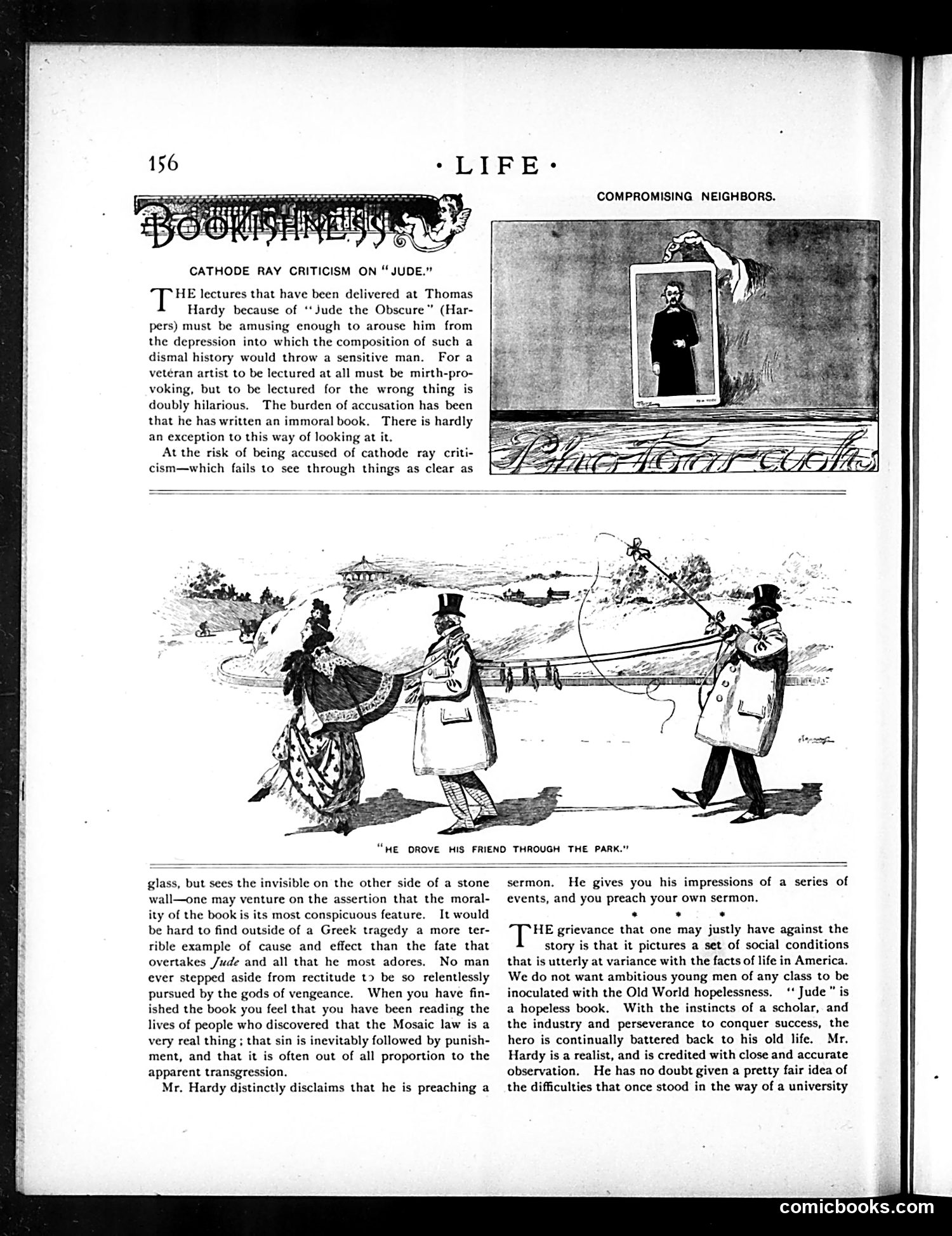
This page critiques Thomas Hardy's novel "Jude the Obscure." The text argues that Cathode Ray (the critic) unfairly attacked Hardy for writing an "immoral book," claiming such lectures are "doubly hilarious" when directed at an artist for supposedly wrong subject matter. The cartoon titled "He Drove His Friend Through the Park" illustrates the article's point about social compromise. It depicts three figures—a woman, a gentleman in top hat, and another man—appearing to manipulate or control a rope, suggesting the compromises and social pressures that constrain individuals in polite society. The satire critiques both Hardy's critics and the restrictive social conventions of the era that condemned realistic literature addressing serious moral and social issues.
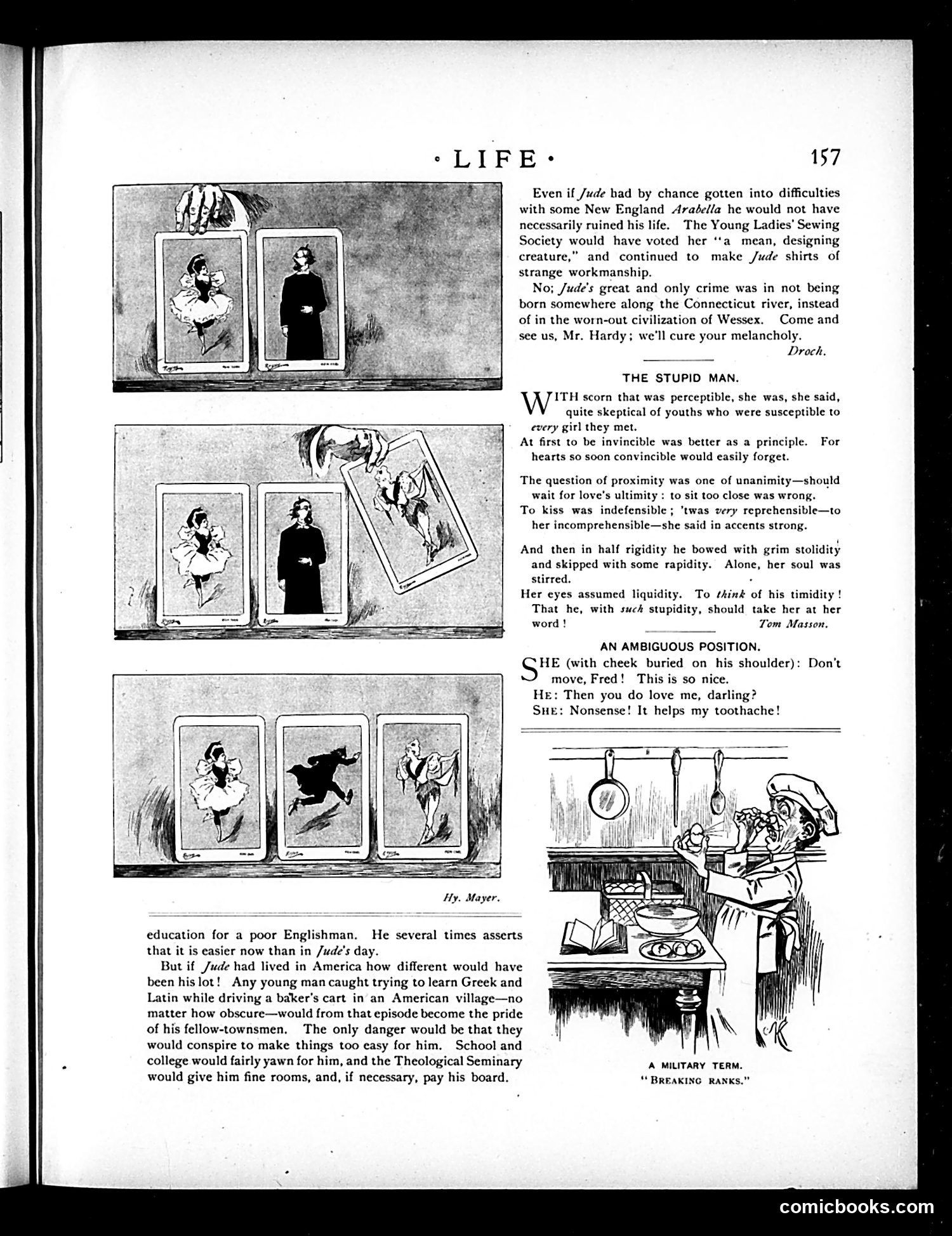
This page contains three distinct satirical pieces: **Top section**: "The Stupid Man" - A narrative about a woman named Jude who is skeptical of men, particularly cautious about physical intimacy. The text mocks male timidity and social awkwardness, suggesting men are foolish for overthinking romantic gestures. **Middle section**: "An Ambiguous Position" - A brief comedic dialogue where a couple's physical closeness is misinterpreted; she claims his embrace merely helps her toothache, not that she loves him. **Bottom illustration**: "A Military Team: 'Breaking Ranks'" - Shows a domestic kitchen scene with a woman and child, satirizing military discipline by comparing home management to military order. The cartoons mock gender relations, male insecurity, and domestic life through lighthearted humor typical of early 20th-century American magazines.
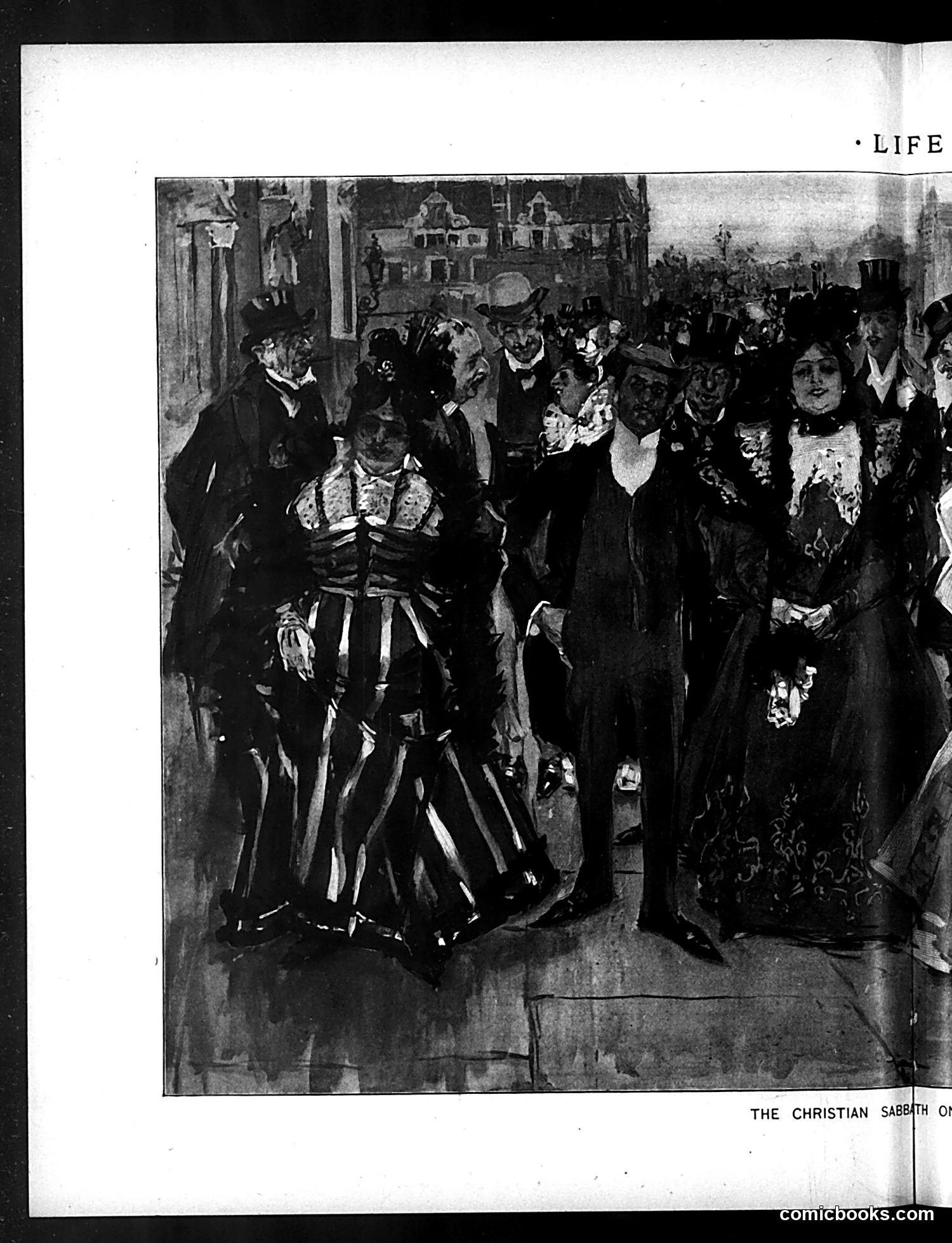
This appears to be a satirical illustration from *Life* magazine depicting a crowded religious or formal procession, likely from the late 19th or early 20th century based on the clothing styles and image quality. The caption reads "THE CHRISTIAN SABBATH O[N]" (text cut off), suggesting the satire targets Christian observance practices. The image shows elaborately dressed figures in formal attire, including what appears to be clergy and wealthy parishioners in a crowded street scene with buildings in the background. The satire likely critiques the contrast between Christian values of humility and the ostentatious display of wealth and finery evident in the fashionable dress of those pictured. This was a common *Life* magazine theme: mocking the hypocrisy of wealthy Americans who professed Christian virtue while engaging in conspicuous consumption and social pretension.
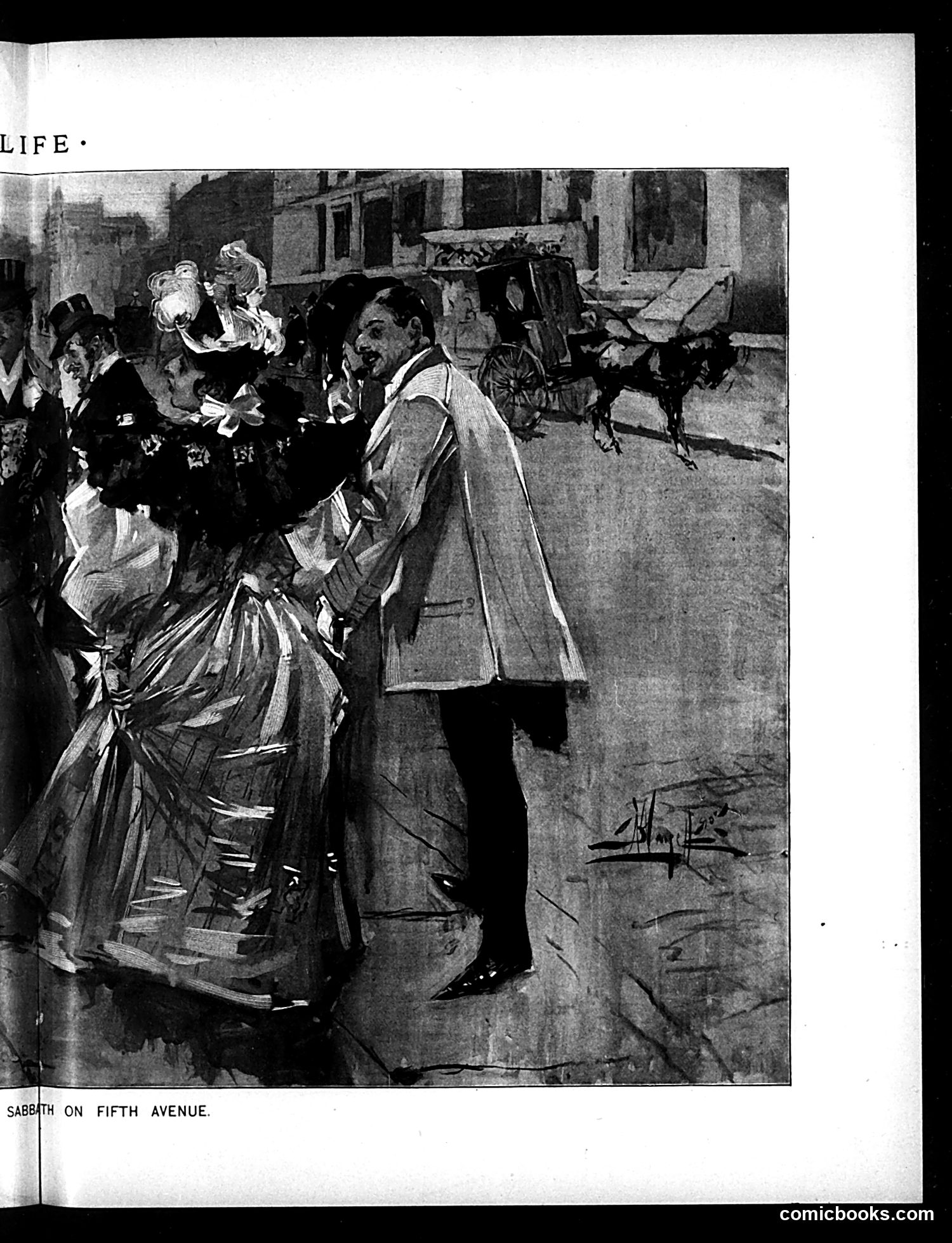
This satirical illustration depicts a street scene on Fifth Avenue (New York's wealthy shopping district) labeled "Sabbath on Fifth Avenue." The image shows elegantly dressed figures in formal attire and elaborate clothing engaged in what appears to be leisurely social activity on a Sunday. The satire likely critiques the hypocrisy of wealthy New Yorkers who observed the Christian Sabbath. Despite religious prohibitions against secular activity on Sunday, the Fifth Avenue elite are shown engaged in fashionable socializing and display—suggesting they honored the Sabbath in name only while pursuing worldly pleasures. The contrast between professed religious observance and actual behavior was a common target of *Life* magazine's social satire in the Gilded Age.
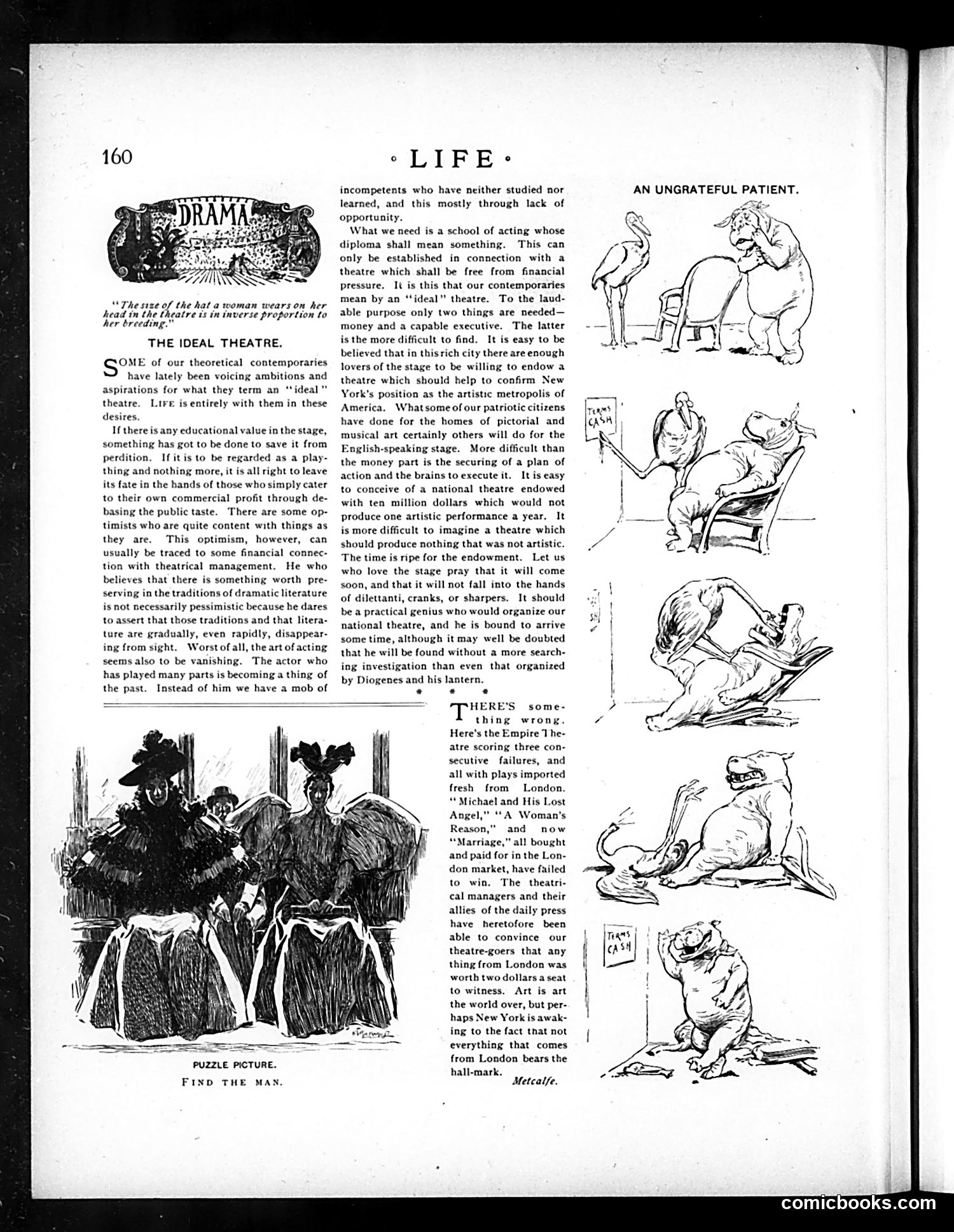
This page contains two main satirical pieces: **"The Ideal Theatre"** argues that American theatre is declining due to incompetent actors and commercial managers prioritizing profit over art. The author advocates for an endowed, non-profit theatre school to preserve dramatic traditions—but notes the real challenge isn't money; it's finding capable leadership. The satire mocks wealthy New Yorkers' reluctance to support such ventures and those who profit from mediocrity. **"There's Something Wrong"** mocks theatre managers and critics who uncritically promoted imported London plays as superior. The Empire Theatre's three consecutive failures—including "Michael and His Lost Angel," "A Woman's Reason," and "Marriage"—all London imports, suggest American audiences are finally recognizing that British origin doesn't guarantee quality. The satire targets both theatre management and newspapers' complicity in this snobbish promotion. The right-side cartoon depicts "An Ungrateful Patient"—a caricatured figure in various positions, likely satirizing someone's behavior toward a doctor or benefactor (though the specific target is unclear from this page alone).
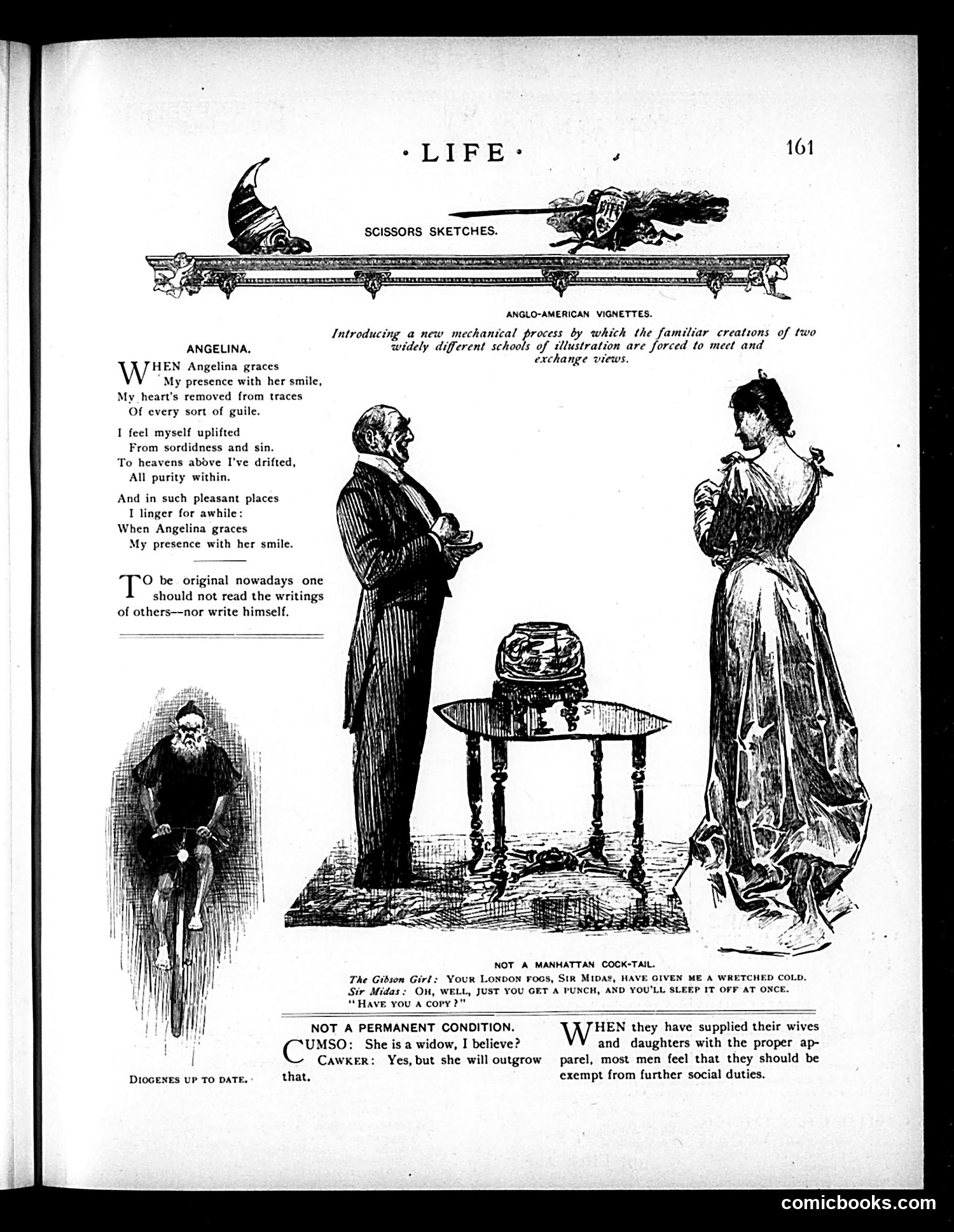
This page presents three separate satirical sketches comparing American and British social customs and characters. **"Angelina"** is a sentimental poem about a charming woman's uplifting presence—mocking Victorian sentimentality. **"Not a Manhattan Cock-tail"** depicts the American Gibson Girl (a popular idealized female type) receiving a cold remedy from a British gentleman (Sir Midas), with the joke being the contrast between American and British approaches to treating illness. **"Not a Permanent Condition"** jokes that a widow won't remain one—she'll remarry and "outgrow" her widowed status. **"Diogenes Up to Date"** shows a modern cynic figure, referencing the ancient Greek philosopher known for seeking an honest man. The page's header explains these are "Anglo-American Vignettes" where "two widely different schools of illustration are forced to meet and exchange views"—pairing American and British comic sensibilities and character types for comparative humor.
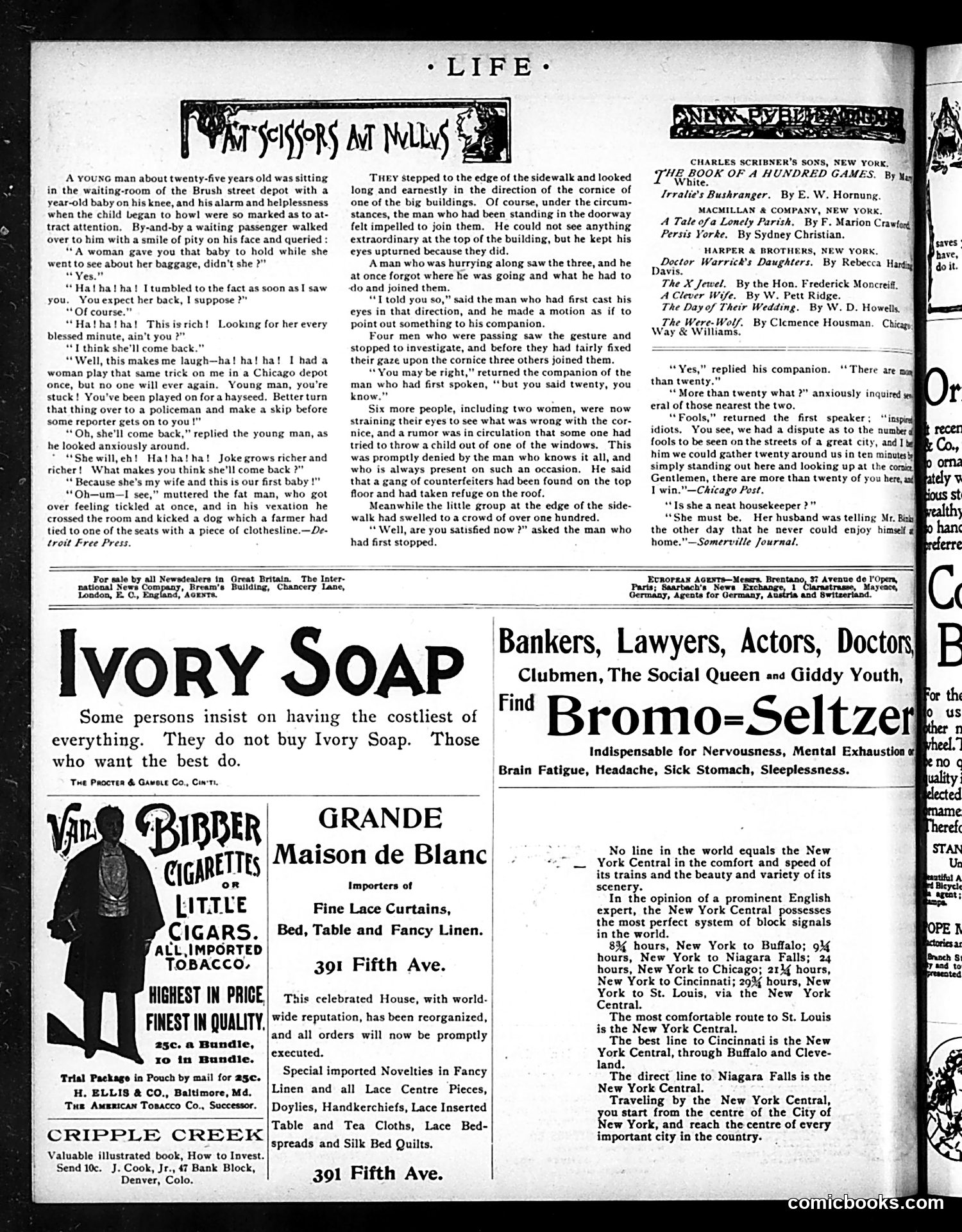
This page contains two satirical stories from *Life* magazine illustrating human folly. **"Scissors at Nullys"** (top): A young man holds a stranger's baby while the mother retrieves luggage. A cynical passenger insists the woman abandoned him—a common con he'd experienced. The joke: the man is actually married to the woman, making the passenger's worldly skepticism foolish. The satire mocks those who assume the worst of others based on urban cynicism. **The Cornice Story** (middle): A man stares at a building's cornice for unclear reasons. Others stop to look, then more join, until a crowd of over 100 gathers. Rumors spread wildly (counterfeiters, child endangerment). When asked if he's satisfied, his companion reveals they were simply looking at "fools"—the crowd itself. This satirizes mob behavior and how people mindlessly follow others without questioning why. The remaining content is period advertisements (Ivory Soap, Bromo-Seltzer, etc.).
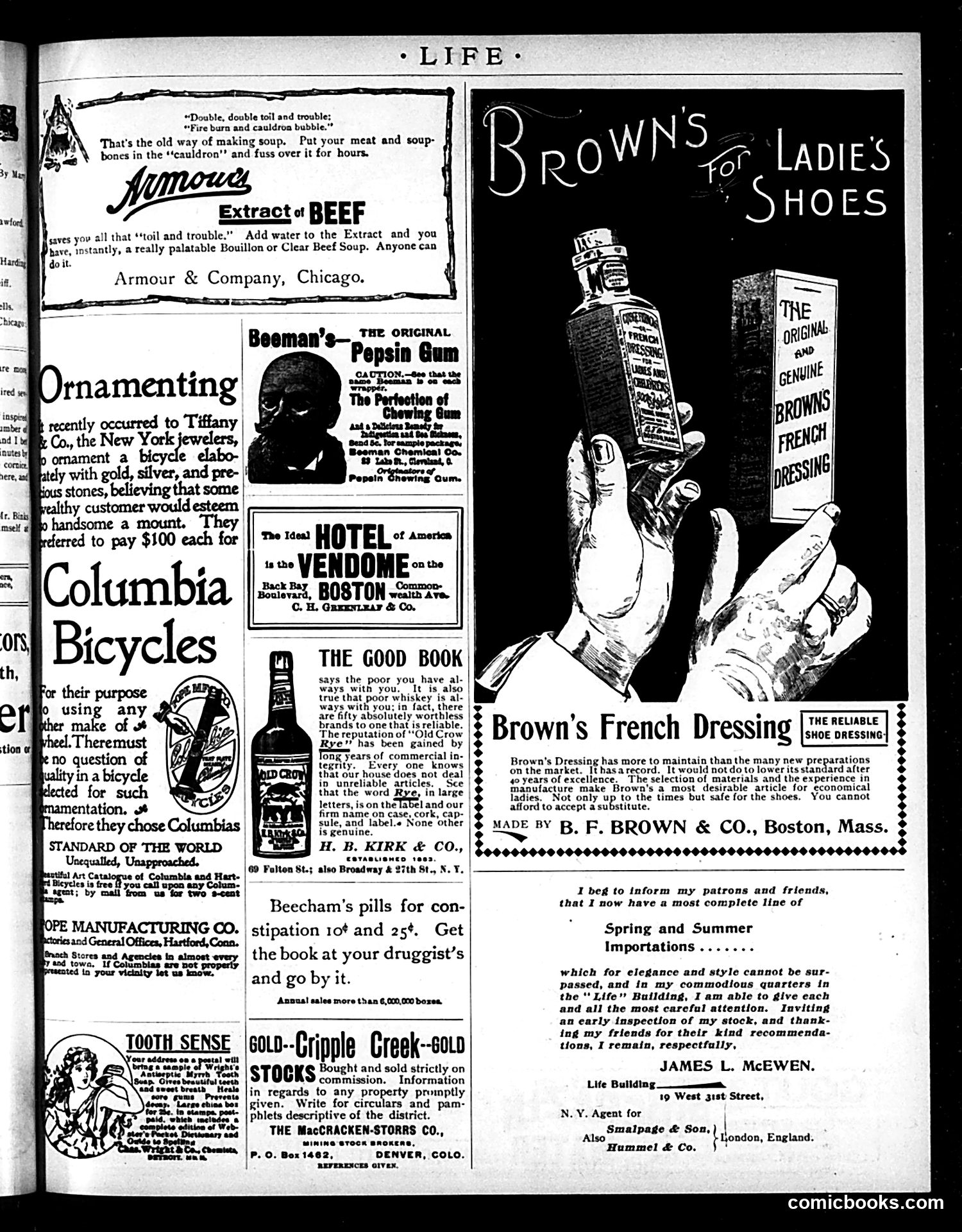
This is primarily an **advertising page** with minimal editorial content. The main elements are: **Notable Advertisements:** 1. **Armour's Beef Extract** (top left): Uses a Macbeth reference ("Double, double toil and trouble") to mock old-fashioned soup-making, positioning instant beef extract as modern convenience. 2. **Brown's French Dressing** (dominant right side): A large ad for shoe dressing, emphasizing its 40-year track record and reliability—appealing to conservative consumers skeptical of newer products. 3. **Columbia Bicycles**: Frames the product as a status symbol, noting wealthy customers paid $100 for ornamental versions with precious stones. 4. **Minor ads**: Popsin Gum, the Vendome Hotel (Boston), Beecham's pills, Tooth Sense remedy, and mining stocks. The page reflects **turn-of-century consumer culture**—emphasizing tradition, convenience, and conspicuous consumption. There is **no political satire** visible; this appears to be a standard commercial page from Life's advertising section.
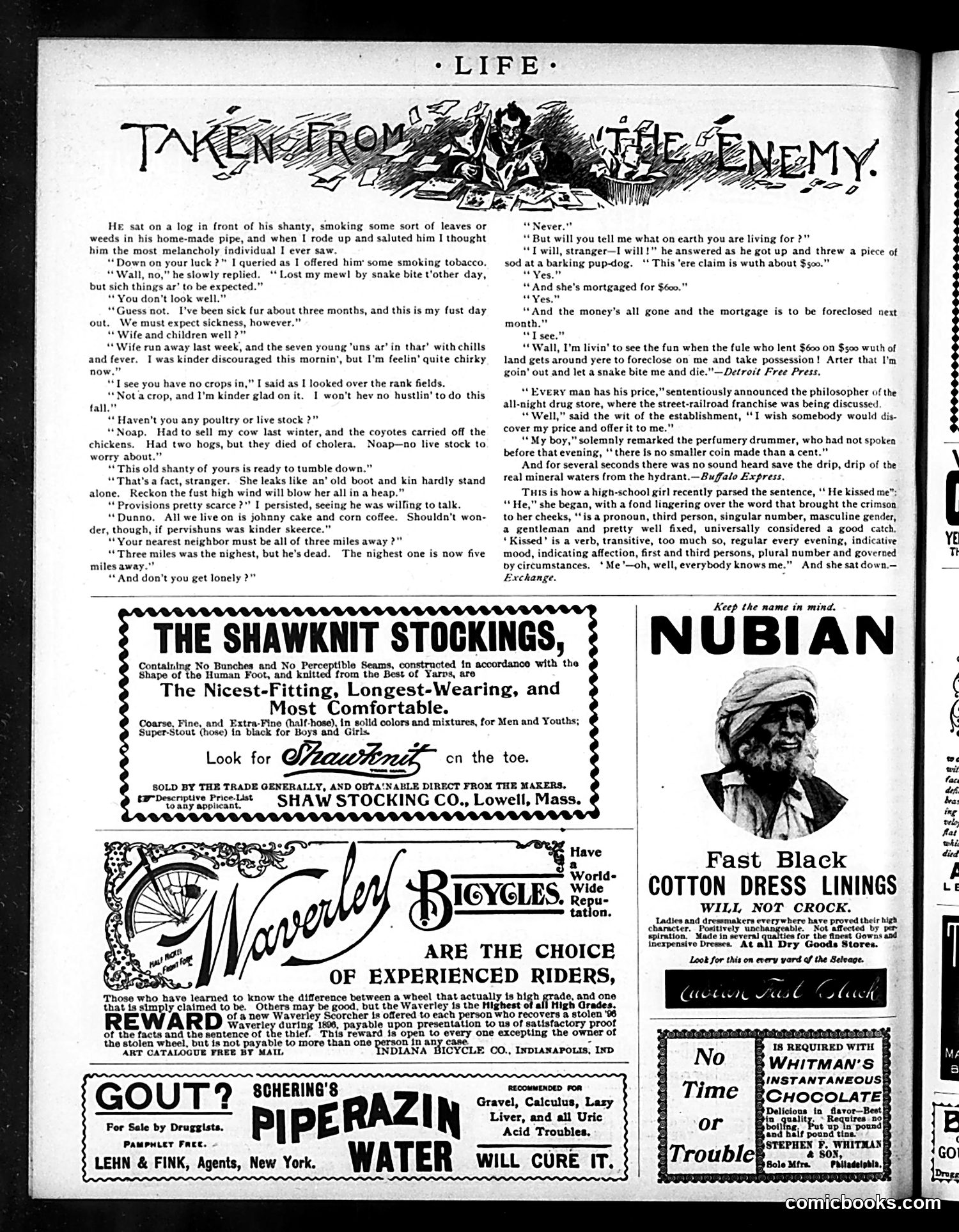
This page features a satirical story about frontier poverty and desperation. The main narrative depicts a poor settler living in abject misery—his wife has fled, his children are sick, his crops have failed, livestock died, and his shanty is collapsing. Yet he remains oddly cheerful. The bitter punchline reveals his only reason for living: to witness the foreclosure when a fool lender loses money on the property. The settler's land is worth $500 but mortgaged for $600—a deliberately bad investment doomed to failure. His grim satisfaction comes from watching someone else's financial ruin, even as he plans suicide afterward. This satirizes **Gilded Age economic desperation** and the predatory lending practices that trapped settlers and farmers. The "joke" exposes how poverty could reduce a man to finding meaning solely in schadenfreude—taking pleasure in another's misfortune—rather than in his own survival or dignity. The page also includes lighter anecdotes about grammar parsing and a romantic encounter, plus period advertisements for stockings, bicycles, and patent medicines.
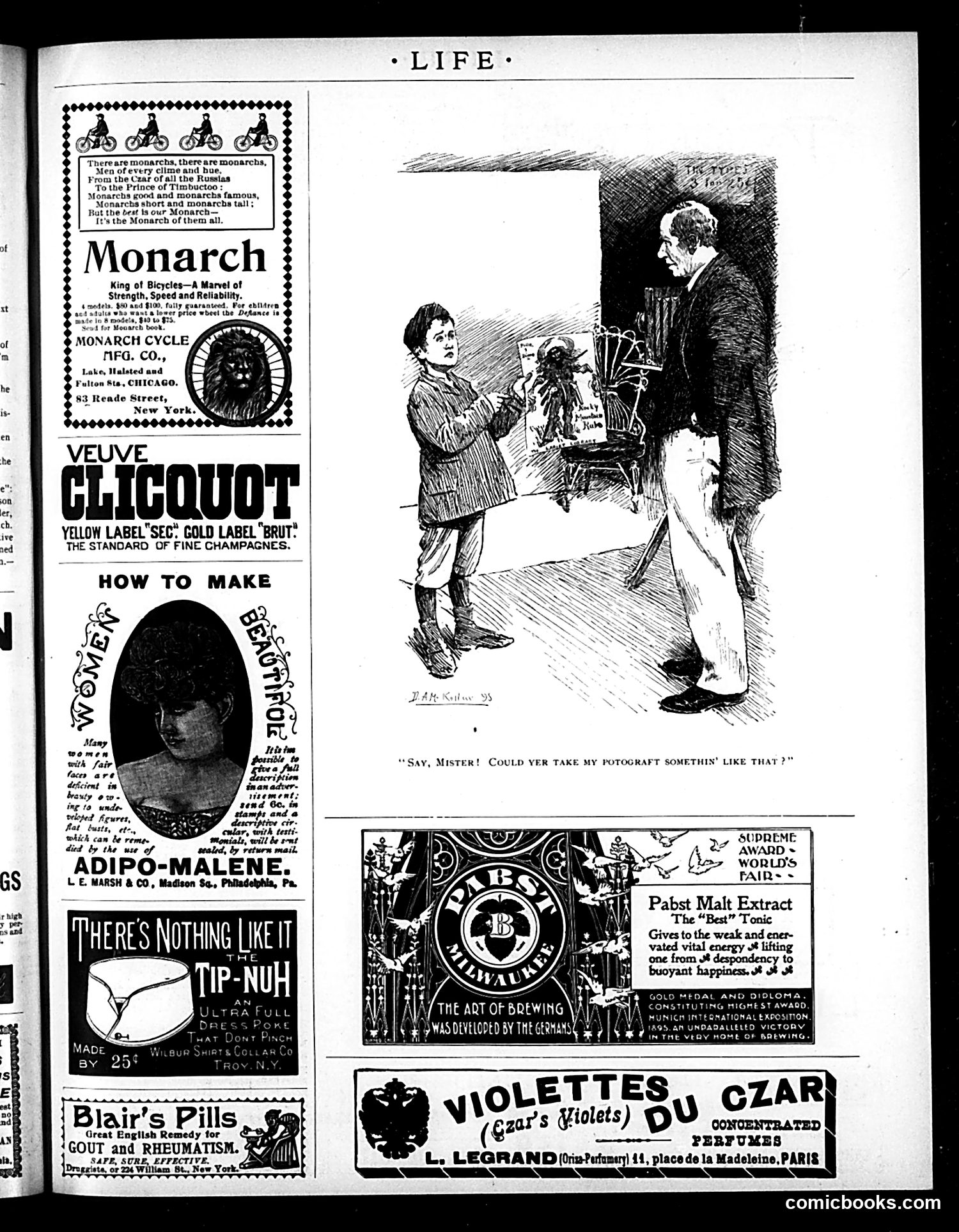
**The Main Cartoon:** The central illustration depicts a young boy asking a photographer to take his portrait "somethin' like that"—pointing to what appears to be a professionally styled photograph. The humor targets the pretensions of working-class people imitating posed, formal portraiture. The boy's rough appearance and dialect ("yer," "potograft") contrast with the refined, aristocratic styling he admires, satirizing aspiration and class mimicry. **The Advertisements:** The page is dominated by period product ads (Monarch bicycles, Veuve Clicquot champagne, Adipo-Malene beauty treatment, Blair's Pills, etc.). Notable is the "Monarch" bicycle ad's verse celebrating monarchy—likely a patriotic/nationalist reference typical of early 1900s American marketing. **Overall Context:** This appears to be a typical Life magazine page blending satirical cartoon commentary on social behavior with commercial advertisements, reflecting turn-of-century American consumer culture and class anxieties.
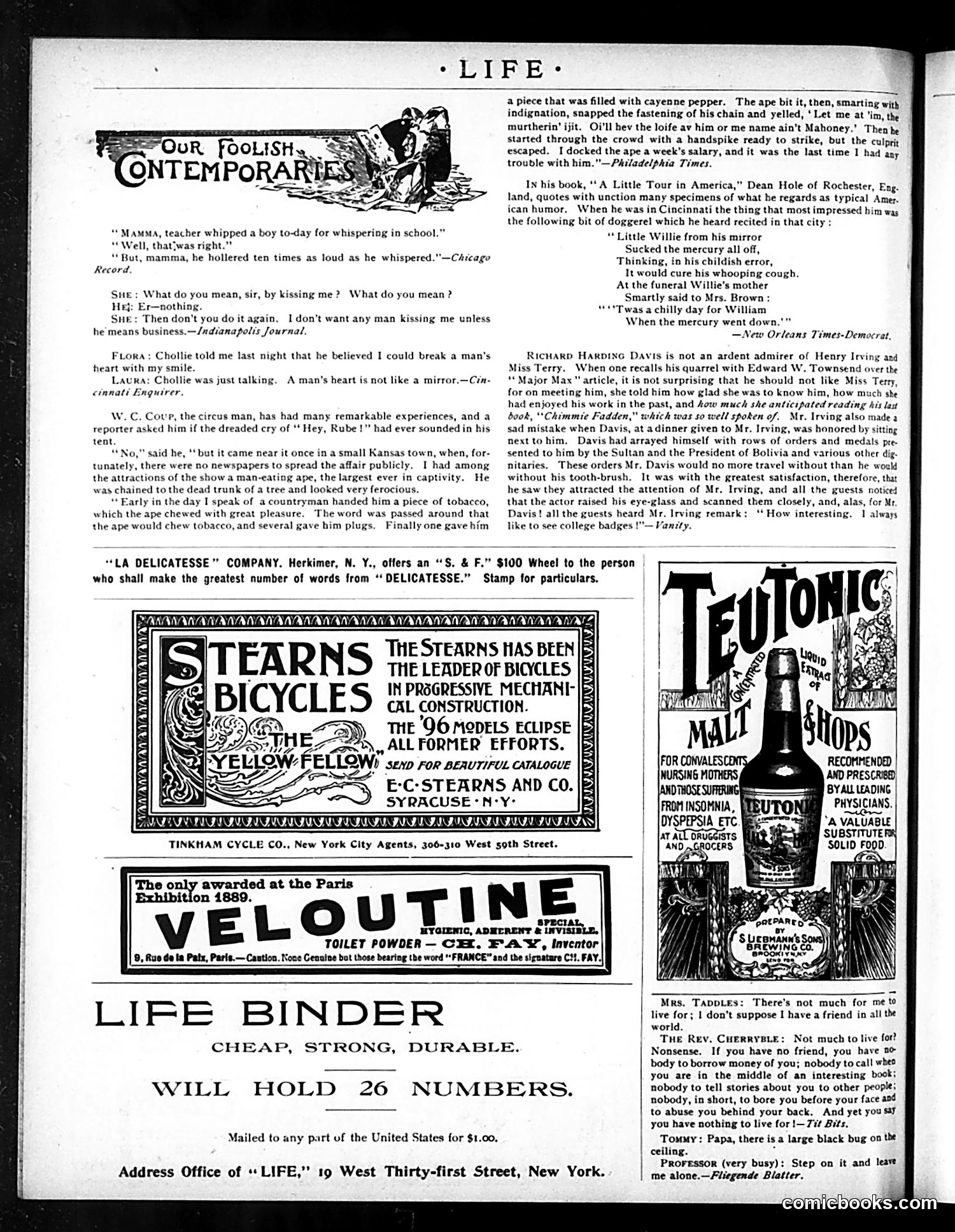
This page from *Life* magazine contains several short humorous anecdotes mocking human folly and social pretension. The cartoons/jokes satirize: **The School Whisperer**: A boy is punished for whispering but ironically yells much louder—mocking ineffective discipline. **Kissing Expectations**: A woman rejects a man's kiss unless he "means business" (marriage)—satirizing courtship conventions and female agency. **The Man-Eating Ape Story**: A circus animal supposedly speaks Irish dialect after eating cayenne-pepper tobacco, escapes its chain, and threatens violence—absurdist humor about uncontrolled nature and Irish immigrant stereotypes. **Little Willie Doggerel**: Dark humor about a child dying from drinking mercury from a mirror, presented as typical American humor (the text notes a British dean found this representative of American comedy). **Richard Harding Davis Anecdote**: Mocks the writer's vanity—he wears military medals to impress actor Henry Irving, who insultingly mistakes them for college badges. The page's overall tone ridicules pretension, foolishness, and social awkwardness across various contexts.
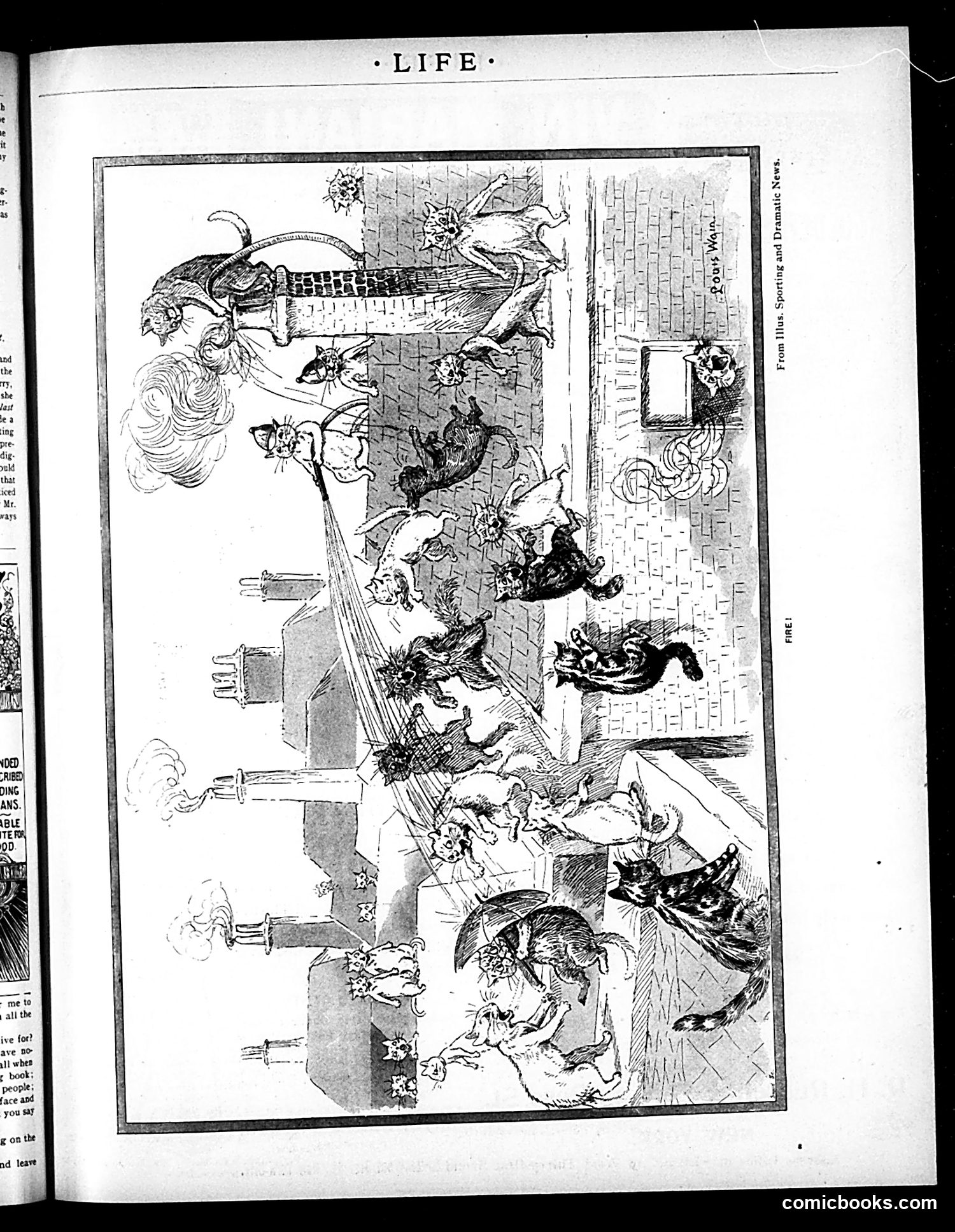
This appears to be a satirical illustration from *Life* magazine, rotated 90 degrees, depicting a chaotic scene of multiple figures in what looks like an indoor setting with brick walls. The image shows numerous people engaged in tumultuous activity—falling, gesturing dramatically, and interacting in exaggerated poses typical of late-19th or early-20th century satirical cartooning. The style and composition suggest social or political commentary, though **the specific identities of the figures and the precise target of satire are unclear from the image alone**. The credit line references "Ilus. Sporting and Dramatic News," indicating this may satirize theatrical or sporting world figures or events. Without additional context or legible text, the exact meaning remains ambiguous to a modern reader.
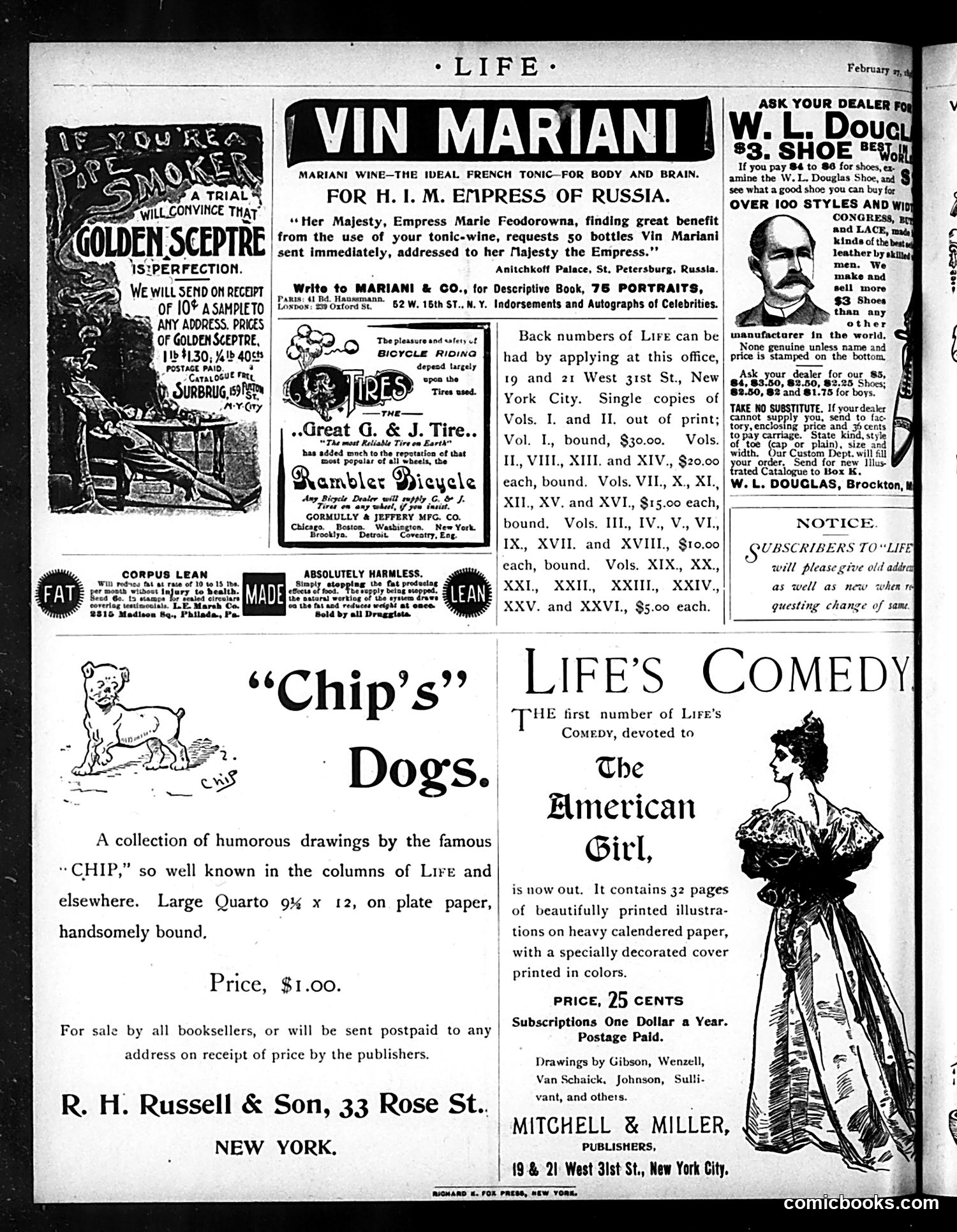
This is primarily an **advertisement and notices page** from *Life* magazine (dated February 1904, based on the header). The main advertisements include: 1. **Vin Mariani wine** — promoted as a health tonic "for body and brain," with a fabricated endorsement claiming the Empress of Russia requested 50 bottles. This is classic patent-medicine marketing, exploiting celebrity/royal names to sell dubious tonics (common in this era). 2. **Golden Sceptre cigars** — a competing product using similar testimonial tactics. 3. **W.L. Douglas shoes** — emphasizing numerous styles and durability. 4. **Various tire and bicycle advertisements** — reflecting the cycling craze of the 1890s-1900s. 5. **"Chip's Dogs"** — a collection of humorous dog drawings by the cartoonist "Chip," a regular *Life* contributor. 6. **Life's Comedy: The American Girl** — a 32-page illustrated publication featuring drawings by Gibson, Wenzell, and others, priced at 25 cents. The page reflects early-1900s consumer culture: patent medicines, bicycles, and illustrated humor publications were major commercial products. No political satire appears here—it's purely commercial.