
Life, 1896-02-27 · page 12 of 20
Life — February 27, 1896 — page 12: what you’re looking at
What you’re looking at
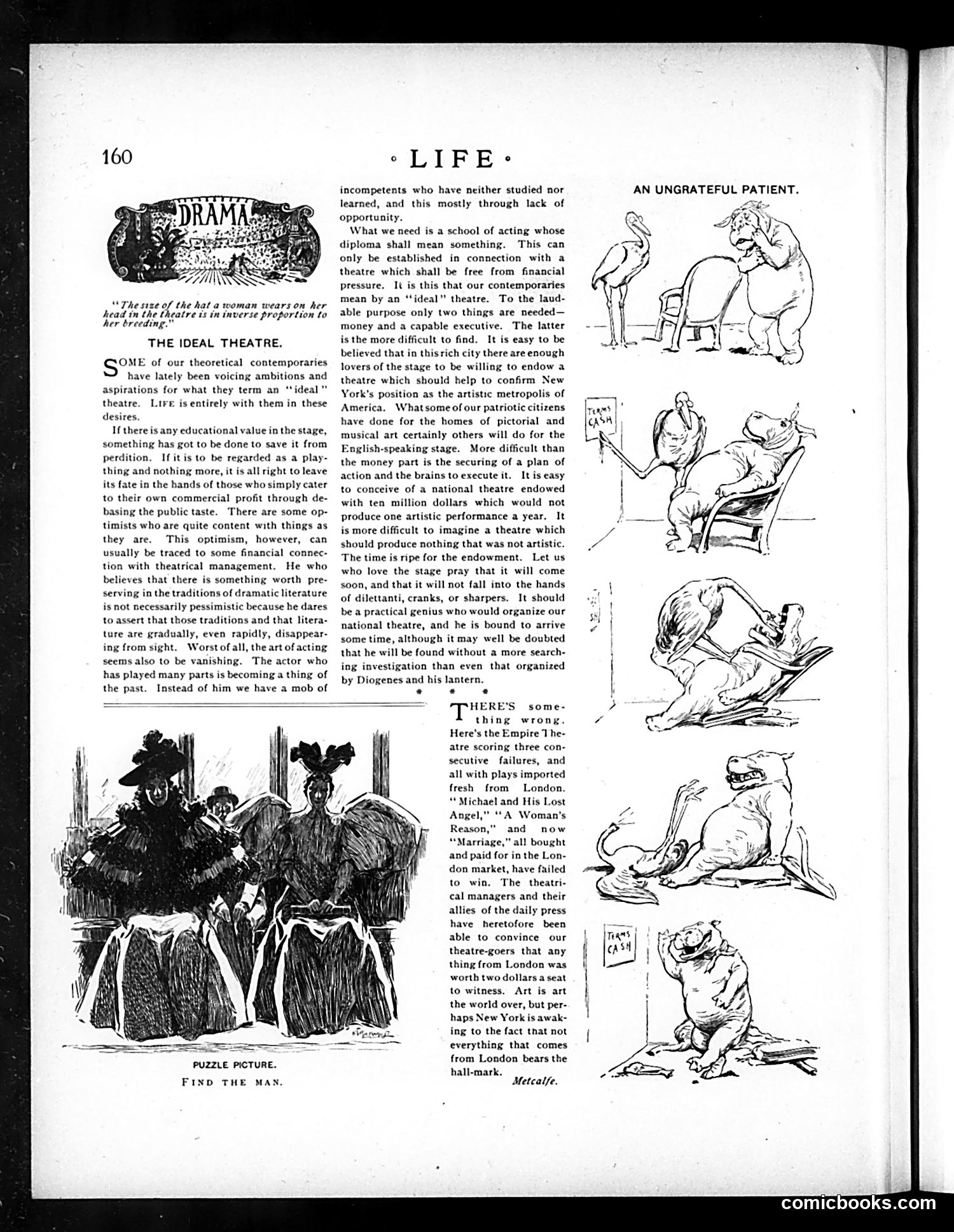
This page contains two main satirical pieces: **"The Ideal Theatre"** argues that American theatre is declining due to incompetent actors and commercial managers prioritizing profit over art. The author advocates for an endowed, non-profit theatre school to preserve dramatic traditions—but notes the real challenge isn't money; it's finding capable leadership. The satire mocks wealthy New Yorkers' reluctance to support such ventures and those who profit from mediocrity. **"There's Something Wrong"** mocks theatre managers and critics who uncritically promoted imported London plays as superior. The Empire Theatre's three consecutive failures—including "Michael and His Lost Angel," "A Woman's Reason," and "Marriage"—all London imports, suggest American audiences are finally recognizing that British origin doesn't guarantee quality. The satire targets both theatre management and newspapers' complicity in this snobbish promotion. The right-side cartoon depicts "An Ungrateful Patient"—a caricatured figure in various positions, likely satirizing someone's behavior toward a doctor or benefactor (though the specific target is unclear from this page alone).
📄 Transcribed text from this page (OCR, searchable)
Machine-transcribed from the original scan — historical spelling and the odd misread are preserved.
“The size of the hat a woman wears on her head in the theatre is in inverse proportion to her breeding.” THE IDEAL THEATRE, OME of our theoretical contemporaries have lately been voicing ambitions and aspirations for what they term an “ideal” theatre. Lire is entirely with them in these desires, If there is any educational value in the stage, something has got to be done to save it from perdition. If itis to be regarded as a play- thing and nothing more, it is all right to leave its fate in the hands of those who simply cater to their own commercial profit through de- basing the public taste. There are some op- timists who are quite content with things as they are. This optimism, however, can usually be traced to some financial connec- tion with theatrical management. He who believes that there is something worth pre- serving in the traditions of dramatic literature is not necessarily pessimistic because he dares to assert that those traditions and that litera- ture are gradually, even rapidly, disappear- ing from sight. Worst of all, the art of acting seems also to be vanishing. The actor who has played many parts is becoming a thing of the past. Instead of him we have a mob of LIFE: incompetents who have neither studied nor learned, and this mostly through lack of opportunity. What we need is a school of acting whose diploma shall mean something. This can only be established in connection with a theatre which shall be free from financial pressure. It is this that our contemporaries mean by an ‘tideal” theatre. To the laud- able purpose only two things are needed— money and a capable executive. The latter is the more difficult to find. It is easy to be believed that in thisrich city there are enough lovers of the stage to be willing to endow a theatre which should help to confirm New York's position as the artistic metropolis of America. Whatsome of our patriotic citizens have done for the homes of pictorial and musical art certainly others will do for the English-speaking stage. More difficult than the money part is the securing of a plan of action and the brains to execute it. It is easy to conceive of a national theatre endowed with ten million dollars which would not produce one artistic performance a year. It is more difficult to imagine a theatre which should produce nothing that was not artistic. The time is ripe for the endowment. Let us who love the stage pray that it will come soon, and that it will not fall into the hands of dilettanti, cranks, or sharpers. It should be a practical genius who would organize our national theatre, and he is bound to arrive some time, although it may well be doubted that he will be found without a more search- ing investigation than even that organized by Diogenes and his lantern. * oe PUZZLE PICTURE. FIND THE MAN. HERE'S some- thing wrong. Here's the Empire 1 he- atre scoring three con- secutive failures, and all with plays imported fresh from London. “ Michael and His Lost Angel,” “A Woman's Reason,” and now “Marriage,” al! bought and paid for in the Lon- don market, have failed to win, The theatri- cal managers and their allies of the daily press have heretofore been able to convince our theatre-goers that any thing from London was worth two dollars a seat to witness. Art is art the world over, but per- haps New York is awak- ing to the fact that not everything that comes from London bears the hall-mark, Metcalfe. AN UNGRATEFUL PATIENT. comicbooks.com