
Life, 1896-02-27 · page 8 of 20
Life — February 27, 1896 — page 8: what you’re looking at
What you’re looking at
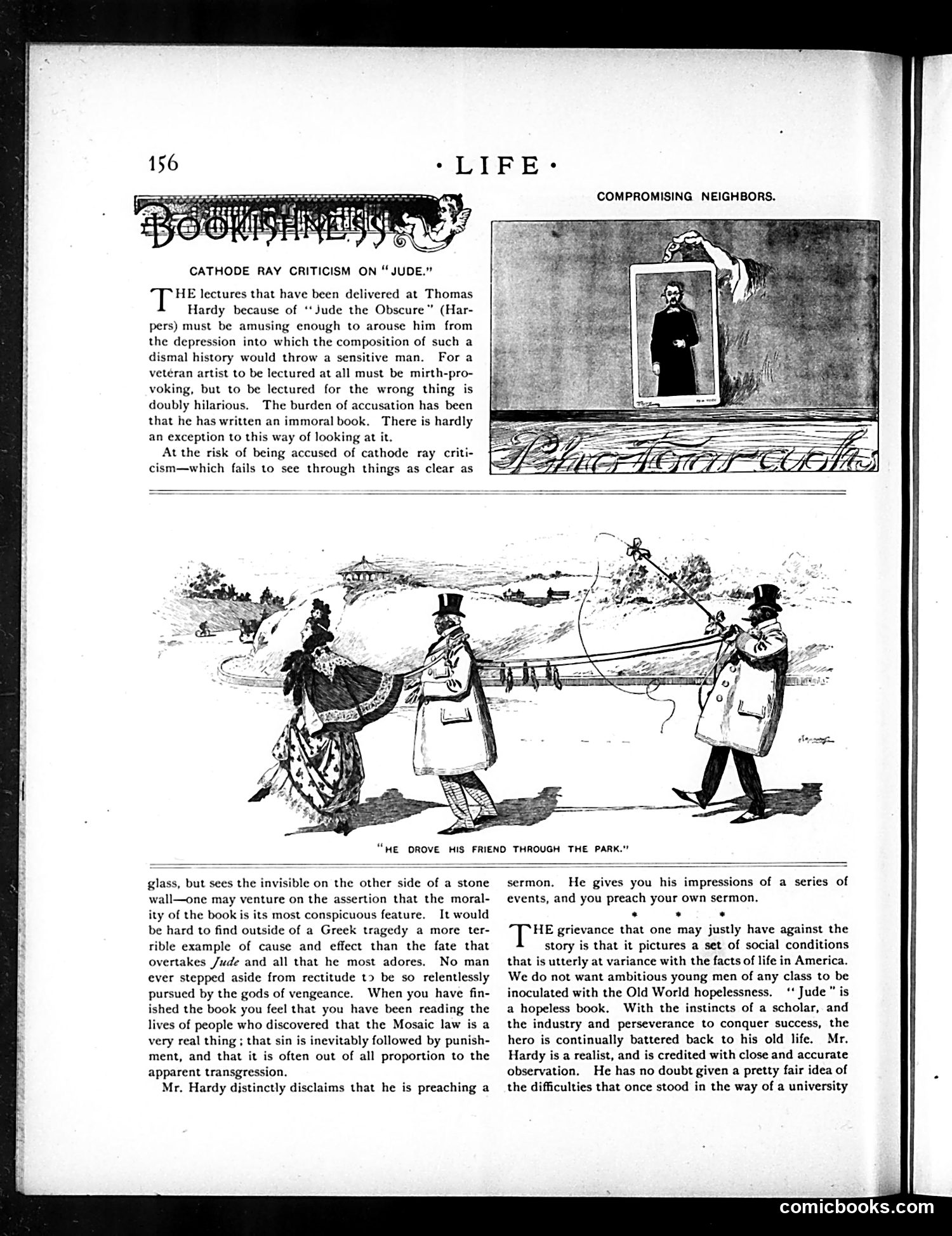
This page critiques Thomas Hardy's novel "Jude the Obscure." The text argues that Cathode Ray (the critic) unfairly attacked Hardy for writing an "immoral book," claiming such lectures are "doubly hilarious" when directed at an artist for supposedly wrong subject matter. The cartoon titled "He Drove His Friend Through the Park" illustrates the article's point about social compromise. It depicts three figures—a woman, a gentleman in top hat, and another man—appearing to manipulate or control a rope, suggesting the compromises and social pressures that constrain individuals in polite society. The satire critiques both Hardy's critics and the restrictive social conventions of the era that condemned realistic literature addressing serious moral and social issues.
📄 Transcribed text from this page (OCR, searchable)
Machine-transcribed from the original scan — historical spelling and the odd misread are preserved.
CATHODE RAY CRITICISM ON “JUDE.” HE lectures that have been delivered at Thomas Hardy because of ‘‘jJude the Obscure” (Har- pers) must be amusing cnough to arouse him from the depression into which the composition of such a dismal history would throw a sensitive man. For a veteran artist to be lectured at all must be mirth-pro- voking, but to be lectured for the wrong thing is doubly hilarious. The burden of accusation has been that he has written an immoral book. There is hardly an exception to this way of looking at it. At the risk of being accused of cathode ray criti- cism—which fails to see through things as clear as “HE DROVE HIS FRIEND THROUGH THE PARK.” glass, but sees the invisible on the other side of a stone wall—one may venture on the assertion that the moral- ity of the book is its most conspicuous feature. It would be hard to find outside of a Greek tragedy a more ter- rible example of cause and effect than the fate that overtakes /ude and all that he most adores. No man ever stepped aside from rectitude t> be so relentlessly pursued by the gods of vengeance. When you have fin- ished the book you feel that you have been reading the lives of people who discovered that the Mosaic law is a very real thing ; that sin is inevitably followed by punish- ment, and that it is often out of all proportion to the apparent transgression. Mr. Hardy distinctly disclaims that he is preaching a sermon. He gives you his impressions of a series of events, and you preach your own sermon, . . . HE grievance that one may justly have against the story is that it pictures a set of social conditions that is utterly at variance with the facts of life in America. We do not want ambitious young men of any class to be inoculated with the Old World hopelessness. ‘‘ Jude ” is a hopeless book. With the instincts of a scholar, and the industry and perseverance to conquer success, the hero is continually battered back to his old life. Mr. Hardy is a realist, and is credited with close and accurate observation. He has no doubt given a pretty fair idea of the difficulties that once stood in the way of a university : if comicbooks.com