
Life, 1896-02-27 · page 4 of 20
Life — February 27, 1896 — page 4: what you’re looking at
What you’re looking at
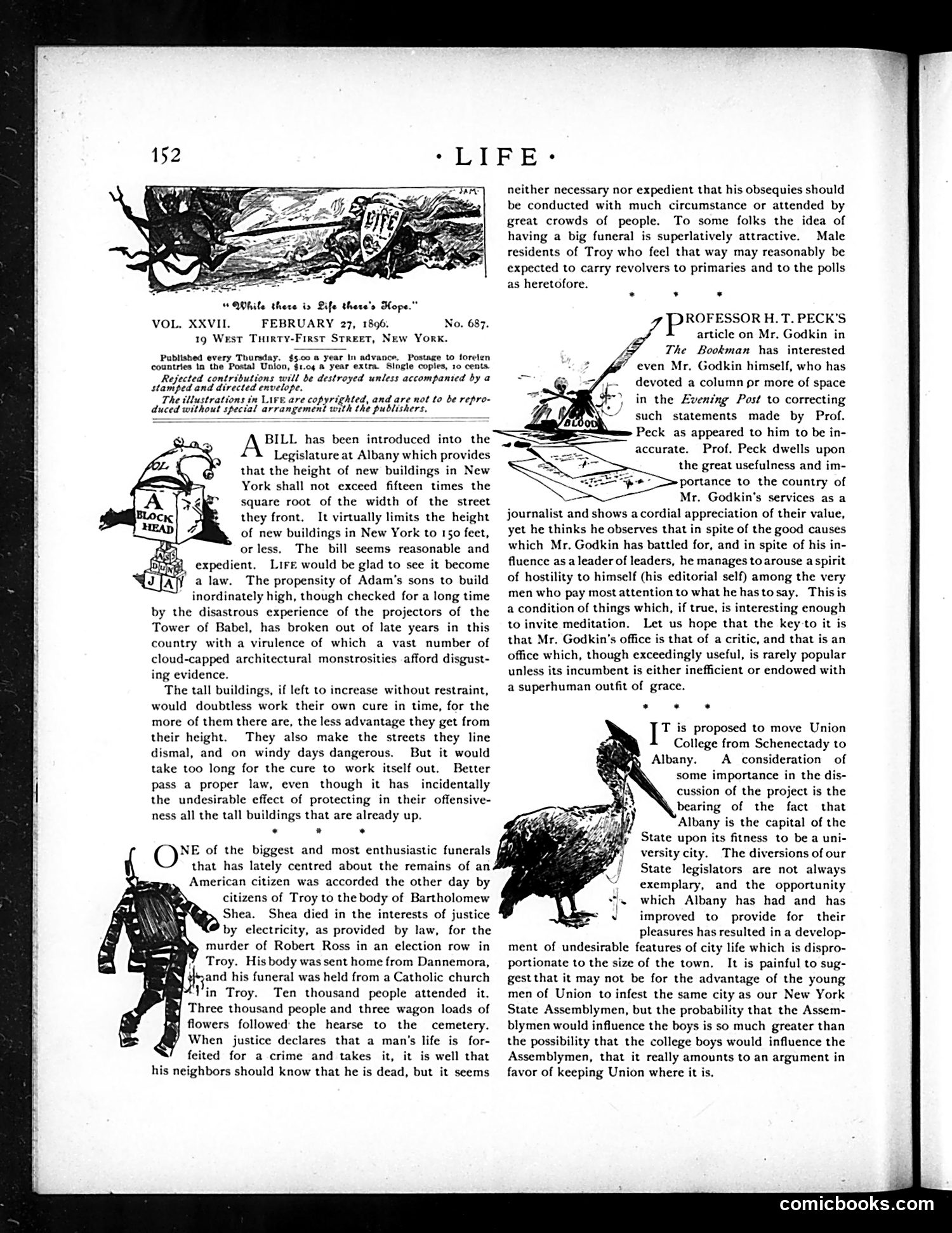
This page from *Life* (February 27, 1896) contains three separate satirical pieces: 1. **Building Height Bill**: Criticizes a proposed Albany law limiting New York building heights to fifteen times street width. The satire mocks the impracticality—suggesting it would stifle urban development while failing to address the actual problems tall buildings create (streets becoming "dismal" and "dangerous"). 2. **Godkin Editorial Critique**: References Professor H.T. Peck's article about Mr. Godkin (likely E.L. Godkin, editor of the *Evening Post*). The satire suggests Godkin's journalistic influence has made him hostile to editorial criticism, creating an unpopular office environment—a commentary on journalistic ego. 3. **Union College Relocation**: Discusses moving Union College from Schenectady to Albany. The satire argues Albany's status as state capital makes it a suitable university city, while questioning whether student influence would sway legislators' support.
📄 Transcribed text from this page (OCR, searchable)
Machine-transcribed from the original scan — historical spelling and the odd misread are preserved.
* LIFE: “While there is Life there's Hope.” VOL. XXVII. FEBRUARY 27, 1896. No. 687. 19 West Tuirty-First STREET, New York. Published every Thursday. $5.00 year In advance. Postage to foreten countries In the Postal Union, $1.04 @ year extra. Single copies, 10 cents. Rejected contributions will be destroyed unless accompanied by a staniped and directed envelope, The illustrations in Lik are copyrighted, and are not to be repro- duced without special arrangement with the publishers, BILL has been introduced into the Legislature at Albany which provides that the height of new buildings in New York shall not exceed fifteen times the square root of the width of the street they front. It virtually limits the height of new buildings in New York to 150 feet, or less, The bill seems reasonable and , expedient, Lire would be glad to see it become a law. The propensity of Adam's sons to build inordinately high, though checked for a long time by the disastrous experience of the projectors of the Tower of Babel, has broken out of late years in this country with a virulence of which a vast number of cloud-capped architectural monstrosities afford disgust- ing evidence. The tall buildings, if left to increase without restraint, would doubtless work their own cure in time, for the more of them there are, the less advantage they get from their height. They also make the streets they line dismal, and on windy days dangerous. But it would take too long for the cure to work itself out. Better pass a proper law, even though it has incidentally the undesirable effect of protecting in their offensive- ness all the tall buildings that are already up. . * . NE of the biggest and most enthusiastic funerals that has lately centred about the remains of an American citizen was accorded the other day by 3 citizens of Troy to the body of Bartholomew b Shea. Shea died in the interests of justice by electricity, as provided by law, for the murder of Robert Ross in an election row in Troy. His body was sent home from Dannemora, and his funeral was held from a Catholic church Ten thousand people attended it. Three thousand people and three wagon loads of fs! flowers followed the hearse to the cemetery. ¥ When justice declares that a man's life is for- feited for a crime and takes it, it is well that his neighbors should know that he is dead, but it seems neither necessary nor expedient that his obsequies should be conducted with much circumstance or attended by great crowds of people. To some folks the idea of having a big funeral is superlatively attractive. Male residents of Troy who feel that way may reasonably be expected to carry revolvers to primaries and to the polls as heretofore. . , . ROFESSOR H. T. PECK’S FA article on Mr. Godkin in The Bookman has interested g” even Mr. Godkin himself, who has devoted a column pr more of space in the Evening Post to correcting such statements made by Prof. Peck as appeared to him to be in- accurate. Prof. Peck dwells upon the great usefulness and im- portance to the country of Mr. Godkin's services as a journalist and shows a cordial appreciation of their value, yet he thinks he observes that in spite of the good causes which Mr. Godkin has battled for, and in spite of his in- fluence as a leader of leaders, he manages to arouse a spirit of hostility to himself (his editorial self) among the very men who pay most attention to what he hastosay. Thisis a condition of things which, if true, is interesting enough to invite meditation. Let us hope that the key-to it is that Mr. Godkin’s office is that of a critic, and that is an office which, though exceedingly useful, is rarely popular unless its incumbent is either inefficient or endowed with a superhuman outfit of grace. * . . T is proposed to move Union College from Schenectady to Albany. A consideration of some importance in the dis- cussion of the project is the bearing of the fact that Albany is the capital of the State upon its fitness to be a uni- versity city. The diversions of our State legislators are not always exemplary, and the opportunity which Albany has had and has improved to provide for their pleasures has resulted in a develop- ment of undesirable features of city life which is dispro- portionate to the size of the town. It is painful to sug- gestthat it may not be for the advantage of the young men of Union to infest the same city as our New York State Assemblymen, but the probability that the Assem- blymen would influence the boys is so much greater than the possibility that the college boys would influence the Assemblymen, that it really amounts to an argument in favor of keeping Union where it is. comicbooks.com