
Life, 1896-02-27 · page 6 of 20
Life — February 27, 1896 — page 6: what you’re looking at
What you’re looking at
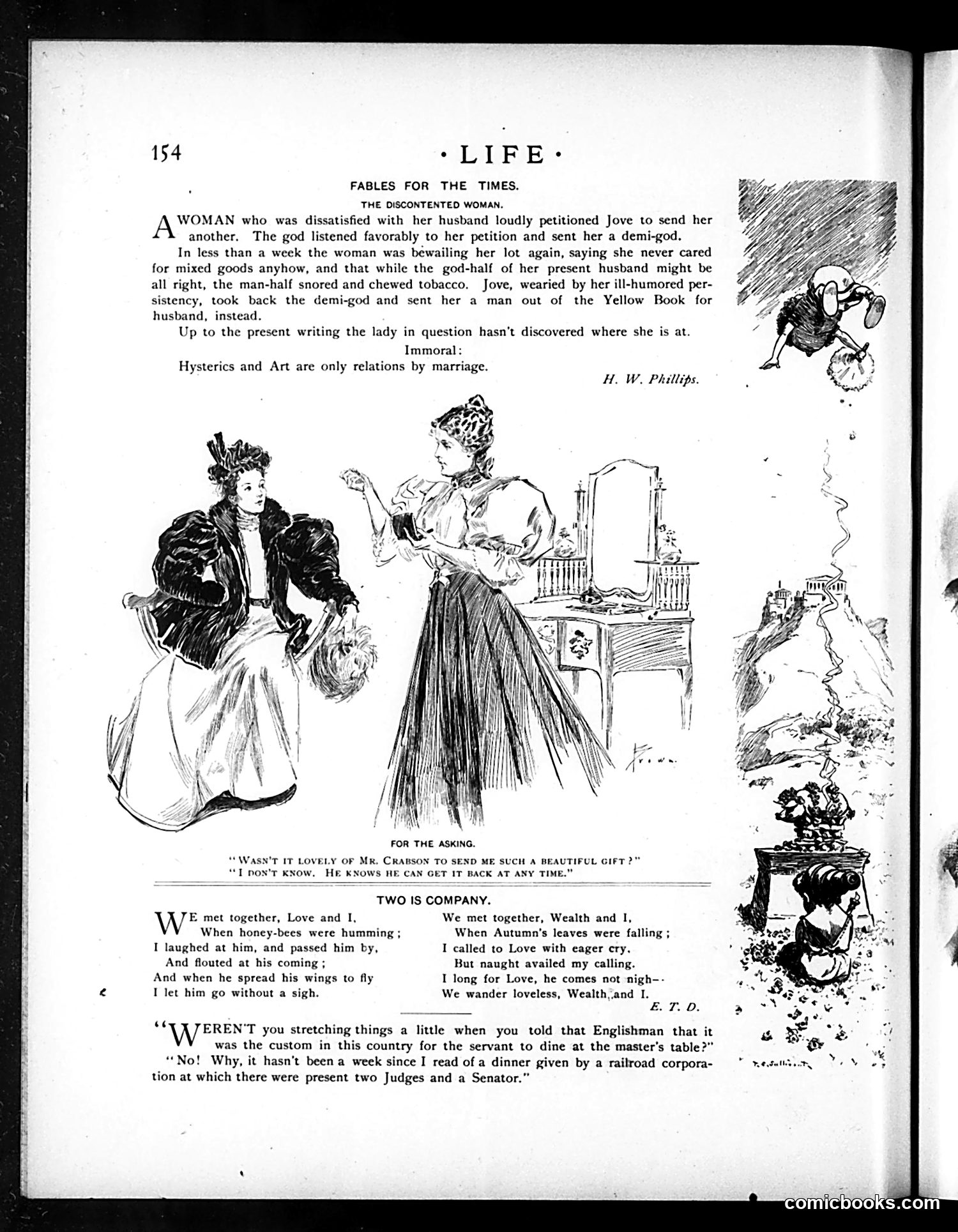
This page contains satirical content about gender relations and marriage in the early 1900s. **"The Discontented Woman"** fable mocks a wife who petitions a god for a lover because her husband ignores her. The satire suggests women's dissatisfaction with marriage is frivolous—the implied lesson being that women should accept their lot. **"For the Asking"** illustration depicts a woman at her vanity, with dialogue suggesting a man can easily reclaim an unwanted gift, implying casual attitudes toward women's value. **"Two is Company"** poem contrasts Love with Wealth as romantic pursuits, sarcastically suggesting both are equally unfulfilling. The final anecdote jokes about English servants dining at masters' tables—Americans apparently found this custom laughably improper, revealing class anxieties of the era.
📄 Transcribed text from this page (OCR, searchable)
Machine-transcribed from the original scan — historical spelling and the odd misread are preserved.
154 * LIFE: FABLES FOR THE TIMES. THE DISCONTENTED WOMAN. A OMAN who was dissatisfied with her husband loudly petitioned Jove to send her another. The god listened favorably to her petition and sent her a demi-god. In less than a week the woman was bewailing her lot again, saying she never cared for mixed goods anyhow, and that while the god-half of her present husband might be all right, the man-half snored and chewed tobacco. Jove, wearied by her ill-humored per- sistency, took back the demi-god and sent her a man out of the Yellow Book for husband, instead. Up to the present writing the lady in question hasn't discovered where she is at. Immoral: Hysterics and Art are only relations by marriage. H.W. Phillips. “WASN'T IT LOVELY OF IN TO SEND ME SUCH A BEAUTIFUL GIFT?” n KD p KNOWS HE CAN GET IT BACK AT ANY TIME.” TWO IS COMPANY. E met together, Love and I, We met together, Wealth and I, When honey-bees were humming ; When Autumn's leaves were falling ; I laughed at him, and passed him by, I called to Love with eager cry, And flouted at his coming ; But naught availed my calling. And when he spread his wings to fly I long for Love, he comes not nigh-- I let him go without a sigh. We wander loveless, Wealth,and I. &. 7.0. se EREN'T you stretching things a little when you told that Englishman that it was the custom in this country for the servant to dine at the master's table?” “No! Why, it hasn't been a week since I read of a dinner given by a railroad corpora- tion at which there were present two Judges and a Senator.”