
A complete issue · 26 pages · 1895
Life — November 28, 1895
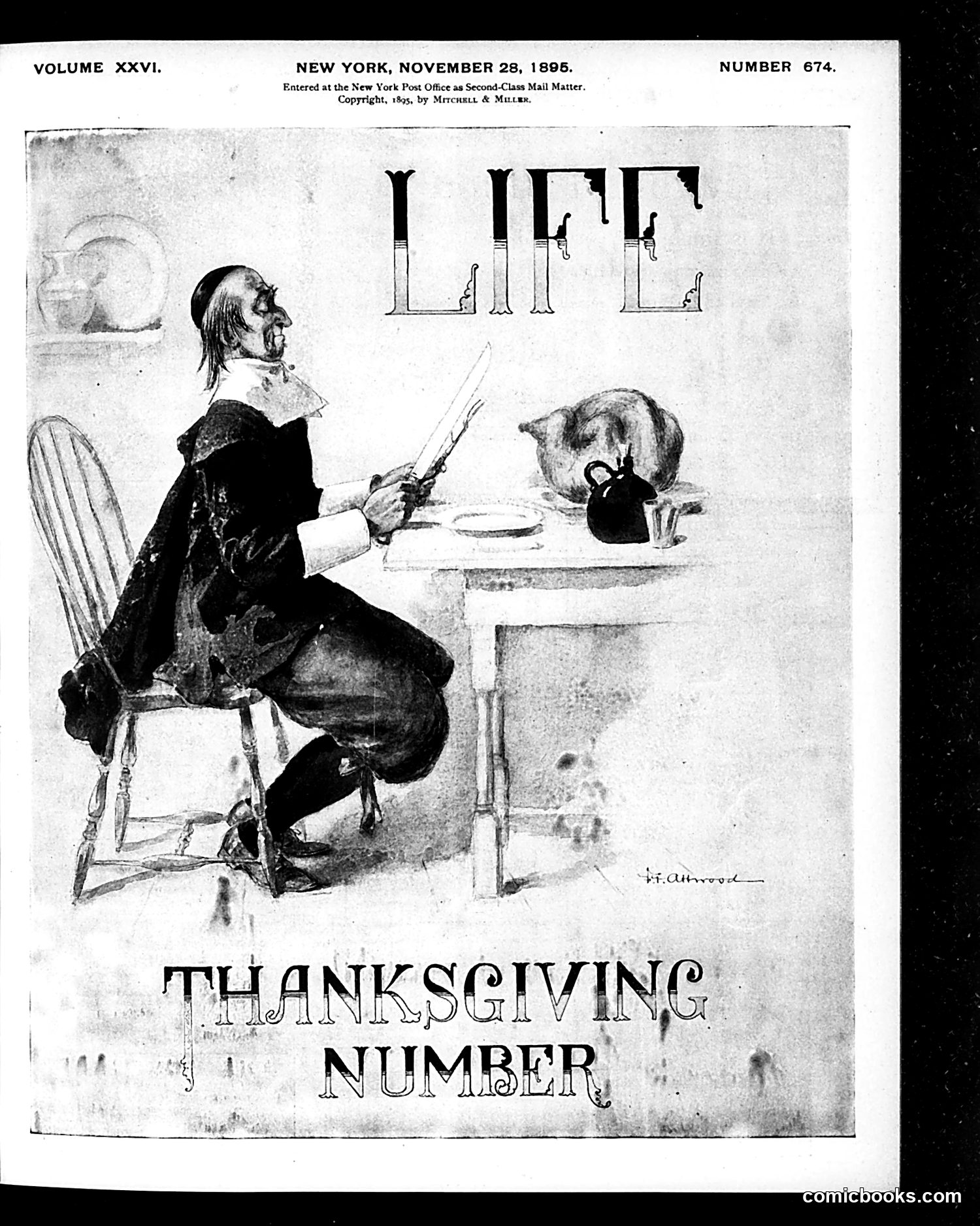
This cover depicts a gaunt, menacing figure seated at a table with a gun, facing a large turkey. The cartoon appears to be a darkly comic commentary on Thanksgiving traditions—the figure's skeletal appearance and aggressive posture suggest he's starving or desperate, creating grotesque humor around the holiday's feast theme. The exaggerated caricature with sharp features and disheveled appearance likely represents a social type (possibly a vagrant or impoverished person) who starkly contrasts with Thanksgiving's associations of abundance. The satirical point seems to be commentary on class disparity or economic hardship during this period, using the holiday's idealized imagery of plenty to highlight the grim reality for society's poorest members.
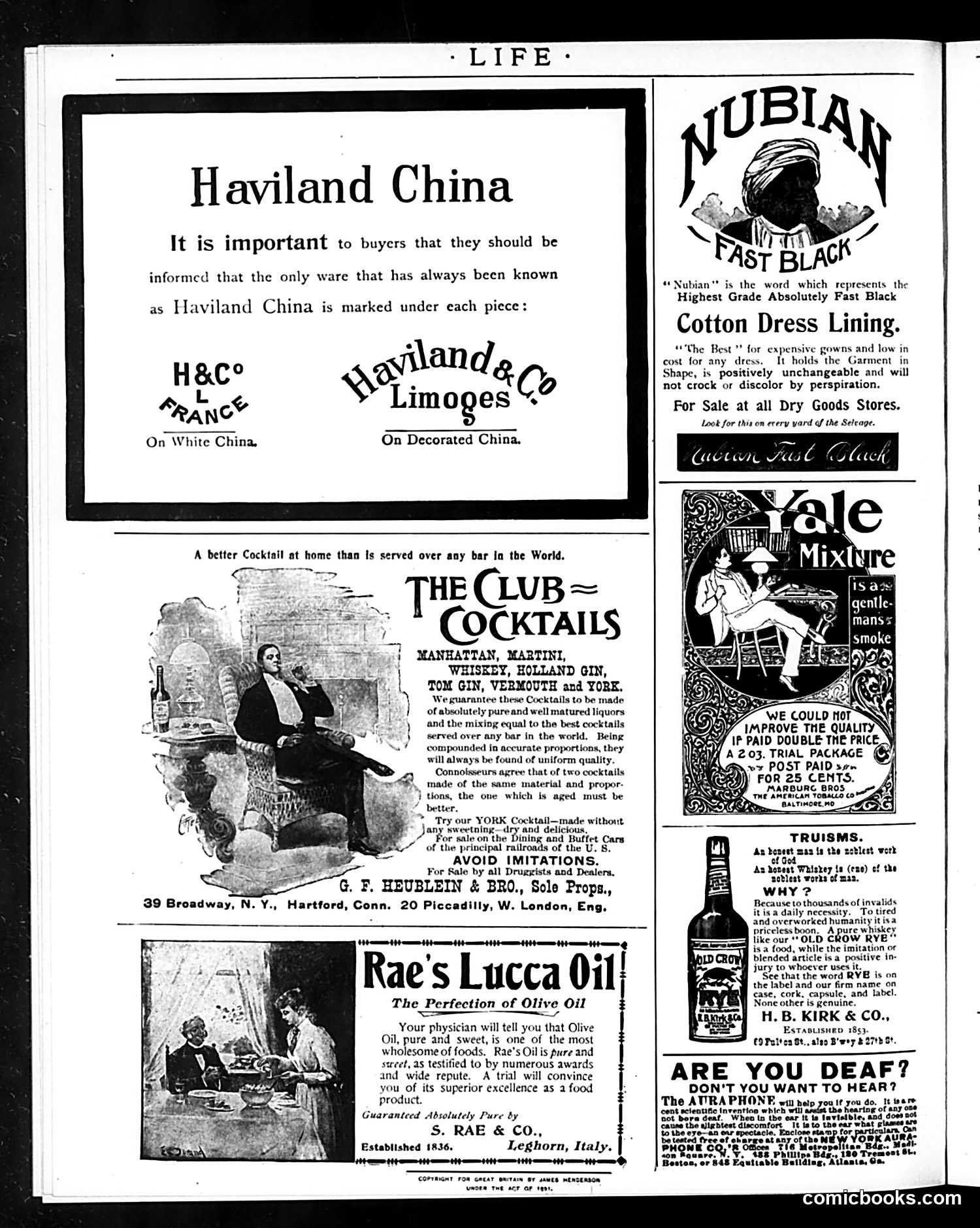
This page is **primarily advertising** with no discernible political cartoons or satire. The layout includes: 1. **Haviland China** - advertisement for French porcelain dinnerware, distinguishing authentic pieces by their marks 2. **The Club Cocktails** - an advertisement promoting home cocktail preparation, featuring a man relaxing with drinks 3. **Nubian Fast Black Cotton Dress Lining** - fabric product ad 4. **Rae's Lucca Oil** - Italian olive oil advertisement 5. **Yale Mixture** - tobacco/smoking product 6. **Additional product advertisements** for whiskey, an audiophone device for deaf people, and other consumer goods The page represents typical early 20th-century magazine advertising rather than satirical editorial content. No political figures or social commentary requiring historical context are evident.
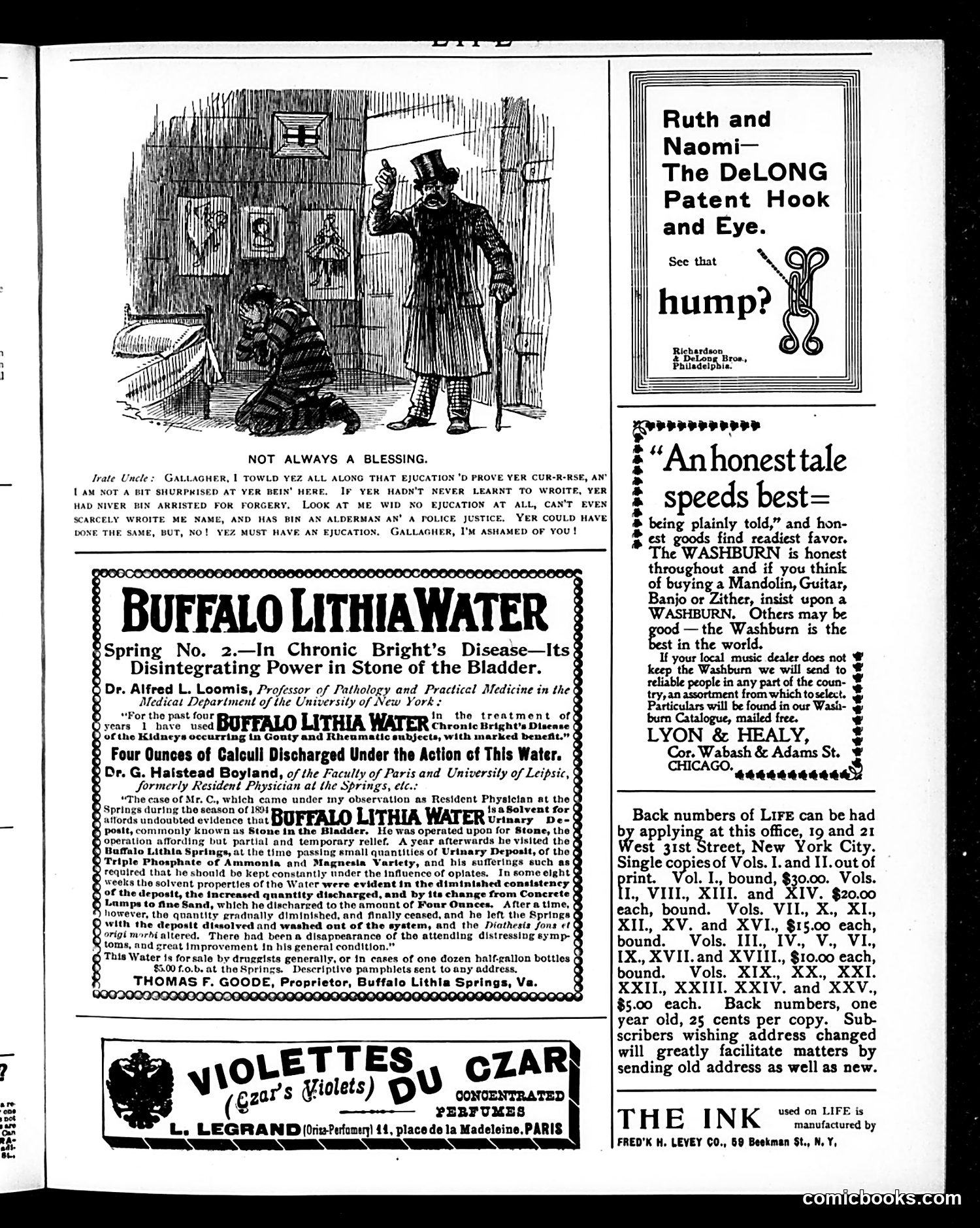
The main cartoon, titled "Not Always a Blessing," depicts a wealthy man in a top hat confronting a poor person, likely an Irish immigrant ("Uncle Gallagher"). The caption suggests the wealthy man is lecturing about education as a solution to poverty, but the text sarcastically notes that education can be dangerous—the poorly educated man couldn't write to commit fraud, but an educated criminal can. The satire targets the naive belief that education automatically improves social conditions, and critiques how education might paradoxically enable criminality among the disadvantaged. The rest of the page consists primarily of patent medicines and commercial advertisements typical of early 20th-century publications, including Buffalo Lithia Water and perfume ads.
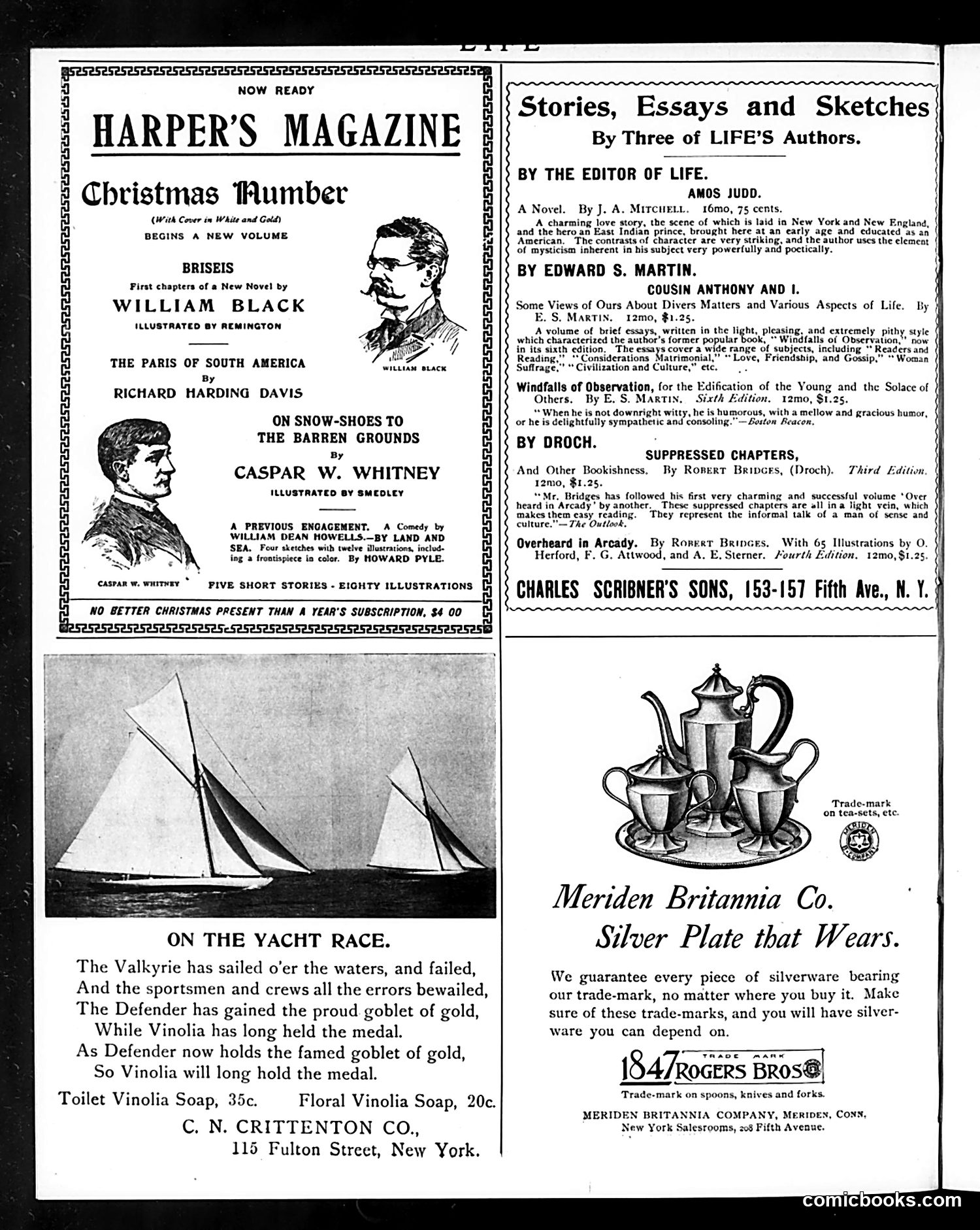
This page is primarily **advertising and literary promotion** rather than political satire. It announces Harper's Magazine Christmas Number and advertises books by authors including William Black, Richard Harding Davis, and Caspar W. Whitney. The main visual content shows a **yacht race photograph** captioned "On the Yacht Race," depicting two sailing vessels. Below it is a poem about the race, promoting Vinolia Soap—a common advertising strategy of the era, pairing products with current events. The right side features book advertisements from Charles Scribner's Sons and the Meriden Britannia Company (silverware). **No political satire is evident.** This is a standard magazine page mixing editorial content with commercial advertisements, typical of late 19th-century American periodicals.
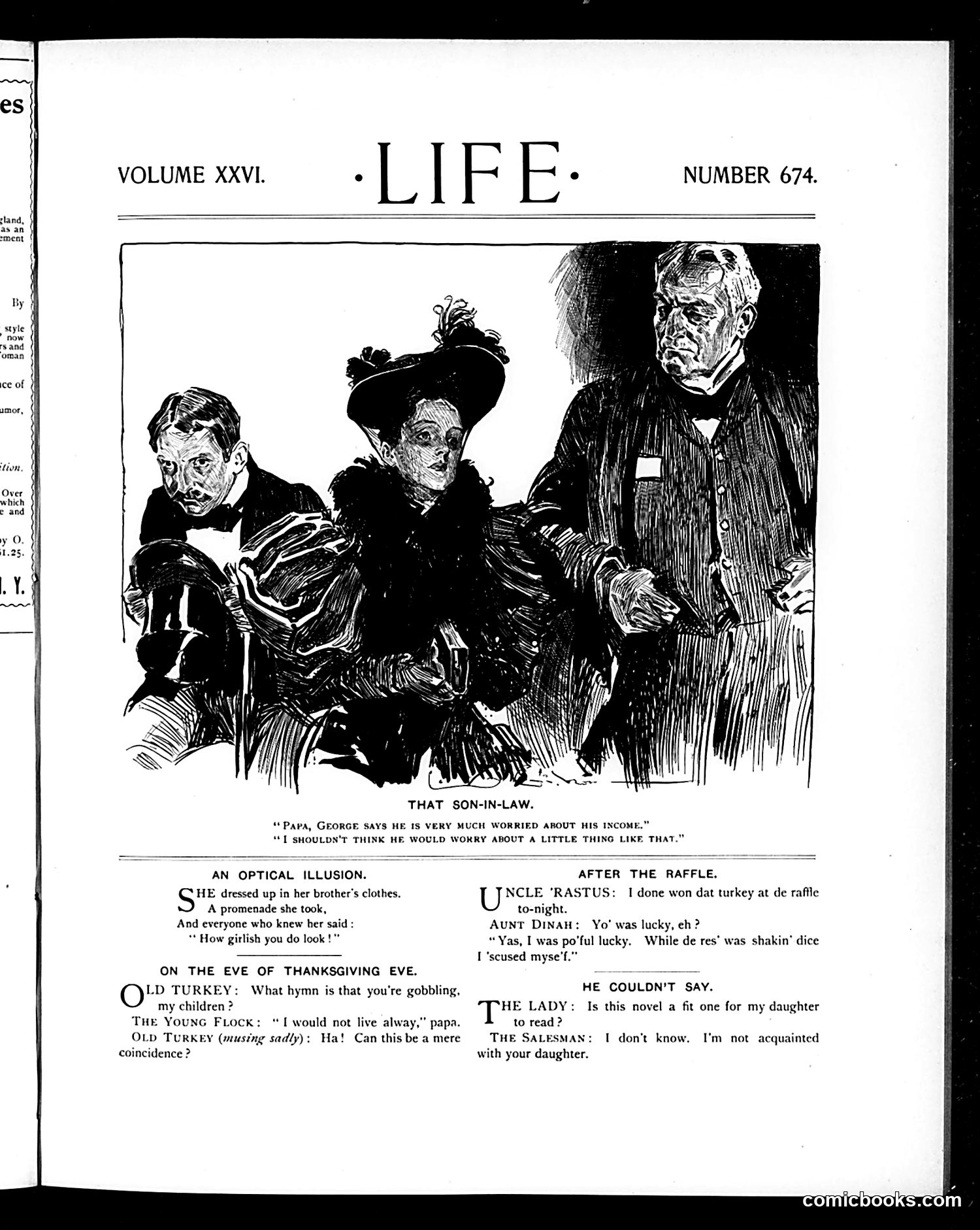
This Life magazine page (Volume XXVI, No. 674) contains several brief humorous sketches with an early-1900s sensibility. The main illustration, "That Son-in-Law," shows three figures in what appears to be a domestic concern about finances—the father worries about his income while the son-in-law dismisses such concerns as trivial. The text pieces satirize everyday situations: "An Optical Illusion" jokes about cross-dressing for comedic effect; "On the Eve of Thanksgiving Eve" presents a darkly humorous exchange where an old turkey questions whether its death is mere coincidence; "After the Raffle" depicts humble working-class luck; and "He Couldn't Say" shows a salesman's awkward inability to recommend a novel to a customer. These sketches reflect typical Life magazine humor: domestic comedy, class observations, and gentle social satire of middle-class American life.
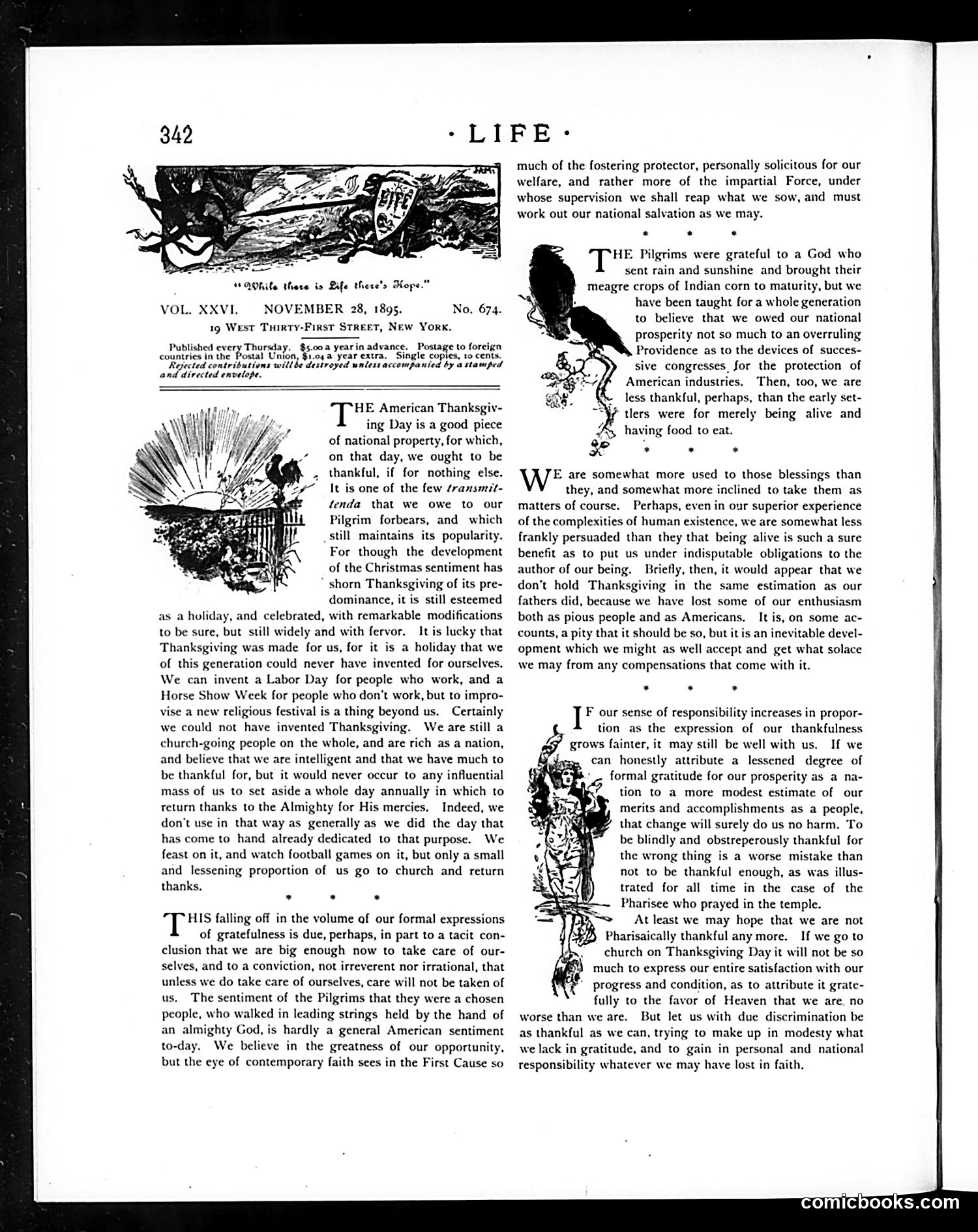
This page is primarily **editorial text about Thanksgiving**, not political satire. The article argues that Americans should feel more genuinely grateful for their blessings, comparing contemporary Thanksgiving observance unfavorably to the Pilgrims' original gratitude. The decorative illustrations—a turkey and cornucopia—are thematic ornaments rather than satirical cartoons. The article's implicit critique targets **American complacency**: it suggests that modern Americans, despite prosperity from industrial protection and successful "congresses," lack the sincere thankfulness earlier generations possessed. The piece advocates for more authentic gratitude and personal responsibility in national character. This reflects late-19th-century anxieties about whether industrial wealth had made Americans morally soft or spiritually hollow.
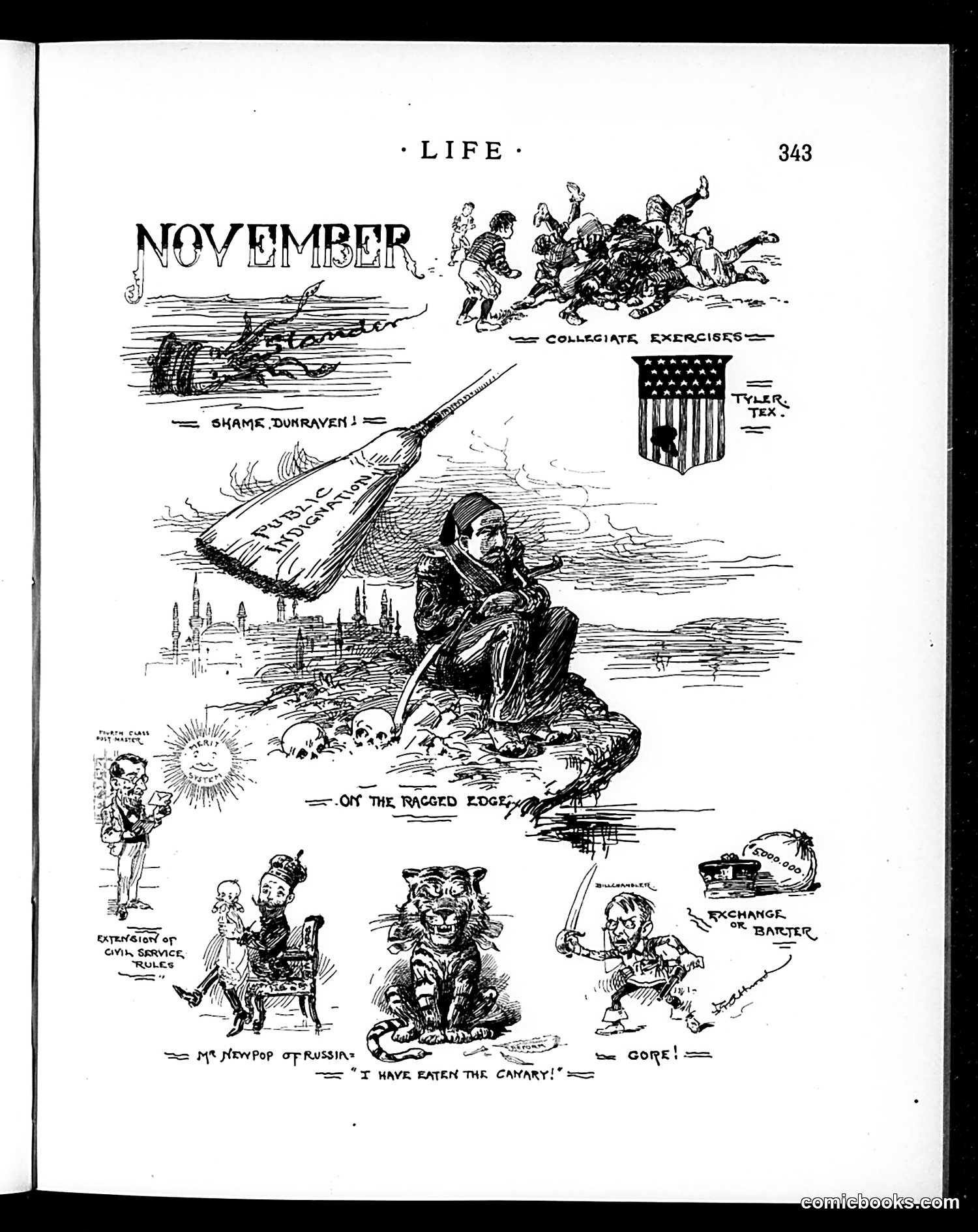
This page contains several political cartoons mocking current events and figures. The central image shows a figure "On the Ragged Edge," apparently depicting hardship or precarious circumstances. Other visible captions reference: - "Sham's Dunraven" (likely a sailing scandal involving Lord Dunraven) - "Collegiate Exercises" (showing rowdy students) - "Mr. Newpop of Russia" with "I have eaten the canary!" (appears to reference Russian political figures) - "Gore!" with "Exchange or Barter" - "Extension of Civil Service Rules" The "Tyler, Tex" shield suggests Texas political content. Without clearer dates visible, the specific November and year remain uncertain, but the cartoons employ exaggeration and caricature typical of 1890s-era American political satire addressing contemporary political and social issues.
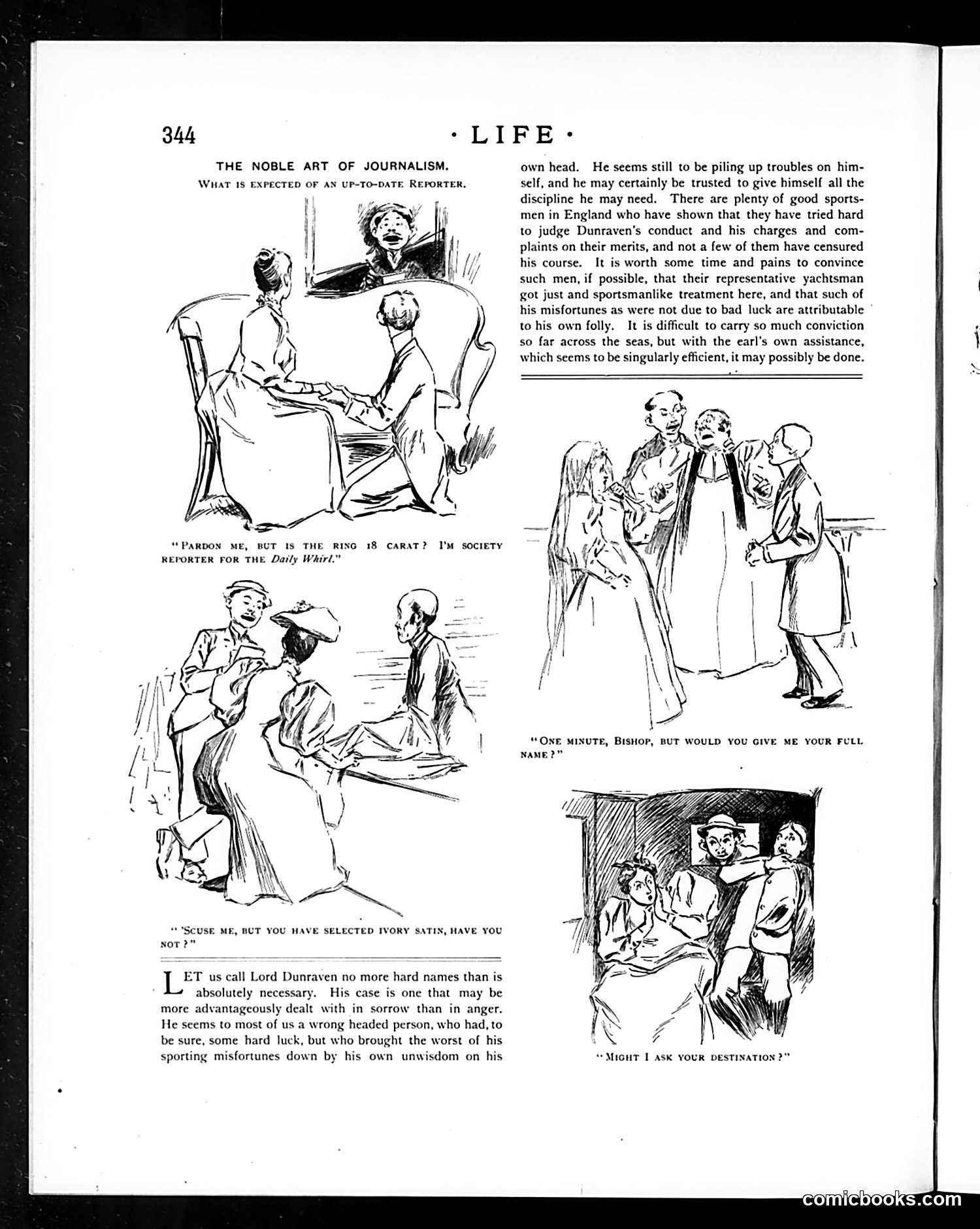
This page satirizes journalistic practices and Lord Dunraven, an apparent public figure involved in a sporting scandal (likely yachting, given references to "the ring" and "carat"). The cartoons mock journalists pursuing sensational stories. The top sketch shows a reporter interviewing someone about a scandal. Lower panels depict reporters aggressively questioning various subjects—a bishop about his name, someone about ivory satin purchases, and asking destinations. The accompanying text defends Dunraven against harsh press treatment, arguing his misfortunes resulted from bad judgment rather than malice, and suggesting English sportsmen should judge him fairly rather than condemn him in print. The satire targets both the press's sensationalism and the public's eagerness for scandal—showing journalists as intrusive and opportunistic.
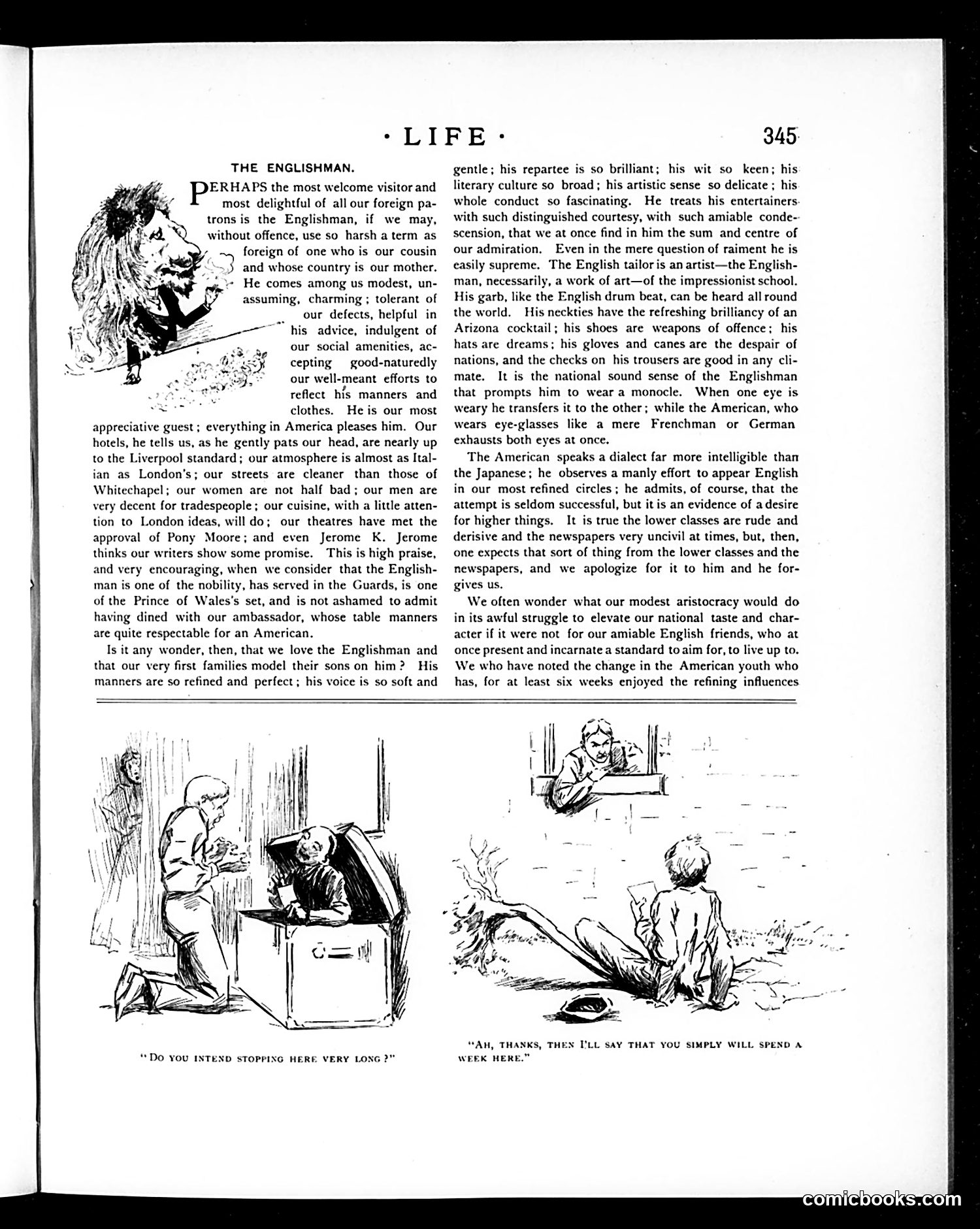
This article praises English visitors to America, describing the Englishman as refined, cultured, and well-mannered—a positive counterpart to other foreign stereotypes. The piece celebrates English traits like gentle deportment, sophisticated wit, and good taste. The two cartoons below illustrate contrasting scenarios: one shows a figure inquiring about a long stay (implying concern about overstaying); the other depicts someone contentedly settling in for a week, saying they'll "simply spend a week here." The satire likely plays on American ambivalence about English visitors—simultaneously admiring their sophistication while poking fun at their tendency to linger or impose themselves on American hospitality. The cartoons gently mock English social habits through these domestic situations.
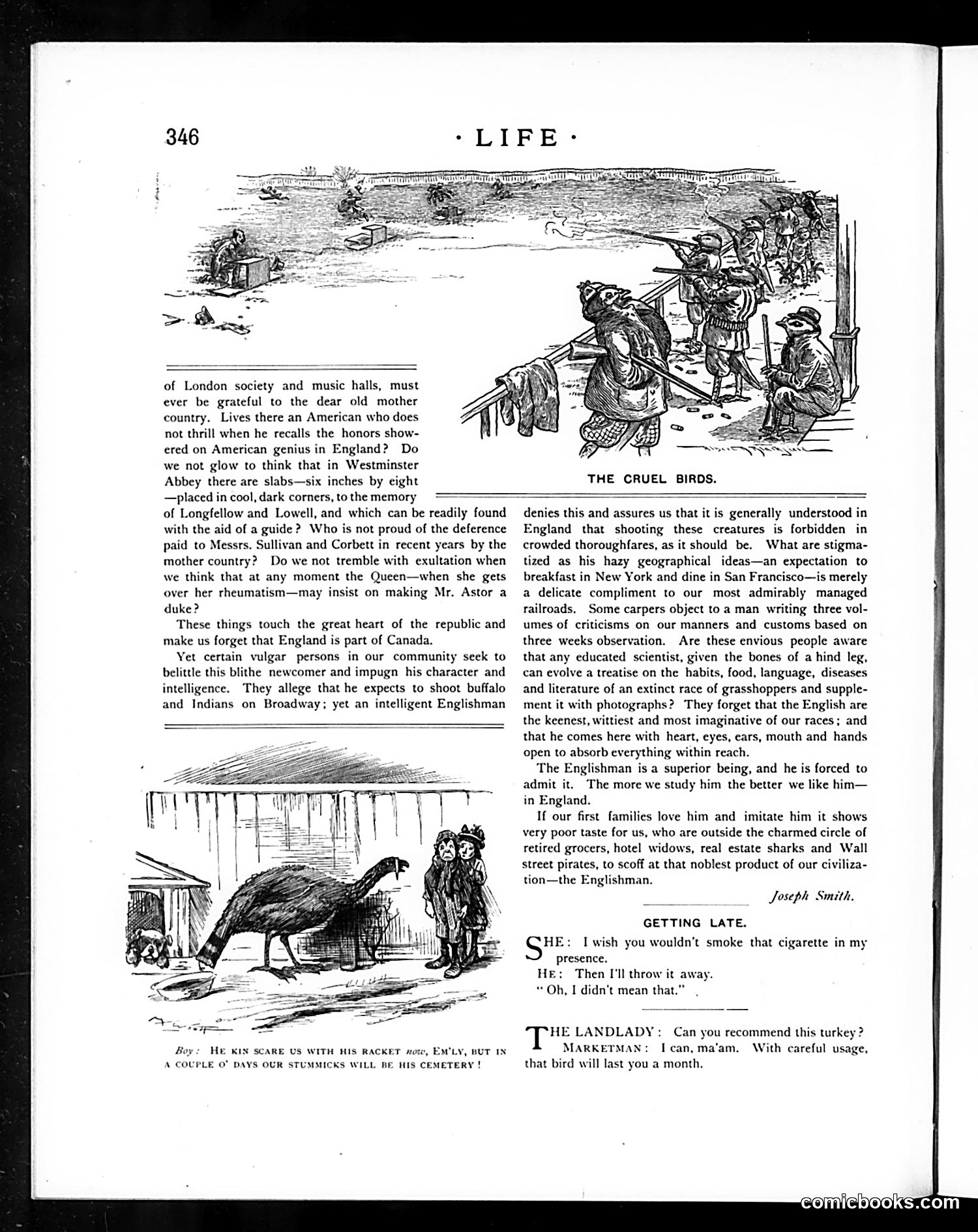
This page contains satirical commentary on English vs. American cultural differences, particularly critiquing American tourists' behavior in England. **"The Cruel Birds"** (top illustration): Shows American visitors mistreating what appears to be native English birds or wildlife, satirizing Americans' ignorance of local customs and disrespect for British traditions. **The turkey dialogue** (bottom): Humorously contrasts English reserve with American materialism—the Marketman's deadpan promise that a turkey will "last you a month" with "careful usage" mocks both English thrift and American conspicuous consumption. The main text attacks vulgar American newcomers who embarrass the nation abroad, specifically mentioning Broadway performers and wealthy tourists. It defends the English character as superior and sophisticated, while portraying certain Americans as uncultured and arrogant representatives of their country.
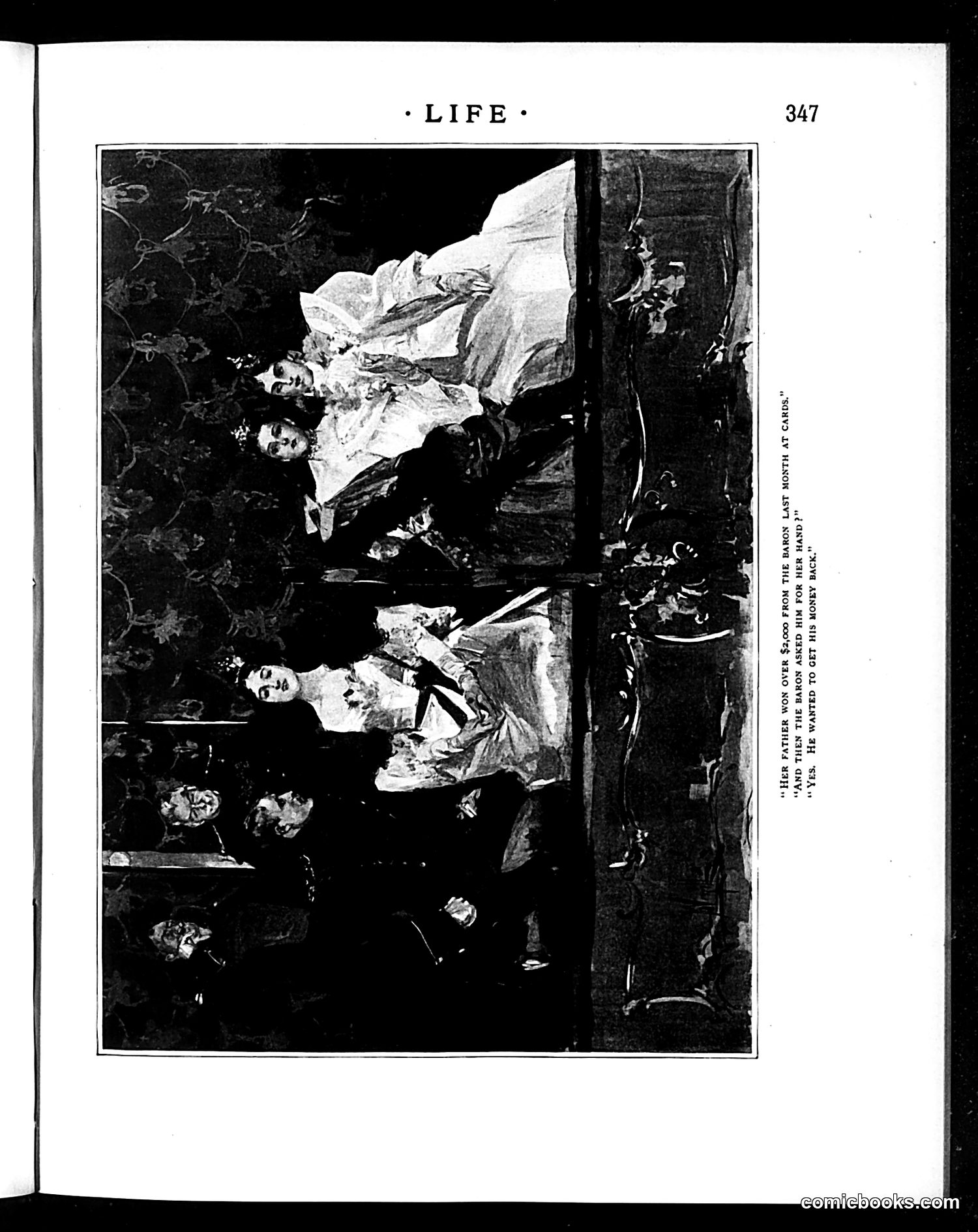
This page from *Life* magazine (page 347) contains a black-and-white photograph rather than a cartoon. The image shows what appears to be a domestic or theatrical scene with figures in period costume - one person in elaborate light-colored dress reclining on a couch or fainting couch, and another figure below. The caption text on the right is partially legible but appears to reference "her father" and mentions something about "banks" and "sect," though the exact wording is unclear in this reproduction. Without clearer caption text or additional context about the publication date, I cannot definitively identify the specific figures, event, or satirical point this photograph illustrates. It may be a theatrical review, social commentary, or humorous domestic scene typical of *Life*'s satirical content of that era.
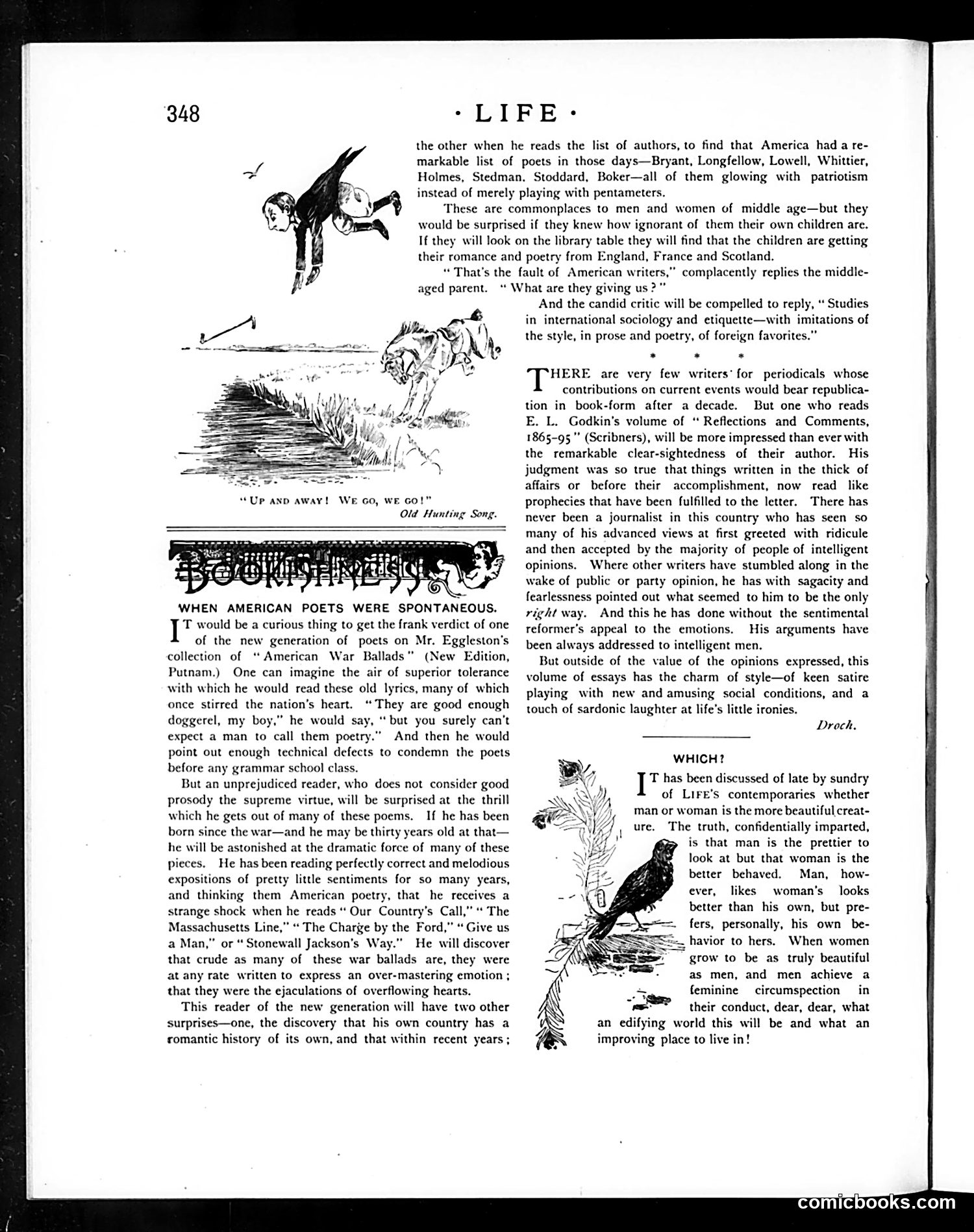
This page critiques the declining appreciation of American literature among younger generations. The cartoon depicts a hunting scene with the caption "Up and away! We go, we go!"—likely referencing the energetic patriotic spirit of older American war ballads. The article argues that 19th-century American poets (Bryant, Longfellow, Lowell, Whittier, Holmes, et al.) wrote with genuine emotion and patriotic fervor, whereas modern young people prefer derivative European literature. The author laments that contemporary children find their "romance and poetry from England, France and Scotland" rather than American sources. The satire targets middle-aged parents who blame "American writers" for failing to inspire youth, when the real problem is that modern literature—whether American or foreign—prioritizes technical perfection and sentimental prettiness over authentic emotional expression. The piece nostalgically contrasts "crude" but heartfelt Civil War ballads with polished but hollow contemporary verse.
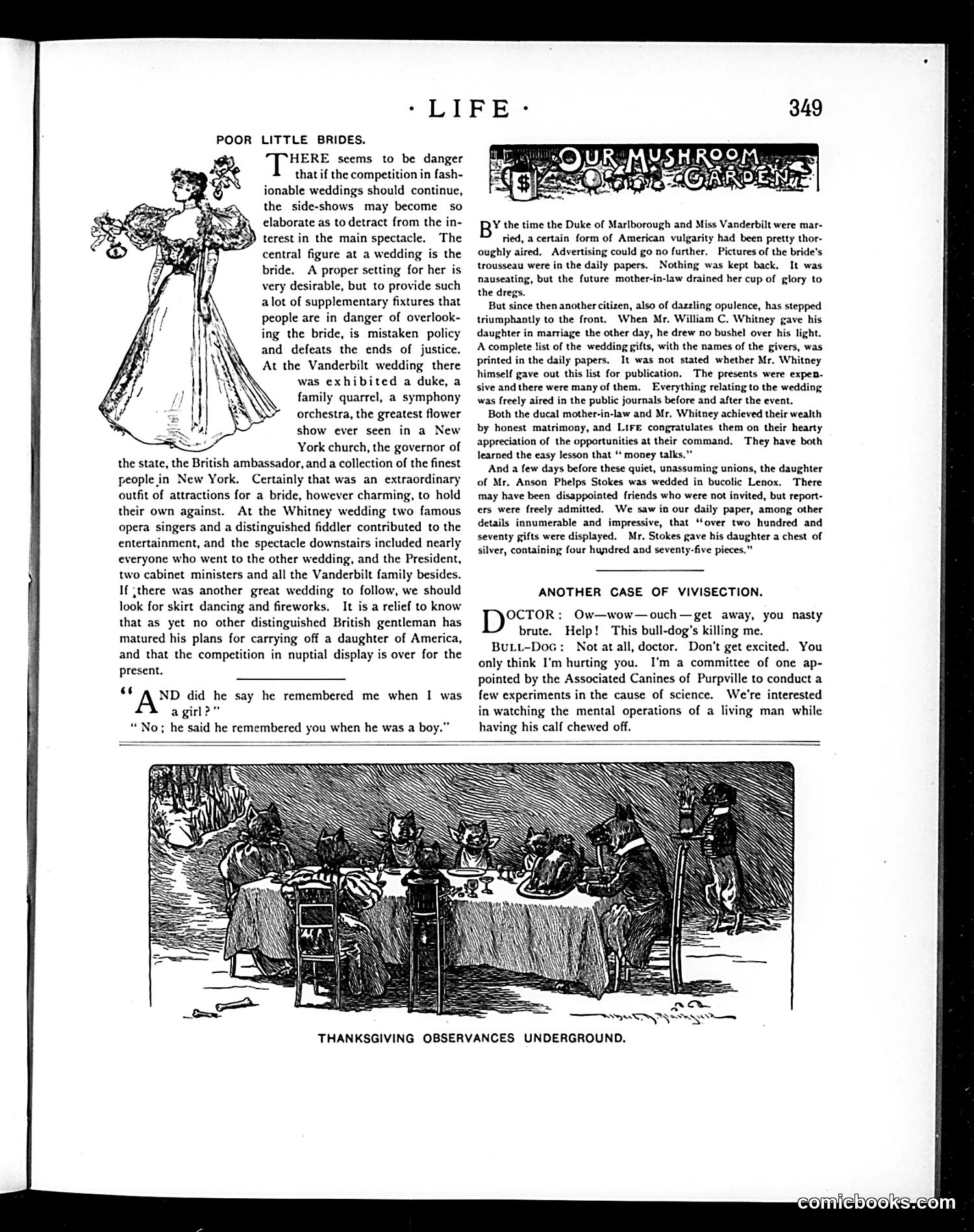
This page satirizes the ostentatious display surrounding wealthy American weddings of the Gilded Age. The main article mocks the Vanderbilt and Whitney family weddings, which had become public spectacles featuring opera singers, orchestras, governors, and British ambassadors—overshadowing the bride herself. The satire targets the nouveaux riche mentality where wealthy industrialists like William C. Whitney publicly paraded wedding gifts (even publishing complete lists with donors' names) to demonstrate status and "money talks." Life criticizes this vulgar competition in "nuptial display," noting that each subsequent wedding attempted to outdo the last with more elaborate entertainment and publicity. The joke at bottom—"he remembered you when he was a boy"—implies the bride has aged noticeably or is marrying someone much younger. The illustration "Thanksgiving Observances Underground" appears unrelated; it's a separate cartoon, likely satirizing something contemporary to the magazine's publication.
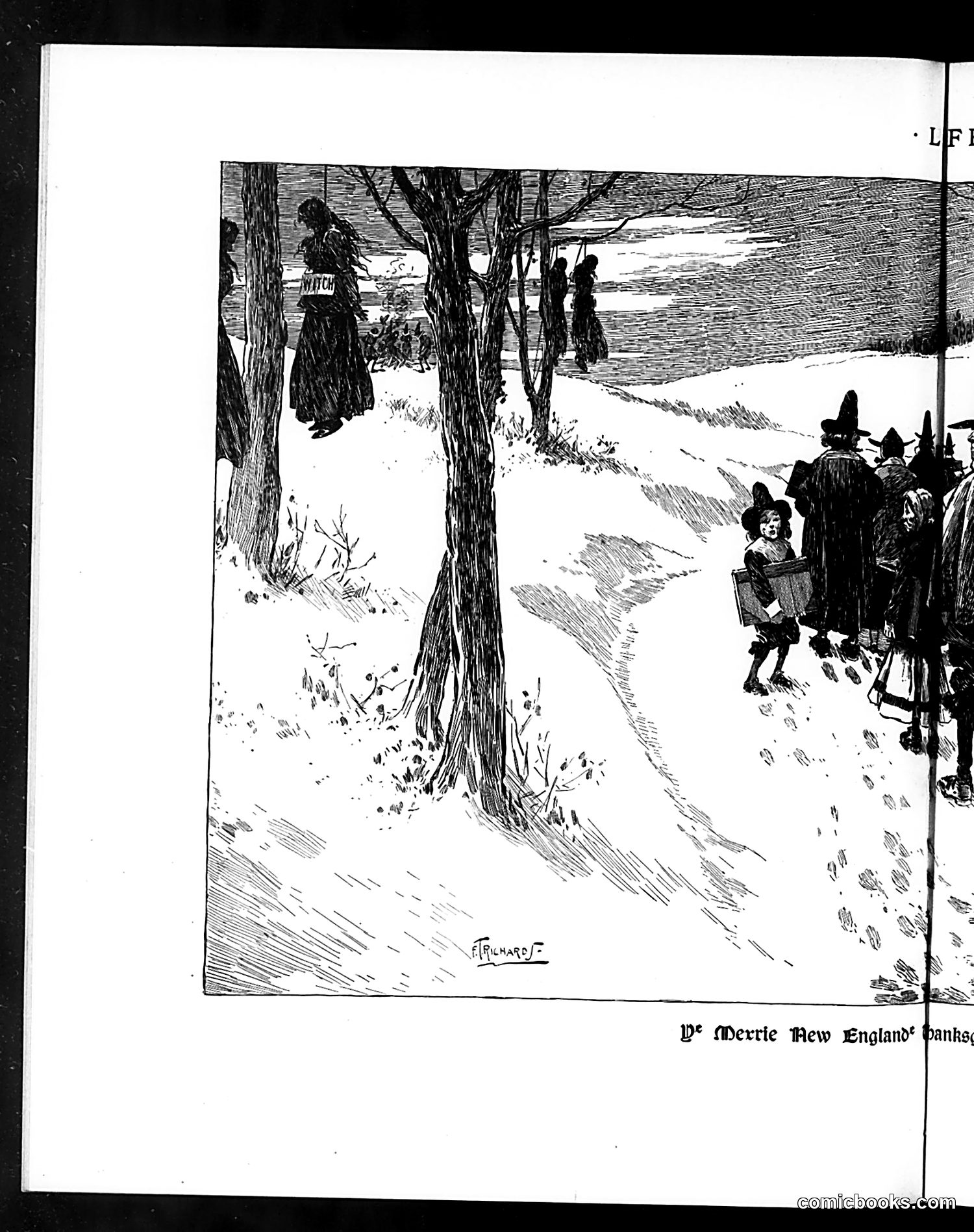
This is a winter scene illustration signed by the artist (signature appears to be "Eichberg" or similar). The image shows a snowy landscape with bare trees and a group of people gathered on the right side, appearing to be caroling or celebrating together. The caption reads "A Merrie New England" (likely "Merry New England"), suggesting this is a seasonal holiday illustration celebrating New England winter traditions. The scene depicts what appears to be Christmas carolers or celebrants in a snow-covered rural setting, romanticizing traditional New England holiday customs. Without additional context from the magazine's surrounding articles or advertisements, this appears to be a straightforward seasonal illustration rather than political satire—celebrating nostalgic Americana and winter holiday traditions rather than mocking them.
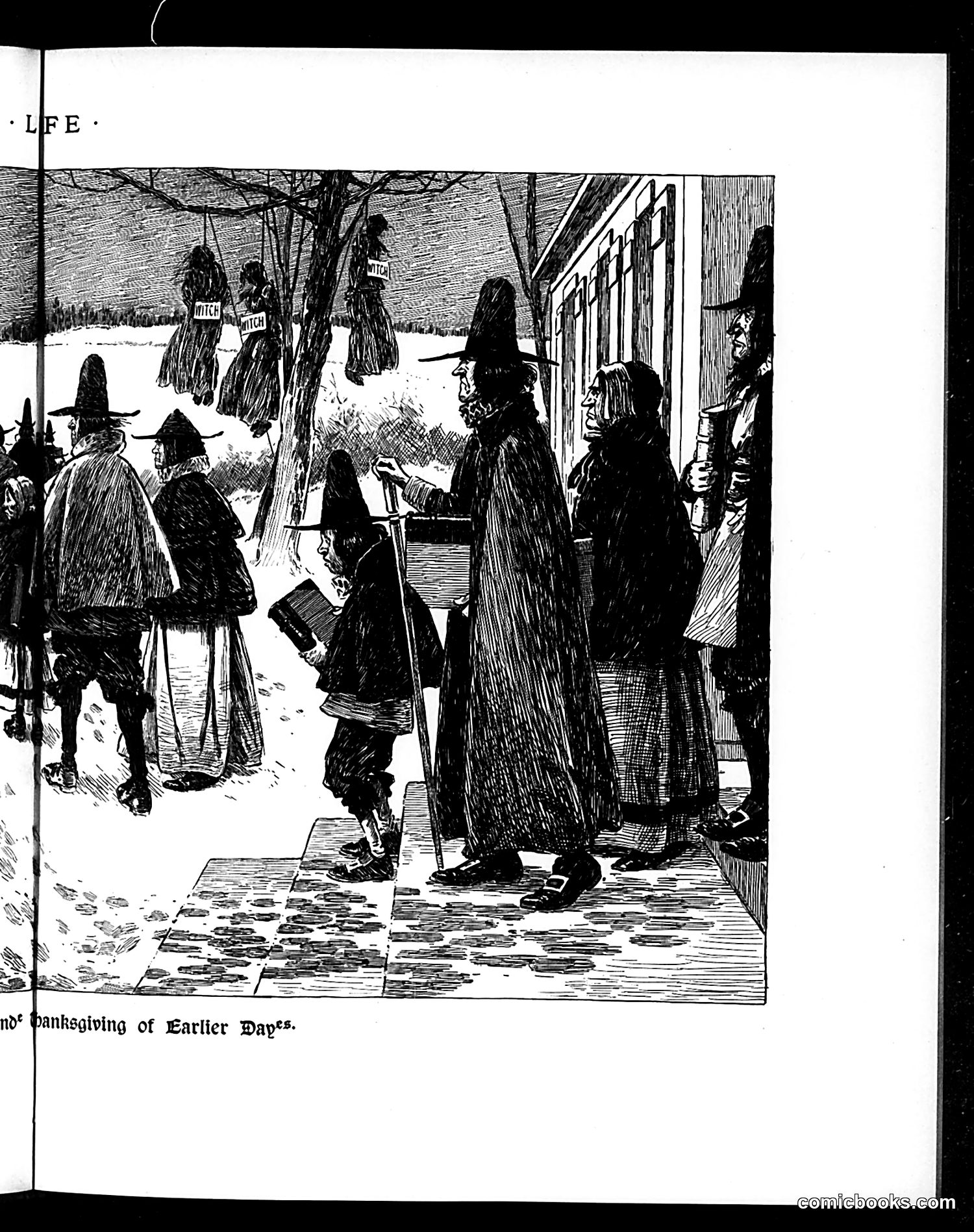
This historical engraving depicts a colonial-era Thanksgiving scene. The illustration shows a group of people gathered outside a building during winter, with snow on the ground and bare trees visible. The figures wear period clothing including long coats and hats typical of early American settlers. The caption's nostalgic reference to "Earlier Days" suggests the piece contrasts past and present Thanksgiving traditions. This appears to be a straightforward historical illustration rather than political satire—likely included in *Life* magazine to educate readers about how their ancestors celebrated the holiday. The engraving style and subject matter position early American Thanksgiving as a foundational cultural moment, appealing to readers' sense of historical continuity and tradition.
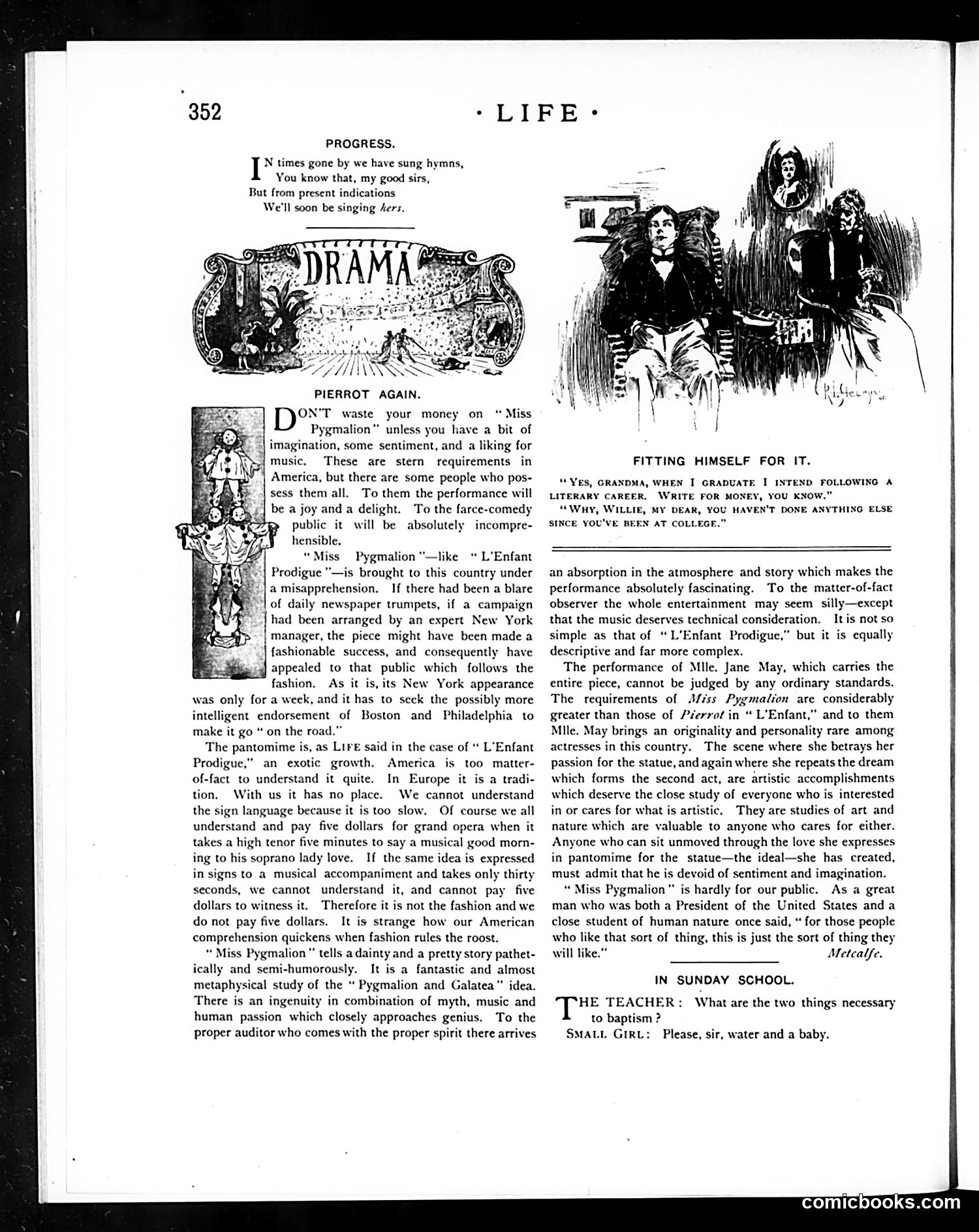
This page contains two separate satirical pieces targeting American cultural attitudes: **"Pierrot Again"** critiques American audiences' rejection of European pantomime theater. The review discusses "Miss Pygmalion," an imported French theatrical production that failed commercially. Life mocks American audiences for paying five dollars to sit through slow opera but dismissing pantomime that conveys the same idea in thirty seconds—exposing the hypocrisy and irrationality of fashion-driven taste. The satire argues Americans are too "matter-of-fact" to appreciate sophisticated European art forms. **"Fitting Himself For It"** (cartoon) jokes about a college student claiming he intends to pursue a literary career upon graduation, while his grandmother notes he's already been "writing for money" throughout college—implying he's been cheating, plagiarizing, or submitting others' work for payment rather than actually studying. Both pieces satirize American cultural pretension and intellectual dishonesty.
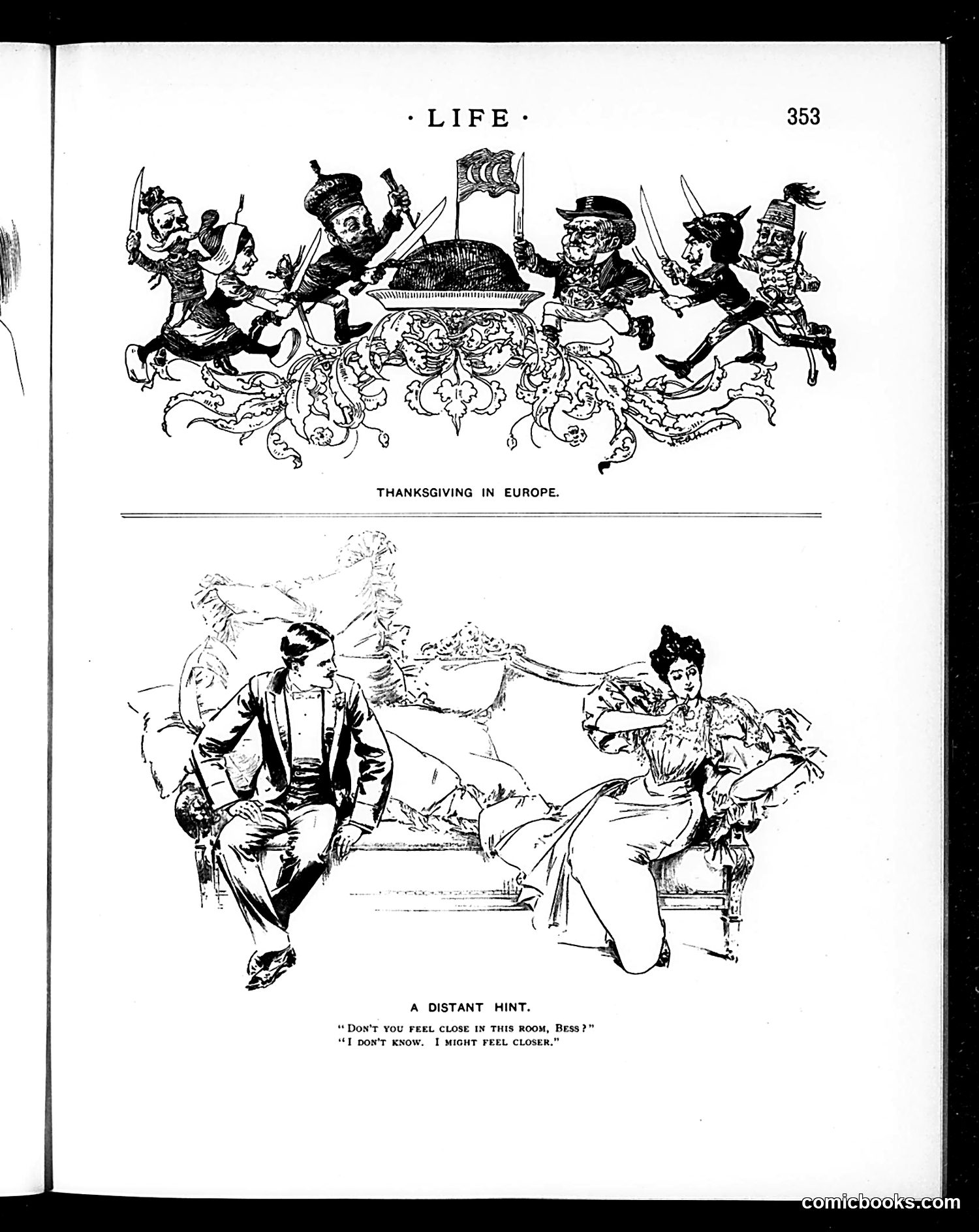
The top cartoon depicts European military and political figures engaged in chaotic conflict around a decorative central object, satirizing European political turmoil and militarism during what appears to be a period of international tension (likely early 20th century). The bottom cartoon, titled "A Distant Hint," shows a flirtatious domestic scene between a man and woman. The woman's coy response—"I might feel closer"—is a suggestive double entendre, likely mocking American sentimentality or naiveté about romance. The juxtaposition suggests satire about American attitudes: while Europeans engage in serious political/military conflict, Americans occupy themselves with romantic dalliance. The contrast highlights perceived American insularity or indifference to international affairs.
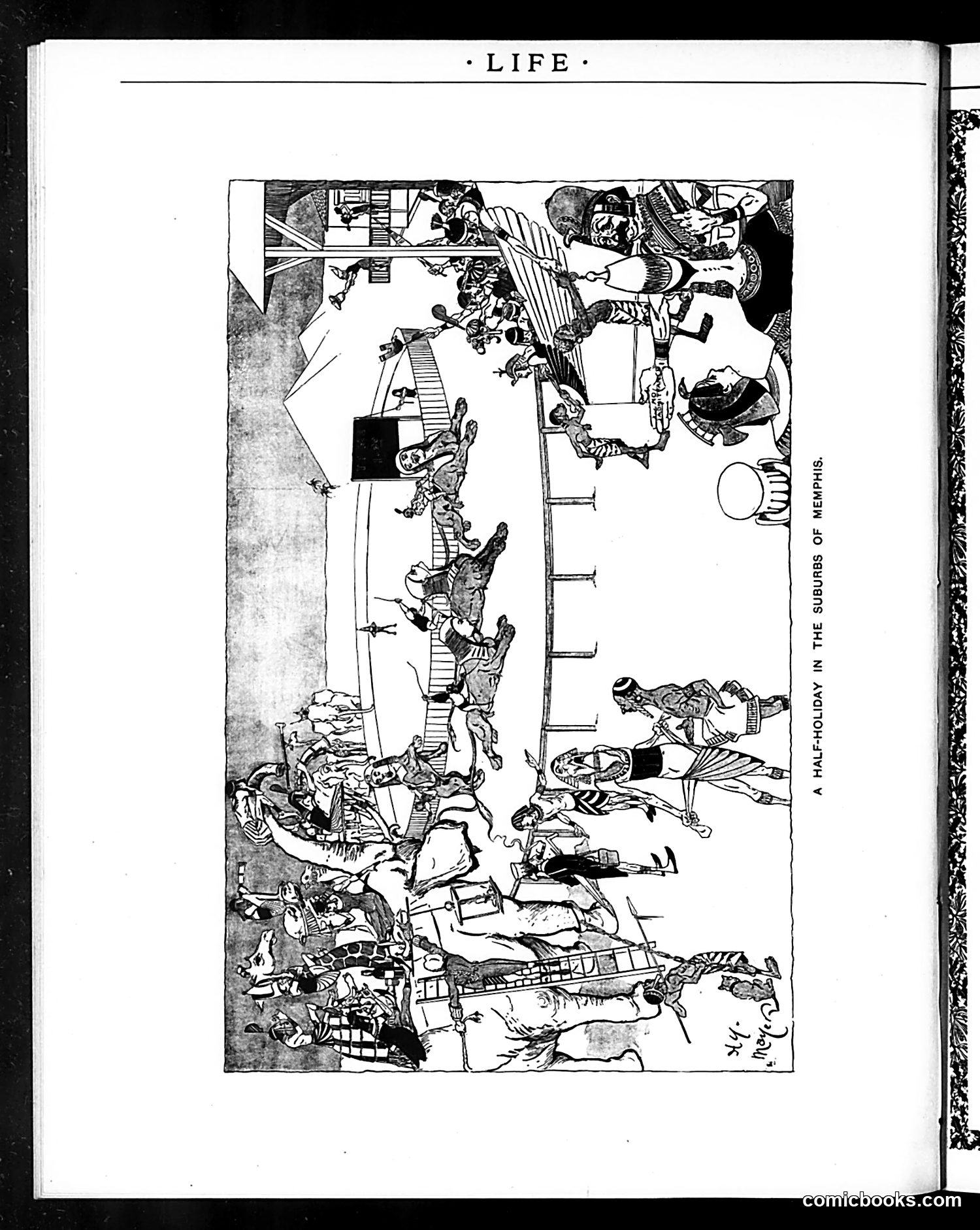
This satirical illustration depicts a chaotic scene labeled as "a half-holiday in the suburbs of Memphis," presented as social commentary on leisure activities in that region. The cartoon shows numerous figures engaged in various activities around what appears to be a residential street or gathering space, rendered in a busy, densely-packed composition typical of early 20th-century Life magazine satire. The drawing style and composition suggest mockery of suburban social customs or behavior. However, without additional context about the specific date or Memphis circumstances being referenced, the precise targets of the satire remain unclear. The image appears critical of how Memphis residents spent their free time, though the exact social or political point requires knowledge of contemporary Memphis history.
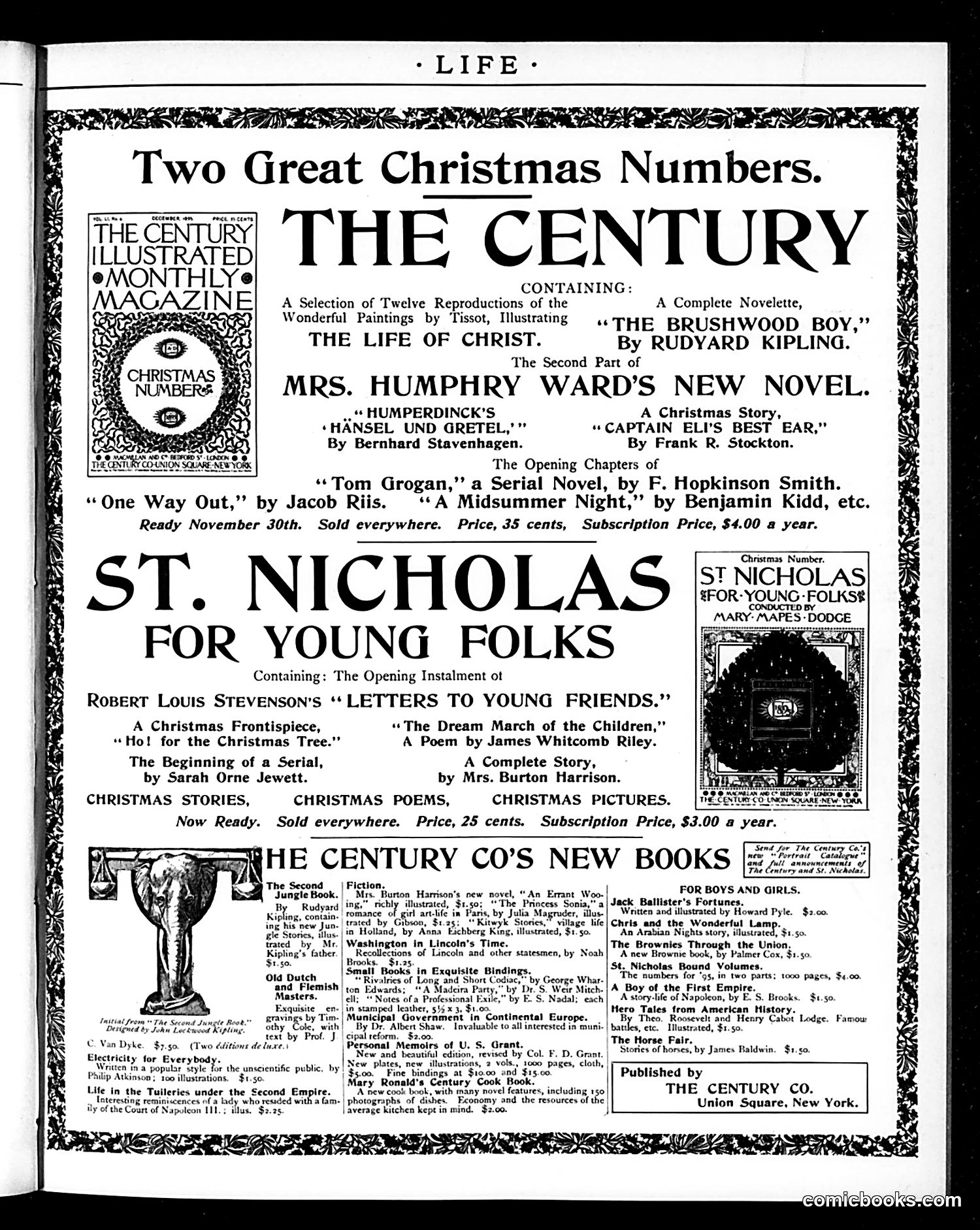
This page is primarily **advertising**, not political satire. It announces holiday publications from major American publishers circa 1890s. The page promotes two "Great Christmas Numbers": 1. **The Century Magazine** (35 cents)—featuring Tissot paintings illustrating Christ's life, plus fiction by Rudyard Kipling ("The Brushwood Boy") and serialized novels. 2. **St. Nicholas for Young Folks** (25 cents)—a children's magazine with stories by Robert Louis Stevenson and James Whitcomb Riley, plus Christmas content. Below, "The Century Co.'s New Books" lists upcoming publications for adults and children, including works by famous authors (Kipling, Noah Brooks, Theodore Roosevelt) on topics ranging from history to cookery. **No political satire is visible.** This is a straightforward publishing advertisement targeting holiday gift-buying, featuring established literary names to signal quality and prestige to potential readers.
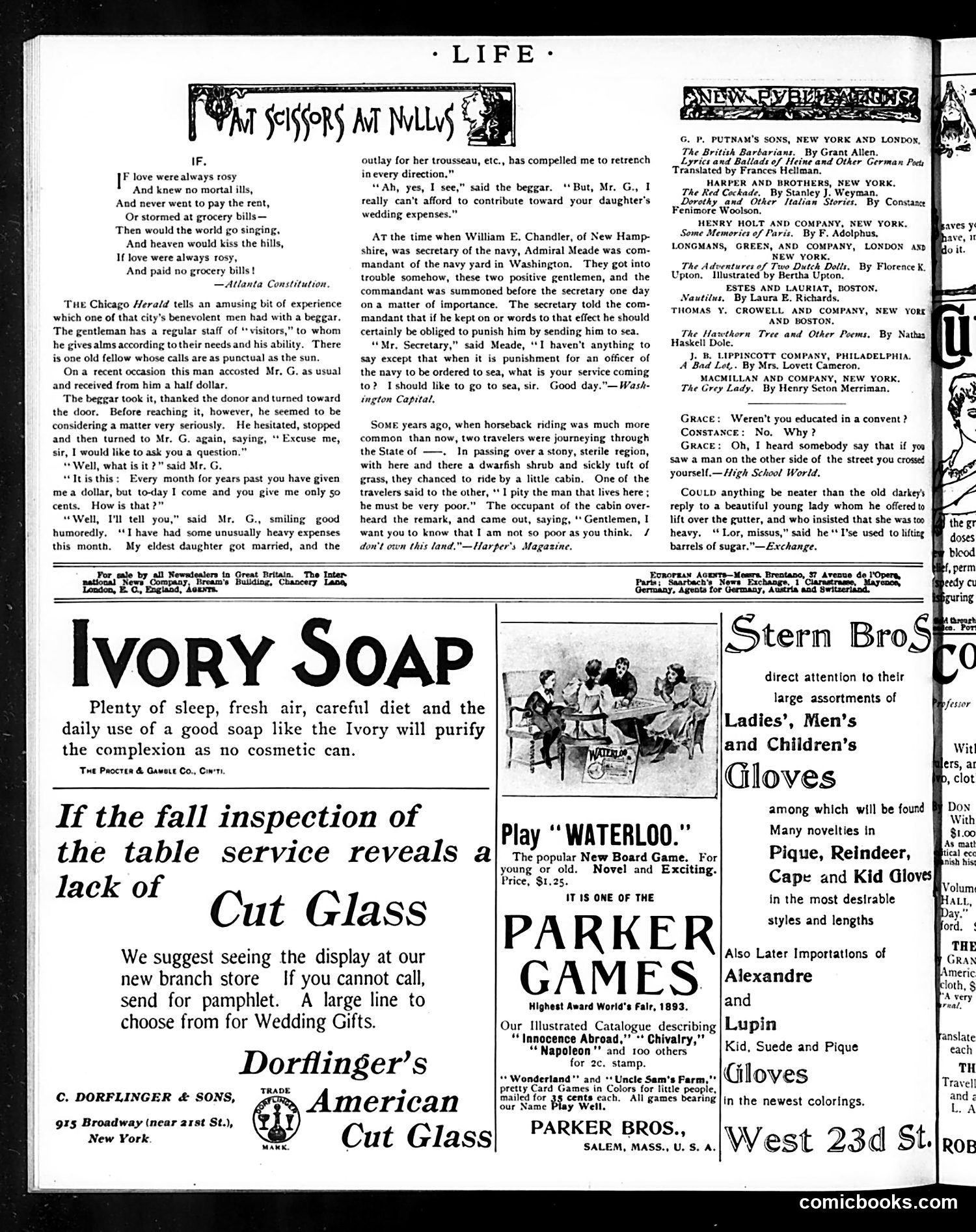
This page is primarily **text-based content** rather than visual cartoons. It contains three satirical anecdotes from American newspapers: 1. **The Beggar's Logic**: A Chicago Herald story where a regular beggar questions why a donor gave him only 50 cents instead of his usual dollar. The donor explains his daughter's wedding expenses forced retrenchment. The beggar's reply—that he "can't afford to contribute toward your daughter's wedding expenses"—satirizes entitlement and social absurdity. 2. **Secretary Chandler & Admiral Meade**: A historical anecdote depicting conflict between naval officials, with Meade rebuking the secretary's threat of sea duty as punishment, asserting sailors should desire service. 3. **The Poor Farmer**: Two travelers pity a cabin-dweller's poverty, but he corrects them: he's not poor because he doesn't own the land. Each story uses ironic or absurd logic to mock social assumptions about wealth, obligation, and perspective. The page also contains book advertisements and an Ivory Soap ad promoting hygiene—typical of *Life* magazine's mix of satire and commercial content.
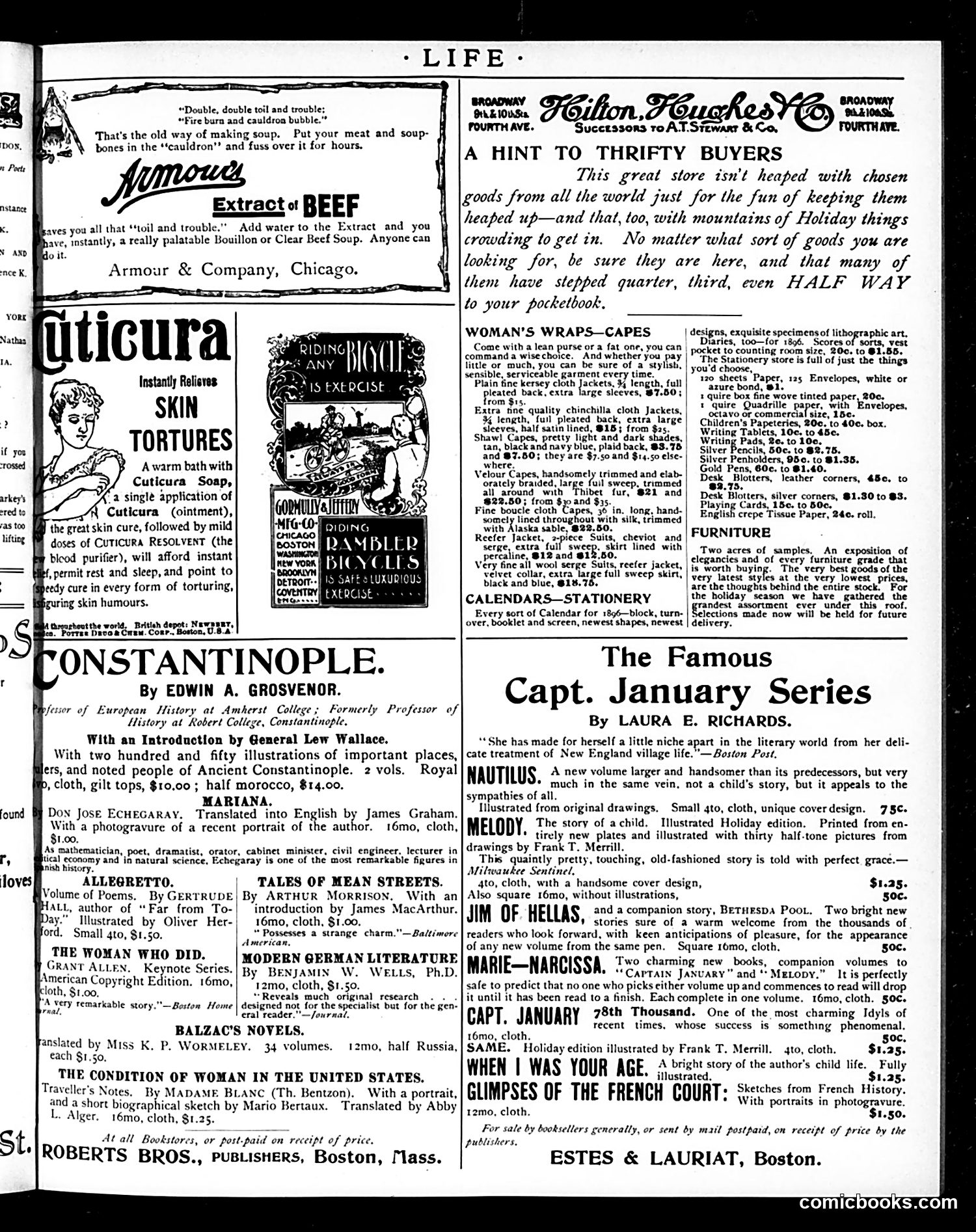
This page is primarily **advertising and book announcements** with no political cartoons or satirical content requiring historical context. The left side features product advertisements typical of the era: Armour's Beef Extract (promoting convenient soup-making over traditional "toil and trouble"), Cuticura remedies for skin conditions, and bicycle advertisements. These are straightforward commercial pitches using common Victorian marketing language about health and convenience. The right side is dominated by a department store advertisement (Hoskins, Houchels & Co.) promoting holiday sales, and extensive book announcements from Roberts Bros. Publishers in Boston. The books advertised—including works on Constantinople, German literature, and biographical sketches—reflect late 19th-century literary tastes. There is **no satire, political commentary, or caricature** on this page. It represents a typical mixed-content page from Life magazine's advertising section rather than its editorial content.
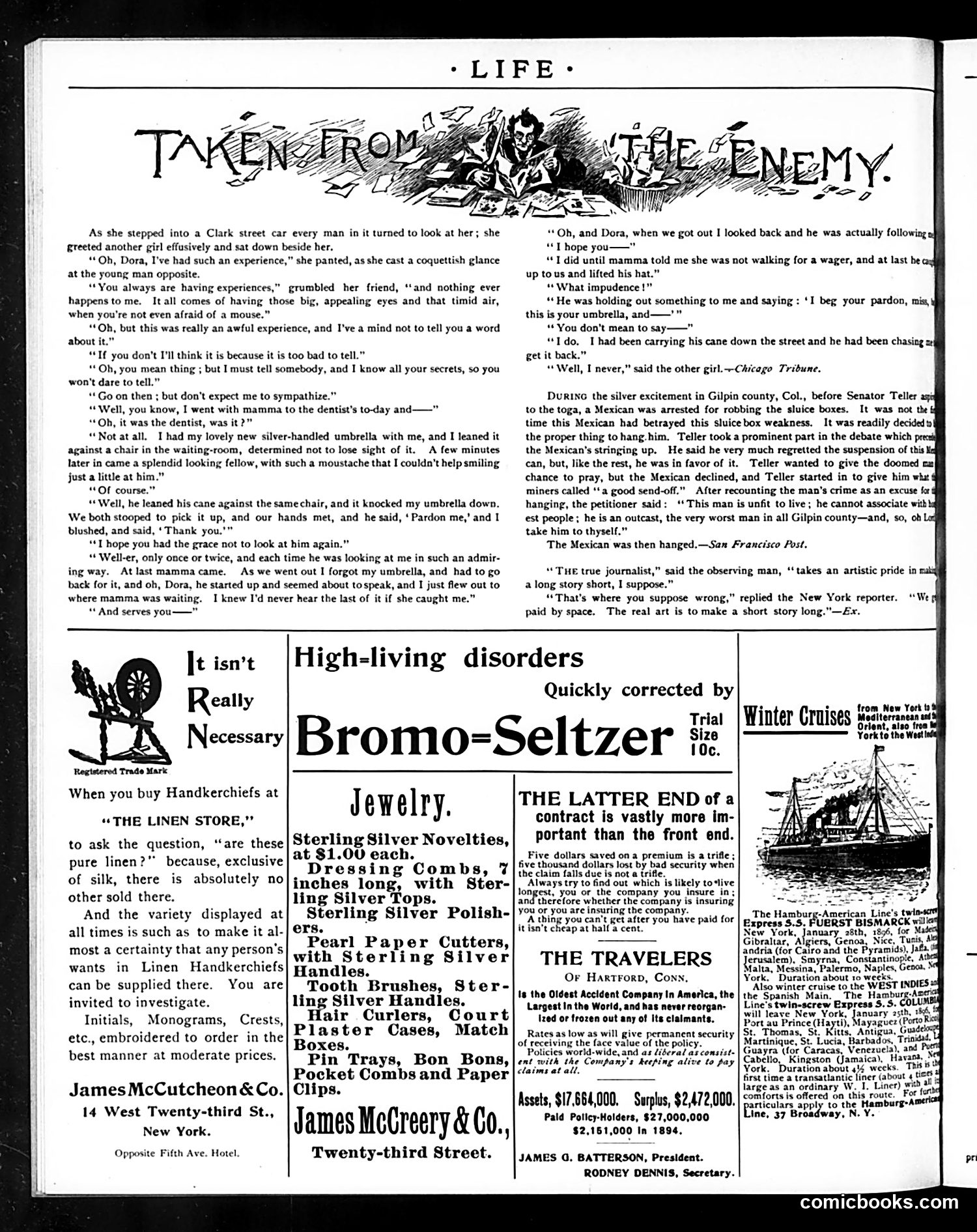
This page contains two main satirical pieces: **"Taken from Life: The Enemy"** (top story) satirizes young women's vanity and romantic fantasizing. Two girls on a streetcar discuss an "experience"—what the narrator builds up as dramatic turns out to be a mundane umbrella-switching incident at a dentist's office. A gentleman mistakenly took her umbrella; she imagined romantic interest ("admiring way") but he was merely trying to return it. The satire mocks how women construct romantic narratives from ordinary encounters and their concern with appearing modest before their mothers. **The Mexican lynching anecdote** (middle column) describes a lynching in Colorado before Senator Teller "went to the Senate." Though presented matter-of-factly, the piece subtly satirizes frontier "justice" and self-righteousness—Teller's pious prayer for the condemned man contrasts with casual endorsement of execution. The advertisements below are period product placements (Bromo-Seltzer, jewelry, cruise ships).
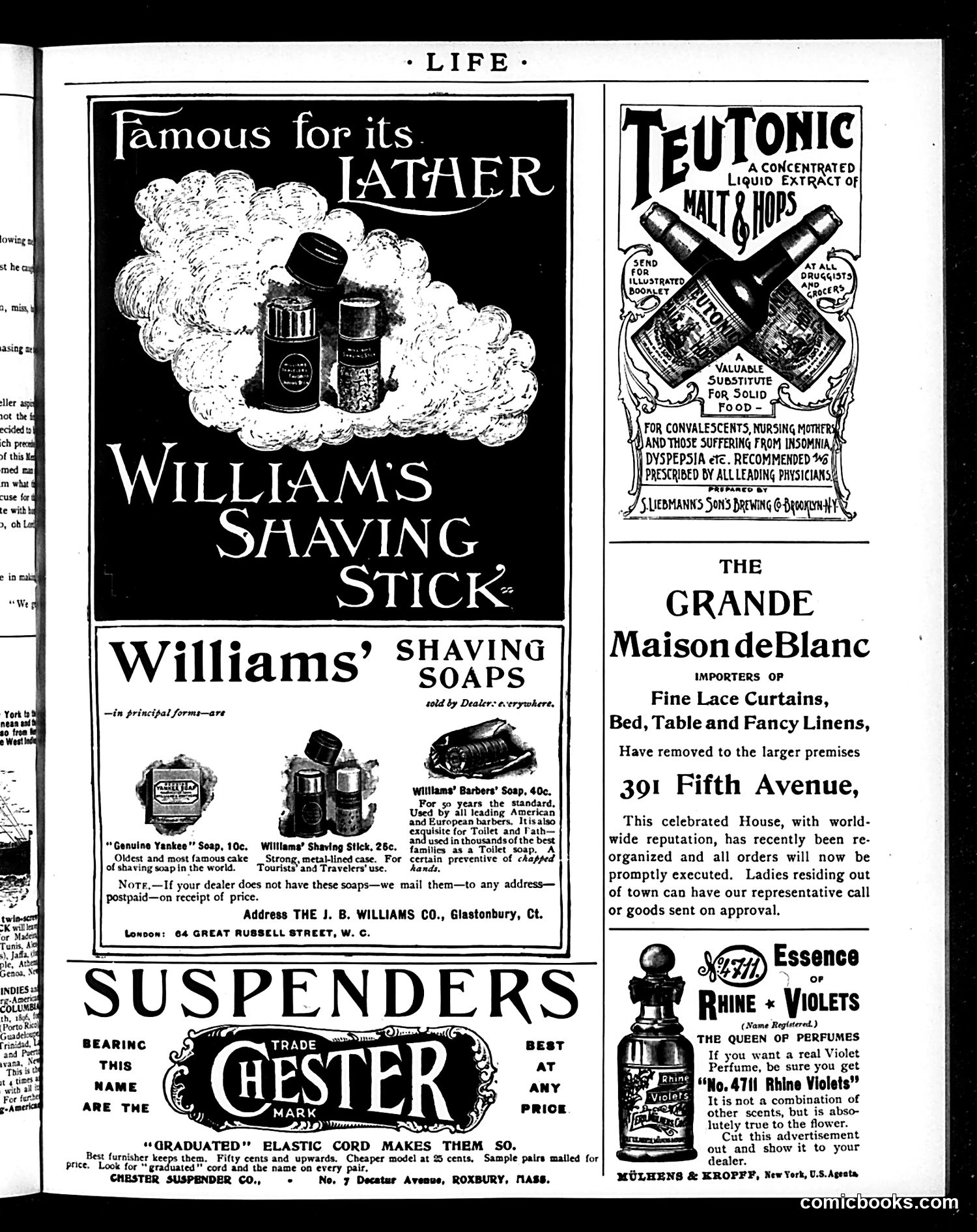
This is **primarily a commercial advertising page**, not a political cartoon. It contains five distinct product advertisements from the early 20th century: **Williams Shaving Products** promote soap and shaving sticks, emphasizing their use by "leading American and European barbers" for 50 years—appealing to tradition and professional endorsement. **Chester Suspenders** highlight their "elastic cord" design as superior to competitors, using price competition ("fifty cents and upwards") as a sales angle. **Teutonic Malt & Hops Extract** markets itself as medicinal for "convalescents, nursing mothers" and digestive ailments—typical of patent medicine advertising before FDA regulation. **Grande Maison deBlanc** announces relocation to Fifth Avenue, targeting wealthy women interested in imported linens and curtains. **Essence Rhine Violets** perfume claims authenticity as "the queen of perfumes," warning consumers against imitations. The page reflects early 1900s advertising strategies: appeals to authority, medical claims, class aspirations, and product differentiation. There is no satire—Life's editorial content likely appears on facing pages.
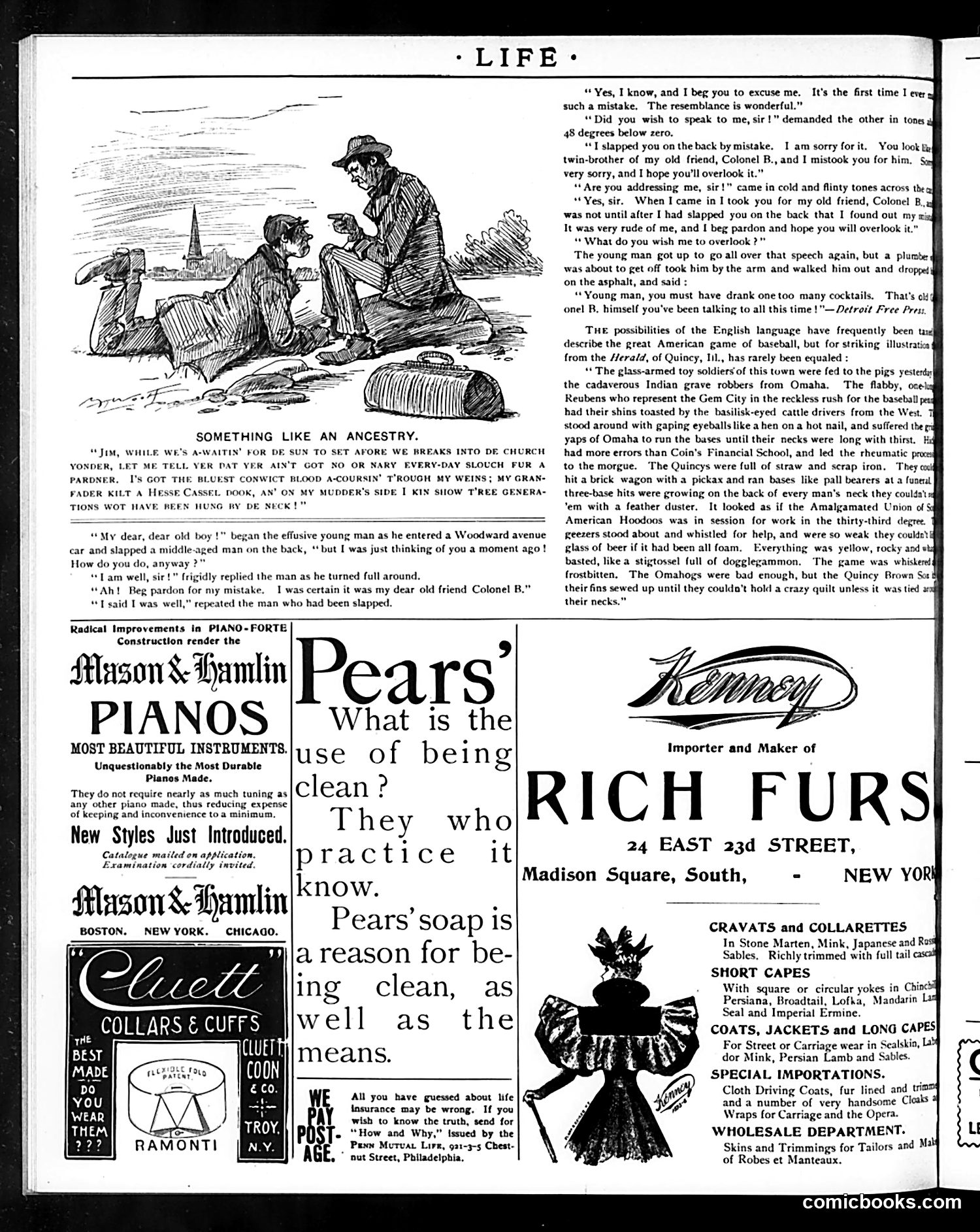
This Life magazine page contains two satirical pieces: **Top cartoon ("Something Like an Ancestry"):** A poorly-dressed man with a criminal background boasts to a companion about his lineage of convicts and hanged relatives—a deliberate inversion of how people typically brag about distinguished ancestors. The satire mocks both the pretension of ancestry-bragging and, implicitly, lower-class criminality. **Middle story:** A young man repeatedly apologizes to a stranger on a streetcar, mistaking him for an old friend Colonel B. The joke culminates when a bystander reveals the apologizer has been talking to Colonel B. himself the entire time—the victim's icy coldness made him unrecognizable as someone the apologizer supposedly knew well. **Bottom text:** A deliberately overwrought, nonsensical baseball game description using absurd mixed metaphors ("glass-armed toy soldiers," "basilisk-eyed cattle drivers"). The satire targets flowery sportswriting and the difficulty of describing baseball colorfully without descending into gibberish. The remainder consists of period advertisements for pianos, collars, fur coats, and soap—typical magazine filler content.
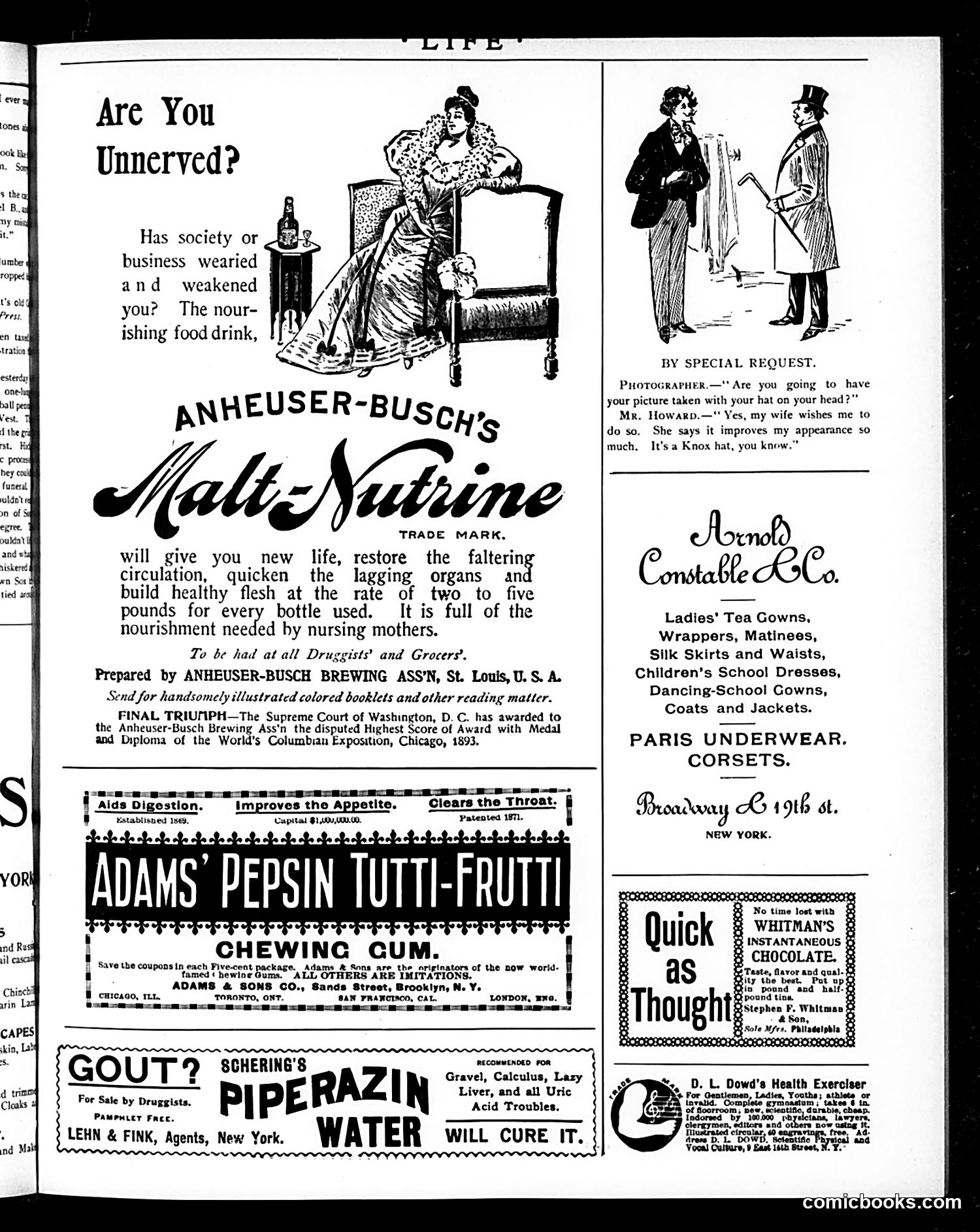
This page is primarily **advertisements** for patent medicines and consumer goods typical of early 20th-century American marketing. The one cartoon ("By Special Request") depicts a man being photographed wearing a Knox hat. His wife insists he wear it because she believes it improves his appearance. This is gentle satire of advertising culture—the joke is that the hat's brand name itself supposedly confers respectability, playing on contemporary consumer anxieties about social presentation. The advertisements below exploit health fears common to the era. Anheuser-Busch's "Malt-Nutrine" promises to restore vigor to the "unnerved"—those weakened by modern society. Other products claim to cure gout, digestive problems, and urinary issues. These remedies typify the "patent medicine" industry's exaggerated health claims, which were largely unregulated before FDA oversight existed. The page reflects a society anxious about modernity's physical toll and eager to purchase solutions—whether hats or tonics—promising renewed vigor and social acceptability.
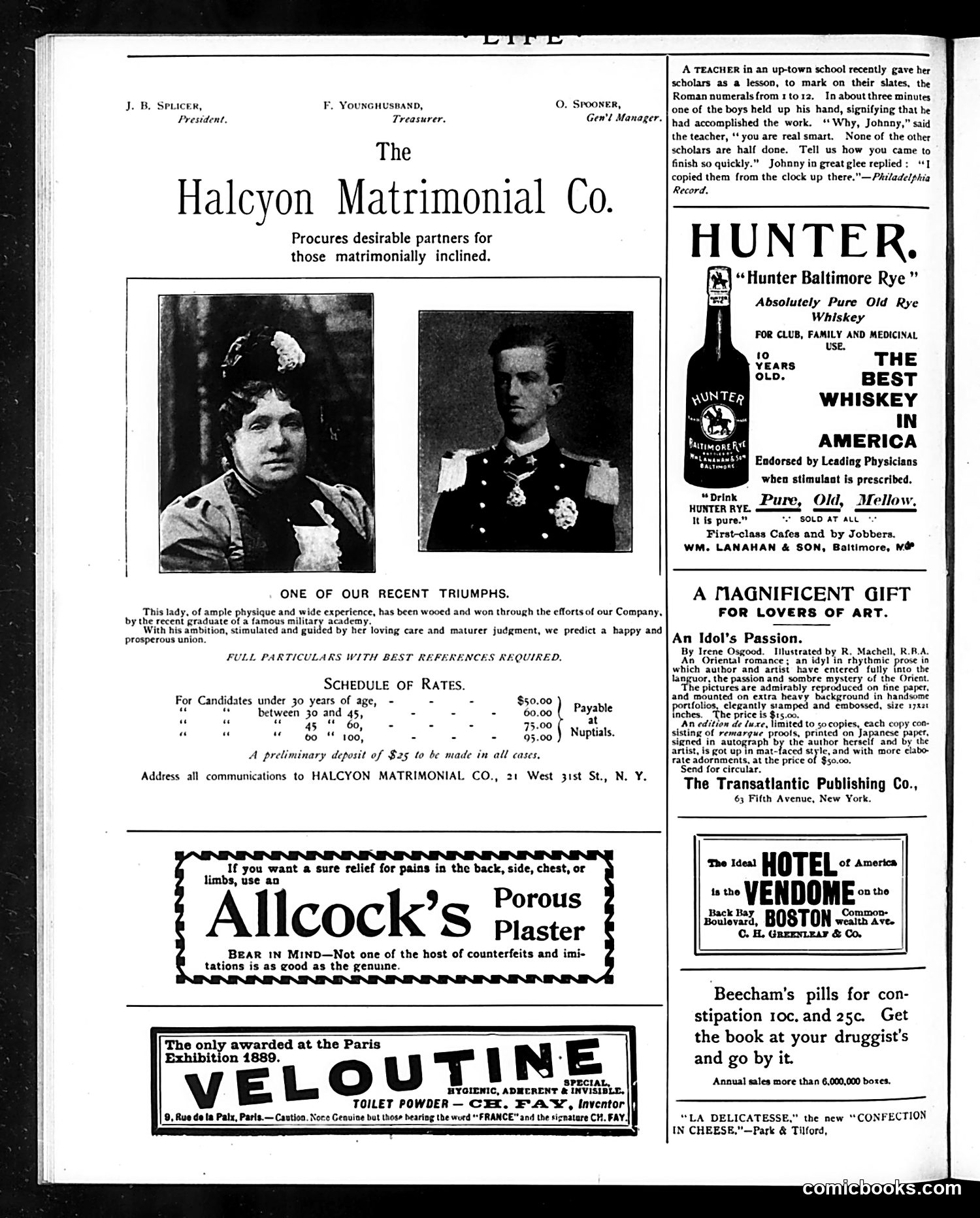
This page consists primarily of advertisements and humorous sketches rather than political cartoons. The main content is a satirical advertisement for the "Halcyon Matrimonial Co." (a matchmaking service), featuring a farcical "marriage success story" about a woman of "ample physique" matched with a recent military academy graduate. The joke relies on stereotypes: suggesting an older, larger woman would appeal to an ambitious young military officer seeking advancement. The page names the company officers with transparent pseudonyms—"J.B. Splicer" (President), "F. Younghusband" (Treasurer), "O. Spooner" (General Manager)—playing on marriage-related wordplay. A separate humorous anecdote describes a schoolboy copying Roman numerals from a clock face, bypassing actual learning—a joke about cheating and shortcuts rather than satire. The remaining content is period advertisements for patent medicines, whiskey, and luxury goods, typical of Life magazine's revenue model. No specific political figures or events are referenced.