
Life, 1895-11-28 · page 12 of 26
Life — November 28, 1895 — page 12: what you’re looking at
What you’re looking at
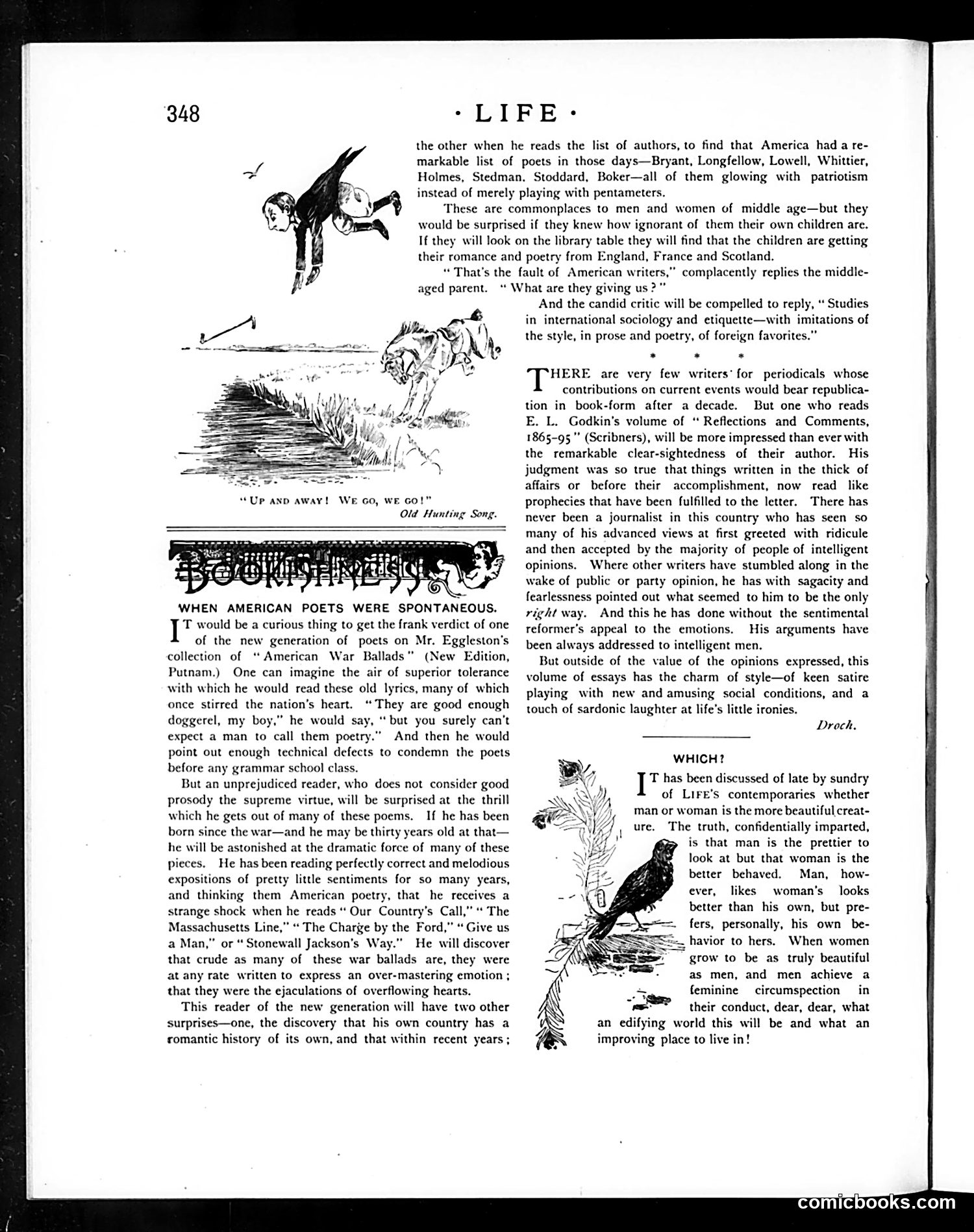
This page critiques the declining appreciation of American literature among younger generations. The cartoon depicts a hunting scene with the caption "Up and away! We go, we go!"—likely referencing the energetic patriotic spirit of older American war ballads. The article argues that 19th-century American poets (Bryant, Longfellow, Lowell, Whittier, Holmes, et al.) wrote with genuine emotion and patriotic fervor, whereas modern young people prefer derivative European literature. The author laments that contemporary children find their "romance and poetry from England, France and Scotland" rather than American sources. The satire targets middle-aged parents who blame "American writers" for failing to inspire youth, when the real problem is that modern literature—whether American or foreign—prioritizes technical perfection and sentimental prettiness over authentic emotional expression. The piece nostalgically contrasts "crude" but heartfelt Civil War ballads with polished but hollow contemporary verse.
📄 Transcribed text from this page (OCR, searchable)
Machine-transcribed from the original scan — historical spelling and the odd misread are preserved.
- LIFE: the other when he reads the list of authors, to find that America had a re- markable list of poets in those days—Bryant, Longfellow, Lowell, Whittier, Holmes, Stedman, Stoddard, Boker—all of them glowing with patriotism instead of merely playing with pentameters. ‘These are commonplaces to men and women of middle age—but they would be surprised if they knew how ignorant of them their own children are. If they will look on the library table they will find that the children are getting their romance and poetry from England, France and Scotland. “ That's the fault of Ame iters,”” complacently replies the middle- aged parent. ‘ What are they gi We co, WE Go!” Old Hunting Song. WHEN AMERICAN POETS WERE SPONTANEOUS. T would be a curious thing to get the frank verdict of one of the new generation of poets on Mr. Eggleston's collection of “American War Ballads" (New Edition, Putnam.) One can imagine the air of superior tolerance with which he would read these old lyrics, many of which once stirred the nation’s heart. “They are good enough doggerel, my boy,” he would say, ‘ but you surely can’t expect a man to call them poetry.” And then he would point out enough technical defects to condemn the poets before any grammar school class. But an unprejudiced reader, who does not consider good prosody the supreme virtue, will be surprised at the thrill which he gets out of many of these poems. If he has been born since the war—and he may be thirty years old at that— he will be astonished at the dramatic force of many of these pieces. He has been reading perfectly correct and melodious expositions of pretty little sentiments for so many years, and thinking them American poetry, that he recei strange shock when he reads “ Our Country's Call, Massachusetts Line,” “ The Charge by the Ford, a Man,” or “ Stonewall Jackson’s Way." He will discover that crude as many of these war ballads are, they were at any rate written to express an over-mastering emotion ; that they were the ejaculations of overflowing hearts. This reader of the new generation will have two other surprises—one, the discovery that his own country has a romantic history of its own, and that within recent years; And the candid critic will be compelled to reply, “ Studies in international sociology and etiquette—with imitations of the style, in prose and poetry, of foreign favorites.” . . . HERE are very few writers’ for periodicals whose contributions on current events would bear republica- tion in book-form after a decade. But one who reads E. L. Godkin's volume of “ Reflections and Comments, 1865-95 " (Scribners), will be more impressed than ever with the remarkable clear-sightedness of their author. His judgment was so true that things written in the thick of affairs or before their accomplishment, now read like prophecies that have been fulfilled to the letter. There has never been a journalist in this country who has seen so many of his advanced views at first greeted with ridicule and then accepted by the majority of people of intelligent opinions. Where other writers have stumbled along in the wake of public or party opinion, he has with sagacity and fearlessness pointed out what seemed to him to be the only right way. And this he has done without the sentimental reformer’s appeal to the emotions. His arguments have been always addressed to intelligent men. But outside of the value of the opinions expressed, this volume of essays has the charm of style—of keen satire playing with new and amusing social conditions, and a touch of sardonic laughter at life’s little ironies. Droch. WHICH? T has been discussed of late by sundry of LIFE’S contemporaries whether man or woman is the more beautiful creat- The truth, confidentially imparted, is that man is the prettier to look at but that woman is the better behaved. Man, how- ever, likes woman's looks better than his own, but pre- fers, personally, his own be- havior to hers. When women grow to be as truly beautiful as men, and men achieve a feminine circumspection in their conduct, dear, dear, what an edifying world this will be and what an improving place to live in! comicbooks.com