
Life, 1895-11-28 · page 9 of 26
Life — November 28, 1895 — page 9: what you’re looking at
What you’re looking at
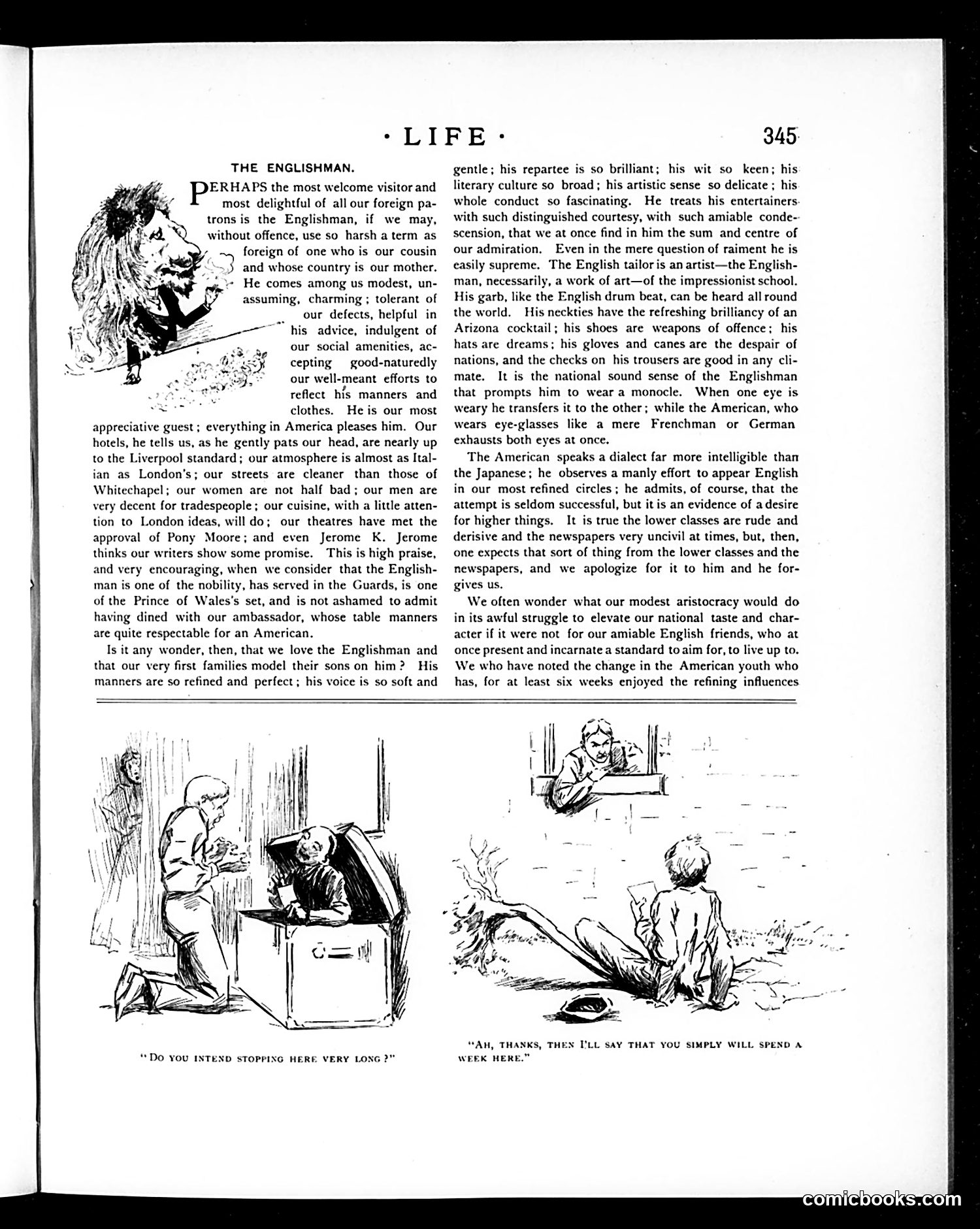
This article praises English visitors to America, describing the Englishman as refined, cultured, and well-mannered—a positive counterpart to other foreign stereotypes. The piece celebrates English traits like gentle deportment, sophisticated wit, and good taste. The two cartoons below illustrate contrasting scenarios: one shows a figure inquiring about a long stay (implying concern about overstaying); the other depicts someone contentedly settling in for a week, saying they'll "simply spend a week here." The satire likely plays on American ambivalence about English visitors—simultaneously admiring their sophistication while poking fun at their tendency to linger or impose themselves on American hospitality. The cartoons gently mock English social habits through these domestic situations.
📄 Transcribed text from this page (OCR, searchable)
Machine-transcribed from the original scan — historical spelling and the odd misread are preserved.
- LIFE: THE ENGLISHMAN. ERHAPS the most welcome visitor and most delightful of all our foreign pa- trons is the Englishman, if we may, without offence, use so harsh a term as ‘ ~4 foreign of one who is our cousin ) and whose country is our mother. ,° He comes among us modest, un- assuming, charming ; tolerant of _ our defects, helpful in his advice, indulgent of our social amenities, ac- cepting good-naturedly our well-meant efforts to reflect his manners and clothes. He is our most appreciative gu everything in America pleases him. Our hotels, he tells us, as he gently pats our head, are nearly up to the Liverpool standard; our atmosphere is almost as Ital- ian as London's; our streets are cleaner than those of Whitechapel; our women are not half bad; our men are very decent for tradespeople; our cuisine, with a little atten- tion to London ideas, will do; our theatres have met the approval of Pony Moore; and even Jerome K. Jerome thinks our writers show some promise. This is high praise, and very encouraging, when we consider that the English- man is one of the nobility, has served in the Guards, is one of the Prince of Wales's set, and is not ashamed to admit having dined with our ambassador, whose table manners are quite respectable for an American. Is it any wonder, then, that we love the Englishman and that our very first families model their sons on him? His manners are so refined and perfect; his voice is so soft and 345 gentle; his repartee is so brilliant; his wit so keen; his literary culture so broad ; his artistic sense so delicat whole conduct so fascinating. He treats his entertainers: with such distinguished courtesy, with such amiable conde- scension, that we at once find in him the sum and centre of our admiration, Even in the mere question of raiment he is easily supreme. The English tailor is an artist—the English- man, necessarily, a work of art—of the impressionist school. His garb, like the English drum beat, can be heard all round the world. His neckties have the refreshing brilliancy of an Arizona cocktail; his shoes are weapons of offence; his hats are dreams; his gloves and canes are the despair of nations, and the checks on his trousers are good in any cli- mate. It is the national sound sense of the Englishman that prompts him to wear a monocle. When one eye is weary he transfers it to the other; while the American, who wears eye-glasses like a mere Frenchman or German exhausts both eyes at once, The American speaks a dialect far more intelligible than the Japanese; he observes a manly effort to appear English in our most refined circles; he admits, of course, that the attempt is seldom successful, but it is an evidence of a desire for higher things. It is true the lower classes are rude and derisive and the newspapers very uncivil at times, but, then, one expects that sort of thing from the lower classes and the newspapers, and we apologize for it to him and he for- gives us. We often wonder what our modest aristocracy would do in its awful struggle to elevate our national taste and char- acter if it were not for our amiable English friends, who at once present and incarnate a standard to aim for, to live up to. We who have noted the change in the American youth who has, for at least six weeks enjoyed the refining influences “DO YOU INTEND STOPPING HERE VERY LONG 2?” “AN, THANKS, THEN I'LL SAY THAT YOU SIMPLY WILL SPEND A WEEK HERE.”