
Life, 1895-11-28 · page 16 of 26
Life — November 28, 1895 — page 16: what you’re looking at
What you’re looking at
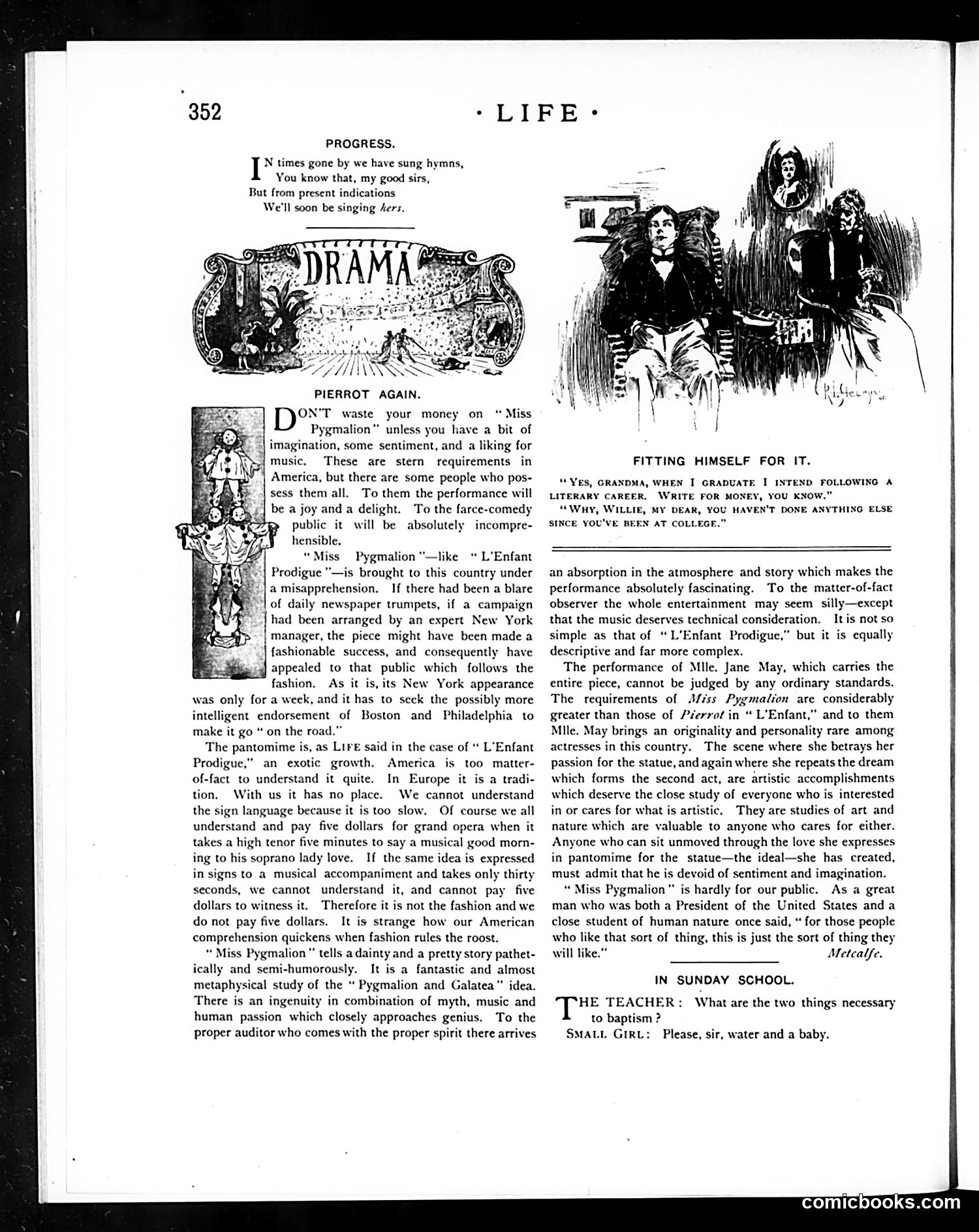
This page contains two separate satirical pieces targeting American cultural attitudes: **"Pierrot Again"** critiques American audiences' rejection of European pantomime theater. The review discusses "Miss Pygmalion," an imported French theatrical production that failed commercially. Life mocks American audiences for paying five dollars to sit through slow opera but dismissing pantomime that conveys the same idea in thirty seconds—exposing the hypocrisy and irrationality of fashion-driven taste. The satire argues Americans are too "matter-of-fact" to appreciate sophisticated European art forms. **"Fitting Himself For It"** (cartoon) jokes about a college student claiming he intends to pursue a literary career upon graduation, while his grandmother notes he's already been "writing for money" throughout college—implying he's been cheating, plagiarizing, or submitting others' work for payment rather than actually studying. Both pieces satirize American cultural pretension and intellectual dishonesty.
📄 Transcribed text from this page (OCR, searchable)
Machine-transcribed from the original scan — historical spelling and the odd misread are preserved.
PROGRESS. N times gone by we have sung hymns, You know that, my good sirs, But from present indications We'll soon be singing hers. PIERROT AGAIN. ON'T waste your money on “Miss 4 Pygmalion” unless you have a bit of =| imagination, some sentiment, and a liking for music. These are stern requirements in America, but there are some people who pos- sess them all. To them the performance will be a joy and a delight. To the farce-comedy public it will be absolutely incompre- hensible. Miss Pygmalion ""—like “ L’Enfant Prodigue "—is brought to this country under a misapprehension. If there had been a blare ‘lof daily newspaper trumpets, if a campaign had been arranged by an expert New York | manager, the piece might have been made a fashionable success, and consequently have appealed to that public which follows the fashion. As it is, its New York appearance was only for a week, and it has to seck the possibly more intelligent endorsement of Boston and Philadelphia to make it go “ on the road.” The pantomime is, as LiFe said in the case of * L’Enfant Prodigue," an exotic growth. America is too matter- of-fact to understand it quite. In Europe it is a tradi- tion, With us it has no place. We cannot understand the sign language because it is too slow. Of course we all understand and pay five dollars for grand opera when it takes a high tenor five minutes to say a musical good morn- ing to his soprano lady love. If the same idea is expressed in signs to a musical accompaniment and takes only thirty seconds, we cannot understand it, and cannot pay five dollars to witness it, Therefore it is not the fashion and we do not pay five dollars. It is strange how our American comprehension quickens when fashion rules the roost. “ Miss Pygmalion” tells a dainty and a pretty story pathet- ically and semi-humorously. It is a fantastic and almost metaphysical study of the “ Pygmalion and Galatea” idea. There is an ingenuity in combination of myth, music and human passion which closely approaches genius. To the Proper auditor who comes with the proper spirit there arrives FITTING HIMSELF FOR IT. ES, GRANDMA, WHEN I GRADUATE I INTEND FOLLOWING A LITERARY CAREER. WRITE FOR MONEY, YOU KNOW.” “WHY, WILLIE, MY DEAR, YOU HAVEN'T DONE ANYTHING ELSE SINCE YOU'VE BEEN AT COLLEGE.” an absorption in the atmosphere and story which makes the performance absolutely fascinating. To the matter-of-fact observer the whole entertainment may seem silly—except that the music deserves technical consideration. It is not so simple as that of “L’Enfant Prodigue,” but it is equally descriptive and far more complex. The performance of Mlle. Jane May, which carries the entire piece, cannot be judged by any ordinary standards. The requirements of A/iss Pygmalion are considerably greater than those of /errot in “ L’Enfant,” and to them Mile. May brings an originality and personality rare among actresses in this country. The scene where she betrays her passion for the statue, and again where she repeats the dream which forms the second act, are artistic accomplishments which deserve the close study of everyone who is interested in or cares for what is artistic. They are studies of art and nature which are valuable to anyone who cares for either. Anyone who can sit unmoved through the love she expresses in pantomime for the statue—the ideal—she has created, must admit that he is devoid of sentiment and imagination. “ Miss Pygmalion” is hardly for our public. As a great man who was both a President of the United States anda close student of human nature once said, “ for those people who like that sort of thing, this is just the sort of thing they will like.” Metcalfe. IN SUNDAY SCHOOL. HE TEACHER: to baptism ? SMALL GIRL: What are the two things necessary Please, sir, water and a baby. comicbooks.com