
Life, 1895-11-28 · page 6 of 26
Life — November 28, 1895 — page 6: what you’re looking at
What you’re looking at
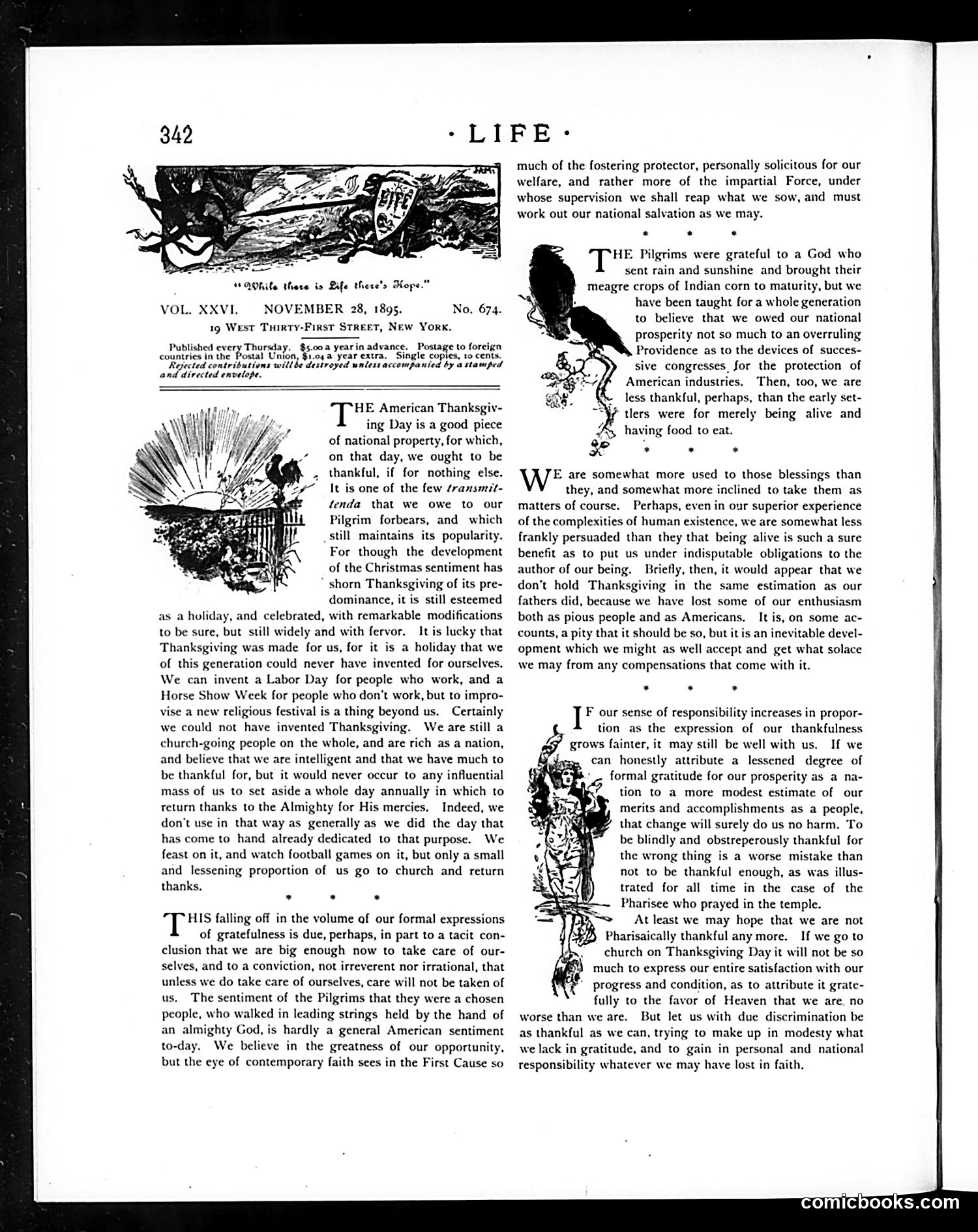
This page is primarily **editorial text about Thanksgiving**, not political satire. The article argues that Americans should feel more genuinely grateful for their blessings, comparing contemporary Thanksgiving observance unfavorably to the Pilgrims' original gratitude. The decorative illustrations—a turkey and cornucopia—are thematic ornaments rather than satirical cartoons. The article's implicit critique targets **American complacency**: it suggests that modern Americans, despite prosperity from industrial protection and successful "congresses," lack the sincere thankfulness earlier generations possessed. The piece advocates for more authentic gratitude and personal responsibility in national character. This reflects late-19th-century anxieties about whether industrial wealth had made Americans morally soft or spiritually hollow.
📄 Transcribed text from this page (OCR, searchable)
Machine-transcribed from the original scan — historical spelling and the odd misread are preserved.
*LIFE-: “OBVHile there is Life there's Hope.” XXVI. NOVEMBER 28, 1895. 1g West Tuirty-First STREET, New York. No. 674. Published every Thursday. $5.00 yearin advance. Postage to foreign countries in the Postal Union, $104 a year extra. Single copies, 10 cents, Rejected contributions willbe destroyed wnless accompanied by a stamped and directed envelope. HE American Thanksgiv- ing Day is a good piece of national property, for which, on that day, we ought to be thankful, if for nothing else. It is one of the few ¢ransmit- tenda that we owe to our Pilgrim forbears, and which still maintains its popularity. For though the development of the Christmas sentiment has shorn Thanksgiving of its pre- dominance, it is still esteemed as a holiday, and celebrated, with remarkable modifications to be sure, but still widely and with fervor, It is lucky that Thanksgiving was made for us, for it is a holiday that we of this generation could never have invented for ourselves. We can invent a Labor Day for people who work, and a Horse Show Week for people who don’t work, but to impro- vise a new religious festival is a thing beyond us. Certainly we could not have invented Thanksgiving. We are still a church-going people on the whole, and are rich as a nation, and believe that we are intelligent and that we have much to be thankful for, but it would never occur to any influential mass of us to set aside a whole day annually in which to return thanks to the Almighty for His mercies. Indeed, we don’t use in that way as generally as we did the day that has come to hand already dedicated to that purpose. We feast on it, and watch football games on it, but only a small and lessening proportion of us go to church and return thanks. . . . THs falling off in the volume of our formal expressions of gratefulness is due, perhaps, in part to a tacit con- clusion that we are big enough now to take care of our- selves, and to a conviction, not irreverent nor irrational, that unless we do take care of ourselves, care will not be taken of us. The sentiment of the Pilgrims that they were a chosen people, who walked in leading strings held by the hand of an almighty God, is hardly a general American sentiment to-day, We believe in the greatness of our opportunity, but the eye of contemporary faith sees in the First Cause so much of the fostering protector, personally solicitous for our welfare, and rather more of the impartial Force, under whose supervision we shall reap what we sow, and must work out our national salvation as we may. * . . HE Pilgrims were grateful to a God who sent rain and sunshine and brought their meagre crops of Indian corn to maturity, but we have been taught for a whole generation to believe that we owed our national prosperity not so much to an overruling Providence as to the devices of succes- sive congresses, for the protection of American industries. Then, too, we are less thankful, perhaps, than the early set- tlers were for merely being alive and having food to eat. . . . E are somewhat more used to those blessings than they, and somewhat more inclined to take them as matters of course. Perhaps, even in our superior experience of the complexities of human existence, we are somewhat less frankly persuaded than they that being alive is such a sure benefit as to put us under indisputable obligations to the author of our being. Briefly, then, it would appear that we don’t hold Thanksgiving in the same estimation as our fathers did, because we have lost some of our enthusiasm both as pious people and as Americans. It is, on some ac- counts, a pity that it should be so, but it is an inevitable devel- opment which we might as well accept and get what solace we may from any compensations that come with it. . . * F our sense of responsibility increases in propor- tion as the expression of our thankfulness grows fainter, it may still be well with us. If we can honestly attribute a lessened degree of formal gratitude for our prosperity as a na- tion to a more modest estimate of our merits and accomplishments as a people, that change will surely do us no harm. To be blindly and obstreperously thankful for the wrong thing is a worse mistake than not to be thankful enough, as was illus- trated for all time in the case of the Pharisee who prayed in the temple. At least we may hope that we are not Pharisaically thankful any more. If we go to church on Thanksgiving Day it will not be so much to express our entire satisfaction with our progress and condition, as to attribute it grate- fully to the favor of Heaven that we are no worse than we are. But let us with due discrimination be as thankful as we can, trying to make up in modesty what we lack in gratitude, and to gain in personal and national responsibility whatever we may have lost in faith. comicbooks.com