
A complete issue · 20 pages · 1895
Life — November 14, 1895
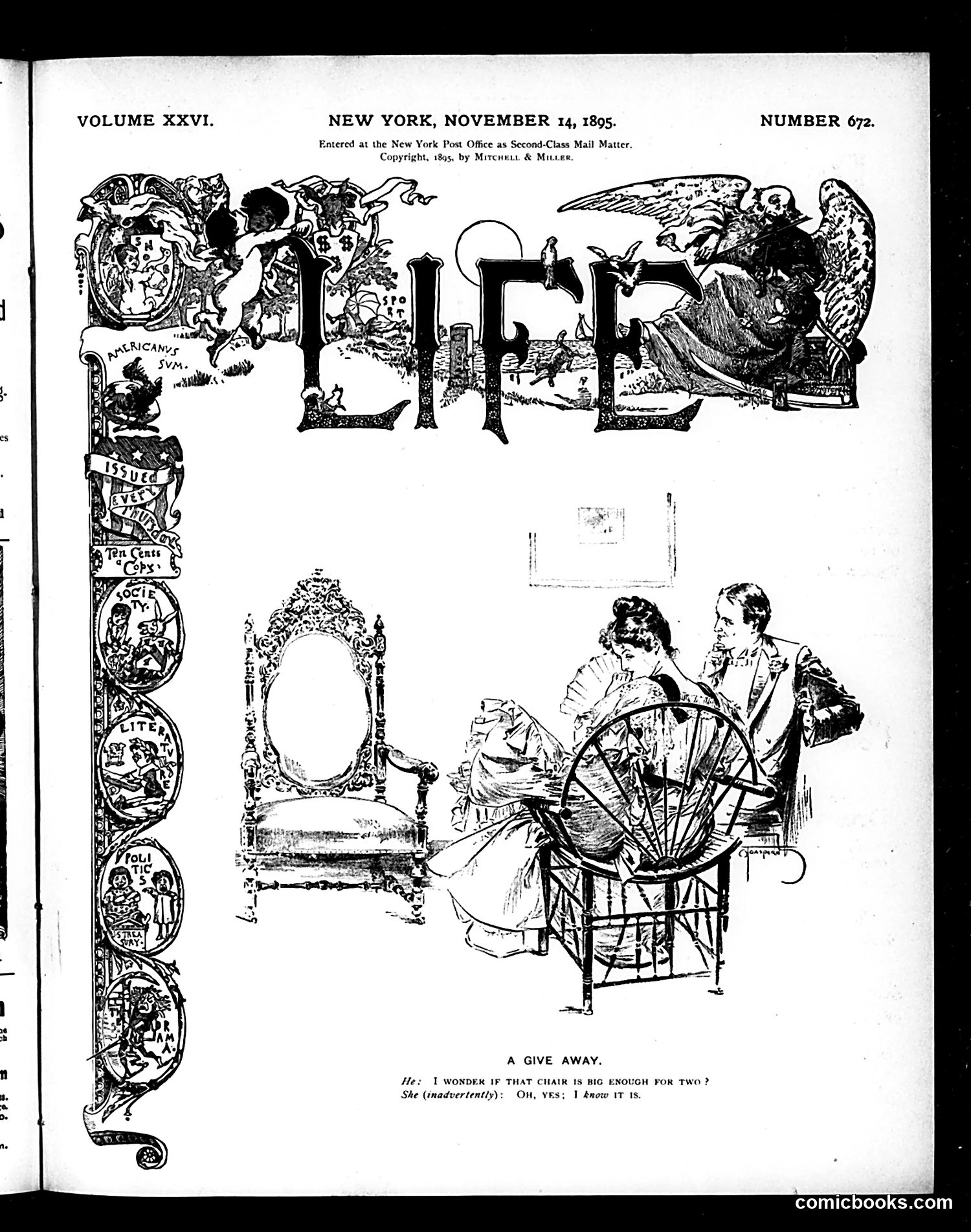
**The Cartoon: "A Give Away"** This page features a single cartoon depicting two well-dressed figures examining an ornate chair. The male figure asks whether the chair is "big enough for two," and the woman responds (inadvertently revealing something) that "I know it is." **The Joke:** This is a double-entendre cartoon playing on domestic/marital humor typical of 1890s satirical magazines. The humor relies on the woman's unguarded admission that she and the man have previously shared the chair together—implying an intimate or improper relationship. The title "A Give Away" suggests she has accidentally revealed a secret through her careless response. The ornate chair and formal dress suggest upper-class social pretense, which the satire punctures through the woman's revealing slip of the tongue.
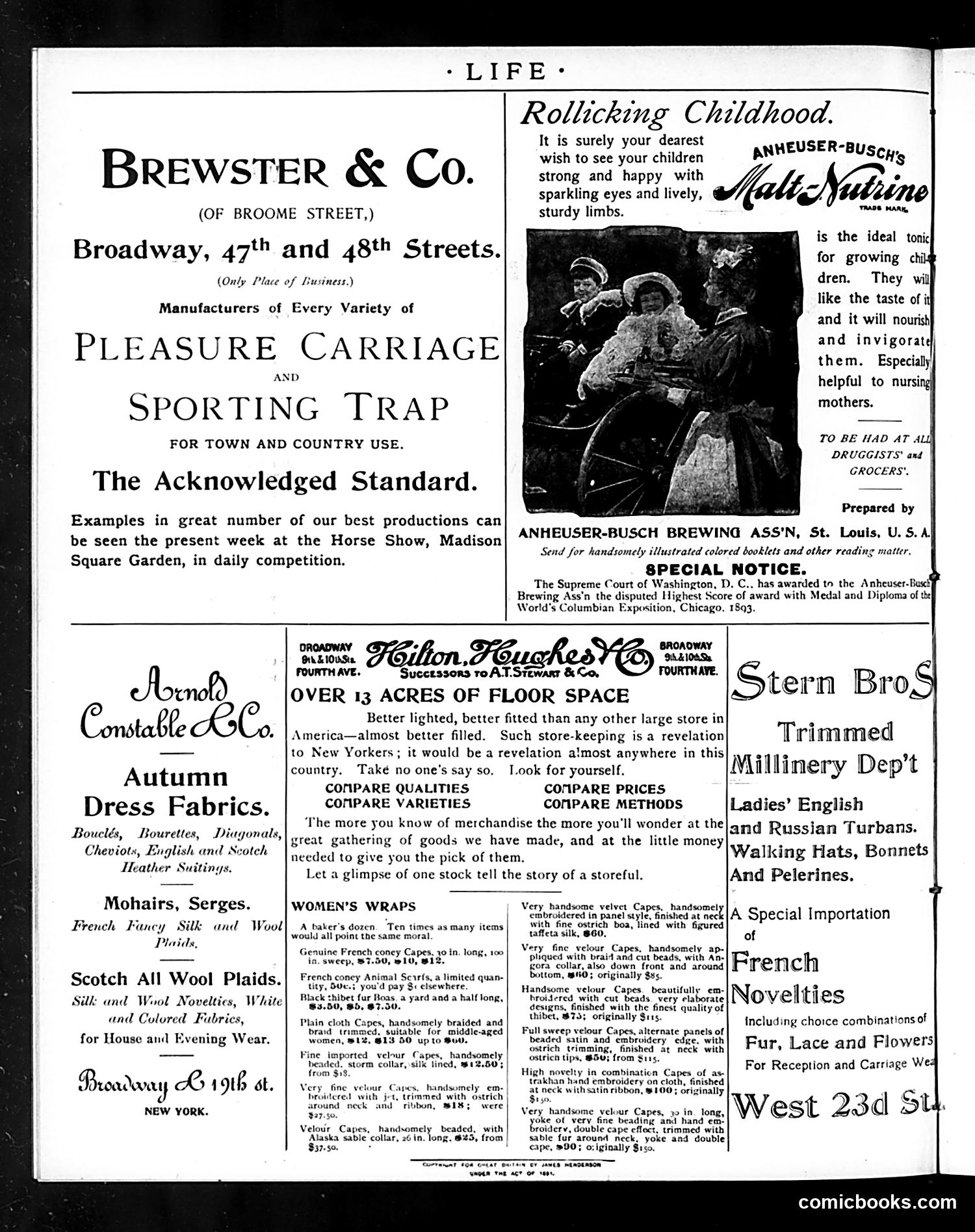
This page is **primarily advertising**, not editorial content or satire. It contains: 1. **Brewster & Co.** carriage manufacturer advertisement 2. **Anheuser-Busch Malt-Nutrine** tonic product ad (featuring children) 3. **Hilton, Huckles & Co.** department store advertisement 4. **Arnold Constable & Co.** dress fabrics advertisement 5. **Stern Bros** millinery department advertisement There are **no political cartoons or satirical commentary** on this page. The only image is a photograph advertising the Anheuser-Busch product, showing children in period dress—standard advertising imagery for the era, though modern readers might find the marketing of a "tonic" to children unusual. The page represents typical turn-of-the-century American magazine advertising, targeting affluent urban readers interested in luxury goods and services.
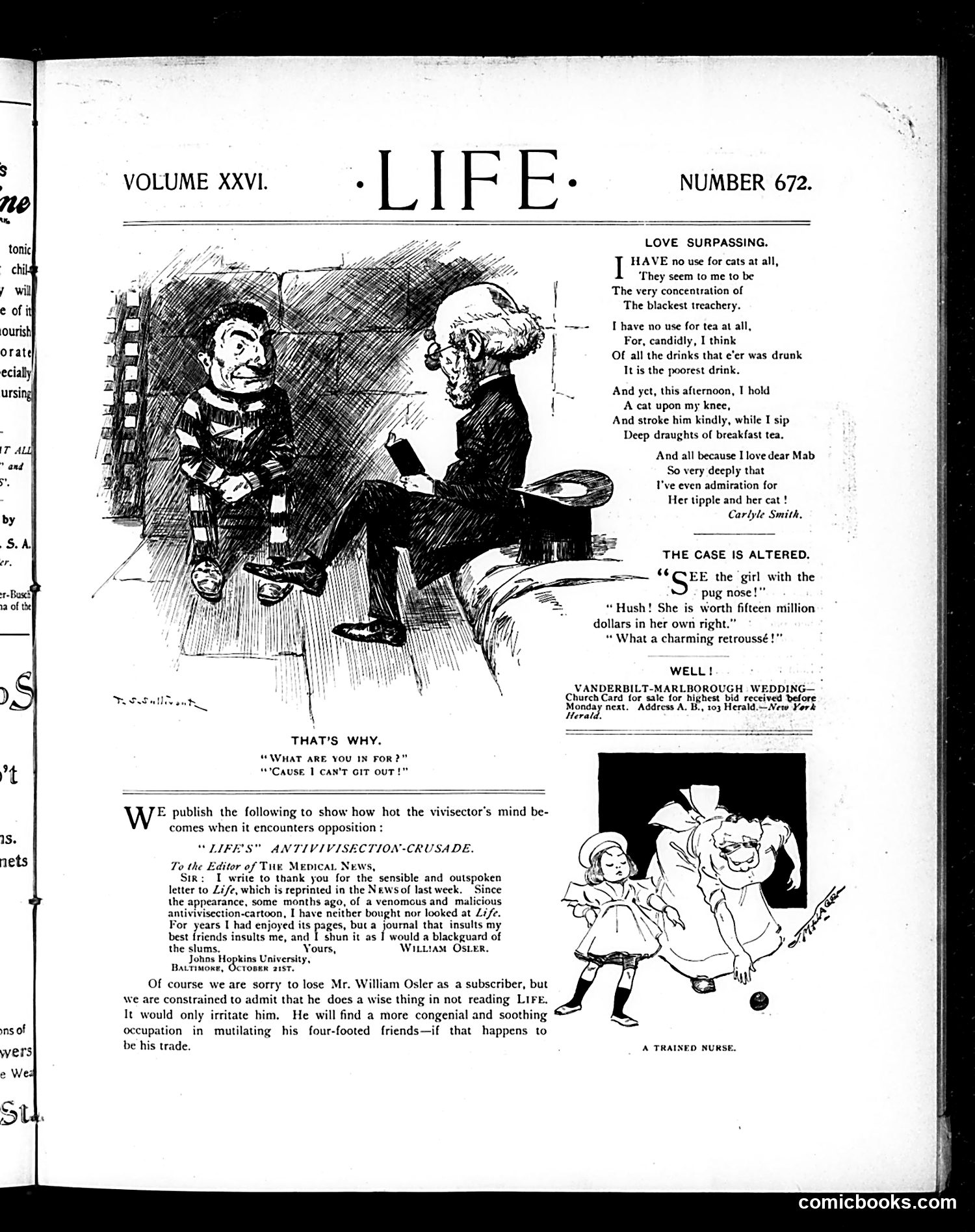
The main cartoon depicts two figures in conversation—one appearing disheveled and the other more formally dressed—with the caption "THAT'S WHY" and dialogue: "WHAT ARE YOU IN FOR?" / "'CAUSE I CAN'T GIT OUT!" The page includes a poem titled "LOVE SURPASSING" by Carlyle Smith about preferring cats and tea to alcohol, followed by a section called "THE CASE IS ALTERED" about a wealthy girl with a "pug nose." Below is a letter from William Osler at Johns Hopkins University, responding to Life's "ANTIVIVISECTION-CRUSADE," defending medical research practices. The magazine's editors reply, noting they're sorry to lose Osler as a subscriber but understand his position. A small cartoon titled "A TRAINED NURSE" appears at bottom right, though its specific meaning is unclear from the image alone.
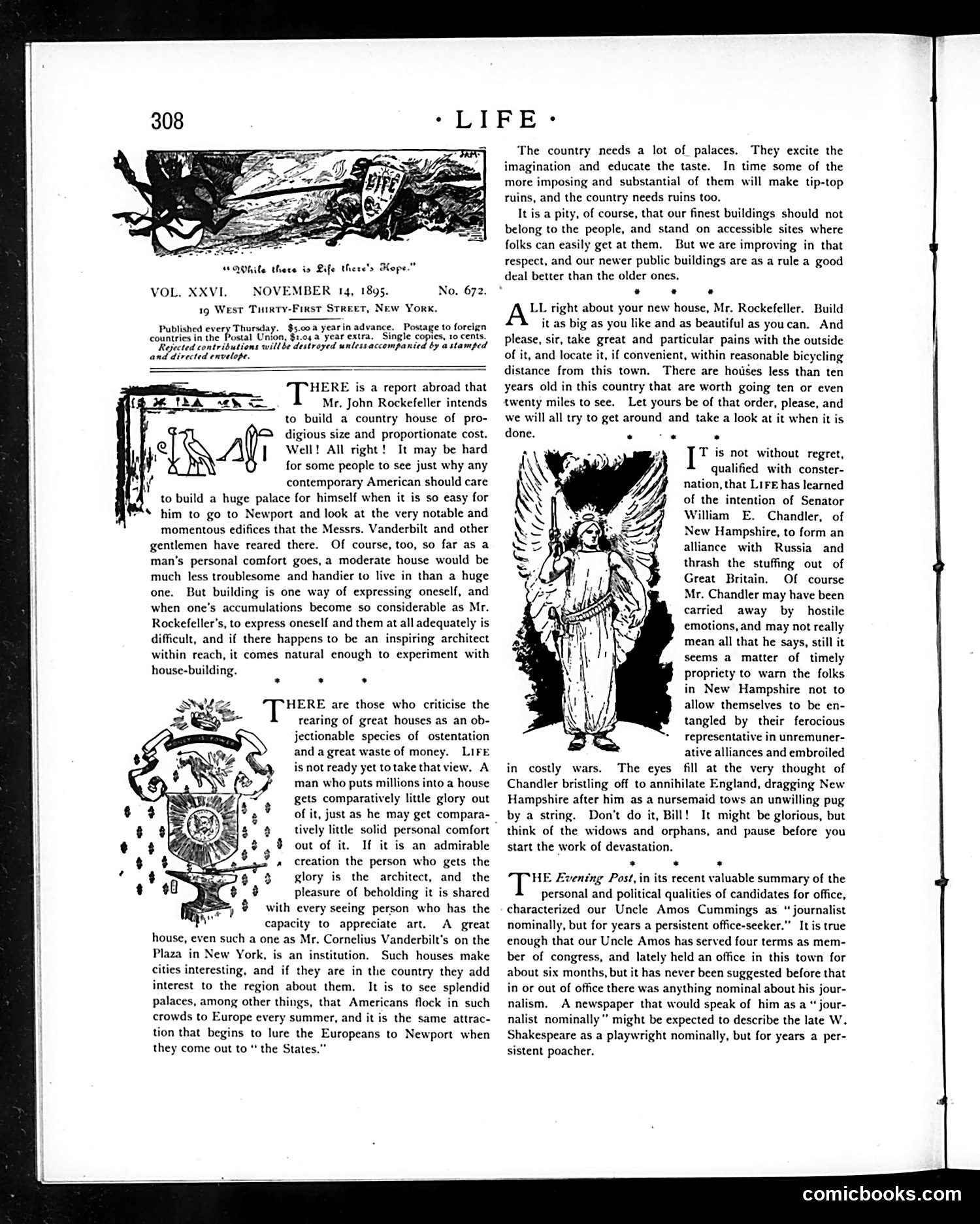
The page contains editorial commentary rather than political cartoons. The main content discusses John D. Rockefeller's plans to build a large country house, debating whether such grand private mansions represent admirable artistic achievement or wasteful ostentation. The author argues that great houses, while potentially frivolous, serve a cultural purpose by attracting European visitors and showcasing American wealth and taste. A secondary piece criticizes William E. Chandler of New Hampshire for forming an alliance with Russia and making inflammatory anti-British statements. The satire suggests Chandler's patriotic posturing masks political opportunism—comparing him to someone who would superficially adopt nominal positions for career advancement, using Shakespeare as an analogy for shallow characterization.
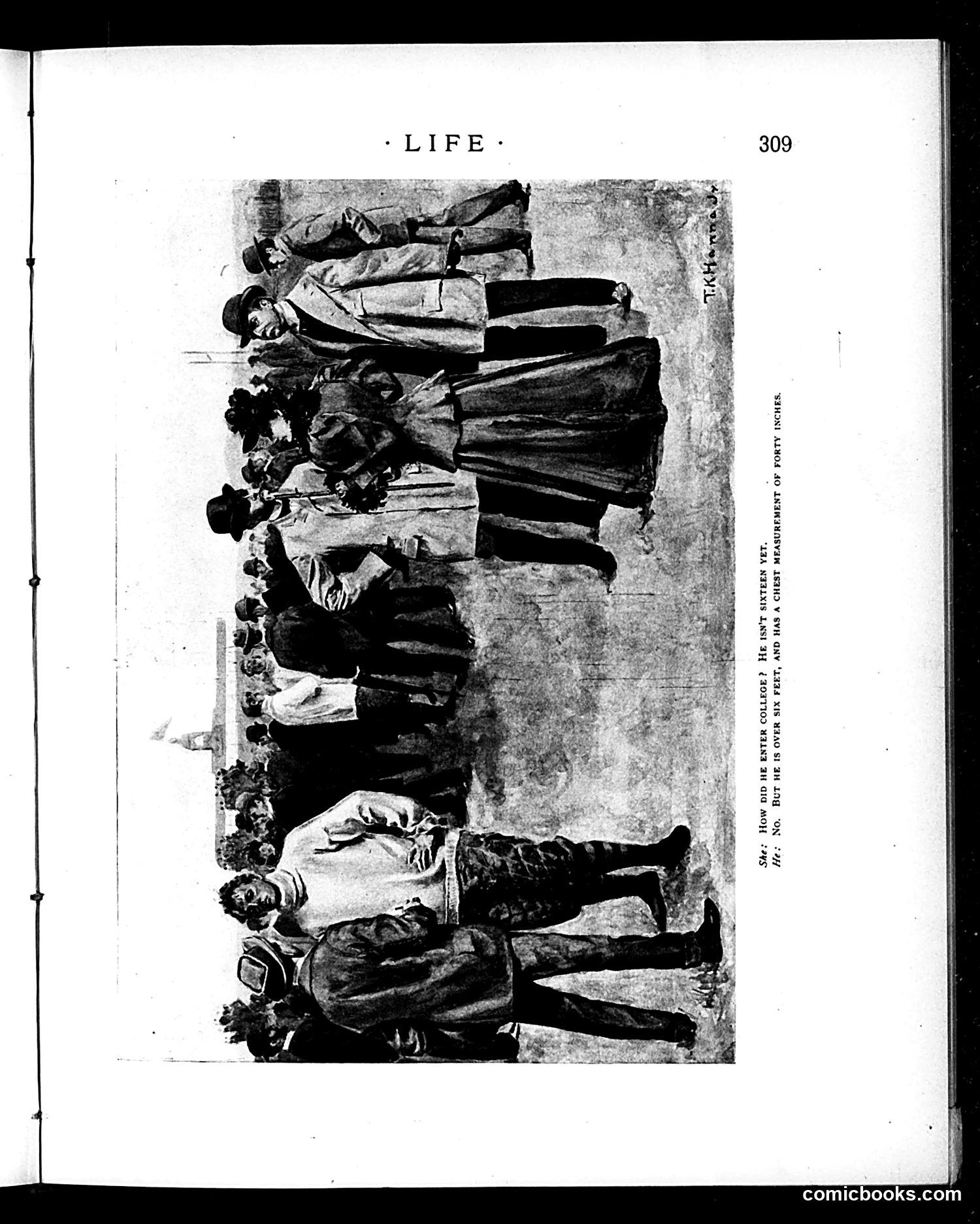
The image shows a group photograph rotated 90 degrees, displaying what appears to be a formal gathering of men in business attire from the early 20th century. The caption references "How did the extra college? He isn't yet" and mentions something about "every engagement of forty hours." The satire appears to mock either: - A newly hired or promoted businessman struggling to keep pace with demanding work schedules - The contrast between academic preparation and actual workplace demands - The exhaustion of corporate culture, with the rotated perspective emphasizing disorientation However, without clearer text legibility or identifying the specific figures in the photograph, I cannot definitively identify which individuals or business leaders are being satirized, or what particular 1910s-era event this references. The humor seems to play on workplace fatigue and the gap between education and professional reality.
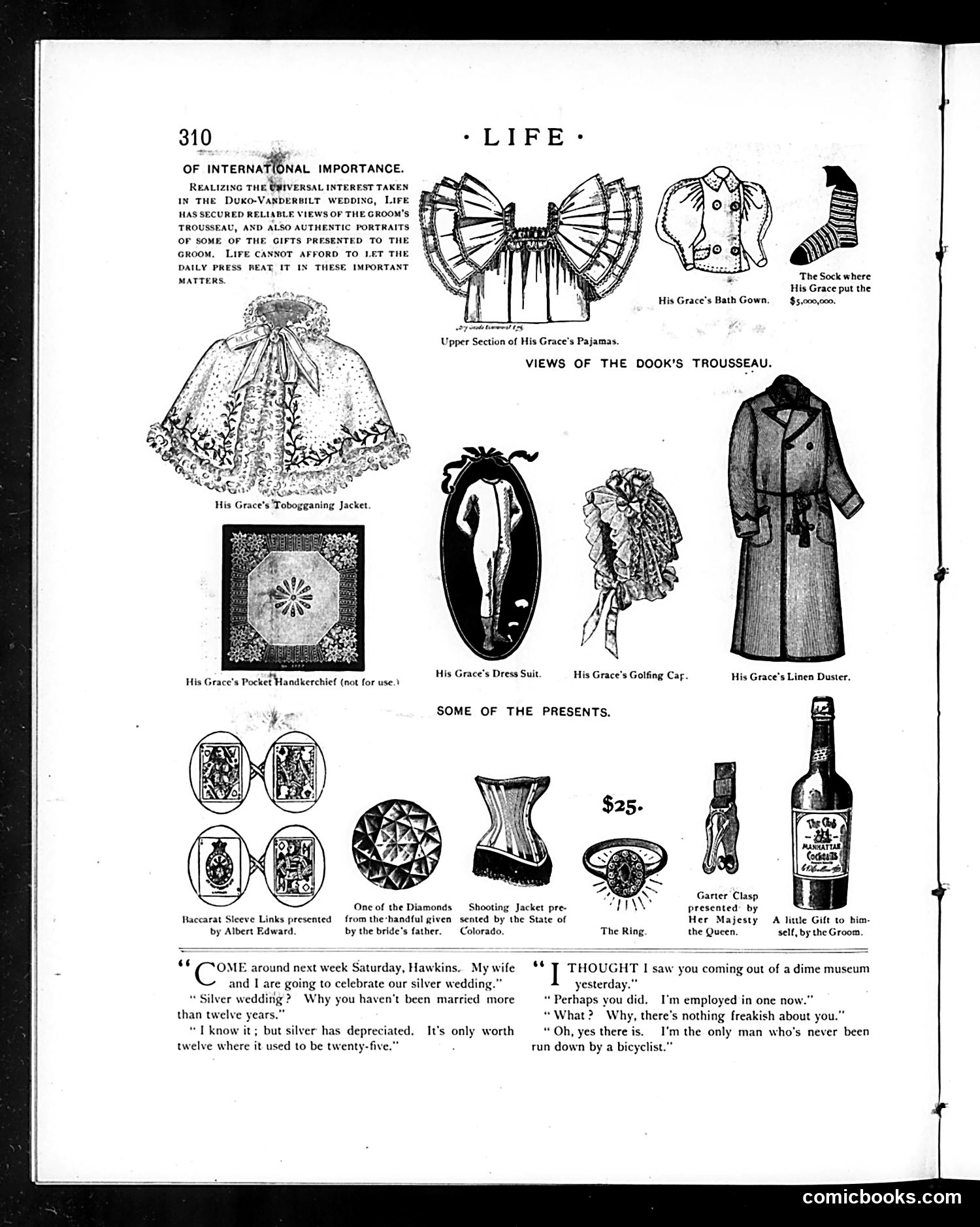
This page satirizes an elaborate **wedding trousseau** for a high-society groom ("His Grace"), likely a duke or aristocrat. The upper section catalogs luxurious items: an ornate jacket, pajamas, bath gown, and a sock valued at $1,000,000—absurdly expensive for a single sock, which is the joke's exaggeration. The bottom section shows wedding gifts including diamond jewelry, cufflinks, and wine, mocking wealthy excess. The two dialogues below ridicule pretension: one involves a silver wedding anniversary discussion where silver has depreciated in value; the other jokes about a man employed at a "dime museum" (a cheap tourist attraction), suggesting he's not actually wealthy despite his affected status. The satire targets **Gilded Age excess and social climbing**.
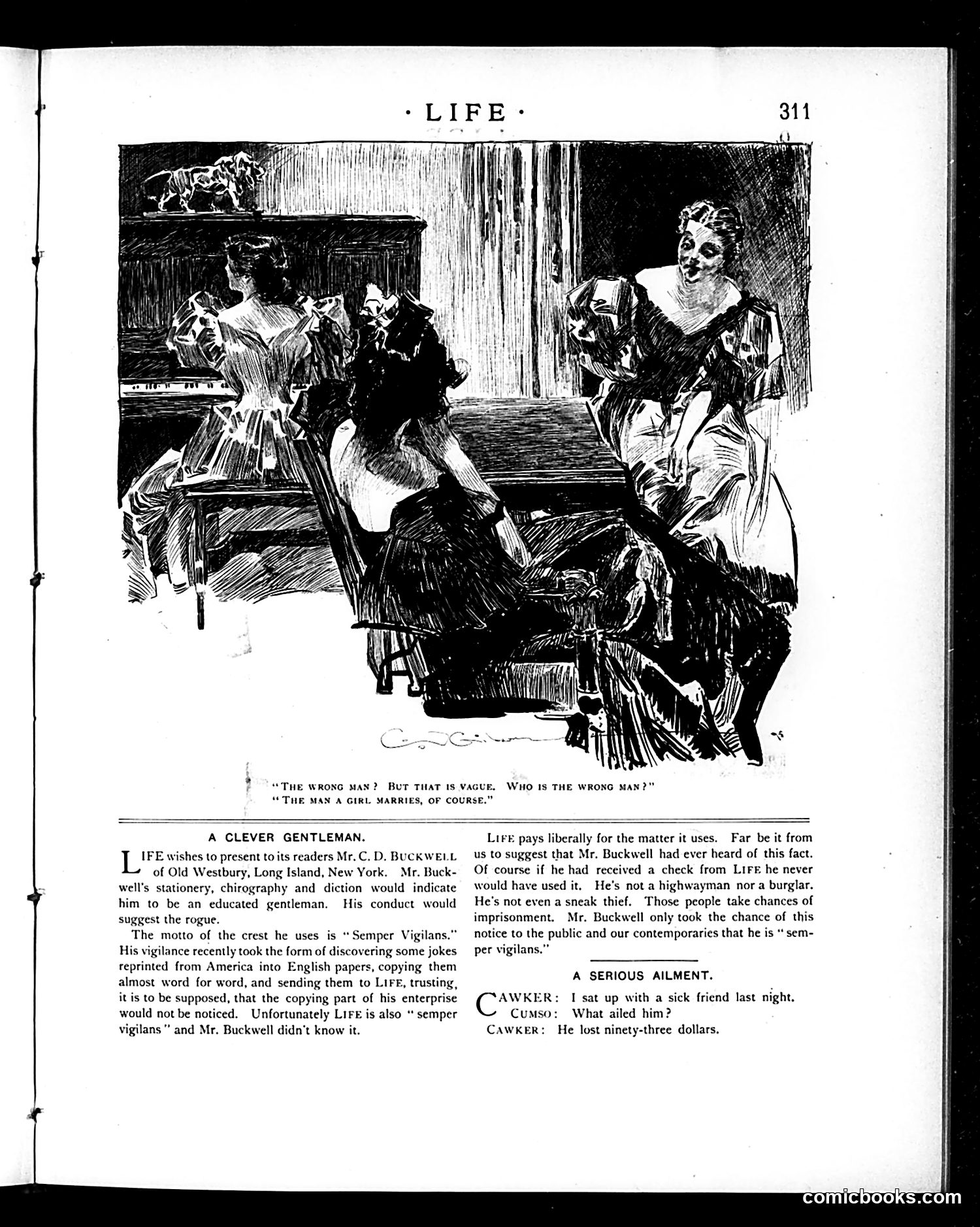
This page contains two satirical pieces typical of early Life magazine humor: **"A Clever Gentleman"** mocks Mr. C. D. Buckwell of Old Westbury, Long Island, who apparently copied jokes from American newspapers and submitted them to English papers under his own name, claiming to be an "educated gentleman." The satire suggests his vigilance motto "Semper Vigilans" is ironic—Life itself caught his plagiarism, yet he remained undetected by others. The piece criticizes both Buckwell's dishonesty and the naïveté of publications that accepted his submissions without verification. **"A Serious Ailment"** is a brief humorous dialogue: when asked why his friend is ill, Cawker replies the friend "lost ninety-three dollars"—the implication being financial loss causes genuine distress. The illustration shows an indoor social scene with women and men in period dress, likely accompanying one of these anecdotes.
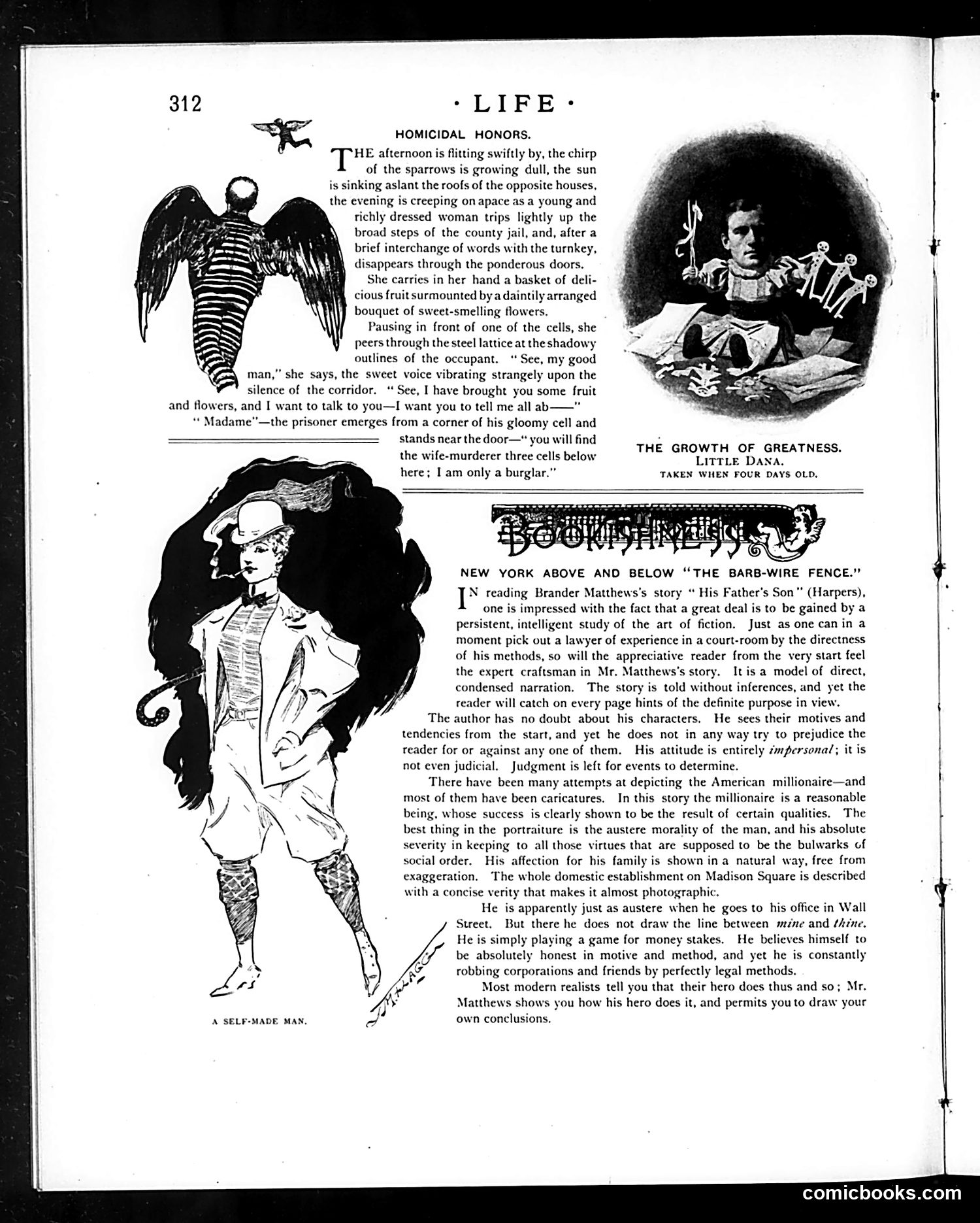
This page contains three sections: **"Homicidal Honors"** (top left): A skeletal winged figure with an elephant's trunk illustrates a dark narrative about a woman visiting a county jail prisoner. She brings flowers and fruit, offering kind words to what's revealed to be a "wife-murderer" in the cell below. The satire suggests the grim irony of civilized gestures extended to violent criminals. **"The Growth of Greatness: Little Dana"** (right): A portrait of an infant labeled as "taken when four days old"—likely satirizing excessive celebration or media attention given to notable births, though the specific identity isn't stated. **"New York Above and Below 'The Barb-Wire Fence'"** (bottom): A book review of Brander Matthew's story "His Father's Son," praising its realistic depiction of an American millionaire character and his morally ambiguous business practices.
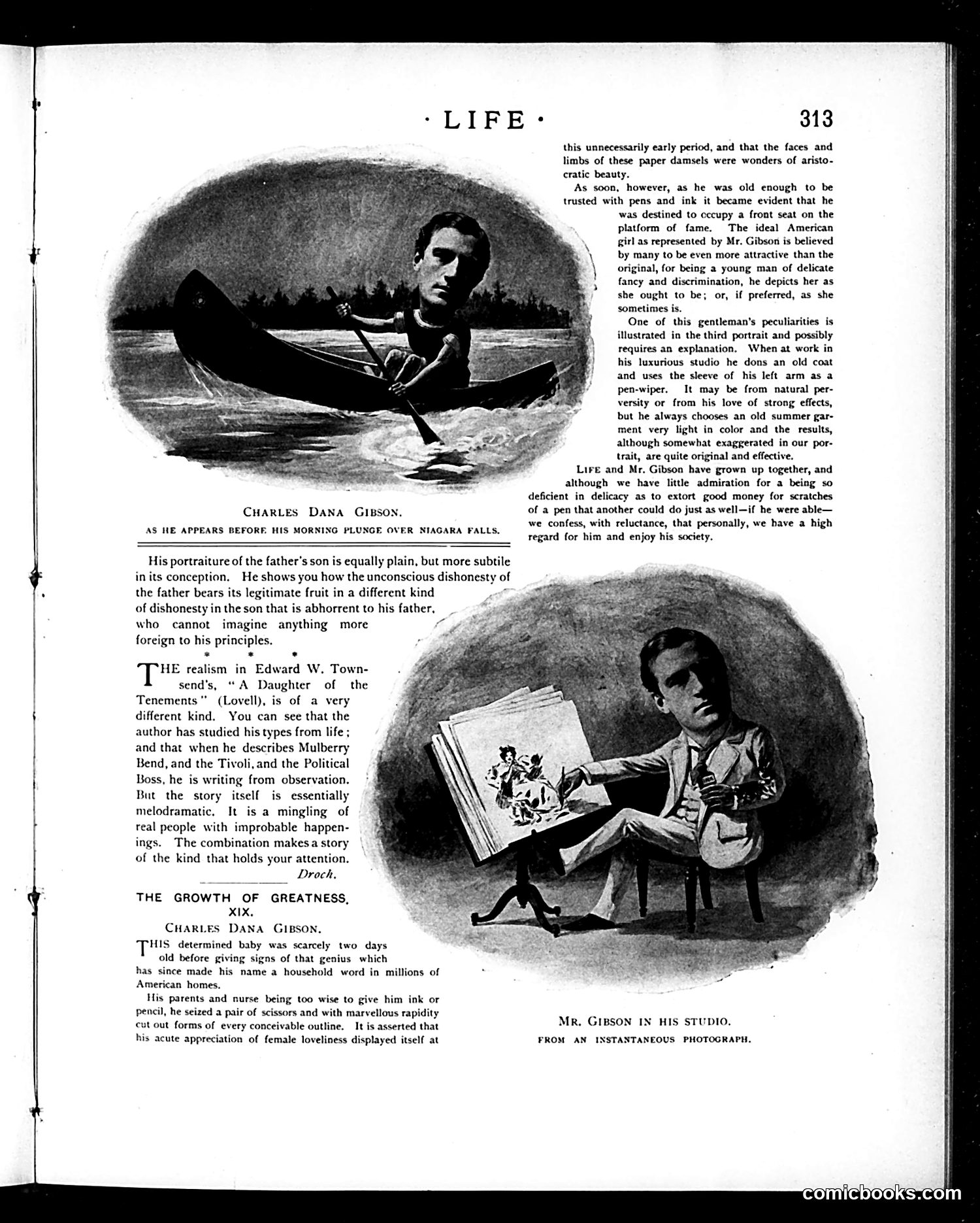
This page features Charles Dana Gibson, the famous illustrator and creator of the "Gibson Girl" ideal of American beauty. The two sketches show Gibson at work—one depicting him at his drawing board in his studio, the other showing him preparing to sketch before Niagara Falls. The text celebrates Gibson's artistic genius and influence. It notes he achieved fame young for depicting idealized female beauty, and praises his subtle character studies of types like those in Edward W. Townsend's social realist fiction. The satire appears gentle—acknowledging Gibson's delicate aesthetic preferences (he uses light summer garments for color effects) while gently mocking his refined artistic sensibilities as somewhat affected or precious compared to broader public taste.
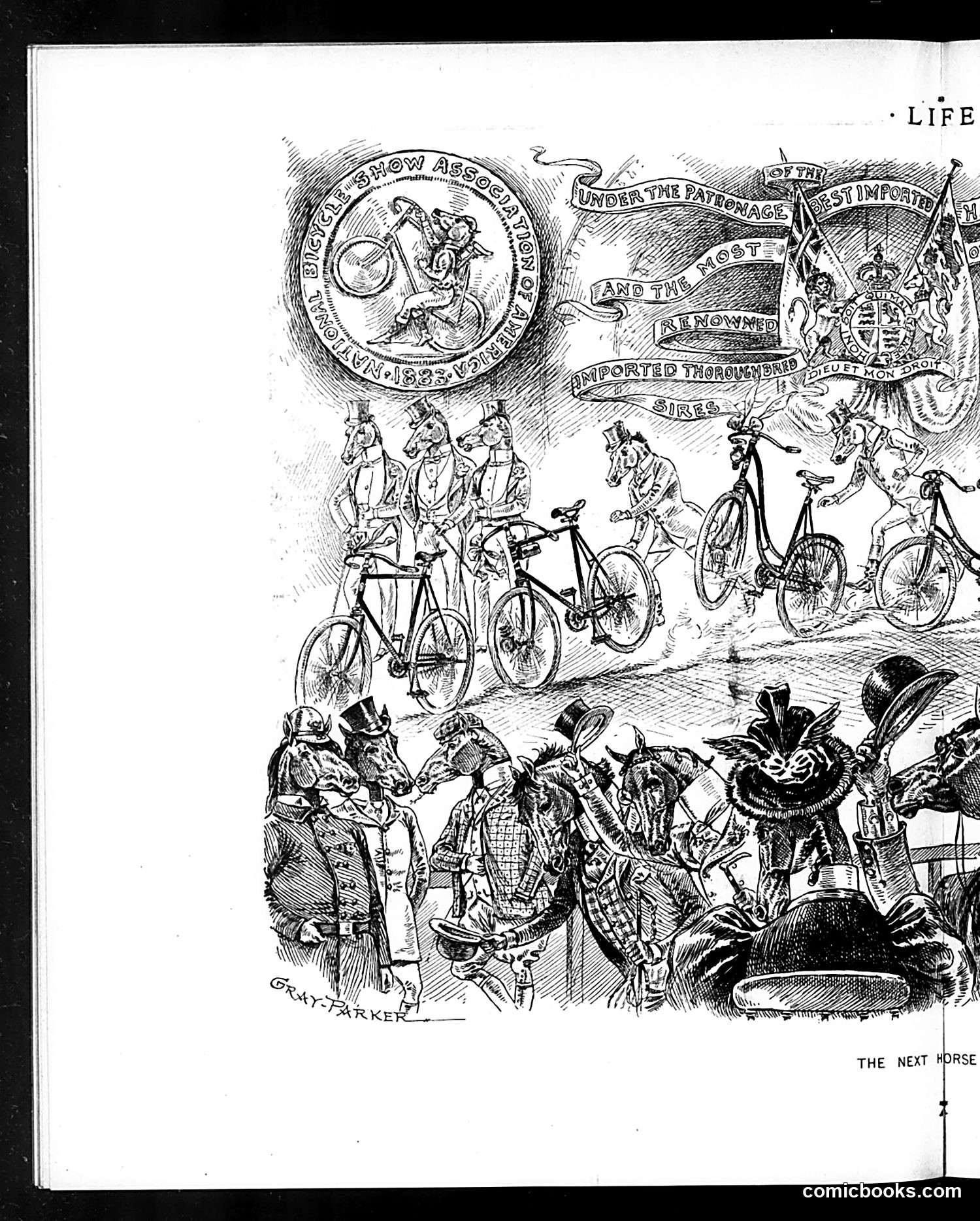
This is a satirical illustration about bicycle culture and imports. The top seal reads "International Bicycle Show Association" dated 1883, establishing the context. The cartoon depicts well-dressed gentlemen on bicycles above, while below, working-class figures in period dress examine or discuss the bicycles—suggesting tension between imported luxury goods and domestic workers or manufacturers. The text references "under the patronage of the best imported" and "most renowned...imported thorughbred sires," sarcastically emphasizing the foreign origin of these bicycles. The satirical point appears to criticize the American fascination with European imports over domestic production, a common late-19th-century protectionist complaint. The contrast between upper and lower figures highlights class divisions around this new consumer technology.
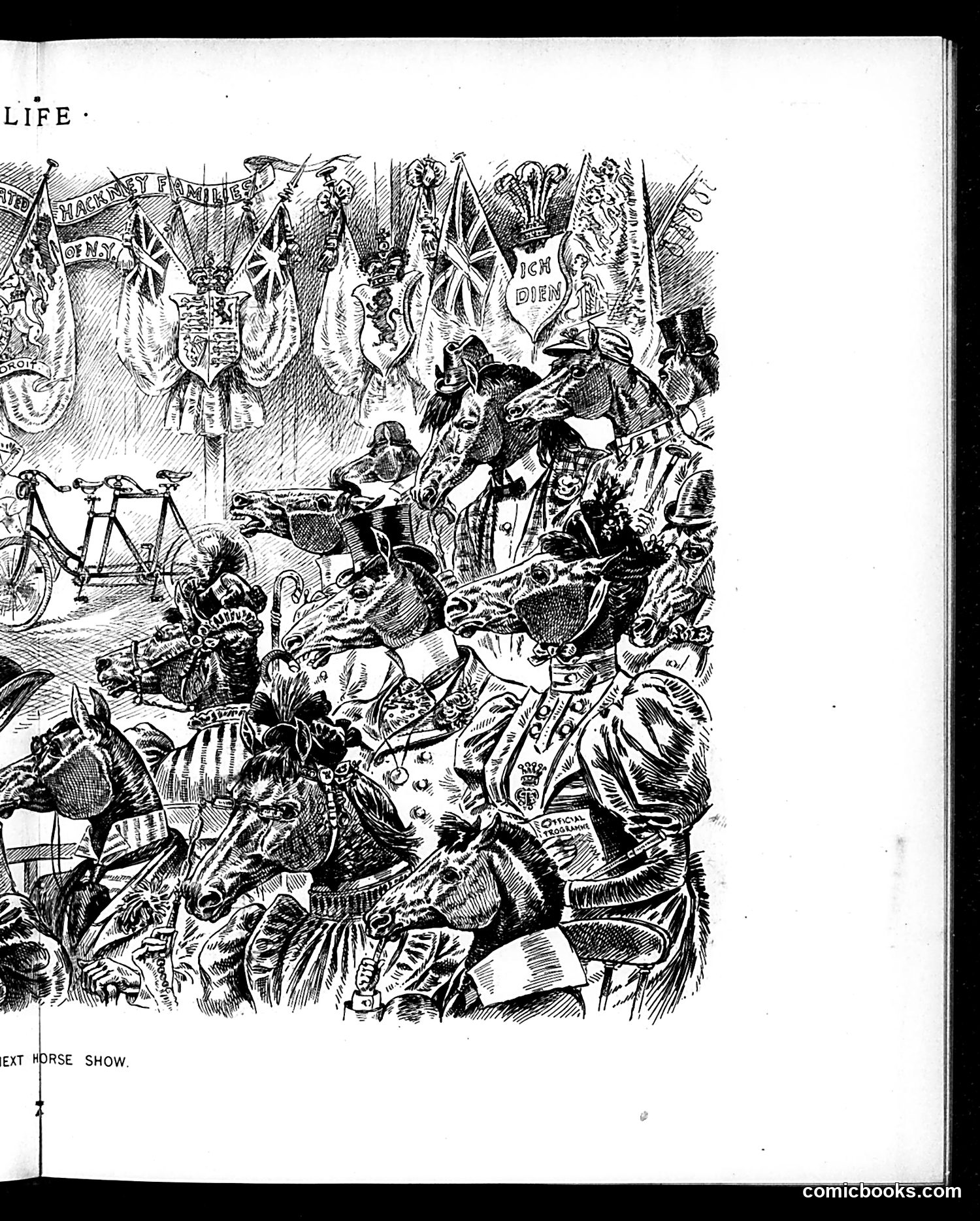
This appears to be a satirical illustration from *Life* magazine depicting a horse show or equestrian event. The scene shows elaborately dressed figures on horseback and standing, wearing ornate clothing with decorative patterns and formal attire typical of high-society events. The text reference to "NEXT HORSE SHOW" suggests this satirizes the pretensions and pageantry of elite equestrian competitions. The cartoon likely mocks the excessive formality, vanity, and social posturing of wealthy participants in such events. The densely packed composition and exaggerated detail in the clothing emphasizes the superficiality being ridiculed. Various heraldic banners and shields visible in the background reinforce themes of aristocratic pretension. Without clearer text or specific identifiable caricatures, the broader satire appears directed at upper-class social vanity rather than particular individuals.
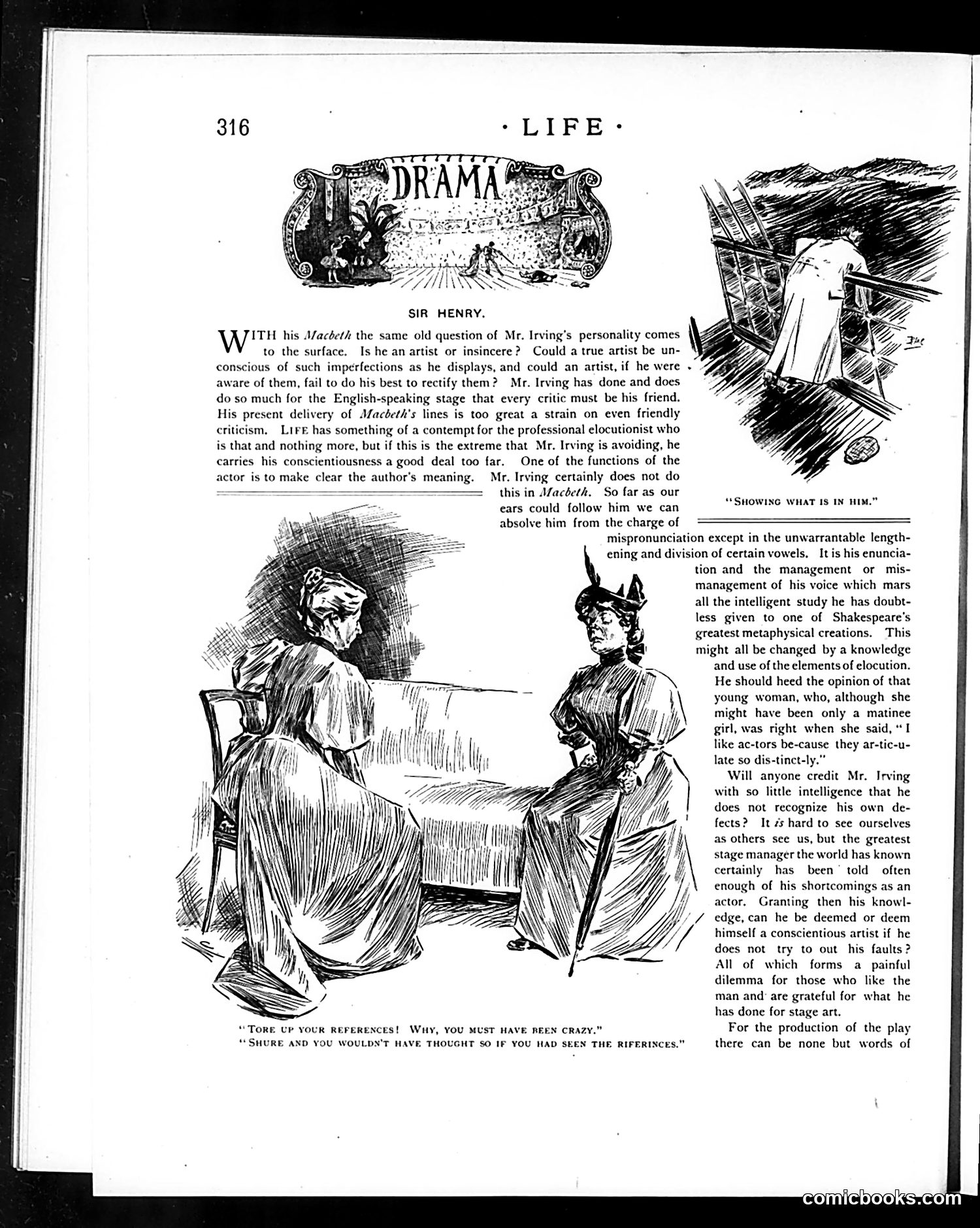
This is a critical review of actor Henry Irving's performance in *Macbeth*. The article questions whether Irving is a true artist, given what Life sees as significant flaws in his delivery—particularly his affected elocution, unwarranted vowel lengthening, and unclear articulation that obscures Shakespeare's meaning. The accompanying sketches show two figures in conversation (likely depicting audience members or critics discussing the performance). The dialogue caption mocks Irving's exaggerated diction: "Tore up your references! Why, you must have been crazy. Sure and you wouldn't have thought so if you had seen the references." Life's critique is paradoxically sympathetic—acknowledging Irving's enormous contributions to English theater while arguing his current vocal choices undermine his own scholarly work. The satire targets Irving's apparent obliviousness to (or refusal to correct) these mannerisms, questioning whether true artistic consciousness allows such persistent technical failings.
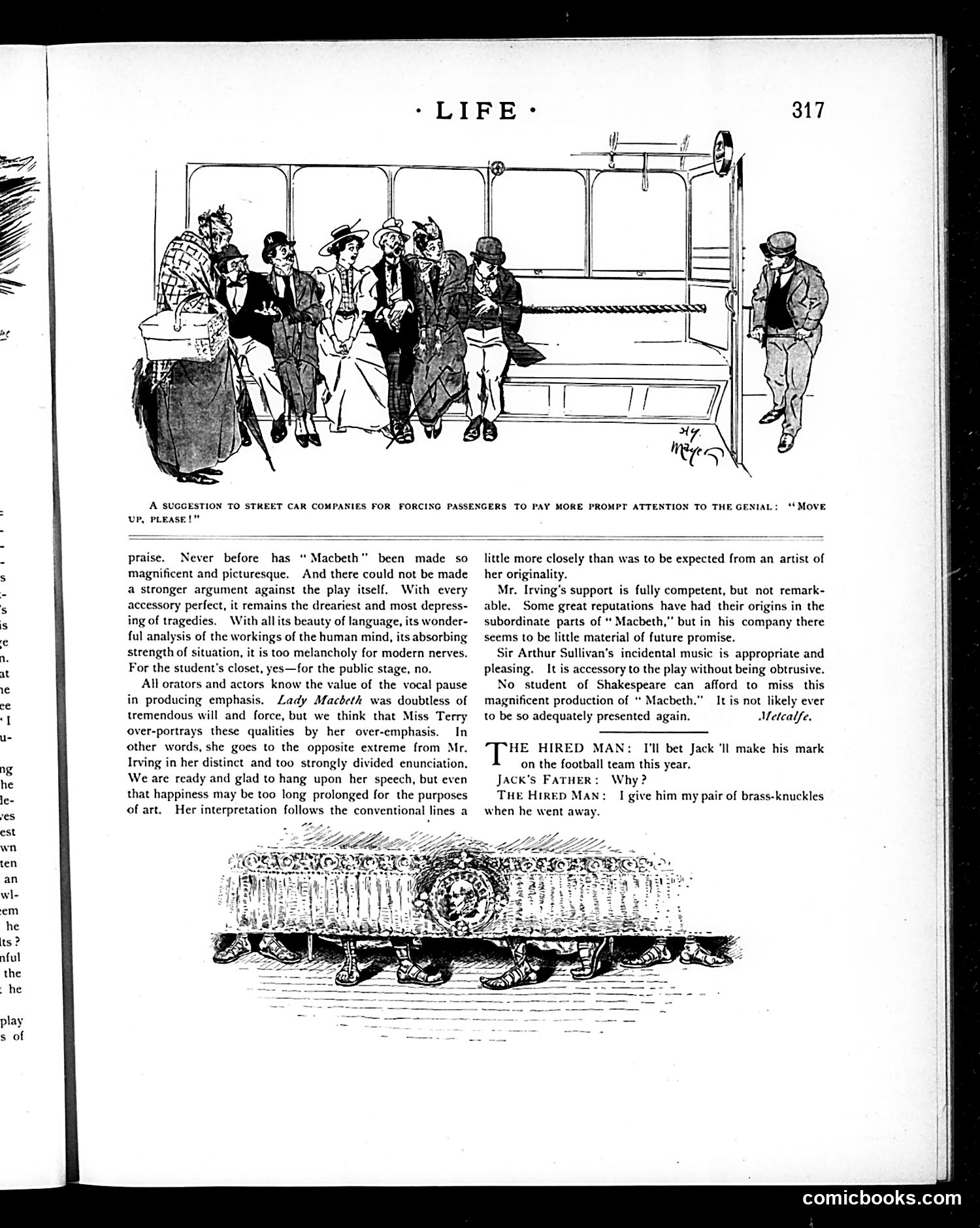
The top cartoon satirizes crowded street cars by suggesting transit companies force passengers to stand by installing a theatrical stage set—here depicting a Shakespearean scene. The joke: if passengers had to perform dramatic recitations (like "Move up, please!"), they'd pay more attention and actually comply with requests, making the cars function better. It's social satire about urban commuting inconvenience and passenger discourtesy. Below that is a theater review discussing a production of *Macbeth* featuring actors (likely Henry Irving and Ellen Terry, major Shakespearean performers of the era, though not named here). The critic praises the production's magnificence while arguing the play itself remains depressing and unsuitable for modern audiences. The bottom item is a brief joke: a farmer's hired hand gives the farmer's son brass-knuckles as a parting gift, suggesting the boy will fight his way to prominence on the school football team—crude humor about violence and athletics.
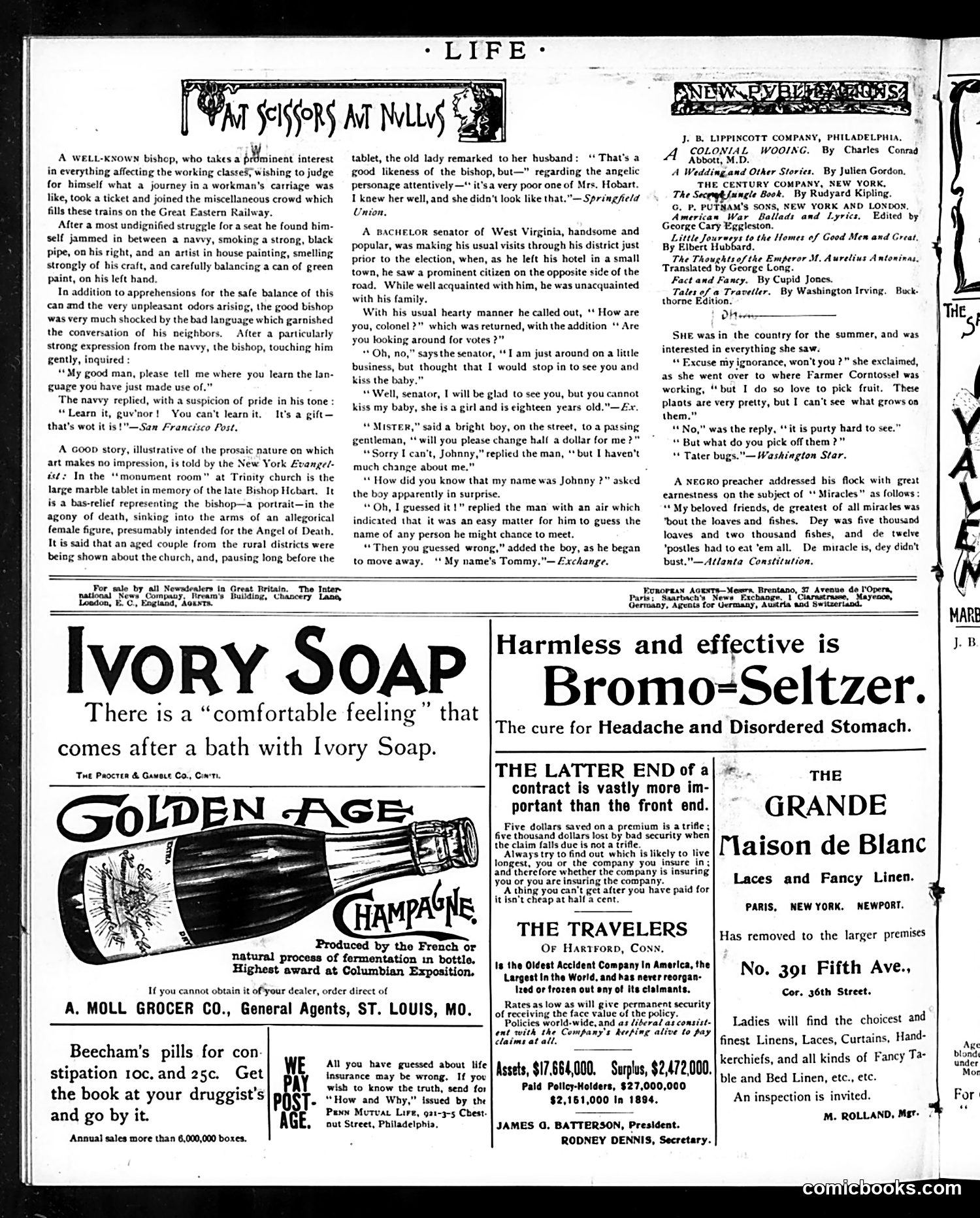
This page contains four short humorous anecdotes rather than political cartoons. Each satirizes class attitudes and social pretension in late 19th-century America: 1. **"I'm Scissors at Nulls"**: A bishop, curious about working-class life, travels in a crowded railway car with rough laborers. When shocked by profanity, a navvy claims foul language is a "gift" rather than learned—satirizing both working-class crudeness and the bishop's naïveté. 2. **Trinity Church tablet**: Rural visitors viewing a monument of Bishop Hobart dying in an angel's arms mistake the allegorical figure for his wife, finding it an unflattering portrait—mocking unsophisticated viewers' literal, practical interpretations of religious art. 3. **Senator and baby**: A politician's awkward assumption that a stranger has a son (whom he offers to kiss) backfires when told the child is a daughter—satirizing political presumption and changing social expectations. 4. **Johnny/Tommy**: A man's trick of guessing a boy's name "Johnny" fails humorously—gentle satire on false confidence. The humor relies on social class contrasts and misunderstandings typical of Victorian-era magazine comedy.
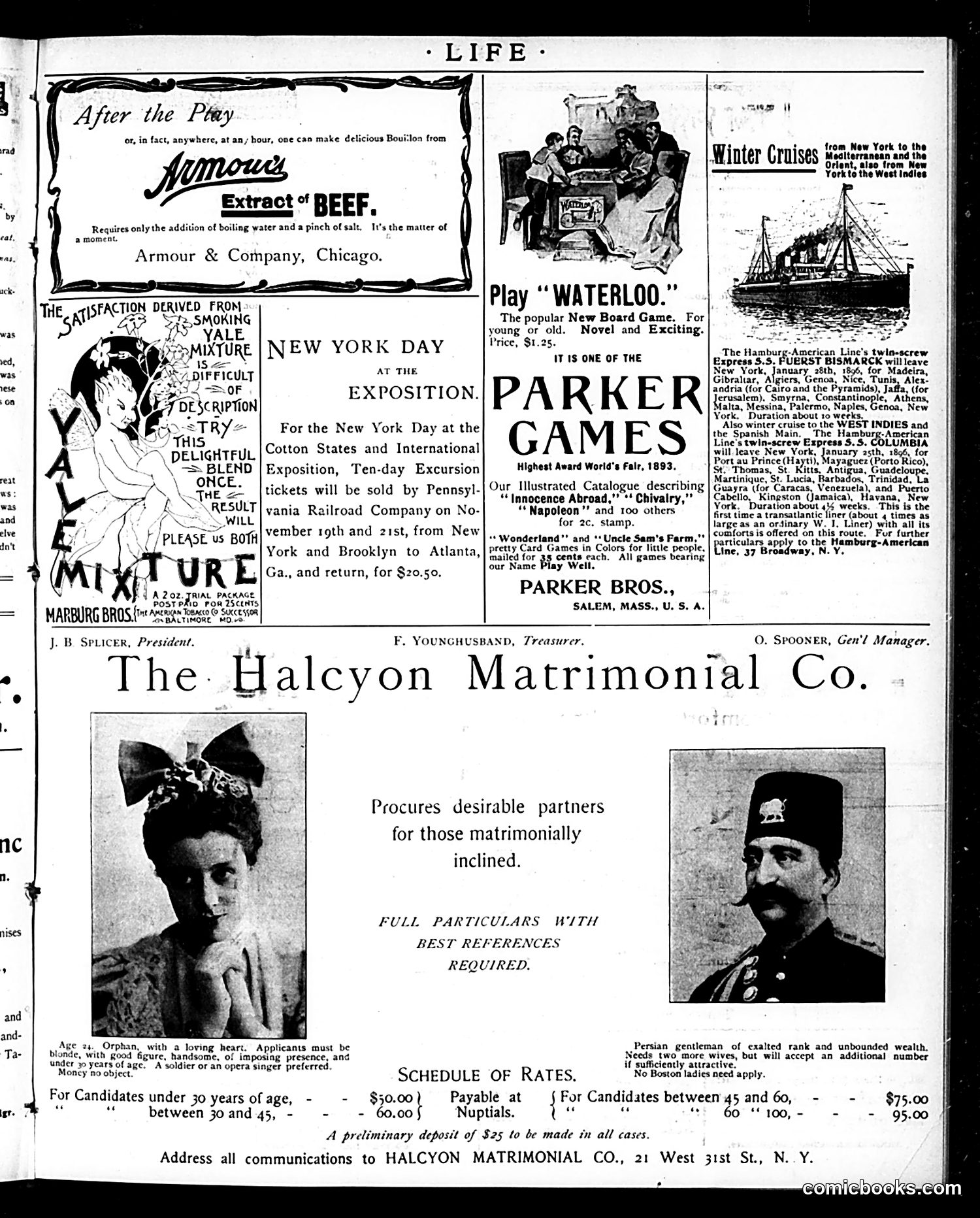
This page is primarily **advertising**, with one notable satirical element. The left side features a small cartoon labeled "The Satisfaction Derived from Smoking a Miniature Difficult Description Try This Delightful Blend Once. The Result Will Please us Both" — advertising a Marburg Bros. tobacco product. The cartoon appears to show a woman smoking, likely satirizing contemporary debates about women and smoking, which was controversial at the time. The rest of the page contains straightforward commercial advertisements: Armour beef extract, Parker Games board games, a Cotton States Exposition railroad excursion, Hamburg-American cruise lines, and most notably, **The Halcyon Matrimonial Co.** — a matchmaking service. The matrimonial ads are unintentionally humorous by modern standards, featuring absurd candidate descriptions (an "orphan with a loving heart" for a soldier/opera singer; a "Persian gentleman" seeking multiple wives). This reflects era-typical matrimonial advertising practices, not satire. The page lacks political commentary or recognizable caricatures of public figures.
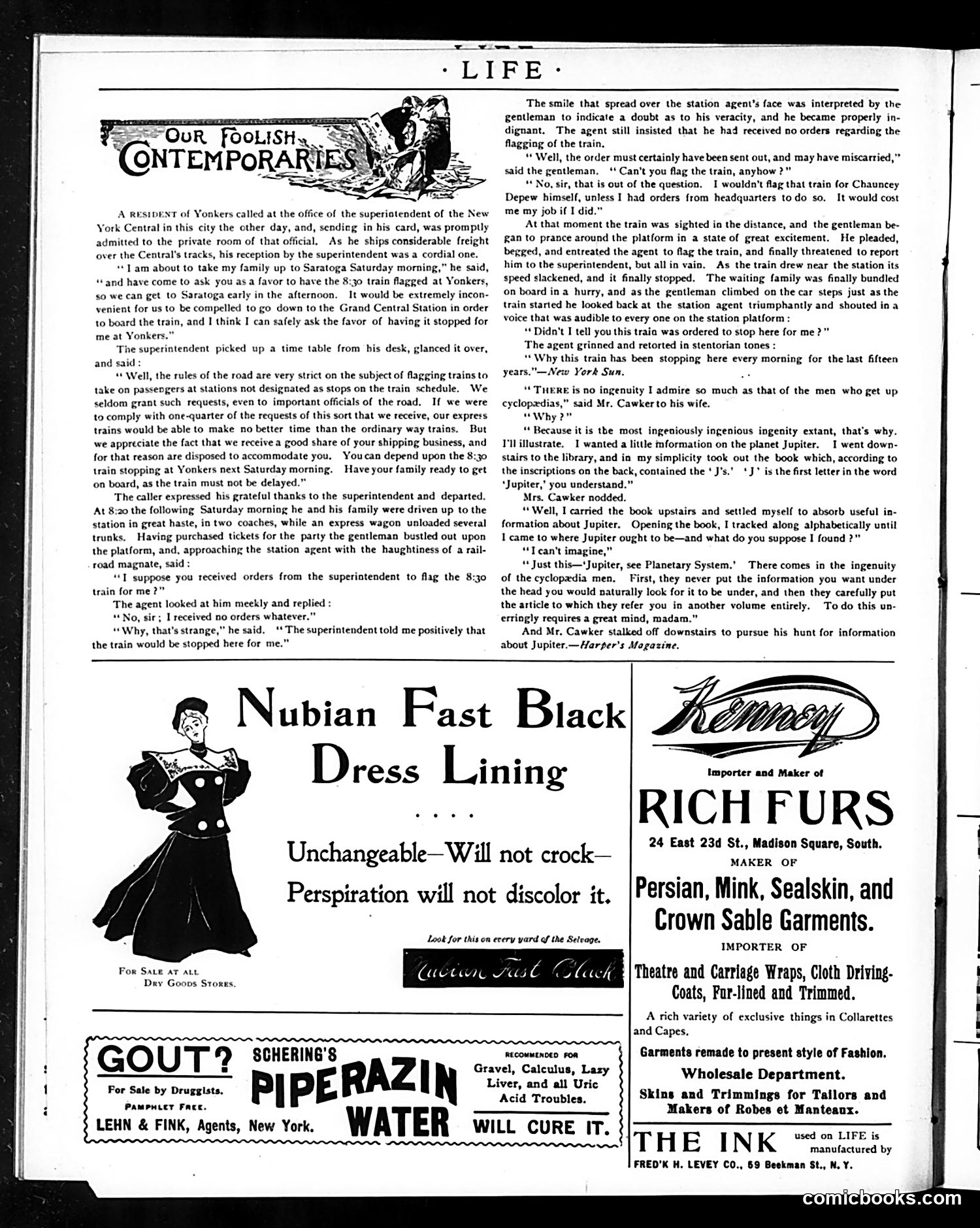
This satirical story mocks a wealthy Yonkers businessman's entitled assumption that railroad rules don't apply to him. He asks the superintendent for a special favor: stopping the 8:30 train at an undesignated station so he needn't travel to Grand Central. The superintendent agrees as a courtesy to an important shipper. However, the station agent—operating by actual railroad rules—receives no orders and refuses to flag the train. When the train stops anyway (for legitimate operational reasons), the businessman triumphantly concludes his influence worked, proving he misunderstands the situation entirely. The satire targets upper-class obliviousness: a man so accustomed to privilege that he cannot recognize coincidence from favor, and assumes his importance supersedes institutional rules. The agent's knowing grin suggests the joke is ultimately on the businessman's vanity.
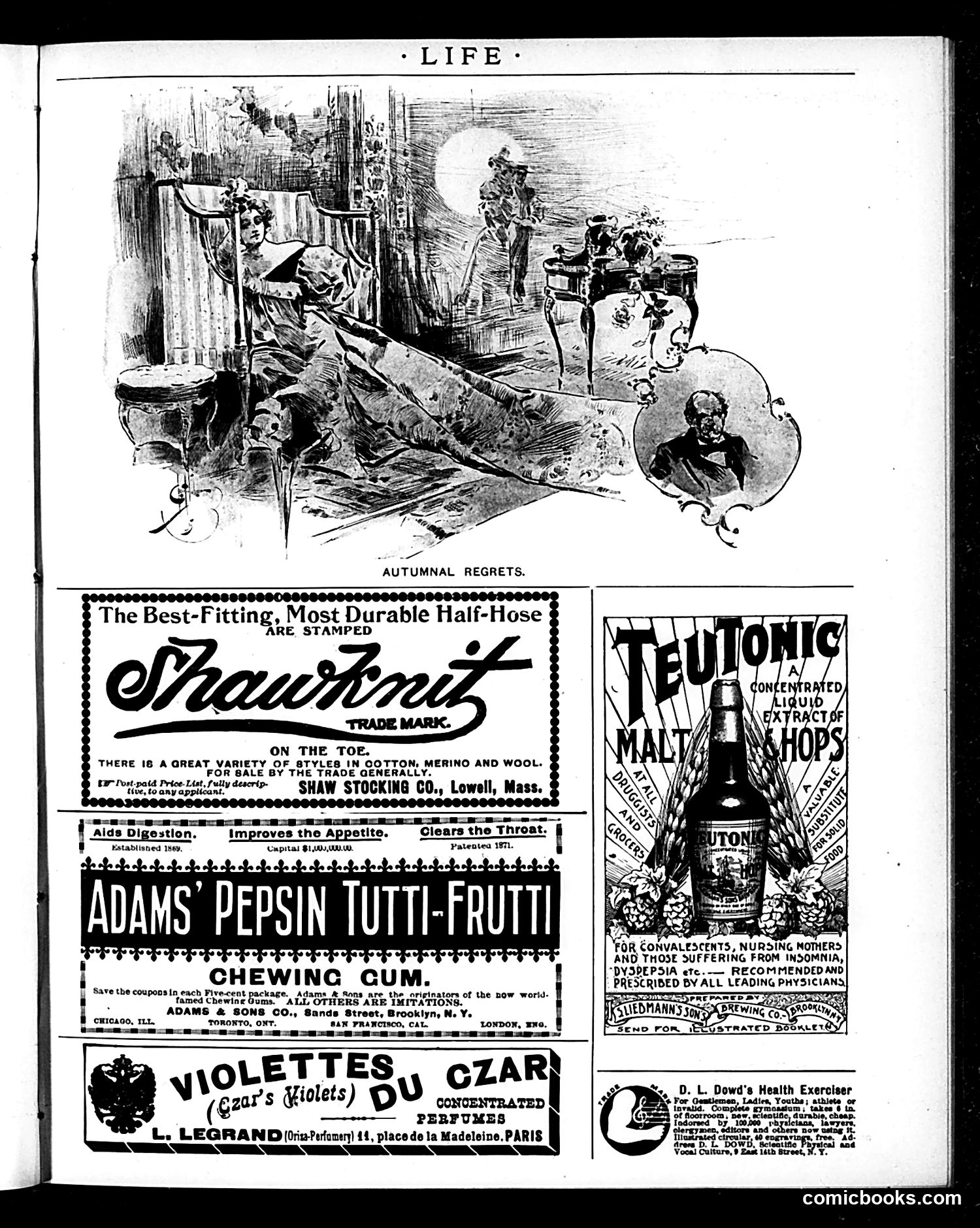
This page is primarily **advertisements with a satirical cartoon at the top**. The cartoon depicts a melancholy scene titled "Autumnal Regrets"—showing what appears to be a romantic or domestic relationship in decline. A woman reclines indoors while a man departs on horseback in moonlight; circular vignettes show their contrasting states, suggesting lost love or disappointed expectations as seasons change. The satire likely comments on **seasonal mood shifts or the disappointments of aging romance**—a common Victorian theme. The juxtaposition with aggressive product advertising below (socks, gum, perfume, malt extract) creates ironic social commentary: while people suffer emotional regrets, commerce cheerfully peddles solutions for appetite, digestion, and attractiveness. The specific identities of the figures are unclear, but the mood is distinctly melancholic rather than comedic.
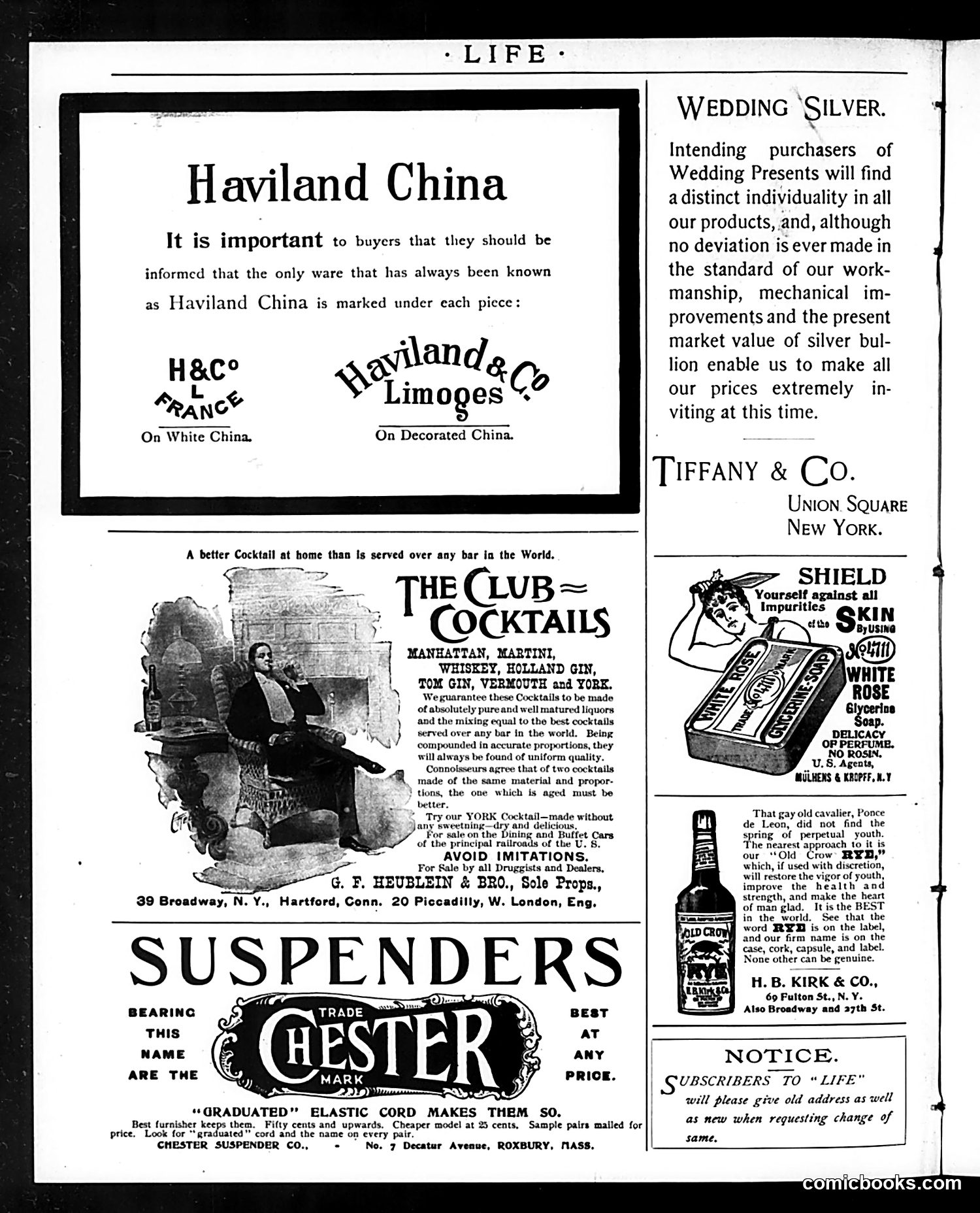
This is primarily an **advertising page** from Life magazine, not a satirical cartoon page. It contains six advertisements for luxury goods and services targeting wealthy consumers: 1. **Haviland China** - emphasizing authentic French porcelain marked with specific maker's marks to avoid counterfeits 2. **The Club Cocktails** - pre-mixed, bottled cocktails claiming superiority to bar drinks, sold nationally 3. **Tiffany & Co. Wedding Silver** - luxury silverware for wedding gifts 4. **Chester Suspenders** - with "graduated elastic cord" technology 5. **Shield White Rose Glycerin** - a skin product 6. **Old Crow Rye Whiskey** - referencing the legendary explorer Ponce de León's failed search for youth The page reflects **Gilded Age consumerism**: advertisements emphasize authenticity (avoiding imitations), scientific improvement (graduated elastic), and aspirational luxury. The Old Crow ad's Ponce de León reference is the only attempted humor—suggesting whiskey offers what the fountain of youth couldn't.
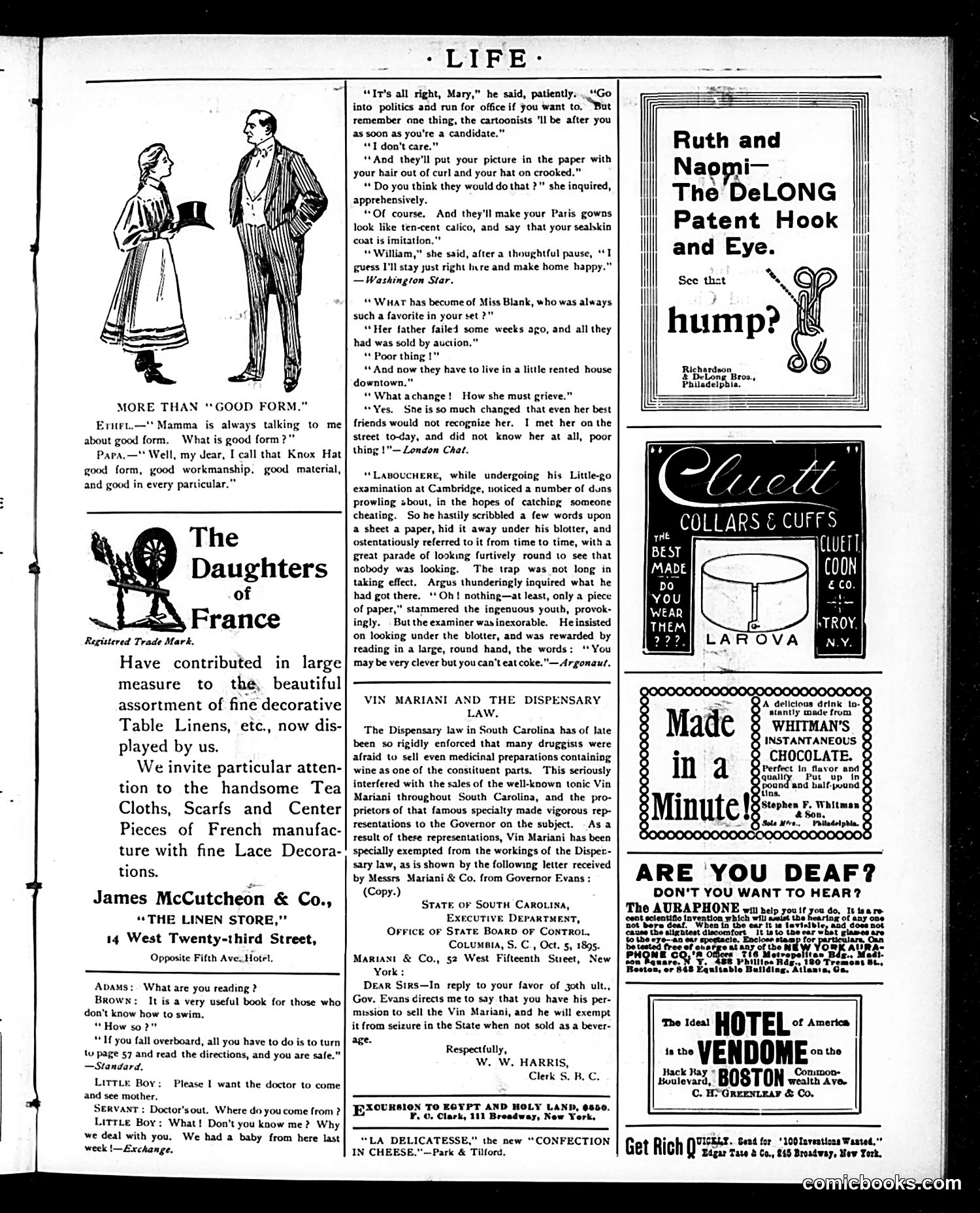
This cartoon humorously illustrates a conversation between a child ("Eitel") and parent ("Papa") about social propriety. The father redefines "good form" from abstract etiquette to practical quality—specifically praising Knox hats for their craftsmanship and materials. It's advertising disguised as humor. Below it, a separate joke comments on political ambition and press mockery. A woman considers running for office, but her husband warns that cartoonists will caricature her cruelly—depicting her disheveled hair, crooked hat, and cheap imitation clothing. The woman decides against candidacy, choosing domestic contentment instead. The satire targets both political cartooning's meanness and women's vulnerability to appearance-based ridicule, reflecting late-19th-century attitudes about women, politics, and media power.
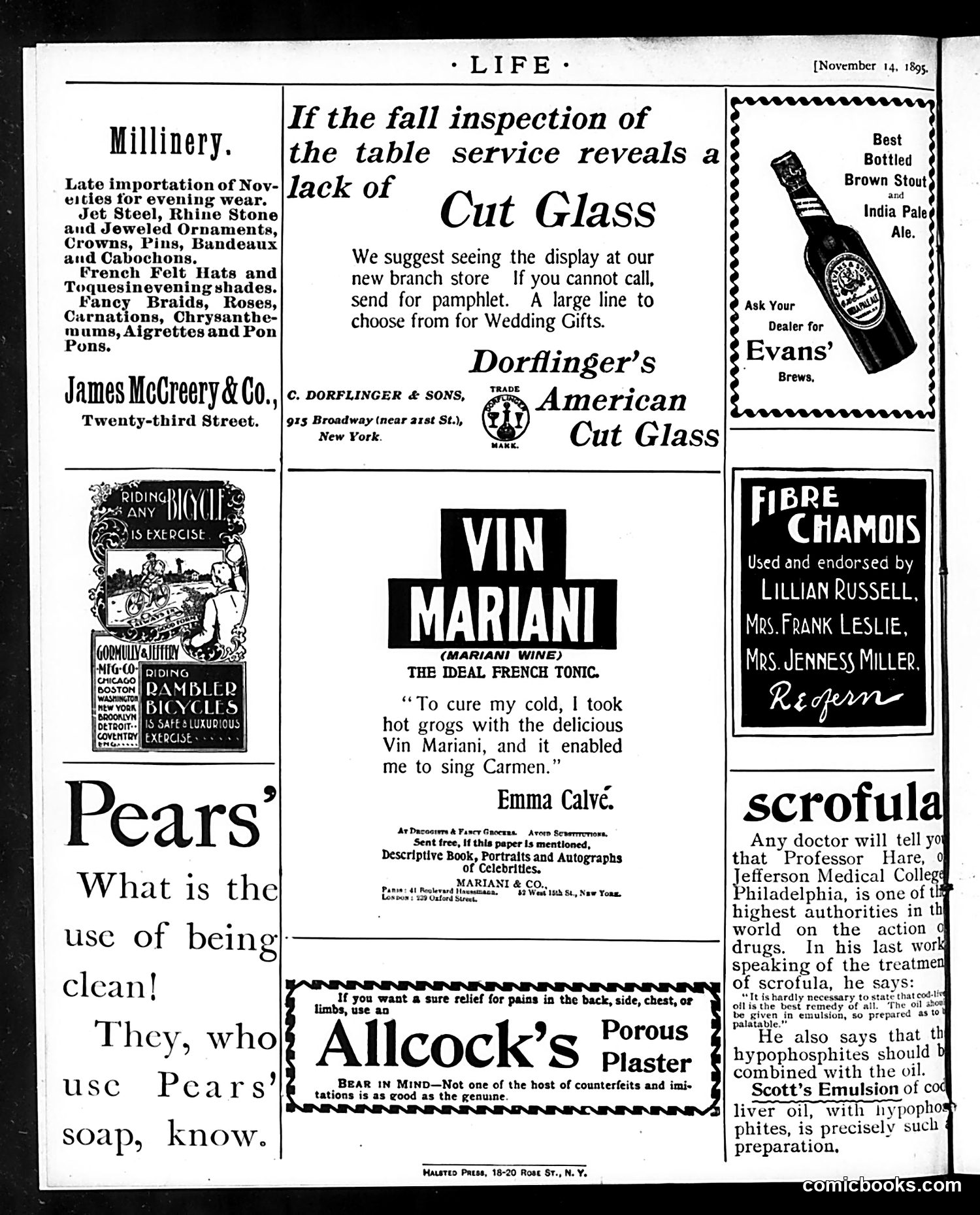
This is primarily an **advertising page** with no political cartoons or satirical content. The page features period product advertisements typical of the 1890s: **Key Ads:** - **Dorflinger's Cut Glass** (upper center): promotes glassware for wedding gifts - **Vin Mariani** (center): a French tonic wine, endorsed by opera singer Emma Calvé, claiming to cure colds - **Pears' Soap** (lower left): implies cleanliness through simple rhetorical questioning - **Allcock's Porous Plaster** (lower center): medical pain relief patch - **Fibre Chamois** (right): endorsed by theatrical personalities like Lillian Russell - **Scott's Emulsion** (lower right): liver oil treatment for scrofula, citing medical authority The advertisements reflect late-Victorian consumer culture and patent medicine marketing, where celebrity endorsements and medical claims (often unsubstantiated) drove sales. No satire or political commentary is evident on this page.