
Life, 1895-11-14 · page 13 of 20
Life — November 14, 1895 — page 13: what you’re looking at
What you’re looking at
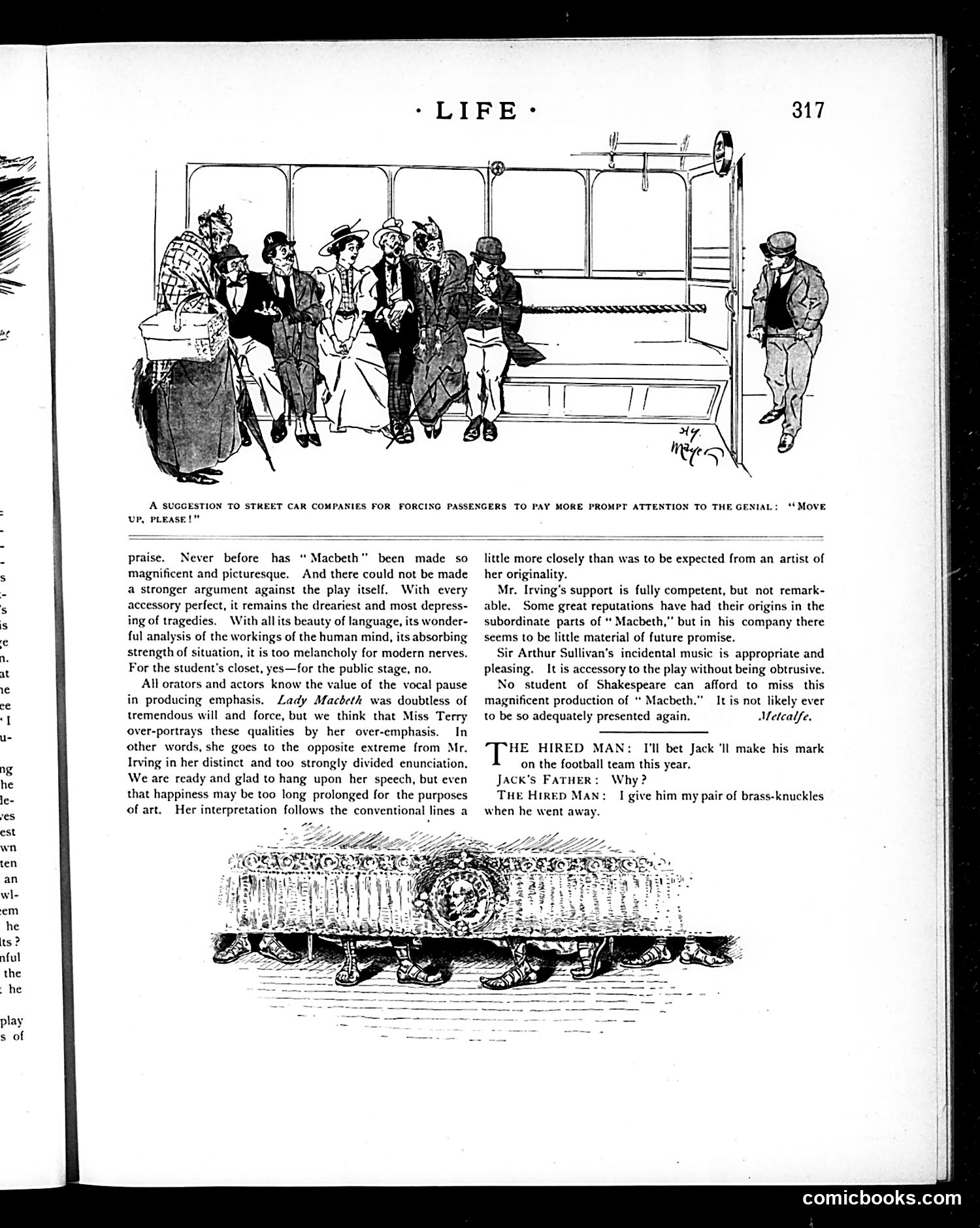
The top cartoon satirizes crowded street cars by suggesting transit companies force passengers to stand by installing a theatrical stage set—here depicting a Shakespearean scene. The joke: if passengers had to perform dramatic recitations (like "Move up, please!"), they'd pay more attention and actually comply with requests, making the cars function better. It's social satire about urban commuting inconvenience and passenger discourtesy. Below that is a theater review discussing a production of *Macbeth* featuring actors (likely Henry Irving and Ellen Terry, major Shakespearean performers of the era, though not named here). The critic praises the production's magnificence while arguing the play itself remains depressing and unsuitable for modern audiences. The bottom item is a brief joke: a farmer's hired hand gives the farmer's son brass-knuckles as a parting gift, suggesting the boy will fight his way to prominence on the school football team—crude humor about violence and athletics.
📄 Transcribed text from this page (OCR, searchable)
Machine-transcribed from the original scan — historical spelling and the odd misread are preserved.
A SUGGESTION TO STREET CAR COMPANIES FOR FORCING PASSENGERS TO PAY MORE PROMPT ATTENTION TO THE GENIAL: UP, PLEASE!" “Move praise. Never before has ‘“ Macbeth” been made so magnificent and picturesque. And there could not be made a stronger argument against the play itself. With every accessory perfect, it remains the dreariest and most depress- ing of tragedies. With all its beauty of language, its wonder- ful analysis of the workings of the human mind, its absorbing strength of situation, it is too melancholy for modern nerves. For the student's closet, yes—for the public stage, no. All orators and actors know the value of the vocal pause in producing emphasis. Lady Macbeth was doubtless of tremendous will and force, but we think that Miss Terry over-portrays these qualities by her over-emphasis. In other words, she goes to the opposite extreme from Mr. Irving in her distinct and too strongly divided enunciation. We are ready and glad to hang upon her speech, but even that happiness may be too long prolonged for the purposes of art. Her interpretation follows the conventional lines a little more closely than was to be expected from an artist of her originality. Mr. Irving's support is fully competent, but not remark- able. Some great reputations have had their origins in the subordinate parts of “ Macbeth,” but in his company there seems to be little material of future promise. Sir Arthur Sullivan's incidental music is appropriate and pleasing. It is accessory to the play without being obtrusive. No student of Shakespeare can afford to miss this magnificent production of * Macbeth.” It is not likely ever to be so adequately presented again, Metcalfe, HE HIRED MAN: I'll bet Jack ‘Il make his mark on the football team this year. JACK’s FATHER: Why? THE HIRED MAN: I give him my pair of brass-knuckles when he went away. comicbooks.com