
Life, 1895-11-14 · page 12 of 20
Life — November 14, 1895 — page 12: what you’re looking at
What you’re looking at
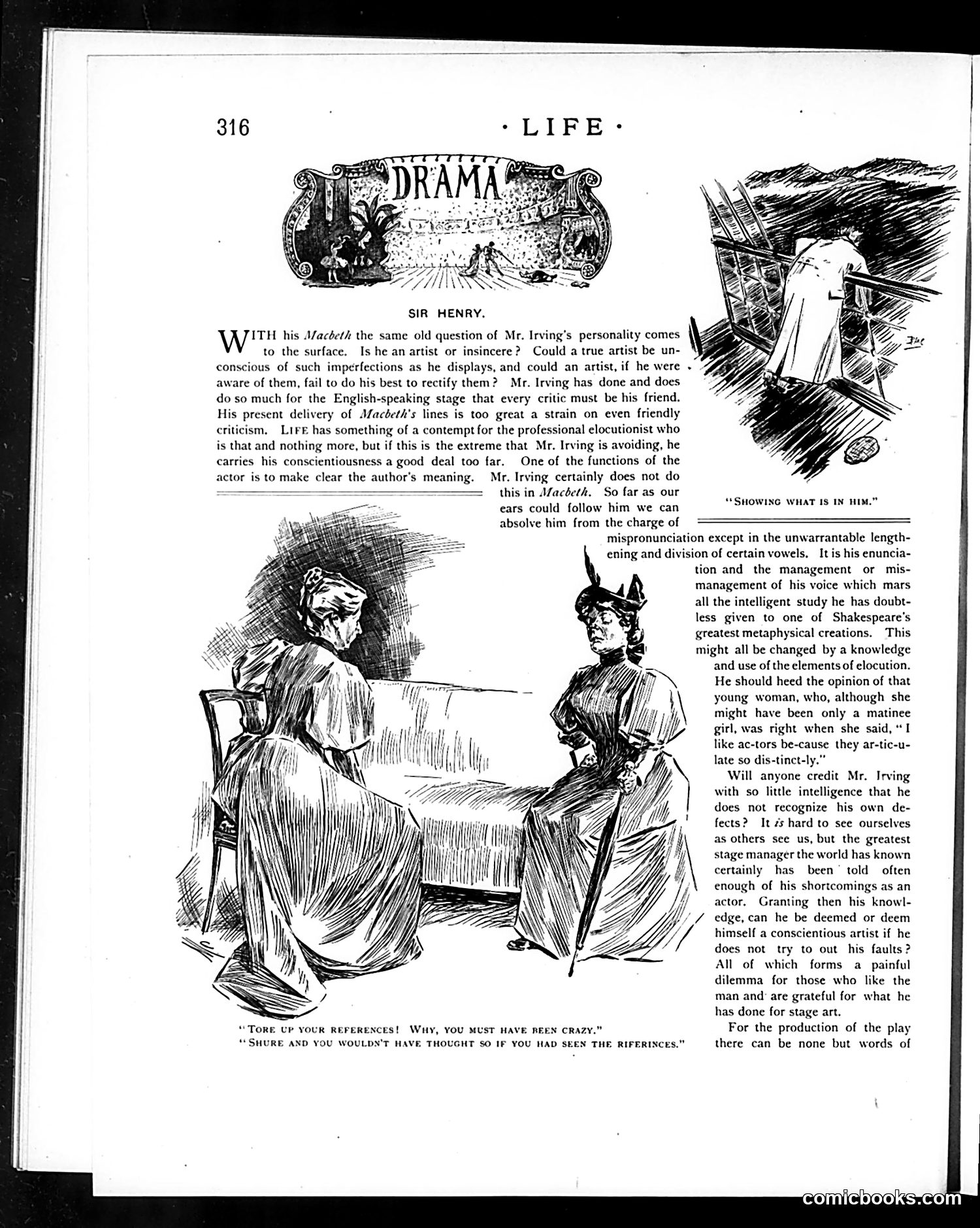
This is a critical review of actor Henry Irving's performance in *Macbeth*. The article questions whether Irving is a true artist, given what Life sees as significant flaws in his delivery—particularly his affected elocution, unwarranted vowel lengthening, and unclear articulation that obscures Shakespeare's meaning. The accompanying sketches show two figures in conversation (likely depicting audience members or critics discussing the performance). The dialogue caption mocks Irving's exaggerated diction: "Tore up your references! Why, you must have been crazy. Sure and you wouldn't have thought so if you had seen the references." Life's critique is paradoxically sympathetic—acknowledging Irving's enormous contributions to English theater while arguing his current vocal choices undermine his own scholarly work. The satire targets Irving's apparent obliviousness to (or refusal to correct) these mannerisms, questioning whether true artistic consciousness allows such persistent technical failings.
📄 Transcribed text from this page (OCR, searchable)
Machine-transcribed from the original scan — historical spelling and the odd misread are preserved.
SIR HENRY. ITH his A/acdeth the same old question of Mr. Irving’s personality comes to the surface. Is he an artist or insincere? Could a true artist be un- conscious of such imperfections as he displays, and could an artist, if he were aware of them, fail to do his best to rectify them? Mr. Irving has done and does do so much for the English-speaking stage that every critic must be his friend. His present delivery of AMacbeth's lines is too great a strain on even friendly criticism, LIFE has something of a contempt for the professional elocutionist who is that and nothing more, but if this is the extreme that Mr. Irving is avoiding, he carries his conscientiousness a good deal too far. One of the functions of the actor is to make clear the author's meaning. Mr. Irving certainly does not do = this in Macbeth, So far as our ears could follow him we can absolve him from the charge of “SHOWING WHAT IS IN HIM.” mispronunciation except in the unwarrantable length- ening and division of certain vowels, It is his enuncia- TORE UP YOUR REFERENC! “SHURE AND YOU WOUL s! WHY, YOU MUST HAVE REEN CRAzy.” HAVE THOUGHT SO IF YOU HAD SEEN THE RIFERINCES.” tion and the management or mis- management of his voice which mars all the intelligent study he has doubt- less given to one of Shakespeare's greatest metaphysical creations. This might all be changed by a knowledge and use of the elements of elocution. He should heed the opinion of that young woman, who, although she might have been only a matinee girl, was right when she said, “I like ac-tors be-cause they ar-tic-u- late so dis-tinct-ly.” Will anyone credit Mr. Irving with so little intelligence that he does not recognize his own de- fects? It zs hard to see ourselves as others see us, but the greatest stage manager the world has known certainly has been’ told often enough of his shortcomings as an actor, Granting then his knowl- edge, can he be deemed or deem himself a conscientious artist if he does not try to out his faults ? All of which forms a_ painful dilemma for those who like the man and’ are grateful for what he has done for stage art. For the production of the play there can be none but words of